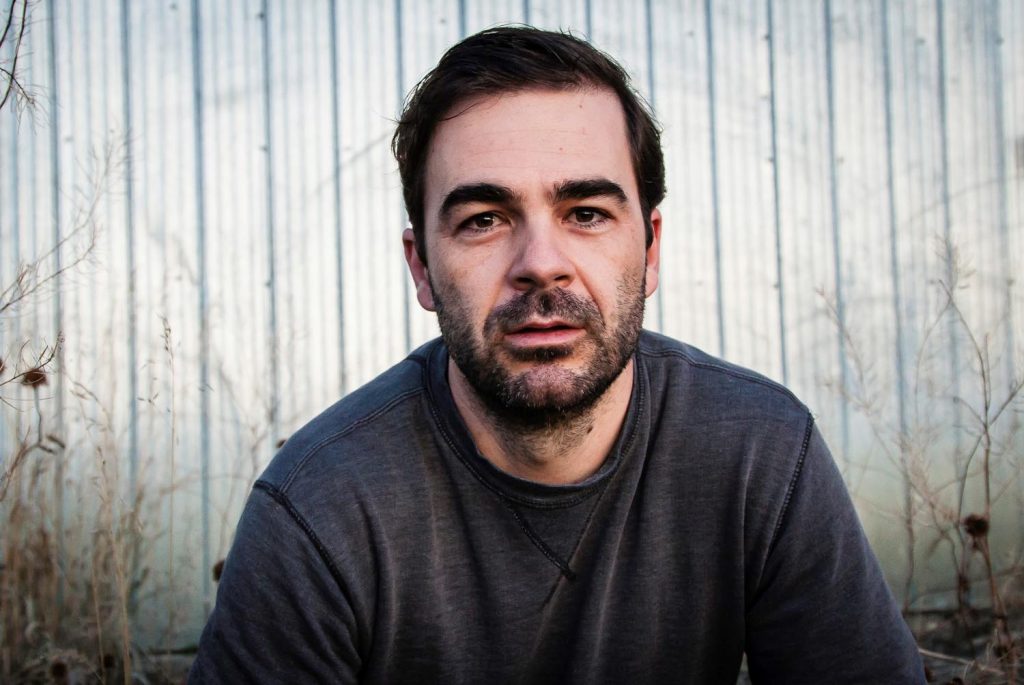
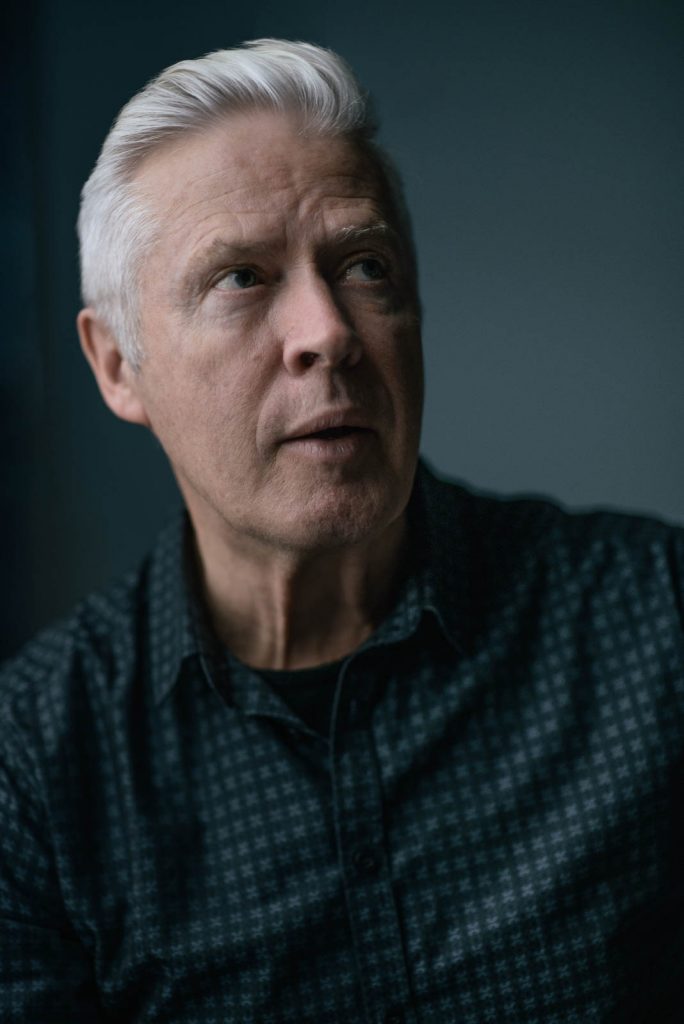
Interview with Actor John Craggs – A Christmas Carol

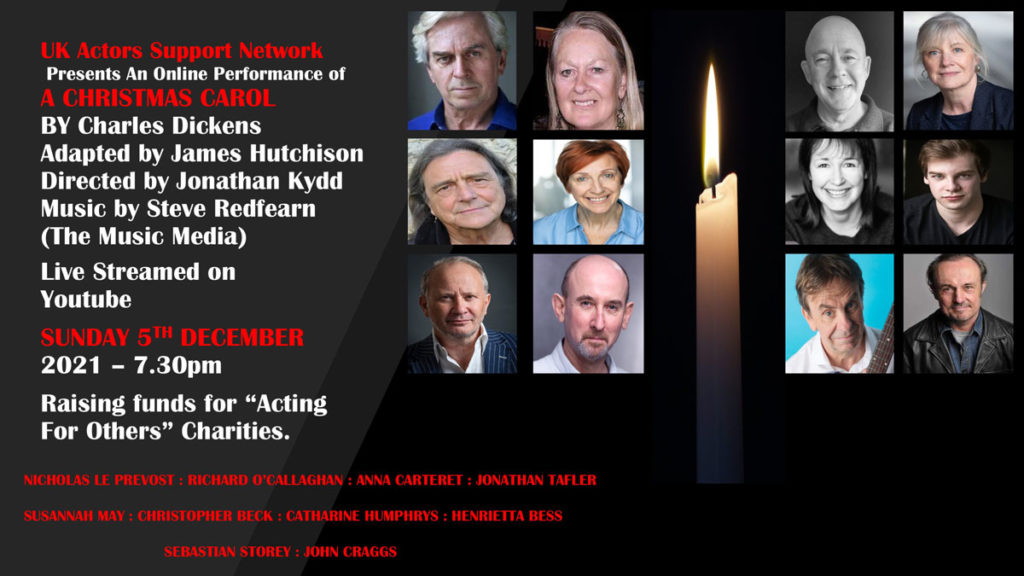
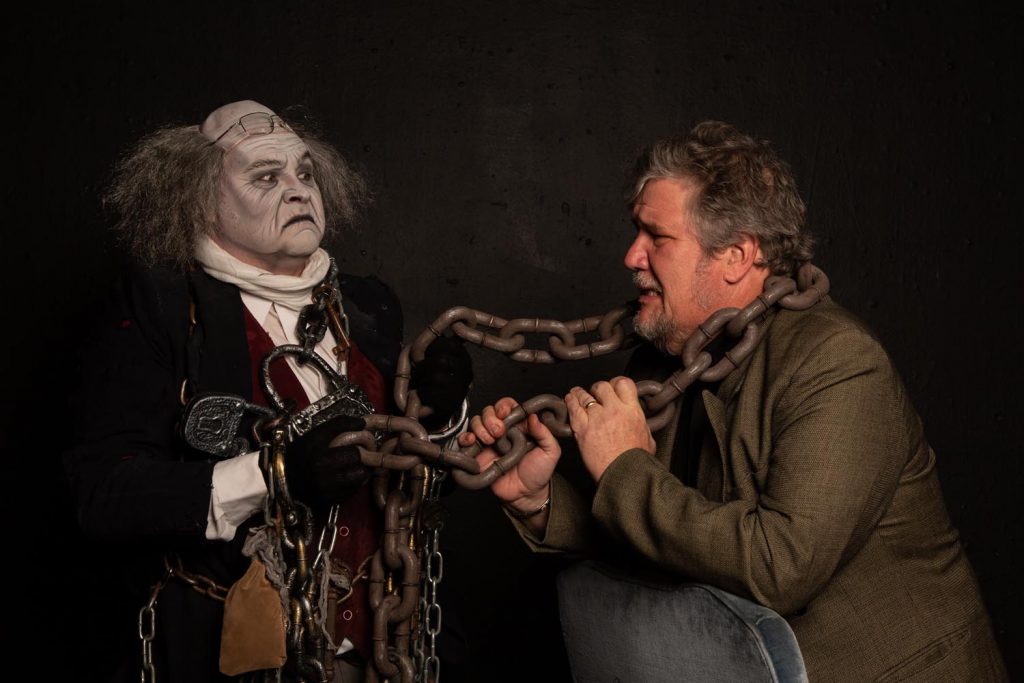
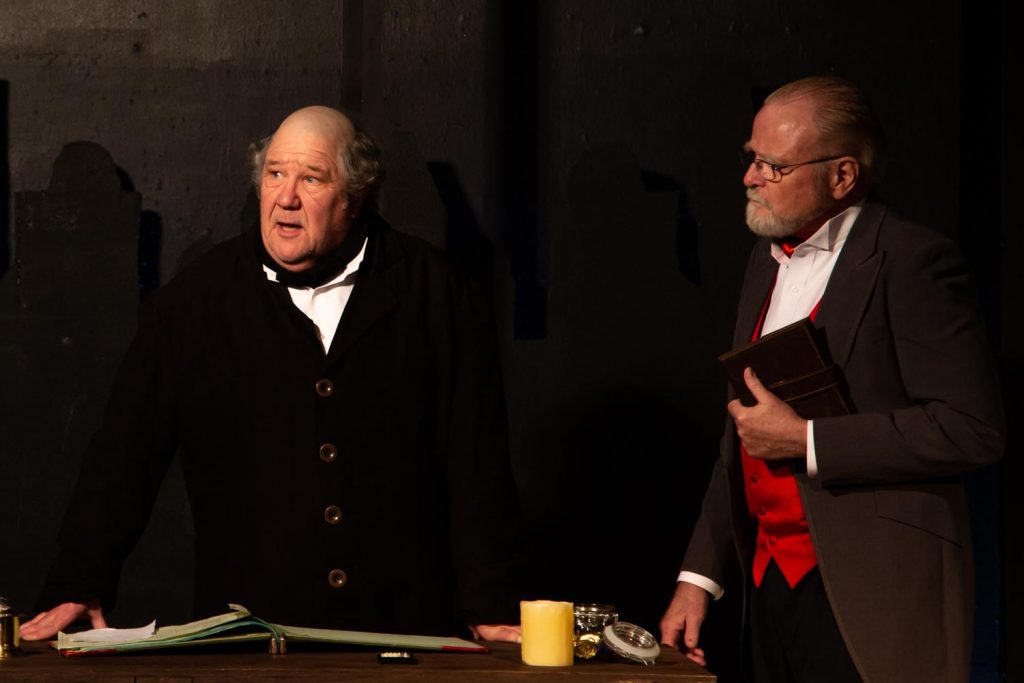
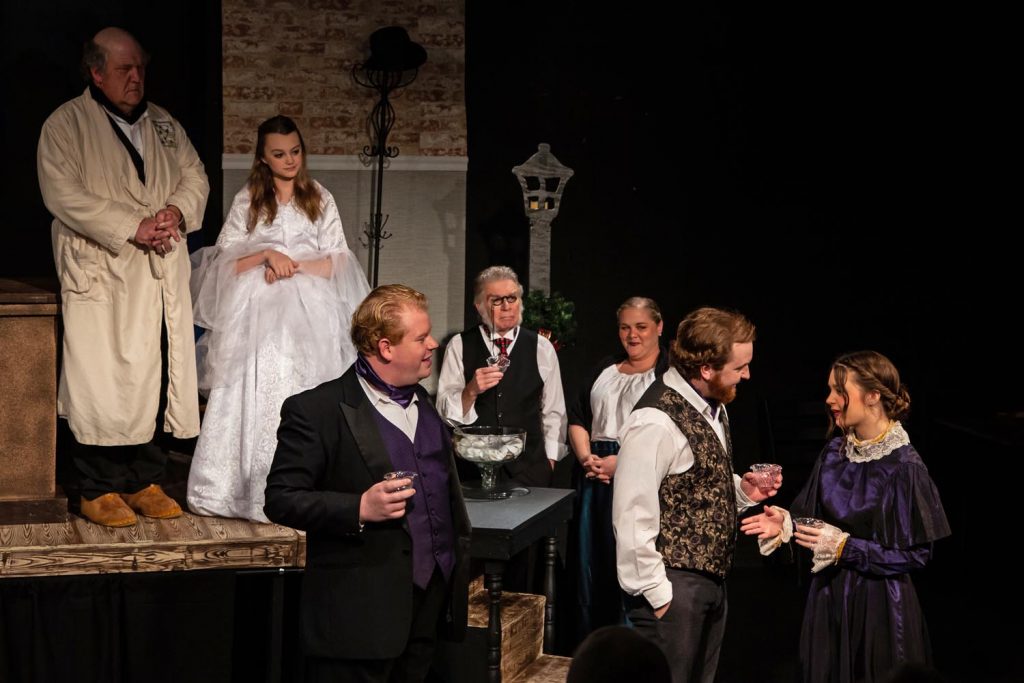
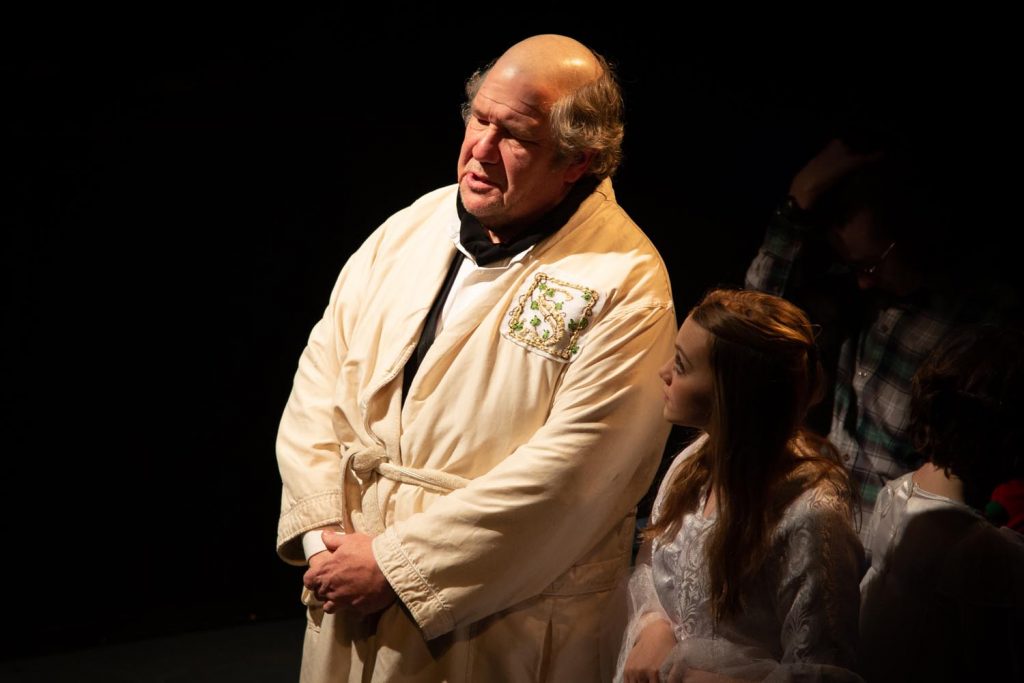
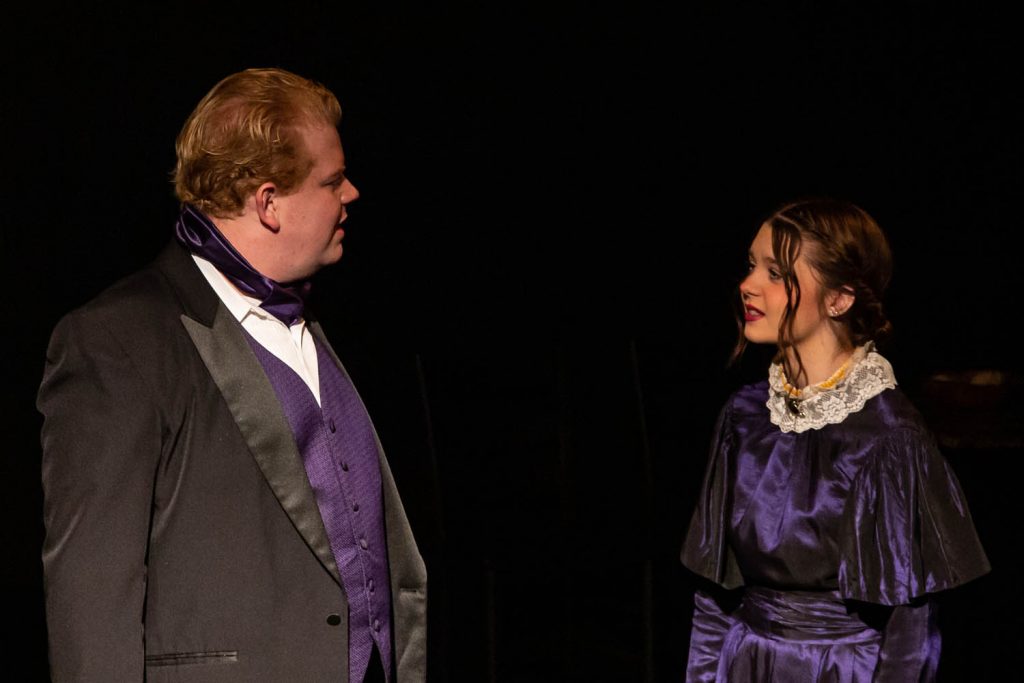
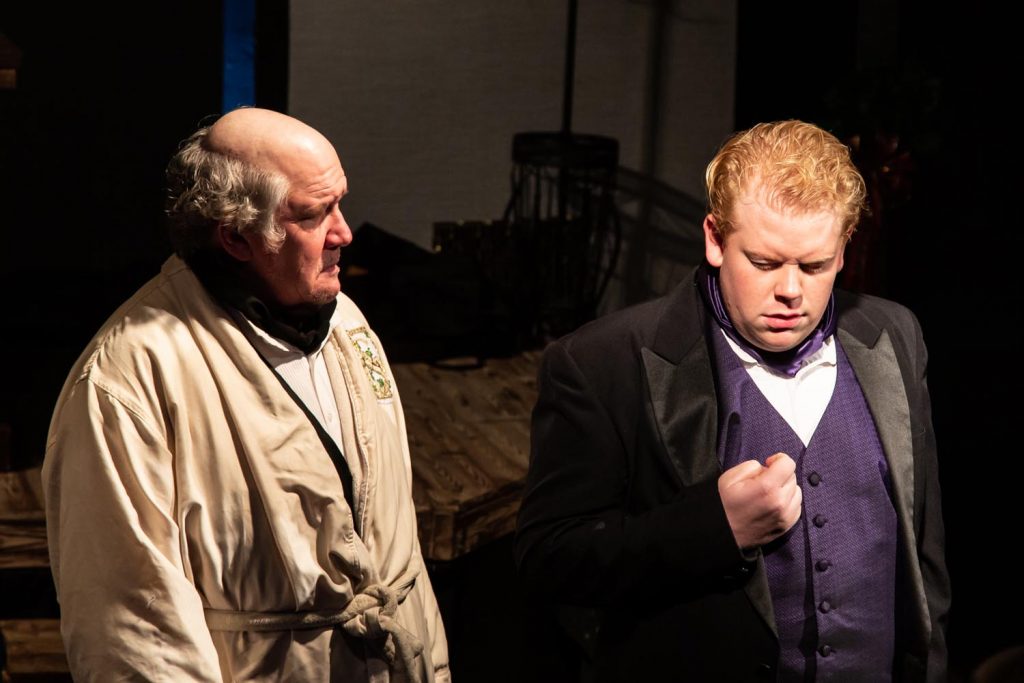
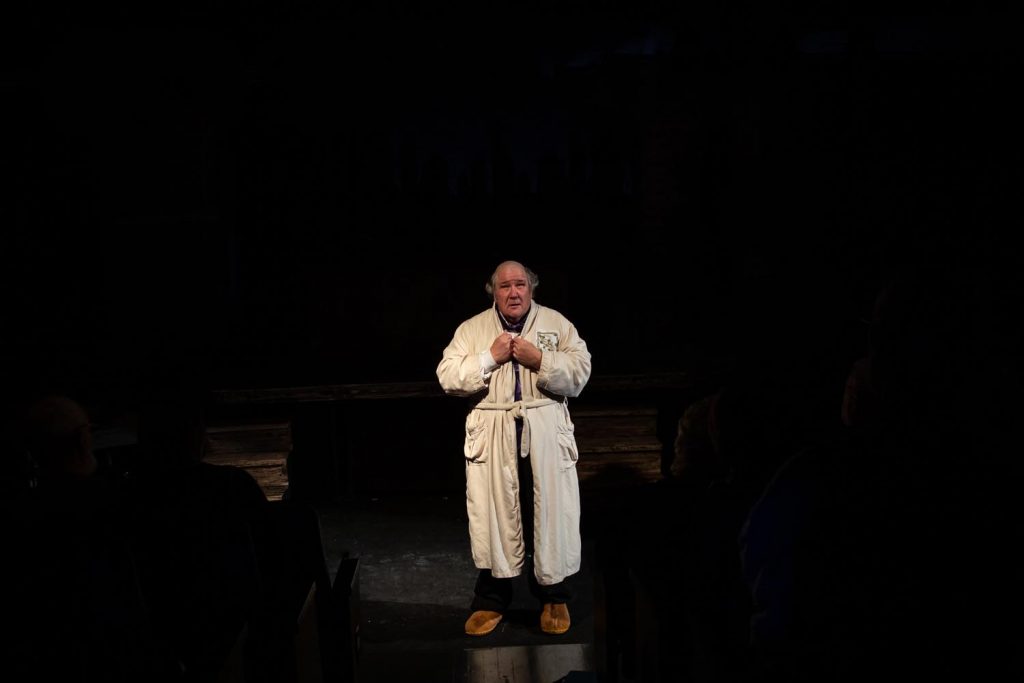
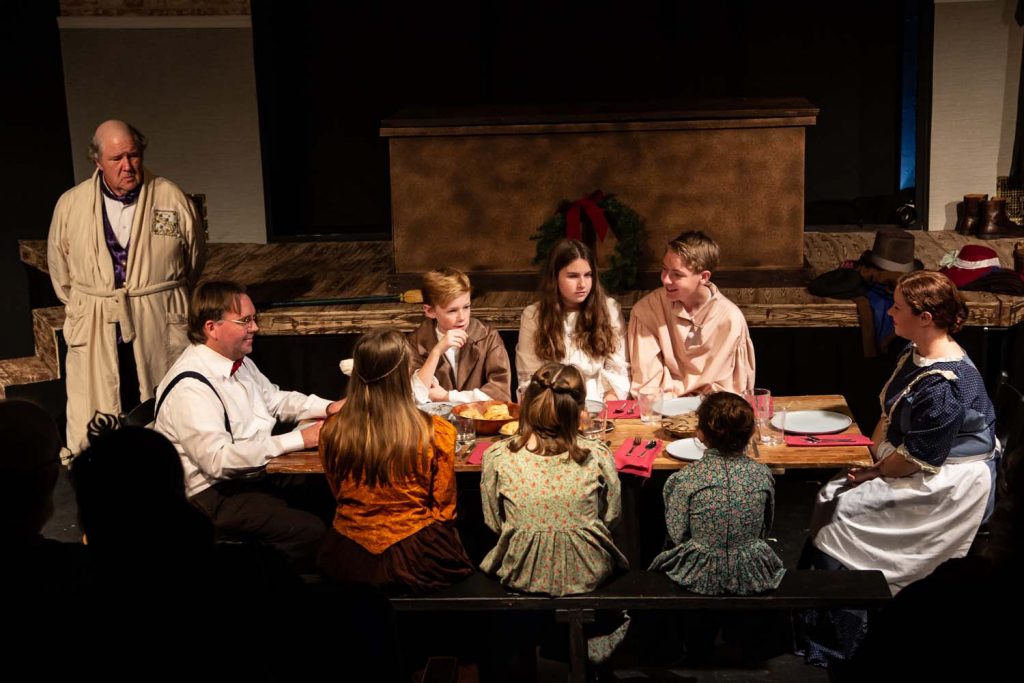
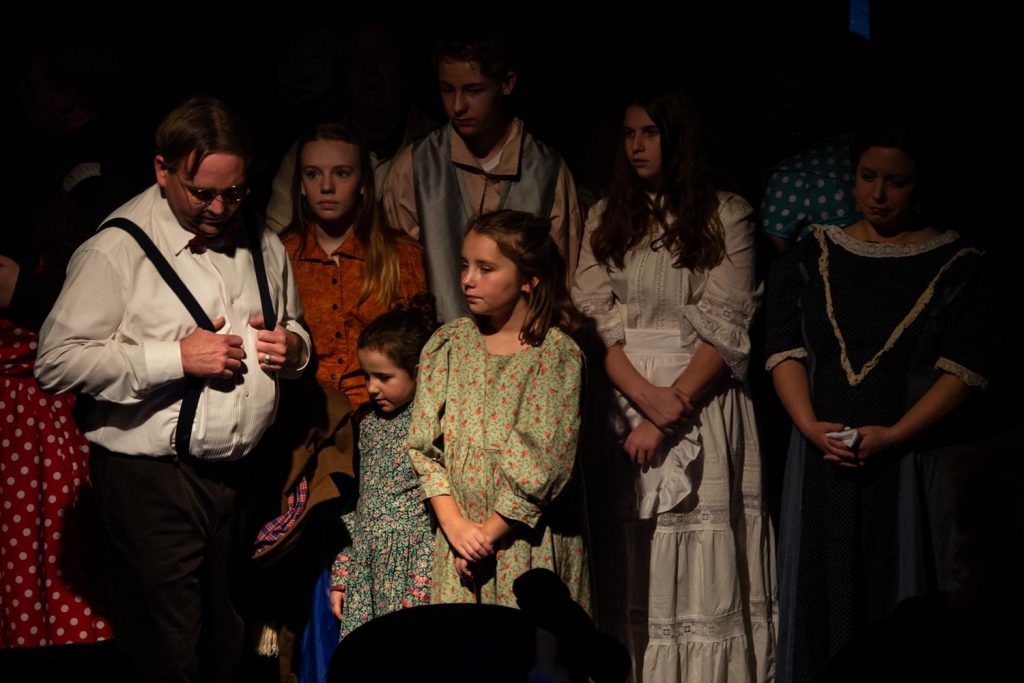
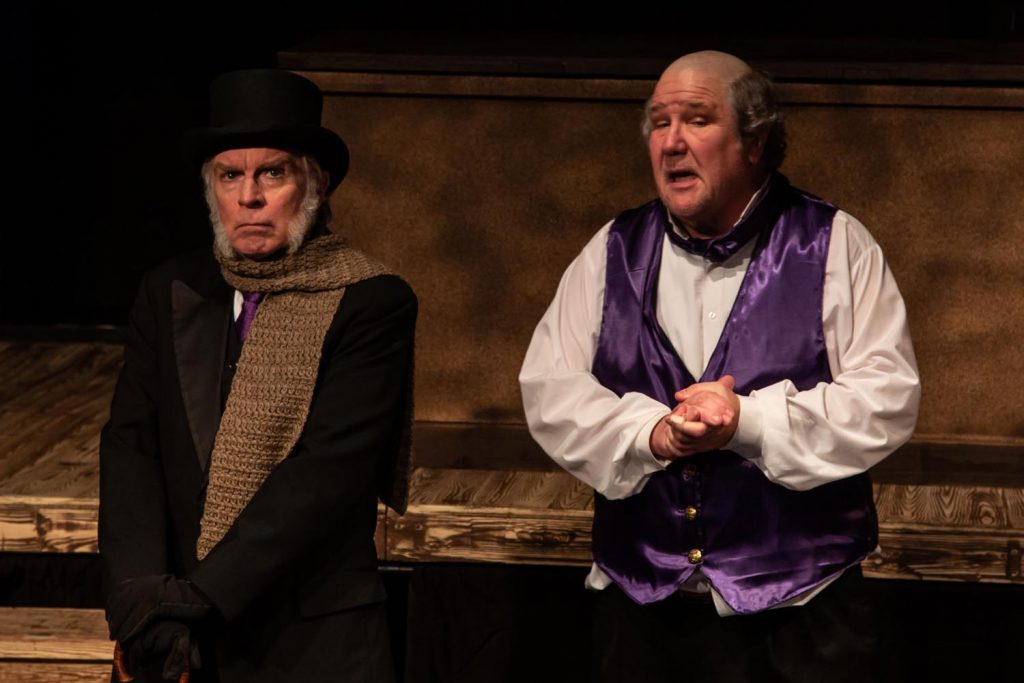
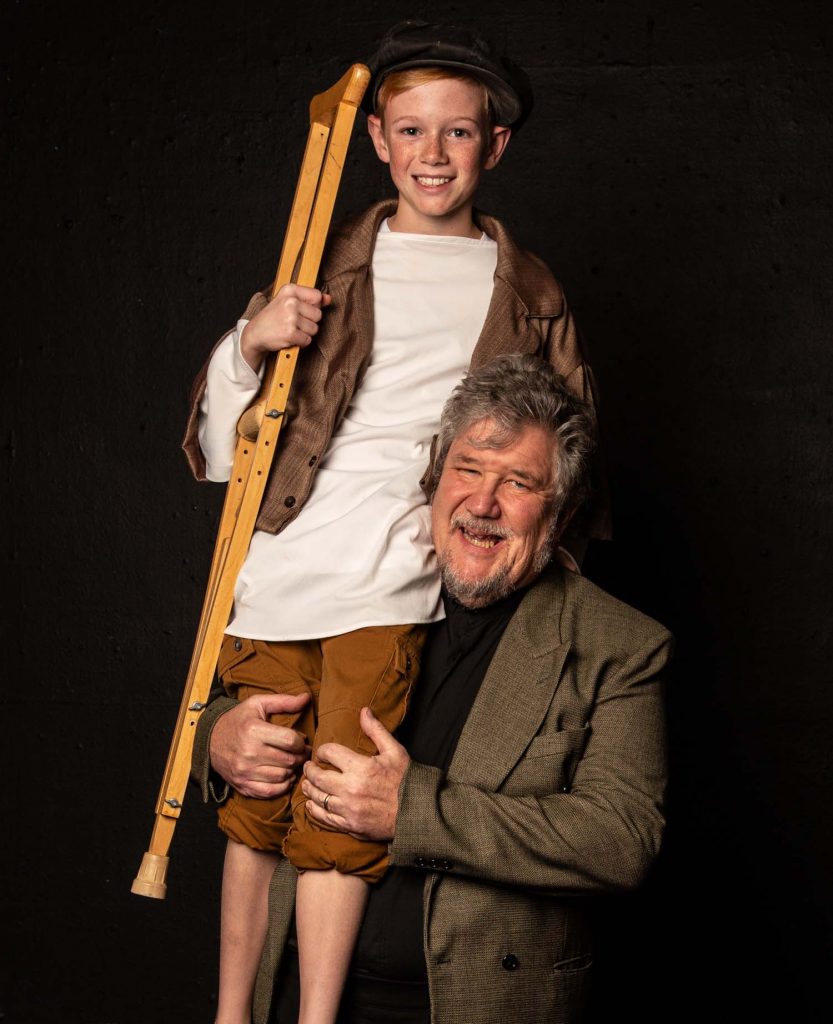
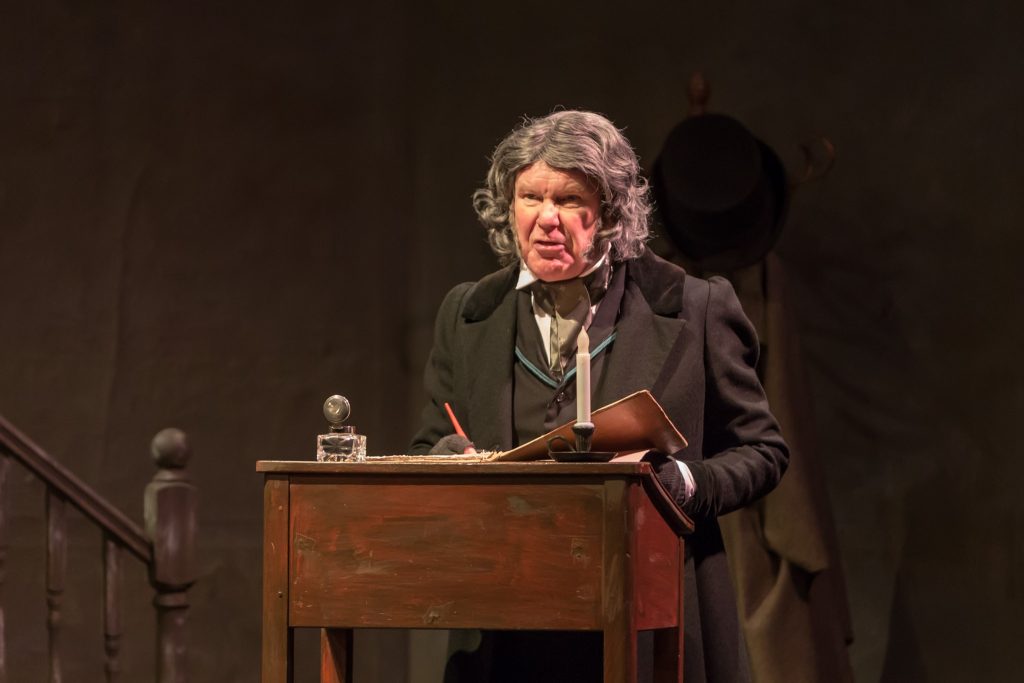
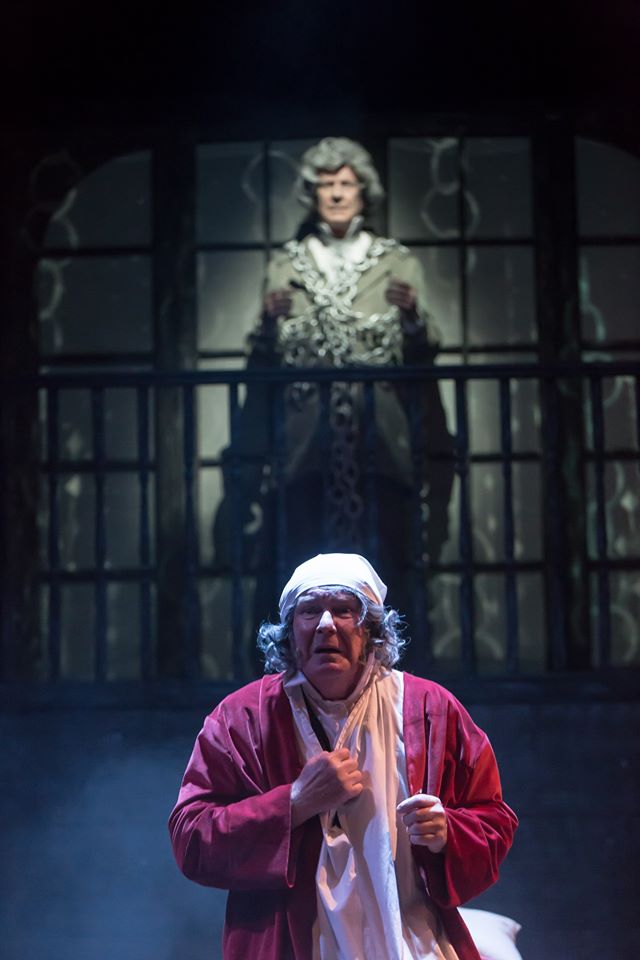
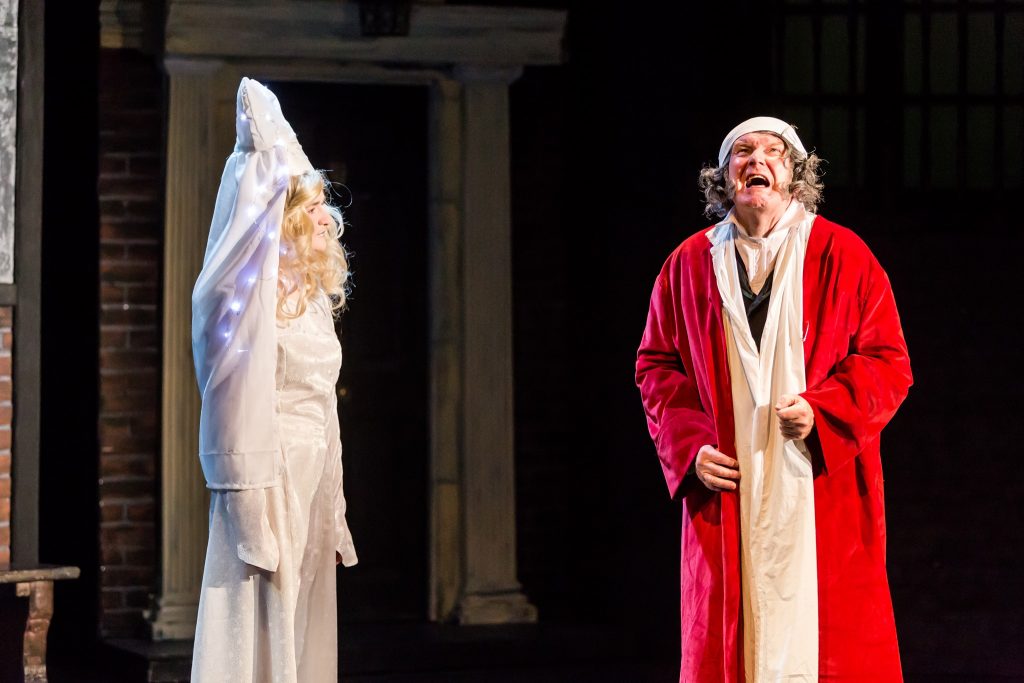
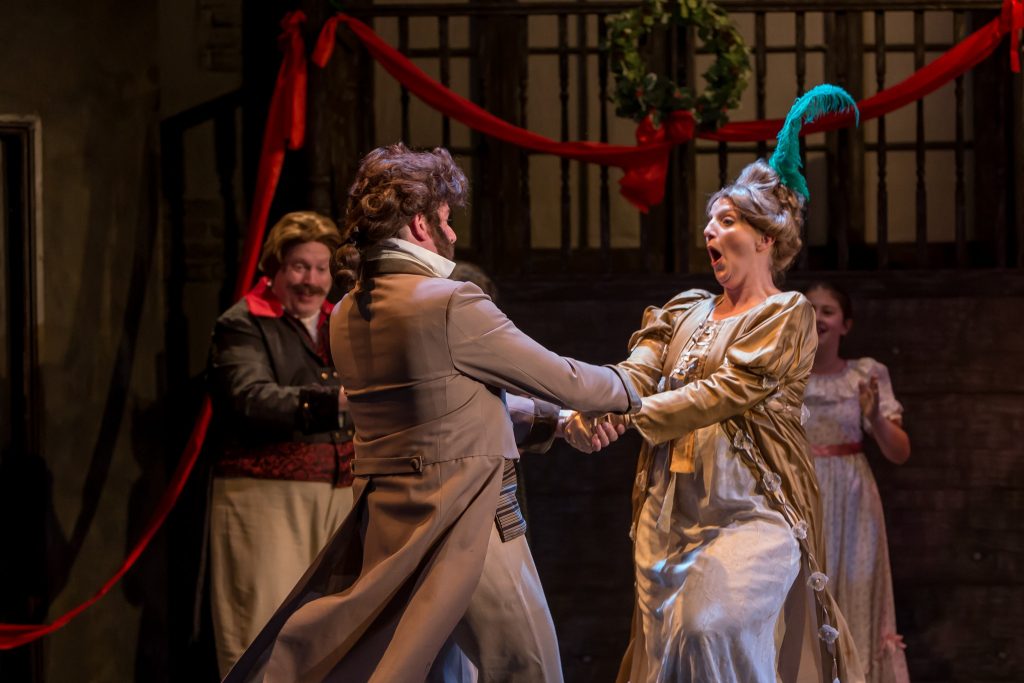
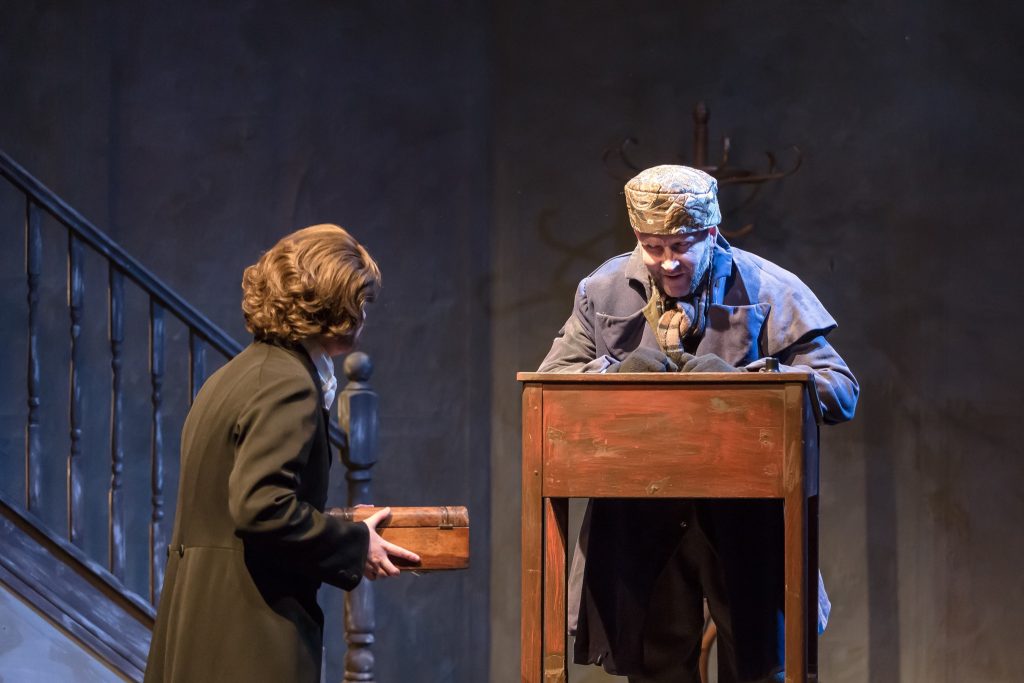
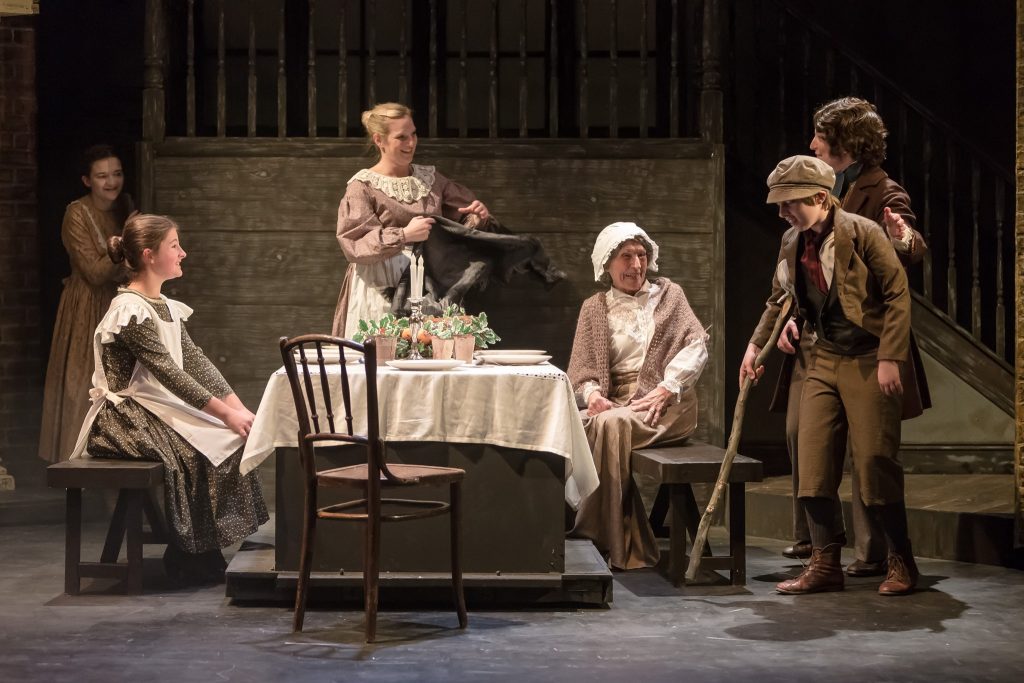
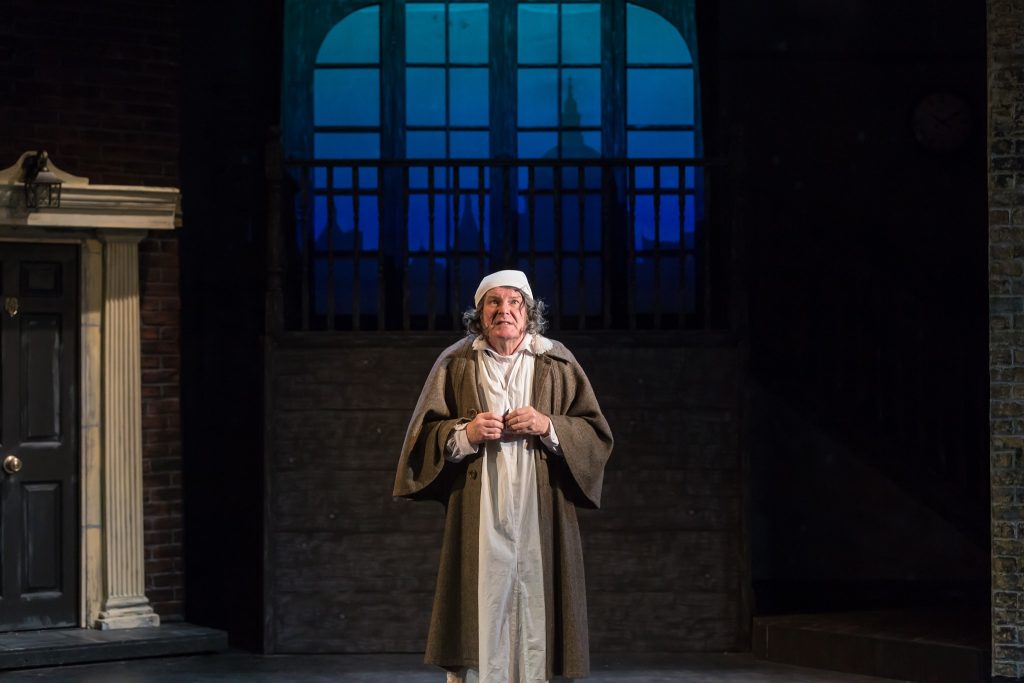
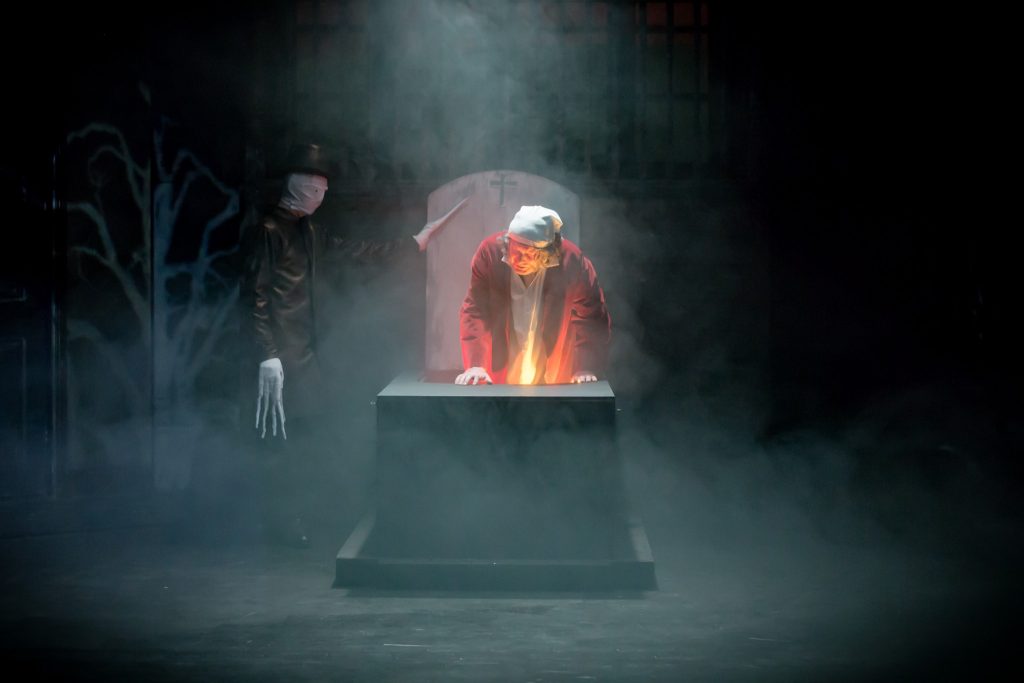
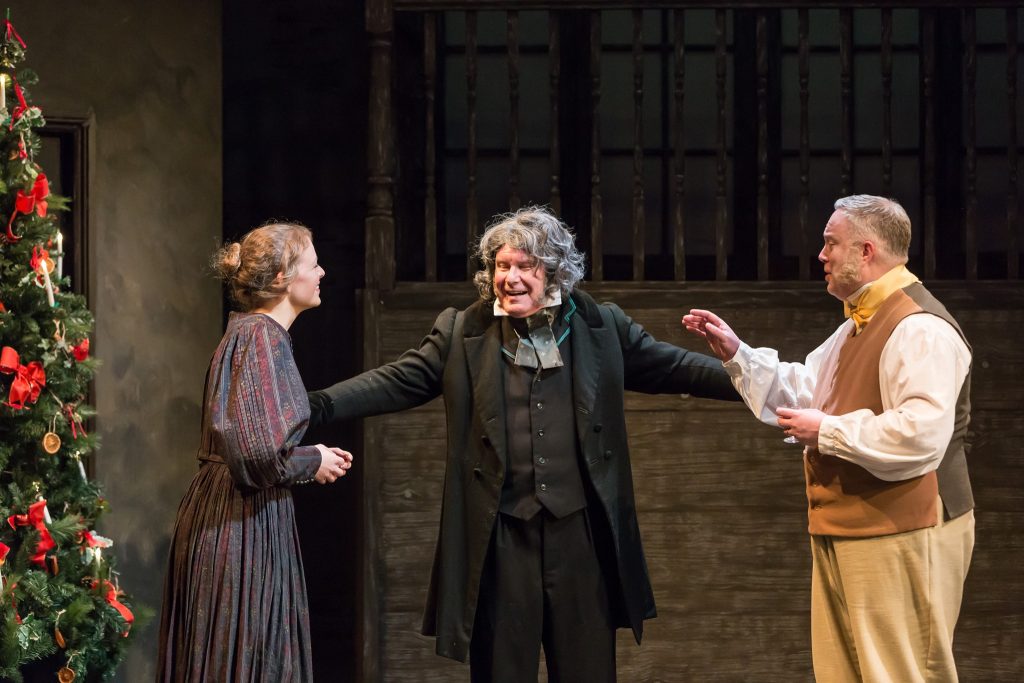
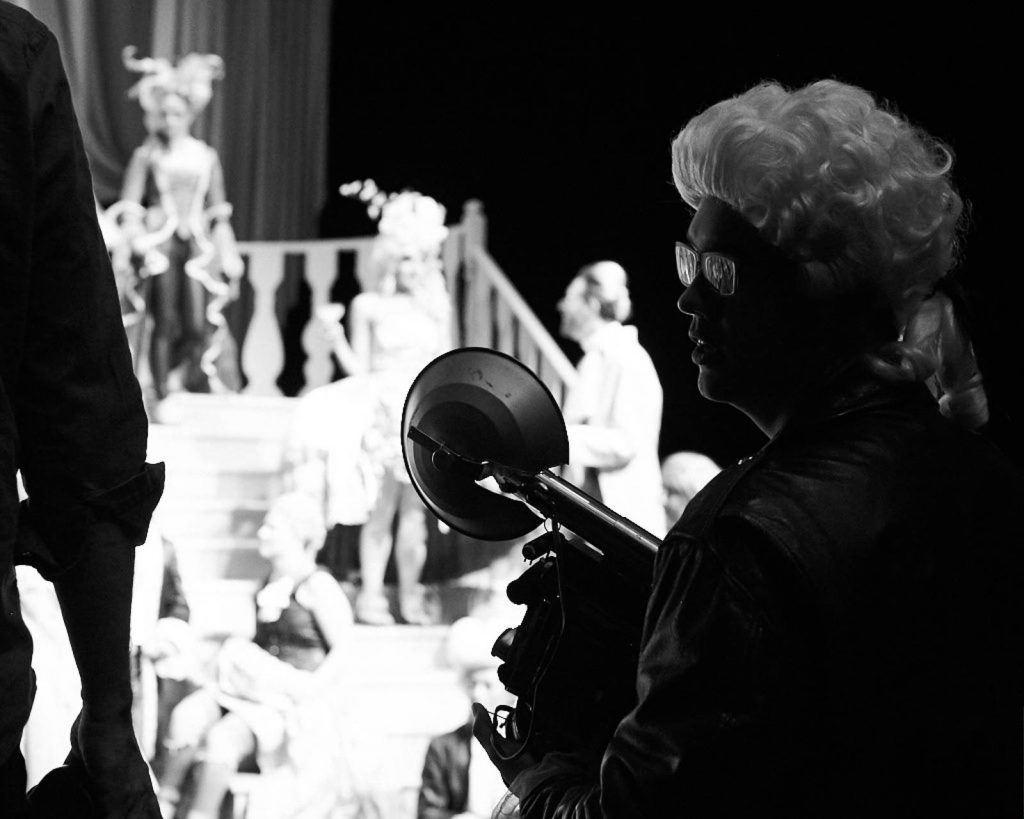
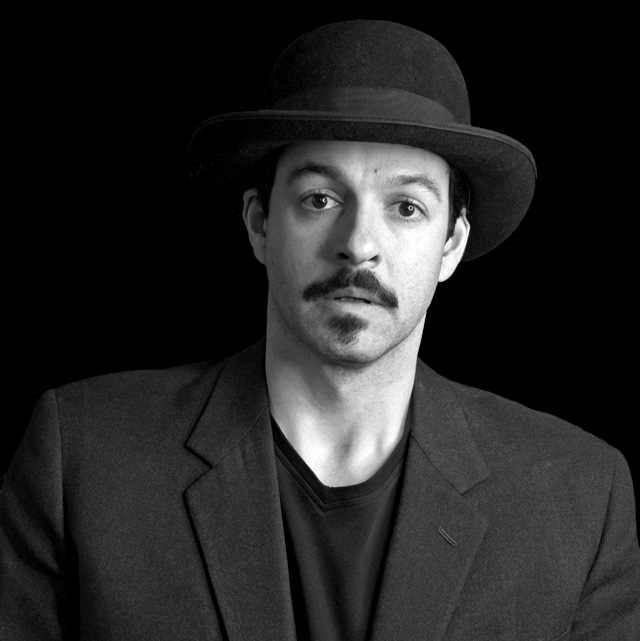
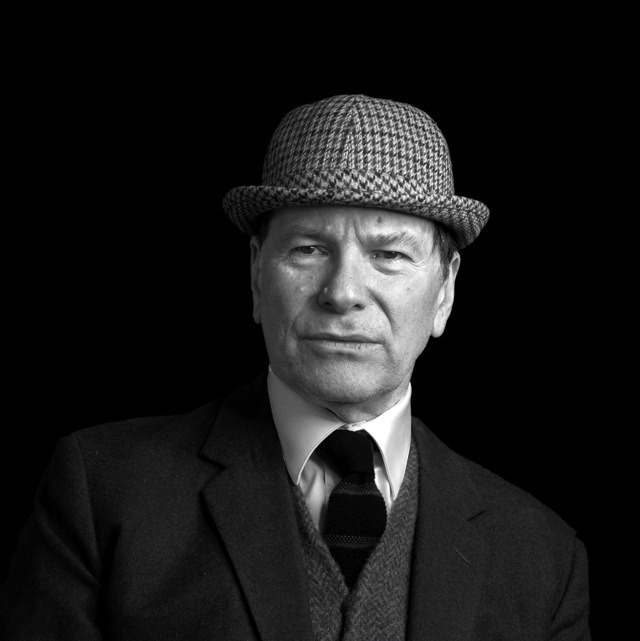
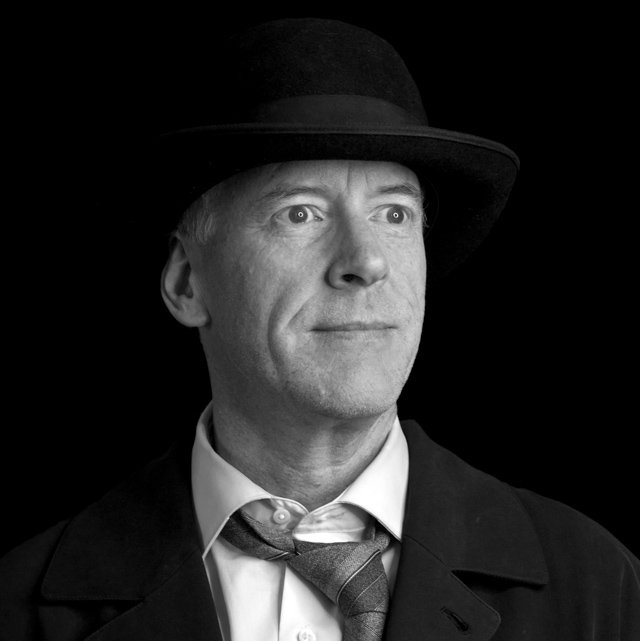
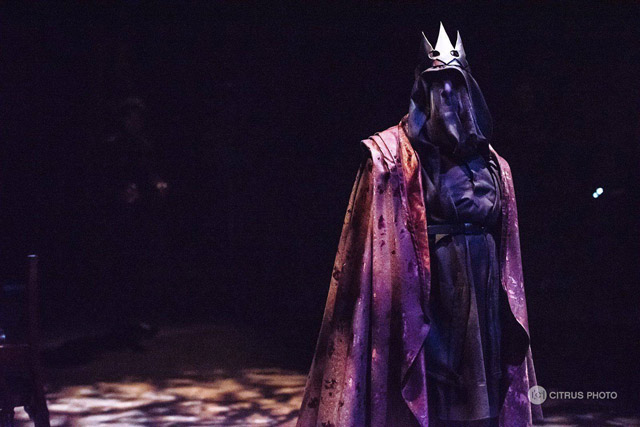
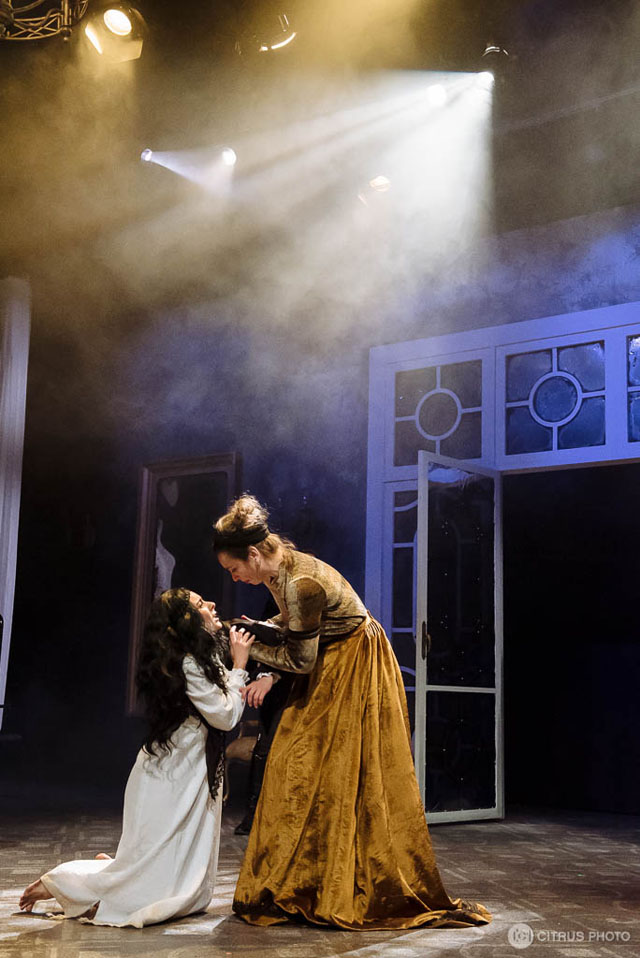
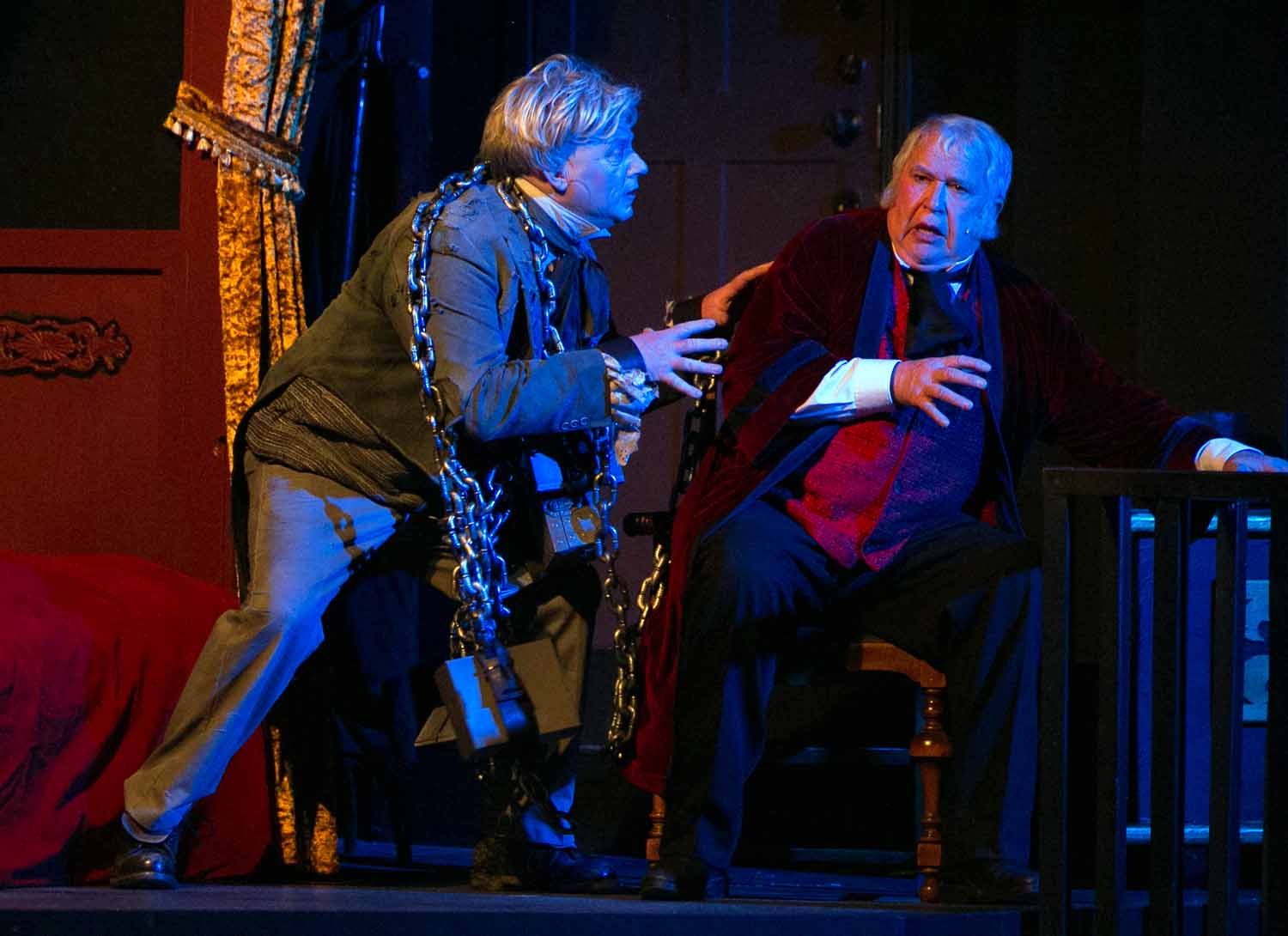
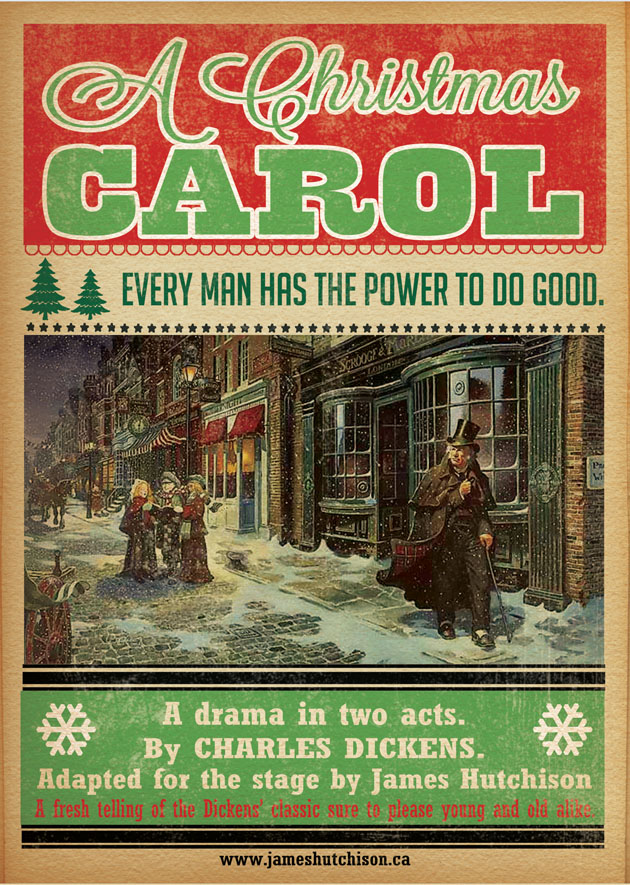
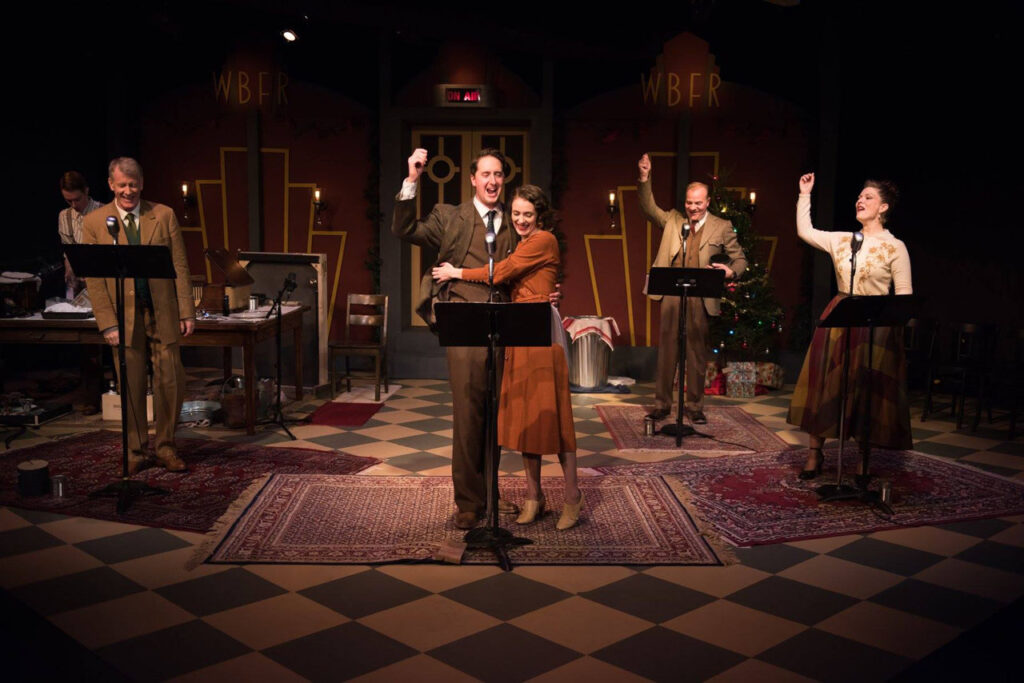
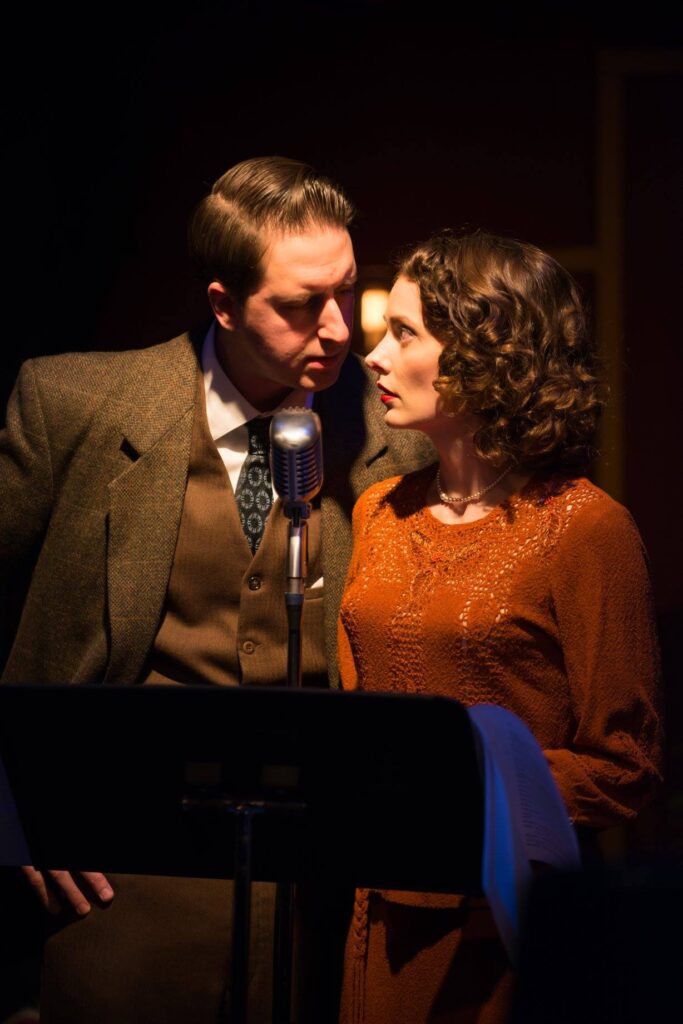
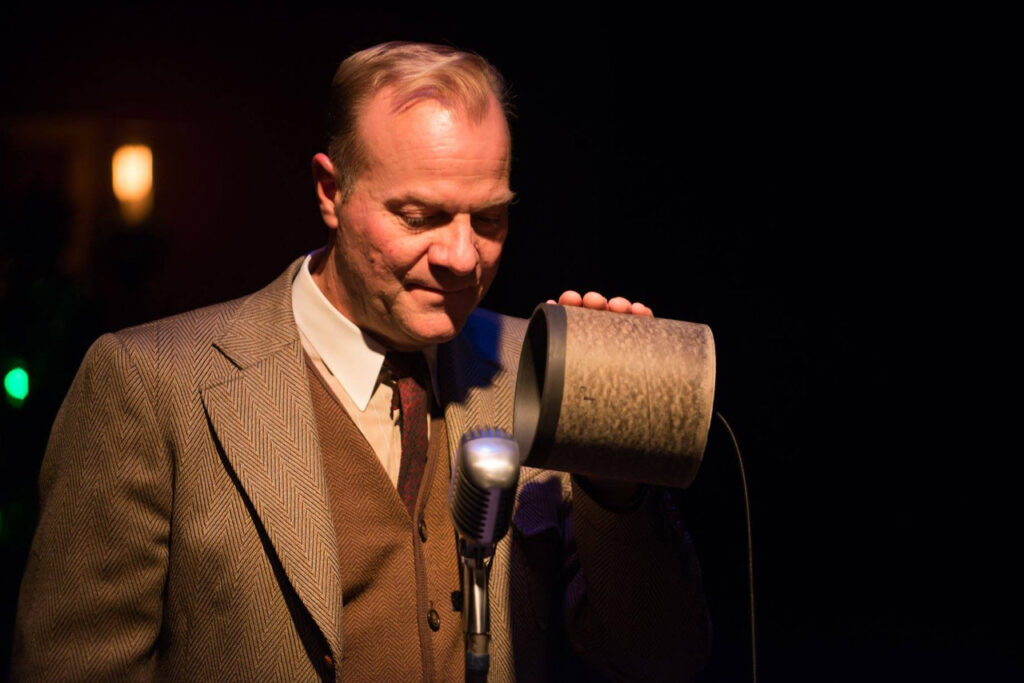
John Craggs produced a rehearsed reading of my adaptation of A Christmas Carol which featured a stellar cast including Nicholas Le Prevost as Ebenezer Scrooge, Richard O’Callaghan as Mr. Fezziwig, Susannah May as Belle, Jonathan Tafler as Fred, John Craggs as Jacob Marley, Henrietta Bess as the Ghost of Christmas Past, Sebastian Storey as Tiny Tim, Anna Carteret as Mrs. Dilber, Catharine Humphrys as Fan, and Christopher Beck as Bob Cratchit. The production was directed by Jonathan Kydd with original music by Steve Redfern

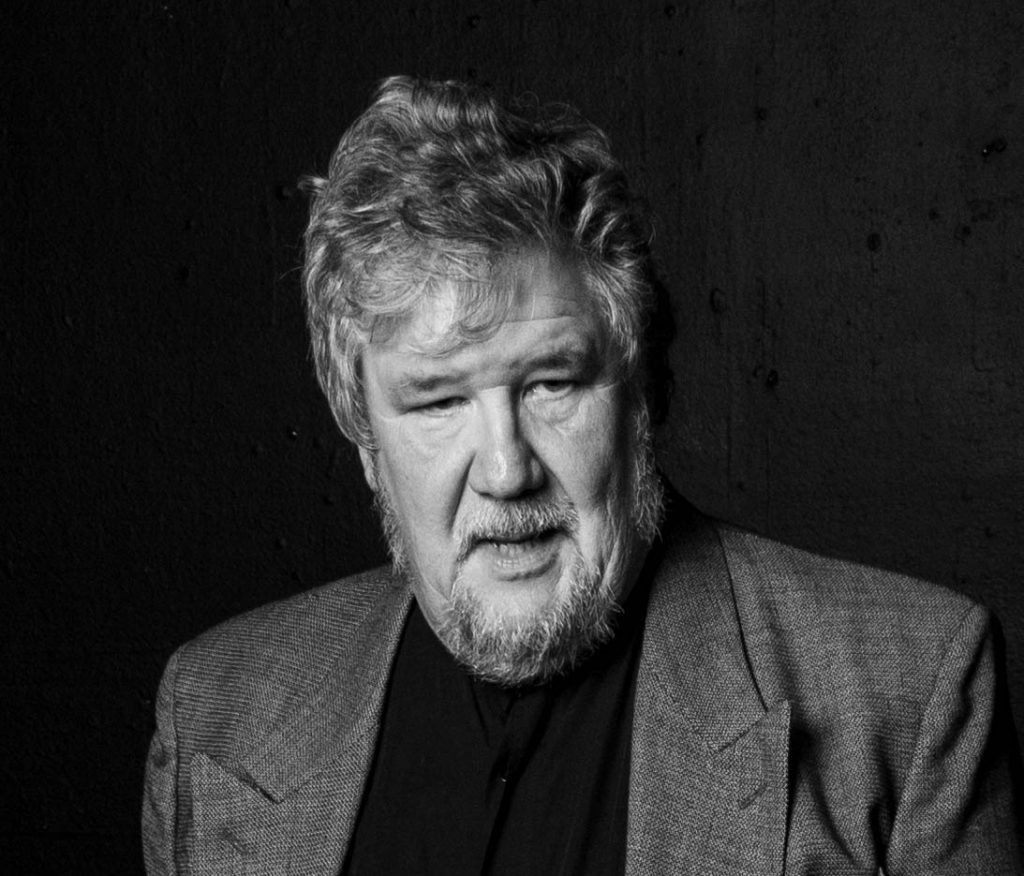
A Christmas Carol was the seventh in a series of rehearsed readings that John has produced. The play was presented in support of Acting for Others. Acting for Others provides emotional and financial help to the many actors, designers, and technicians that have lost work during the pandemic and are facing tough times both mentally and financially. I had a chance to sit down with John over Zoom back in November and talk with him about A Christmas Carol and his life as an actor.

JAMES HUTCHISON

A lot of movies and stories including A Christmas Carol talk about the spirit of Christmas. How would you describe the Christmas spirit? What does that mean?

JOHN CRAGGS

It’s something that’s happening even now in November. I can sense it. There are people that would walk past other people in the street and not give them the time of day, but at Christmas people are a little more amicable and focused on each other. There’s just something that seems to rain down on people in the nicest possible way at this time of year.

JAMES

What role do you think telling stories and in particular telling stories in theatre plays in our lives?

JOHN

It plays a great deal, I think. Telling stories to people is essential. And you know it can touch anyone, and hopefully, it can change people’s lives depending of course on the subject matter. I think we want to entertain but we also want people to leave the theatre with a message, a story of some kind. And I think that is essential within our entertainment industry. No matter whether it’s a musical, whether it’s just a play, or it’s a comedy, there is always an underlining meaning behind everything that we see within theatre, including pantomime as well.

JAMES

Is there a particular play you’ve done that was sort of that right balance of entertainment and message that comes to mind?

JOHN

Yes, I’m going to go right back to 1997. And that was an Ibsen play – An Enemy of the People at the National Theatre. That play is the equivalent to Peter Benchley’s Jaws as bizarre as it may sound. Are you familiar with An Enemy of the People?

JAMES

I am. And funny you mentioned it because I was figuring that coming out of the pandemic, we should be seeing a lot of productions of An Enemy of the People. Arthur Miller did an adaptation and I recently reread that one. For those people that don’t know the play, it’s about a doctor who sounds the alarm bells about these springs in a community that have some kind of a bacteria in them that makes people sick and none of the business people or politicians want that information made public because they don’t want to shut down the springs and fix them. And you’re right it’s like Jaws. It’s exactly the same thing. They don’t want to shut the beaches down even though they know there’s a shark in the area.

JOHN

When we did the play and the main character Peter Stockman is speaking to the crowd we actually had a guy in the audience – and I think he’d had a few too many drinks – and he actually stood up and out of his seat – and I was working with the fabulous Ian McKellen who was playing Peter Stockman – and this guy stood up in the auditorium and he shouted, “Why don’t you effing well be quiet? You’re talking a load of rubbish. You want locking up.” And the ushers had to come down to remove him from the theatre and we literally froze on stage when that happened. So, when he’d gone, Ian said – within the character – “Right people, I’m going to carry on with what I was saying after I was so rudely interrupted.” And then of course he carried on.

JAMES

What was that experience like? Having a chance to share the stage with Ian McKellen.

JOHN

Ian is a very generous actor, and he is a lovely guy. And he’s got no affectations about him. It was a pleasure working with him. And, you know, he’d already been knighted, and a lot of people did call him Sir Ian and I said to him, “Do you like being called Sir Ian?” “John,” he said, “I was bestowed this title and it was very nice, but my name is Ian.” He’s a lovely guy. I had a good time doing that.

JAMES

What qualities do you think make a good actor so mesmerizing to an audience?

JOHN

Less is more and I think it’s that magical connection you have with another actor when you walk on stage. It’s not so much about the character as it’s about you as an individual. I mean, from a personal point of view when you walk out on stage the audience lifts you and to me that makes a big difference. If you’ve got an audience there – then that magic starts to happen.

JAMES

One of the things that is a big part of being an actor is of course doing auditioning. So, I’m kind of curious, how do you approach an audition? What strategies do you use that have helped you over the years?

JOHN

Well, it depends. I mean, as you probably know, a lot of what’s happening now and especially because of the pandemic and because of lockdown and not being able to be in the room as such, which you know, I miss – and a lot of actors miss – we do things called self-tapes. So basically, my agent will send me something and then I need to film it.

And I see an audition as a job in itself. Which means that I don’t look ahead. You look at the script, familiarize yourself with it. Get the essence of what you’ve got to say. Try to memorize as much as you possibly can but don’t let the words get in the way of the character. If I’ve got quite a bit of time, and if it’s from a play, then obviously I’ll make it my business to look the play up and read about the characters and how my character fits into that scene. And then David Cleverley, my partner, very kindly films it for me. The audition, the casting, the self-tape, that is a job in itself. If you get the job that’s great. If somebody else gets it, you shake their hand and you move on.

JAMES

Well, speaking of auditioning Daniel Craig is ending his run as James Bond. So, in a what-if world would you be interested in playing Bond or would you be more interested in playing a Bond villain?

JOHN

Oh, a villain. Most definitely. I’m too bloody old for James Bond. No, it definitely has to be a villain unless of course they wanted an older James Bond’s brother or something. It definitely has to be a Bond villain.

JAMES

So, you are available for the next film then.

JOHN

Oh yes. Yes. So, keep that bit in. (Laughs) But of course, they tend to go for, shall we say, a more familiar face.

JAMES

One of the things I was thinking about, you know, there’s Twitter, there’s Instagram, there’s Facebook, there’s Tik Tok, there’s LinkedIn. There are all these social media platforms. And I’m wondering, what role do you think social media plays now days in the career of an actor?

JOHN

I don’t use Tik Tok. I very seldom go on LinkedIn. I’ll use Facebook. I set up my own account on Twitter @johncraggsactor and then of course I set up @network_actor as well. Twitter has given me and a lot of other people a lot of connections.

You have to be careful I think with social media and just watch what you say, but I do think it can create a lot of opportunities. And I think it’s important to connect with people because this is what a lot of this industry is about. Social media is not the real world, but I do think it does play quite a big part in connecting people. Not necessarily getting the work, but the connections can often lead to work.

It’s where people can connect and interact with each other and show their work and their headshots and what they’re doing and that’s been a very, very useful tool.

And, you know, I’ve had people come back and say to me, “Thank you very much. Through doing that I managed to get an agent.” Well, that’s great, but the hard work came from you. I just gave you that platform to do it. What I have to be very careful about, of course, is a lot of people initially thought that there was a team of people running it, but I run it solo as a fellow actor. It’s not a business. I don’t make a penny.

JAMES

One of the things you did as part of your support for the theatre communities, you started performing rehearsed readings of a variety of plays such as King Lear and The Importance of Being Earnest. How did that come about as part of what you’re doing?

JOHN

Right. I’m going to go back to August of 2020. God, it seems like years ago. And this idea was thrown up by my partner David. He said to me, “You said everyone’s getting bored. Everything’s getting shut down. You’re unable to do anything.”

It felt like our hands were tied, and it was literally like being put into a box. You know, we were caged. We couldn’t get out. And he said, “Have you ever thought of doing plays on Zoom or something?”

And I said, “No. Categorically, no way. It isn’t going to work.” And he said, “Well, what about speaking to Anna Carteret.” Anna is quite a well-known British actress and was very good friends with Laurence Olivier and she’s got a lot of contacts in the industry. He said, “Ask Anna. She knows a lot of people.” So, I phone Anna up and I said, “What do you think of this?” And she said, “Oh, it would be just so uplifting for so many of us.”

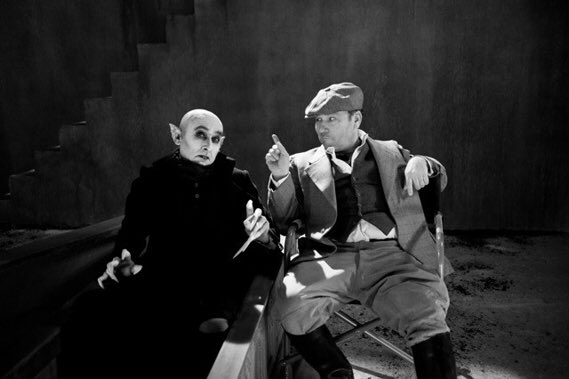
And so now we’ve done some Shakespeare. A Winter’s Tale, and Twelfth Night, and King Lear. And we’ve done Bram Stoker’s Dracula as an online reading raising funds for Acting for Others. And people loved it. And it’s been brilliant. And Anna Carter played Van Helsing, so we did a gender swap. She was nervous about it, but I said, “Look it just says Professor Van Helsing so let’s have you as Van Helsing.” And she did a terrific performance.

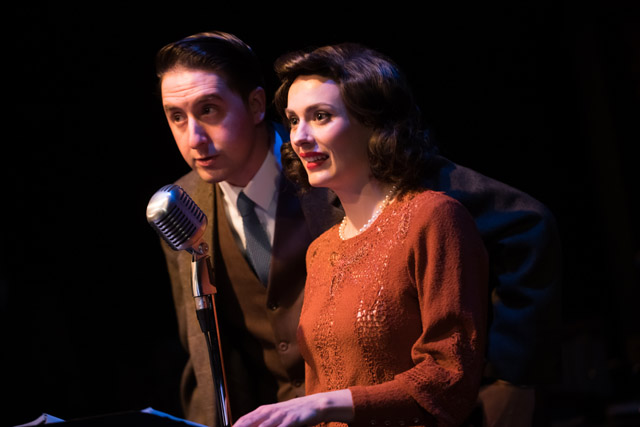
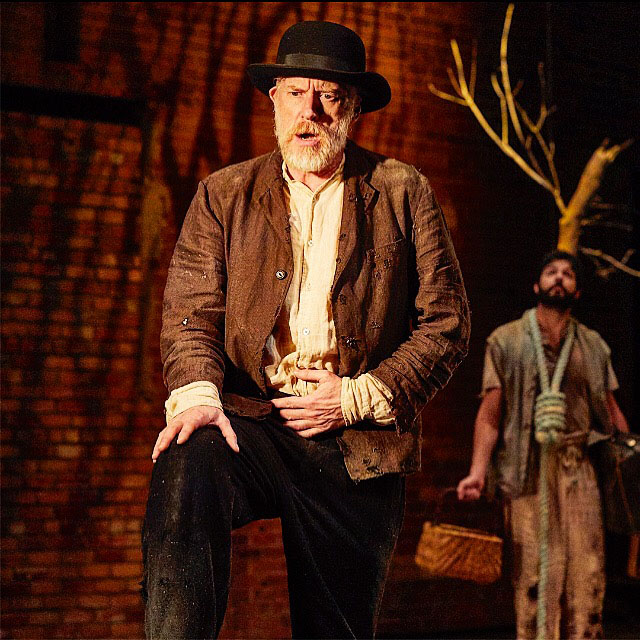
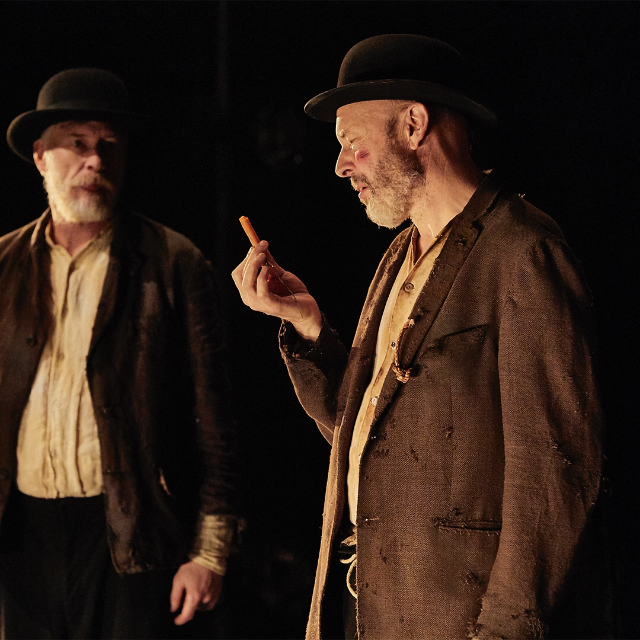
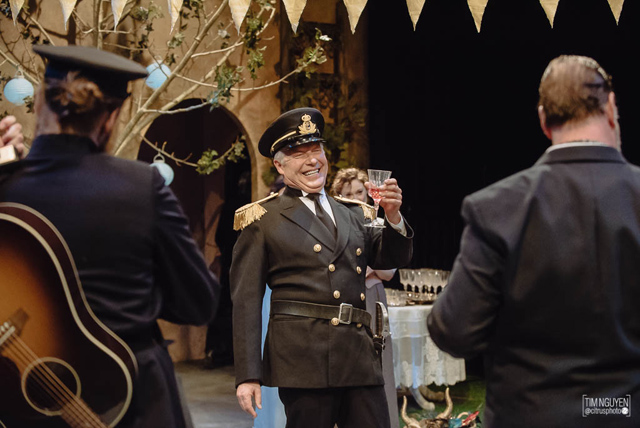
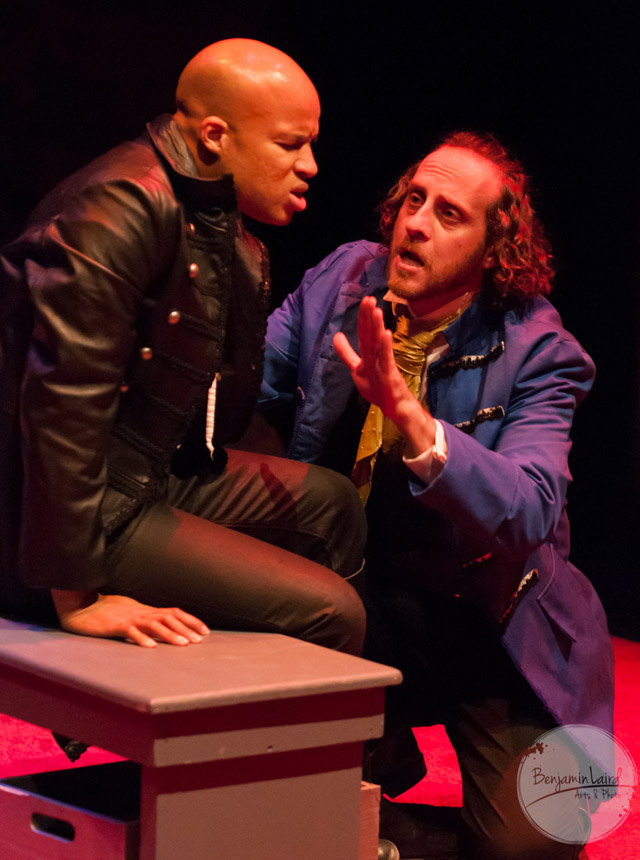
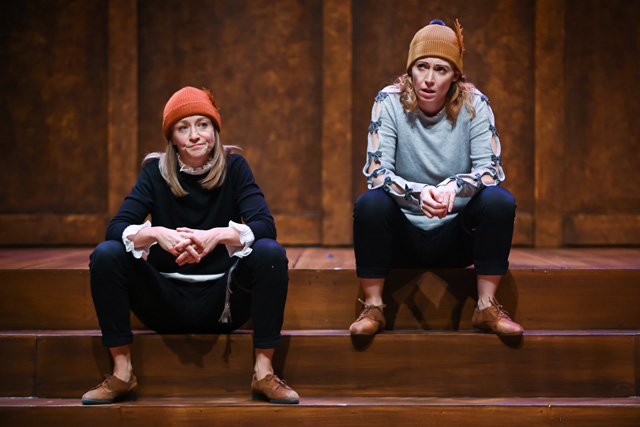
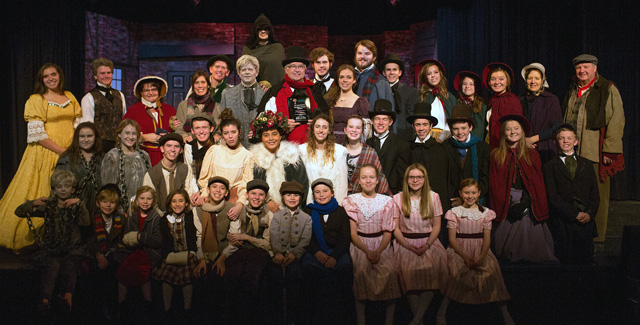
Graphic of Cast in a Christmas Carol

JAMES

And A Christmas Carol is the next rehearsed reading you’re doing. I’m wondering why do you think the story of Ebenezer Scrooge still appeals to people today?

JOHN

Well, I think it’s the essence of Christmas, you know. It’s just the whole atmosphere. And I think everybody knows an Ebenezer Scrooge. And Scrooge is, I think, almost another tragic figure like Macbeth, in the sense that he brought about his own doom and by the manner in which he was influenced by Jacob Marley and his cruelty to Mr. Fezziwig. You know, just taking Fezziwig’s business away from him because he was a kind man. It was horrible and I think everyone can relate to so much in that story. I really do. I implore people to watch it and take from it what you can and you’ll see that there’s something there for you within that story.

JAMES

So, A Christmas Carol uses past, present, and future to examine a man’s life. And I’m wondering if you could talk about theatre in Britain in terms of past, present, and future. What was theatre like pre-COVID? Where are we now? And what do you think things are going to look like next year and beyond?

JOHN

It’s never been an easy industry and a lot of people don’t like this terminology, but it is competitive. And I think pre-COVID there were still a lot of people all fighting for the same job.

But I did notice when COVID happened, when lockdown came, people seemed to unite. People seemed to support each other because we were all in no man’s land. We’re all in the same – not so much the same boat – there are some people that are on cruise liners and some people that are in little rowing boats, you know. But people started to connect with each other a lot more. And I think it was a case of, “Right, we’re all in a dreadful storm together. Let’s weather it together.”

And what has happened now is its transitioning – as things are beginning to open up – we’ve gone back to a little bit of the past, and I don’t think there will be a massive difference, but I hope a majority of people in the future will think about and remember how they were when the doors were closed. And I think if people can keep that unity between each other as much as possible we hopefully will have a better future.

JAMES

So, John, every year the Queen gives her Christmas message, and the Prime Minister gives his, the Pope chimes in as well. Politicians, artists, religious leaders, all have their Christmas messages. What is your Christmas message to your friends and family and the world this year?

JOHN

This time last year, it was almost nine months since lockdown happened and looking back over the last twelve months, there’s been a great deal of unrest and uncertainty, and loss of businesses. And of course, many lives have been lost because of COVID, and I think as I said before, it has in a way drawn many people closer together.

Christmas is a time for reflection. And although this is said by so many people, it’s so true. We need now more than ever to stand by family, friends, and the people who we work with.

And it is always good to remember, if you are with family at this time of the year, there is always going to be individuals who may be alone. They’re vulnerable. So, if you know of anyone who’s spending a festive period on their own, simply act, pick up the phone. A few kind words are priceless.

Speaking for my fellow actors and creatives I’ve said it has been and certainly continues to be a time of uncertainty for us all. On a good note, we are beginning to see some positive movements in the industry and all I can say is that I hope we continue to stick together and support one another. We shall prevail and come through the storm in 2022.

And finally, a little footnote to what I’ve said – a little something to think about. Christmas is a time for giving. But we must care and give to ourselves in order to be able to give back to others and not just at Christmas, but 365 days of the year.


CAST OF A CHRISTMAS CAROL

Nicholas Le Prevost as Ebenezer Scrooge
Richard O’Callaghan as Ghost of Christmas Present
Susannah May as Belle
Jonathan Tafler as Fred
John Craggs as Jacob Marley
Henrietta Bess as Ghost of Christmas Past
Christopher Beck as Bob Cratchit
Sebastian Storey as Tiny Tim
Anna Carteret as Mrs. Cratchit
Catharine Humphrys as Fan

Directed by Jonathan Kydd
Original Music by Steve Redfern


Link to plays by James Hutchison
Link to Four Christmas Plays for Community Theatre by James Hutchison

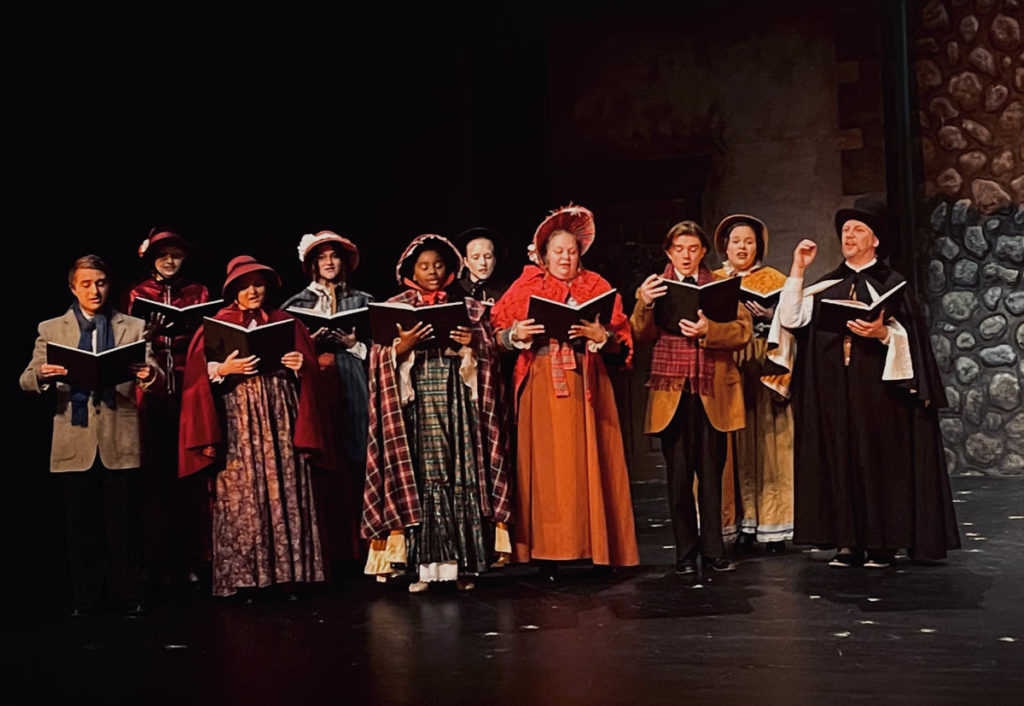
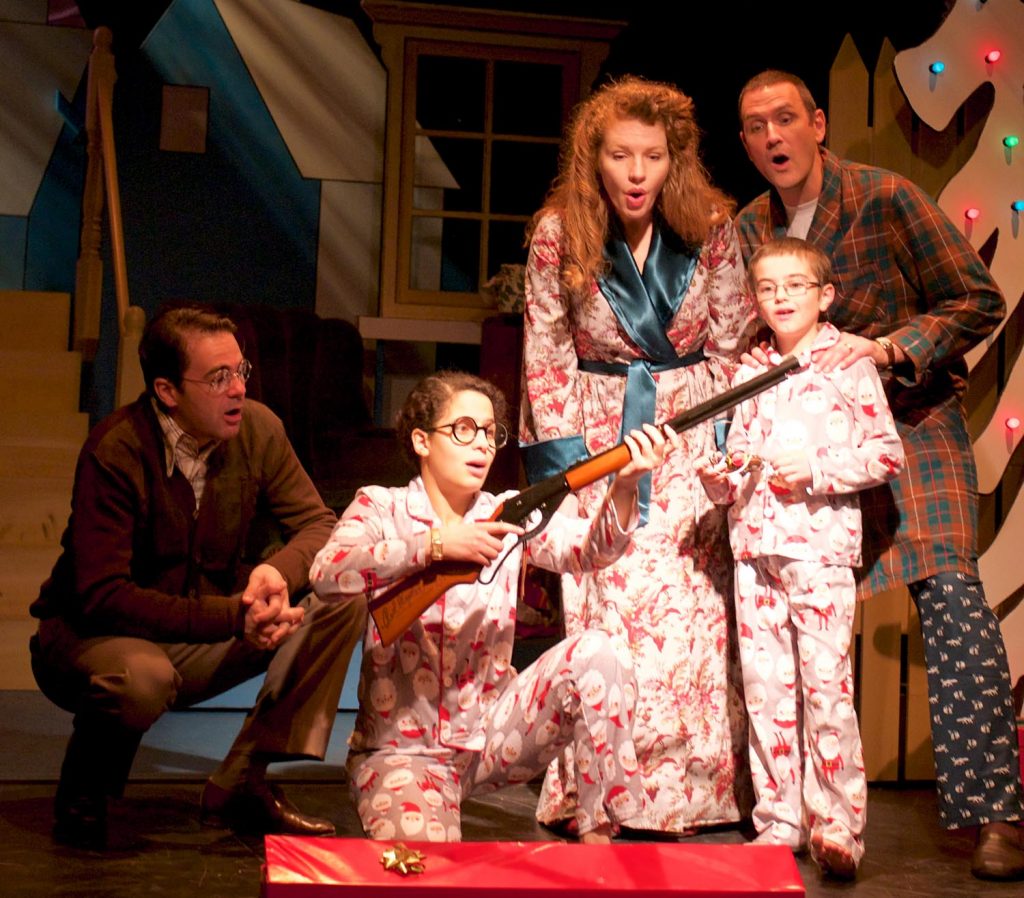
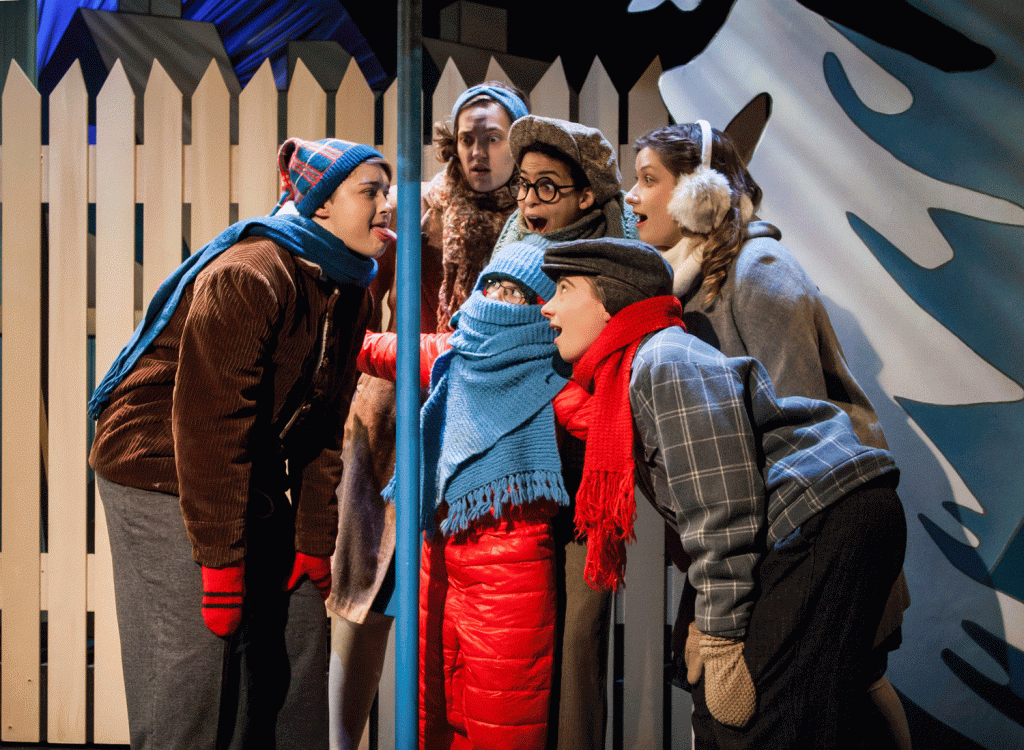
A Christmas Carol at Tarleton State University

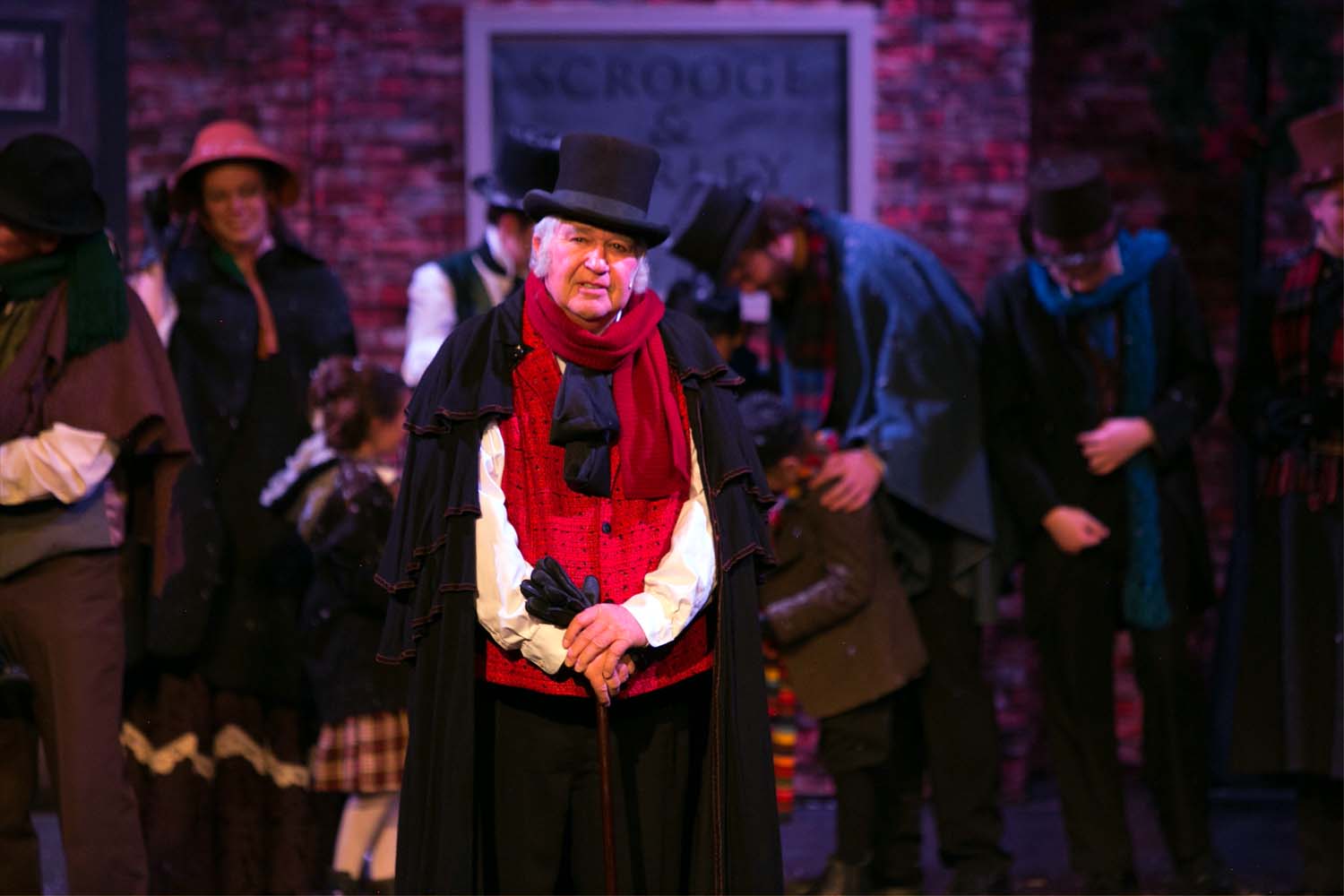
A Christmas Carol Tarleton University: “I think one thing that’s really beautiful about live theatre specifically is the trust between the audience and the actors on the stage. Because the audience knows it’s not real, but they trust us, and they let themselves be fully engulfed by our story and these characters. And theatre teaches you lessons even if you don’t know it, and you keep those lessons subconsciously for the rest of your life.”

Cheyenne Nash, Lighting Designer


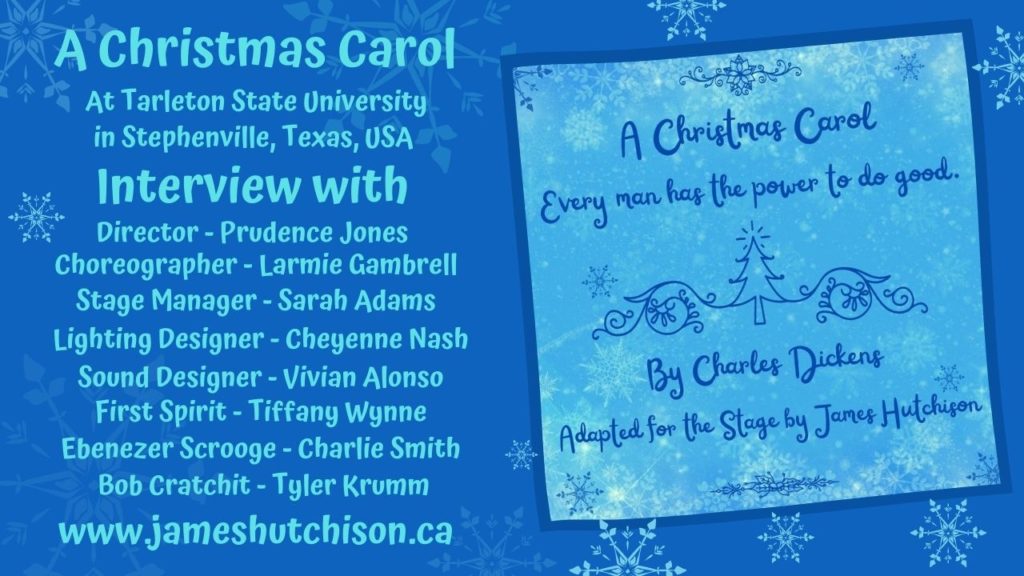
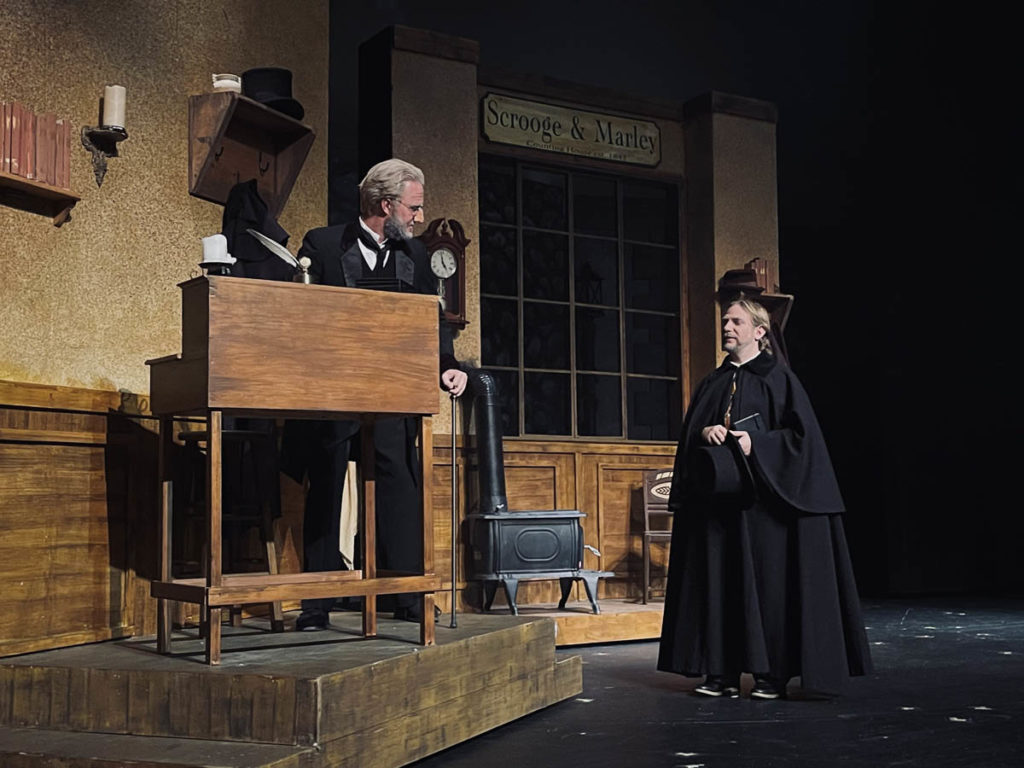
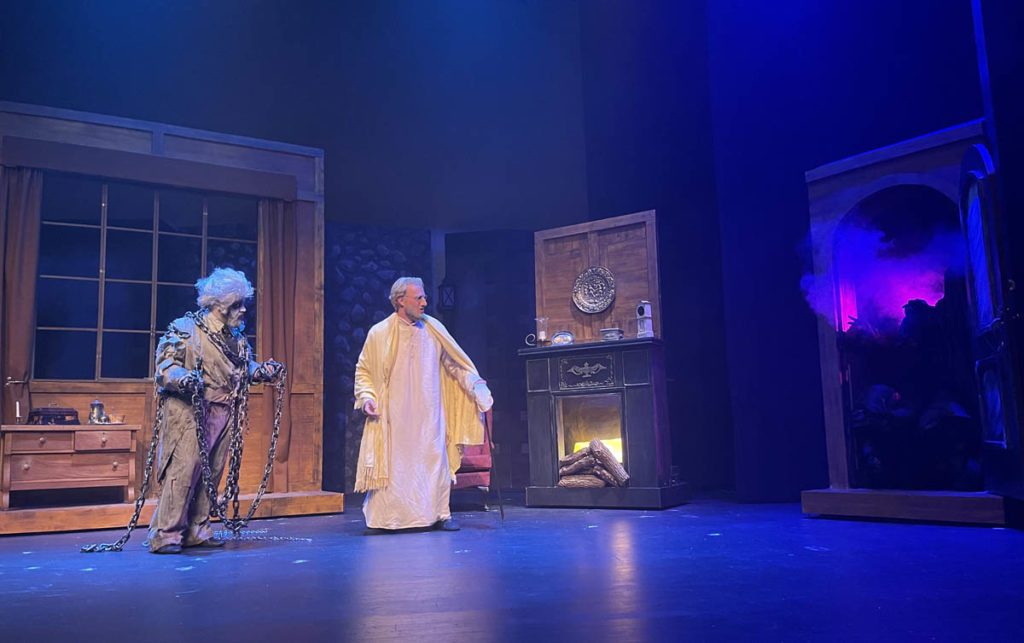
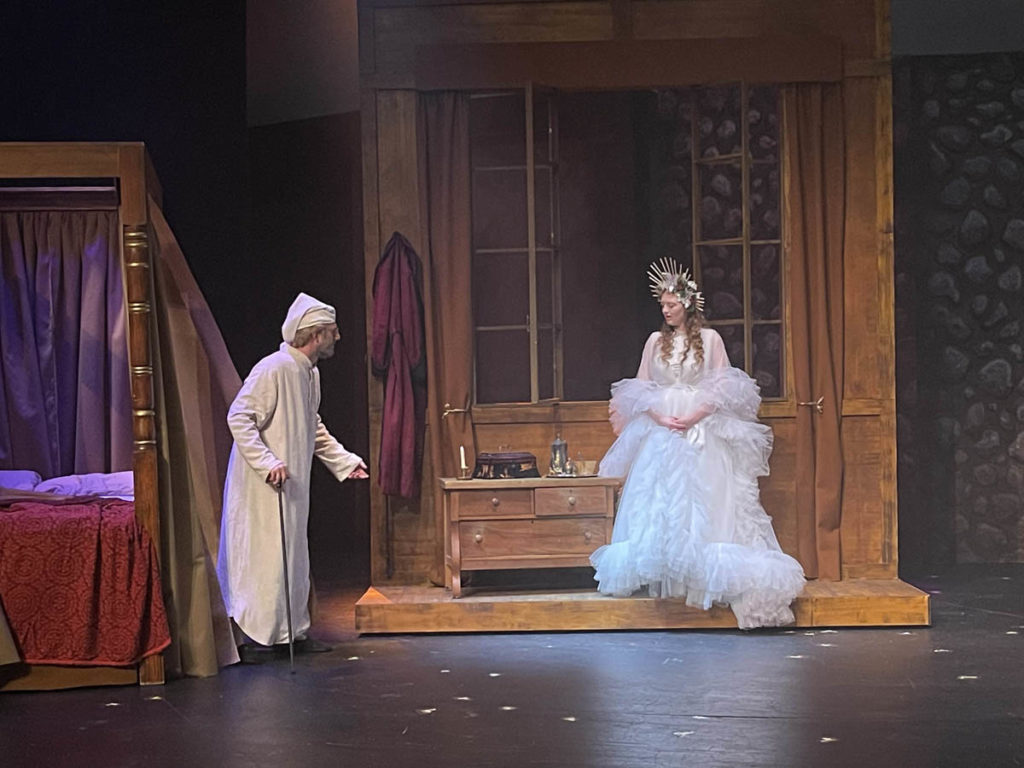
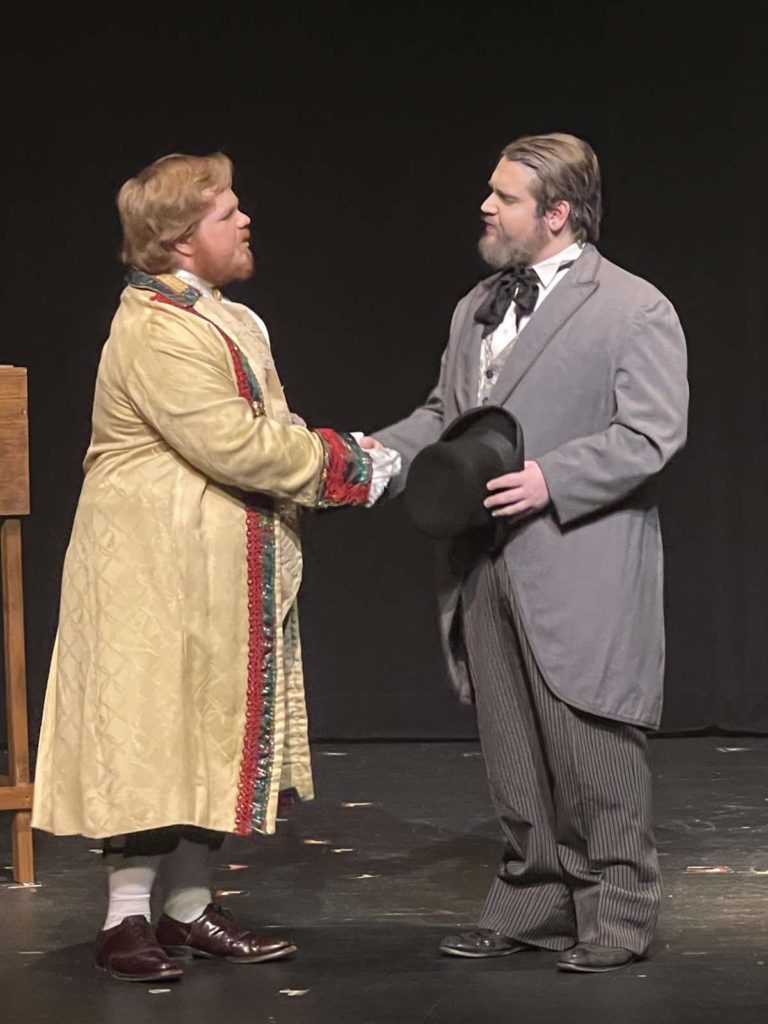
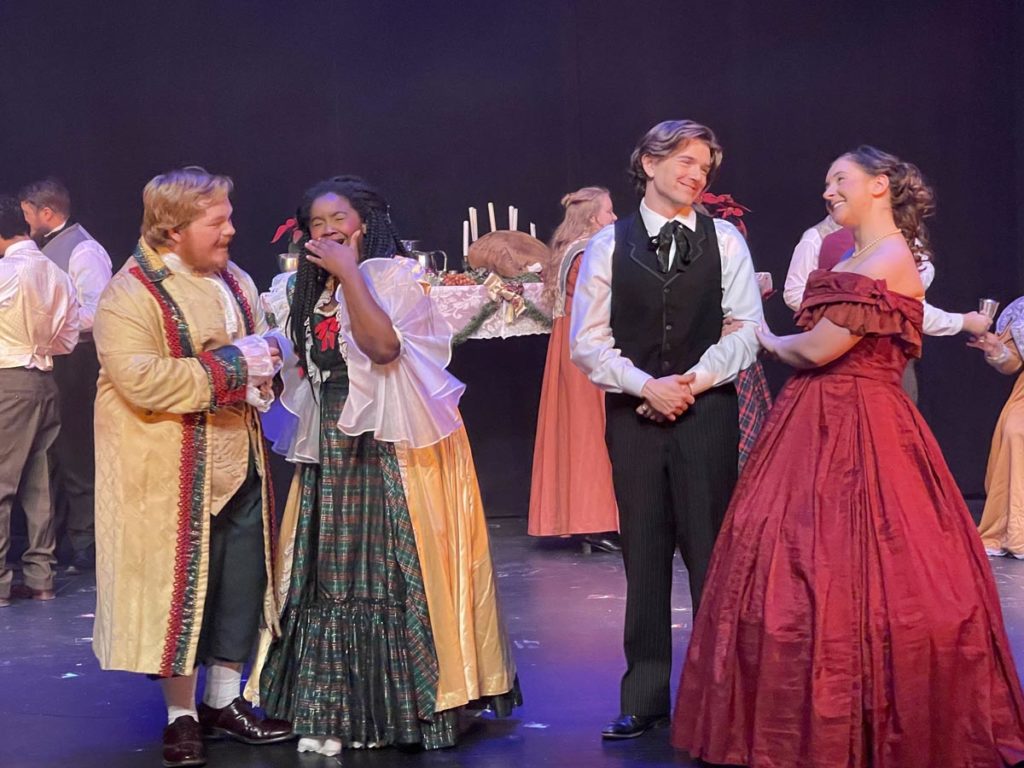
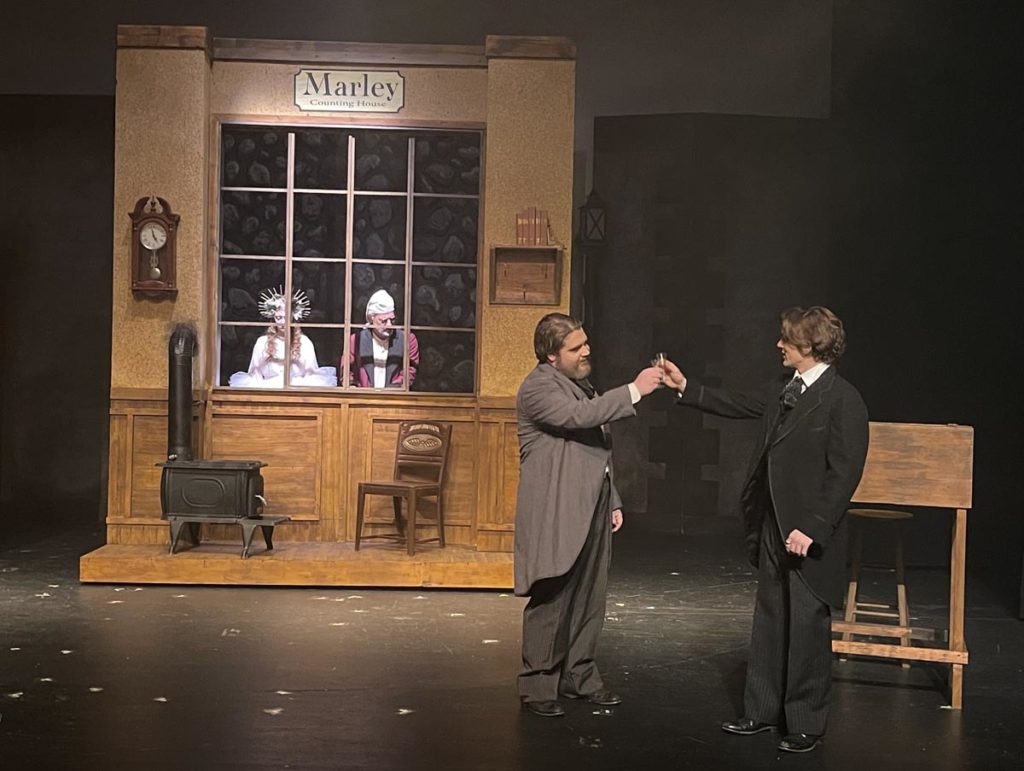
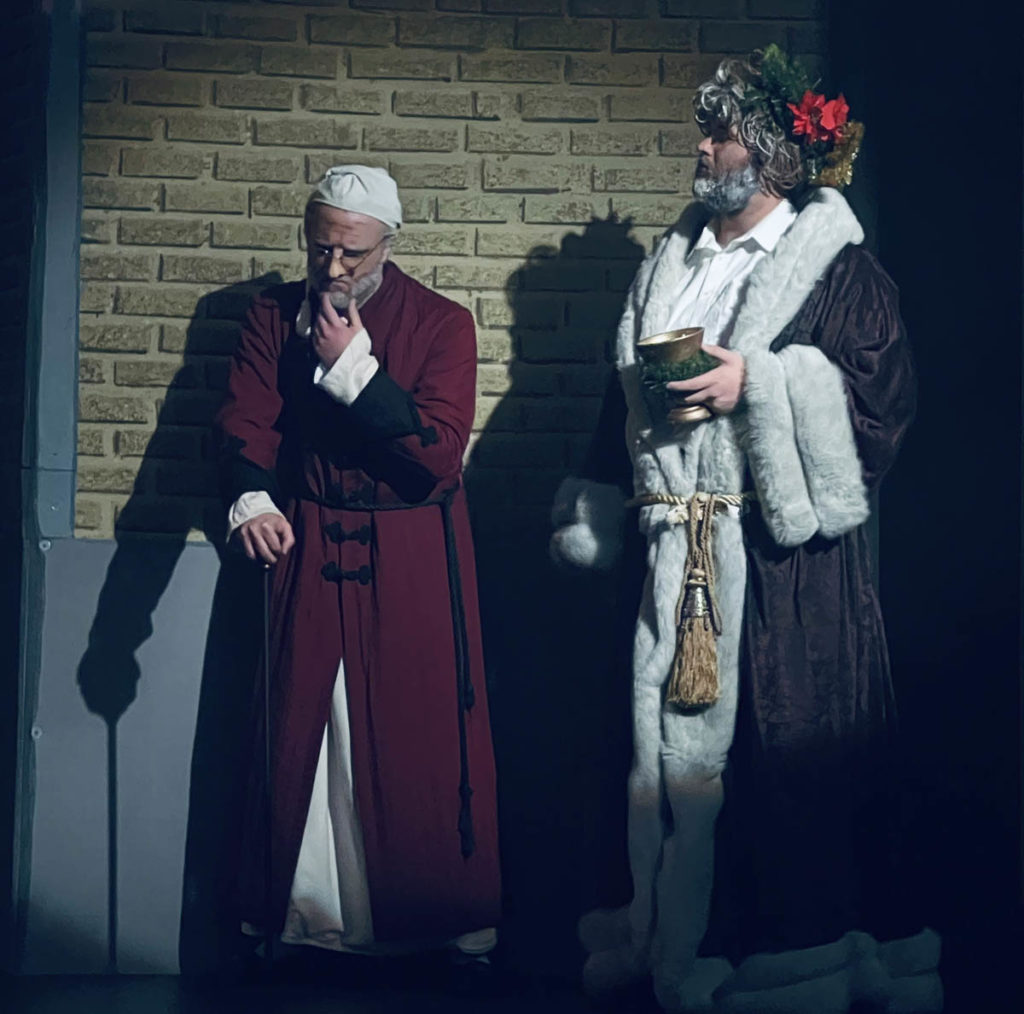
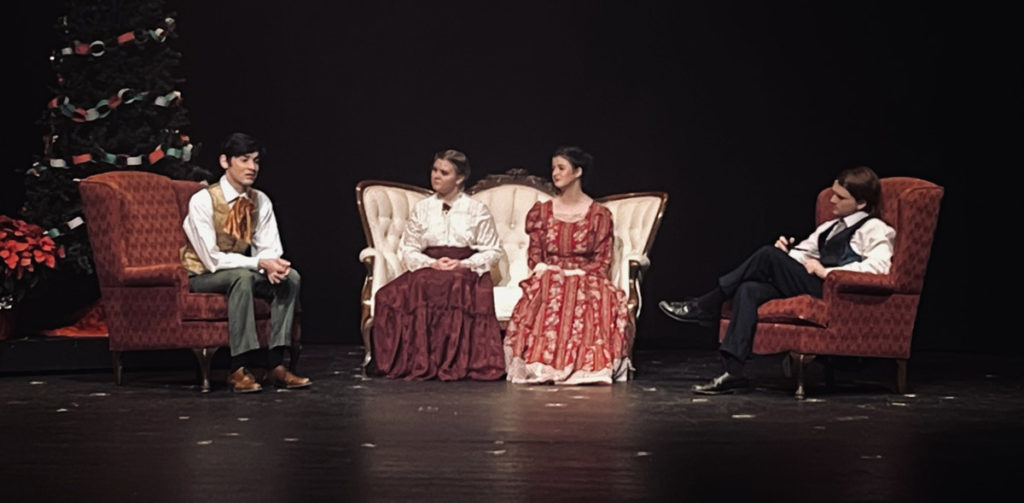
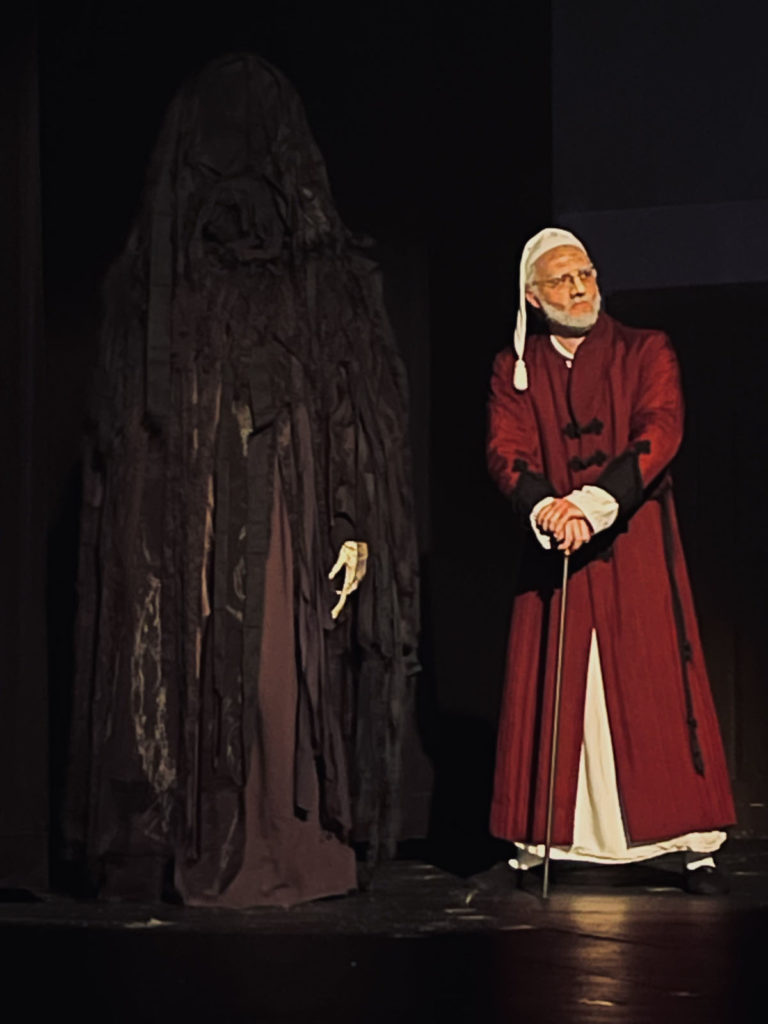
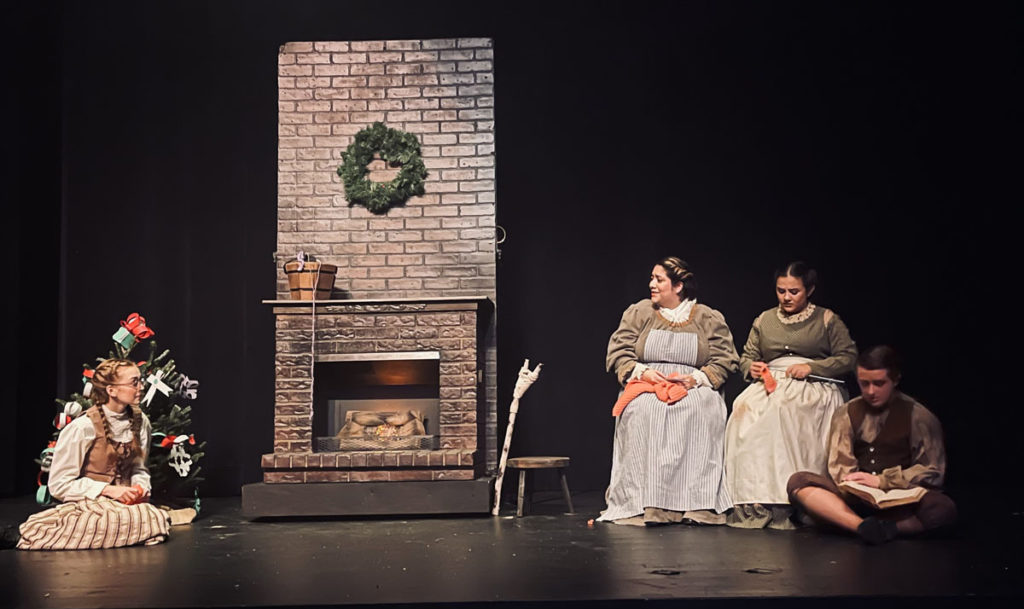
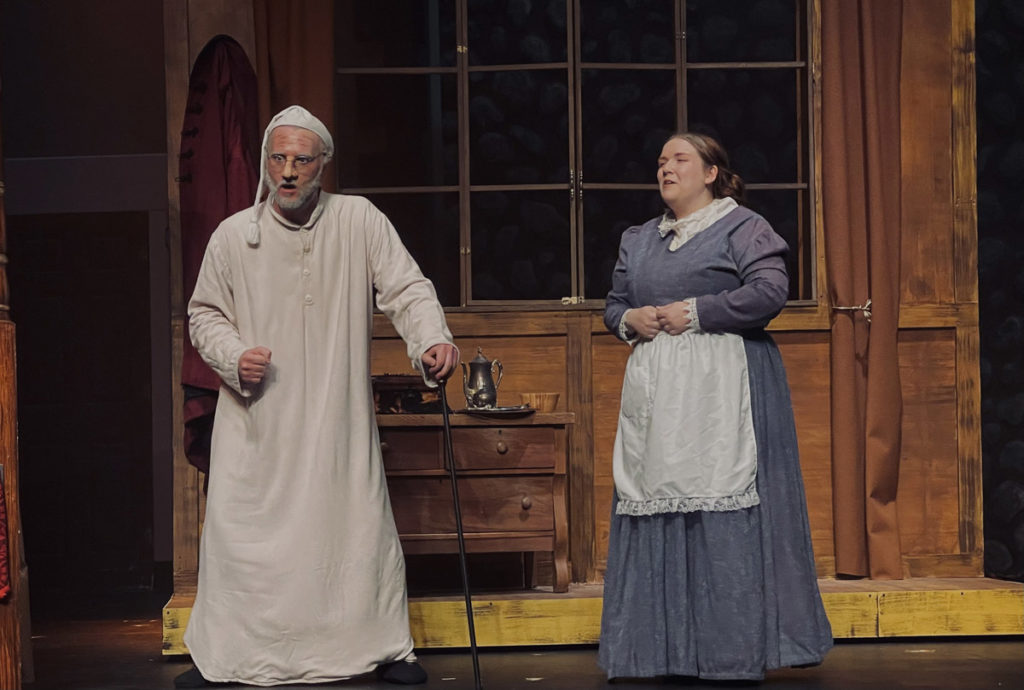
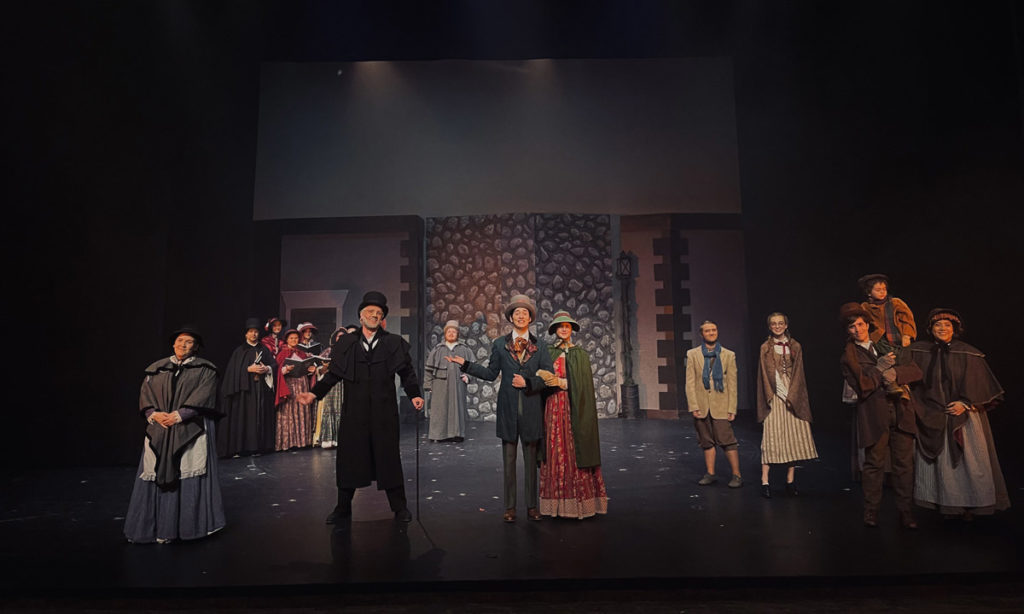
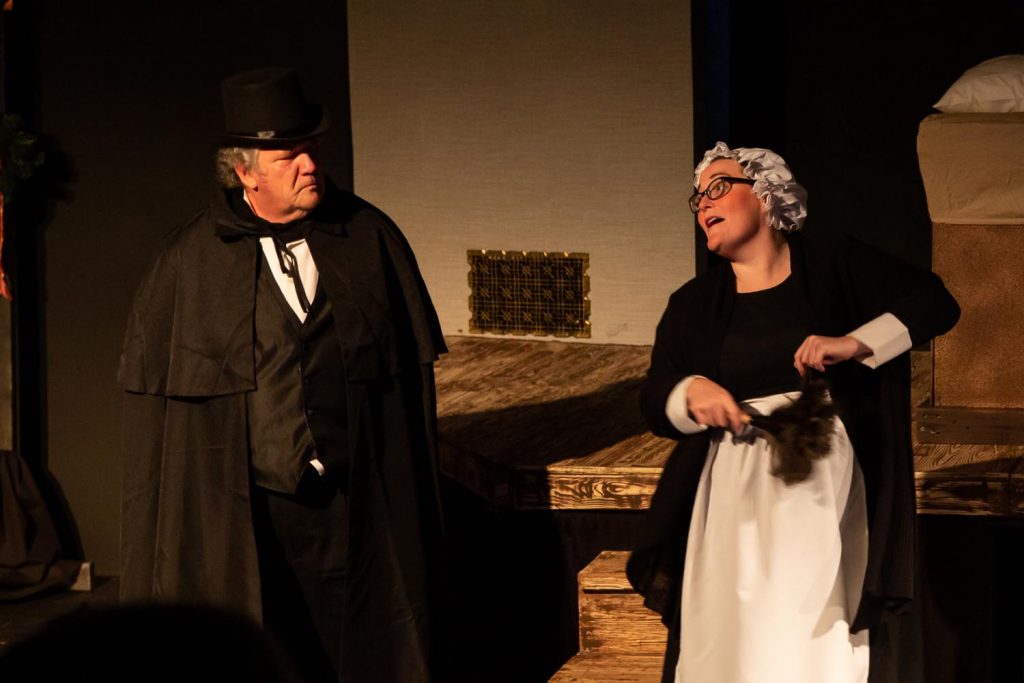
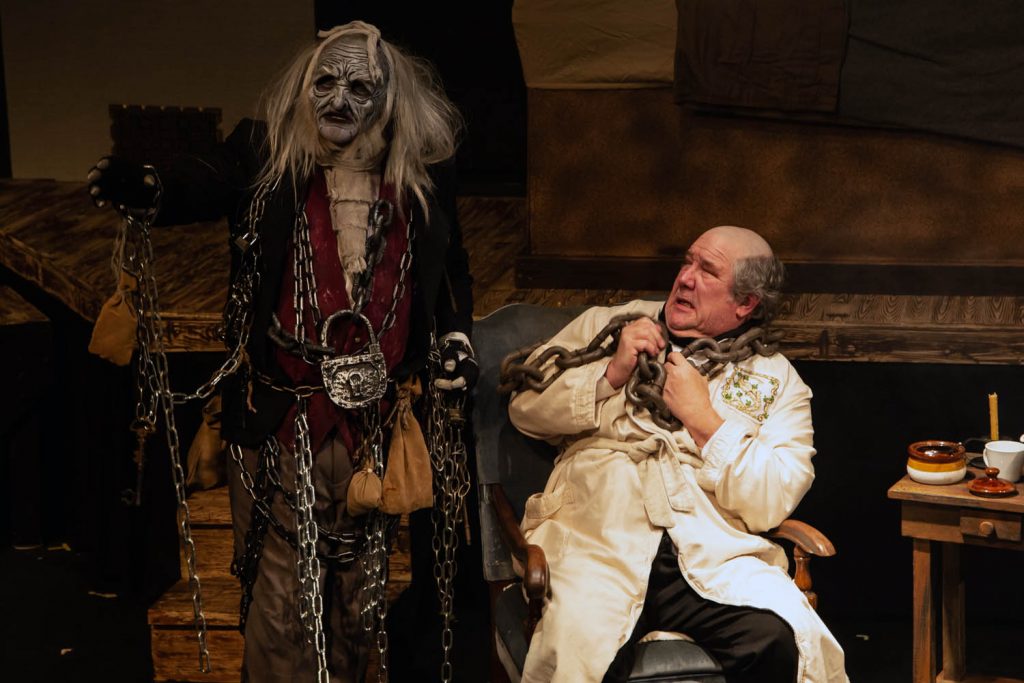
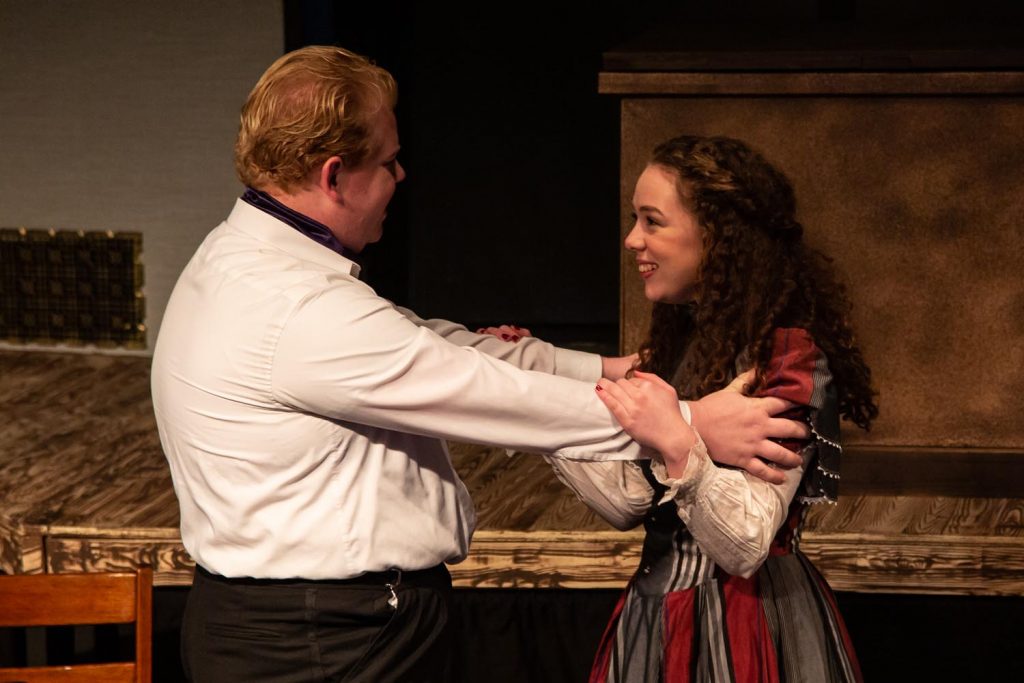
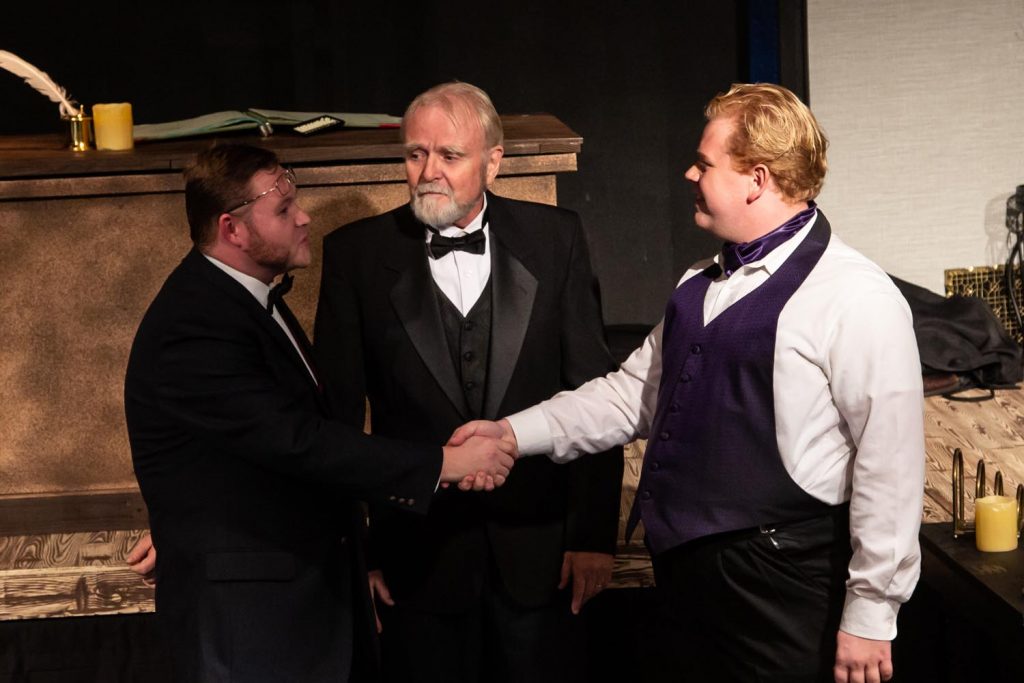
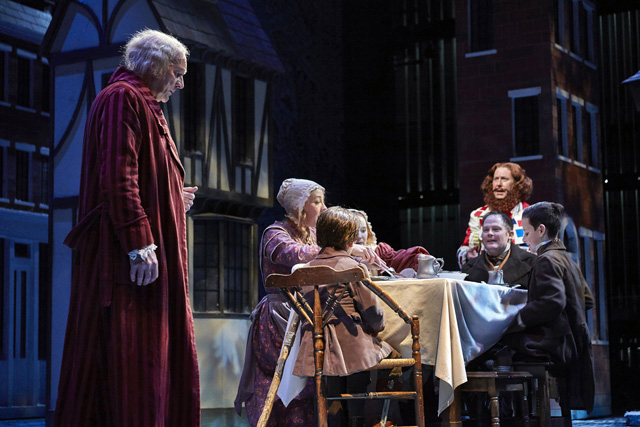
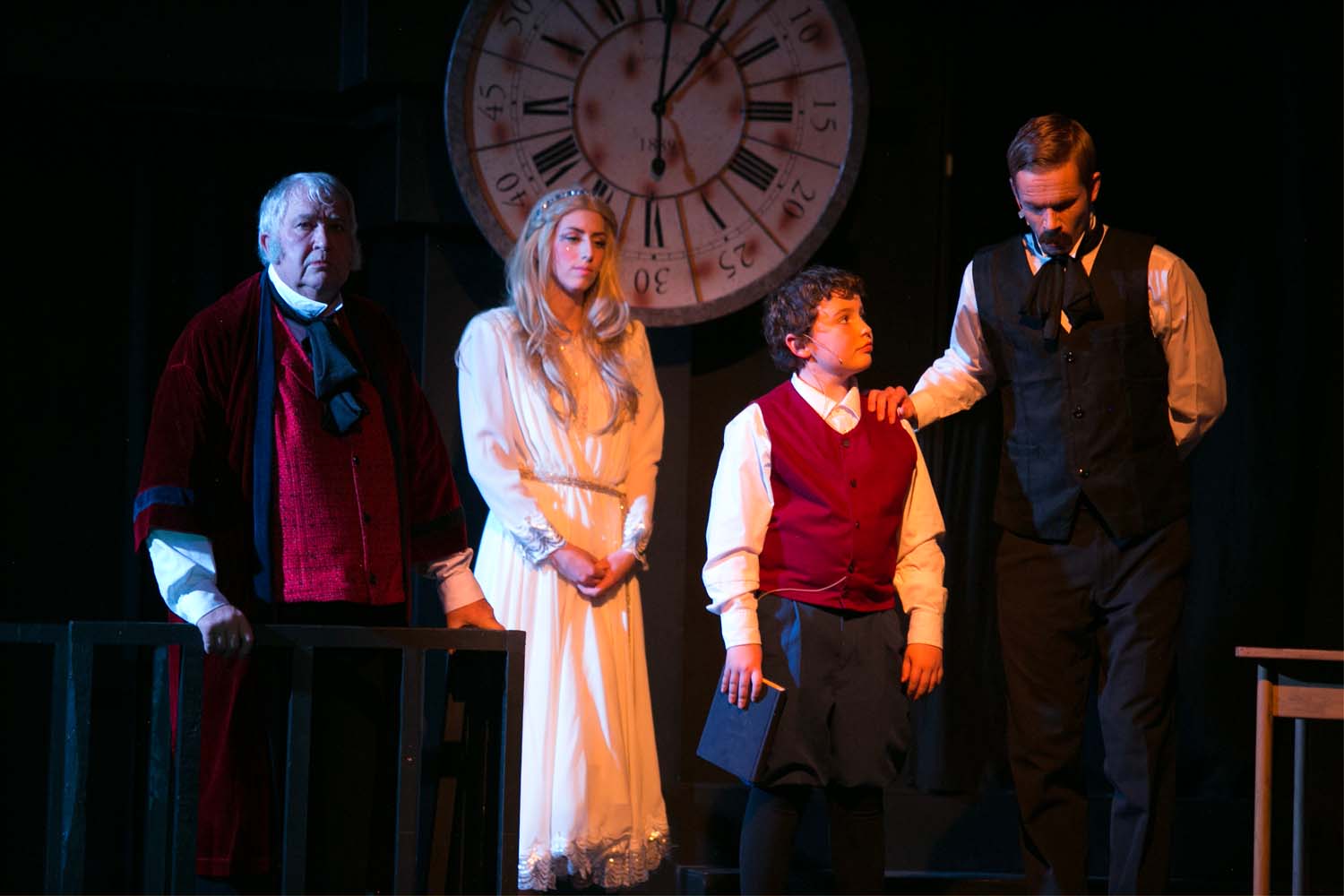
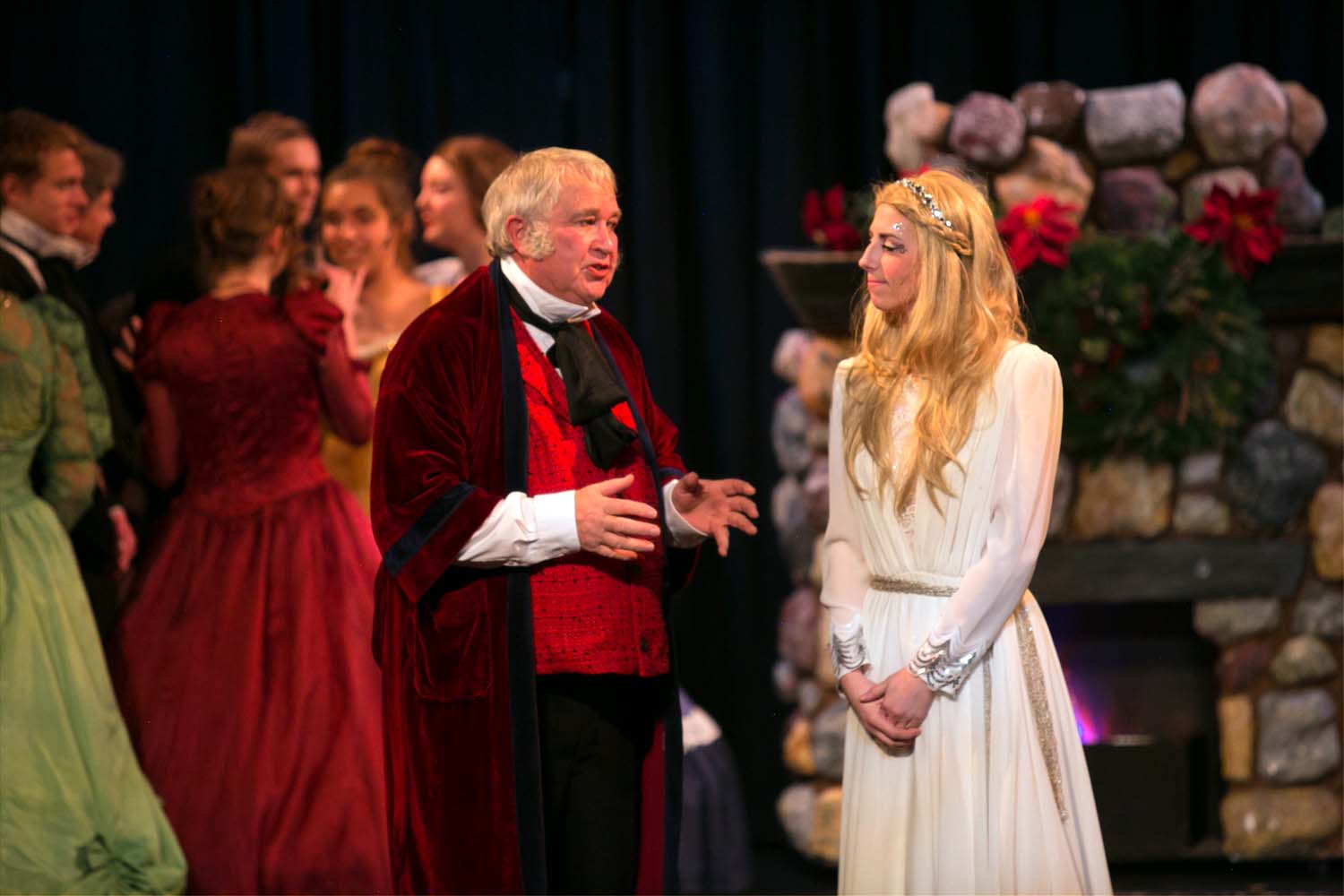
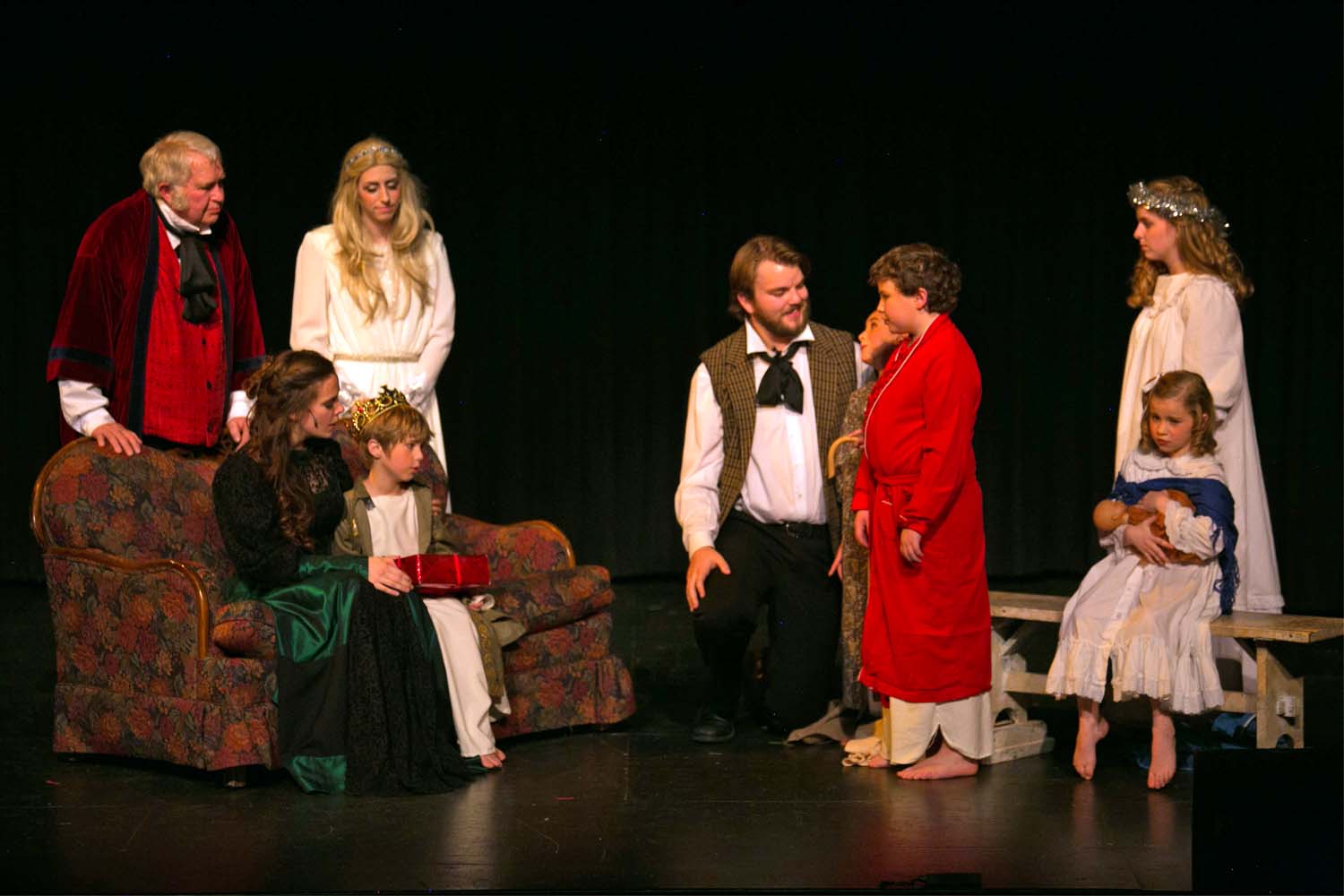
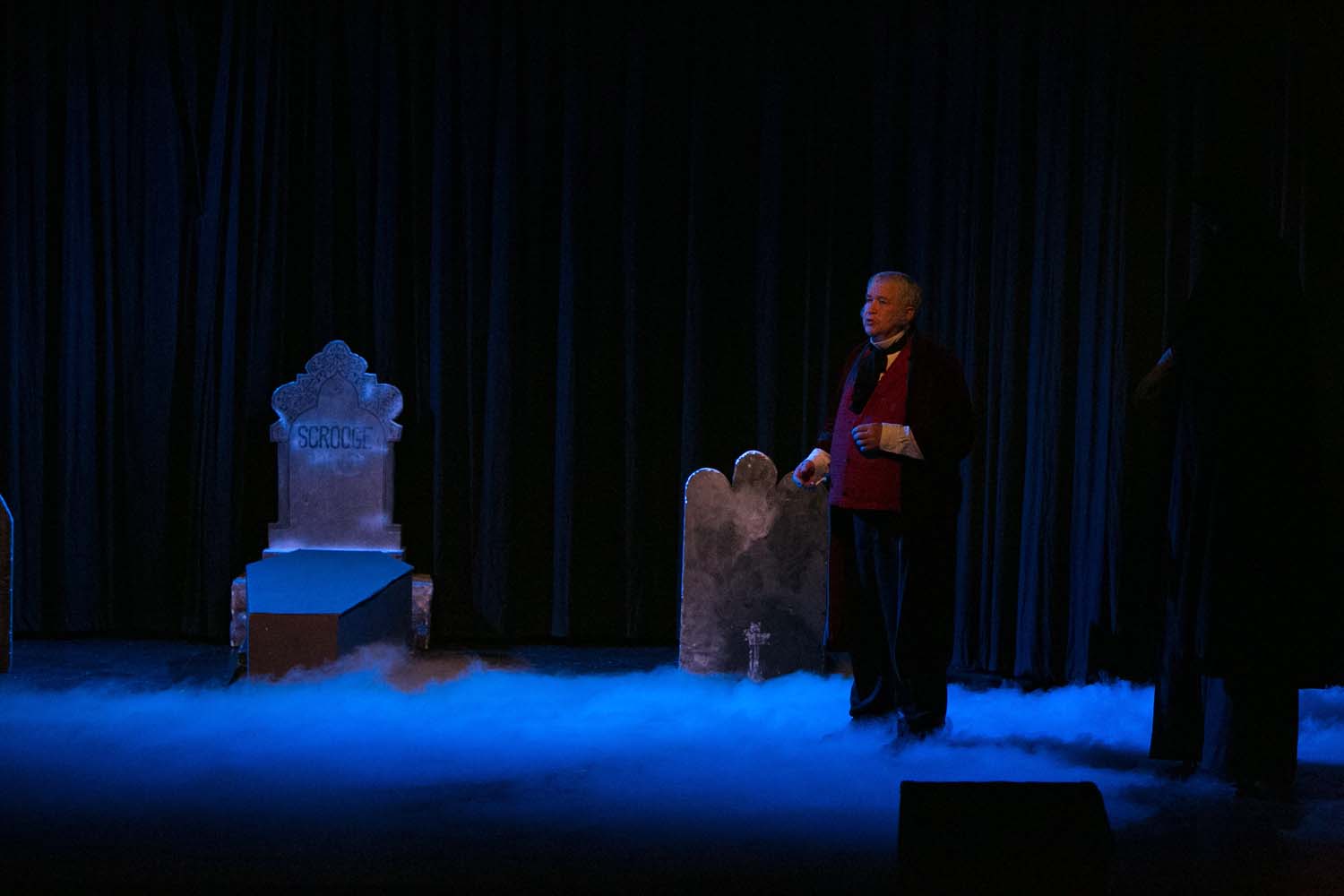
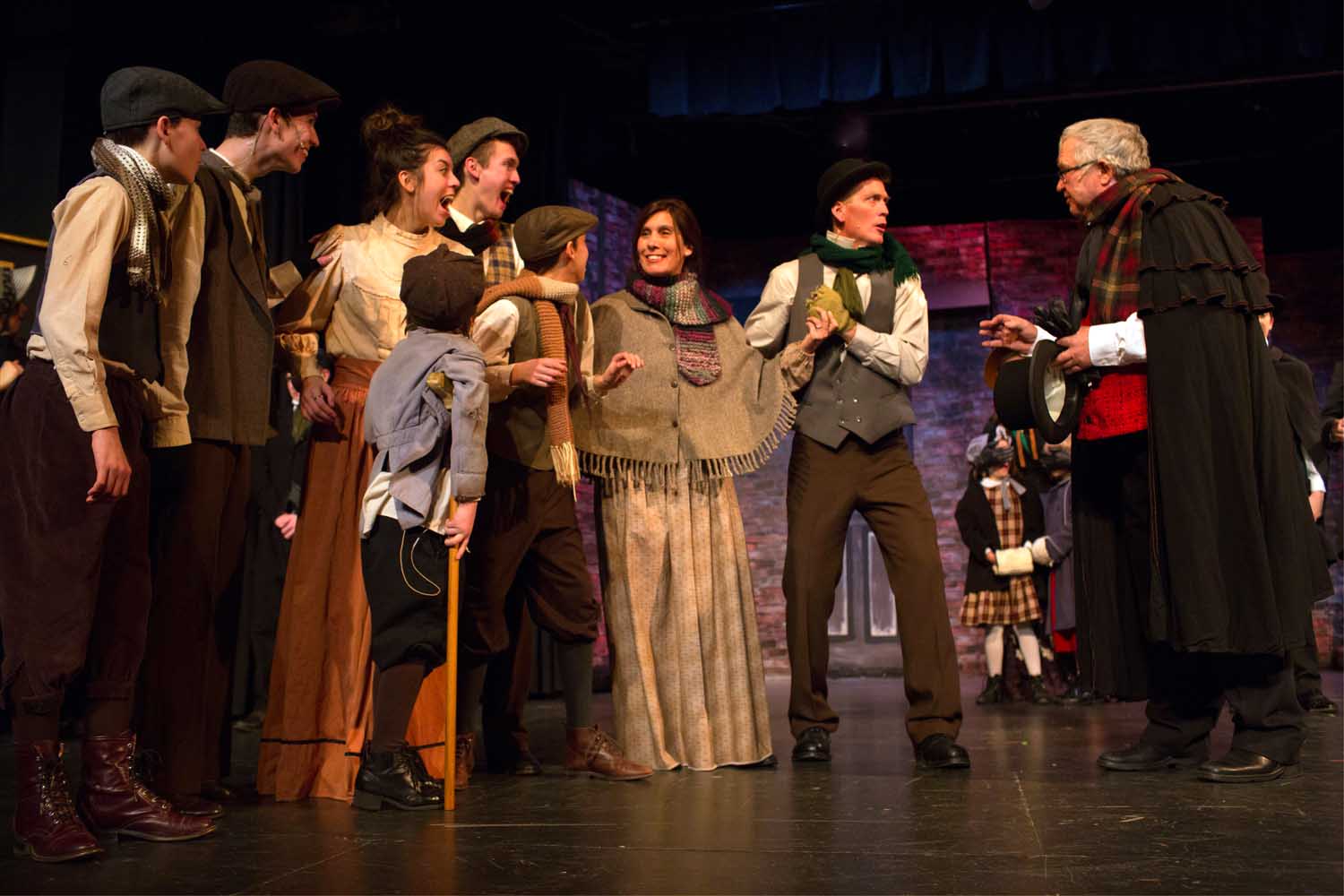
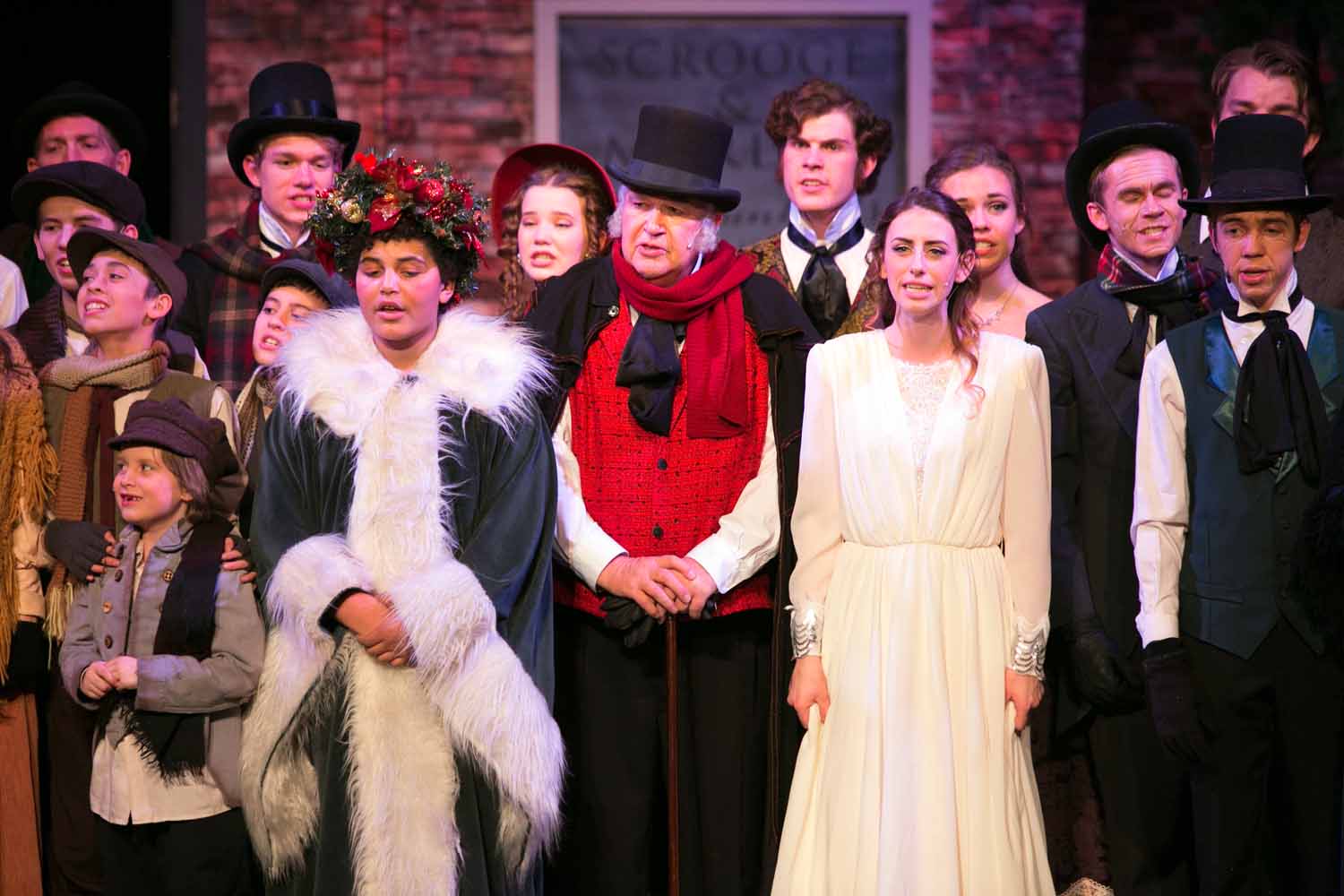
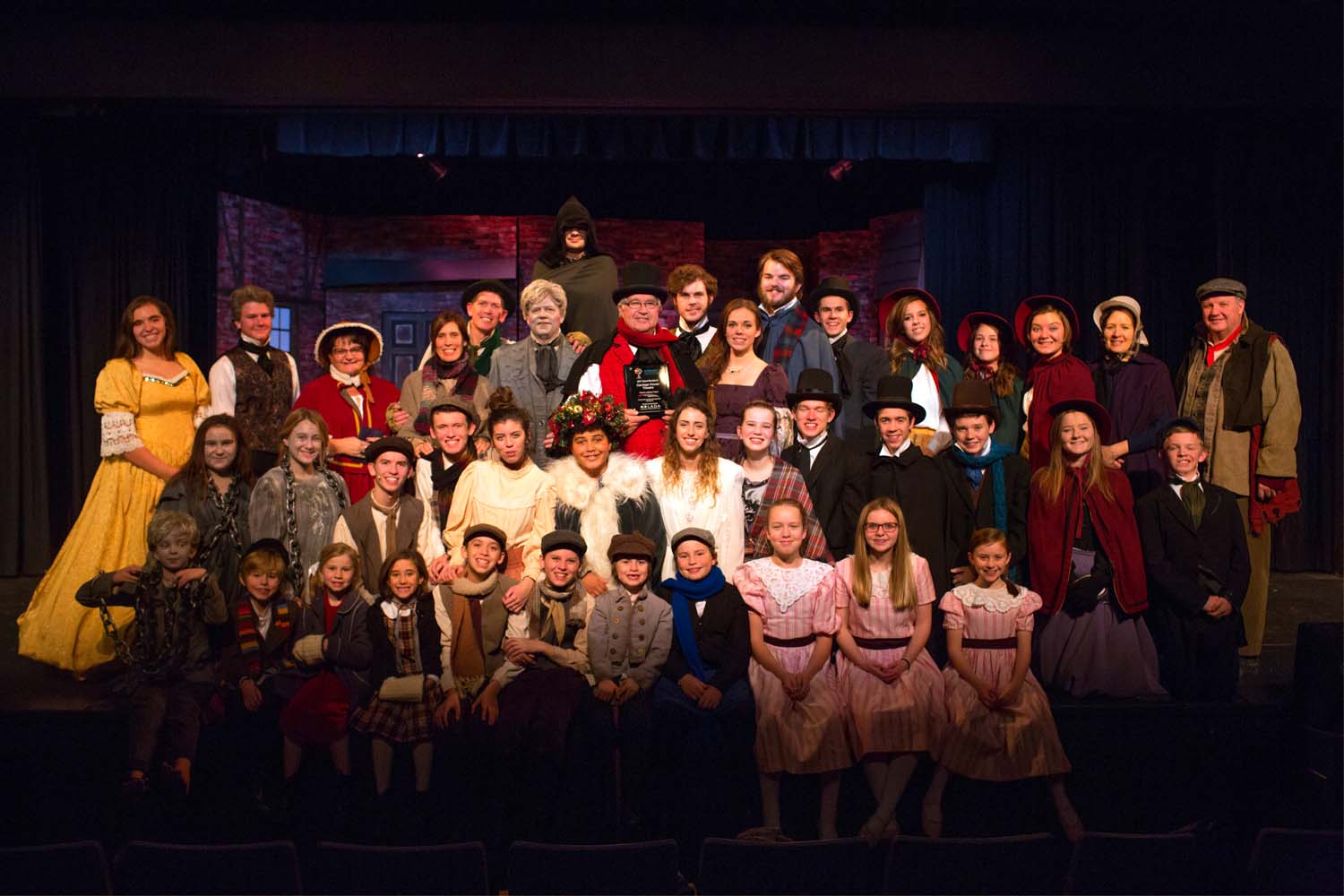
This year my adaptation of A Christmas Carol will be haunting several stages across America this Christmas including the stage at Tarleton State University in Stephenville Texas. A few weeks ago, I had the opportunity to chat with Prudence Jones Assistant Department Head and Associate Professor of Theatre and several of the students involved with the production of A Christmas Carol.

JAMES HUTCHISON

So, Prudence what do you think it is about the story of Ebenezer Scrooge that still appeals to people more than 175 years after it was written?

PRUDENCE JONES

We all respect and want to see a redemption story. Getting to watch Scrooge and see him change from being this miser to being a good person and realizing that he is not the most important person out there is important, because inside of us all we have qualities about ourselves that we may not like, and we may want to change. A Christmas Carol allows us to see that there is the possibility for someone who was so bad to do what’s right and change and to realize that we are responsible for the other people on this planet – not just ourselves.

JAMES

This is a big show. It’s a large cast. There are lots of scenes, tons of things happening. So, how do you as a director work on a show like this and bring it together?

PRUDENCE

There’s a lot of leg work before we even cast the show. I am a very detail-oriented person, so I spend a lot of time taking the script and breaking it down. Tracking who could play multiple parts. Making sure I know where individual characters are going to be within the show as well as the set pieces because for this particular show the set pieces are moving and double-sided. So, we have Scrooge’s counting-house that turns around to become his bedroom. And the other side of the counting-house turns around to become the Cratchit’s home.

I also have really great assistants, like Larmie who is handled all our choreography and Sarah our stage manager. It’s really important for me as a director to have people that I can rely on. And so, in rehearsal they’re able to use all that prep work that I did to track all the pieces – the props and the actors and the sets and it allows me to focus on my creative side and to be a director.

JAMES

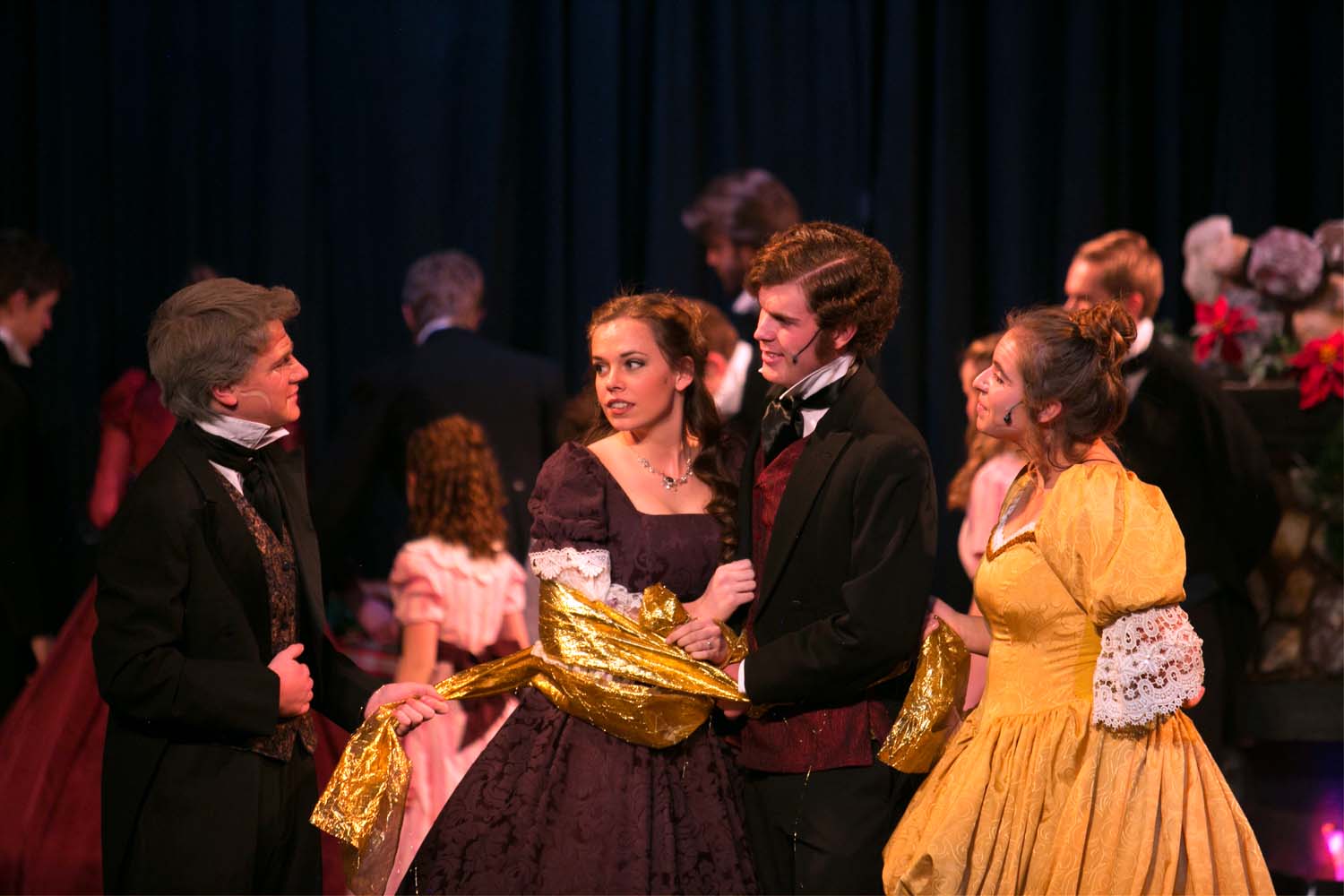
Larmie as the choreographer on the show there’s the party at Fezziwig’s and the description that I’ve put in the play is simply that they perform a dance of the period. What can you tell me about the dances you’re featuring in the production and how you go about working them into the play?

LARMIE GAMBRELL

Right from the get-go Prudence and I had discussed that we wanted to do a waltz because that was a popular dance during that time period. So, I went to Vivian – the sound designer – and she found me a perfect song. As soon as I had a chance to sit down and really listen to the music I pretty much came up with the dance in my head. I’m a very visual person, so I just went in the theatre, and I played the song on repeat over and over, and I danced it myself until I had it down perfect, because I had to teach fourteen other people the dance, and they caught on really quick too. I think they learned it in about forty-five minutes

JAMES

What have you enjoyed most about the theatre program at Tarleton?

LARMIE

I personally love that we’re a smaller program. It allows us the opportunity to get involved with just about anything we want to. One minute I’m painting the set. The next minute I’m acting in a show. There’s a wide variety of things that we get to do here, and we get to feel really close to one another and to learn about one another and to rely on one another and I just like the opportunities that we’re given here.

JAMES

Sarah, you’re the stage manager and I’m not sure everybody understands how important a stage manager is. I was wondering if you could explain some of the key duties of a stage manager and illustrate it with some of the challenges of putting on this production.

SARAH ADAMS

One of the main challenges in this show is just how big the cast is. I’ve never stage managed let alone stage managed this big of a cast and so I have to make sure everyone is on time doing what they’re supposed to do and being quiet and being courteous. Making sure the actors know they’re blocking is probably one of the biggest challenges and I’m also making sure I’m giving time to every single actor and not just focusing on Scrooge or the spirits.

PRUDENCE

Since we’re a generalist program we make it a point that every person is important. Not just the person playing Scrooge. And since Sarah is the one running the show when it comes time for the actual full production we make sure all the students have a good understanding and respect for their stage manager.

SARAH

And I’m working with the designers and making sure I’m aware of what they need from me. I work with the sound designer and the lighting designer throughout the process, and I make sure everyone is comfortable with what they’re doing, and that they know exactly what they’re supposed to be doing and making sure everyone’s on the same page.

JAMES

What attracted you to this particular theatre program?

SARAH

My high school theatre teacher went here and she told me to go do my own visit and I came here and there was this beautiful atmosphere and it felt kind of like home. And everyone here is literally like a family.

JAMES

So, Cheyenne you’re the President of the Tarleton Players and I’m wondering what does that mean? What does that involve?

CHEYENNE NASH

We do a lot of fundraisers and a lot of social events, and we raise money for anything the department needs. And we also want to bring our students a little bit closer together. So, that’s the purpose of the group. And we have a group of officers with a variation of ages and a variation of focuses, and they are kind of the voice for the students, and they make the plans, and I just make them happen. So that’s kind of what I do as the President.

JAMES

Both the sound and lighting elements of a play complement the production and I’m curious as the lighting designer what are you doing with the lighting to tell the story of Scrooge and his Ghostly Spirits as he travels through his past, present, and future?

CHEYENNE

I kind of decided that my biggest challenge would be the spirits. I use the intelligent lighting and LED and colour to separate the worlds between Scrooge’s reality and the supernatural dream. And so, for the first spirit I’m using a lot of sombre colours. Yellows and oranges and white almost. And then the second spirit is vibrant reds and greens. You know, the true Christmas colours because we saw the second spirt as more like a Santa Claus kind of spirit. And for the third spirit I’m using purple, dark blues and colours that are kind of scary.

JAMES

Vivian, you are playing Mrs. Cratchit and the sound designer for the show. How are you incorporating sound in various ways to enhance the production?

VIVIAN ALONSO

There’s a lot of scary scenes like when Jacob Marley first comes or the third spirit appears and so those scenes have a lot of intricate sounds like the chains and footsteps and hellish sounds. And in underscoring the Fezziwig scene I’m using sound to enhance the cheerfulness and to keep up the holiday spirit throughout all of it.

JAMES

You’re also playing Mrs. Cratchit. I’m curious about how you prepare for the role. Have you been looking at lives in Victorian times or are you looking at it more as an emotional journey? What’s been your process?

VIVIAN

It’s been more an emotional journey at least going from her being so happy and content with her family and Tiny Tim and her children and everybody coming together for Christmas. And then the next scene that they’re in, her youngest child is gone. And it’s a huge milestone that she has to get through – holding herself together and holding her family together.

JAMES

Tiffany, you’re playing the ghost of Christmas past. The Ghost of Christmas past offers Scrooge a chance for reflection – what are the qualities you think are most important that the Ghost of Christmas past should possess?

TIFFANY WYNNE

I think all the spirits are very wise and compassionate. What I think is important about the first spirit is that it acts as more of a teacher to Scrooge, and it uses different tactics to make Scrooge come to conclusions himself, rather than directly telling him what he’s done wrong.

JAMES

Since you’re the Ghost of Christmas past I’m wondering when you look at your own Christmas Past are there some traditions or memories that make Christmas time special for you?

TIFFANY

I think what makes my Christmas most special is that my family gets together and cooks all the meals for the holidays. I don’t cook, but I do in fact, participate in that. And I just think that brings us together, and I think that’s probably one of the most important things that we do.

JAMES

Charlie, you’re playing Scrooge. How do you make Scrooge a human character and not just a miserable old miser?

CHARLIE SMITH

Well, it’s the moments that Tiffany mentioned. You know, throughout the play, he sees his own life and where it went wrong. And instead of being told, like Tiffany said, he starts to realize and starts to understand things. So, during those moments, I try to crack the ice a little bit more each time while still retaining that surliness.

JAMES

Why do you think we actually care about what happens to Scrooge? What does that indicate about us as humans?

CHARLIE

Well, it’s sort of piggybacking on what Prudence said at the beginning. We all have a Scrooge within us. A miser that wants to hold onto everything and we might all develop certain tendencies throughout our lives that we come to regret. Sometimes we find it very hard to take back those tendencies or to break out of certain habits. And so, it is good for people to see a story where someone’s so far gone and so self involved that even he can dig himself out of the hole he’s dug for himself.

JAMES

Tyler, you’re playing Bob Cratchit. What type of a man do you think Bob Cratchit is and how does his situation resonate with audiences today?

TYLER KRUMM

I think Bob Cratchit is a very simple man. He doesn’t really require much in life. He doesn’t want much in life. He has what he wants and that makes him happy – his family, his friends. And even though he doesn’t get that much through his job it’s still more than enough than what he needs to be happy. And I think audiences really resonate with that because they look and see what they have in their lives, and I think most people realize they don’t really need a whole lot to be happy.

JAMES

So, if someone was trying to decide between a couple of different theatre programs, what would you tell them about your theatre program and why they should consider it?

TYLER

It’s a program that really allows for a lot of different opportunities. No matter what it is you’re going to do. Maybe you want to be backstage doing lighting, or maybe you might think, I want to give acting a try. Well, you can do that here. It’s a small enough program that not only can you really connect with everyone, but it gives you opportunities to work with a lot of different people on a lot of different things.

JAMES

So, a final question for the group and anyone can answer. Why is theatre important? Do we still need it? What does theatre offer our communities?

PRUDENCE

With live theatre you’re sitting there making a memory that no one else can have except for you and the other audience members and the actors on stage. Theatre is one of the very last art forms in the world where it’s just you as an audience member and the people on stage and the rest of the world is gone. It’s the moment that’s happening in front of you right then and there and it can never be repeated and that makes it unique.

CHEYENNE

I think one thing that’s really beautiful about live theatre specifically is the trust between the audience and the actors on the stage. Because the audience knows it’s not real, but they trust us, and they let themselves be fully engulfed by our story and these characters. And theatre teaches you lessons even if you don’t know it, and you keep those lessons subconsciously for the rest of your life.

A Christmas Carol at Theatre Tarleton

CAST of CHARACTERS

Charlie Smith as Ebenezer Scrooge
Clay Luton as Mr. Bentley
Tyler Krumm as Bob Cratchit
Jake Wadkins as Fred
Rolan Garcia as Mr. Granger
Kaitlyn Dearth as Mrs. Harrington
Landen Harbour as a Boy
Rachel Thompson as Mrs. Dilber
Gerik Lyssy as Ghost of Jacob Marley
Tiffany Wynne as the First Spirit
Morgan Williams as the Cook
Luke Thomas as Scrooge as a young boy
JD Dovark as Scrooge as a young man
Allie Mackey as Fan
Damion Smith as Mr. Fezziwig
Nakiya Oleru as Mrs. Fezziwig
Rolan Garcia, Gabriel Leal, Clay Luton as Fezziwig’s Daughters’ Beaux
Emma Morrow, Shiann Reese, Allie Shaffer, Clara Chestnut as Fezziwig’s Daughters
Gerik Lyssy as Jacob Marley
Matalynn Thayer as Belle
Cameron Bishop as Dick Wilkens
Landen Harbour as Hugh
Mary Lou Graves as Georgia
Micaela Medina as Grace
Kyllie Avery as Tabatha
Tommy Vest as Second Spirit
Vivian Alonso as Mrs. Cratchit
Luke Thomas as Peter Cratchit
Vivan Horton as Abigail Cratchit
Erika Owen as Martha Cratchit
Elena Gracia as Tiny Tim Cratchit
Emily Turner as Emma
JD Dovark as Topper
Shiann Reese as Rose
Emily Rose as Ignorance
Micaela Medina as Greed
Gabe Escoto as Third Spirit
Gabriel Leal as First Man Businessman
Clay Luton as Second Man Businessman
Damion Smith as Mr. Newbury
JD Dovark as Old Joe
Cameron Bishop as Thomas
Emma Morrow as Caroline
Landen Harbour as Boy
Mary Lou Graves as Girl

Luke Thomas, Rolan Garcia, JD Dvorak,
Nakiya Oleru, Allie Shaffer, Shiann Reese,
Taylor Fambrough, Clara Chestnut,
Morgan Williams, and Emily Rose
as Carollers

PRODUCTION STAFF

Director – Prudence Jones
Assistant Director/Choreographer – Laramie Gambrell
Stage Manager-Sarah Adams
Assistant Stage Manager-Olivia Santisteban
Set Design- Prudence Jones
Costume Design- Riley Fischer and Carol Stavish
Lighting Design- Cheyenne Nash
Sound Design- Vivian Alonso
Hair Design- Samantha Heately
Make-up Design- Gabe Escoto
Projection Design- Sarah McGrath
Props Head – Cameron Bishop

PRODUCTION CREW

Light Board Operator – McKenzie Lucero
Sound Board Operator – Jakayla Daniels
Spotlight Operator – Phillip Skinner
Projections Operator – Robby Green
Master Electrician – Kody Lewis
Deck Manager – Turner Laxson
Run Crew – Jillian Lambert, Kody Lewis
Paint Charge – Andrea Alviar
Paint Crew – Cheyenne Nash, Allie Shaffer,
Cameron Bishop, Kyllie Avery, Mary-Lou Graves,
Laramie Gambrell, Bella Jarmon
Props Crew – Mary-Lou Graves, Mary Maturo,
McKenzie Lucero, Jillian Lambert,
Rachel Thompson, Emma Morrow
Light Crew – Kyllie Avery, Tiffany Wynne,
Jillian Lambert, Andrea Alviar, Allie Shaffer,
Emma Morrow, Cameron Bishop, Nakiya Oleru,
Sarah McGrath, Tommy Vest
Wardrobe Crew – Alicia German, Andrea Alviar,
Sam Heatley, Jake Wadkins, JD Dvorak
Makeup Crew – Bella Jarmon, Clara Chestnut
Publicity Head – Mary Maturo

Tarleton State University Theatre Program – The Theatre Program encourages creative thinking and the development of the multiple crafts of theatre through experiences in design, rehearsal, and performance. Tarleton strives to provide students with exposure to a wide variety of performance styles and historical periods, opportunities to improve self-discipline in preparation for a deadline-driven, production-oriented career, and a supportive environment where students are encouraged to try new things and learn from their failures.


Submission Opportunities for Playwrights

This is a Title Graphic. Along the left side of the graphic it says Submission Opportunities for Playwrights. Followed by a list of competitions: Sir Peter Ustinov Scriptwirting Award, Yale Drama Series Playwriting Competition, American Blues Theatre - Blue Ink Playwriting Award, Ashland New Plays Festival, PlayFest Santa Barbara. On the right side of the graphic is the comic and tragic mask.

I’ve listed several submission opportunities and conferences for playwrights and provided a short description as well as a link to each opportunity’s website for further information. Please check out the submission guidelines for each festival or playwriting development opportunity before deciding whether or not you want to submit your work. Listing these opportunities is in no way an endorsement. If the deadline has passed then take note for the following year.

This list is no longer being updated. Several of the contests are still active so please feel free to follow up on your own.


The Great Canadian Playwright Showcase

Two-thirds of Canadian playwrights agree that greater compensation and access to programming opportunities would provide the highest impact in satisfying their current needs as a playwright.*

*Source: Casemore, L. (2021). Surveying the Landscape: The New Play Ecology in Canada Alberta Playwrights’ Network. 

TGCPS is a networking event to foster production possibilities by uniting creatives, coordinators, and crew with theatre industry decision-makers for a few spring days in Grande Prairie, Alberta.

This first edition of TGCPS invites delegates to meet with each other and experience new frontiers on an epic journey of discovery.  TGCPS No. 1 kicks off in  Alberta’s hidden treasure of the north, Grande Prairie. The expedition takes place May 10 -13, 2024, when a hardy group of intrepid souls from across Canada and abroad meet to exchange perspectives, languages, cultures, and ideas. Join us at the Trading Post where the future of Canadian theatre takes shape.

Conference Details: The Great Canadian Playwright Showcase


When Words Collide – Writers Conference

Where: Calgary, Alberta, Canada

When: August 16 – 18, 2024

When Words Collide is a festival for readers, writers, artists and publishers of commercial and literary fiction, including genre, YA, children’s books, poetry, and much more. WWC is a festival that welcomes all lovers of the written word regardless of age, background, citizenship, disabilities, sex, educational level, ethnicity, family status, gender, gender identity, experiences, race, religion, or sexual orientation.

Festival Information: When Words Collide


The Relentless Award

Applications are limited to shows by writers with United States citizenship, those who possess or are in the process of obtaining a green card, those with student, immigrant, or work visas for the United States, or anyone who currently resides in the United States and has lived here for at least four years.

The Relentless Award was founded in honour of Philip Seymour Hoffman and places special emphasis on works that are fearless in their choice of subject matter, featuring passionate voices that are relentlessly truthful. The winner along with finalists and semifinalists will also receive development opportunities through a series of staged readings at Theatre Row as well as at some of the top regional theatres in the country.

Submission details: The Relentless Award


The Alpine Fellowship 2024

The Alpine Fellowship is a charitable foundation that supports, commissions and showcases artists, writers, academics and playwrights. They are committed to discovering emerging talent, to disseminating new ideas and to sharing thoughts about art, literature and philosophy.

If you’re a writer, poet, academic, playwright or visual artist, then consider entering one of their prizes based on this year’s theme – Flourishing. There are cash prizes and you’ll be invited to attend their 2023 symposium.

The winner of the Theatre Prize will receive a cash prize to support the writing of their proposed play, and the runners-up will receive travel expense support that must be used to attend the 2023 symposium which will be held from August 10th-13th, 2023 in Fjällnäs, Sweden

Submission details: The Alpine Fellowship 2024


Vancouver Asian Canadian Theatre MSG Lab

vAct’s MSG Lab facilitates the creation and development of new theatrical work by emerging and mid-career Asian Canadian artists. The MSG Lab showcases stories from Asian Canadian perspectives and develops new works for future production opportunities. This year’s MSG Lab runs from May to December, with a series of 6 writers’ seminars and two 5-day writing/creation residencies (non-live-in).

During the MSG Lab, each writer will have a personally designed process that will propel the current script/proposal to a more fully realized version for an informal public presentation. Selected applicants will receive development support including:

  • A $4000 stipend per project;
  • 16 hours of in-studio workshop time with actors and collaborators
  • Approximately 60 hours of dramaturgical support (inclusive of workshops and a public presentation);
  • In consultation with the dramaturg, each writer will have the opportunity to design a personalized writing/creation process that best serves their creative needs.

The application deadline for the 2023 MSG Lab is Monday, February 27th, 2023.

Submission details: vAct’s MSG Lab


KHN Center for the Arts – Artist Residency

Application deadlines are March 1st and September 1st annually.

The Kimmel Harding Nelson Center for the Arts awards up to seventy juried residencies per year to established and emerging visual artists, writers, composers, and interdisciplinary artists from across the country and around the world. Residencies are available for 2 to 8 weeks stays. Each resident receives a $100 stipend per week, free housing, and a private studio.

The mission of the KHN Centre for the Arts is to support established and emerging writers, visual artists and composers by providing working and living environments that allow uninterrupted time for work, reflection and creative growth and to present and support arts-related programming that expands public awareness and appreciation of the arts. 

Since 2001, KHN has hosted more than 50 working artists each year which include a combination of visual artists, writers, composers, and interdisciplinary artists. Each has found privacy in which to create along with ample opportunities to interact with fellow artists in the vibrant and friendly community of Nebraska City located an hour’s drive south of Omaha.

Application details: KHN Centre for the Arts – Artist Residency


Drama Notebook Submission Guidelines Summer/Fall 2023

Drama Notebook is accepting play script submissions from playwrights, teachers, and actors who have written scripts or scenes for children and teens. Currently looking for plays based on popular works in the public domain, such as Peter Pan, Beauty and the Beast, Pinocchio, The Jungle Book, The Legend of Sleepy Hollow, Anne of Green Gables, The Scarlet Letter, The Sword in the Stone, The Velveteen Rabbit, Swiss Family Robinson, and others. Plays that are of a timely or educational nature, such as Christmas plays, Cinco de Mayo or Day of the Dead plays, plays that explain nature, geography, math, history or science. Also, looking for plays by BIPOC writers and plays that celebrate cultural diversity and equity. Complete information about Drama Notebook and how the company works with authors can be found on their website.

Submission details: Drama Notebook Play Submission Opportunities


National Alliance for Musical Theatre Annual Festival of New Musicals

Musicals that are complete and ready for readings, workshops and/or productions.

The NAMT’s Festival of New Musicals is the cornerstone of NAMT’s mission to be a catalyst for nurturing musical theatre development and production. Every year, we feature eight musicals in short presentations for an audience of over 700 industry professionals. We look for new musicals at all stages of development from the broadest possible range of voices.

Submission details: National Alliance for Musical Theatre Festival of New Musicals


Dramatist Guild of America – End of Play

End of Play is open to both members and non-members of the Dramatists Guild. Writers of all backgrounds are encouraged to participate, and prior writing experience is not necessary.

Starting April 1, 2024, participating playwrights, composers, lyricists, and librettists will be challenged to write a brand new play or musical, or revise an old draft. Through a combination of community-building events, motivation, and that all-important deadline, DG hopes to inspire countless new works.

End of Play is an annual initiative, created by the Dramatists Guild, to incentivize the completion of new plays, scores, or songs over the period of one month. Since the launch of End of Play in 2020, hundreds of participants from all over the world have connected with one another, uniting to overcome the obstacles that stand in the way of creating new theatrical work.

Each year, writers set goals for themselves at the beginning of End of Play month and share their weekly progress with the community. Goals may include writing a new full-length play/musical, two one-act plays/musicals, or completing a second draft of any of the above. Ultimately, the aim of End of Play is to get writers to the finish line with inspirational prompts, motivational events, and the support of their End of Play community.

Participation details: Dramatist Guild of America – End of Play


Theatre 503 – International Playwriting Award

Theatre503 is the home of new writers and a launchpad for the artists who bring their words to life. Theatre 503 supports new writers and champions their role in the theatre ecology. Their goal is to find exceptional playwrights who will define the canon for the next generation. Learning and career development are at the core of what they do.

Theatre 503 is a 63-seat theatre based in Battersea, London. They stage the work of more first-time writers than any other theatre in the country and programme over 100 new pieces of writing every year ranging from short plays to full runs of superb drama. They believe the most important element in a writer’s development is to see their work developed through to a full production on stage, performed to the highest professional standard in front of an audience.

Submission details: Theatre 503 – International Playwriting Award


The Magnetic Theatre 5th Annual One Act Play Festival

Plays 5-15 minutes in length.

The Magnetic Theatre produces plays that have not been previously produced. Playwrights accepted into the One Act Play Festival will be notified by May 30, 2023. Playwrights, actors, and production team members participating in the Festival receive a small stipend. The festival will be held in November 2024.

Submission details: The Magnetic Theatre – 5th Annual One Act Play Festival


The Helene Wurlitzer Foundation Artist Residency Program

The Foundation accepts applications from painters, poets, sculptors, writers, playwrights, screenwriters, composers, photographers, and filmmakers of national and international origin.

The Helene Wurlitzer Foundation of New Mexico (HWF) is a private, 501(c)(3) non-profit, educational and charitable organization committed to supporting the arts. The Foundation offers three months of rent-free and utility-paid housing to people who specialize in the creative arts. Our eleven artist casitas, or guest houses, are fully furnished and provide residents with a peaceful setting in which to pursue their creative endeavours. Applications are reviewed by a selection committee consisting of professionals who specialize in the artistic discipline of the applicant. Numerous jurors serve on committees for each: visual arts, music composers, writers, poets, playwrights, and filmmakers. Jurors, who know nothing about the artist’s demographics, score in five categories based purely on the merit of the applicant’s creative work samples. The Foundation provides residency grants to creative artists from all over the world, regardless of age, experience, nationality, ethnicity, gender, or sexual preference.

Submission details: The Helene Wurlitzer Foundation Artist Residency Program


National Theatre Playwriting Masterclasses

The National Theatre London offers a series of Masterclasses that provide different techniques and insights into the process of play development. Each session uses discussions, exercises, and a Q&A with a different playwright each month. Playwrights leading the sessions will be associated with the National Theatre and will have work currently on at the National Theatre or coming up or recently staged by the National Theatre. Sessions are £25, run 2 hours and are provided through ZOOM. This is an ongoing series.

Information: National Theatre Playwriting Masterclasses


Jewish Plays Project Annual National Jewish Playwriting Contest

Full Length Plays a minimum of 65 minutes in length

The Jewish Plays Project identifies, develops, and presents new works of theatre through one-of-a-kind explorations of contemporary Jewish identity between audiences, artists, and patrons. Submit unproduced full-length (65+minutes) plays and musicals that are written primarily in English and focus on aspects of 21st Century Jewish identity, culture, ideas, and the complex and intersectional nature of contemporary Jewish life.

Submission details: Jewish Plays Project Annual National Jewish Playwriting Contest


Quannapowitt Players – Suburban Holidays XII!

Plays 10 to 20 minutes in length

QP is seeking new plays for Suburban Holidays XI for 2022, our popular annual holiday-themed play festival and fundraiser. We are proud to be presenting our eleventh year of holiday shows! Play submissions should be between ten and twenty minutes in length and focus on a holiday. All holidays are welcome! In the past we have produced plays centered on Arbor Day, Valentine’s Day, New Year’s Day, Halloween, Mother’s Day, Kwanza, Hanukkah, and Christmas, just to list a few! We appreciate large casts (within reason), and also welcome smaller shows. Plays featuring children are also welcome. Also, please keep in mind that we do try to keep the festival family-friendly, so plays with excessive profanity are discouraged.

Submission details: Quannapowitt Players – Suburban Holidays XI!


Theatre Rocks National Playwriting Competition

Full-Length Plays
US Residents

Full-length plays that have not been published or produced professionally. Previous non-equity productions are accepted. Submissions open on November 1, 2023, and close on April 19, 2024.

Submission details: Theatre Rocks National Playwriting Competition


Drip Action Theatre Trail 2022 One-Act Plays

Short plays 30 to 40 minutes in length.

Plays should be between 30 and 40 minutes long, with practicable casting, props and effects and a maximum of five performers.

Submission details: Drip Action Theatre Trail 2022


Golden Thread Productions ReOrient Festival of Short Plays

Plays that are 10 – 30 Minutes in Length
Playwrights of Middle Eastern Heritage

Produced once every two years, ReOrient Festival showcases the diversity of voices and aesthetics from the Middle East and its worldwide diaspora in a curated festival of short plays produced biennially in San Francisco. Playwrights should be of Middle Eastern heritage. The submission deadline for consideration in ReOrient Festival 2023 is July 30, 2022.

Submission details: Golden Thread Productions – ReOrient Festival of Short Plays Submission Opportunities


Gallery Players Black Box New Play Festival

Plays that are 10 to 30 Minutes in Length

Gallery Players is seeking plays for its 26th Annual Black Box New Play Festival to be held in January 25 – February 4th. Each play selected will be given a black box production with non-Equity actors. Playwrights must be available via Zoom or some other virtual venue for rehearsals and use this as an opportunity to continue work on their play.

Submission details: Gallery Players Black Box New Play Festival


VetRep 10 Minute and Full-Length Play Submissions

Full-length and 10-minute Plays
US Veterans – Military, Law Enforcement, Fire Service, EMS, Foreign Service, Intelligence Service, DoD employee, DoD Contractor or Immediate Family of the Service Member.

VetRep provides opportunities for veterans interested in writing. Until July 3, 2024, VetRep is accepting both 10-minute and full-length plays. Full-length competition winners will receive a $10,000 grant, second place finalists will receive a $7,500 grant, and the third-place finalist will receive a $5,000 grant. The winner of the 10-minute play competition will receive a $1,000 grant, the second-place finalist will receive a $750 grant and the third-place finalist will receive a $500 grant.

Submission details: VetRep 10 Minute and Full-Length Play Submissions


Vivid Stage Seeking Full-Length Plays

Full-Length comedies and dramas

Submissions are accepted from November 1 to December 31. Scripts should not be submitted from April to November. One script per writer with a maximum cast of 9 and must include realistic and substantial roles for women. No musicals.

Submission details: Vivid Stage Seeking Full-Length Plays


Screen Craft Stage Play Writing Competition

Some of the greatest films ever written were adapted from stage plays. ScreenCraft’s Stage Play Competition is a great opportunity to have your work considered by influential writers and industry professionals. Drawing on a long history of playwrights transitioning to screenwriting, this competition seeks to celebrate excellent plays that have great film or TV adaptation potential.

Submission details: Screen Craft Stage Play Writing Competition


OFF OFF BROADWAY SHORT PLAY FESTIVAL

Plays no longer than 15-minutes in length.

The OOB Festival is one of Samuel French/Concord Theatricals’ primary initiatives to work with the next wave of emerging playwrights. Come summer 2022, we will present 30 short plays selected through an open submissions process and evaluated by a distinguished panel of judges. The 30 plays are narrowed down to 10-12 finalists, 6 of which are selected by the Concord Theatricals staff to be licensed for future productions and published in an anthology of short plays that will become the 47th edition of our Off Off Broadway Festival Plays series.

Submission details: OOB Short Play Festival


Native Voices: Annual Call for Scripts 2021-2022

Native Voices is seeking short plays and full-length plays written for the stage by American Indian, Alaska Native, Native Hawaiian, and First Nation Artists

Short Plays – Many Native stories involve a Trickster, a cunning, crafty, clever, mischief-making being who often teaches humankind how to be while embodying what not to be. For our 2022 Short Play Festival, we invite you to tell a story inspired by a Trickster. These plays can be funny, sad, triumphant, or anything in between. The only rule: they must be 10 minutes long and must incorporate the “Trickster” theme.

Full-Length Plays – Native Voices is currently accepting submissions of full-length plays (60+ pages) by American Indian, Alaska Native, Native Hawaiian, and First Nations playwrights addressing all themes and topics. The 2023 Playwrights Retreat and 29th Festival of New Plays brings artists to Los Angeles to work on a selected number of plays through a rigorous directorial and dramaturgical commitment for 8–10 days in June. The Retreat culminates in public staged readings of the plays at the Autry Museum of the American West in Los Angeles. Selected playwrights receive artistic support as well as an honorarium; out-of-town artists receive roundtrip airfare plus lodging in Southern California.

2023 OPEN Submission for Production Consideration – Native Voices accept scripts all year long.

Submission details: Native Voices: Annual Call for Scripts


PWC – Many Voices Fellowships

Full-Length plays
Black Playwrights, Playwrights of Colour, and Indigenous Playwrights residing in the U.S. with the legal right to work.

The Many Voices Fellowship is intended to support early-career Black playwrights, playwrights of colour, and/or Indigenous playwrights who demonstrate extraordinary potential, artistic vision, and a commitment to spending a year in residence in Minnesota developing their work with the Playwrights’ Center in community with other fellows. The fellowship is additionally supported by a professional theatre artist mentor. Many Voices Fellows will receive a $20,000 stipend and $3,000 in development support. Full length plays by Black Playwrights, Playwrights of Colour, Indigenous Playwrights residing in the U.S. with the legal right to work

Submission details: PWC Many Voices Fellowship


University of Calgary – Canadian Writer-in-Residence

We encourage applications from writers of all genres who have one to four published and/or professionally performed works to their credit. This residency is a full-time term position, dates are non-negotiable.

The Canadian Writer-in-Residence is expected to spend 50% of their time working on their own writing, and 50% of their time on community outreach, including one-on-one consultations with the public and public lectures or readings. We encourage candidates to propose their own initiatives for community engagement. A background or demonstrated interest in community engagement — such as experience teaching or mentoring writers — is an asset.

Submission details: University of Calgary – Canadian Writer-in-Residence


The Neukom Institute Literary Arts Awards for Playwriting

Full-length plays and other full-length works for theatre that address the question, “What does it mean to be human in a computerized world?”

Submission details: The Neukom Institute Literary Arts Award for Playwriting


Lake Tahoe WordWave One-Act Play Competition

One-Act Plays up to 60 minutes

Each year three one-act plays no longer than 60 minutes are selected and playwrights receive a $500 cash prize and are invited to a 2-night stay in South Lake Tahoe in order to see their work directed and produced as a staged reading at the historic Valhalla Boathouse Theatre.

Submission details: Lake Tahoe WordWave One-Act Play Competition


Lanford Willson New American Play Festival

Full-Length and Short-Plays

The Lanford Wilson New American Play Festival honours new American plays that provide dynamic performance opportunities for college-aged actors. Submitted plays should not have had a previous full production. Workshops and readings are fine.

Submission details: Lanford Wilson New American Play Festival


Premiere Stages – The Premiere Play Festival

Full-Length Plays
Playwrights from New York, New Jersey, Connecticut, Pennsylvania, and Deleware

Premiere Stages accepts submissions of unproduced unpublished full-length plays written by playwrights affiliated with the greater metropolitan area. (New York, New Jersey, Connecticut, Pennsylvania, and Deleware) All plays submitted to the festival are evaluated by a panel of professional theatre producers, directors, dramaturgs, playwrights, and publishers. Four to five finalists are selected for a public Equity. Premiere Stages is committed to supporting a diverse group of writers, and playwrights of all backgrounds, ages, and experience levels are encouraged to apply.

Submission details: The Premiere Play Festival


Titchfield Festival Theatre Playwriting Competition

Full-Length Plays no longer than 120 minutes
UK Writers

All plays are read anonymously by a panel of readers appointed by TFT.(made up of a diverse mix of patrons, volunteers, language and literature professionals, all from a wide age range and geographical area). This panel creates a shortlist for a final expert panel. This final panel of readers includes Artistic Directors, Professional Actors, Directors and Playwrights. Plays must be full length a maximum of two hours in length submitted by UK writers 16 years of age or older.

The winner is awarded a £1000 cash prize and a one-week production in the ACORN Theatre with a TFT Director and actors in a package worth £10,000.

Submission details: Titchfield Festival Theatre Playwriting Competition


The Blank Theatre & Ucross Foundation of Wyoming – Future of Playwrighting Prize

Must reside in the United States

This award represents a unique collaboration between the prestigious Ucross Foundation in Wyoming, where artists from all disciplines have been supported by residencies since 1983, and The Blank Theatre in Hollywood, which has been developing new plays and new artists since 1990.

The Future of Playwriting Prize will be given annually to an early-career playwright who personifies the future of theatre — someone whose voice will shape theatre for decades to come, and who will bring new thoughts and views to the American theatrical conversation.

The winner will be awarded a $5,000 cash prize and an all-expenses-paid, two-week residency at Ucross’s ranch at the foothills of the Bighorn Mountains. The residency includes transportation, accommodations, meals, and the opportunity to commune with other visiting artists. The winner will also receive a professionally produced staged reading in The Blank Theatre’s Living Room Series new play development program.

Submission details: The Blank Theatre & Ucross Foundation of Wyoming – Future of Playwriting Prize


Diversionary Theatre Submission Guidelines

Full-Length Plays

Part of Diversionary’s mission is to tell the story of the LGBTQIA+ community, which we accomplish by considering works that have queer characters, themes, or are by queer playwrights. If at least one of these three applies to your work, submit away!

Submission details: Diversionary Theatre Submission Guidelines


Theatre in the Raw – One-Act Contest

One-Act Plays no longer than 30 minutes

Theatre in the Raw is looking for the best, new and fresh One-Act plays no longer than 30 minutes never before performed or published. In particular, they are looking for plays dealing with the themes of culture/social diversity.

Submission details: Theatre in the Raw – One-Act Contest


Scripts on Fire – New Play Competition

Full-Lenth plays with a minimum length of 80 minutes.
Canadian Playwrights

Scripts on Fire is open to all residents of Canada and scripts entered in other competitions that have received workshops or been given public readings are eligible, but scripts that have a planned production at the time of submission are NOT eligible. First Prize: $500, a workshop and staged reading. (Fire Exit Theatre will have the option for inaugural production as a part of their 2022-2021 season).
Honourable Mentions: A prize of $200 may be awarded for Honourable Mention (up to 2 per competition).

Submission details: Scripts on Fire – New Play Competition


Dayton Playhouse FutureFest

Full-Length Plays with a minimum length of 75 minutes

Entry must be an original work that has not been published or produced where admission was charged. Staged readings/workshop productions are not necessarily disqualifying factors. No musicals or plays for children.

Should your script be selected and produced as one of the six finalists, playwrights must be available to attend the festival in person and participate in all events. Finalists must acknowledge the Dayton Playhouse when their script is published. The winning playwright awards the Dayton Playhouse the option to produce the winning play as part of its main stage season royalty-free.

Submission details: Dayton Playhouse FutureFest


Long Wharf Theatre – Submit a Play for Consideration

Full-length, One-act, 10-minute scripts, musicals, adaptations, translations, virtual/Zoom plays.

Long Wharf Theatre has a proud and rich history of forming meaningful relationships with artists, supporting the development of their work, and moving their projects towards production. We are also eager to support projects that originate with artists other than playwrights, such as designers, directors, dramaturgs, and activists. Many of these works have become part of the modern American canon with more than thirty Long Wharf Theatre productions transferred to Broadway or Off-Broadway runs. Particularly interested in plays by BIPOC writers, plays centering on cultural narratives, stories of joy and resilience, multi-disciplinary work, and theatrical innovation.

Submission details: Long Wharf Theatre – Submit a Play for Consideration


The Cape Cod Theatre Project

Playwrights may send one play per season for consideration. The proposed play must still be in development and cannot have received a professional production, or a production that has been reviewed, prior to August 2022. If your play is selected, your play will have a 20-25 hour developmental rehearsal process followed by 2 or 3 public readings with talkbacks.

Submission details: The Cape Cod Theatre Project


Goodman Theatre – Playwrights Unit

The Goodman Playwrights Unit is a season-long residency program for Chicago-area playwrights.

The program invites up to four playwrights each year to meet bi-monthly with the Goodman’s literary staff and other cohort writers to develop their new Goodman commissions. Playwrights must be available to meet at the theatre at least twice a month during business hours and have had at least one fully-produced play.

Submission details: Goodman Theatre – Playwrights Unit


Studio 180 Theatre

Studio 180 Theatre is interested in material that engages audiences intellectually and emotionally and encourages dialogue and action even after the curtain falls. They are interested in works that tackle politically and ideologically challenging issues using a non-prescriptive approach. Interested artists are asked to make a maximum two-page submission that includes an outline of their play, as well as a description of its production history and/or stage of development.

Submission details: Studio 180 Theatre


Theatre One Emerging Voices

Plays that have not received a professional production
Playwrights that reside in Canada

Theatre One’s Emerging Voices is a series of workshops and staged readings of three new, original plays by local and regional Canadian playwrights. Participating playwrights benefit from dramaturgical support before, during and after the workshops, have the opportunity to engage with professional artists during a CAEA workshop and see their plays read before live audiences that evening, receiving valuable feedback from actors and patrons.

Submission details: Theatre One Emerging Voices


The Henley Rose Playwright Competition for Women

Full-Length or Two-Act plays.
Female-identifying playwrights.

The Henley Rose Playwright Competition for Women was founded by Yellow Rose Productions, with the permission of Beth Henley, to encourage and recognize the new works of female playwrights. The competition aims to give voice to the stories of this generation and to bring into the spotlight important works that have been crafted. Submissions are welcome from July 1st until August 31st and will be read by a committee of writers, theatre artists, and producers. The first 250 submissions to be received between July 1st until August 31st will be considered.

Submission details: The Henley Rose Playwright Competition for Women


Enough! Plays to End Gun Violence

10 Minute Plays that address the issue of gun violence.
Unpublished and unproduced plays by writers aged 13-19. Plays must be the original work of a single writer.

ENOUGH! Plays to End Gun Violence creates space for teens to confront gun violence by creating new works of theatre that will spark critical conversations and inspire meaningful action in communities across the country. Their mission is to promote playwriting as a tool for self-expression and social change, harnessing this generation’s spirit of activism and providing a platform for America’s playwrights of tomorrow to discover and develop their voices today.

Submission details: Enough! Plays to End Gun Violence


Newmarket International Festival of One Act Plays

One-Act Plays between 15 to 45 minutes in length
International Submissions

The Newmarket International Festival of One Act Plays is an annual festival with a focus on one-act plays. Plays are performed for a single performance over a three-day festival in September. The submission window for the 2023 festival ends on February 28th, 2023.

Submission details: Newmarket International Festival of One Act Plays


Constellation Stage + Screen: Woodward/Newman Award

Full-length Plays between 75 and 135 minutes. TYA shows should have a complete running time of over 40 minutes.

The Woodward/Newman Award is an exclusive honour offered by Bloomington Playwrights Project, started through the support of Joanne Woodward, Newman’s Own Foundation, and the Newman family, celebrating Paul Newman & Joanne Woodward’s tremendous history of work on stage and screen. The Woodward/Newman Award presents the best-unpublished play of the year with a cash prize of $3,000 and a full production as part of BPP’s Mainstage season, along with travel reimbursement.

Submission details: Constellation Stage + Screen: Woodward/Newman Award


The Kennedy Center VSA Playwright Discovery Program Competition

10-Minute Plays

Young writers with disabilities are invited to submit a ‘ten-minute script’ of any genre. Scripts may be for plays, musicals, multimedia, video, film, TV, podcasts, or other writing for performance. Entries may be the work of an individual student or a collaboration of two students that includes at least one student with a disability. A panel of theater professionals selects division winners.

We welcome international applications. International applicants must be ages 15-18, have a disability, and submit all materials in English or ASL.

Submission details: The Kennedy Center VSA Playwright Discovery Program Competition


MadLab Theatre Roulette

Plays 5 to 15 minutes in length

Theatre Roulette is Ohio’s longest-running shorts festival. The festival receives over 1,000 scripts annually from every corner of the world. Playwrights will be notified when their script is received, but only contacted further if the show is selected for production.

Submission details: MadLab Theatre Roulette


Theatre Oxford 10-Minute Play Contest

10-Minute Plays

Theatre Oxford’s annual 10-Minute Play Festival draws new works from all over the world. The grand prize is $1,000 plus production in arts-loving Oxford Mississippi, a town beloved for its literary history. Through this festival, Theatre Oxford encourages creativity and advances its mission to make the theatre accessible and enjoyable for all.

Submission details: Theatre Oxford 10-Minute Play Contest


The Valley Players Playwright Award

Full-Length Plays
Vermont, New Hampshire or Maine Playwrights 

The Valley Players Playwright Award was established in 1982. The intent of the award is to promote the theater arts and to encourage and support the creation of original plays by residents of Vermont, New Hampshire and Maine. Any Vermont, New Hampshire or Maine resident is eligible to submit one or more original, full length, non-musical plays for consideration, providing the play has not been produced on stage before and has not been previously published. Plays which have had workshop readings are eligible. Plays which have won an award or prize in any other playwriting contest are not eligible.

Submission details: The Valley Players Playwright Award


The Road Theatre Company 15th Annual Summer Playwrights Festival

Plays of any length and any genre are accepted but plays must be unproduced on the West Coast and remain unpublished until after the festival.

Now in its 31st season THE ROAD THEATRE COMPANY and Taylor Gilbert, Founder/Artistic Director together with Sam Anderson, Artistic Director, remain committed to our meaningful mission to produce and develop new work for the stage. We are thrilled to announce that the play submission process is now open for new and diverse plays to be considered for our Summer Playwrights Festival. One of the largest staged reading festivals in the United States, SPF hosts a diverse gathering of playwrights from across the country and around the world. Submissions from established/published authors or first time playwrights are welcome.

Submission details: The Road Theatre Company – 15th Annual Summer Playwrights Festival


Green Man Theatre Troupe – 10 Minute Play Festival for Midwestern Playwrights

10-Minute plays maximum of 8 pages long
Playwrights must be currently residing in Illinois, Indiana, Iowa, Wisconsin, Missouri or Michigan. Scripts with previous performances are permitted but must be unpublished.

GreenMan will be presenting Eight to the Bar/ista, an evening of eight 10 minute plays. The prompt is “Happy Anniversary!” The show will be performed in July, 2023 at Brewpoint Coffee in Elmhurst, Illinois.

Submission details: Green Man Theatre Troupe 10 Minute Play Festival for Midwestern Playwrights


Little Fish Theatre – Pick of the Vine

Plays a Maximum of 15 minutes

Little Fish Theatre in San Pedro CA accepts scripts for their annual PICK OF THE VINE short play festival.

Submission details: Little Fish Theatre – Pick of the Vine


Eugene O’Neill Theater Center – National Playwrights Conference

All genres and styles of drama, including one-acts and solo pieces
Playwrights must be 18 years of age and have the right to work within the United States.

Founded in 1964, the National Playwrights Conference at the Eugene O’Neill Theater Center is the country’s premier institution for new play development. Every summer, a select number of unproduced works are selected from a pool of 1,000+ submissions for a playwright-driven workshop on the O’Neill’s campus in beautiful Waterford, CT. The O’Neill strives to foster an inclusive, collaborative environment in which artistic exploration and experimentation are encouraged at every step in the process.

The National Playwrights Conference is delighted to accept script submissions from playwrights of all stripes. We hold our mission of discovering and amplifying the voices of new plays and playwrights in high esteem, and remain committed to maintaining the open, blind submissions policy that has been place since the inception of the National Playwriting Conference itself.

Submission details: Eugene O’Neill Theater Center – National Playwrights Conference


Eugene O’Neill Theater Center – Young Playwrights Festival

Original Plays 10-15 Pages in Length
Playwrights 12 to 18 years of age living in the United States

oung Playwrights will spend a weekend at the O’Neill with a dedicated creative team – director, dramaturg, and actors – comprised of National Theater Institute alumni helping them stage their plays. The development process draws on principles and techniques used during the O’Neill’s renowned National Playwrights Conference. With these methods, the young playwrights hone their work, furthering it from the initial isolation of writing to the collaborative process involved in making their script into a living, breathing play. Students receive a rigorous exploration of their work guided by professional artists as well as a script-in-hand public reading of their new play.

Submission details: Eugene O’Neill Theater Center – Young Playwrights Festival


Hampstead Theatre – Open Script Submissions

Full-Length Plays

All submissions should be unperformed, original full-length plays written in English by UK based playwrights.

Submission details: Hampstead Theatre – Open Script Submission Opportunities


Gloucester Stage – Play Submissions

Gloucester Stage Co. is looking for new plays that reflect a cultural competency with cunning, intelligence, and passion. Because of their intimate performance space they are looking for shows with no more than 6 characters. Gloucester Stage is committed to upholding the work of local authors and stories from under-represented communities. Playwrights in the United States, Canada, and the UK may submit.

Submission details: Gloucester Stage – Play Submissions


The Bread & Roses Playwriting Award

Full-Length Plays
Playwrights based in Europe

The Bread & Roses Playwriting Award is a competition for full-length theatre plays by European-based writers that have not previously been produced or published and feature at least half female, non-binary or gender neutral roles.

Submission details: The Bread & Roses Theatre Playwriting Award


Stage It! 10-Minute Plays Competition – Center for Performing Arts – Bonita Springs Florida

10-Minute Plays
International Submissions

The STAGE IT! Ten-Minute Play Festival is an annual short play festival that culminates with the production of at least 10 ten-minute plays, along with the release of a volume of collected short plays selected by an international panel of judges. The Center’s intention with the Festival is to promote playwrights and their work. Playwrights maintain full rights over their plays beyond publication and are not held back from further publishing or future productions. Direct contact information is included in the book and the book states clearly that any and all production rights are solely the playwrights’. The book encourages readers and possible producers to make contact with the authors.

Submission details: Stage It! 10 Minute Plays Competition


Atlanta Shakespeare Co. – MUSE OF FIRE BIPOC PLAYWRITING FESTIVAL

Full-length plays between 90 minutes to 2 hours and 30 minutes
New Works no previously published or produced plays will be accepted.

The Atlanta Shakespeare Company is launching a new playwriting initiative for historically marginalized artists. The “Muse Of Fire Playwriting Festival” invites playwrights of the global majority to create a full-length play that reimagines Shakespeare’s themes and plots through the lens of BIPOC America. Script submissions will be accepted through spring 2023, and three finalists will be invited to Atlanta to see their scripts receive staged readings in summer 2023. The winning script will also receive a $5000 cash prize and a staged reading at the January 2024 Shakespeare Theatre Association Conference, hosted by the Atlanta Shakespeare Company.

Submission details: Atlanta Shakespeare Co. – MUSE OF FIRE BIPOC PLAYWRITING FESTIVAL


The Seymour J. and Ethel S. Frank Festival of New Plays: JETFest

Full-Length Plays with a maximum of 85 minutes
Playwrights 18 years of age and older.

JET’s main stage programming is wide-ranging, including comedies, dramas, and plays that often reflect issues of family, community, and humanity. Entry must be a full-length original work or adaptation with a minimum running time of 85 minutes that has not been produced prior to the festival. Maximum cast size of 10. Staged readings/workshop productions are not disqualifying factors.

Submission details: The Seymour J. and Ethel S. Frank Festival of New Plays: JETFest


Windsor Fringe – The Kenneth Branagh Award for New Drama Writing

Plays 25 to 35 minutes in length.

Amateur playwrights worldwide are invited to submit unpublished one-act plays. Three winning scripts will be selected for fully staged performances during the Windsor Fringe Festival.

Submission details: Windsor Fringe – The Kenneth Branagh Award for New Drama Writing


Pioneer Drama Service – Shubert Fendrich Memorial Playwriting Contest

Family Friendly Submissions between 15 minutes and two hours.

In order to encourage the development of quality theatrical materials for the educational, community and children’s theatre markets, Pioneer Drama Service sponsors the annual Shubert Fendrich Memorial Playwriting Contest. Shubert Fendrich founded Pioneer Drama Service in 1963 and was the heart and soul of the business for more than twenty-five years. The Shubert Fendrich Memorial Playwriting Contest is an ongoing contest, with a winner selected by June 1 each year from all eligible submissions received during the previous year. All eligible plays accepted for publication will be considered contest finalists, from which the winner will be selected. The contest winner will receive a $1,000 royalty advance in addition to publication.

Submission details: Pioneer Drama Service: Shubert Fendrich Memorial Playwriting Contest


Alleyway Theatre:  Maxim Mazumdar New Play Competition

One Act and Full Length Plays

The annual international competition was founded in 1989 by Alleyway Theatre in memory of Canadian actor/playwright Maxim Mazumdar (1953-1988). Playwrights around the world (with or without representation) are encouraged to submit their plays and musicals each season to the Maxim Mazumdar New Play Competition. Each category of the Mazumdar Competition is for plays that are ready for production. The winning script in each category will receive a full production, along with a cash prize.

Submission details: Alleyway Theatre – Maxim Mazumdar New Play Competition


The International Academy of Television Arts & Sciences Foundation: Sir Peter Ustinov Television Scriptwriting Award

One-hour television script.

Created in 1989, The International Academy of Television Arts & Sciences Foundation has its own Constitution, Officers and independent Board of Trustees. Each year, The Foundation administers the Sir Peter Ustinov Television Scriptwriting Award. The competition is designed to motivate non-American novice writers under the age of 30, and offer them the recognition and encouragement that might lead to a successful career in television scriptwriting. Entrants are asked to create a completed half-hour to one-hour English-language television drama script. The award winner receives $2,500.

Submission Details: Sir Peter Ustinov Television Scriptwriting Award


Know Theatre – Playwrights and Artist Festival

Plays 15 to 20 minutes in length.

When we look at a piece of art, each person has a different interpretation. That is the beauty of art and the challenge to our playwrights. Each year, we offer three works of art and ask writers for plays from 15 to 20 minutes in length based on how they are moved or inspired by the artwork. We blind-read the submissions, select two for each artwork and produce them. The art is exhibited, we perform the play and ask the audience for feedback. Musical pieces inspired by the artwork are also shared. After each performance, there is a talkback that includes the playwright, the composer, the director and actors. We also like to include our artists, if possible. This mixed-media event draws inquisitive art and theatre lovers to the festival and it makes for an exciting night of theatre.

Submission details: Know Theatre Playwrights and Artists Festival


Playwrights Guild of Canada Tom Hendry Awards

Full Length plays multiple categories.

The Playwrights Guild of Canada hosts an annual awards competition honouring Canadian playwrights in a wide range of categories, including the RBC Emerging Playwright Award, Carol Bolt Award, TYA Award, Playwrights Guild Comedy and Musical Awards, Lifetime and Honorary Membership Awards, and the Bra D’Or Award. The awards are named after Tom Hendry, a founding member of PGC who passed away in 2012. The winners are recognized in a ceremony that takes place in the fall each year at The Arts & Letters Club of Toronto. Playwrights must be a member of the Playwrights Guild of Canada.

Submission details: Playwrights Guild of Canada Tom Hendry Awards


The Ten-Minute Musical Project

Musicals between seven to twenty minutes.

Since the inception of The Ten-Minute Musicals Project, over sixteen hundred submissions have been received, from librettists, lyricists and composers in seventeen nations: Australia, New Zealand, Canada, the United States, Uruguay, Ireland, England, Scotland, France, Denmark, Germany, Italy, South Africa, Egypt, Israel, Saudi Arabia, and Ukraine. Submissions should be completely original stage musicals that play between seven and twenty minutes. Works which have been previously produced are acceptable, as are excerpts from full-length shows if they can stand up on their own.

Submission details: The Ten-Minute Musical Project.


Three Rivers Theatre Company seeks Faith-Based and/or Family Friendly Plays

Full-length Plays

Three Rivers Theatre Company, a non-profit community theatre, based in East Tennessee, has launched a playwrighting contest looking for faith-based or family-friendly plays. Each playwright may only submit one play for consideration. All entries should be original, unpublished and previously unproduced material. Submissions should be full-length plays with an approximate running time of no more than two hours.

Submission details: Three Rivers Theatre Company Faith-Based Family Friendly Play Competition.


Stage Door Productions One-Act Festivals

One-Act plays 15 pages or less

The Stage Door Productions One-Act Festival is an opportunity for new playwrights to showcase their work. Each spring, six original one-act plays 15 pages or less are selected from submissions and then performed. Prizes are awarded to top judges’ choice as well as the audience’s favourite.

Submission Details: Stage Door Productions One-Act Festivals


Annual Alberta Playwriting Competition presented by Alberta Playwrights Network and Theatre Alberta

The Alberta Playwriting Competition is presented by the Alberta Playwrights Network in association with Theatre Alberta. It was recently announced that with the blessing of the Pollock family, APN is renaming the “Grand Prize” to now be know as “The Sharon Pollock Award” – in recognition of the Most Outstanding Un-produced Play written by an Alberta Playwright. Sharon Pollock was an untiring champion of the Alberta Playwrights’ Network and anyone that devoted themselves to the craft of playmaking.

Submission details: Alberta Playwrights Network/Theatre Alberta – Alberta Playwriting Competition


New England Theatre Conference – Aurand Harris Memorial Playwriting Award

This award for full-length plays for young audiences was created in 1997 to honour the late Aurand Harris (1915-1996) for his lifetime dedication to all aspects of professional theatre for young audiences. A panel of judges named by the NETC Executive Board will administer the award. A staged reading of the prize-winning scripts will be held along with the Annual Excellence in Theatre Awards ceremony.

Submission details: Aurand Harris Memorial Playwriting Award


Echo Theatre’s BIG SHOUT OUT 3 – International Play Contest for Women+ Playwrights

Playwrights who self-identify as a woman are invited to enter one play or play-with-music (45-minute one-acts to full-length scripts) to Echo Theatre’s 3rd BIG SHOUT OUT International New Play Contest.

Submission details: Echo Theatre’s International New Play Contest for Women+ Playwrights


Yale Drama Series Playwriting Competition

Plays a minimum of 65 pages in length.

The Yale Drama Series is seeking submissions of full-length plays a minimum of 65 pages in length for its 2022 playwriting competition. The winning play will be selected by the series’ current judge, Paula Vogel. The winner of this annual competition will be awarded the David Charles Horn Prize of $10,000, publication of their manuscript by Yale University Press, and a staged reading or virtual performance. The prize and publication are contingent on the playwright’s agreeing to the terms of the publishing agreement.

Submission details: Yale Drama Series Rules and Submission Guidelines.


Austin Film Festival Playwriting Competition

Full-Length Plays

The Austin Film Festival Playwriting Competition gives playwrights a chance to explore the film and television conference which providing film professionals a chance to discover storytellers who have mastered the art and craft of stage drama. Austin Film Festival furthers the art and craft of storytelling by inspiring and championing the work of writers, filmmakers, and all artists who use written and visual language to tell a story.

Submission details: Austin Film Festival Playwriting Competition


American Blues Theatre: Blue Ink Playwriting Award

 Unpublished Original Full-Length Plays

The nationally-renowned Blue Ink Playwriting Award was created in 2010 to support new work. Each year American Blues Theater accepts worldwide submissions of original, unpublished full-length plays. The winning play will be selected by Artistic Director Gwendolyn Whiteside and the theatre’s Ensemble. The winning playwright receives a monetary prize of $2,000. Cash prizes are awarded to finalists and semi-finalists too.

Submission details: American Blues Theater Blue Ink Playwriting Award.


The Sauk Hillsdale County Community Theatre Call for Plays in Development

Plays of Any Style or Length

The Sauk, Hillsdale County’s Community Theatre, located in Jonesville, Michigan is seeking unproduced plays to consider for their eighth annual Plays-In-Development. Plays can be of any style and of any length. The goal of Plays-in-Development is to help playwrights improve plays that have yet to be produced by working with a director and actors and a talkback with the audience after the reading.

Submission details: The Saulk Hillsdale County Community Theatre Call for Plays in Development


Fred Ebb Foundation – Fred Ebb Award

Musical Theatre

As a writer, lyricist, composer and director, Fred Ebb made incalculable contributions to the New York theatrical community. Mr. Ebb is a Tony®, Grammy®, Emmy®, Olivier® and Kennedy Center Honors Lifetime Achievement Award winning recipient. Fred Ebb and John Kander collaborated for over 35 years and produced such classics as CABARET, ZORBA, CHICAGO, WOMAN OF THE YEAR, KISS OF THE SPIDER WOMAN, CURTAINS and THE VISIT.

Each applicant for the Fred Ebb Award must be a composer/lyricist or composer/lyricist team wishing to create work for the musical theatre, and must not yet have achieved significant commercial success. Only musical theatre work will be considered. Applications will be accepted from June 1st – June 30th. The winner will be selected in November and will receive $60,000.

Submission details: Fred Ebb Foundation – Fred Ebb Award


New Works of Merit Playwriting Contest

Full-length Plays

New Works of Merit seeks full-length plays that are powerful and not only entertain but also educate and enlighten. The contest assists winning and honourable mentioned playwrights to have their play presented in a public forum and to bring these scripts to the attention of producers and artistic directors. New Works of Merit seeks full-length plays that are powerful, heartfelt new works that not only entertain, but also educate, enlighten, and uplift humanity.

Submission details: New Works of Merit Playwriting Contest


Ashland New Plays Festival

Full-length drama or comedy, intermission preferred. If no intermission, then 75 minutes minimum running time.

Founded in 1992 and managed by a volunteer board of directors, Ashland New Plays Festival is a nonprofit theatre that encourages playwrights in the creation of new works through public readings. ANPF’s flagship Fall Festival is an international playwright competition that culminates in the reading of four new plays chosen by a team of volunteer readers from hundreds of submissions. This unique and much-loved event features professional actors from Oregon Shakespeare Festival, Southern Oregon University’s Theatre Department, the local community, and regional theatre hot spots. The reading performances, and the talkbacks that follow, are a rich theatrical experience for audiences.

Submission details: Ashland New Plays Festival


Theatre BC – Canadian Playwriting Competition

Full-length and one-act plays
Canadian Playwrights

Since 1989, Theatre BC had sponsored the Canadian National Playwriting Competition and its subsequent New Play Festival. The competition is open to all permanent residents of Canada who have been permanent residents of the country for the past 12 months.

Submission details: Theatre BC – Canadian Playwriting Competition


Seven Devils Playwrights Conference

Full-Length Plays

Seven Devils will not be accepting submissions for the 2022 Conference. The Conference expects to return to the open submission model in 2023. All submissions must come directly from playwrights – no agent submissions.

Submission details: Seven Devils Playwrights Conference


The New American Theatre Full Length Play Competition

Unproduced and unpublished full-length plays.

The New American Full-Length Play Competition has been created to support new plays. The competition is in line with The New American Theatre’s ongoing commitment to inspire, educate and nurture artists and our community toward a thoughtful and humane worldview through the art of storytelling. We help theatre artists find their voices, cultivate social consciousness and prepare for a lasting career. We support new and established playwrights and incubate new plays. We seek to make a lasting, life-long impression on our community – inspiring the audience to continue provocative conversations long after the curtain closes. (Note there is also a New American Theatre One Act Play Competition)

The New American Theatre is a critically-acclaimed actor-driven theatre company best known for exploring and supporting new and challenging work in the American theatre and for producing classic plays with modern, cultural relevance. The New American Theatre is dedicated to the support and growth of all artists who participate in the collective imagination that is theatre.

Submission details: The New American Theatre Full Length Play Competition


The New American Theatre One Act Play Competition

One-Act Plays a maximum of 15 minutes in length not produced in Los Angeles.
International Submissions

The New American One-Act Play Competition was created to support new plays. The competitions are in line with The New American Theatre’s ongoing commitment to inspire, educate and nurture artists and our community toward a thoughtful and humane worldview through the art of storytelling. The New American Theatre helps theatre artists find their voices, cultivate social consciousness and prepare for a lasting career. They support new and established playwrights and incubate new plays. They seek to make a lasting, life-long impression on their community – inspiring the audience to continue provocative conversations long after the curtain closes. (Note there is also a New American Theatre Full Length Competition)

Submission details: The New American Theatre One-Act Play Competition. 


Eden Prairie Players – Women’s One Acts

One-Act Plays

Women’s One Acts is an annual selection of short plays that are written and directed by women.

Submission details: Eden Prairie Players – Women’s One Acts


PlayFest Santa Barbara

Full-length Plays

PlayFest Santa Barbara accepts submissions for full-length plays, musicals, translations and adaptations, and works for young audiences. Any works submitted must not have had a prior professional production. Playwrights, librettists and composers with professional representation may have their agents send manuscripts at any time. Playwrights, composers and librettists without representation are welcome.

Submission details: PlayFest Santa Barbara


Edwin Wong Presents: The Risk Theatre Modern Tragedy Competition

Plays 90 to 120 minutes in length.

Edwin Wong calls on playwrights worldwide to submit full-length plays from 90 to 120 minutes in length to the 4th annual 2024 Risk Theatre Modern Tragedy Competition, juried by an international panel of professionals, anonymous to each other and the public until the winners are announced. Cash prizes of $10,200 for the winner and five $600 prizes for the runners-up.

Submission details: Edwin Wong Presents: The Risk Theatre Modern Tragedy Competition


Alfred Fagon Award

New Full-Length Plays In English
Playwright of Caribbean or African descent, resident in the UK.

Alfred Fagon lived in Clarendon Jamaica, Nottingham, Bristol and London. He was a boxing champion, a welder, an actor, a poet, and a playwright. After his untimely death in 1986, his friends held a memorial evening at Tricycle Theatre to commemorate his life and work. The donations collected at the memorial formed the basis of the Alfred Fagon Award to recognize Black British playwrights from the Caribbean. The first award was supported by Arts Council England and The Peggy Ramsay Foundation was presented to Roy Williams. The Peggy Ramsay Foundation continues to support the Award and the prize this year for the winning writer is £6,000.

Submissions are now open for the 25th Alfred Fagon Award! The award is the leading award for Black British playwrights. The competition is open to any playwright of Caribbean or African descent, resident in the UK, for the best original, new full-length stage play in English.

Submission details: Alfred Fagon Award Supported by the Peggy Ramsay Foundation


Screencraft – Stage Play Writing Competition

Some of the greatest films ever written were adapted from stage plays. ScreenCraft’s Stage Play Competition is a great opportunity to have your work considered by influential writers and industry professionals. Drawing on a long history of playwrights transitioning to screenwriting, this competition seeks to celebrate excellent plays that have great film or TV adaptation potential. 

Submission details: Screencraft – Stage Play Writing Competition


FADE TO BLACK: Play Festival

Plays 8 to 10 minutes in length.

Play must be unpublished and unproduced and have a running time between 8-10 – minutes. Fade To Black is Houston’s 1st and only national play festival to showcase the new works of African American playwrights.

Submission details: Fade to Black: Play Festival


The Road Theatre Company: Annual Summer Playwrights Festival

The Summer Playwrights Festival is the largest staged reading festival in the nation, with playwrights from across the country and around the world participating. Each reading is followed by a talkback with the playwright and director. New and established playwrights are encouraged to submit.

Submission details: The Road Theatre Company Annual Summer Playwrights Festival


American Stage’s 21st Century Voices: Emerging Plays

Full-Length Plays

American Stage is committed to producing powerful and relevant professional live theatre. Our 21st Century Voices is an initiative dedicated to developing and presenting new full-length works for the stage that speak to a contemporary audience in fresh and compelling ways. 21st Century Voices programming includes an annual staged reading festival, workshopping of new scripts, playwriting residencies and fully produced new plays receiving one of their first three professional productions at American Stage.

Submission details: American Stage’s 21st Century Voices: Emerging Plays


Southeastern Louisiana University – Inkslinger Playwriting Contest

Full-Length Plays

Southeastern Theatre is committed to developing emerging voices in theatre by providing full productions of yet-to-be-published winning full-length plays as part of its Mainstage Season. All submissions must be original unpublished plays intended for a college-aged cast and audience. Plays that have been produced still qualify but they must be unpublished.

Submission details: Southeastern Louisiana University – Inkslinger Playwriting Contest


THEATRE THREE – Annual Festival of One-Act Plays

30 minutes maximum no minimum length.

Since its inception in 1998, The Festival has received over 10,000 submissions from across the world and produced 132 world premieres by 102 different playwrights. The Festival presents between five and seven plays each season. Playwrights may only submit one play per Festival. Only unproduced works will be accepted. Plays that have had staged readings or online productions are eligible. Selected plays will be presented for ten performances (dates to be determined in winter-spring 2024), at the Ronald F. Peierls Theatre, on THEATRE THREE’s Second Stage.

Submission details: THEATRE THREE – 25th Annual Festival of One-Act Plays


Playwrights Horizons Submissions Opportunity

Full-Length Plays

Playwrights Horizons is in pursuit of storytelling that is rich in self-expression and theatrical imagination that explores the multiplicity and complexity of American culture and experience and it is their aim to support artists who have a demonstrated commitment to the craft, art, and profession of playwriting. NOTE: Playwrights Horizons does not consider: new drafts of previously submitted work, autobiographical solo shows, one-acts, and straightforward adaptations or dramatizations of historical events.

Submission details: Playwrights Horizons Submission Opportunities


Adirondack Theatre Festival

Full-Length plays and musicals submitted by literary agents.

The Adirondack Theatre Festival produces new high-calibre scripts throughout each season. ATF welcomes the opportunity to read submissions of full-length plays and musicals from skilled playwrights who feel their work would be a good fit at the Adirondack Theatre Festival.

Submission details: Adirondack Theatre Festival


The Bruntwood Prize for Playwriting

Full-Length Plays 60 minutes or longer.
UK, Republic of Ireland, British Overseas Territory Playwrights

The Bruntwood Prize for Playwriting – which seeks scripts from established, emerging and debut writers to develop for the stage – will return in 2022. Submissions will open in late January 2022 along with the announcement of the judging panel, before closing on 6th June. Playwrights residing in the UK or Republic of Ireland or British Overseas Territory or with a British Forces Post Office address. Plays must be a minimum of one hour or longer in running time.

Winning plays are selected across four categories, with each winner entering into a development process with the Royal Exchange Theatre in an endeavour to bring their work to production.

Submission details: The Bruntwood Prize for Playwriting


National Arts Centre – National Creation Fund

The Fund is a catalyst for Canadian artists to take their projects to a new level. Investments provide the additional time and resources that bold, ambitious projects need to be successful on the national and international stage.

To be considered for an investment the project must:

  • be led by Canadian creators in theatre, dance, music and inter-disciplinary performing arts;
  • have a strong artistic team and be artistically ambitious and compelling;
  • have committed Canadian and/or international producing and presenting partners;
  • have long-term national or international impact, including through touring; and
  • have a significant amount of confirmed funding and a clear plan for how our investment would enhance your development process and elevate the project to a new level.

The National Arts Centre does not invest small amounts of money in a large number of projects; instead, they invest $2,000,000 to $3,000,000 a year in 10 to 20 projects.  To date, their investments have ranged from $80,000 to $240,000. In addition to their investments, they offer access to other NAC resources, such as production expertise and connections to national and international networks.

The National Arts Centre supports bold and ambitious work representing a diversity of disciplines, abilities, genders, ethnicities, languages, cultures, and regions. They find compelling and ambitious projects for investment in two ways: by actively seeking great projects across the country; and by accepting proposals from artists and arts organizations.

There is no deadline. Proposals are accepted throughout the year, and the curatorial team reviews them on an on-going basis.

The Fund is open to professional artists, producing companies and organizations. To be eligible, an artist must be a resident or citizen of Canada, although you may be pursuing your work outside the country. While the lead producing company must be based in Canada, the project can include international partners and co-producers.

Program and submission details: National Arts Centre – National Creation Fund


Banff Centre for Arts and Creativity – Playwrights Lab

Canadian Playwrights

Each year the Lab welcomes Canadian playwrights and their collaborators, providing each writer with a residency tailored to their specific needs with the goal of nurturing, challenging, and inspiring the next phase of their work. Each Lab features international writer/dramaturg teams, an acting company, and partnerships with organizations from across Canada and beyond.

Playwrights will experience an inspiring, interdisciplinary, and inclusive environment to work on their plays while surrounded by performing artists from across the country and around the world. The Lab supports challenging, multi-disciplinary, provocative approaches to telling stories and is proud to gather on Treaty 7 territory to create, share, and explore theatrical storytelling.

Submission details: Banff Centre for the Arts and Creativity – Playwrights Lab


Synecdoche Works – The Frank Mosier Fellowship for Works in Heightened Language

Plays 40 minutes or longer.

Synecdoche Works accepts English-language plays from anywhere in the world. Submitted works can not be currently attached to a theatre or production company. Submissions must be in a heightened version of the English language. This includes but is not limited to works using meter, verse, rhyming schemes, pidgins, creoles, and code-switching. Plays must contain at least 60% heightened language and be longer than 40 minutes. Authors awarded a grant must be willing to participate in a brief rehearsal process culminating in an online video reading of their submitted work. The winning playwright receives $3,000 U.S.

Submission details: Synecdoche Works – The Frank Mosier Fellowship for Works in Heightened Language


The Siminovitch Prize

Mid-career Canadian Playwright or Director or Designer (Prize rotates)
For 2023 – Call for Nominations of Canadian Playwrights

Over a three-year cycle, the Siminovitch Prize celebrates a professional mid-career director, playwright, or designer whose work is transformative and influential. The Prize also recognizes the importance of mentorship to support emerging talent: the Laureate receives $75,000 and selects a Protégé who receives $25,000. In 2021, the Siminovitch Protégé Prize is presented by the RBC Foundation.

Do you know an outstanding playwright who deserves national recognition, $75,000, and the opportunity to support an emerging artist with mentorship, and $25,000?

Peers are invited to nominate an exceptional artist who has made a remarkable contribution to enriching theatre in Canada.

Nomination deadline – midnight on June 18, 2023.

Nomination details: Siminovitch Prize
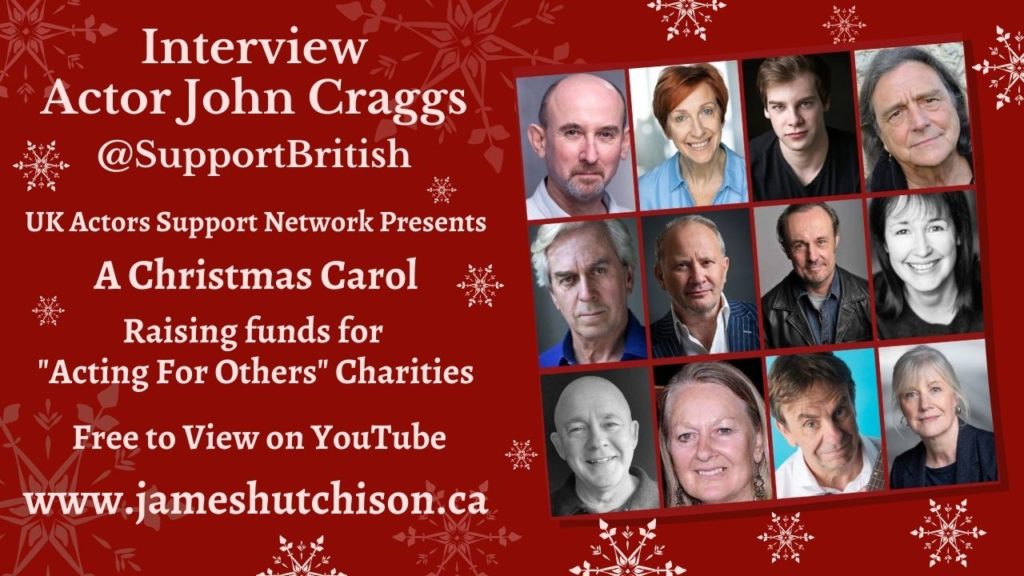


Interview Tracy Carroll & Katherine Koller

I love that quote from Ezra Pound that artists are the antenna of the nation. I love that because it’s as if artists are sort of tuned into the zeitgeist of what is important to people right now or what they’re talking about. But I don’t know if a play can ever change anything. I think it can ask questions. Generate discussion from viewers, but I don’t know if it’s actually where the change happens. I think change happens in people’s hearts, really.

Katherine Koller
Playwright – Novelist – Screenwriter

You know there’s research that’s been done with audiences that shows their heartbeats and breathing actually get into a rhythm while they’re watching the same play. There’s something really intimate and connecting about that. It’s amazing. Plus, theatre does hit at the heartstrings. Hits at the emotions. Hits at the brain waves. It does all those things and helps us think about issues and relationships – things that maybe we don’t often think about.

Tracy Carroll
Director – Dramaturg – Producer

For six years, playwrights, actors, and audiences have been gathering at Holy Trinity Anglican Church in Edmonton for a monthly play-reading series called Script Salon. While the in-person gatherings have stopped, due to COVID-19, Script Salon ended 2020 with an online reading of my romantic comedy Under the Mistletoe.

Under the Mistletoe is about Harvey Swanson and Nancy Potter, two old friends, who find themselves trying to navigate the tricky road of love, sex, and desire while spending a romantic night in the Candy Cane Suite at the Prairie Dog Inn Regina during the holiday season. The play will be performed by Ian Leung and Melissa Thingelstad and is being directed by Tracy Carroll.

I connected with Katherine Koller and Tracy Carroll, the producers of Script Salon, over ZOOM a couple of weeks ago to talk with them about theatre, the origins of Script Salon, and their plans for 2021.

JAMES

I’m wondering, as artists, and as playwrights, and as theatre people, do you think people, as human beings, are ruled more by mind or emotion?

KATHERINE

I think it’s always going to be emotion. And I think that’s the brilliance of theatre because it hits us in the gut before it gets us in the head.

TRACY

I think it may depend on the person. Some people are led more by the heart, and some are led more by the head. It depends, I would think.

JAMES

You mentioned theatre, but how do you think stories, in general, appeal to the mind, to the intellect, of people.

KATHERINE

I think one of the big reasons we are story people is that we are curious to know how someone else has solved the problem that we may not yet have met. So, I think we’re constantly gathering evidence, both emotional and intellectual knowledge, to help us navigate a world in which there’s no guidebook.

JAMES

How much do you consider theatre, a collaborative art? And how much do you see theatre as an expression of an individual vision?

TRACY

It’s wholly collaborative. A hundred percent. Even though it can be an isolating kind of craft with the playwright often writing by themselves eventually the play will be read by someone else. Will be heard by someone else. The characters will come alive with actors. A director gets involved. The designers get involved. The dramaturg. Everybody. It’s always fully collaborative to me.

JAMES

It’s collaborative but then I also wonder about when you want to look at a block of work – a volume of work – a playwright’s ten or fifteen or twenty plays that they write in a lifetime, and I know there’s collaboration, but is there an individual vision in there as well that reveals itself over the course of the playwright, or actor, or director’s lifetime?

KATHERINE

I think, you know, when you put on a play, it’s actually layers of individual visions. I think the playwright has a vision at the beginning which gets elaborated on and challenged and sometimes, you know, surprisingly so, but that’s the nature of what it is. It’s collaborative. The designer has her vision. The lighting person has their vision, and so it’s like these layers of individual visions that go into making the whole, I think.

JAMES

And it’s not unusual for the playwright after seeing a production to rewrite the play and incorporate a lot of those ideas and visions into the rewrites and development of the play, I suppose, is it?

TRACY

That’s right. You’re really not doing it on your own, but when you’re talking about the canon of someone’s work, I think it really depends on the playwright. Some playwrights will write different things with different themes, and others will really hone in on specifics. I’ve worked with one writer quite a bit who pretty much one hundred percent has written about environmental issues in different ways. Other people will write about more personal things. About LGBTQ issues, or family issues, or other important issues in the world.

I had Beth Graham in last week as a guest in the young playwriting company at the Citadel Theatre and we were talking about her different ideas for her plays, because they seem quite varied. And she was asked, “Where do you get your ideas?” And she said, “I don’t know. Sometimes it’s from a headline. Sometimes it’s an image. Sometimes it’s a character. And then it sort of grows into something else. So, the plays are vastly different because they’re coming from different places.”

JAMES

Yes, mentioning Beth and her sensitivity to different inspirations makes me want to ask a question that often gets asked – do you think the theatre is more a reflection of society, or more a catalyst for change? Is it looking back, or is it looking forward?

KATHERINE

I think, it’s always a reflection of what’s going on, which could be a call to action or a desire for change. I love that quote from Ezra Pound that artists are the antenna of the nation. I love that because it’s as if artists are sort of tuned into the zeitgeist of what is important to people right now or what they’re talking about. But I don’t know if a play can ever change anything. I think it can ask questions. Generate discussion from viewers, but I don’t know if it’s actually where the change happens. I think change happens in people’s hearts, really.

TRACY

I agree. I think that’s why plays are so important. They’re a reflection – a little photo of the time – that we’re in, right? And I think that’s important. To reflect. Not just in plays but in art in general. Looking at what’s happening right now helps the future. Knowing the feelings and knowing the struggles helps us think about repeating those things or not repeating those things in the future.

So, for example, I’ll go into a different genre here. Theatre for young audiences is very much about teaching about a specific subject. So, if you’re teaching about bullying hopefully the play will change the future so that these kids, especially the bystanders, will know what to do when they encounter bullying in the future.

And otherwise, there’s a lot of discussion. Some of the best plays I think are when you go to the bar after – which we can’t do right now – but when you go to the bar after and you can really talk about the play and pull it apart and it really makes you think and talk and maybe it makes an individual make a change. You never know.

JAMES

I’m wondering, you mentioned zeitgeist. Because you are involved deeply with Alberta playwrights and the work that’s being done here is there an Alberta voice? Are there any unifying themes? Is there a unique Alberta voice out there that we can identify or not?

TRACY

For some playwrights their setting will be somewhere in Alberta, which of course affects the play. Theme wise – I don’t know. Have you noticed that Katherine?

KATHERINE

That’s a really tricky question. I mean there’s no limit to the kind of voices we hear in Alberta. I don’t think we have corralled ourselves into one category, or theme. I think in Alberta we’ve got so many different voices going on here…

TRACY

…a lot of diverse voices…

KATHERINE

…no one is like the other. That’s what I would say. No one sounds like the other person.

JAMES

I want to move on to Script Salon which is a series of readings that you have been doing up in Edmonton since 2014. I’m just wondering what was the genesis of Script Salon and how has it evolved over the last six years?

KATHERINE

Well, there were four of us in the room and we were all Playwrights Guild of Canada members, and we were trying to come up with a way to showcase work in Edmonton. And we wanted to access the membership of the PGC, and we wanted to elicit assistance from the Alberta Playwrights Network, and we happened to have access to this space at Holy Trinity Anglican Church. And then, you know, we thought, “Well we’ve got all these amazing actors in town who would jump at the chance to do a cold reading.” So, we put all those elements together and then later we expanded out a little bit to be more Alberta based. And then once we started, we realized we had something because people kept coming.

TRACY

And one of the amazing things is that about fifty percent, I think, have gone on to production.

KATHERINE

I think it’s up to like fifty-eight percent. It’s quite high. We started to get artistic directors coming to shows and then we started to get artistic directors coming in the room to rehearse the reading for the shows that they would then go on to direct. And so, we think it’s pretty awesome that theatre companies and playwrights are seeing us as a tryout for a production. It was really fun to see that we were part of that ecosystem of Edmonton theatre. But not all of these were produced in Edmonton. Some of them have gone and been produced in lots of other places.

JAMES

Well let’s talk a little bit about COVID-19 and 2020 here. You had to shift. I know you haven’t had your monthly readings. So, how has COVID-19 impacted Script Salon and then looking at 2021 – what is the plan?

TRACY

Well, one thing is the space, right. We always gathered at the church in this space and we haven’t been able to do that. So, it’s been sort of a challenge to try to figure out what to do. So, we took a pause. We had a little message back in April for our sixth birthday on our Facebook page, and other than that, we’ve been fairly silent except in September we had six writers read from their works. And we did that online. And it was wonderful. And now we’re going to do your Christmas piece which I think is a nice way to wrap up 2020 with some fun for our audience.

KATHERINE

One other thing I wanted to mention, James, about the success of Script Salon is the audience. We spent six years developing a really unique community. We open our doors about forty-five minutes before the show and it’s a racket in there. People are talking to each other and reconnecting. And you know, part of the fun is that they get to see each other again, and they get their drink and chat, and that’s something I don’t always see in the theatre. In the theatre I see this kind of anticipatory, you know, sort of hush, but not at Script Salon. I’ve had people in the audience come to me and say, “I so love this. I’m a theatre goer anyway, but when I come to Script Salon I feel like I’m part of the theatre. I feel like I’m contributing because I can hear the playwright talkback afterward, and I can ask a question, and I can go up to the playwright and give my compliments directly in person.” And those are things you can’t actually do very easily at a production. So, the audience part is essential to the way we do things and that’s why we were kind of at a loss when we couldn’t meet with our audience directly.

But then, when we did the readings in September. You know, we were very surprised at the loyalty of the audience coming in, and the feedback that we got afterward, and people were so happy that we were still alive. I don’t know how much we can speak about 2021 and what we’re going to do. We have one plan for January. Maybe Tracy you want to talk about that.

TRACY

In January of 2021, we’re going to do readings, just like we did in September, except we’re going to have all Albertan BIPOC writers, so they’ll read from their works. And then, in March, we will do readings from the Alberta Playwriting Competition. And in April, for our 7th anniversary, we’re going to do more readings from playwrights. And then we’re going to see what happens with COVID and if we can get back into our space.

JAMES

We were talking about collaborative versus individual vision, and then we touched on audience, and I guess your final collaborator in the creative process is the audience. And so, I’m wondering about your own thoughts about theatre as a social gathering as a community event. Why are you attracted to this community experience and the creation of theatre?

TRACY

Well, let’s see James, I started dancing when I was four, and I think I was Chicken Little when I was about six or seven.

JAMES

So, it’s been a lifelong passion.

TRACY

Indeed. Yeah, boy, it really feels when I think about theatre and the gathering tradition…ritual…I really…I really miss that. That’s for sure. And having that liveness in front of you – there’s just nothing like it, and it’s not the same on-screen. Although I’m really enjoying some things on screen. But that interaction with audiences is everything, whether it’s watching the play, or being in the lobby and talking about things beforehand or afterwards.

You know there’s research that’s been done with audiences that shows their heartbeats and breathing actually get into a rhythm while they’re watching the same play. There’s something really intimate and connecting about that. It’s amazing. Plus, theater does hit at the heartstrings. Hits at the emotions. Hits at the brain waves. It does all those things and helps us think about issues and relationships – things that maybe we don’t often think about.

Theatre really is about bringing community together, so it’s really challenging right now with COVID and I am hoping that all our theatres in Edmonton and Calgary can hang on and get through so we can do theatre in the future. We’ll get over it eventually. You know, the world has been through plagues before, and theatres have come back, so theatre is going to come back. There’s, I think, no doubt about that, but it’s shifting things. It’s making things different. I think that all this online stuff is really interesting because there’s a different kind of access for a lot of people, which is really fascinating to me. So, it might be an interesting way to keep new audiences coming by having some of this online interaction, you know, along with the live part.

KATHERINE

I do agree with Tracy that we’ve had to find other ways to access our need for theatre, and for myself, what’s happened is that audio drama has filled that niche probably more than zoom theatre or film, because I’m partially creating the show as I’m listening to it in my own head.

TRACY

And I think a lot of theatres, and a lot of theatre-makers are doing just unbelievably creative things whether it’s something live like a cabaret type of thing or something on screen or workshops or whatever people are offering, I think it’s amazing. And boy, the access has been incredible for artists to be able to…

KATHERINE

…to work with anybody…

TRACY

…right to work with anybody across the country. It’s just incredible. So, I hope that the creativity and collaboration just keep happening. And on top of COVID the other layer is a bigger awareness of Black Lives Matter and of BIPOC artists, being involved. That’s a whole other layer that’s going to shift our rehearsal halls, our readings, and our productions. We have to be more aware of everybody in the room and my hope is that we have a more inclusive working space for everyone.


Download – Interview with Tracy Carroll & Katherine Koller – Tuned into the Zeitgeist
This interview has been edited for length and clarity.


Under the Mistletoe
CAST
Ian Leung as Harvey Swanson
Melissa Thingelstad as Nancy Potter

Ian Leung is pleased to be reading at Script Salon again. His recent theatre credits include Pastor John in The Blue Hour (SkirtsAfire Festival), Daedalus in Slight of Mind (Theatre Yes), King Berenger in Exit the King (Studio Theatre), Wormold in Our Man in Havana (Bright Young Things), Professor Ogawa in Pugwash (Ship’s Company Theatre) and Trigorin in Stupid F**king Bird (Edmonton Actors Theatre).

Melissa Thingelstad received her BFA in Acting from the University of Alberta and has worked as a professional actor in Amiskwacîwâskahikan (Edmonton) for fifteen years. She is an Associate Producer for theatre no. 6, an Artistic Associate with Theatre Yes and was cocurator on the National Elevator Project. Her acting portfolio includes stage work, film work, and voice over. She has had the great privilege of working in Edmonton, Banff, Winnipeg, Washington, DC, London, England, and Halifax and is the recipient of three Elizabeth Sterling Haynes awards for acting. Theatre credits include: Slight of Mind, Viscosity, and The List (Theatre Yes), Stupid F@#king Bird and Fatboy (Edmonton Actors Theatre), An Accident (Northern Light Theatre), Kill Me Now (Workshop West Playwright’s Theatre), and Proud and The Fever (theatre no.6). Melissa has also collaborated on new works for a number of multidisciplinary festivals in the city including: Visualeyze Festival, Storefront Cinema Nights, The Expanse Movement Festival, and The Kaleido Festival.


Tracy Carroll has worked as a director, dramaturg, teacher and producer for over 20 years including 6 years as the Artistic Associate- North for Alberta Playwrights’ Network and Artistic Associate at the Citadel Theatre where she co-created and directed KidsPlay @ the Citadel.

She is the Coordinator of Peep Show!, a tease of new plays, which started during the inaugural SkirtsAfire Festival in 2013, co-producer of Script Salon, a monthly play-reading series featuring Alberta plays and playwrights and co-producer of EDMONten- A Showcase of Ten-Minute Plays.

Tracy was dramaturg on The Mommy Monologues, written by 10 women and produced at SkirtsAfire 2017. She also directed and dramaturged The Book of Ashes by Emil Sher for the Northern Alberta Children’s Festival, Last Chance Leduc by Katherine Koller and The Invention of Romance and Matara by Conni Massing at Workshop West Playwrights’ Theatre.

Tracy is facilitator of the Young Playwriting Company at the Citadel Theatre, teaches for the Writes of Passage program in schools, and has been offering online playwriting classes through her company Write-A-Play. She also teaches Drama in the Classroom to teachers and will be offering workshops at several Alberta Teachers’ Conventions in 2021.

Katherine Koller writes for stage, screen and page. Her first plays were for CBC radio. Her Alberta LandWorks Trilogy is Coal Valley: The Making of a Miner, The Seed Savers and Alberta Playwriting Competition winner, Last Chance Leduc.

Her opera, The Handless Maiden, received a recital reading in Vancouver and Hope Soup, for radio, was recorded at the 2019 Edmonton Fringe and available at .

Her web series, about Edmonton youth changing their world, is at sustainablemeyeg.ca. Art Lessons, her novel, was a finalist for the Edmonton Book Prize and the Alberta Readers’ Choice Award. Winner of a High Plains Book Award and the Exporting Alberta Award, Winning Chance is her recent collection of short stories.


Interview with Griffin Cork – Actor, Producer, Filmmaker

Griffin Cork
Photo by Tim Nguyen

When I was eighteen I was freaking out about paying for theatre school and doing this career because I’d been told how hard it is and there are so many unknowns, and my dad sat down beside me, and he was quiet for a moment, and then he put his hand on my back and he went, “Do the thing that you want to do until you don’t want to do it anymore. And then find something else to do.” And I stopped freaking out. And of all my mentors, that sentence is the best piece of advice I ever got, because you wouldn’t want to be forty and going, “God, I wish at eighteen I’d gone and done what I wanted to do.”

At twenty-four Griffin Cork has already stacked up an impressive list of film and theatre credits and several awards that illustrate his artistic talent, hard work, and dedication. In 2017 The Alberta Foundation for the Arts named him one of the top 25 Young Artists in the province, and in 2020 he was one of ten recipients of a Lieutenant Governor of Alberta Emerging Artist Award.

Griffin has worked extensively on stage appearing in productions for Theatre Calgary, The Shakespeare Company, Lunchbox Theatre, and Birnton Theatricals. He made his film debut at the age of twelve alongside Matthew Perry in the feature film The Ron Clark Story and can currently be seen in the Alberta produced Abracadavers by Numera Films which is available on the Fantasy Network and Amazon Prime.

Griffin is currently working on several film, television and theatre projects while also launching and co-hosting The Breakfast Dish Podcast along with his mother Karen Johnson-Diamond. The Breakfast Dish offers listeners get-to-know-you conversations with a variety of artists creating dance, music, visual art, and theatre online.

I contacted Griffin over Zoom back in July and we had a far-ranging conversation about theatre, acting, Dungeons and Dragons, and his experience at Alberta Theatre Projects as part of the D. Michael Dobbin Apprenticeship Program.

GRIFFIN CORK

I heard about the D. Michael Dobbin Apprenticeship Program at ATP and I applied and got in and it was phenomenal because you are cycled through almost every department at the theatre. So, my first couple of weeks were in props and costumes. And then, marketing, and then play development, and fundraising, and youth education and outreach. And as part of the apprenticeship, you get to assistant stage manage a show during the ATP season, and I worked on the Last Voyage of Donald Crowhurst with Ghost River Theatre.

My stage management team was Jen Swan and Patti Neice, and I had an appreciation for the acting side of production, but I don’t think I had a full appreciation of stage management until that show, because Ghost River Theatre Shows are very tech-heavy. I think Jen was working with something like a thousand to fifteen hundred cues and there were a million props. It was very Brechtian, and the audience sees everything working. That gave me such an appreciation and love for stage managers everywhere.

Braden Griffiths in Alberta Theatre Projects’ production of Ghost River Theatre’s The Last Voyage of Donald Crowhurst. Photo by Benjamin Laird. Set and Costume Design: Patrick Du Wors. Lighting Design: Kerem Çetinel. Sound Design and Video Technology: Matthew Waddell. Video Design and Technology: Wladimiro A. Woyno Rodriguez.

JAMES HUTCHISON

Talk about being thrown into the deep end.

GRIFFIN

Totally and you know, Eric Rose and David van Belle from Ghost River Theatre and everyone were as accommodating as they could be. But because of the nature of that show and how intense it was no one really had the chance to sit down and explain things. Which is also kind of how I prefer learning anyway is trial by fire. I like going in and figuring it out in the moment. That’s how I learn best. When there’s a little bit of pressure.

JAMES

What was that show about?

GRIFFIN

So, basically there’s this British race to sail around the world solo – you don’t bring anybody with you – it’s just you in a boat sailing around the world. And Donald Crowhurst isn’t really a sailor. He’s more of an inventor and things went poorly on the ship.

JAMES

He and several others set off on this voyage and he decided he’d never make it. So, he went down and pretended to be going around the world, but all the time he was just floating off South America. His plan wasn’t to win the race but then everyone else ended up dropping out of the race for various reasons and he was the last one, and he knew that if he finished the race he’d be found out.

GRIFFIN

Totally. He’s faking logs. He’s faking radio check-ins. And the craziest part is the only real evidence we have of his race is his black box entries, his fake logs, and his journals. There’s not actually a clear picture of what happened and what he did and where he went, because eventually he goes absolutely insane. And I can’t remember if this is true or not, but in our adaptation of the story he jumps off the boat and drowns.

The cast of Alberta Theatre Projects’ production of Ghost River Theatre’s The Last Voyage of Donald Crowhurst. Photo by Benjamin Laird. Set and Costume Design: Patrick Du Wors. Lighting Design: Kerem Çetinel. Sound Design and Video Technology: Matthew Waddell. Video Design and Technology: Wladimiro A. Woyno Rodriguez.

JAMES

It’s true that the boat was found abandoned.

GRIFFIN

Yeah, they did find the boat. So anyway, it’s a combination of sea madness, and guilt, and you know everything that he would put his family through if he came back and it was revealed that he faked it. It was an outstanding production.

JAMES

So, looking at that experience, and the people you’re connected with now. How has that helped you in your career making those connections and working on those shows?

GRIFFIN

That’s the number one benefit of the MDA is that it allows you to meet people in the profession. ATP is in the Arts Commons which is Calgary’s central arts building. And so you’re around there all the time working in the office when actors and directors are coming in to pick up their scripts or when you go down to the cafe and get your lunch for the day and you meet people there. It’s a phenomenal networking opportunity.

The cast of Alberta Theatre Projects’ production of Ghost River Theatre’s The Last Voyage of Donald Crowhurst (on screen: Griffin Cork (Apprentice Stage Manager), Braden Griffiths and Vanessa Sabourin). Photo by Benjamin Laird. Set and Costume Design: Patrick Du Wors. Lighting Design: Kerem Çetinel. Sound Design and Video Technology: Matthew Waddell. Video Design and Technology: Wladimiro A. Woyno Rodriguez.

JAMES

Who are some of the folks who have been significant for providing you some guidance and what are some of the key pieces of advice they’ve given you over time?

GRIFFIN

I remember there was a point at the University of Lethbridge where I had to decide between two shows and I called Braden Griffiths who played Donald Crowhurst, and I aspire to have a career trajectory like his and also to be as well-liked as Braden is. He’s a phenomenal actor. He’s a lovely man. I consider him a very close friend, and the best advice he gave me about choosing a role was, “Don’t think about the production, don’t think about the company, don’t think about the money, none of those things matter. If there’s a conflict, you go with the one that serves you artistically at the time.”

JAMES

What role was that?

GRIFFIN

I had to choose between an ensemble part in the UofL mainstage production of Carrie, or a decently larger part in Dennis Kelly’s show DNA but with Theater Extra which is the student company at the University of Lethbridge. It’s about a group of teens that do something bad and then they have to decide how to cover it up and deal with that guilt. I eventually ended up going with the DNA role because it was a little meatier. I’m glad I did. I loved that show so much that my company Hoodlum Theatre produced it the summer after.

Hoodlum Theatre’s Production of DNA by Dennis Kelly 
(From L to R): Taylor Sisson, Walker Nickel, Ciaran Volke, John Tasker and Miku Beer
Photo by Griffin Cork

GRIFFIN

And I have to give love to Samantha McDonald. She was one of, and still is one of, my greatest mentors. When she was production manager at Lunchbox Theatre she would look over some of the grants I wrote and she gave us rehearsal space for Hoodlum’s first show. And she took me out to dinner one time and the piece of advice that she gave me was, “There are going to be so many things in this career that try and break you. Don’t let them break you. There are going to be so many things in this career that don’t mean to deter you but will. Don’t let them deter you.” And I think that’s a really elegant and poignant way of saying this career is hard work but it’s possible, and there’s a lot of things that really make it worthwhile.

And my mom and dad are Karen Cork and Kevin Cork. Karen is better known by her stage name Karen Johnson-Diamond. My mother is still an actress and a director, and my father used to be one. He went to Stratford for a few years and I think he had too many productions where he was guard number three and he got kind of disillusioned. So it was like, I don’t want to do this anymore, and now he’s a financial planner. And having someone who has a financial brain in your family, who also knows what it’s like to live on an actor’s budget, is insanely helpful.

Kevin Cork and Karen Johnson-Diamond in As You Like It RIGHT before they got married!

JAMES

How does he allow his artistic side to still get sunlight? What does he do?

GRIFFIN

I’ll tell you, James, him and I have really connected over the past three or four years over Dungeons and Dragons. Which is the tabletop role-playing game and I think the way he gets his creative side out is by being the dungeon master. And in Dungeons and Dragons you can buy books of modules and campaigns to send your characters through, but my dad doesn’t do that. My dad creates his own worlds and rules and settings and characters and plot events. He basically writes a campaign or a quest. And what’s great about it is, if we make stuff up in the session as the characters, he’ll write down the names and what we said and bring them up in a later session. And keep in mind that a lot of Dungeons and Dragon sessions are three to four hours apiece, and campaigns can last from twenty-five to thirty sessions.

JAMES

So, what have you learned from your mom?

GRIFFIN

From my mom I learned kindness, and empathy, and a lot of human values, but if we’re talking career one of the most important things she taught me from a young age is the career and real-life applications of improv. Improv is a phenomenally useful tool for anybody. It teaches you listening, positivity, empathy, and critical thinking. It will literally help you with anything you do, and it’s mind-numbingly useful for acting. A lot of directors like actors that come into the room and can offer a lot of different things on a line or a scene. And that’s what improv is. Improv is having an offer ready.

JAMES

So, I’m wondering when you sit in the audience and you’re watching a show what are your expectations of a production?

GRIFFIN

So, my grandmother, my mother’s mother started seeing a lot more theater after my grandpa, her husband, passed away a couple of years ago. She’d go to the theater and then come home and go to bed and it became like a bedtime story. And a very crucial part of that was because it let her not think about anything else except the story and what was happening in front of her.

She says, “I don’t want to be thinking about my shopping list when I go to a play. If it’s a matinee, I don’t want to be thinking about the thing I have to go to after this matinee. I don’t want to be thinking about any other life event. I want this story to grab my attention. Hold it. And hold it for however long they asked me to be there. An hour. An hour and a half. Two hours. It doesn’t matter.”

And so, for me, I don’t know if there’s any formality or structure or trope or story elements that I have come to expect or demand from a production when I go to the theatre. My expectations have kind of shifted to what my grandmother has described as her expectations, and I think they’re really simple, and I think almost any production can achieve it. “No shopping list,” and that’s a Sandy Moser quote.

Shooting Abracadavers – Photo by Rachael Haugan

JAMES

I know you do some film work so tell me a little bit about how you got involved in film and what you’re working on right now.

GRIFFIN

I started acting in film when I was in grade five, and there was a TV movie coming through town called The Ron Clark Story, and it was about a teacher who goes to this rough and tumble school and has to change things. Matthew Perry, who plays Chandler on Friends, was the teacher, and when he got to this new school the camera pans over to see twelve-year-old Griffin. And I had a rat tail, and vanilla ice lines shaved into the side my head, and a mohawk. And I’m standing in a garbage can. Basically, I was the dumb kid being abused by the teachers. I’m so dumb I have to go stand in the trash. I’m standing in a wastebasket. So, that’s how I got started in film.

And I have a buddy named Josef Wright who I met at Theater Alberta’s ARTSTREK which is a week-long Summer Intensive that happens at Red Deer College. And he was like, “Hey man I’m in film school at SAIT and I’m doing a student film, it’s kind of goofy, do you want to come be in it?” And I was like, “Sure.” And it was about a guy who gets a genie lamp and he’s really lonely and he wishes for a date. And I met the camera operator on that film whose name was Morgan Ermter. And Morgan and Joseph have a film company called Numera Films.

And in 2014 they entered the STORYHIVE Web Series competition which provides winners with funding for the project they’ve entered. And they asked me to be in it, and it was called Abracadavers. So, we did the pilot and sometimes as a film actor you kind of show up to set and you do your bit. You get your cheque. You leave. You’re not usually involved in any of the other parts of the project. But something about the content of this particular project and the people involved and the way they were talking was pretty cool.

And we didn’t win STORYHIVE so I was like, “Okay what are we going to do with it?” And so, we took it to the Banff World Media Festival, and we pitched it to a bunch of distributors and financers. And basically, I just bugged my way into Numera Film. I pestered Morgan and Joe, as much as I could to just let me help out more. And then Abracadavers got funding and we did it for a season and we got a distribution deal. And I really found a lot of joy in film producing just because of how much you are involved. It’s really satisfying. It’s a different feeling to sit in a screening as an actor and then to sit in the screening as the producer, because as a producer you’re involved in every stage of making a film. There was something really fulfilling about that.

And so now me, Morgan, and Joe are Numera Films and we have a couple of things in the works. Right now, we’re pitching a few features. We filmed another web series pilot called Restless Sleep, which is kind of like a web Black Mirror. It’s like a horror anthology where every episode is a different story.

And I am working with a company right now called Thousand Year Films. They’re producing Father of Nations which is a post-apocalyptic film that’s being filmed in the Badlands. They’re doing pickup shots today, as we speak, because they got shut down by COVID.

Screen Grab of Griffin Cork in Father of Nations from Thousand Year Films

JAMES

You were in a one man show and I’m sorry I missed it, but you won an award for best actor for the show from…

GRIFFIN

…Broadway World. That was for Fully Committed by Becky Mode.

JAMES

Tell me about being in a one man show. What type of challenges do you face? How do you work the day? What is that experience like for an actor?

GRIFFIN

I find there’s usually a point in a run of a show say, anywhere from like forty to seventy percent of the way through the run that you feel like you’re in a groove. Not that you can go on autopilot. You still have to connect with your fellow actors, but you can do the show confidently. With Fully Committed I never hit a groove.

Every night, I was unsure if the show was going to go well. But there’s something really exciting about that and my stage manager, Meg Thatcher, was my lifeline. Fully Committed unlike a lot of one-man shows doesn’t interact with the audience at all. No asides. No inner monologues. Nothing. And there’s a lot of tech, and seventy cues that were all phones.

The story follows Sam who works at an expensive restaurant’s booking line. That’s his gig. He’s a failing actor and he’s trying to make a living. So, we slowly discover the plot and meet all these characters through three phones. There’s the main phone line. There’s one phone line that goes directly to the chef. And then there’s a cell phone.

So, throughout the play one of the phones will ring. And sometimes that’s in the middle of me being one of the two characters that I’m talking to and playing on stage. And then this phone rings and I have to remember who’s on the phone. And frankly, there were one or two times where I totally goofed and I picked up the phone and went – “Hello.” And I went with a different accent than the person I’m supposed to be in the play at that moment and thank God for Karen’s improv because I improvised a conversation that kind of revolved around what was happening, and then I put the phone down.

And God bless Meg that phone would ring again, and she’d give me another shot at remembering who that person was supposed to be. I don’t know if stage managers get enough recognition, because they are your scene partner, technically, in a one man show.

Birnton Theatricals Production of Fully Committed by Becky Mode
Starring Griffin Cork, Directed by Chris Stockton, Lighting and Design by Kathryn Smith
Photo by Chris Stockton

JAMES

Here’s an interesting question for you to ponder. Actors look at human nature. So, in your exploration of human nature what do you think is the fundamental force driving human behaviour?

GRIFFIN

Holy crap, James. Oh, man. Are you asking what I hope drives human nature, or what I actually think drives human nature?

JAMES

I like truth.

GRIFFIN

I think one of the largest driving forces for humanity and human nature right now and the way that people act in today’s world is a sense of identity. And I mean that in the simplest ways in terms of who am I? What values do I have? You know, kind of the more metaphysical questions, but also in the more social questions of how am I seen? 

But I think human nature is an ever-growing evolving beast. I know who I was at seventeen is not who I am right now, and I think my understanding of human nature and my understanding of what drives human nature is not the same as it was then. I think everybody would like to say that they know who they are and what their values are, but I think it’s always changing. So, I think what drives human nature is to kind of keep up with the ever-evolving nature of your identity. And I think that is really exciting, and I think it also explains the surge and use of social media.

I use social media as a work tool for marketing and also for acting. When you’re know as an actor, you’re marketing yourself, which I think is a weird phrase, but it’s kind of true. That’s why social media became so popular because it gave people a sense of identity.

It’s like on a very basic level deciding whether you’re a cat person or a dog person so if you’re having a conversation in the group, and the other person goes, “Oh I’m a dog person too” there’s that brief moment where you go, “Oh, you and I are part of something.” So how you’re perceived on social media is not a separate identity but a part of your identity, but for those who don’t know you personally it’s your only identity.

It’s so scary for me to just declare what I think drives human nature because I think I only have such a small sliver of what human nature is. Like I bet you someone who works in literally any other profession will have a totally different answer. But I think because my job is so focused around people and relationships, and sometimes pretending to be other people or adopting the qualities of other people that it requires you to constantly re-examine your own identity.

JAMES

After playing a role have you ever afterwards adopted a perspective or had a character you’ve played influence your identity?

GRIFFIN

Interesting. (Long Pause) Yeah, kind of. It was a production of All for Love by John Dryden at the University of Alberta. You know the show?

JAMES

No, I don’t.

GRIFFIN

It’s basically just the story of Antony and Cleopatra. It’s not exactly Elizabethan, but it’s still a very classical text. It was directed by Peter Hinton, and I played Ventidius, who was one of Anthony’s lieutenants. And in our adaptation and exploration it was almost like a love triangle between Anthony, Ventidius, and Cleopatra. Ventidius didn’t have any romantic or sexual love for Anthony, but just a profound respect, and I don’t want to say platonic love because it was stronger. It was love and respect and admiration. But even those words aren’t enough. I think it’s something that gets generated by wartime and warfare and all those insane psychological pressures that come with that time. And there was just this phenomenal bond between them. For so long I had a certain way of expressing my love for my male friends and I walked away from that show with a deeper confidence to be vulnerable and honest, when expressing deep admiration and love and respect for a male friend.

All For Love with Sarah Emslie, Helen Belay and Leila Raye-Crofton
Production Design by Sofia Lukie, Photo by Ed Ellis

JAMES

So, I noticed there was a Lieutenant Governor of Alberta Award announced a few weeks ago.

GRIFFIN

That’s right.

JAMES

I think they had one hundred and sixty submissions and they picked ten young emerging artists. You being one of the ten. Tell me about winning the award. What was that like? What does that mean to you?

GRIFFIN

It was really, really phenomenal. Since high school or junior high school a lot of my friends are like, “Oh, I can’t wait to get out of Calgary. I can’t wait to get out of Alberta.” And even when I was like thirteen I was like, “I think it’s pretty good here.” And I’m fortunate that my parents made travel an important part of my life, because I’ve been to a lot of places in the world and that’s kind of solidified my love for Alberta. I’ve seen other places and life’s pretty good here. It’s kind of like you don’t know what you have until you don’t have it, right?

It’s also kind of why I haven’t made the move to Toronto or Vancouver. It’s not that I think my life and career would be a lot different if I moved to Toronto or Vancouver, but I find I truly believe in Alberta. I think Alberta has a lot to offer. And I think the way I described it to the Lieutenant Governor is, I think Alberta has for the past ten or fifteen years had this compressed nugget of diamond potential that is going to burst soon. There’s a part of me that just believes it’ll happen, and I really want to be here when it does. And frankly a lot of my friends make fun of me for defending Alberta the way that I do so winning the award was a little Alberta love and a nice high five back.

Griffin Cork
2020 Lieutenant Governor of Alberta Emerging Artist Award

JAMES

So, how old are you now? If you don’t mind my asking. About twenty-five?

GRIFFIN

Twenty-four. Oh my God, I think I’m twenty-four.

JAMES

Okay, I have a question for you. Where are you at forty?

GRIFFIN

At forty. It’s hard to think about. I’d like to get married. I love the idea of marriage. I’d like to have a kid. I don’t know how many. I can’t imagine more than one or two.

JAMES

It’s interesting to me that the first thing you think of is home life. When I asked you where you saw yourself at forty it wasn’t theatre. It wasn’t career first. The first thing that popped into your mind is I would love to be married. I would love to have kids.

GRIFFIN

Well that’s the result of a lot of inner exploration that I’ve been doing since I graduated in terms of what would actually make me happy in life. Like what is it that contributes to your quality of life, because from eighteen to twenty-two I was very business focused. Not that I’m not anymore. I just didn’t make time for anything else. I was just hustling – hustling – hustling – constantly going at it. And I don’t regret it because it benefited me greatly. But I think as I get older, I’ve started to explore what will make me happy.

JAMES

Give you a happy life.

GRIFFIN

Totally. Rather than just a good career. Have a happy and fulfilling life.

JAMES

Have you identified any of those?

GRIFFIN

Man, I want a partner for sure. Absolutely. I can’t imagine going through this life without a partner. I know people that do it. People that never marry or never date. I don’t think I could do it. I think there’s so many cool life experiences that happened to everybody but also different cool life experiences that happened based on the career you chose and where you live and are more special when you share. 

One of the first times that I travelled without my parents was when I went with some of my friends and my partner at the time to Australia and New Zealand. And it was euphoric experiencing a part of the world that I’ve never experienced before and having the experience of travelling on my own, but in my own generation with one of the most important people in my life at the time. I think it was that life event that I went, “Oh man, there’s more to life than work.”

JAMES

So where are you going to be at sixty? A grandfather I’m assuming.

GRIFFIN

Definitely a grandfather. Frankly, I don’t see myself, directing, I’ve only ever directed one thing, and it was a music video, and that’s about as far as I’ll go. I don’t think I have the skills or interest in directing. I would love to have a television series at some point in terms of being a character on a full season of a show because that’s four months of filming, and I think that kind of journey would be really interesting. And I love the idea of doing a touring show. I’d like to be teaching, a little bit. One of the most fulfilling experiences of my life, so far, was being a supervisor at ARTSTREK. ARTSTREK is the best. If you’re a drama geek and you go to ARTSTREK there are ninety other drama geeks that you get to hang out with. I really like teaching kids. It’s so much fun.

JAMES

You have a new podcast. The Breakfast Dish. I’m curious. What is The Breakfast Dish and how’s that going?

GRIFFIN

So, my mother had a photo series on Facebook she called The Breakfast Series. It started when she had a meeting at 9:00 a.m. or something and she went okay, “If we’re going to meet at 9:00 a.m. we’re going to go for breakfast.” So, they went out for breakfast and after the meeting was done because breakfast wasn’t over, they just started talking about who they were, as people. Breakfast was conversation. Breakfast was who are you?  Breakfast was what are you working on right now? Breakfast was, I’ve never met you let’s go for breakfast. So, then she started this thing called The Breakfast Series, where she wrote a blurb about the person she was having breakfast with and what they’re doing and why she loves them.

And so we pitched a breakfast series to Verb Theatre for their Blue Light Festival. The Blue Light Festival was A Festival of Social Media Performance meant to run entirely online that was announced back in October 2019 long before COVID entered the picture. We called it the Blue Light Breakfast Series and the idea was to interview all of the people in the festival. To find out who they are, and the work that they’re doing, but the work is secondary to us. We just want to know who you are. This is just us hanging out.

And because a lot of theatre is moving online, we wanted to make a good archive of all the socially distant online work that is happening right now within Alberta, but also across the country. So, we got a lot of development through Verb Theatre and then we wrote a grant to the Rozsa Foundation, The Calgary Arts Development Authority, and the Alberta Foundation for the Arts, and they chose to support us.

So, then we started The Breakfast Dish and The Breakfast Dish is for people who are making work online digitally. It is both to assist the artist in terms of the promotion of the work they’re doing because it’s a whole new theatrical marketing landscape that no one really knows how to do, and to help audiences find the work online. And it’s just me and my mom and we made a pact when we started hosting it that it’s just a conversation. We have some ideas of what to talk about but it’s just three or four people chatting about their work, who they are, what their favorite breakfast is, and why they do the work they do.

JAMES

Griffin, because you’re a host and because you have your podcast if you were going to sit down with Griffin Cork and be the interviewer, what would you ask yourself? Is there anything that you would want to bring up and love to talk about?

GRIFFIN

I don’t often get asked about what is the driving force of human nature in today’s world.

JAMES

I get asked that all the time.

GRIFFIN

I’ll bet you do. The thing that I could probably talk to you about ad nauseam is something we touched on earlier.

JAMES

Ah, I think I know what it might be.

GRIFFIN

Guess.

JAMES

Dungeons and Dragons.

GRIFFIN

Yes sir! Just give me one second. (Holds up sheets and notebooks) These are all my character sheets and notebooks, of all the campaigns that I am in currently. Oh boy. It’s the best because it’s just creative storytelling, with your buddies, or your family or random strangers at a gaming store. And especially if you do what my dad does which is the Homebrew, right? Homebrew is the term we use where you make up your own campaign. You don’t use the books. You just make up your own world and your own story. So, you get to make this TV series length saga story every Thursday night with your friends at a table with some chips. I mean you can’t do that right now, but before COVID that’s what you did.

JAMES

You do it in four different locations now. We have Zoom. We have the connectivity. We have the ability to stay in touch. We didn’t have that before.

GRIFFIN

Yeah, and I think Dungeons and Dragons and video games or computer games or anything like that tricks people into exploring their own creativity, even if they think they don’t have any. Even if they think they have no artistic talent or creativity or anything.

Something like Dungeons and Dragons or video games, kind of pulls that out of you. Whether you like it or not. And then you get to see it and view it and experience it. That I think is why I love Dungeons and Dragons. You’re just making stuff up. That’s how you don’t think about your shopping list is you’re trying to figure out the world that’s being presented. I’ve talked about Dungeons and Dragons so much. I could talk your ears off.

JAMES

I have a suggestion for you.

GRIFFIN

Hit me.

JAMES

The driving force of human nature is the desire to play.

GRIFFIN

Oh yeah, that’s a very good suggestion.

JAMES

Because you know we say play around with it see what you come up with. Scientists play around with ideas. We play with things all the time. That’s it. Humans just like to play. There you go. There’s our self-help book. Play it Forward.

GRIFFIN

Perfect.

JAMES

So, we covered a few things.

GRIFFIN

We sure have covered a few things. The only thing that I would toss in is that I forgot to tell you the advice my dad gave me.

JAMES

What advice did you father give you?

GRIFFIN

The only reason I bring it up now is because I think it’s not just a theatre thing. I think it’s a life thing. When I was eighteen I was freaking out about paying for theatre school and doing this career because I’d been told how hard it is and there are so many unknowns, and my dad sat down beside me, and he was quiet for a moment, and then he put his hand on my back and he went, “Do the thing that you want to do until you don’t want to do it anymore. And then find something else to do.” And I stopped freaking out. And of all my mentors that sentence is the best piece of advice I ever got, because you wouldn’t want to be forty and going, “God, I wish at eighteen I’d gone and done what I wanted to do.”


DOWNLOAD – James Hutchison Interviews Griffin Cork: Actor, Producer, Filmmaker
This interview has been edited for length and clarity.


Old Stock: A Refugee Love Story

Ben Caplan in Old Stock: A Refugee Love Story
Ben Caplan as The Wanderer in Old Stock: A Refugee Love Story by 2b theatre company. Stoo Metz Photography

Old Stock: A Refugee Love Story is a story about desperation – hope – love – refugees – babies – grandchildren – the past – and the present. It’s an entertaining, touching, and memorable night at the theatre. Did I like it? I loved it. Would I recommend it? Without a doubt.

Playwriight Hannah Moscovitch
Playwright Hannah Moscovitch. Photo Alejandro Santiago

This show has won praise and sold out around the world. It’s been to New York where it was nominated for six Drama Desk Awards and was a New York Times Critic’s Pick. The Herald Scotland called it, “A thing of raw and unmissable beauty.” David Cole, from the Village Voice, said: “It will reaffirm your faith in the enduring spirit of humanity, community, and family.” And our very own Louis B. Hobson from the Calgary Herald said that Old Stock is a “must-see for anyone who loves and appreciates theatre that pushes boundaries.”

So, what’s it about?

Well, it’s about the great-grandparents of Hannah Moscovitch. Hannah Moscovitch is one of Canada’s most celebrated and talented playwrights and she along with her husband Christian Barry and Ben Caplan got together over pickled herring and decided to tell the story about Hannah’s Jewish grandparents who fled the ethnic and religious violence in Romania in the hopes of starting a new life in Canada.

The story is told to us in songs and scenes and one of the best parts of the play is Ben Caplan’s performance as The Wanderer. The Wanderer is the narrator of the tale. A tall, energetic, and bearded master of ceremonies who is a commentator and a comedian and a joyful dancing spirit who celebrates life but still acknowledges the darker side of humanity.

Ben Caplan in Old Stock: A Refugee Love Story
Ben Caplan as The Wanderer in Old Stock: A Refugee Love Story. Stoo Metz Photography

Caplan is a pure joy to watch and he sure knows how to use his voice in ways that convey emotion and humour and add texture to the sound. And while his voice has shades of Topal from Fiddler on the Roof and Leonard Cohen’s melancholy ballads I’d describe his sound as truly unique and powerful.

Director Christian Barry has assembled a talented group of musicians and performers to round out the ensemble. Eric Da Costa plays Chaim with wonderful shyness and tenderness while also playing the woodwinds. Shaina Silver-Baird is perfect as Chaya who is a little more matter-of-fact about life. A little less the dreamer and a little more the pragmatist. She also plays the violin. The rest of the band includes Jeff Kingsbury on drums and Graham Scott on keyboards and accordion. And this is a tight-knit group of musicians who weave a tapestry of sound throughout the show.

And as far as the songs go they’re a lot of fun to listen to with smart and playful lyrics that comment on the story and on broader issues. For example, in Truth Doesn’t Live in a Book it’s a song about the tension between oral traditions and the written word and that once things get written down they lose their ability to adapt and evolve. Because as The Wanderer points out “An eye for an eye means fair compensation. It doesn’t mean take up arms against another nation. Anything written down can be twisted apart.” You can check out the full song by following this link where Ben Caplan drops by Paste Studios in New York City to perform.

Ben Caplan in Old Stock: A Refugee Love Story
Ben Caplan in Old Stock: A Refugee Love Story by 2b theatre company. Stoo Metz Photography

The whole story unfolds before us from a shipping container that opens up to create the world of Chaim and Chaya as they arrive in Canada in 1908 and meet for the first time at Pier 21 in Halifax as they stand in line waiting for a medical exam.

He has a rash. She has a cough.

This is a beautifully written scene as two strangers meet and learn about each other and clearly one of the two is interested in maybe being more than just friends. And so they both move to Montreal where they meet again and love blossoms. Well, not exactly. Chaya who along with her husband and family fled Romania before the trouble started lost her husband, whom she dearly loved, to typhus and her newborn child to starvation as they made their way along a dirt road to Russia. She paid a heavy price coming to Canada and those memories haunt her.

But Chaim’s story is no less tragic. He left after the pogroms started and the details about what happened to his family makes you question God and humanity. And it’s that dose of reality that counters the humour and fun and gives Old Stock its power.

In the end, Chaim and Chaya marry. They have a child. Then another one. And one more after that. And then a fourth. And those children have children. And then those children have children. And then Hannah Moscovitch and her husband Christian Barry bring their first child, Elijah, into the world – who just so happens to be the great-great-grandchild of Chaim and Chaya.

Old Stock: a Refugee Love Story is a Klezmer, rock, folk musical and it’s a true story…for the most part. I mean obviously, it’s a story and some poetic license has been taken and what takes years in life is told in ninety captivating minutes on the stage. This is a story about life and death and hope and perseverance and lessons to be learned about how we treat our fellow man and the assumptions we make and the things we say.

Have we learned those lessons?

History would say no.

But that doesn’t mean we should stop teaching them. After all, we tell stories to learn about ourselves and others and maybe at the end of the day to help us live our life a little bit better and with a little more compassion and meaning.

So, let me just sum up by saying I’m just a guy who likes to go to the theatre and when I see something, I like, I like to tell others. So, I’m telling you – go see this play. I loved it. This is a play I’ve been looking forward to seeing for over a year and it did not disappoint.

Old Stock: A Refugee Love Story was part of Alberta Theatre Projects 2019/20 Theatre Season and the show has done numerous tours. You can check out 2b theatre company to see if it will be coming to a theatre near you and if it does I’d highly recommend you see it.


A Christmas Carol by James Hutchison at Johnson City Community Theatre Tennessee

Scrooge was in love – once long ago. This must be clearly understood or nothing wonderful can come of the tale you are about to hear.

That’s not exactly how A Christmas Carol begins. No, it begins with Marley was dead and looooong buried. Marley was Scrooge’s business partner and only friend in the world, but Scrooge had once been in love. That is true. He had loved Belle. They were engaged. His life could have been very different and that’s what makes Scrooge such a tragic and sympathetic character.

This Christmas, 176 years after the story was first published, the Johnson City Community Theatre is producing my big cast version of a Christmas Carol from Thursday, December 5th to Saturday, December 22nd. The production is being directed by Melanie Yodkins and stars Tom Sizemore as Ebenezer Scrooge. I connected with Melanie and Tom early in November to talk with them about the Johnson City Community Theatre and the production of the play.

JAMES HUTCHISON

Tell me a little bit about the Johnson City Community Theatre.

Director Melanie Yodkins

MELANIE YODKINS

Johnson City Community Theatre is the longest consecutively running community theatre in the entire state of Tennessee and next year will be our 108th season. The patrons have always kept it going. The people who love to perform. The people who love to be in the productions.

We have an archive going all the way back 108 years with photographs and production brochures and memorabilia. We’ve got folks who have been here forever. Generation after generation.

That’s really the joy of community theatre. Family is really the biggest piece. My husband Jason and my son Andrew are in the play. My son is a year old and cute as the dickens.

TOM SIZEMORE

No pun intended.

MELANIE

No pun intended. I literally only have them walking across the stage and they light the lamps in the street scenes. Andrew is definitely not old enough to handle much more than that. My husband and I actually met on that stage six years ago. We met and fell in love. We were doing a Christmas play, and we started dating on December 18th. We were married less than two years later. And just before our third wedding anniversary, Andrew was born and now he gets to perform on the same stage.

JAMES

But, isn’t that nice. We were talking about history and so when your son is twenty years old there will be a production photo of him and his dad in the play. So, what do you think theatre provides a community?

MELANIE

I think people crave story. I think they crave that connection with literature with the past with people with opposing viewpoints, and I think theatre allows those doors to just be blown wide open, to allow for people to see and to experience things that otherwise they would not.

Actor Tom Sizemore

TOM

And with the times we’re living in people can be transported to, in this case, Victorian England and so it’s a way for them to feel better and feel good about things that maybe in other areas or other walks of life they’re not feeling so good about. And I think it’s a wonderful way for children to develop self-esteem, self-image and confidence.

JAMES

How young were you when you got on the stage, Tom?

TOM

Well, I’ve been doing community theatre for about twenty years. But my parents always said that I was singing before I could talk. I’ve been singing my whole life and after college and having been in a few musical productions it just made sense for me to branch out and do some non-musicals as well.

JAMES

You’ve had a lot of vocal and musical training and I’m wondering when you’re doing a play like a Christmas Carol, which is not a musical, how does your vocal training impact your ability to portray a character?

TOM

Quite a bit, actually. There are moments in this play that are sublime – that really tug at the heartstrings – that are very tender – that are very touching. And so, from a vocal standpoint, and especially in a smaller, more intimate venue, which is what is here at the theatre in Johnson City I’m really trying to use different vocal techniques to bring out some tenderness – to bring out in this character, some vulnerability. Which I definitely think should be there. But at the same time when the spirits are aggravating me to death and wanting me to see things that I really don’t want to see and I don’t want to deal with – then my disapproval or my impatience with that whole situation comes out and I use a lot of vocal techniques to let them know that I’m not happy.

JAMES

So, Tom, you and Melanie are talking to me from a room in your home that is filled with Christmas Carol memorabilia. Clearly this story is a love and a passion for you.

TOM

It is. I told Melanie that this is a dream come true for me. I had played Marley in a previous production but to play the old miser is something I’ve always wanted to do. I grew up in the Washington DC area and it was a tradition for us to go to Ford’s Theatre, every Christmas and see their production of Christmas Carol. I’ve been fortunate because I’ve been able to meet Charles Dickens’ great-grandson and his great, great-grandson and to have been to Dickens’ home in London. When I was growing up the story was one that I just loved, and I’ve seen every version that I could find whether it was film or television or just in any media. And then I started collecting things that are related to that including a 1916 poster from a version of A Christmas Carol, and I actually have a silent movie and was produced by Thomas Edison.

JAMES

You’ve been prepping for this role for a long time.

TOM

I have.

The Ghost of Jacob Marley and Ebenezer Scrooge in the Johnson City Community Theatre Production of a Christmas Carol by Charles Dickens. Adapted for the stage by James Hutchison. Directed by Melanie Yodkins. Eric Donahue Photography

JAMES

Melanie, I’m curious to know what resonated with you about my particular adaptation?

MELANIE

I read over fifty scripts and when I was reading through your script what it provided that no other script did was the ability to add my own creative flair to the story. And you had already written in several things that I wanted to do. For example, the part where Christmas Future comes out of the box and wraps all of the chains around Scrooge and then Scrooge ends up in the box and I wanted to do that very same thing and it was already written in your script.

And I was reading it myself but I decided I needed more voices so I could just sit and listen to the voices telling the story so I could visualize it. So, I put together a table reading with some folks who I trusted and I just sat there and I listened. And it just resonated so deeply with me. And it was a no brainer. I was like, “This is the one I want. This is the one I want to do.”

JAMES

So, tell me a little bit then about some of the things you’re doing in terms of design elements for your vision of the story?

MELANIE

Andrew Whitman is our set designer. He’s actually one of my students from eons ago. He was in high school doing a summer arts program and I was one of the teachers running the program. And he has since graduated from college and worked at the Barter Theatre, the equity theatre up in Virginia. And so, I asked him to pitch me some ideas after reading the script himself. And one of the things that he brought up was that he wanted the desk to also be Scrooges bed and Scrooges tomb.

So, we’ve built this gargantuan desk. It’s big enough that Tom can fit on top of it. And Tom can also fit inside of it with another person. We really wanted to play on that concept that the desk represented Scrooges Empire. It really is his idol. It really is his life and then to have him buried in it or entombed in it we thought would be a really poignant way to drive home that little nugget. And then we also have it on a three-foot-high platform. So, I’ve got two staircases that kind of move around this platform so you can create different spaces based on where the stairs are so for example when they’re both in front of it that’s when it’s Scrooge and Marley’s. So, it’s this homage to the great and powerful desk and Scrooge.

JAMES

One of the most challenging parts for me to write was the scene where Belle leaves Scrooge. I rewrote that a number of times because I needed to make it very clear what was going on there. I love that the older Scrooge watching the scene tells his younger self to “Go after her you fool.” That’s a wonderful moment but we wouldn’t feel anything unless we had the earlier scenes where we see some real tenderness and love between them.

MELANIE

You have to feel something for Scrooge, or it wouldn’t matter. It’s not enough to know that he is who he is. You have to understand how he got to be the way he is. And you have to understand what he sacrificed to become that person without even realizing that he was sacrificing it.

You know, the first time the actors playing young Scrooge and Belle went through that scene their levels just kept going up and up and up until they were actually yelling at each other. And all of a sudden she says, “Are you not miserable?” And he just looks at her and there’s this dead silence there for a minute and you just sit there holding your breath. And, then she goes on to say, “I have no choice but to release you. And, I hope you’re happy in the life that you’ve chosen instead of a life with me and I will always mourn the life that we could have had.” And she leaves him standing there absolutely shredded.

JAMES

Tom, what are your thoughts about Scrooge’s journey to redemption?

TOM

By the end of the play he needs to show how deeply affected he is by what he has been shown, but he resists and fights it tooth and nail and he tries to make excuses. And one of the other ways I’ve looked at it is Scrooge is a businessman and being a businessman he’s smooth and persuasive and he’s used to getting his own way and when he doesn’t that’s not a feeling that he is very comfortable with. But I also think there is a humourous aspect to it as well. For instance, when the Ghost of Jacob Marley asks him, “Do you believe in me or not?” Melanie has blocked the scene so that Marley is only about an inch from my face. And then Scrooge says, “No, I do not.”

JAMES

Why do you think A Christmas Carol resonates today so many years after it was originally written?

MELANIE

I think there is a little bit of Scrooge in every single person. To the extent that we get wrapped up in me, me, me, my, my, my, this is my world, this is what I’m doing. These are my goals. This is my focus. And then all of a sudden, Christmas comes around and we’re like, oh, hey, we can give ten dollars to a charity or we can collect food for the food bank or we can give gifts to people that they’re going to love. But then you still have people who don’t even want to do that.

I love the fact that this truly is a story of redemption which makes a really beautiful connection to Christmas too. Because if we think about the biblical side of it Christmas represents the time of Christ’s birth and the beginning of redemption and you kind of have a really nice parallel with Scrooges own redemption and the redemption that we find in Christ, which is much of what literature of the time alluded to back when A Christmas Carol was written. People weren’t writing Bible stories, but they were utilizing the same moral concepts from Scripture and putting it into story form.

And so it touches people’s hearts in such a way that doesn’t make them feel like we’re shoving Jesus down their throat. We’re touching people’s hearts on a totally different level and reminding people about charity and compassion and those are the things that should really be our business in life. That’s why we’re here. We’re here for all of humanity. It’s all our responsibility. And all of those elements work together to create a reason why so many people love this story.

JAMES

Tom, how about you?

TOM

Tiny Tim and Ebenezer Scrooge in the Johnson City Community Theatre Production of a Christmas Carol by Charles Dickens. Adapted for the stage by James Hutchison. Directed by Melanie Yodkins. Eric Donahue Photography

If Scrooge can change, we all can change, but that process is not easy. And in Scrooge’s case I think there’s a reason Dickens wrote it as a ghost story. It’s significant to me that in order for this process to begin, Scrooge has to be scared to the point that his legs are shaking. He’s never experienced anything like this before in this life. So, in order for change to occur sometimes, we have to experience something that we would never expect or something out of this world has to happen in order for a person to change. And because of all of the relationships, the family bonds, the love of the Cratchits the story is timeless. We probably all have, truth be known, family members that we are reminded of from the story.

JAMES

Why should folks come out and see Johnson City theatre’s production of A Christmas Carol?

MELANIE

Because the artistic concept of how we’re presenting this play, while telling an absolutely fabulous story, isn’t like anything I’ve ever seen. It’s incredibly original. And we have incredible actors. After Tom auditioned, I needed to find a Marley that matched the epitome of the Scrooge that Tom brought to his audition. And the young man who is playing Marley, absolutely, bar none just blew me out of the water. It brings such a high calibre of performance quality to this production that people need to come and see the hard work, the dedication and the heart of storytelling that is found only on this stage this season.

TOM

I think it’s definitely an ensemble cast so that each person brings something to their role and their character. People will be talking about it and raving about it. And it goes without saying that I’m just honoured and privileged to be part of it.


Cast A Christmas Carol

Olivia Ares, Gavin Arsenault, Larry Bunton, Asher Church, Lorelai Church, Sam Church, Adam Derrick, Tony DeVault, Camden Downes, Hudson Downes, Cierra Fannon, Jada Greenlee, Shanna Greenlee, Danielle Hammonds, Andrew Headen, Jason Headen, Linden Hillhouse, E.C. Huff, Landon Kell, Audrey Kuykendall, Magee Little, Jamie Lombardi, Richard Lura, McKenna Marr, Tom Sizemore, Nathaniel Oaks, Evangeline Perreault, Matthew Pickle, Raelyn Price, Elizabeth Renfro, Saqqara Scott, Derek Smithpeters, Alice Tester, Lucy Tester, Daniel Tester


Links to Play Page where you can download four Christmas Play Scripts by Playwright James Hutchison for Free including the comedy What the Dickens, the romantic comedy Under the Mistletoe, and both a large cast version and small cast version of A Christmas Carol.


A Christmas Carol by James Hutchison at Wokingham Theatre England

“You may find me cold and unfeeling sir, but I would venture to say I am a man of my word; a man whose word carries weight; a man whose word allows him the ability to strike a deal and back it up with his signature. My signature is worth something. Yours it would appear – if you continue to treat your financial obligations and business dealings in this manner – will soon be worthless.”

Jerry Radburn as Scrooge in the Wokingham Theatre Production of A Christmas Carol by Charles Dickens. Adapted for the stage by James Hutchison. Directed by David Stacey. Photograph Simon Vail Photography

These are the words of a man who hates Christmas! A man who hates anything that does not make him richer and so he hates Christmas most of all. These are the words of a man filled with pride who has forsaken humanity and measures his life in dollars or pounds sterling only. These are the words of Ebenezer Scrooge.

And this Christmas those words, which happen to be from my adaptation of A Christmas Carol by Charles Dickens, are being brought to life in Wokingham England where Wokingham Theatre is producing my small cast version of the play from December 4th to 14th. The production is being directed by David Stacey who I connected with in early November to talk with him about Wokingham Theatre and his production of the play.

JAMES HUTCHISON

Tell me a little bit about Wokingham. The community and the theatre.

Director David Stacey

DAVID STACEY

It’s quite a traditional lovely old English town that has a good community atmosphere. The theatre group itself started back in the 1940s. And through community spirit and amateur theatre clubs it developed and sustained itself and in the 1980s they built a theatre. Unlike a lot of other theatre groups who have to either rent accommodation or share the space with other societies or groups Wokingham Theatre has its own space.

JAMES

Why do you think A Christmas Carol still resonates so many years after it was originally written?

DAVID

The Christmas that we know, certainly here in Britain, with the roast turkey or roast goose, the Victorian Christmas carols and all those kinds of traditions come from Dickens. Everybody, when they’re celebrating Christmas, encounters all of those as part of the Christmas season. So that’s partly it, but it’s also a lovely moral story that taps into what is important about Christmas. And that’s not necessarily anything to do with religion, even though it’s obviously a religious feast, but for those that aren’t religious they can still tap into the spirit of the story and what Christmas means. And everybody knows the story and they like to listen to it, again and again, year after year, and it has a happy ending which audiences love.

Vicky Lawford as Mrs. Dilber and Jerry Radburn as Scrooge in the Wokingham Theatre Production of A Christmas Carol by Charles Dickens. Adapted for the stage by James Hutchison and directed by David Stacey. Photograph Simon Vail Photography

JAMES

What are some of the unique things that you’re bringing to your production?

DAVID

When the spirits arrive there will be some video projection onto the stage to add special effects. And we’ve got music that has been written for the show. It’s not a musical or anything but rather than just taking pre-recorded Christmas carols or Christmas music, which everyone will have heard before, we’re composing music. I also wanted to keep it traditional. So, we’re still using the Victorian setting and we still have the Victorian imagery and everything, but we’re doing things slightly different with how the spirits look and how that’s played.

So, for example, the second spirit rather than dressed exactly in the costume, as described in the book, our second spirit is going to be on stilts. So, he’s quite the giant but a bit more like a circus or Willy Wonka type of character rather than a Santa Claus character in the big beard and costume. And the third spirit is traditionally done as a grim reaper, so I wanted to do something different with that. He’s quite creepy. You look at his face that has a mask on and a black suit and he has these long fingers. And we have an interactive set that moves and hopefully the audience will be magically surprised by that.

JAMES

What do you like about directing?

DAVID

It’s the creativity. I do acting as well as directing. And when I act in something I tend to miss the directing and when I direct something I tend to miss the acting. But I really like directing and trying to get my vision of the story out and seeing it created. Whether that’s doing a small black box studio theatre show or something larger on the stage in Wokingham with more people involved. It’s about bringing the magic of the story to the audience. And I will read the script and think this is my vision of it. And I want to then be able to turn that into a reality and that’s why I really enjoy reading play scripts, rather than novels. Because the play script is written for somebody else to take and to visualize it and to physically produce it and turn it into something for people to watch. And I find that really exciting, rather than books which stay in your head, you’re not expected to physically recreate the physicality of it. And I like that the audience is watching it from the front, and then from behind you have all of these sets that are actually all fake. And it’s all people in makeup and costumes that are taking on a character and I really, really like that.

JAMES

One of the things I tried to do in my adaptation was have Scrooge interact more with the spirits or speaking to the people that are memories and making him more resistant to changing by having him argue more with the spirits than what’s in the book. Scrooge has to take the whole night to change and that’s a process and a journey and I wonder if you’ve found that playing well and just how the actors are using it.

DAVID

That’s one of the things that attracted me to this particular script. And also because you introduced the device of the letters. The letters allow Scrooge to have more regret at the end. In the original book he wakes up the next morning and is going to change but there needs to be some sort of regret as well because he’s lost out on marrying his childhood sweetheart because he didn’t behave very well. And that’s life. You can’t go through life behaving badly and then decided to change your mind and get everything back that you’ve missed out on. The letters are a lovely, lovely device to really emphasize that and as you say the talking to the spirits is good fun. He’s particularly argumentative with the first spirit and we’re having the first spirit be quite argumentative back. She’s not playing it all nice. Because even though it’s not a complete nightmare, it isn’t a pleasant dream he’s having in any way.

JAMES

Well as a playwright I’m not set in you having to produce the play as I’ve described it. Generally when I write I try to minimize the amount of character description and character action I put in my scripts because I believe those things are going to be discovered by how you design the set, by the actors you cast, by how you want to stage the play, by the size of your stage, all of these things that I can’t anticipate. So, it’s absolutely wonderful and so fascinating to see the different takes on telling the story that all come from the same script.

DAVID

And because our audience is an adult audience we’re not trying to do anything that’s too saccharine or anything like that. It’s not really targeted to a child or family audience so we can have some bits that are maybe a little bit more unpleasant or you don’t have to worry about scaring kids or getting them upset.

And so one of the other things I’ve introduced for when Scrooge travels with the spirits is to make the journey quite unpleasant. Particularly with the first spirit. When she says, “I will take you or let’s go and see somebody else or the Fezziwigs – that kind of stuff – she grabs hold of Scrooge and it’s almost as if he’s being electrocuted. So, there’s going to be lots of special effects of electricity and sparks and things like that. And it’s painful for him. And then with the second spirit, it’s a bit more wonderous and swirly and everything is going to get spun around and he’s going to get physically thrown around as if he’s on a sort of like a roller coaster. I didn’t want it to be where they all just float off into the sky like Peter Pan and drift around pleasantly, because then I’m not convinced that Scrooge has changed. Or why would he change if it’s all been a nice dream? No, it’s because he’s been taught a lesson in a painful way and I think the script allows for that.

JAMES

I think you found my big cast version of the script first and then I sent you my smaller cast version for you to read. That version has one actor play Scrooge and then the other actors play multiple roles. How is that working for you in terms of staging the play and telling the story

DAVID

Wokingham Theatre is a relatively large group, but we certainly couldn’t have cast a thirty strong production. So, I really liked how you reduced it down and have the multi rolling and have it as an ensemble piece. And, that’s the main reason I went with the smaller cast version although we didn’t go strictly with the casting as you have it in your script. But I like the idea of the actors taking on more than one role because it gives them more to do and they do enjoy that in my experience, and it gives them a bit more stage time.

Peter Pearson as Jacob Marley and Jerry Radburn as Scrooge in the Wokingham Theatre Production of a Christmas Carol by Charles Dickens. Adapted for the stage by James Hutchison and directed by David Stacey. Photograph by Simon Vail Photography.

JAMES

Tell me a little bit about the cast.

DAVID

Jerry Radburn who is playing Scrooge and has been acting at Wokingham Theatre and at various other theatres for a very long time is someone I know very well. I’ve been in lots of plays with him but I haven’t directed him before. Most of the cast I know and I’ve worked with in various guises either being in plays with several of them or directed them in other shows but there’s one or two that I’d never met before who turned up because we have open auditions. And so, it’s really, really nice when we get new people coming along. And as part of this season I had a policy that I sent to all of my directors that you needed to cast at least one new person for each show if they’re suitable for a particular role just to expand the diversity of the group. And we have a youth theatre group, as part of Wokingham Theater, which runs classes and so we often tap into that to find keen youngsters who want to take parts and be in our main season shows. And so that’s kind of good fun to work with the youth cast as well. The key thing is that everybody’s doing it because they love it. Everyone has fun and that’s the main priority.


A Christmas Carol by Charles Dickens and adapted for the stage by James Hutchison runs from December 4th to December 14th at Wokingham Theatre. The production stars Jerry Radburn as Scrooge and is directed by David Stacey. To find out more about Wokingham Theatre and their upcoming season visit the Wokingham Theatre Website.

Wokingham Theatre A Christmas Carol – Cast & Crew

Jerry Radburn – Scrooge
Matthew Lugg – Fred
Claire Bray – Bob Cratchit, Scrooge as a young man
Peter Pearson – Mr. Bentley, Jacob Marley, Thomas
Chris Westgate – Mr. Granger, Second Spirit, Mr. Fezziwig
Gary Smith – Mr. Harrington, Old Joe
Vicky Lawford – Mrs. Dilber, Mrs. Fezziwig, Mrs. Cratchit
Becca Tizzard – First Spirit, Martha Cratchit. Rose
Louise Punter – Cook
Sophie Marsden – Belle, Emma, Caroline
Andi Lee – Granny Cratchit

Youth Cast:
Oliver Lees, Nicholas Zezula, Amber Pearce, Annabel Brittain, Jonathan Willis, Joseph Rea

Director – David Stacey
Assistant Director – Heather Maceachern
Production Manager – Claire Lawrence
Stage Manager – Mike Rogers
Costume – Rosemary Matthews & Sue deQuidt
Props/models – Claire Willis
Lights – Nick Gill & Richard Field
Sound – John Gold
Original Music – Charlie Lester
Choreography – Lesley Richards
Set Design – Henry Ball


Links to Play Page where you can download four Christmas Play Scripts by Playwright James Hutchison for Free including the comedy What the Dickens, the romantic comedy Under the Mistletoe, and both a large cast version and small cast version of A Christmas Carol.


Interview with Aaron Krogman: Actor

Rebbekah Ogden and Aaron Krogman in the Rosebud Theatre Production of A Christmas Story based on the 1983 movie and the books by Jean Shepherd and adapted for the stage by Philip Grecian. Directed by Paul F. Muir. Photo credit Kelsey Krogman.

“The first show I ever went to see before I became a student here was a Christmas show and it was such a warm feeling of like showing up to someone’s house and the Christmas lights are on and there’s a warm fire and there’s laughter and good food and good drink in that house. That Christmas vibe is on offer here in a really particular and unique way. And, the show is the central point of that. We come together around this holiday and this moment of connection and I think the story is really connecting with people. It’s really a place where you come around and feel that warmth and that joy and the camaraderie and cheer of Christmas.”

Aaron Krogman, Actor

Rosebud Opera House – Christmas 2019 – Photo Credit Randall Wiebe

My son and I journeyed out to Rosebud a few weeks ago to see A Christmas Story. The play is based on the 1983 movie and the books by Jean Shepherd and has been adapted for the stage by Philip Grecian. It’s the classic tale of Ralphie Parker’s relentless campaign to get his parents to buy him, “an official Red Ryder, carbine action, 200-shot, range model air rifle, with a compass in the stock and this thing that tells time,” for Christmas.

Surrounding this core story there are several other subplots and adventures where we meet a whole cast of characters including Ralphie’s friends, the neighbourhood bully, his little brother Randy, the mall Santa, and of course Ralphie’s mother, and his father “the old man.” The Rosebud production features a terrific cast and a versatile and stylized set that adapts easily from one location to the next all while keeping the action moving.

A Christmas Story is a fun and family-friendly production that not only includes a highly entertaining and memorable holiday classic but also features a delicious holiday buffet feast and live Christmas Carols to put you in the mood before you go and see the show. The production runs until December 22nd and tickets are available online at the Rosebud Theatre Website or by calling the box office at 1-800-267-7553.

Aaron Krogman portrays the grown-up Ralphie in a charming and nuanced performance where he guides us through this particular childhood Christmas memory and adds some humourous insights and observations from an adult point of view. I spoke with Aaron about the production, his time as a student in Rosebud, his five years playing Jesus in the Badlands Passion Play, and his love of music.

Aaron Krogman – Rosebud Centre of the Arts

JAMES HUTCHISON

You’re a graduate of the Rosebud School of the Arts from 2008. Tell me a little bit about your time here as a student and what that was like?

AARON KROGMAN

When I graduated high school, I had no idea what to do with my life. I had high levels of interest in multiple topics and zero confidence in any of them. And I remember one summer other friends of mine had been back in town for the summer on their college summer break. And one of my friends said to me, “Dude, if you don’t go to school and do something, I will be so disappointed in you.”

And, a week later I said to my dad, “Dad, if I don’t get a plan together and go to school this fall, I never will, but I don’t know what I should study.” And he thought about it for a little bit and said, “You know Aaron, I’ve always thought you could be an actor on a stage.”

So, on his suggestion, I called Rosebud School of the Arts. Making that phone call was probably the scariest part of the whole thing. Paul Muir, who is the education director at Rosebud, and who is now my boss, answered the phone. We had a conversation about my interests and why I was calling, and I think that first conversation just opened a door for me that has never closed since.

When I showed up that September to start school, it was just amazing. I didn’t think the world could be the way it was in Rosebud. I didn’t think there would be people in the world who cared about the kind of stuff that I cared about. People who spent their lives making space for storytelling with the human being as the prime subject of storytelling and about the possibilities of making the world a better place and making human culture a better place and enabling us to see the best in each other. My time as a student in Rosebud is one of the most amazing life-giving experiences I’ve ever had.

Aaron Krogman in the 2007 Rosebud School of the Arts Production of As You Like It

JAMES

Do you feel that you discovered your purpose in life by going to Rosebud?

AARON

I have memories of being very young and caring about the kinds of things that Rosebud’s about. I wouldn’t say that I discovered my purpose. I recovered it. It was something that was alive in me at a very young age and coming to Rosebud as a student and now being here as a member of the company and as an instructor I feel like I recovered my five-year-old self.

JAMES

Was there any particular instructor or mentor at the school that you remember any lesson learned or experience that still resonates with you today?

AARON

You know it’s funny, I’ve been thinking about what’s been so significant for me in the last month about opening A Christmas Story because it’s been a five-and-a-half-year break for me from interacting with the Rosebud audience. And now I’m back and this is my first time on stage and re-engaging with that audience. And I think it is the collective education that the audience has given me – the feedback and the support and the affirmation of what good, clear, generous storytelling is.

I think what’s particularly unique about Rosebud educationally is the chance to be in front of the audiences that come here. I think they are a powerful part of the training that takes place and I think there are many in the audience who deliberately come here because they want to see students grow. And so, I think, in the big-picture view of what has really made a difference for me has been exposure to and vulnerability with that audience. They are just as significant an educator as any of the faculty here.

And most of the direction that I’ve received as an actor has been with Morris Ertman the Artistic Director of Rosebud. I’ve done more shows with him than any other director and cumulatively his confidence in the ideal that we as storytellers have something vital to offer that matters has rubbed off on me in ways I’m still just discovering.

Aaron Krogman, Rebbekah Ogden, Glenda Warkentin, Silas Winters, and Nathan Schmidt in the Rosebud Theatre Production of A Christmas Story based on the 1983 movie and the books by Jean Shepherd and adapted for the stage by Philip Grecian. Directed by Paul F. Muir. Photo credit Morris Ertman

JAMES

Well, let’s talk a little bit about A Christmas Story. At the end of the night after the audience has seen the play what do you think they walk away with?

AARON

Well, I think it’s similar to what the play does for me. We end the story on Christmas morning. And I remember Christmas after Christmas my dad giving me a Christmas gift and being really excited about it. And in the play the dad is excited that his son’s going to open the gift that he’s been asking for – forever. And the father and boy open the present and the dad has all this additional information about the gift and I have so many memories of my dad saying things like, “Oh, I got you this little stereo for your room. And it has all these features and let me take you through all the features.” And that’s what happens in the play. And that’s so familiar to me. And it makes me so fond of my own father in that moment. And I love story that returns us to our own life in a way that makes us more able to live it somehow. Whether that’s remembering the best parts of it or whether that’s looking at it in a slightly more positive way.

JAMES

Tell me about the cast and what it’s like to work with them and how you guys worked on the play and brought it together?

AARON

It’s a ton of people who are all currently Rosebud School of the Arts students or grads. A lot of times we bring in guest artists which is awesome, but this is a rare thing where it’s a big cast that’s in house. And there are lots of opportunities for students in this show to take their first steps on the Opera House stage.

It’s one of the things I’m loving the most about this process right now. I’m watching students go through what I went through as a student. Which is having the opportunity to perform in front of an audience and how that changes your experience of the text and how important that is and to realize, “Oh, there’s an opportunity for a laugh in this line, which I didn’t see at all. And if I just say it clearly and communicate it, and offer it up, the audience will be ready for it. They know there’s a laugh line coming before I do as an actor. And if I just listen to them, they lead me to it.” So that’s one of the elements that’s happening in the play right now and I love to see that happen.

Back: Kalena Lewandowski, Anja Darien, Rebbekah Ogden, Holly Langmead. Front: Silas Winters, Keisha Wright in the Rosebud Theatre Production of A Christmas Story based on the 1983 movie and the books by Jean Shepherd and adapted for the stage by Philip Grecian. Directed by Paul F. Muir. Photo credit Kelsey Krogman.

JAMES

In Rosebud you do these main stage shows that run for two months. What as an actor is beneficial about having these longer runs where you get to spend time with this character in a story every week?

AARON

The educational opportunity is exponentially bigger. I think it’s amazing to experience the full range of what different audiences can be like in terms of their engagement. If you do a two-week run where you do ten shows, the greater part of your experience of that show is going to be rehearsal. Performance is the smaller part. And, I think that in most theatre programs you never get out of rehearsal.

You might do your student shows for a weekend or for a two-week run, but they’re all in house audiences. They are people who are coming that know you. There is value in an audience that is objective and indifferent and paying money to see a show. And there are those elements in a Rosebud audience and while they care about theatre they’re also paying money and they want it to be good. And I think that is part of the pressure cooker of what it means to be part of live theatre.

JAMES

When I was doing my research for this interview, I discovered that you released an album in 2012. I was just curious about music in your life and the importance of music and the creation of that album. How did that all come about?

AARON

I got into music long before I got into theatre. I was raised in the church and the primary involvement I had with the church was musical. So, I started playing drums and then played bass and then guitar and just did everything. I really loved music. It was one of the first things that really spoke to me.

And I was working on a play with Lucia Frangione, who’s a very successful award-winning Vancouver playwright who teaches a course here at Rosebud and she liked my writing and offered to collaborate with me on a project she was working on. And we started working on a piece about a songwriter who wrote songs and so I started writing songs for that play. We did some development and it was pretty exciting, but it didn’t really take off and so, in the end, I had these songs. And a friend of mine here in town Paul Zacharias was a music engineer and producer and he just made an offer to record them through his company doG House Studios. And I said, “Yeah, let’s do it.”

It’s funny that you asked about that because I’m actually scheduled to have another meeting with Paul and we’re going to record another album. And I’m excited about it because I’ve always loved music.

Aaron Krogman as Jesus in The Badlands Passion Play

JAMES

Let’s talk a little bit about the Badlands Passion Play. You’ve been in the play for seven years and five of those years you played Jesus. Tell me a little bit about the experience of being in that production and what that was like.

AARON

It’s theatre, but it’s different. It’s unique. It’s outdoors and it’s primarily community theatre. There are a few people who are there in a professional capacity and most of those contracts are behind the scenes in terms of stage management, design, and direction.

Almost all of the actors are volunteer or from community theatre and I think that is probably what makes it the most unique. There’s an amateur vibe to it, which is amazing. I’ve become a huge fan of the word amateur, as I’ve heard it defined by some of my favourite authors, as those who do something for the love of it. These are the real priests of culture. They’re the ones who are making an offering with the work of their hands.

JAMES

How did you find your interpretation of Jesus and that story change over the time of you performing it?

AARON

I think it charts some of my growth as an actor. I understudied the part for two years and so I watched it and I developed my opinions. My first-time playing Jesus was a reaction to what I had seen. I really wanted to play Jesus as understated and not as profound and to be motivated by the present moment. But in some ways, it didn’t serve the stage because that’s a particularly large stage and the size of the performance has to be a certain thing in order for it to reach the back of the house. People are watching with binoculars. They’re not seeing my authentic transparent thought.

JAMES

You were acting for the camera instead of the stage.

AARON

Totally. And, you know, the directors were all over me for that, and rightfully so. And I think we each have our imagined version of who Jesus is or was regardless of our faith and we also have this imagined version of Jesus that our culture offers us. Is he angry or is he warm and kind?

And I really wanted him to be like my version where he’s warm, thoughtful, and a little bit of a rebel. But the second year I got to do it I went really hard in the other direction. And the third year I did it, I sort of was like, I have no idea what I’m doing in any of this. And so, I just emptied myself of any preconceived ideas and based my performance very much in the moment and it’s not my strength as an actor.

I pre-plan. I know my text. I do my backstory. That’s been my habit, and that third year, I threw it all out. I just emptied myself of any preconceived notion of what I ought to do, and I just entered and reacted, and it was very much a roll of the dice in terms of who I was embodying. And I still did the right blocking. I didn’t surprise anybody really, but it was for me internally a hands-off kind of thing. And then the last two years I did the same thing and that’s kind of how I am as an actor now.

Rehearsals are about finding the boundaries, the thresholds, the gates to pass through. The ones that matter. And then after knowing those boundaries taking my hands off the wheel and having less control and the less control I have the more alive I am in the scene and the more people can enter into it. So, I flush the lines from my head. I empty myself of my awareness so I’m not conscious of what’s coming. I just let go and trust that the lines will be there and then I just react in the moment. Which is something I should have been doing in the first place.

JAMES

But that’s the big challenge, right? It’s the ability to know the lines so well that you can forget them. So, the emotional energy of your interaction with the characters on stage is what you’re actually responding to.

AARON

Totally. And that’s what I’ve loved about acting alongside someone like Nathan Schmidt who plays my Dad in A Christmas Story. He’s just one of the most generous scene partners. He pays attention. And he just says yes to everything you do.

JAMES

I have one more question about the Passion Play just because I was reading that it’s becoming more musical. There’s been the addition of live music and rather than the lines always being spoken some of them are now being sung. Is that correct?

AARON

In 2018 they went on a big tangent down this musical road and then in 2019 they jumped in with both feet. I think I sang twelve songs in last summer’s version. And now for next year, they’re not going to be doing the music they’re going to go in a different direction.

JAMES

Oh, interesting.

AARON

That’s another unique thing about the Passion Play. They’re workshopping it every year. And sometimes there are big changes and sometimes there are smaller changes. The production, as a whole, is hungry to grow and always kind of morphs.

But there is something really cool about the musical theatre form because it’s larger than life. The size of the expression and the form of the expression reaches further, it’s more obvious and it demands more of your body. It demands more of your instrument. And I think it lends itself to the size of an outdoor stage. And in the Passion Play, you have to use your hands. You have to point at who you’re talking to. All those things which feels so manufactured, when you’re not used to them become the language of that stage. And musical theatre already lives a huge step further in that direction.

But it’s funny because in recent years I’ve spent much more time on the Passion Play stage than on a smaller stage like the Rosebud Opera House and I’ve had to shake off the habit of full arm extension every time I say a line to somebody. It’s been great to let that go and find a more subtle size of performance.

Rebbekah Ogden, Nathan Schmidt, Silas Winters, Glenda Warkentin, Geordie Cowan, Kalena Lewandowski, and Keisha Wright in the Rosebud Theatre Production of A Christmas Story based on the 1983 movie and the books by Jean Shepherd and adapted for the stage by Philip Grecian. Directed by Paul F. Muir. Photo credit Kelsey Krogman.

JAMES

So, why should people come out to Rosebud to see A Christmas Story?

AARON

Because it’s more than just the show. It’s coming to this town. There’s Christmas lights everywhere. There’s Turkey in the buffet. You get to hear Christmas music sung to you as you eat. You enter into the Christmas context in a way that is just so memorable.

The first show I ever went to see before I became a student here was a Christmas show and it was such a warm feeling of like showing up to someone’s house and the Christmas lights are on and there’s a warm fire and there’s laughter and good food and good drink in that house. That Christmas vibe is on offer here in a really particular and unique way. And, the show is the central point of that. We come together around this holiday and this moment of connection and I think the story is really connecting with people.

It’s really a place where you come around and feel that warmth and that joy and the camaraderie and cheer of Christmas.


A Christmas Story based on the 1983 movie and the books by Jean Shepherd and adapted for the stage by Philip Grecian runs until December 22nd at the Rosebud Opera House. The production stars Aaron Krogman, Rebbekah Ogden, Glenda Warkentin, Nathan Schmidt, and Silas Winters and is directed by Paul F. Muir. Tickets are just $84.00 for adults and $62.00 for youth and include a seasonal buffet with roast turkey and stuffing, plenty of side dishes and other main courses, plus a vast array of pies and cookies and puddings. Order tickets on-line at the Rosebud Theatre Website or by calling the box office at 1-800-267-7553.


JP Thibodeau – StoryBook Theatre

JP Thibodeau Storybook Theatre
Artistic Director – JP Thibodeau

StoryBook Theatre is Canada’s largest volunteer-run Theatre for Young Audiences and produces a season of plays that are designed to offer mentoring opportunities and artistic development to emerging artists while providing high-quality entertainment at affordable prices for Calgary families and theatregoers. In addition to offering a season of plays, StoryBook also runs a year-round theatre school that provides classes in acting, dance, and music for children, teens, and adults. Now in its 43rd Season and operating out of the Beddington Theatre Arts Centre StoryBook has entertained more than a million Calgarians and has become an important part of the cultural fabric of this city and an integral link between the professional theatre community and emerging artists.

Part of the driving force behind StoryBook Theatre’s success and growth has been its Artistic Director JP Thibodeau who is an award-winning actor, director, and theatre designer. Over the last few years JP has worked with playwright and composer Joe Slabe to create world premiere musicals, including Lest We Forget, Naughty But Nice, and the multi-award- winning Touch Me: songs for a disconnected age, presented by Theatre Calgary. He has worked on stage and behind the scenes on a variety of productions including Richard III and Romeo & Juliet with The Shakespeare Company; Rock of Ages and The 39 Steps with Stage West; Dad’s in Bondage and Lest We Forget with Lunchbox Theatre: and A New Brain and Avenue Q with StoryBook Theatre. JP has directed more than 55 musical productions and has worked tirelessly to foster the growth and development of young musical theatre artists across the country. He is the recipient of the 2016 Greg Bond Memorial Award for outstanding contribution to musical theatre in Calgary and was just awarded the Sandstone City Builder Award at the Mayor’s Lunch for Arts Champions in recognition of his work with StoryBook theatre and emerging talent.

I met with JP at his office in the Beddington Theatre Arts Centre at the end of July just before he was about to begin directing the North American tour of Queen’s We Will Rock You by Ben Elton for Annerin Productions and Jeff Perry Promotions to talk with him about his own journey and his vision for StoryBook.

Storybook Theatre Production Still Rent
StoryBook Theatre’s Production of Rent

JAMES HUTCHISON

You got a nice honour at the Mayor’s Lunch for Arts Champions this year. You received the Sandstone City Builder Award.

JP THIBODEAU

The award is really about the initiatives we’ve been doing here at StoryBook. And I didn’t really realize it but my entire career has been about emerging artists and community building. I think the hard part about getting the award is that I get the honour of the award, but there really is a team of people that contribute in a lot of different ways.

JAMES

So, you came into StoryBook with a vision that you’re now seeing realized. Can you can talk about that initial idea and vision?

JP

I left a previous job after ten years because I got to a point where I wasn’t fulfilled artistically or business-wise. So, I had to walk away from that for my own sanity, and at that point I didn’t know what I wanted to be when I grew up.

And George Smith, who was running StoryBook at the time, had reached out to me and said, “Can you direct a show for us?” And so, I came out and directed a show and we had lots of talks about StoryBook and where it was because the year previous it had almost gone bankrupt. So, they were trying to figure out what it needed to be when it grew up.

So, we were both in this – what do we want to be when we grow up stage?

And when 2013 came around, they asked me to take over interim, but I knew I didn’t want to take a job just because I needed a paycheck. I needed to make sure that there was some fulfillment in it. So, the board and I talked a lot about vision. And we had a retreat and I said, “What’s missing in this community is a bridge between the professional theatre community and the amateur world.”

And there’s nothing wrong with the amateur world. There’s an important place in the world for community theatre. But what’s missing is that in between for the people who’ve gone away to school and they’ve come back to Calgary, but they can’t get hired at Theatre Calgary or anywhere professionally yet. And there’s no one helping them hone their musical theatre craft and saying you have potential – so let’s change that and put them with some professionals.

And one of the biggest realizations I had my first year when I took over was understanding the importance of networking in the arts and how fundamental that is to any career longevity. You need to know people. You’re not going to get an audition – you’re not going to get an interview – you’re not going to get anything with anybody unless they’ve heard of you, or someone in their circle has heard of you. And so that really became my focus as an emerging artist myself.

JAMES

What were some of the pillars that you wanted to put in place to make your vision of StoryBook a reality?

JP

My kids had a big part of that because at that time we were going to the Saddledome to see The Wiggles, or we were going to see these big touring shows that we’re paying 80 and $90 to go see. And there’s nothing in it for the parent. It’s just for the kids. So, as parents, you’re just chaperones, you’re just babysitters and I’d think, “This isn’t family time because I’m not getting anything out of it.”

And StoryBook used to have this thing called Cookie Cabarets, and the audience would come in and all the kids would file down to the front of the building, and the parents would sit at the back, and I would go to the booth and watch the show from the back, and I’d see all the parents on their phones while all their kids are down front, and they weren’t sharing the experience because we were telling them the kids sit close and the parents sit at the back. We were telling them don’t enjoy this as a family.

Within the first month after seeing that I changed it and said, “We aren’t doing it anymore.” And I got lots of backlash. And I said, “No, they need to enjoy this together.” So, then it became if they’re going to enjoy it together, there’s got to be something in it for the adults. So how do we do that? And that’s when the re-planning and the reshaping of what our seasons would look like began.

Storybook Theatre - Artistic Director JP Thibodeau - Season 43

JP

And for me, it became about engaging professionals. Every show needed to have professional mentorship. Whether that was the director or the choreographer, or the stage manager, whoever it was, there needed to be that professional development and mentorship on the team. And in those early years, and even today, I really make sure that everyone on the team is offering some kind of a mentorship to those emerging artists who are finishing high school or have just come back from university or college. And by giving them that mentorship we instantly elevate the quality of the show.

And that’s when directors like Mark Bellamy or Karen Johnson Diamond or Kevin McKendrick and all these other great Calgary artists got involved and started really helping me shape who we were going to be. And so, we started elevating the production quality and that gave the parents something. So now they’re going, “For my $25 I’m getting so much more, and it’s worth the time with my kids.” And I think the beauty of theatre, in general, but especially in our city with a lot of oil and gas families where mom or dad work a lot is that they get to spend that time in the theatre with their kids and this is their hour they’ve set aside to come and be with the family.

JAMES

One of the things I really like is that you have the cast come out for autographs and selfies at the end of the show.

JP

That was the one thing I was told I would not be allowed to change, but when I first took over I didn’t want to do it.

JAMES

Really?

JP

As an actor, I don’t like being me. I like being a character on stage. But after watching the first season I thought I don’t know how you couldn’t do it. We get letters from the kids and from the parents who took their child to their first show ever where they got to see the show and then meet the people in the show after.

And when we do our first meet and greet for a new show that’s starting production we talk about the importance of what we do and why we do it. We talk about StoryBook and who we are and where we’ve been, and why I’ve assembled the team I’ve assembled for that show.

And we talk about how they’re going to be someone’s first theatre experience and someone in that audience is going to be moved enough to pursue this as an art form or become a future patron all because of what we do in this show. And nine times out of ten that someone comes and talks to you after the show and you may not even realize it until I get the email later and forward it to you.

Mary Poppins at StoryBook Theatre
StoryBook Theatre’s Production of Mary Poppins

JAMES

Where do you want StoryBook to be two, three, four years from now?

JP

Right now the office runs with two – three people – max and at this point we want to look at the internal and figure out how do we support me? How do we support the office? How do we support the Theatre School in a way that has longevity and sustainability, because while we were growing all the programming, we never grew the office. So, we never gave focus to the bloodline that makes this all actually happen.

The board and I had a great talk last year and I said, “You know, when I first took over, I said in ten years, we should be equity, and be a full union house.” And last year, I said to them, “I’m going to retract that. I don’t know that we should because I still think we’re a necessary part of the building blocks of the community. We are the next step for someone who’s looking to make a career. But we’re not the full step. And so, we need to focus on the educational component, and really make sure that what we’re offering is mentorship and guidance into the next level of someone’s career.”

And we do that right now through the shows but I’d love to see that transcend a little bit more into education. And you know, by no means am I suggesting that in five years StoryBook will become a college or anything like that and it’s not necessarily the Rosebud model either but something where a student could finish school and we offer internships where they’re directly correlated to a school program where they can come here and work on set design, for example, and create these relationships beyond the StoryBook doors. But right now, we don’t have the capacity to do that administratively, so I want to figure out how to grow us from the inside.

JAMES

So, what you’re looking for is the business model that will allow for people to come here and work and mentor and build an organization that has stability.

JP

That’s exactly what we’re looking at is the business model and I think this current season has the right number of shows for us, and I think beyond this it would probably be doing tours. We could take some of the shows we’ve created, or some of the shows that we’re working on, and start touring them. Like Alberta tours, or Western Canada tours, or across Canada tours.

JP Thibeadeau Singing with the Cast of MisCast – A StoryBook Theatre Fund Raising Event

JAMES

StoryBook offers subsidized programming can you tell me about that?

JP

When I first took over, we had a theatre school and at that point we were seeing about 500 kids a year. Now we see about 3000. And so it’s grown a lot. But one of the biggest comments we would get on feedback forms was parents saying they wish they could do more but they can’t afford it. And so, we started talking in the office, and I said to the team, “Well, what’s one more kid? It doesn’t cost us anything more to throw one more kid in the classroom.” And I said, “Let’s just try it.”

And so it quickly became our mantra to not say no to anybody. So, on average we get five or six requests for subsidy a week. And I remember I was talking to this one girl’s dad and he said they feel like they’ve done their daughter a disservice because they couldn’t afford piano or dance or voice lessons for her because this is her love, but they just have no money to do it. And they were so so happy that she can at least audition for the shows and get in and that made me realize how fortunate I was as a kid. I was fortunate enough to have voice lessons and piano lessons because my parents could afford it.

But there are so many kids who can’t. So, we decided that we’d create this program, The Ellie Tims Project named after one of the founders of StoryBook. And the intention is to give youth whose families can’t afford it free piano or dance or voice lessons for a semester and provide free building blocks and inspire them. That’s part of the reason we want to look at the business model and figure out how to get more fundraising to support these programs.

JAMES

So, what you initially started in order to create a bridge between the professional world and the community theatre world has turned into city-building and community-building.

JP

It is now, for sure.

JAMES

I bet you didn’t anticipate that.

JP

I didn’t. Not at all. I never saw myself as an emerging artists advocate. But when I ran this dinner theatre in Canmore, you know, having been freshly out of school, I was hungry for a job. So, I knew where the hungry people were, right, the ones who were just finishing school. They’re keen, they’re eager, they’re willing to try and do things and they have a more naive, yet energetic attitude, and there’s more optimism to them wanting to be a part of something.

So I did that – then, and I’m still doing it now. And at StoryBook our Student Summer Intensive Program is the nearest and dearest to me. It’s all these young people who have just found themselves. They’ve just decided who they are, and how to express themselves and you watch them form these relationships that will last a lifetime. They don’t know it yet, but we know it – watching it.

And so, you watch them bond and I always say to the parents on opening night that this program isn’t about them putting on a show. It’s about them finding themselves and creating something together and being community builders. And usually, at the end of the program, I’ll ask who’s planning to make this a career and less than half raise their hands.

There was one girl a couple of years ago who went through the program and now she’s in her fourth year of University because she’s always wanted to be a lawyer, but she took the program because she just loves it. That made me realize that this is about building and understanding community. And theatre is about community and how we interact with each other. Good or bad. We work together. We work through it.

StoryBook Theatre’s Production of The Wizard of Oz

JAMES

One of the things I want to talk about, other than the StoryBook is your own work because you’re a designer, you’re an actor, you’re a singer. You’ve done all these other things. I’m just curious about some aspects of you as an artist. What about as a director? How do you approach a show?

JP

The script has to be one that I’m excited about and passionate about and I think a lot of it comes down to casting. And I think for me as a director I’m okay with young people who don’t have it already there. I think for a lot of directors the casting is 90% of the work, because if you cast the right people the show is done. But I like casting the diamonds in the rough. The talent is there, but it might not be polished, and I like that, as a director, I like that challenge and seeing them grow in the process.

JAMES

And perhaps an artist at that stage is going to grow a great deal more given that opportunity.

JP

I think so. A lot of my process is about living on your growing edge and so I talk about that a lot in the rehearsal process. If the scenes are too comfortable, you’re not growing. And so, we talk a lot about that and a lot about storytelling and that musicals aren’t about music they’re about storytelling and using the music to help tell that story. So, if that means that the song isn’t as perfect and beautiful as it could be that’s okay as long as you’re telling the story because the audience can feel the story and hear the story and that’s fundamentally your job.

JAMES

Any particular show on your wish list that you want to direct?

JP

There’s two. One is A Chorus Line. I don’t know why. Maybe it’s because I’m not a dancer, and I’m not a choreographer. But I’ve always had this great vision for this show, and I would just love to see it come to fruition. The first time I saw it I don’t think the director understood the show. It was a tour. I saw it in Toronto. All the acting was disconnected from the song. And I felt like there was acting going on and then songs going on and there was no connection. And for me, as a director, in my rehearsals I’ll talk a lot about how dialogue is the extension of music.

So when a song is up tempo the dialogue immediately following that song should still be in that tempo. And the dialogue in that scene should take us to whatever the tempo is for the next song. We should feel that naturally. It shouldn’t feel jarring when all of a sudden the song stops and now we’re talking to this person in the scene.

I think the way A Chorus Line is set up is it is very much – dialogue by this person, they sing a song, next person, and so on, right. Given that the title of the show is Chorus Line it’s about the group of people not the individuals, and I think, every time I’ve seen it, that’s been a part that I feel is lost – the idea that this is about that group, the whole group of people and their connection to each other, not just one person, which is the irony of the show.

JAMES

So, that’s one.

JP

Yeah, that’s one. And I want to direct Shakespeare but I don’t know it well enough. And I’ve done my fair share of contemporary Shakespeare designs but I just don’t feel Shakespeare’s as accessible for a modern audience as it could be. I think the Shakespeare Company’s done a great job of bringing that together but I would like to direct it and make it more accessible to a modern audience and someone more like me.

JAMES

That would mean commissioning and reworking the script obviously.

JP

Totally.

JAMES

The Lion King did a pretty good job of reimagining Hamlet.

JP

I think my bucket list would be to do something like that. Something that’s innovative. I’d love to create something new and be a part of the creation of it and a part of a team of creators.

JAMES

What are you working on right now?

JP

I’m working on Queen’s We Will Rock You by Ben Elton for a North American tour.

The 2019/20 North American Tour Cast of We Will Rock You – The Musical by QUEEN and Ben Elton

JAMES

How did that opportunity come about?

JP

I think this is one of those networking opportunities where you’re just connecting with all the right people at different times and then somehow, they all connect and come together at the same time.

This is through Annerin Productions here in Calgary and Jeff Perry Promotions. Jeff has been one of the biggest stadium promoters in Canada for years and they wanted to start creating shows. And they’ve done this with RAIN and Let It Be that went on to Broadway and the West End. And they recently did that with Jukebox Hero and when they were developing that show they asked me for advice and input about how they could do it in Calgary.

And with We Will Rock You I think there are ten Alberta based artists performing in the show out of a cast of sixteen and the whole band is from Calgary. The entire production company is all Calgary based and so it’s pretty impressive for a North American tour coming out of Calgary to be happening.

JAMES

I’m seeing A Chorus Line down the road.

JP

There you go.

JAMES

So, here’s a logistical question. You’re designing a show that you’re going to pick up, and you’re going to set up that morning, you have a quick tech and that evening you have a show, and then you strike and go to the next town. What are some of the logistics of creating a touring show like that?

JP

My brain has been hurting? Just so many questions. Every stage is a different size. So, how do I block the show? Do I block it for the smallest stage? Do I block it for the medium stage? So we’re making decisions as we go and seeing what works best. And there’s been a lot of that kind of stuff. Plus, Queen’s pretty heavily involved. Which is so cool and so scary all at the same time. So, their music Supervisor flies in on Monday to be with us for the first week of rehearsals to make sure all of the music is learned the way that Queen wants it learned.

JAMES

So, you have to lock things in earlier. Things that you wouldn’t normally have to lock in at that point.

JP

Yeah. The show’s been designed to travel and transport and build in four hours and so it’s got to easily pack up and the set has to be built before we even start rehearsals. I have to commit to everything whereas with StoryBook there’s a little more flexibility.

JAMES

When does it open?

JP

It opens September 3rd in Winnipeg and then travels to ninety-plus cities in the US and Canda through to March 2020. Including New York City at Madison Square Gardens in November and then it comes back to Calgary December 27 at the Jubilee.

JAMES

I have one other question. So how do you manage your time? Like with your commitment at StoryBook and your directing how do you keep organized? How do you keep things on schedule? Because you’re such a busy guy.

JP

Well first, I hate the word busy. I call it living. It’s a choice and no one’s forcing me to do it. So, it’s not busy and I know my wife on certain days will disagree, but I think we’ve gotten a custom in our society to glorifying busy or the idea of busy. You know someone might say to me, “I’m so busy at work today.” And I’ll go, “What’s so busy?” And they’ll say, “Well all these patients today.” And I’ll say, “Oh, so like you went to work. You did your job.” So busy now is just working. That’s why I hate it

JAMES

Alright, I’ll change the question, then. How are you so productive?

JP

I don’t think I would be if I wasn’t organized. And there are times of the year where it’s great and there are times when it’s a gong show. Christmas time is a gong show every year until December 12th hits, and it’s my birthday, and all the shows that I’m part of are open. It’s fortunate that in the position I’m in now and where I am at in my life that I can be a little bit more prescriptive about when I work, or when I’m on-site to work. Because I can do a lot of it from other places. And we’ve done pretty good as a family setting aside time. I’ve got two boys. So, even driving here today, I was dropping my boys off at swimming and I would reach over and poke my son and do these things that annoyed the hell out of me as a kid when my dad would do it. And I’m doing it now because I just want to be connected to him. But it’s tricky, because, my job is night and my wife’s job is day and so we’re passing ships in the night sometimes.

JAMES

You have a very clean desk for a person who is so productive.

JP

It’s funny, you’re the third person this year, who has said that to me. Someone came into my office and said, “Well, who’s desk are you sitting at?” I said, “Mine.” He said, “That is your desk? I figured your desk would be the messiest desk.” And everyone in the office was laughing because that’s exactly, I think, how people see me. They see everything I’ve got my fingers in, and they think I must live in chaos. And I don’t. I can’t be artistic and thrive unless I’m organized, at least I know that works for me.


Interview with Photographer Tim Nguyen

The Drowning Girls – Vertigo Theatre – Photo Tim Nguyen

Tim Nguyen’s work is striking and vivid and the images remain with you long after you’ve seen them. He’s one of the most sought after performing art photographers in Calgary and his work ranges from capturing all the energy and emotion of live theatre to the intimate and personal process of portraiture. You can see more samples of his work and contact him through his website: Tim Nguyen

I sat down with Tim at his home office to talk with him about his theatre work, his award-winning fine art photography series Lumination, and his Rococo Punk project for the School of Creative and Performing Arts at the University of Calgary.

Photographer Tim Nguyen

JAMES HUTCHISON

So, before you became a photographer you were thinking of acting as a career and you went to the University of Calgary because you were bitten by the acting bug.

TIM NGUYEN

I was.

JAMES

What type of acting? Comedies? Dramas?

TIM

I discovered very early on that I’m not funny on stage. My comic timing is atrocious. I’m relatively amusing in conversation, I would like to think, but on stage, it’s the patter or the timing, the thinking on my feet – just doesn’t happen the same way. So, I made peace with that fairly early on, and I decided that I would try my hand at more dramatic roles. Angsty roles. Because I was twenty and I wanted to talk about my feelings on stage.

So, I got to the middle of third year and it became really clear to me that this was not the right path that I was on. I’d botched a couple of auditions that I thought I was a shoe-in for, and when the casting came out I was at the bottom of the list. So, I got handed a lesson. A harsh lesson. And it left me time to reflect and realize that this wasn’t the right thing for me. I felt like I was moving vaguely in the right direction, but the artistic direction was slightly askew of where it needed to be.

So, after having this very difficult conversation with a prof of mine, who’s now retired from the university, I realized that it was actually okay to change directions and to admit that I hadn’t been approaching things quite right and to move on to the next thing. And it was a breath of fresh air, and at the same time, it was a bit of a kick in the pants. But I was also sort of lost at sea. After I graduated, I worked in retail for a while. I sold cameras. I did construction. I travelled Europe for a little while. And when I got back from Europe a few photo jobs just landed on my desk and then snowballed into bigger and bigger things.

Sylvie Moquin – Lumination – Photo by Tim Nguyen

JAMES

When did you start to realize you had an eye for composition?

TIM

I have a really specific point in time that I can call back to. I think it was grade eleven where I had this little box camera. It was basically a reloadable disposable camera. And that was what I carried around in high school for the most part. And there was a day where my girlfriend at the time and myself were downtown in the Devonian gardens with the late afternoon sun spilling in through the windows and just beautiful shadows coming across the old Devonian gardens. They had those big angled skylights on the one side and this really stark tile. And for whatever reason, I asked her to go and sit over inside the shadow. Inside this specific area. And I took four pictures on this little box camera and when I got them back that was it. It was this lightning moment where I looked at what I had shot and what I was trying to do and I looked at the shapes – the forms – the shadows – the light and I knew that there was something there that I needed to keep investigating.

Brian Smith – Portrait – Photo by Tim Nguyen

JAMES

It’s interesting, you said you walked in there and you’re looking at the shadows. You’re looking at the light. You’re looking at the textures. You’re looking for that place where you can put the subject and something magical is going to happen. Because most people would not see that and so much of photography is understanding or being attuned to the light.

TIM

Once the camera-specific elements were muscle memory everything else just became about the composition. I don’t spend much time or energy on getting my settings dead on when I’m shooting theatre anymore because it’s just automatic for me.

JAMES

And when you’re doing production stills they’re running the show.

TIM

I get one crack at it. I have not read the script. I haven’t seen the set. And that is the only day of the production that I’m in house.

Crime Does Not Pay – Downstage – Photo by Tim Nguyen

JAMES

Why do you choose not to know the play before you go shoot it?

TIM

It didn’t start off as a conscious choice. It started off as a matter of opportunity. The first company that I shot for was Downstage when they first formed. Simon Mallett, who founded the company, was doing his masters at the same time I was an undergrad. So, we’d known each other in university and even in school I was the guy with the camera. And he started bringing me down to the Motel Theater to cover shows that he was producing. And these are shows that were being done with Home Depot lighting and bits of pipe and drape. There was no production value to them. They were just people trying to do politically motivated theatre, and they had a statement they needed to make.

JAMES

Right, because Downstage is based on conversation. We want to start a conversation about a particular subject, so they’d create a show.

TIM

Right from the get-go that was their mandate. So, I was given the freedom to just show up. I was given a couple of bucks for my time. It was the starting point, the foundation of learning how to tell a story through still imagery and finding my own aesthetic inside of that as a medium. Because it’s one thing to just document a production as it’s happening. I could stand in the middle of the house and point my camera at various corners of the stage, but it’s going to look like that’s the level of effort that I put in. When I go and I cover a production I am running the entire time. I’m sweating as much as the actors on stage are, and it’s been quite a while since I’ve been concerned with how much noise I’m making. If anything, I’m akin to phones going off, candy wrappers crinkling, or a baby crying in the house. But I’m the only person in the audience so it’s less problematic.

Mark Bellamy, Barbara Gates Wilson, and Tyrell Crews in the Vertigo Theatre Production of Death Trap by Ira Levin – Photo by Tim Nguyen

JAMES

And you’re capturing something that’s going to be here and then gone anyway – and yours is the record. It’s an extremely challenging thing to get good photographs of a stage performance because you’re trying to capture particular moments – particular connections between the characters – or particularly revelations of a character, and those are fleeting and fast. So, I imagine your time as an actor, has in some ways, informed your shooting of plays.

TIM

A hundred percent it has. One of the things that I noticed early on was my sense for where an actors blocking was going to go – where they were going to travel on stage. I was effectively predicting it a lot of the time. So, I’m trying to stay a step ahead of the actors and where they’re travelling, but then I have to have the right composition to complement their eyeline for their intention plus whoever they’re speaking to. It’s a hell of a challenge.

JAMES

It’s spontaneous, yet there’s a certain structure to it

TIM

Very much so.

Andy Curtis, Anna Cummer, and Tyrell Crews in the Vertigo Theatre Production of The 39 Steps – Photo by Tim Nguyen

JAMES

How would you summarize what you’re trying to capture in the frame when you shoot a play?

TIM

When I’m shooting a play I’m not really paying a ton of attention to the text. I don’t fully absorb the storylines most of the time. I’m looking for moments of heightened emotional responses from the actors. Moments of high intensity. High action where lighting effects or special effects are going to go off. Things like that. But at the same time, those are really particular moments. Eighty percent of the play is still covered beyond that.

When I’m looking at the rest of the show what I’ve realized is that I’m not really looking a hundred percent at what’s happening through the viewfinder either. I kind of relax my eyes – kind of like when you take your glasses off. I relax my eyes a bit and I look at forms, negative space, where the highlights are and how elements complement one another, and I’m composing around that for the most part. So, it’s a bit of experience based, and it’s a bit of a sense for how shape and form and colour should fit and interplay, and those I think are the main approaches that I’m using these days

Jesse Lynn Anderson and Graham Percy in the Vertigo Theatre Production of Raymond Chandler’s The Big Sleep adapted by Aaron Bushkowsky – Photo Tim Nguyen

JAMES

In addition to doing production stills you’re also doing some advertising work for theatre companies with your photography. Let’s talk about the new season campaign you created for Vertigo.

TIM

This has really been a natural progression of what I’m doing in the performing arts community. I’ve been doing the production stills and headshots for ages and doing advertising and poster work for the arts isn’t completely brand new for me, but it’s relatively recent.

One of the conversations I had with Vertigo towards the end of last season was that they were getting a little tired with their existing imagery and style especially when Lunchbox and ATP and everybody else was refreshing their brand. So, I presented about eight different styles of artwork that I thought were potentials in one of the pitch meetings with Craig their artistic director and Evelyn and Kendra their marketing people and Darcy who was their graphic designer. The two winning concepts were the lighting style of my own Lumination work which Craig was aware of because I’d actually done a gallery show at Vertigo the season before and had about twenty of the Lumination prints on display there for most of the season.

The other part of this concept was influenced by True Detective, the TV series. The intro and theme has a ton of video compositing that’s done layer upon layer of faces with cityscapes that are sort of washed across them. They kind of look like projections that kind of look like they’re coming from inside the skin. And it’s this beautiful style of work that got copied over, and over, and over again by other people when it was popularized including us to some degree. So, what I ended up pitching to Craig was a combination of those two things. I wanted to do a floating shape and I wanted to create a composite that was tailored to each show.

Sherlock Holmes and the Ravin’s Curse at Vertigo Theatre – By Tim Nguyen

JAMES

So, there are little clues in your composition about the themes of the show about the subject matter of the show. And right now, we’re looking at the Sherlock Holmes image.

TIM

Sherlock Holmes and the Raven’s Curse. So going with fairly literal imagery to begin with we’ve got the bird’s wings. The raven wing shape moving upwards and then the raven sort of sitting over top of this particular part of the Isle of Skye. The Isle of Skye being one of the main backdrops for the show. And we’ve got Sherlock Holmes and Dr. Watson in the image as well.

JAMES

And then a mysterious woman.

TIM

There’s a mysterious woman of Asian descent. That’s why there’s dragon imagery in the background. At the time of creating this that role hadn’t been cast. So, we were looking for a creative way to incorporate the knowledge that there was going to be a third primary figure without making them identifiable. So, I decided to have her looking out into the scenery and having her back to camera.

JAMES

The great thing about this image is that when I look at it I want to know what this play’s about. It makes me curious. It looks intriguing and interesting. It looks mysterious.

TIM

Yeah, I’m really, really satisfied with how this one came out.

JAMES

Is this type of work something you want to pursue more?

TIM

I think so. This was a lot more satisfying to do than some of the piecemeal stuff that I’ve been doing just to keep bills paid. With this project, I was able to sit down for a longer period of time and concentrate on it and really give it some critical thought about how I wanted the aesthetic to come across.

Mercy from Overwatch by Porzelain PNG – Photo by Tim Nguyen

JAMES

You mentioned your Lumination series. Tell me a little bit about that project and how it got started.

TIM

So, Lumination was born from theatre as well. It was inspired by a Downstage play called In the Wake that I documented at the Motel Theater in 2010 and then they took it on tour. The production was entirely presented on a platform. It was five actors on a platform that was about ten by ten and they performed on it for ninety minutes. It was a fairly large chunk of plexiglass with pockets of lights that were on dimmers underneath that they could control and they could colour. And these were all Home Depot lights at the time.

And they did something absolutely beautiful with it. There was shadow play. There was puppetry. There was contact improv and shape creation with their bodies. It was just beautiful to take in. And it led to this immediate thought when I was documenting the play that I wanted to see what I could do with it. I wanted to see what I could do with that style of lighting.

And so, I asked Simon Mallett to borrow that set for probably about a year and a half before he let me borrow it, and I showed up at the Motel theatre one night after they’d done a run, and I put my own lights inside their box, and I put a light overhead. And that was the very first time that I had ever done that look. And it was just called the lightbox project or something like that at the time. I had a dancer, and I had a nude that I had brought to the space, and we just experimented with shape and form and musculature to see how it worked. And it worked out beautifully. Those photos are as good as any of the things that I shot during the two years after that.

And then a couple of years later, I got my own studio space, and I had Anton deGroot who built the set for In the Wake rebuild that stage in my studio. And I had that for three and a half years. I’ve since replaced that with something more robust. Something that’s actually got an acrylic top and I stick lights underneath and point them upwards now.

Justin Dale, world Champion Cyr Wheel Performer – Photo by Tim Nguyen

JAMES

So, what was the evolution of the subject matter then in terms of what you were shooting?

TIM

It didn’t start off as theatre, I can tell you that much. I started off mostly with dancers. I had a fairly good in with Dancers Studio West and a couple of other companies at the time. I was really interested to see what this hard contrast lighting would do with musculature, particularly legs and movement and jumping and that sort of thing. So, dancers were a natural and for the first year that I was doing this project I was asking people to come as they were. I did have some styling on site, but I was mostly interested in seeing who these people were as I was having a brief conversation with them and finding out what made them tick.

JAMES

You were looking to capture something of the person and the personality?

TIM

Yep. So, I was shooting this with a 200-millimetre lens. I was 25 feet away from the set. So, there was a bit of shouting back and forth over music and that sort of thing. But what it did was – it isolated people in space.

So, I just rolled a blank sheet of paper down behind them. And the studio was thirty feet by twelve feet. So, I’m on one end and my crew is sitting behind me and the subjects – they’re on the far end totally by themselves. No props. No sense of background. The overhead lights were on because that was how I chose to shoot all these. So, they didn’t even really have a sense of what the lighting style was like.

Scorpio Theatre – Photo by Tim Nguyen

TIM

For a lot of these people it was it was a leap of faith and just assuming that I knew what I was doing. To start with I didn’t give people a ton of direction. I asked people not to bring a lot of props. For the most part, it was articles of clothing. It was wigs. Anything handheld was passable, but I wanted to look at people as they were. Or, who they wanted to present themselves as, and sort of play within that realm and see what I could extract from them. And I found that really fascinating. But about halfway into that process the theater stuff starting to creep in.

I had the entire crew from Scorpio Theatre come down to see me. They brought swords, shields, chain mail, and axes. They were doing a stage combat based show and there was a bunch of short scenes all stacked together, and each one of the scenes devolved into some kind of big fight. It was super amusing. I really enjoyed their show. And this ended up being their marketing material for it. We ended up creating these long panorama images that were a composite of this person fighting this person. With this person overhead. And this person down here.

Pan and Hook – Lumination – Photo by Tim Nguyen

JAMES

So, you would shoot people individually or two people at a time and then compose the whole image.

TIM

For the most part, all of these shoots have been two people at the most. In fact, in the Peter Pan one, those two people were photographed six months apart.

JAMES

That’s how Orson Welles used to shoot his films. We’ll do the close up now in Europe and I’ll get the guy in Hollywood six months later.

TIM

That’s a good comparison, I like that. So that actually touched off a really hard change in what my intention was. I suddenly had people showing up and they were putting on these full characters. For me, they weren’t showing up as themselves. That led to 2017 where all I did was photograph people in cosplay. I did a year’s worth of people in these high colour, cartoony type of outfits, and those were the characters that they wanted to present, and that I found incredibly fascinating. At one point I had nine Disney Princesses show up all at once. So, we spent an entire morning photographing Cinderellas and Ariels and Rapunzels.

The YYC – Princesses – Photo by Tim Nguyen

JAMES

And then you decided to make a book.

TIM

I did. The book doesn’t have any of the Cosplay work in it, unfortunately. The book is entirely black and white and it is the work that I did between 2012 and 2015. Since that time, I’ve been doing everything in colour.

JAMES

Some great portraits have been done in black and white.

TIM

Absolutely. Some of the best portraits have been done in black and white. For me, black and white changes the way somebody takes in the image. You are not focusing on blemishes, skin tone, bags under the eyes. You’re not focusing on nudity. You’re not focusing on anything other than the texture of an image and where the light is and the negative space. And those are all things that I gravitate towards, quite heavily.

Christina Robertson – Lumination – Photo by Tim Nguyen

JAMES

So, I’m curious when you’re going to do a portrait and you’re trying to capture somebody – how do you go about doing that?

TIM

It’s similar to how I approach doing headshots for people. And I think portraiture sort of evolved naturally out of my headshot business. When somebody comes for a professional headshot the first conversation I have with them is how uncomfortable are they being in the studio knowing that they’re about to be on camera? Because despite all of us being performers in one way or another, there is a heavy sect of people that really don’t want to be on camera. They would much rather be behind a keyboard. Behind the lens. Behind the scenes.

With portraiture, I put a lot of stock into putting people at ease before we even get started. And I feel like part of that is actually my personality. I present myself as very easygoing, very relaxed, low intensity, and that puts people at ease most of the time. So that’s a starting point and the portrait work I’ve been doing for the last year and a half has largely been conversational. So, I have a lot of outtakes, where people’s mouths are moving, or their eyes are darting around, and that sort of thing. And that’s something that I’ve had to teach myself to shoot around.

Erin Madill – Portrait – Photo by Tim Nguyen

JAMES

And so maybe you’re capturing the moment when they’re thinking about the question rather than answering the question.

TIM

Those pondering kinds of looks are quite popular.

JAMES

Because they drop the facade. They’re internally in their mind.

TIM

As soon as you get somebody really thinking about something all of the external stuff goes away.

So that is how a lot of my portrait work has been developing over the last year. I’ve been discussing, in advance, with people that are coming for a portrait what subject matter we should get into. And it’s led down some very curious paths including been given some really brutal trauma stories from people. And I’ve been let in on secrets from people that I will never – never redistribute. But it’s also led to this artistic wall that I’ve run into where I’m not totally sure how to present that work now, because of the context of how it was given to me. But I’m trying to find the right voice to put that into the world without exposing people in the wrong sense. The best that I’ve come up with so far is, I think, I’m going to discuss the questions that were asked more than the answers that were given. So, I’m sitting on about a year’s worth of portrait work that’s both beautiful and brutal.

Zac Savage – Portrait – Photo by Tim Nguyen

JAMES

Let’s talk a little bit about the project you did for the School of Creative and Performing Arts at the University of Calgary which is being unveiled this Saturday during Alumni weekend.

TIM

The Rococo Punk?

JAMES

Yeah. What exactly is Rococo Punk?

TIM

My interpretation of Rococo Punk – as an art style – is effectively the embodiment of Renaissance silliness.

JAMES

I like your definition better than what I read on Wikipedia. How did the project come about?

TIM

I had been developing a Renaissance style of lighting that I had been using mostly on nudes and on portraits, and I wanted to do something broader with that. The first thing I did was rent this dress from the university and I hired Natasha Strickey and we generated that photo. And after she graduated she ended up becoming a good friend of mine. And we’ve done a lot of creative work together like that, that has influenced to a heavy degree, the way that I’ve moved forward.

Natasha Strickey – Lumination – Photo by Tim Nguyen

TIM

And then I had a conversation about a year and a half ago about doing something like that with April Viczko, who directed a show called, The Learned Ladies at the University of Calgary three seasons ago. What I actually pitched to her was that I wanted to get the cast back together from that show and see if we could do a renaissance group portrait with everyone. Unfortunately for me, I hadn’t really considered that some of those actors aren’t in town anymore, or they’ve ceased acting, or they’ve just moved on to different parts of their lives. So that wasn’t really an option.

April counter-offered and suggested we try and see if there’s an event that we could wrap this inside of and get somebody to fund it. And the next time we sat down that was exactly what she had done. The Alumni Association was interested. Alumni Weekend was interested. So, let’s see if we can get some grad students and prominent alumni to come down for this rather than having to get these specific actors.

JAMES

This is a big project.

TIM

Humongous. I had the responsibility of the shooting days, and the post-production was entirely on my shoulders. But there was a team of about five people that did the initial groundwork and gathered the costumes and the casting and did all the fittings. And all of that took about a year and then on Alumni Weekend last year there was a team of 30 people that were working on this plus all the talent that came which for the most part are alumni, faculty and students and includeS 62 different people.

The camera was thirty feet back from the set. And I had it up on a platform on a tripod for the entire weekend. We photographed about two people at a time. It took two full days. It was about 20 hours of photography. And then it took all of October last year to put the image together.

So, this is going to end up as an enormous print that is going to be 60 inches wide that’s going to hang in the Reeve Theatre lobby. So right outside the space where we created it. And that’ll be a permanent installation that we’re revealing on the seventh of September and I’ve got wall space set aside at my studio, which I’ve just finished renovating, and I’m going to have my own copy of this made.

Rococo Punk – University of Calgary School of Creative and Performing Arts – Photo by Tim Nguyen

The grand reveal for the Rocco Punk was held on Saturday, September 7th in the Reeve Theatre Lobby during the University of Calgary’s Alumni Weekend. The photograph features University of Calgary alumni from the School of Creative and Performing Arts including: Anton deGroot, Michaella Haynes, Sarah Mitchell, Brad Mahon, Odessa Johnston, Julie Orton, Megan Koch, Cayley Wreggitt, Sadaf Ganji, Brittany Bryan, Jason Mehmel, Connor Pritchard, Marisa Roggeveen, Mark Bellamy, Emily Losier, Michèle Moss, Tim Nguyen, Natasha Strickey, Donovan Seidle, Pil Hansen, Allison Lynch, Tina Guthrie, Laurel Simonson, Jason Galeos, Meghann Mickalsky, Christopher Hunt, Vicky Storich, Clem Martini, Louisa Adria, Shondra Cromwell-Krywulak, Allan Bell, Allison Weninger, Kaili Che, Megan Stephan, Lisa Russell, Ana Santa Maria, Madeline Roberts, Myah Van Horm, Elizabeth Rajchel, Onika Henry, Val Campbell, Hailey McLeod, Taylor Ritchie, Liam Whitley, Adam Kostiuk, Bruce Barton, Zachary McKendrick, Simon Mallet, Braden Griffith, Laura Hynes, Lana Henchell.

Tim Nguyen – Behind the Scenes of Rococo Punk


Written in Stone Premieres at the Newmarket National Ten Minute Play Festival

Stephanie Christiaens in the NNPF 2019 production of Written in Stone by James Hutchison. Directed by Heather Dick. Scenic design, Ellen Brooker. Costume Design, Madeline Ius. Lighting Design, Christopher Pattenden. Photo: Jason Wighton.

Michael Halfin, Artistic & Executive Director Newmarket National Play FestivalI have always been fascinated by the 10-minute format. I find it exciting and I had my senior students write 10-minute scripts for production every year. I came to see that this was a format akin to the studies visual artists do before they explore a concept on a larger canvas. Playwrights such as ‘Tennessee Williams and William Inge explored these short versions of plays before they expanded them into full-length scripts. So, what is wonderful about the format, is that it is an invitation for EVERYONE to write. For EVERYONE to have a voice because it’s a format wherein even the novice playwright can find success.”

Heather Dick, Director Written in Stone“For me, one of the themes the play explores is the traditional corporate structure and goals such as getting the corner office and the expense account at the cost of perhaps personal integrity and values. Changing the genders allows us to question how women have perhaps succumbed to following these traditions in order to take their place in the business world both as employee and owner. I’m hoping that an all-female cast will start people talking about and questioning female roles and power within a corporate structure, especially as God is presented as a woman.”


I’m very excited to announce that for the second year in a row I have a play being produced in the Newmarket National 10 Minute Play Festival. Last year my drama Valentine’s Day which is a story about a recently widowed old man named Tom remembering the day fifty years ago when he met the love of his life, Heather, was part of the festival. This year my short comedy, Written in Stone, which is about the creation of the Ten Commandments is one of twenty-four new plays being premiered from Monday, July 22nd to Sunday, July 28th. The NNPF is a festival dedicated to Canadian plays and the diverse voices of this country and takes place forty minutes north of Toronto in Newmarket Ontario.

Download Play Script

It took Charlton Heston, Cecile B Demille, and Hollywood $122,000,000 million dollars, adjusted for inflation, and 220 minutes to tell a story I can tell in 10 minutes with a much smaller cast and budget. Of course, I didn’t really cover the part of the story where Moses is set adrift as a baby into the reeds and grows up as a son of Pharaoh, and I didn’t deal that much with the 10 plagues, although I mention it, and the Exodus doesn’t really appear in my version of the story although it obviously happened because Moses is heading up Mt Sinai to get the commandments and he had to cross the Red Sea in order to get there.

The plays are grouped into four themed Pods with six plays being presented in each Pod. Tickets are just twenty bucks per Pod and each Pod is presented four times during the festival. Written in Stone which is part of the “you|TURN” Pod tells the story, as mentioned before, about the creation of the Ten Commandments but it’s also about the reason man was given a soul, and how Lucifer ended up in hell. The production is being directed by Heather Dick and stars Bridget Bezanson as Michael, Meredith Busteed as Lucifer, Stephanie Christiaens as Gabriel, and Alexia Vassos as God. Other plays in the “you TURN” Pod include Running Low by Jessica Ayana-May where a misty morning jog along a mountain trail leads to a disturbing discovery and Penance by Peter Genoway where the un-cloistered truth leads two nuns into conflict. This pod is suitable for most ages and is described as: “When travelling the winding road, it’s hard to see the curve that lies ahead.”

If your tastes run a little more mature you might want to see the “end|RUN” Pod which has plays dealing with mature themes, and contains adult language, and violence. This Pod includes Plus ça change by Genevieve Adam where a royal romping rumpus disrupts the king’s court and Not Going Nowhere by Natalie Frijia where more than a house is reduced to ashes as the fire rages on. This Pod is described as: “If the end is inevitable, why didn’t we know that from the beginning?”

The third Pod called “stand|OUT” includes a story about a lonely woman who hopes a furnace repairman can restart her pilot light in a play by Jerri Jerreat called Seducing Harry and Nothing but the Tooth by Jody McColman which is an incisive story about a cash transaction that goes hilariously awry. This Pod is suitable for most ages and its description reads: “Sometimes, a door isn’t locked; It’s just stuck in place.

“Life belongs to the living, and he who lives must be prepared for changes.” That’s the description of Pod number four: “after|LIFE”. Plays include Dispatch by Andrew G. Cooper about a 911 operator coping with the unceasing trauma of the job and Like a Kite by Ron Fromstein where the traditional family dinner goes up in smoke in this half-baked comedy. This pod is intended for a mature audience as it contains disturbing scenes and deals with mature themes and language.

A few weeks ago, I did an interview with Michael Halfin the Artistic and Executive Director of the Newmarket National Play Festival to talk with him about this year’s festival and his thoughts about the importance of Art as well as an interview with the director of my play Heather Dick.

Michael Halfin – Founder, Artistic and Executive Director Newmarket National Play Festival

JAMES HUTCHISON

This is year three of the festival and it continues to grow. What have you retained from the past two years and what have you added or improved on the festival for this year? 

MICHAEL HALFIN

I am very excited about our partnership with the Newmarket Group of Artists. We explored the idea of combining a visual arts interpretation of our pod themes in year one with some success but went another direction last year. This year, we’ve returned with more lead time to the idea of the art exhibition, and I’m thrilled that we have close to 50 pieces linked to our four themes. We are offering guided tours of “NGA-EXPLORE” that focus on the theme of one pod at a time. Patrons explore a theme—like after|LIFE—as a visual art experience, then they go up and see the performance art exploration of that same theme.

JAMES

So, every year the festival selects twenty-four plays and you put those plays into four individual pods that are focused on particular themes. And last year you told me you don’t “theme” the festival and people can write about whatever they want, but what you’ve discovered is that playwrights are attuned to the Zeitgeist and seem to write around particular themes on any given year anyway so the plays seem to naturally group around particular themes and that seems to indicate that playwrights are responding to issues and events of the time, and so I’m wondering what do you think the themes at this year’s festival tell us about what’s on people’s and playwrights minds?

MICHAEL

That, sir, is a great question. I don’t want to be too pinned down on that one because we collocate words as pod themes. That is, a pod like After|Life can be read and interpreted in many different ways such as: Someone is after your life which is threatening; the afterlife we know from our faith systems; the pursuit of happiness and people’s dissatisfaction with their life as it is because it seems like people are chasing after the life they think they deserve rather than the life they are living; a new reality such as climate change means we are now living life after a change from the way we’ve always lived it. And that’s as much as I’m going to give you because if I deconstruct the various interpretations of each pod theme, I’m ruining the fun for the playgoer. And, in any case, there’s the after-show talks where people can explore how the pod theme applied to each of the six plays in it.

JAMES

Over the last few years, I’ve entered a lot of ten-minute festivals and they’re not all equal in terms of their treatment of writers and artists. One of the things I really appreciate and like about the NNPF is the amount of exposure and support and professionalism you offer the winning playwrights and participating artists. You put a biography online for all the playwrights, directors, actors, and production staff with links back to their websites if they have one. You promote the festival as well as individual playwrights and artists through your social media including Facebook, Instagram, and Twitter. You are a Canadian Actors’ Equity Association production under the Festival Policy. You offer playwrights that can come to the festival an opportunity to do a public reading from another work. Plus, and this is a big plus, all playwrights receive a royalty for the production of their plays. To me, you really set the standard for what a 10-minute play festival should be especially when asking to premiere new work. I’m curious, how did you arrive at this vision and decide this was the way you wanted to produce the festival?

MICHAEL

Wow. You’re forcing me to put as much thought into my answers as you are putting into your questions. I guess this idea had been growing in my mind for many years. As the Coordinator of the Regional Arts Program at Huron Heights Secondary School, I wanted kids to know what Canadian Culture is. To that end, I conceived what we called the Canadian Play Festival, which I ran for 25 years and the school is still producing to this day. In any given year, we produced 6-7 Canadian Plays. I would order 60 or so scripts a year from Playwrights Canada for student directors to comb through and select what we should produce. I am proud to say that Playwrights Canada told me that Huron Heights had the largest library of Canadian plays in the country.

I have always been fascinated by the 10-minute format. I find it exciting and I had my senior students write 10-minute scripts for production every year. I came to see that this was a format akin to the studies visual artists do before they explore a concept on a larger canvas. Playwrights such as Tennessee Williams and William Inge explored these short versions of plays before they expanded them into full-length scripts. So, what is wonderful about the format, is that it is an invitation for EVERYONE to write. For EVERYONE to have a voice because it’s a format wherein even the novice playwright can find success.

Newmarket National Play Festival Table work and Rehearsals
Table work and Rehearsals for this year’s National Newmarket 10 Minute Play Festival. Photo Jason Wighton.

JAMES

The arts would not exist without partnerships and support from the community, local business, and governments. I think the success of your festival indicates you’ve spent the time and energy to develop and nurture those partnerships. How did you go about creating those partnerships and what do your partners get out of participating and supporting the festival?

MICHAEL

I couldn’t ask for more from our principal partner, The Town of Newmarket. We had our table read on Tuesday, July 2nd and the Mayor and half of the town councillors came out to welcome the 24 companies. How do I get that kind of buy-in? I honestly don’t know. I just believe that we can do things in better and different ways than people have done before, and others seem to want to ride along on this dream. But, honestly, it’s very hard work. It’s 365 days a year, it’s—literally—walking up and down the same street dozens of times to talk to people, thousands and thousands of emails and phone calls, and pitching, pitching, pitching. My dad was a salesman and when he retired, my mother wanted me to take over his business. I said, “No, mom, sorry, I’m not a salesman.” I realize, now, that I am very much my father’s son. He said to me once, “Michael, you can’t sell anyone something they really don’t want to buy.”

JAMES

You often hear people question the value of arts and yet music surrounds us. We hang paintings on our wall. We watch television. We go to movies and music festivals. And many of us paint and play instruments and write fanfiction or poetry. So, we are surrounded by art and consume art on a daily basis. To remove art would be to remove much of what gives life value and meaning. Because it’s a national play festival how do you think the NNPF contributes to the artistic and cultural life of our country?

MICHAEL

Another great question and I’m not going to give you a cliché answer. I spent 35 years as a drama educator and the last 20 of those as a very vocal arts advocate. You’d think that the point you’ve made here is obvious—why wouldn’t the “Everyman” realize what a huge consumer of arts and culture he really is? Well, do we actually have to concentrate on breathing, or do we just autonomically do it? Well, that’s the arts. We breathe it in and out and don’t realize how it sustains us and is the life’s breath that permeates our collective consciousness. That’s why the NNPF, through the art exhibition, the director/actor talk back sessions, the pints with the playwrights, the staged readings of plays we are helping to develop from 10 minutes to full-length scripts, the playwriting workshops, and of course, the playwright readings are all about connecting the artists with their audience and the audience with their artists. We have 16 of 24 playwrights coming to the festival this year and many of them, as you can see from their biographies, come from all over Canada. Whether it be Newfoundland or B.C, our regions shape our views. Those regional voices come together here, and I feel, help us articulate what it means to find our unity in our diversity.

Quote from Newmarket National Play Festival Executive Director Michael Halfin.

JAMES

Last year you told me a little bit about your vision for the future of the festival so I’m curious about where you’re at with your vision of expanding the festival to go beyond the ten-minute play?

MICHAEL

Well, as I just referenced, we are taking two scripts that were introduced at last year’s festival and are performing them as staged readings with two performances each on July 22 and 23. One show, in particular, has had a lot of dramaturgical support from us and the playwright has told me that the script has grown enormously through the process. My guess is our next step will be to do full productions on plays like this as either an adjunct to the summer festival or as part of a winter season.

JAMES

Okay, so my play in this year’s festival is more or less a discussion about the Law of God and what those laws should be. If you had the power to add a commandment to God’s Law what would it be? What do you think is a good guiding principle for mankind? And just so you know it can be serious or otherwise. My own favourite unserious but highly beneficial commandment would be, don’t forget to floss.

MICHAEL

Yes, I do have an 11th commandment, and I’m quite serious about it. It is, “Thou shalt not be mediocre.” I find wayyy too many people are satisfied with doing the minimum; that, well, that’s good enough. Nothing is ever good enough. Luisa, a character in The Fantasticks, exclaims, “Oh, God. Oh please. Don’t let me be normal!” That’s the point. Don’t be normal—be excellent!

JAMES

Final thoughts? Anything you want to add?

MICHAEL

I really appreciate your kind words about how we respect the work of the artists who participate in NNPF. This is a place where you will find respect and the freedom to create.

***

***

Actors, directors, and designers all make significant contributions to bringing a play to life and no two productions are ever going to be the same so it’s always fun to get a chance to talk with the people putting your work before an audience. I asked Heather Dick, the director of my play a bit about her own theatre company as well as some questions about working on Written In Stone.

JAMES HUTCHISON

Heather, you’re the founding Artistic Director of the Sirius Theatrical Company. Tell me a little bit about the company and how it started and what type of theatre you generally produce?

HEATHER DICK

I founded the company in 1989 because I was interested in creating theatrical performances and working on roles that inspired and challenged me in ways that I wasn’t being cast at the time.  As is often the case, I was frustrated with the roles I was being offered and wanted to work on darker material and themes and to experiment with a variety of styles of theatre including traditional, site-specific, and others that would leave audiences questioning traditional perspectives.  Founding the Sirius Theatrical Company gave me the opportunity to experiment and work in non-traditional ways.  Now, the shows that I produce are very connected to the community in which I live and work and incorporate themes and issues that are relevant to the people who live here.

JAMES

Have you found that the themes or types of the plays you produce now compared to when you started the company are different and if so why and if not – why do you think that would be?

HEATHER

When I first began producing, I wanted to focus primarily on Canadian work and as much as possible new work. Since early 2006 I have produced large scale multi-disciplinary performance pieces that incorporate photography, dance, music and poetry as well as traditional scene work. I’ve also written several of the pieces, which I’ve very much enjoyed doing and which has sparked my work as a playwright. This work is very connected to issues that are specific to the community in which the company is located.

Gwyn Beaver, Dan Karpenchuk, Stephen Ingram in Valse Sentimentale (stand|OUT) by Wyatt Lamoureux, Directed by Trevor Curran. Scenic design, Ellen Brooker. Costume Design, Madeline Ius. Lighting Design, Christopher Pattenden. Photo: Jason Wighton

JAMES

You’re directing two plays in this year’s Newmarket National Play Festival. Buried by Sarah Anne Murphy and my play Written In Stone. Tell me a little bit about what attracted you to these particular plays and why you wanted to tell their stories?

HEATHER

I loved both Buried and Written In Stone the minute I read them. They are as different as can be from each other in style, characters, setting and story, yet both grabbed my heart in different ways.

Buried is a mother/son relationship story and, as you might imagine, touches on so many aspects of the love and ties between a mother and her son. It is bitter, sweet, loving, sometimes pain-filled and sometimes full of joy and happiness. As a mother, I understand how hard and scary it is to let a child fly on their own when all you want to do is, perhaps selfishly, keep them close. As a daughter, I understand the need to be my own person unbound by parental issues and needs. I wanted to share all of this with an audience.

Your play, Written In Stone, had me laughing but also asking myself, “Could this be the way the ten commandments were written? What if……?” I love that it makes me reflect on traditional beliefs while taking place in such a contemporary corporate setting that everyone will be able to relate to the characters, their relationships and the questions it poses. I also love all the humour. I hope that people leave the theatre chatting about it and laughing too.

JAMES

When I originally wrote the play it was about God and three angels working on the ten commandments and it was intended for an all-male cast but for the NNPF we’ve recast the play so that all the parts are being played by women. I’m curious to know if changing genders offered any additional insights or new takes on the themes of the play?

Written in Stone at the Newmarket National Play Festival

HEATHER

I’d say ‘yes’ and ‘no’.

For me, one of the themes the play explores is the traditional corporate structure and goals such as getting the corner office and the expense account at the cost of perhaps personal integrity and values. Changing the genders allows us to question how women have perhaps succumbed to following these traditions in order to take their place in the business world both as employee and owner. I’m hoping that an all-female cast will start people talking about and questioning female roles and power within a corporate structure, especially as God is presented as a woman.

Written In Stone also looks at traditional stories/beliefs surrounding the creation of the ten commandments and asks us to reflect on whether or not they all still have value and relevance in the world as it is today, as represented by the modern corporate boardroom setting. I think this reflection stands whether the gender of the characters is male or female, so changing the gender doesn’t affect this questioning.

JAMES

Okay, so my play in this year’s festival is more or less a discussion about the Law of God and what those laws should be. If you had the power to add a commandment to God’s Law what would it be? What do you think is a good guiding principle for mankind? And just so you know it can be serious or otherwise. My own favourite unserious but highly beneficial commandment would be, don’t forget to floss.

HEATHER

Find a moment of laughter in everything you do.

The Last House (after|LIFE) by Andrew Paulsen. Photo: Jason Wighton

JAMES

What have been some of your discussions with the cast about the play and its story and themes?

HEATHER

I’m delighted with the cast. Everyone is bringing a sense of humour and play to both the rehearsals and the production.  Bridget Bezanson is playing Michael, Meredith Busteed is Lucifer, Stephanie Christiaens is Gabriel and Alexia Vassos is God. Our wonderful stage manager is Ashley Frederick who keeps all organized and on time with a light and caring touch. To date, our discussions have focussed on character relationships – employee to employee, employee to boss, and jealousy – which are all relevant to many of the commandments and how we treat our fellow human beings.

JAMES

So, I asked Michael the same question, you often hear people question the value of arts and yet music surrounds us. We hang paintings on our wall. We watch television. We go to movies and music festivals. And many of us paint and play instruments and write fanfiction or poetry. So, we are surrounded by art and consume art on a daily basis. To remove art would be to remove much of what gives life value and meaning. I was wondering what you felt arts in general and the Newmarket National play festival specifically contributes to the artistic and cultural life of our country?

HEATHER

The Festival is a gift to the actors, directors, and production crew who have an opportunity to create and learn in a generous and supportive environment. For our country, it is building a stronger Canadian cultural voice.


DIRECTOR, CAST, and STAGE MANAGER

WRITTEN IN STONE

Heather Dick Director of Written in Stone at The Newmarket National Play Festival.

Heather Dick – Director

Heather is excited to be directing at the Newmarket National 10 Minute Play Festival for the first time. As a director, actor and voice artist she has worked across the country. Favourite directing credits include: Earth Tourist (Chandlier Factory Prods.), Forgotten Voices (World Premiere), Mail-Order Annie and Streethearts ( Sirius Theatrical Co.), The Art of Listening (Canadian Premier, Southern Mirrors Prods.), La Sante C’est Pas Sorcier (Waterwood Prods. – Ontario Tour), and The Peacemaker (Golden Horseshoe Players). For over 30 years, Heather has coached and taught workshops in acting, comedy and voice for many independent Toronto acting studios. She is also the Founding Artistic Director of the Sirius Theatrical Company (Toronto) where she currently teaches acting and voice and has produced multi-disciplinary performance pieces. Heather Dick is a member of Canadian Actors Equity Association. www.siriustheatrical.com

Bridget Bezanson in Written in Stone at The Newmarket National Play Festival.

Bridget Bezanson – Buried, Seducing Harry, Written in Stone

Bridget is excited for her third summer with the Newmarket National 10 Minute Play Festival. She is an actor and classically trained singer with credits in regional theatre throughout Ontario and Atlantic Canada. Favourite performances include Funeral Sandwiches (NNPF), Rockbound (Two Planks and a Passion), Love You Forever (Stirling Festival), No Way to Treat a Lady (Festival Antigonish), and Annie (Neptune Theatre). Other credits include voice work in radio drama and animation (CBC), radio commercials, and narration. A versatile vocalist, Bridget has recently performed at corporate events for Manulife and Shoppers Drug Mart, and performs regularly as a soloist and band singer. Bridget Bezanson is a member of Canadian Actors Equity Association. www.bridgetbezanson.com

Meredith Busteed in Written in Stone at The Newmarket National Play Festival.

Meredith Busteed – Secret Santa, Written in Stone

Meredith is thrilled to be joining The Newmarket National Ten Minute Play Festival this summer. She is a music theatre performer with credits in regional theatre throughout Southern Ontario and the United Kingdom. Favourite performances include The Wizard of Oz (Diversified Theatre), 9 to 5 The Musical (Edinburgh Fringe Festival), Assassins (RCS), Up the River (Thousand Islands Playhouse), Anne in Anne of Green Gables (MMT), and Mary in Mary’s Wedding (Theatre Kingston). Other credits include commercials with Rogers (Next Issue), Anti-mean tweets campaign (Sportsnet). A versatile performer, Meredith has also dedicated her career to teaching private voice, musical theatre and dance to the next generation of artists. @mabusteed

Stephanie Christiaens in Written in Stone at The Newmarket National Play Festival.

Stephanie Christiaens – Like a Kite, Written in Stone

Steph is excited to be making her debut at the Newmarket National 10 Minute Play Festival! She has been performing around Southwestern Ontario for over 20 Years and recently made her professional debut last summer at the Lighthouse Festival Theatre in Port Dover in Stage Fright. Favourite performances include The Day They Shot John Lennon (Players’ Guild of Hamilton), Noises Off! (Dundas Little Theatre), The Whores (Stage 88), Key For Two (The Aldershot Players), and Don’t Misunderstand Me (Act 4 Productions). Other credits include TV commercials (CTV London), independent film productions (Post-Life Productions), and reporting for Rogers Local access network.

Alexia Vassos in Written in Stone at The Newmarket National Play Festival.

Alexia Vassos – Nothing but the Tooth, Secret Santa, Written in Stone

Alexia is delighted to be involved with the Newmarket National 10 Minute Play Festival for the very first time. She is a recent graduate from the Theatre and Drama Studies program at the University of Toronto Mississauga and Sheridan College. Alexia’s credits include: Olga in Three Sisters (Theatre Erindale), Silenus/Therapist/Baucis in Metamorphoses (Theatre Erindale) and Maria in Twelfth Night (Theatre Erindale).

Ahsley Frederick Stage Manager Written in Stone at The Newmarket National Play Festival.

Ashley Frederick – Stage Manager

Ashley is thrilled to be participating in the Newmarket National 10 Minute Play Festival for her first time! Recent stage management credits include The Teeny Tiny Music Show (Hamilton Fringe, 2016), This Is War (York University, 2016) R.E.M. (York University, 2017), and InspiraTO Festival- Blue Show (2017). Ashley is also a performer, director, deviser, and founding member of Atomic Oddity Productions, whose first show After George premiered this year at the Devised Theatre Festival, and the Theatre Centre. Ashley will be graduating from York University’s Theatre program with a specialization in Devised Theatre in January 2020.


Christopher Duthie, Julie Orton & Ayla Stephen: A Dinner Party

Allison Lynch is Darling, Ayla Stephen is Boo, Kiana Wu is Sweetie, and Geoffrey Simon Brown is Baby in A Dinner Party by Christopher Duthie. Directed by Julie Orton

We write songs about love. We tell stories about love. We long for love. We celebrate love. Love is all around us and yet we don’t always know what it means. If we did we wouldn’t need to keep discussing it and exploring it and talking about it. We are, it seems to me, bound by our heart’s desire. So, what is this thing called love? I think if I was to define love – I would simply call it absurd.

So, I’m really excited that Christopher Duthie, Julie Orton, and Ayla Stephen have joined forces to bring Calgary the premiere of Christopher Duthie’s new play, A Dinner Party, which just so happens to be an absurdist examination of love.

When Boo, Darling, Baby and Sweetie are unable to agree on a common definition of Love, their otherwise normal dinner party spirals into an absurd chaos of marriage proposals, identity crises, culinary emergency and polite cannibalism. Part absurdist meta-theatre, part romantic cringe comedy, A Dinner Party asks how we know our individual Selfs and understand our Love for one another in the fragmented social landscape of the 21st Century.

If that doesn’t sound like a fun night at the theatre I don’t know what does. I sat down with Christopher, Julie, and Ayla while they were in rehearsal to talk with them about the play and how it explores relationships and love.

JAMES HUTCHISON

We’re going to be talking about your play A Dinner Party which is an exploration of love and so I’m curious about what your favourite love song is and why?

CHRISTOPHER DUTHIE

I think my favourite love song is, Naïve Melody – This Must Be the Place by the Talking Heads because it’s so beautiful and also because it’s about what we think love will be and then we discover what it is.

JAMES

Are you checking Google music?

AYLA STEPHEN

Yeah. (Laughs) I can’t think of any. I love – love songs so much and they always hit me right in the heart but then I forget about them and find new ones.

JULIE ORTON

I have two. The first one is Little Person by Jon Brion and it’s from the movie Synecdoche, New York which is a Charlie Kaufman movie.

JAMES

It’s a strange movie.

JULIE

It’s a very strange movie but it’s a beautiful song and it’s very reminiscent of this play. It’s about going through the world in a disconnected way hoping that one day you’ll bump into that other person you’ve been waiting for and that you can just live a simple life together with that other person. And my other one is When you Get to Ashville by Steve Martin and Edie Brickell because it’s just a really pretty lovely yearning song.

Christopher Duthie – Playwright – A Dinner Party

JAMES

So, where did the inspiration for this play come from?

CHRISTOPHER

I was doing my MFA in creative writing from 2015 to 2016 in Guelph when I was living in Toronto and I needed to figure out what to do for my thesis, and I had literally written down this conversation that I’d woken up with in my head that was funny, and then I’d put it away and I had figured once I finish my thesis I will come back to it. And I think I was secretly intimidated by the pressure of writing a thesis play and having to write something serious and important. And as a way of psyching myself out of that kind of thinking I just said, “I’m going to write this ridiculous play and try to make myself laugh and give myself the freedom to make myself laugh and see if anything comes from it.” And that scene became the play and quite quickly the structure and setting of the play became very clear, and I found that as I started writing something emerged that would be funny at first and then it would stop being funny and it became kind of serious, and once it was serious something real would happen and it would become funny again.

JAMES

So, what is the play about?

CHRISTOPHER

A Dinner Party is an absurdist party about two couples whose evening is thrown off course into a kind of chaos of marriage proposals, heartbreak, culinary emergency, polite cannibalism…but essentially it’s about two young couples disagreeing on what love is.

JAMES

The definition of love.

AYLA

It’s a millennial viewpoint on love and relationships that’s absurdist and highly relatable and also very funny. And I say millennial in a good way. It’s not derogatory and it’s not a judgemental term. It’s just that’s where we are and that’s where these characters are living.

JULIE

And one of the great things about the way Christopher has written the play is that it can to be explored in an ungendered way. So, every character could be played by anyone and have any sexual orientation. And it’s funny because when you end up with your cast, just by virtue of the dynamics in the room, all of a sudden, you’re making a different comment on a love dynamic. And so you can tell many different versions of love and many different stories.

And so we have a couple in the play who have been together for a long time and in our version of the play, they’re being played by two female-identifying performers. And so all of a sudden, the dynamics of an older settled love between two women is a really interesting story to dig into compared to the younger love couple in the play being played by a male-identifying performer and a female-identifying performer. Suddenly the dynamic of the settled female couple becomes much more interesting when compared to the younger male and female couple.

And the first time I was introduced to the play was when we did a reading at Christopher’s house. So myself and Mike Tan, Graham Percy, and Brett Dahl, were invited to read the play. And so in that dynamic, I was the only female and there were different dynamics at play for sure. But it didn’t change the arc of the play, it didn’t change the relationships at the core and what their issues are. It was fascinating. Now we have the inverse of that where we have one male and three females, and it works just the same.

JAMES

Who have you cast in the show?

AYLA

I’m playing the character Boo, and Allison Lynch is playing Darling, who is my partner in the show. And we have Geoffrey Simon Brown playing Baby and Kiana Wu playing Sweetie.

JAMES

Did you make any interesting discoveries during the writing process in terms of love that you didn’t expect?

CHRISTOPHER

I think I confirmed ideas that I had always sort of operated with. Like, I don’t necessarily believe that everyone experiences love in the same way. I don’t necessarily believe that there’s one person for everyone. I don’t necessarily think that everyone wants as their ultimate fulfillment of self to be with another person. I think those sorts of ideas made themselves apparent.

JULIE

There are definitely parts of both couples that I can relate to. You have this young couple that are in the early stages of being together. Like six weeks of being together and everything is wonderful. Everything is new and fresh. And there’s definitely parts of that relationship where I go, “Oh, I remember what that was like.” And it was so perfect, right? “Why can’t we live there forever?”

And then there’s this more settled couple that I recognize immediately. And I think, okay, I love the intimacy of how well they know each other. And I love the comfortability between them, but I also see the traps of that. And I also see the disconnections that can happen after spending a lot of time with someone. And so, I think for me, same as Christopher, it just confirmed the things that had been swimming around in my head.

JAMES

Ayla, what about yourself? Have you discovered anything new in terms of your views of love and relationships?

AYLA

I haven’t been in relationships as long as my character has but there is that beautiful comfortability and knowing that even if you’re having a fight there’s still that underlying love, and support and commitment that’s there. And not to say that’s easy or that makes it okay when you are not nice to the person you love, but there is a kind of security built into that.

Julie Orton – Director – A Dinner Party

JAMES

Why do we do that? Why aren’t we nice to the people we love? As actors, you do dramas all the time, where people who are supposed to love each other are not nice to each other. Any insights on good old human nature?

JULIE 

I think in order to be in a long term committed relationship, you have to maintain a certain amount of vulnerability at all times. And I think it is human nature when you are feeling not as strong as you did yesterday or if you’re feeling a little insecure to occasionally swipe out in order to protect yourself. And sadly, it tends to be at the person that you love the most, because they know you the best. And it’s frustrating, and you wish it didn’t happen, but it does.

JAMES

Do you think in love we expect too much from our partner?

JULIE

Oh yes. And I think committing to one person is a really cuckoo experiment because you are an individual fully formed human with a much different experience leading up to the day you met them. And so, your way of interpreting things or looking at things or defining things is different than theirs. And so sometimes you come up against something that is just a conflict of experience and it’s really hard to say we’re two different people, but we’re going to continue on the same path, even though we don’t know where this is going.

JAMES

Is that a cultural thing or is it a human thing?

CHRISTOPHER

Without giving too much away I have right in the play that we have these two holy things in the West, in our culture. We have the dream of the perfect monogamous love, and then we have this dream of total personal freedom. And those ideas are at war constantly. Because I don’t really believe you can have both. Because I think how we define perfect love in our culture involves giving up a piece of yourself and surrendering to the fact that I’m with you on this road that we are creating together. And that is going to involve some of where you want to go, and that’s going to involve some of where I want to go, and we are going to disagree. And if our dream is to stay together, then we need to figure out a way to do that.

Ayla Stephen is Boo in A Dinner Party

JAMES

How much do you think we understand our partners and how does the play explore that?

AYLA

I think the play explores that quite a bit. I think that might be one of the thesis points. How are we communicating and what language are we using? Because if your timelines are different, and the way you’re talking about getting there is different – even if it might look the same – it’s not the same thing. And that can cause feelings of insecurity and vulnerability that can lead to those miscommunications and those anger points. So it’s like, “Oh, it sounds like we’re not working towards the same thing? Is this the right relationship for us to be in?”

JULIE

And I think another thing that the play explores is not just how well do we know our partners, but how well do we know ourselves in our partnerships, because I think we invest a lot in a dual identity and we end up losing a little bit of our individual identities. And so, at the end of the day, when you sit down with yourself and think how well do I know my partner – I think it’s actually who am I in this relationship?

JAMES

Julie, I want to ask how did you go from reading it in Chris’s home to now sitting in the director’s chair. At what point did you go, “I’m going to be the director?”

JULIE

Not one point did that happen. When I read it my gut reaction was I really want to be in this play because there are so few opportunities to do absurdist Theatre in Calgary these days. There’s been a little more this season with Rosencrantz and Guildenstern and Waiting for Godot which is great but not new absurd theatre. I don’t think I have seen a new absurdist play in years. And Christopher’s writing is so funny and quick and smart, and really profoundly beautiful.

So after reading it that first time, I just thought, “Oh, my God, I really hope he’s gathered us all here because he wants us to be in his play.” And then I didn’t hear a lot about it because he was working on his thesis. And then he reached out to me and said, “I want to talk to you about A Dinner Party,” and we met for coffee and he said, “I think you should direct it.” And it scared the poop out of me James, but I think I said yes immediately and then I went home and I was like, “What have I done? I don’t know what I’m doing. I have no idea the first thing about how to direct a play, how to lead a room, how to talk to actors. I just know how to be talked to as an actor.”

AYLA

See, and I disagreed. 

JULIE

Yeah, you did.

AYLA

Julie and I worked on Goodnight Desdemona Good Morning Juliet together. And that was the first time we’ve been actors in a room together since University. And I was like, Julie’s had so many opportunities to work as an actor in Calgary and outside of Calgary. She’s immensely skilled and the way that she’s able to communicate with a director about what she’s doing and what she’s doing with us as actors in the scene I was like, “Julie should move into directing.” 

CHRISTOPHER

You were the first person that said, “Julie could direct this.” 

JULIE

And I’m excited that I said yes because it’s been profoundly exciting in the room. It’s been one of the hardest things I’ve ever done, for sure. But there’s nothing I like more than sitting in a room and watching actors pull apart a script and invest in characters. And this is a character-rich play and so it hasn’t felt like I’m a total fish out of water. It feels like I can actually communicate what’s happening. And it’s been so joyful and I don’t know what happens next with me as a director, but right now, God, I love it!

Playwright/Producer Christopher Duthie; Sound Designer Thomas Geddes; Actors Kiana Wu, Geoffrey Simon Brown and Allison Lynch; Actor/Producer Ayla Stephen; Director Julie Orton; Fight Director Brianna Johnston; Set/Costume/Props Designer Deitra Kalyn – in rehearsal for A Dinner Party by Christopher Duthie

JAMES

So, you were all at the University of Calgary together and I understand that you’ve wanted to work together again for some time and now you’re finally making that happen. What was the process of bringing A Dinner Party to the stage?

AYLA

Chris did a lot of the legwork writing grants and finding opportunities and making partnerships and connecting with people in the community to get extra support. Like Vertigo came on board, once we had some grants, and they’re really doing a lot to support indie artists who are coming up.

CHRISTOPHER

They’re our venue sponsors.

AYLA

We had that support and we had people in our lives who were really excited about seeing us working together again because we’ve established ourselves as artists in the community now. And we raised additional funds through a Kickstarter campaign and it’s all for generating new work which I think hasn’t been happening as robustly as it had been in Calgary about five years ago. And we’re excited to be contributing to that. 

CHRISTOPHER

I will say too that, as much as we are friends we admire each other’s work. And what we’ve talked about is coming to each other with projects we’re interested in leading and trying to find a sustainable way of supporting each other and making theatre in the long term. And also to help each other build the skills that we have and can share with each other to develop our own practices and production abilities.

JAMES

So, just before we wrap up here what’s your favourite line from the play? Without giving too much away.

AYLA

“I could so be a shepherd.” I love that line.

CHRISTOPHER

It feels a bit like tooting my own horn but actually, I really like the line, “No, I knew you were behind me.”

JULIE

Yes, that’s a good one. I like, “Love isn’t just one feeling it’s an amalgamation of every feeling.”

JAMES

And final question, just curious, what is polite cannibalism?

CHRISTOPHER

Oh, you’ll have to find out.

AYLA

Come see the show.

JULIE

Pinkies up.

***

A Dinner Party runs from June 20 to June 29th in the Studio at Vertigo Theatre. Tickets are just $30.00 for adults and $25.00 for students and seniors and can be purchased by calling the Vertigo Box Office at 403.221.3708 or online at VertigoTheatre.com. Please note that the show does contain adult themes and nudity and is intended for a mature audience.


Calgary theatre artists Christopher Duthie, Julie Orton and Ayla Stephen are proud to present the independent premiere production of A Dinner Party by Christopher Duthie, directed by Julie Orton at the Vertigo Studio Theatre from June 20-29, 2019.

Written as Christopher Duthie’s MFA thesis in Creative Writing at the University of Guelph, A Dinner Party is a comedy about true love for the post-truth era. This new take on the absurdist genre is hitting the stage for the first time in an independent production supported by the Canada Council for the Arts, the Alberta Foundation for the Arts, a generous community of Kickstarter crowd funders, the venue sponsorship of Vertigo Theatre and the partnership of Inside Out Theatre’s Good Host Audience Inclusion Program.

A Dinner Party is the pilot project of an indie-producing collaboration between Duthie, Orton and Stephen. With over a decade of experience each onstage as actors and offstage as playwrights, theatre creators and/or producers, they are banding together to play a more active role in making exciting theatre happen in Calgary.

This interview has been edited for length and clarity.


Samantha MacDonald: The Universe Provides

Samantha MacDonald Artistic Producer Lunchbox Theatre

“I guess the other thing that I love so much about our industry is the amazing people who have all, for better or for worse, made this decision to become a part of this crazy thing that we do. And they give their hearts, and their souls, and their blood, and their sweat, and their tears, and we all have our crazy stories about the crazy hours and the hard work and all of the things that go into making theatre, but at the end of the day we get each other, and we come together in this almost spiritual way and support each other and make something beautiful – and then it’s gone. It’s like poof, and it’s gone, and I just love that – I love the temporary nature of what we do. And sometimes it’s heartbreaking, but it’s a big part of what I love about theatre.”

Samantha MacDonald, Artistic Producer – Lunchbox Theatre

Samantha MacDonald has been a part of the Canadian theatre scene for thirty years and has spent a substantial part of that time as both a director and theatre administrator. She was the Co-Founder and Co-Artistic Producer of Project X Theatre Productions in Kamloops BC from 2004 to 2010 and was the Artistic Producer of Theatre North West in Prince George BC from 2010 to 2014, and for the last five years she’s been a vital part of the Lunchbox Theatre team. MacDonald joined Lunchbox in 2014 as the Production and Operations Manager and then became the Associate Artistic Producer from 2015 to 2017 and for the last two years she’s been leading the company as the Artistic Producer.

In addition to her administrative and arts leadership work, she’s an accomplished director having directed several Shakespeare plays including, Two Gentlemen of Verona, The Tempest, and Hamlet for Project X and more recently As You Like It for Shakespeare by the Bow. She’s also directed several contemporary plays including To Dream Again for Storybook Theatre and several productions for Lunchbox Theatre including the very touching and poignant Flight Risk by Meg Braem, the smart and complex In On It by Daniel MacIvor and the very funny and successful Guttenberg! The Musical! which was the final play in the 2018/19 Lunchbox Theatre season.  

I sat down with Samantha to talk with her about her love of theatre, Lunchbox, and her plans for the future.

JAMES HUTCHISON

So, I’ve listened to and read other interviews with you and sometimes you’ll say, “Oh dear, I’ve gotten on my soapbox about theatre.” But I want to hear you on your soapbox. I want to hear what it is you love about theatre. What is it?

SAMANTHA MACDONALD

Oh God, how long do you have? (Laughs) There are a number of things, but I think the first thing I fell in love with about this medium and what we do is just telling a great story. It’s the opportunity to put a bunch of people together in a room and touch them emotionally and to allow them all to feel something and to connect to something in a way you can not do in any other medium. Live theatre is the one place where we all share something so visceral and engaging in one space and we all experience it together at the same time, and part of that experience is how we respond together in a dark space to whatever we’re watching. And I love that.

David Balser, Desiree Maher-Schley, Danielle Dunn-Morris, and Ryan Egan in the 2006 Project X Production of Elizabeth Rex. Directed by Samantha MacDonald

SAMANTHA

Two weekends ago I had the great pleasure of adjudicating the Provincial High School Drama Festival in Red Deer, and my partner in crime was designer Anton de Groot, and one of the things he talked a lot about in his adjudications was exactly that and how on stage you are able to do things that you can’t do on film in terms of engaging an audience. So, you can take a piece of fabric that was once a parachute and turn it into waves or into a mountain or whatever, and the audience goes with you on that journey, and I love how you can tell a story in such an incredible way that maybe you would never have imagined.

And I guess the other thing that I love so much about our industry is the amazing people who have all, for better or for worse, made this decision to become a part of this crazy thing that we do. And they give their hearts, and their souls, and their blood, and their sweat, and their tears, and we all have our crazy stories about the crazy hours and the hard work and all of the things that go into making theatre, but at the end of the day we get each other, and we come together in this almost spiritual way and support each other and make something beautiful – and then it’s gone. It’s like poof, and it’s gone, and I just love that – I love the temporary nature of what we do. And sometimes it’s heartbreaking, but it’s a big part of what I love about theatre.

Creator and performer Michelle Thrush in Inner Elder, co-presented with One Yellow Rabbit as a part of the High Performance Rodeo. Photo Credit: Benjamin Laird

JAMES

When did you decide to go into this profession?

SAMANTHA

When I was in elementary school I was an actor, and I’m not an actor now, and I never ever will be, but I was an actor in elementary school and I loved it. I loved being on stage. I was Sir Joseph Porter in H.M.S. Pinafore. I was Tiny Tim in Christmas Carol. I did all these things and as I got a little older I used to see shows whether it was my sister in a high school production or whatever, and when I would watch theatre there was always this hole in my chest that I could never explain and that I never understood, but I would watch theatre, and I would just have this kind of pain.

After high school I decided I was going to be a corporate lawyer and work for Coca Cola, and because I’d worked on a couple of theatre productions in high school I took a technical theatre class my first year of college, and the second day of this class we went to the Sagebrush Theatre, which is where we would do most of our learning in Kamloops, and I walked into the theatre, and I stood on the stage, and that hole I had been feeling went fwump. And I went, “I’m never going to be a corporate lawyer.” (Laughs) And that was it. The joy of this medium just filled that empty space in me and I was in love. And you know, here we are thirty years later and I still love it. I still absolutely love it. And whatever that hole in me was it never reopened. It went away that day and it’s never come back.

First day of full costume for the 2010 Project X production of The Rocky Horror Picture Show. Director Samantha MacDonald and her assistant director dress up to show solidarity and support for the cast.

JAMES

Let’s talk a little bit about the unique story of Lunchbox because lunch-time theatre was a big thing in the seventies. I was doing a little research about it and I was reading that in London you could see great actors like Bob Hoskins on stage, and interestingly enough there does seem to be a bit of a resurgence of lunchtime theatre going on now, but a lot of the original theatres have disappeared. So, what do you think it is about Lunchbox – because Lunchbox has had good times and tough times and it’s still here – what do you think it is about this theatre company that has made it possible to last for forty-five years?

SAMANTHA

I think there are a few things. I think the organization has always been very good at listening to its audience, and I think we’ve done very well over that large span of time of making sure that we are growing and changing with what our audience needs and wants. And our audience as a result of that has trusted us, and so even when we offer them something that’s maybe a little more challenging or a little different than they’re used to they will go on that journey with us because they trust us and what we’re giving them.

Devon Dubnyk and Arielle Rombough in the 2018 Lunchbox Theatre production of It’s a Wonderful Life: A Live Radio Play, adapted by Joe Landry. Photo credit: Benjamin Laird

SAMANTHA

And I think there’s something really lovely in terms of being able to come for an hour and eat your lunch and watch great entertainment and then go away again. You know it’s a great story, but it’s not a huge commitment, and I think that’s something – particularly in our day and age – that a bite-sized bit of theatre is a great way for people to connect. It’s also, if you’re new to theatre, a really nice way to check it out without a huge commitment.

JAMES

Looking at this last season what have been some of the highlights for you at Lunchbox?

SAMANTHA

One of the big highlights for us was the opportunity to premiere a brand-new musical which we commissioned from a young local playwright. Emily Dallas is incredibly talented and a lovely young woman and so to have an opportunity to say to her, “I want you to write a piece of theatre and these are the parameters I need you to write within,” and then for her to come back with a piece like Brave Girl, which was our Remembrance show was really exciting, and our hope is she’ll be able to take it and expand it beyond a one act.

Elinor Holt, Jessica Eckstadt, and Tara Jackson in the 2018 production of Brave Girl by Emily Dallas. Photo credit: Benjamin Laird

JAMES

How did you two connect?

SAMANTHA

I directed Emily in As You Like It for Shakespeare by the Bow a couple of summers ago, and for one of her audition pieces she sat down at the piano in the Theatre Calgary rehearsal hall and played this beautiful song she’d written about a young person’s struggle in high school and about being your own hero. And by the end of the song, both Susan McNair Reid and I were in tears and then having worked with her all summer long I had a strong sense of both her ideals as a theatre creator and also her talents as an artist. I mean, I would say I took a risk, but it wasn’t really a risk, because I knew she would come up with the goods.

JAMES

Brave Girl is, as you mentioned, a one-act play and Lunchbox does one-act plays. What is it you’re looking for when you select a one-act play for your season? What jumps out at you?

SAMANTHA

It has to have heart. The content and story arch can be about anything, but at the end of the day what we know is that our audiences really connect with and are engaged with stories that have heart. And by that I mean it has to be a piece that connects to our audience in a positive emotional way so whether it’s something that affirms their beliefs, or something that reminds them that there is good in the world, or something that takes them on a journey – at the end of their sixty minutes with us – even if it’s a dark piece – even if it’s a piece that takes them to a place that’s more challenging – it still, at the end of the day, leaves them feeling better off than they did when they arrived.

So, for example, I directed In on It by Daniel MacIvor which was a challenging piece for our audience because it was nonlinear, and it was darker, and there was a character who died in it, and it was about dealing with grief and death, but I think our audience really liked being engaged in those ways. And in Brave Girl there’s the story of these two sisters and their struggles and how it tears them apart, and then of course at the end it puts them back together again, and it’s also the story of the mother who loses her spouse, and then she watches this rift develop between her two children, and it’s her journey as well, and so Brave Girl has lots and lots of heart in it.

Mark Bellamy and Stafford Perry in the 2016 Lunchbox Theatre production of In On It by Daniel MacIvor. Photo Credit: Benjamin Laird

JAMES

Let’s talk a little bit about the season coming up. I’m curious, as an artistic producer, how do you balance your artistic vision with the business realities of running a theatre?

SAMANTHA

Well I mean obviously, as you know, financially it’s always a huge challenge, so when I was programming the 18/19 season, which is just wrapping up, part of what I was really aware of was that we needed to try and find a way to balance things financially in order for us to survive. So part of that was bringing in some shows because they tend to cost a little less, but I was really adamant that moving forward we were going to find a way to get back to producing more local work and hiring more local artists for our 45th season.

And in terms of programming, I always listen to the kinds of things my audience is saying, and I’m always looking at the things that do well for us and what people are talking about. And I suspect over the years we’ve lessened the number of actors over the course of our season so for us a big show is six. It’s a Wonderful Life was a six-person show and that was massive for us, but we also knew that show would sell really well so at the end of the day it wasn’t a risk. People really love the Remembrance show and the Christmas show, and so it is a bit of a challenge in terms of continuing to find new works that fit into both of those two categories.

Selina Wong in the 2016 Lunchbox Theatre Production Lest We Forget, created by JP Thibodeau and Joe Slabe. Photo credit: Benjamin Laird

JAMES

You’re doing Last Christmas by Neil Fleming next year and I was wondering how you arrived at that play as the right choice for next season?

SAMANTHA

I was looking for a Christmas show, and I went back over our history, and we had decided as a team that for our 45th season we wanted to look back in order to look forward a little bit. So with the Remembrance show and the Christmas show we said, “Okay, let’s look back at some of the stuff we’ve done in the past.” And Last Christmas had gone through our Stage One Festival, and it had an original production that had done very well for us, and now here we are ten years later and I think it’s a relevant family story with heart.

JAMES

And it’s funny. Even though it deals with some very serious issues like cancer it’s actually very humourous.

SAMANTHA

It is yeah. And it has that family connection between grandkids and grandparents which I think is relevant, and that’s a connection we don’t see a lot on stage. So, it’s nice to have that multi-generational story. And then similarly we picked Flanders Fields for this year’s Remembrance show because it was our very first Remembrance show that we did and it did really well for us. It also came through Stage One and it has a very clear affiliation with us as an organization, and it’s another moment of looking back to look forward.

Miles Ringsred Riley and Karen Johnson-Diamond in the 2011 Lunchbox Theatre production of Last Christmas by Neil Flemming. Photo credit: Tim Nguyen

JAMES

You’ve also got a world premiere coming up called Old Man the Napi Project can you tell me a little bit about that?

SAMANTHA

Yes, and that won’t be the real title that’s just the working title. So, Justin Many Fingers and I connected about this time last year, and we started to talk about what we can do and one of the things we’re going to do is have an artist in residence program. So, the intention is to take an Indigenous artist and offer them the opportunity to devise a brand-new show under Justin’s mentorship under the auspices of Justin’s company and Making Treaty 7 with Lunchbox as the production side of things. And Justin has now chosen that artist and it’s going to be Zachary Running Coyote, and he will create a show. And the intention is to take the trickster character Napi from the Blackfoot and to look at the trickster character from a variety of different nations perspectives and legends. I’m super excited that it’s going to be Zach because he is a super talented young guy and just a lovely – lovely human and a great storyteller.

JAMES

You’re ending your season with Nashville Hurricane with Chase Padgett who came here a couple of years ago to do his Six Guitars show. And for anybody who hasn’t seen him, he is the most amazing talented performer you’re ever going to see. I even went up to the Fringe in Edmonton last summer just to see Six Guitars, so I’m thrilled to see him coming back to Lunchbox.

SAMANTHA

Our season catchphrase is Together. The whole season is really about togetherness and acceptance and it’s about being all in this together and from the first show to the last show in the season that’s the message. And so in that last moment in Nashville Hurricane where he talks about his epiphany and realizing that we’re all here together and we’re all a miracle – that was for me – a beautiful way to wrap up this season which is really an encapsulation of who we are as Lunchbox Theatre and who we want to be in our community so yeah, it was the perfect show.

JAMES

So, after five years at Lunchbox you’ve made a decision to say goodbye and when it was announced that you were leaving I had this little moment of, “Oh, no not again.” Because you’ve brought Lunchbox to such a good point, and it’s healthy, and the seasons are good and they’re entertaining, and I was like who are they going to get?

SAMANTHA

When I announced to my team that Shari Wattling was my replacement and they cheered I went, “Yeah, okay we’re good. I can leave you guys and you’re in good hands and you’re happy so that’s what matters to me.” And Shari is such a smart lady, and she has really great ideas about where Lunchbox is going, and she has a significant history with the company. Her first professional gig was here. She’s directed for us. She’s dramaturged for us. She’s acted on our stages a number of times, and she was in the office for a period of time, so she has a really good love and understanding of the organization, and I think that’s super important.

Shari Wattling – Incoming Artistic Producer Lunchbox Theatre – Photo credit: Trudie Lee

JAMES

So then, what brought you to this point in your life? Why did you make the decision to leave?

SAMANTHA

There are a couple of things. I should be super clear that I am not leaving Lunchbox. It has nothing to do with this organization. I love this company, and I love the work that we’re doing, and my team is amazing, and if it were ten years ago and I still had the energy and the space in my life that I had then – then I would stay.

But I have been running companies solo essentially for about seventeen years without a break, and I just turned forty-seven, and what I became very aware of in the last couple of years is – that as much as I love the work that we do and as much as I love this industry – my own well has begun to run dry, and I needed to take steps to do a little self-care to refill that well before I started getting bitter and before I started getting angry. Before I stop loving what I do.

And another part that plays into that is when I was twenty-two my mom died of cancer at forty-eight and as I approach that milestone I am aware that in her forty-eight years she lived a vast life, and she raised five children, and she volunteered and studied and had a very rich life. She was an exceptional human. And as I look at my own life in my forty-seven years I’m aware that there’s something a bit lacking for me, because all I’ve done is work and that’s meant the end of a marriage of fifteen years and a lot of stress. So, I made a commitment to myself that I’m going to do something different and see if I can figure out how to live a little bit of life for the next little while. So it’s not about leaving Lunchbox, or even necessarily leaving theatre, it’s about finding a way and a space for me to have a life with a capital L and to re-evaluate things and then move forward from there, and I don’t know what that will look like but that’s the plan. And I’ve been saying for years, “I’m going to get a life one of these days,”  and I finally just went, “No I actually have to do something in order to make that happen. No one’s going to hand it to you.” And I always say the Universe provides, and it always has in my thirty years in this industry. I’ve never been without a job, and there are lots of opportunities sort of floating around out there, and I’m just waiting to see what the next thing is that the Universe offers.

+++

You can check out the entire 2019/20 Lunchbox Theatre season below. Individual tickets to Lunchbox shows are just $25.00 or save some money and purchase a play pass which gives you seven flexible admissions for the price of six. Complete season details and ticket information can be found at LunchboxTheatre.com. 

Lunchbox Theatre 2019/20 Theatre Season

The Pink Unicorn
By Elise Forier Edie
September 14 to October 5

Some battles only a mother can fight. When Trisha Lee’s daughter announces that she is genderqueer, the small-town Texas widow’s world is upended. Suddenly at odds with her faith and her family, Trisha must struggle to understand and accept her daughter’s truth. Hilarious and heartfelt, The Pink Unicorn explores a mother’s boundless love for her child.

In Flanders Fields
By Rober Gontier & Nicky Phillips
October 19 to November 9

This stunning work was our inaugural Remembrance play in 2010, when it received a Betty Mitchell Award nomination for Outstanding Production of a Musical. Based on the extraordinary life of Lt.-Col John McCrae, In Flanders Fields sweeps from rural Ontario to the mud of the French trenches, revealing the brotherhood, love, and true humanity of one of Canada’s most famous poets.

Last Christmas
By Neil Flemming
November 23rd to December 21st

Last Christmas, Jake’s wife Marge was still alive and every ritual was observed. This year, between two feuding daughters and a delinquent grandson, Jake’s holidays will be anything but traditional. This heartwarming comedy offers a contemporary look at the joys and challenges of the season, and reminds us that family just might be the greatest gift of all.

Good Morning Viet Mom
Created and Performed by Franco Nguyen
January 11 to January 25

Filmmaker Franco Nguyen travels to Vietnam seeking inspiration for his first feature film and finds an unexpected subject – his mother. Good Morning, Viet Mom is a comedic and bittersweet gem from a first-generation Canadian raised by his single immigrant mother. Nguyen shares stories about childhood; his relationship with his mother; and their emotional trip to Vietnam.

Old Man: The NAPI PROJECT
A Partnership with Making Treaty 7 Cultural Society

The culmination of a co-operative Artist in Residence program with Making Treaty 7 Cultural Society, this project will explore the tradition of Trickster, and stories that examine our morals and the choices we face. The project will be an exploration of what this cultural character evokes and inspires in an Indigenous artist.

A Tender Thing
By Ben Power
March 21 to April 11

What if Romeo and Juliet had lived? This is the question Ben Power poses in this delicate and profound “remix” of the greatest love story ever told. The premise is simple – rather than taking their own lives, the young lovers have grown old together, their dazzling love undimmed, to endure a more commonplace tragedy. Shakespeare’s timeless poetry creates a new, deeply romantic and powerful play, and a strikingly different love story.

Nashville Hurricane
Written by Chase Padgett & Jay Hopkins
April 18 to May 09

Forty years ago a mysterious guitarist appeared from nowhere, conquered the music industry, and then vanished without a trace… until now.

Hot on the heels of his smash hit 6 Guitars, virtuoso actor and musician Chase Padgett becomes a manager, a mother, a mentor, and the guitar prodigy himself as each one tells their side of the rise, demise, and resurrection of the best damn guitar player you’ve never heard of: the Nashville Hurricane.

509
By Justin Many Fingers
October 3 to October 12
Season add on in Partnership with Making Treaty 7

Still in creation, 509 is an examination of a young man’s connection to his Blackfoot ancestors, a connection he only discovers as he lays dying. The show will be a dance theatre piece, mostly in the Blackfoot tongue. This piece is part of a triptych created by Justin Many Fingers, supported by Making Treaty 7 Cultural Society and Lunchbox Theatre. This show is an add on to the 2019/2020 season, presented at The GRAND Theatre.

+++

LUNCHBOX THEATRE: Lunchbox Theatre is one of the most successful noon hour theatre companies in the world. It aims to provide patrons with a unique theatre experience by producing one-act plays that engage and entertain audiences. Lunchbox Theatre produces six plays per season, as well as the Stage One Festival of New Canadian Work and the RBC Emerging Director’s Program. It is one of Calgary’s longest-running professional theatre companies and is located in the heart of downtown at the base of the Calgary Tower.

This interview has been edited for length and clarity.


Interview with Mark Bellamy and Sayer Roberts: A Gentleman’s Guide to Love and Murder at Stage West

A Gentleman’s Guide to Love and Murder by Robert L. Freedman and Steven Lutvak at Stage West Calgary is one of the most entertaining and fun shows I’ve seen on a Calgary stage. This production is outstanding, and I guarantee you’ll be delighted and amused and laughing at the exploits of Monty Navarro as he plots and murders his way into high society.

The Tony Award winning A Gentleman’s Guide to Love and Murder tells the story of Monty Navarro whose mother was cast out and disinherited by the D’Ysquith family when she married for love. Monty and his mother are forced to live in poverty as the D’Ysquith family remains unmoved by his mother’s appeals for reconciliation. When Monty’s mother dies and Monty learns the truth of his birth and that he’s eighth in line for an earldom he sets about to avenge his mother’s death and take his rightful place as head of the family.

The book, songs, and music from a Gentleman’s Guide are smart, fun, and witty, but having great source material only works if you have an exceptionally talented cast to pull it off, and director Mark Bellamy’s production has assembled a stellar cast that works seamlessly together. Kate Blackburn as Sibella and Ellen Denny as Phoebe are pitch perfect and hilarious as the women in Monty’s life who tempt him, tease him, and manipulate him based on their own desires and ambitions.  Tyler Murree shows he has a real gift for farce as he portrays every member of the D’Ysquith family with an air of comic pomposity and entitlement.  And Sayer Roberts plays Monty Navarro with all the charm of Cary Grant and the elegance of Fred Astaire making Monty one of the most gracious and likeable rogues you’ll ever meet.

The play is filled with memorable and smart songs including, I Don’t Understand the Poor, Better With a Man, and I Will Marry You as Monty knocks off his relatives one by one on his quest to become the Ninth Earl of Highhurst. Will Monty succeed or will he get caught? Will fate lend a hand? Will he marry Phoebe? Will he always love Sibella? You’ll have to see it in order to find out.

This is easily a five-star production and worthy of two thumbs up. In fact, it’s so good I’m seeing it again, and I’d highly recommend you see it before it closes, because you’ll have a darn good time, and this production won’t be available on demand. Theatre and live performance is the ultimate “here for a limited time” experience.

I sat down with the director of the show Mark Bellamy and actor Sayer Roberts who plays Monty, the Wednesday before the finale of Game of Thrones, to talk with them about the play, musical theatre, and our predictions of who will sit on the Iron Throne.

Mark Bellamy – Director and Musical Staging – A Gentleman’s Guide to Love and Murder at Stage West Calgary

JAMES HUTCHISON

How did you both get involved in the Canadian premiere of A Gentleman’s Guide to Love and Murder here at Stage West?

MARK BELLAMY

I’ve loved this show from the minute I’d heard about it. I love the music and I’m a huge fan of this style of musical theatre. There’s a lot of old school techniques that have been put into the writing and the structure of it. So, I learned they were doing it while I was here directing Baskerville last year, and they announced their season, and I was like, “Ah you’re doing Gentleman’s Guide.” And Kira Campbell who’s the Artistic Associate said, “Yeah we’ll get you for Gentleman’s Guide or for this other show, and I’m not sure which one to put you on.” And I was like, “Oh God, please put me on Gentleman’s Guide.” And they did.

Actor Sayer Roberts who plays Monty Navarro in the Stage West Calgary Production of A Gentleman’s Guide to Love and Murder

SAYER ROBERTS

I saw it ages ago when they did the performance on the Tony Awards, and for a lot of Canada that was the first time any of us had seen or heard anything about the show. And I remember watching it and asking, “What is this amazing show?”  And then I got a chance to see the show a couple of years later on Broadway, and I instantly knew that this was one show that I would very much like to do. And the fellow doing it too – he wasn’t the original – he was a replacement – but he was incredible, and I thought, “That’s what I aspire to be as a performer.” So, when the audition posting came out that Stage West was doing this I know that myself and almost every other Canadian was, “What? They’re doing this. I have to be a part of it.”

JAMES

The stars aligned.

SAYER

Exactly.

MARK

Yeah, they sure did.

SAYER

So, I went into the audition with a healthy dose of the cynicism that you always have to have as an actor, “This isn’t my show yet. I’m just going to lay down what I can do and show them what I would bring to the role, and if it happens, it happens, and if it doesn’t you move on.” But as soon as I walked into the room and Mark was there and Kira and Konrad Pluta, the musical director, and we started working on material I really felt like Mark gets this show, and I really wanted to work on it. It was a really fun audition, and I just felt good about it regardless of if I got the part or not, and as an actor you have to take that as a win. It doesn’t matter if you get the show or not. That’s not in your control. So, I left the audition going, “That was really fun, and I had a good time, and I feel like I established a good relationship with the people who are in the room and if that gets me the job that remains to be seen.” It was just one of those things where I felt this could work really well.

Ellen Denny as Phoebe D’Ysquith and Sayer Roberts as Monty Navarro in the Stage West Theatre Production of A Gentleman’s Guide to Love and Murder.

JAMES

Mark, I’m curious about how much you look at the individual and how much you look at the chemistry between the actors when you’re casting a show?

MARK

That’s hugely important to me. I’ve always said that one of my superpowers as a director is that I cast really well. And you don’t just cast the individual roles. You have to cast the rehearsal hall. You have to cast people that are going to work well together and especially in a show like this that has a long run you have to cast people who are going to get along well, and after many years of doing this I have a pretty good sense of who a person is and how they’re going to fit the room. Like Sayer said, so many people were excited to do the show – we had over seven hundred submissions between Toronto, Calgary, and the West Coast, and we saw probably two-hundred of those people either in person or via video because everyone wanted to be in this show. So, I was really fortunate that I got to pick from an incredible pool of talent.

JAMES

Have you ever had that amount of choice before?

MARK

Never.

JAMES

Are you spoiled now?

Kate Blackburn as Sibella, Sayer Roberts as Monty, and Ellen Denny as Phoebe in the Stage West Theatre Production of A Gentleman’s Guide to Love and Murder

MARK

Yes. (Laughs) I’m really spoiled. Especially after working with these guys because there are some really distinct requirements for this show. You have to have people who have legitimately trained voices. Who can sing without a pop sound and these guys all can – as you’ve heard. Especially Sayer, Kate, and El – that trio of voices has to be so clean and they’re extraordinary. And I can’t actually think of anybody else in Canada I’d want to do this show with other than these people. I’ve been saying this – even before rehearsals started – that I have the best cast in the country, and this will be the cast that you will have to beat from now on.

JAMES

This needs to go on tour.

MARK

I would put this production on any stage in Canada.

JAMES

This is one of my favourite shows I’ve seen at Stage West in the last ten years.

MARK

I think it’s one of the best things I’ve ever seen here. And not that I’m biased because I directed it – but I am. (Laughs) I love the show, and because it was the Canadian premiere we worked really hard, and I was able to get these incredible performers. I was like, “We have to make this good. We can’t compromise anywhere. We have to push and push and push to make it as good as we possibly can.”

Elizabeth Stepkowski-Taran as Miss Shingle and Sayer Roberts as Monty Navarro in the Stage West Theatre Production of A Gentleman’s Guide to Love and Murder

JAMES

I’ve been telling people about it and saying you’re going to like it – young or old you’re going to like this show. What do you think are the elements in this play that make it work so well?

MARK

I think there is something about a charming villain that we love. He’s like the antihero. But he is supremely charming, and we root for him. It helps that all of the people he offs, for the most part, have a slightly despicable edge to them or are deserving of their deaths in some way. But I think we love to see someone who’s an underdog and a bit of an outsider succeed in spite of all the odds, and it satisfies that part of our soul that goes, “I know he should get caught but he’s not going to and that’s so great!”

SAYER

The writing is why it appeals to me. It’s the book and the lyrics and the melodies. And it’s like a mixture of Oscar Wilde and Noel Coward and Noises Off and the classic British farce and Gilbert and Sullivan. It’s just such a perfect marriage of all of the mediums coming together to create such an exquisitely written piece. And I think, just like Mark was saying, the antihero charmingness – the fun farce side of it – he’s murdering people and yet this is fun, and there’s the underdog story, and it’s all bouncy and light from the beginning. It’s an entertaining show.

MARK

And there’s a lot of great humour in it. So, there’s that aspect and also the aspect that we have one actor, Tyler Murree, playing all of the D’Ysquith family. That’s a fun little tour de force. And it plays into that theatrical convention, and it gives the audience a bit of that, “Oh we know what’s going on. We’re in on the joke.”

Tyler Muree as Lord Adalbert D’Ysquith and Katherine Fadum as Lady Eugenia D’Ysquith in the Stage West Theatre Production of A Gentleman’s Guide to Love and Murder

SAYER

As if the show isn’t funny enough already it just bumps it up so much more once the audience starts to catch on that that’s the same guy…

JAMES

…and he’s playing all the parts…

MARK

…and it’s really clever, and it starts out really slowly, and as you escalate towards the end of act one you just suddenly start to rip through these people. Like literally in scene eleven – which is the ultimate finale of act one – there are four times where he changes characters and comes in and out.

JAMES

Well, on a show like this just how vital is that backstage crew for you?

SAYER

This show would not be possible without a dynamite costume crew and running crew.

MARK

There are two crew members who are dedicated to doing nothing but changing Tyler Murree into all the D’Ysquiths. And all of those costumes had to be constructed.

SAYER

So, he might be wearing a full suit, but it’s all connected with a zipper in the back.

MARK

So, shirt, tie, vest, jacket it’s all one thing.

JAMES

One piece that he can step into and out of.

MARK

Because for some of his costume changes he’s literally got fifteen seconds.

JAMES

That’s part of the magic for the audience. Didn’t he just leave and then he comes back.

MARK

I think we’re so good at it that sometimes people don’t realize what just happened, because it’s so seamless and he’s coming out so calmly that sometimes you don’t realize he’s just made an immense costume change.

Tyler Muree as Lady Hyacinth with her entourage in the Stage West Theatre production of A Gentleman’s Guide to Love and Murder

JAMES

So, in terms of the production, how do the costumes and the set add to the overall experience of seeing the play.

SAYER

Well for me as an actor whenever I put on a costume it instantly amps up by twenty percent whatever the character was before in rehearsal and that’s particularly true when you’re doing period dramas. Costumes give you the aesthetic, and it definitely adds to the British sensibility of the show, and it changes how you move, how you sit, how you stand. I know for the women wearing those kinds of dresses and with their trains behind them it completely changes things for them. I didn’t have to deal with that as much because I simply wear high waisted suspender pants which I could live the rest of my life in very comfortably. (Laughs) And Monty goes from poor to slowly getting richer and the changing of the jackets really helped with that. That’s a real juxtaposition from starting with a rather old well-loved jacket that literally has pockets that are falling apart to ultimately finishing in a tux.

Tyler Murree as Lord Adalbert D’Ysquith Katherine Fadum as Lady Eugenia D’Ysquith, Sayer Roberts as Monty Navarro, and Ellen Denny as Phoebe D’Ysquith in the Stage West Theatre Production of A Gentleman’s Guide to Love and Murder

MARK

I think the set and the costumes are so vital to this show which was another challenge for Stage West because we need these Edwardian costumes, and that’s not something Stage West has a ton of sitting in their storage room, because they don’t do a lot of shows like this. So, a lot of this had to be created. Leslie Robison-Greene who is our costume designer is a genius. It was just incredible what she came with, what she was able to construct while she was here, and what she was able to adapt.

JAMES

Are there any particular songs that you just love and why?

MARK

I’ve Decided to Marry You, I think, is the pinnacle of the show.

JAMES

Is that the one with the two doors where he has Sibella in one room and Phoebe in the other room and he’s trying to keep them apart?

SAYER

Yes. I think with the exception of the bench scene from Carousel between Billy and Julie there’s no better example of musical theatre than the doors. I shouldn’t say of any musical theatre because there are lots of different genres but going for musical comedy there’s nothing better than that door scene.

MARK

It so hits the peak of the farce that the show is and that kind of encapsulates the whole thing. I think one of the things that’s beautiful about the music is that even though it echoes the British Music Hall and it echoes Gilbert and Sullivan it does it in such a way that it’s a homage that doesn’t copy it, and it doesn’t feel antiquated.

SAYER

It’s accessible.

MARK

It’s accessible and very modern and every single song carries the story forward and that to me is the hallmark of a really good musical.

Sayer Roberts as Monty Navarro and Kate Blackburn as Sibella Hallward in the Stage West Theatre Production of A Gentleman’s Guide to Love and Murder

JAMES

It reminds me a lot of My Fair Lady.

MARK

Yeah.

SAYER

It’s very Lerner and Loewe.

JAMES

I Don’t Understand the Poor really reminds me of…

SAYER

Why Can’t the English

JAMES

Yes, but it feels fresh and original.

MARK

I’m a huge fan of the Golden Age Musicals of the late fifties to mid-sixties, and this really does echo back to that era when all the great American musicals were being produced.

Ellen Denny as Phoebe D’Ysquith and Sayer Roberts as Monty Navarro in the Stage West Theatre Production of A Gentleman’s Guide to Love and Murder

JAMES

So, what is it about musical theatre that adds to a theatrical experience? What does the music bring?

SAYER

Well, there’s an old saying, or a piece of wisdom, or whatever you want to call it, that says, “When you have something to express you speak it. If you can’t speak it – you sing it. If you can’t sing it – you dance it.” And the progression of that so perfectly encapsulates what musical theatre is. And in good musical theatre there is a reason the character is singing. I love speaking Shakespeare. I love speaking monologues and straight plays, but there is nothing quite as deep as you can get into, in my experience, as you can in musical theatre when you sing words that are accompanied with some kind of soaring melody that is an expression of the turmoil or the joy or whatever is going on inside the character. Scientifically music evokes a different part of our brain so the audience tunes into it on a different level. So when you mix the emotion that you can gain from poetry and the emotion you can get from a piece of orchestral music and you put that together that’s double the amount of emotion you could have alone by itself. 

MARK

Music is visceral. It just is. It affects you in a different place, and I think it carries emotion in a way that a scene – I mean not that scenes can’t – but it just heightens everything, right? Which is what I think that saying is about. As you continue to heighten and heighten and heighten – the song heightens the scene and the dance heightens the song. And I think it’s thrilling to watch, and I think it’s also thrilling to watch really talented performers who can sing the way that these guys sing, and when you hear these voices it’s stunning, and it’s beautiful. So, I think that’s part of it because I started my career as a performer doing musicals, so they hold a special place in my heart because I think you can move an audience in a way with a musical that you can’t with a straight play.

Sayer Roberts as Monty Navarro in the Stage West Theatre Production of A Gentleman’s Guide to Love and Murder.

JAMES

Well speaking of moving an audience, why should an audience come see this show?

SAYER

I think it’s probably because they’ve never seen a show like this before. And if you like British Farce, if you like musicals, if you like comedy and drama – you’ll like this.

MARK

It’s got a bit of everything. And I think it’s probably one of the most entertaining evenings you’ll spend in a theatre for a very long time. It’s ridiculously fun. It’s ridiculously entertaining.

JAMES

Okay, quick question for both of you – off topic – do either of you watch Game of Thrones?

MARK

Oh, God yes.

SAYER

I haven’t started yet.

MARK

Not any of it?

SAYER

No.

JAMES

I’m interviewing you now, but by the time this gets published the finale will have aired this coming Sunday. So, Mark who do you think is going to end up on the Iron Throne?

MARK

Oh, God.

JAMES

I’ll tell you who I think.

MARK

I don’t know. If you asked me that two weeks ago I would have had a different answer, but now after seeing what just happened…I think it’s going to be Arya.

JAMES

Oh, interesting.

MARK

I think she’s the only one who isn’t conflicted in some way who can actually do it.

JAMES

Interesting choice. My choice is Tyrion in the South, Sansa in the North, and Jon goes back to his direwolf.

MARK

I read a whole article comparing it to Tolkien’s Lord of the Rings and how you know Frodo doesn’t stay – he ends up going to the Gray Havens and that Jon Snow is Frodo and he won’t stay. He wouldn’t be happy on the throne. But that’s an interesting theory – that it splits. That might be it. 

JAMES

Who knows? I’ve been wrong about so much.

MARK

Who saw any of this coming? Who saw that last episode coming? It will be interesting to see what happens. I had this random thought the other day that the only other person it could possibly be is Gendry because he’s actually been legitimized.

JAMES

Oh yeah.

MARK

She made him a Lord. He’s actually been acknowledged as a Baratheon. Spoiler! He’s the last and technically the Baratheons are kind of still on the throne. Anyway…

JAMES

…we shall see.

SAYER

I just love that.

MARK

People are so invested.

SAYER

And it just shows you that people need this stuff in their lives so much so that here we are talking about something fictitious and completely meaningless in the rest of the trajectory of our life and our world and politics and everything and yet it matters so much to us what happens to these characters and that’s why we’re engaged, and that’s why entertainment is not frivolous.

A Gentleman’s Guide to Love and Murder

Book and Lyrics by Robert L. Freedman
Music and Lyrics by Steven Lutvak
Based on the novel by Roy Horniman

CAST

Mark Allan – Ensemble, The Magistrate, Mr. Gorby & others
Alicia Barban – Ensemble, Miss Evangeline Barley & others Understudy for Phoebe D’Ysquith
Kate Blackburn – Sibella Hallward
Emily Dallas – Ensemble, Tour Guide, Pub Owner’s Wife & others Understudy for Sibella Hallward
Ellen Denny – Phoebe D’Ysquith
Katherine Fadum – Ensemble, Lady Eugenia D’Ysquith & others Understudy for Miss Shingle
Sarah Gibbons – Ensemble, Understudy for Female Ensemble roles
Jeremy LaPalme – Ensemble, Understudy for The D’Ysquith Family
Luke Marty – Ensemble, Tom Copley, Dr. Pettibone, Guard & others Understudy for Monty Navarro
Tyler McKinnon – Ensemble, Detective Pinckney, Pub Owner & others
Tyler Murree – The D’Ysquith Family
Sayer Roberts – Monty Navarro
Elizabeth Stepkowski-Tarhan – Miss Shingle

THE BAND

Konrad Pluta – Musical Director/Keyboards
Rob Hutchinson – Bass sub
Jonathan D. Lewis – Violin
Jim Murray – Trumpet sub
Keith O’Rourke – Clarinet
Sean Perrin – Clarinet sub
Jason Valleau – Bass
Andre Wickenheiser – Trumpet

CREATIVE TEAM

Mark Bellamy – Director & Musical Staging
Konrad Pluta – Musical Director
Howard Pechet – Executive Producer
David Fraser – Set Designer
Leslie Robison-Greene – Costume Designer
Norman Macdonald – Wig Designer
Anton de Groot – Lighting Designer
Michael Gesy – Sound Designer/Head of Audio
Shane Ellis – Scenic Artist
Kira Campbell – Production Manager Artistic Associate
Sean D. Ellis – Technical Director
Ashley Rees – Stage Manager
Darcy Foggo – Assistant Stage Manager
Jennifer Yeung – Apprentice Stage Manager
Taisa Chernichko – Dresser
Chris Cooper – Followspot Operator

This interview has been edited for length and clarity.


Christopher Scott and JC Charlton: Come Home

“Everything I do is to survive. What’s going on out there, and what’s going on in here. You think I’m not counting down the days? I can feel my mind unravelling at the seams. Waking up in the night, cold sweats, my heart pounding so hard I think my ribs are gunna’ crack. I can’t tell what’s fucken’ real anymore there’s this banging and drilling on the walls like someone’s hammering away – is it real? I don’t know.”  

CONNER from the Play Come Home by JC Charlton

+++

Living in Australia and working on the oil rigs far from home Connor Evans a young Calgary man finds himself falling deeper and deeper into a life of drug abuse and criminal activity. Come Home is a raw and honest play about addiction, the importance of friendship, and second chances.

Christopher Scott working the Rigs in Australia

The play is based on the real-life experience of Christopher Scott who along with his friend JC Charlton presented the play at the 2017 Calgary One Act Play Festival and the 2017 Alberta Provincial One Act Play Festival where it won several awards including Best Overall Performance and Best Original Script.

Now two years later the play has been workshopped and expanded and is being presented by Urban Stories Theatre from May 1st to 11th in the Motel Theatre at the Arts Commons. Tickets are $20.00 for adults and $15.00 for students, seniors, and artists and are available online at www.urbanstoriestheatre.org

Sally Cacic and JC Charlton in the Urban Stories Theatre Production of Come Home by JC Charlton. Directed by Nova Lea Thorne.

I sat down with JC and Chris, while they were in rehearsals, to talk with them about how the play came about and what message they want audiences to remember.

Christopher Scott musical artist and sound designer.

JAMES HUTCHISON

Come Home is inspired by your real-life experience of becoming involved in the drug trafficking world in Australia when you were there and eventually being given a second chance. Why did you want to tell your story?

CHRIS SCOTT

For the longest time, it was like a dark spot on the soul. I still held it deeply internally and it just started to eat away at me. I didn’t talk about it to anyone but when this opportunity arose to tell this story as part of the Calgary Regional One Act Play Festival I thought what better way to make something creative and positive come out of something dark and negative.

JAMES

How much of the play is based on real life and how much is poetic license?

JC CHARLTON

We’re saying it’s inspired by a true story. We’re not saying it is a true story. For example, we combined two different people from Chris’s life into one character that became our antagonist. The events we show were events that happened to Chris but at different times and with different people and we just lumped them together so we changed the timeline, so we could tell a story that had a solid beginning, middle and end.

JAMES

I know it’s a personal story but was there some sort of moral message you wanted to convey in the telling of the story?

CHRIS

Yes, you always have to stay positive because there’s always a light at the end of the tunnel it’s just sometimes you have to tough it out to get there. Looking back one thing kind of led to another and I’m surprised by how deep and dark it went. You just have to hold onto your friendships and stay away from nefarious people.

JC Charlton actor and theatre creation artist.

JC

You often watch a movie about drug addiction or drug trafficking or crime and it’s going to have a depressing ending. It’s solely a cautionary tale where you see the characters suffer and lose it all, and in this story – yes there’s suffering – yes there’s loss – but in the end – it’s the belief in this person by his friends and family that pulls him out of it, and I think that’s what separates our story from other stories.

CHRIS

The bonds that we have for each other can save us.

JAMES

The play has a whole soundscape that accompanies it. What was the process like for creating the music and sound for the production?

CHRIS

It was a lot of trial and error. We’d try to capture the feeling of what section we were working on and then we would tweak the soundscape and the music to try and enhance that feeling or that mood.

JC

There’s one section where the main character is having a panic attack envisioning all the terrible things that are going to happen to him, and the only thing that pulls him out of it is his girlfriend and, we’ve got this lovely piano melody that comes in there that’s very separate from anything else we’ve heard in the play up until that point. And then that melody keeps coming through the remaining pieces until we lead to the climax of the play.

JAMES

So, how different is the production that you’re presenting at the Motel compared to the one you did a couple of years ago at the One Act Festival?

JC

The script was in its infancy at the one-act festival. Since then we got in touch with Helen Young from Urban Stories, and I was blown away the first time I talked with Helen, because we wanted to get it into their play festival, and she told me couldn’t because the play was more than twenty minutes, but straight off the bat she said, “From the sounds of it we might want to do this for a mainstage show.” So, we sent her the script and went for a coffee with her, and the next thing we knew it was all in the works. We had them producing it. We’re going to be at Motel. We had a dramaturg come in, and we were fortunate enough to be given enough time to work on the script and develop it further.

Christopher Scott and JC Charlton (foreground) in the Urban Stories Theatre production of Come Home by JC Charlton. Directed by Nova Lea Thorne.

JC

We workshopped the script with Caroline Russell-King, who is a very talented dramaturg, and we completely changed the vehicle for the narrative. Before it was in the form of somebody telling their story to a friend, and now it’s all happening in the moment. And we’ve changed what the play is really about. Before it was focused on a single friendship and this friendship progressed the narrative, but now we’re focusing more on the individuals that Chris knew in Australia. The ones that kept him going when he was completely isolated. We get to know more about them and that changes the outcome of the play so now we have a new emotional climax – which I’m not going to spoil – but the main difference is that we’re including so many more characters and people responsible for bringing Chris home.

Sally Cacic, JC Carlton and Justin Many Fingers in rehearsal for the Urban Stories Theatre production of Come Home

JAMES

So, why should people come see it?

JC

It’s a unique show that combines theatre, electronic music, text and it’s inspired by a true story that happened to a local Calgarian here. Helen’s given us a lot of freedom to develop the play and to assemble a pretty talented production team. Our director is Nova Lea Thorne, and our lighting designer is Neil Fleming. Alexandria Inkster is designing the set, and Justin Many Fingers has come in and been a guest choreographer for us on a couple of occasions.

CHRIS

It’s an excellent tool for healing and also a way for us to express and showcase ourselves theatrically and artistically.

Sally Cacic and JC Charlton in the Urban Stories Theatre Production of Come Home By JC Charlton. Directed by Nova Lea Thorne

JC

When we did the show two years ago we were lucky enough to have a police officer come and see it, and what he said to me after the show was, “You know in my job it’s real easy to get jaded doing what I do, but after seeing this I’m going to remember that the next time I’m arresting a crack head or a drug dealer is that everyone has a story.” And I was surprised by how many people came up to me after the show with tears in their eyes and said that they had a family member that’s gone through the exact same thing. And that’s really what we’re trying to accomplish here. We’re trying to give an entertaining performance, but we’re also trying to do something that’s going to change the way people see people who are going through a hard time.

+++

Urban Stories Theatre presents Coming Home by CJ Charlton May 1st to 11 in the Motel Theatre at the Arts Commons. Tickets are $20.00 for adults and $15.00 for students, seniors, and artists and are available online at www.urbanstoriestheatre.org

+++

Come Home
By JC Charlton

CAST
JC Charlton
Christopher Scott
Sally Cacic

Directed by Nova Lea Thorne
Set Designer by Alexandria Inkster
Sound Design by Christopher Scott
Lighting Design by Neil Fleming
Guest Choreographer – Justin Many Fingers

+++

JC Charlton

JC is an actor and theatre creation artist based in Calgary, Alberta. JC is a University of Lethbridge alumni with degrees in education and fine arts. He has dedicated his career to acting and the development of new Canadian works. He has trained in advanced direction under his mentor Gail Hanrahan. Selected theatre credits include; (Kaahsinnoniks, dir. Justin Many Fingers), (Moon, Moon, No Moon, dir. Blake Brooker), (Come Home, dir. JC Charlton), (Okotoks, dir. Justin Many Fingers), (The Bear, dir. JC Charlton), (509, dir. Justin Many Fingers). 2016 Calgary + Provincial One Act Best Male Actor.

Christopher Scott

Christopher is a musical artist based in Calgary, Alberta. With a passion for melodic and bass heavy electronica he aims to create unique soundscapes and exciting experiences in a combination of theatre and sound design. He is a part of the new electronic duo, Mannequin. Chris has worked in a variety of fields from the drilling rigs in Canada and Australia to landscaping and construction here in Calgary, he has completed his training and holds certificates in the Fundamentals of Firefighting and Hazardous materials/ WMD incidents.

Sally Cacic

Sally Cacic is a West Australian actor. She is a graduate of Company of Rogues Actors’ Studio Master Class Program and StageMilk Drama School, and an ongoing member of StageMilk Drama Club in Sydney, Australia. She apprenticed in the Meisner Technique under her mentor Stacie Harrison, which she applies across her work in both theatre and film & television. Select theatre credits include Laughter (Urban Stories Theatre), How To Almost Be An Adult (Urban Stories Theatre), Late Night At The Plaza (Late Night Productions), and Australian productions A Chorus Line (The Old Mill Theatre), and Beauty & The Beast (The Ballet Company). Select film credits including Bright Hill Road (Nevermine Films), The Little Things (Shotlist Films), Joy To The World (SAIT Film Productions) 2017 AMPIA Rosie Award Finalist, and The Hundy (SAIT Film Productions) 2017 AMPIA Rosie Award Winner.

Nova Lea Thorne

Nova Lea is excited to be working on her first show with Urban Stories Theatre. She is grateful for the opportunity to direct this exceptional piece created by JC Charlton. Although much of her career, of late, has been in the area of stage management, she began her career as a performer, with Theatre New Brunswick, and has been involved in performance training and directing artist in residence programs, in Alberta, since the late 1990’s. She has instructed young performers with Quest Theatre, Theatre Calgary, Triangle Theatre School, as well as Theatre Works School of the Arts, a musical theatre school that she co-owned for twelve years. Nova Lea is the proud recipient of the Duval Lang Theatre for Young Audiences Award, a Betty Mitchell Juried Award.

Alexandria Inkster

Alexandria is a Calgary-based artist comes to performance through visual arts. She obtained her BFA in Sculpture in 2014 from the Alberta College of Art + Design (now the Alberta University of the Arts), and her MFA in 2016 from the University of Calgary. In her creative|research practice, Alexandria investigates the activation of agency and collective mobilization by enacting experiences of ambivalence, intimacy, freedom, and magical ideation. These investigations most often take the form of live performance and/or sculptural installation, where somehow her body always seems to become enmeshed in the work. Come Home is Alexandria’s first stint as a “set designer,” and she is absolutely thrilled to have the opportunity to work with its amazing cast and crew.

Neil Fleming

Neil is delighted to be part of the Come Home artistic team helping Chris and Jeff bring this story to life. Primarily a playwright, Neil sometimes likes to stretch his theatrical design muscles. Some past design credits include: Okotoks (Niitsitapi Dance, MT7), Gruesome Playground Injuries (Ground Zero, Hit & Myth), A Mid-Summer Night’s Dream (CYPT), The Vajayjay Monologues (Urban Curves), Shopaholic Husband Hunt (Lunchbox Theatre), Almost Perfect Thing, Kitchen Witches, In A World Created By A Drunken God, The Attic, the Pearls, & Three Fine Girls (New West Theatre), And So It Goes, Goodness, Bone Cage, Arm’s Length Embrace (Downstage).

URBAN STORIES THEATRE

Urban Stories Theatre supports local playwrights writing about social justice and humanity issues by nurturing their ideas from first draft to finished production. The company is made up of a core group of local artists who will oversee all productions and workshops. Budding actors, directors, stage managers and designers will be encouraged to share their ideas by becoming part of the team on a show by show basis.

Vision: To give local artists a voice in creating theatre that tells stories about real life.


Interview with Actor Christopher Hunt: Waiting for Godot

“It’s a play that changed the theatre landscape in the world, and makes you entertained in the moment, and lets you reflect on your own situation and the world that you’re in. And that’s the other kind of marker for this play is that existential, you know, absurdist world view of ‘There’s no God, there’s no religion, there’s nothing to believe in so why are we here? What’s the point of life? What’s the point of continuing on?’ This play swims in those waters too. All those kind of questions that sometimes wake us up in the middle of the night, or strike us at our most insecure moment.”

Christopher Hunt

On World Theatre Day I journeyed to The GRAND to meet up with Christopher Hunt, one of the founders of Black Radish Theatre, to talk with him about his acting career, Black Radish Theatre, and the ageless appeal of Waiting for Godot.
Andy Curtis as Vladimir, Duval Lang as Pozzo, Christopher Hunt as Estragon, and Tyrell Crews as Lucky, in the Black Radish Theatre Production of Waiting for Godot by Samuel Beckett.

Although we’re a long way in both time and distance from January 5, 1953 when Waiting for Godot premiered in Paris – and opened up new possibilities of expression for the stage – the play still resonates with a modern audience. ‘Before Beckett there was a naturalistic tradition. After him, scores of playwrights were encouraged to experiment with the underlying meaning of their work as well as with an absurdist style. As the Beckett scholar Ruby Cohn wrote: “After Godot, plots could be minimal; exposition, expendable; characters, contradictory; settings, unlocalized, and dialogue, unpredictable. Blatant farce could jostle tragedy.”

At it’s simplest, the play is about two longtime friends waiting on the side of a road near a tree to meet with Godot, but on a deeper level, Godot explores the existential nature of existence and the underlying perseverance of humanity. It’s also a play rich in comedy, and a thought-provoking piece of theatre. So, it seemed rather appropriate that on World Theatre Day I journeyed to The GRAND to meet up with Christopher Hunt, one of the founders of Black Radish Theatre, to talk with him about his acting career, Black Radish Theatre, and the ageless appeal of Waiting for Godot.

Christopher Hunt in Waiting for Godot
Christopher Hunt is Estragon in the Black Radish Theatre Production of Waiting for Godot by Samuel Beckett. Photo by Andy Curtis.

JAMES HUTCHISON

In a previous interview you talked about having inspirational teachers at the start of your career when you were getting interested in drama and acting. Who were some of those teachers and how were they inspiring for you?

CHRISTOPHER HUNT

The first play I ever did was Tom Sawyer in grade four, and Mrs. Allen was my teacher. I remember she had auditions and I thought Sam Crystal was going to be Tom Sawyer because he was so outgoing, and I was really surprised when I got the part of Tom. And we did the play – you know – whitewashing the fence and Aunt Polly and all that stuff, and I just have such vivid memories of the fun that that performance gave me.

And then a few years later in Junior High I had a teacher named Mrs. Palmer who taught drama as an option, and again she played these theatre games that I’d never experienced before, and it allowed this shy little farm boy to open up and try different things and be funny.

And then in High School, I had a teacher named Marlene Hansen – she directed us in one-act plays for festivals, and one year when I was in grade eleven a grade twelve student won a scholarship to the Drumheller Drama School, and this guy didn’t want to go by himself, so Mrs. Hansen scraped together some money so I could tag along too, because I was a young keener. And once I found the Drumheller Drama School, that was like finding my tribe. These were theatre nerds like me – I didn’t know there were so many! And that lead me to take the Drumheller Drama School the next year and the year after that, when I was out of high school.

Jan Alexandra Smith and Christopher Hunt in the Theatre Calgary production of An Ideal Husband by Oscar Wilde. Photo by Trudie Lee.

JAMES

After that, you ended up going to the U of C, and I was interested to learn that you originally went into Education, and I was wondering why you chose Education and what made you switch to Drama?

CHRISTOPHER

I think it was because of those influential teachers that inspired me, and I thought that teaching would be great because I had so much fun with them when I was a student. I remember going to matinees as a student to Theatre Calgary in the old QR Centre and seeing The Importance of Being Earnest with Stephen Hair and Maureen Thomas, and I just thought that was amazing, but I never thought I could do that. I just loved the theatre and the fact that I was doing plays in high school was enough for me so I thought teaching drama would be a great thing to do. But when I got into university and I took some Drama courses and some Education courses – the Education courses were a bad fit, but the Drama courses were a good fit. So I talked it over with my parents who were helping me pay for university, and I said, “I think I’m going to switch.” My dad was a farmer all his life, and he was worried about me going into an industry that was even less reliable than farming. He wanted something a little more stable for the only one of his kids who went on to a university education. My brothers went to Olds College for agricultural studies, and my sister took some college courses. But then my parents did some plays in the amateur High River theatre group – Windmill Theatre Players – and once they saw what it was like, they could understand why I was so enamoured with it, and it became a little easier to get their support.

Christopher Hunt and Cast in the Caravan Farm Theatre production of Our Town by Thornton Wilder. Photo by Tim Matheson

JAMES

As an actor you’ve said you’re open to using all sorts of different tools and techniques for creating a performance and I’m just curious how being able to draw on different techniques such as improvisation or method acting has been helpful in terms of hitting the stage, rehearsing plays, and developing characters.

CHRISTOPHER

I think as actors and as theatre people we get a chance to go into a whole bunch of different worlds and different stories and different kinds of telling stories and different buildings in which to tell those stories and different audiences to tell those stories to. And I’ve seen and worked with people who have a specific way of approaching the work. They always prepare this way. They always warm up this way. They always present themselves a certain way, and to me I admire that, but I think it can be limiting when you have all these variables in terms of types of stories, types of venues, types of characters, and because there’s so much variety, I think it’s better to embrace the variety than protecting a particular way of working. You have to be open, otherwise I think you’re limited in terms of the opportunities that might potentially come your way.

Andy Curtis, Christopher Hunt and John Ullyatt in the Vertigo Theatre Production of The 39 Steps by Patrick Barlow and John Buchan.

JAMES

Now, just before Christmas, you were at Vertigo Theatre in Dracula: The Bloody Truth. You were Van Helsing and that’s a play with multiple characters in it and you’ve done The 39 Steps which also has a lot of different characters and there seems to be a lot of that type of theatre happening now. Do you enjoy performing in that kind of show?

CHRISTOPHER

I do. It’s big bold choices – not subtle choices. But if I was just doing roles where I played a bunch of different characters in funny hats and voices and stuff like that I think it would get pretty tiring. That’s what I love about what I do. I can do that, and then I can do The Scarlet Letter or I can do Rosencrantz and Guildenstern – all these different challenges.

Philip Riccio and Christopher Hunt in 1979 by Michael Healey
Philip Riccio and Christopher Hunt in the ATP production of 1979 by Michael Healey. Photo by Benjamin Laird.

JAMES

Last year you were the recipient of the 2018 Harry & Martha Cohen Award which is given to individuals who have made a significant and sustained contribution to theatre in Calgary. You were nominated for the award by Grant Reddick and Marilyn Potts and they said, “Season after season, Chris has given performances that are significant, technically assured, innovative, subtle, engaging, amusing and often deeply moving. He is a master of comedy, his energy and timing in farce are delightful, and he tackles serious drama with ease.”

CHRISTOPHER

That was very nice of them to say all those things.

Christopher Hunt and Kristen Padayas in Flight Risk by Meg Braem.
Christopher Hunt and Kristen Padayas in the Lunchbox Theatre production of Flight Risk by Meg Braem. Photo by Benjamin Laird.

JAMES

So, what was it like to win that award which has been given to some really talented people? That’s quite an honour.

CHRISTOPHER

Huge honour. Huge. And yeah, just the other night Denise Clarke was given that same honour for this year. It’s a beautiful club to be a part of and I don’t take it lightly. It’s nice to be recognized for the work we do, and for the longevity, and for the decision to stay in one place and to be a part of one community. People say, “Why didn’t you go to Toronto/Vancouver/L.A./New York?” or whatever, but you know, I can have a family here and a home here and a career here, and I get to work with people from all over. And sometimes I get to go all over, so it’s a pretty sweet gig. I’m certainly not in it for the money but I feel pretty fulfilled and rewarded for the work I do.

Founding Members of Black Radish Theatre – Tyrell Crews, Christopher Hunt, Duval Lang, and Andy Curtis. Photo by Hugh Short.

JAMES

So, you’ve assembled a group of people and you’re starting a new theatre company called Black Radish. Why this group of people? Who are they? What brought you guys together?

CHRISTOPHER

Well, we’re all Calgary-based actors. There’s four of us. And what brought us all together was this bucket list show of Waiting For Godot. I met Andy Curtis back in our university days. He was a Loose Moose improviser and a very funny and talented guy, and then we worked together years later at Quest Theatre and at Ghost River Theatre and One Yellow Rabbit, and we’ve been actors-for-hire and have crossed paths several times over the years. And at some point, maybe ten years ago, we talked about Waiting for Godot. And it was a play we both loved and wanted to do. And then maybe about five years ago – maybe even longer – we said, “Let’s get together and just read it for fun.” And I can’t even remember who the other people were who helped us out that first time, but over the years people came and went, and once or twice a year we would read it and talk about how great it would be to do this play. We’d say, “We should talk to the artistic directors and pitch it and see if anyone would want to do it!” And no one did but, we kept on talking about doing it. And Duval Lang was the next person to come on board, and he would have us over to his place to have coffee and read the play and talk about it. And then Tyrell Crews is the fourth member of Black Radish. He had worked at the Stratford Festival a few years ago and saw an awesome production there and he said, “Man, we could do a play like that easily in Calgary, with the talent here.” And for some reason he thought of me and Andy as the main two guys and we said, “It’s funny you should say that, because we’ve been reading this play for years!” And he went, “Seriously?” So he said, “I’m going to apply for the rights – let’s do it.”

Tyrell Crews is Lucky in The Black Radish Theatre Production of Waiting for Godot by Samuel Beckett. Photo by Andy Curtis.

JAMES

What is it about the play that you find so compelling?

CHRISTOPHER

When I read it in high school I didn’t get it, but I liked the simpleness of it but also the complexity of it. And then the summer before I started at U of C, I saw a production of Waiting for Godot at the Pumphouse that Loose Moose did. Keith Johnstone directed it. John Gilchrist the restaurant reviewer was Pozzo. Dennis Cahill and Mel Tonkin were the main two guys. Frank Totino was Lucky and I believe Keith Johnstone’s wife at the time, Ingrid, played The Boy. And that production blew my head off, and I just went, “This is astounding.” It was so simple. It was so funny. It was so moving. It was a perfect little jewel of a production. And a lot of people loved that production. And I’ve since found out that Keith Johnstone had a huge history with Samuel Beckett. He saw the original English language production in 1955 and loved it. And changed his career to become a theatre guy. And a year later he was the playwright in residence at the Royal Court Theatre, and Samuel Beckett came to London with his next play. And Keith Johnstone met him and they became friends. Keith was one of the first people he allowed in to watch his rehearsals. And Keith’s directed the play maybe eight times since then, including the one that I saw. So Tyrell and I went and chatted with Keith last month and got some of his thoughts on the play and Beckett and that world, How many guys are there in the world who knew Samuel Beckett that are still around? And he’s here in Calgary!

JAMES

Let’s talk a little bit about Godot and that world. How are you approaching it? What do you think of it? I’m curious – what are your thoughts?

CHRISTOPHER

Well, to me, it’s a good play because it’s open to interpretation both for the artists doing it and for the audience watching it. I think what I love about it is its open-endedness, and its ability to speak to whomever. That was one of the nuggets that Keith said. He said, “When I was twenty and I watched this play I went, ‘This play is about me.’ Now, when I read it, this play is about me now as an old man as opposed to a young artist.” And it’s been famously done in Sarajevo and South Africa and prisons, and so it speaks to people everywhere, especially if it’s a good production. And it spoke to me when I saw it and it speaks to me now. It’s deliciously vague and malleable and thought-provoking and funny. And it’s easy I think to veer off and to make it too sombre, or to make it too silly and funny. It’s a tricky balancing act. And that’s what I loved about that Keith Johnstone Loose Moose production because it was moving, funny, and thought-provoking. It was all those things good theatre should be.

Duval Lang is Pozzo in the Black Radish Theatre Production of Waiting for Godot by Samuel Beckett. Photo by Andy Curtis.

JAMES

How would you describe Vladimir and Estragon’s relationship in the play? You’re playing Estragon and Andy Curtis is playing Vladimir, correct?

CHRISTOPHER

Yeah. You know, it took me a long time to start to see any real difference between the two. They’re two kind of clown-like tramp-like figures that are down on their luck and have health concerns and personal concerns and frustrations with each other, but also a long history with each other. And I think as I read more about them and read what other people thought of them I started to figure out that Vladimir is more of the thinker. He’s more looking to the sky, and he’s more thoughtful and intellectual and in his head. And Estragon is more rooted to the ground and hungry and tired and forgetful. And so he’s more earthbound and Vladimir is more outward bound. And they know how to push each other’s buttons, and they know how to support each other. And then there are moments of, “I honestly can’t go on. I don’t think I can do this anymore.” Or, “I think it would be better if we parted,” and those kind of moments hit you like a ton of bricks, because who hasn’t thought about that?

Andy Curtis is Vladimir in the Black Radish Theatre production of Waiting for Godot by Samuel Beckett. Photo by Andy Curtis.

JAMES

What are you hoping to discover in the rehearsal process for the play?

CHRISTOPHER

Well, we’re all really excited to be working with Denise Clarke as our director and our design team because they’re all super talented and have a lot of intellectual rigour and theatrical knowledge to help bring this story alive. Denise has talked about wanting to honour the text and the history of the play, but also to give people something unexpected. We want to shake things up a bit. And Denise, with her work as a choreographer and a writer and a performer, has a lot of ideas around how to be in a space, especially in the Grand which is a beautiful space to be in.

Andy Curtis as Vladimir and Tyrell Crews as Lucky in the Black Radish Theatre production of Waiting for Godot by Samuel Beckett.

JAMES

You know what’s really interesting to me about the text is that it doesn’t really give you much of a clue about the world outside of this tree and rock and road. We don’t know the truth of the world outside although we do know there’s the Eiffel Tower, but this bleak landscape might be more normal than the exception.

CHRISTOPHER

Yup, that’s true and it’s a field day for designers too, because how do you include those elements? How do you make those elements? What kind of a tree is it? What kind of a rock is it? Some people ignore that, and put it inside of a concrete bunker, and some people ignore the stage directions and have them dress totally different. So it’s what you pick and choose, and what you focus on and what you share that makes your version come alive or not.

Christopher Hunt and Andy Curtis in Waiting for Godot.
Andy Curtis as Vladimir and Christopher Hunt as Estragon in the Black Radish Theatre Production of Waiting for Godot by Samuel Beckett.

JAMES

And your designer is Terry Gunvordahl.

CHRISTOPHER

Yes. Set and lighting designer.

JAMES

The last thing I saw on stage that was Beckett was about eight years ago when he did Krapp’s Last Tape. He was acting in it and Anton deGroot was at Lunchbox at that time doing the RBC Emerging Director’s program and that was the play he had chosen to present. And I went to see it and it was a really good production and Terry was really good in it.

CHRISTOPHER

I’m sorry I missed that. Terry is a big Beckett fan and he’s done this play before – an amazingly well-remembered production in Kamloops years ago with some great actors in it including Jonathan Young from The Electric Company and Betroffenheit which was a big hit all across the world actually. So, Terry knows this play well and he’s really pumped to do it again here at the Grand especially because he used to design shows here when Theatre Junction was more active producing their own work.

Anton Matsigura is The Boy in the Black Radish Theatre production of Waiting for Godot by Samuel Beckett. Photo by Andy Curtis.

JAMES

So, why should people come and see the show?

CHRISTOPHER

It’s a new company to support, and it’s in a space that’s revitalized and welcoming again. It’s a play that changed the theatre landscape in the world, and makes you entertained in the moment, and lets you reflect on your own situation and the world that you’re in. And that’s the other kind of marker for this play is that existential, you know, absurdist world view of “There’s no God, there’s no religion, there’s nothing to believe in so why are we here? What’s the point of life? What’s the point of continuing on?” This play swims in those waters too. All those kind of questions that sometimes wake us up in the middle of the night or strike us at our most insecure moment.

Waiting for Godot
a tragicomedy in two acts
By Samuel Beckett

Cast

Estragon: Christopher Hunt
Vladimir: Andy Curtis
Pozzo: Duval Lang
Lucky: Tyrell Crews
The Boy: Anton Matsigura

Production

Director: Denise Clarke – Assistant Director: Sarah Wheeldon – Set & Lighting Designer: Terry Gunvordahl – Costume Designer: Ralamy Kneeshaw – Sound Design & Composition: Peter Moller – Stage Manager: Meredith Johnson – Photography and Graphic Design: Hugh Short – Web Site: Keith Watson

BLACK RADISH THEATRE is a new Calgary-based theatre company, founded by Duval Lang, Andy Curtis, Tyrell Crews and Christopher Hunt, and is committed to revisiting relevant theatre classics. Waiting for Godot by Samuel Beckett is their first bucket list show and is being performed at The GRAND – Calgary’s theatre since 1912.

Black Radish Theatre presents Waiting for Godot – a tragicomedy in two acts – by Samuel Beckett. April 25th to May 12th at The GRAND. Evening performances Tuesday through Saturday at 7:30 pm with Saturday and Sunday matinees at 2:00 pm. Tickets are just $46.00 for adults and $30.00 for Students and Seniors. Tickets are available online at www.blackradishtheatre.ca


Interview with writer, composer, and musical director Joe Slabe: Crossing Swords

Writer, composer, musical director and founding artistic director of Forte Musical Theatre Guild: Joe Slabe

“Music is able to tap right into a visceral emotional reaction that doesn’t require words or which can layer on top of words so there’s a whole other way of communicating that comes into play, because yes there are usually lyrics but the music can lift and elevate those lyrics and actually create a short cut to your emotional core and make you feel things. And when movement and dance get involved that’s a whole other level of expression. It’s really all the arts because theatre involves architecture and colour theory and costume and literature and music and dance and so musical theatre is sort of all the arts in the pursuit of a single vision or message.”

When the boys from St. Mark’s join the girls from St Anne’s to present Cyrano de Bergerac, three friends get more of an education that they bargained for. Love blossoms, jealousies flare, and secrets are revealed that may end their youthful innocence forever as life imitates art in this funny and poignant coming of age story. Winner of five awards for excellence at the New York Musical Festival, Crossing Swords is a backstage musical that shows that sometimes being yourself is the most heroic act of all.

I dropped into the Beddington Theatre Arts Centre, a couple of weeks ago where rehearsals were underway for Crossing Swords, in order to talk with Joe Slabe about musical theatre and the journey his play has taken to reach the stage.

JAMES HUTCHISON

You’re in musical theatre. You’re a composer. Sometimes you’re on stage.

JOE SLABE

Yup.

JAMES

So, I was wondering what kind of music does Joe Slabe listen to when he’s home alone just chillin’?

JOE

I listen to a lot of musicals obviously, because I’m passionate about those, but I like jazz, and I still like classical. I was trained as a classical pianist. So, it depends on my mood. I also still like the pop music of my youth – the pop music of the eighties – and so. if I’m having people over sometimes I’ll just put on that channel on Stingray.

JAMES

Any particular artists? Any particular songs?

JOE

I would say the big popular musical influences on me were the piano-based artists like Billy Joel and Elton John, because you could feel cool as a piano player because they made the piano rock – which was great. And I think every generation discovers the Beatles, and I discovered the Beatles when I was in my teens, and they were a huge influence on me.

JAMES

So, what was the vision behind the creation of the Forte Musical Theatre Guild?

JOE

I was writing these little musicals and I was really interested in the idea of new musical theatre in Calgary because everyone was doing new plays, but no one was doing new musicals. And I was pitching them, and no one would touch them. They said, “No they’re too expensive. You can’t do that.” And then I went well, “Be the change you want to see.” And so, I started the company, and what’s interesting is that within two or three years suddenly everyone was doing new musicals. But that’s okay, we were the first.

Sometimes racy, sometimes sweet, Naughty but Nice! takes a hilarious and slightly risqué look at everyone’s favourite holiday season and promises to leave you with a song in your head and hope in your heart! – Forte Musical Theatre Guild

JAMES

Having your own company gives you more control over the process.

JOE

Yes, you’re not waiting around forever for people to workshop your stuff or whatever. The thing is, I’ve really been trying to work with younger writers too, and that’s why the review shows that we do are so great, because you don’t have to write a whole musical. You can write a song and get a chance to see how it plays in front of an audience. So, in a show like Naughty but Nice or Touch Me – Songs for a (dis)connected Age those were shows structured around a theme where a young writer has a chance to write material for a show, but they didn’t have to write an entire show.

JAMES

I read in an interview you sent me that during your first year of high school you were playing the music for a production of West Side Story.

JOE

Yes.

JAMES

And that really sparked your love for musical theatre, but I’m wondering now, many years later, what do you retain from that young kid who first thought that theatre was special and magical?

JOE

It’s the sense of finding my tribe, I think, this group of people who care about the same things I do. And I feel like musical theatre is a force for good in the world. If you look at the history of musical theatre its always been, sort of, on the leading edge of social justice like, Showboat, which came out in the 1920s and tackled racism head-on or West Side Story where they don’t demonize either group of kids – they just recognize that juvenile delinquency arose out of big social problems, and I think theatre has always been ahead of movies and television in addressing social or hot button issues.

JAMES

Do you think theatre has the ability to respond quicker and to get that work out there?

JOE

And there are fewer filters on the writer and the artists, because in theatre the playwright is the final word. You can’t change a single word without the playwright’s permission. Whereas, in movies the author is the studio, and so they can hire and fire the writer and still own the show, and they can bring someone in to change it. In theatre you can do it faster and there are fewer filters that you have to pass through.

Touch Me – Songs for a (dis)connected Age – Equal parts hilarious and heart wrenching, this modern musical revue impresses with its soaring vocals and refreshingly true depictions of our most private technological transgressions. Winner of three Calgary Critics’ Awards, Touch Me is bound to get you thinking about the connections in your life. Forte Musical Theatre Guild

JAMES

So, what do you think are the unique opportunities for musicals to tell stories?

JOE

It communicates directly with your gut. Music is able to tap right into a visceral emotional reaction that doesn’t require words or which can layer on top of words, so there’s a whole other way of communicating that comes into play, because yes, there are usually lyrics, but the music can lift and elevate those lyrics and actually create a short cut to your emotional core and make you feel things. And when movement and dance get involved that’s a whole other level of expression. It’s really all the arts because theatre involves architecture and colour theory and costume and literature and music and dance and so musical theatre is sort of all the arts in the pursuit of a single vision or message.

Austentatious is a hilarious play within a play musical that follows the Riverdale Amateur Players as they unwittingly butcher Jane Austen’s beloved classic as they present a new adaptation of Pride and Prejudice. Terrible theatre at its absolute comedic best. By Joe Slabe, Matt Board, Kate Galvin, Jane Caplow, and Luisa Hinchliff. Forte Musical Theatre Guild.

JAMES

Well, let’s talk a little bit about Cyrano de Bergerac, because that is your inspiration for your play Crossing Swords, and I’m wondering what is it about the original story – the original play – that appeals to you?

JOE

I’m in awe of it because if it’s done right, and I’ve seen it done well and I’ve seen it done really badly, but if it’s done right, it’s really funny. It’s lushly romantic. There’s sword fighting, and it’s tragic, and it’s heartbreaking, and I can’t think of another play that balances those elements so well. And so, my challenge was to try and write a show that was funny and was romantic and was sad. And when I started writing it-it was going to be a tragedy, but I backed off the tragic element of the show when the Dan Savage, “It Gets Better” campaign happened, and I kind of went, “You know the world doesn’t need another gay coming of age tragedy. The world needs a gay coming of age hero.” But the ending is bittersweet because of the love triangle. No one gets what they want, and they all emerge a little bit bruised but wiser, and the kids are alright in the end.

Katie McMillan as Nicky, Troy Goldthorp as Jeremy, and Adam Forward as David in the Storybook Theatre Forte Musical Guild Production of Crossing Swords by Joe Slabe.

JAMES

So, how did the idea for Crossing Swords actually begin?

JOE

I was doing my masters in musical composition in London and up until then I was writing mostly comic stuff, and my sense of humour was a little bit dirty and kind of smart-alecky, so a lot of the songs in my book were these smart witty things, and my instructor on the course said, “You know talking to you-you seem like the kind of guy that cries at long distance commercials. You know, I feel like you are a very sentimental person, and yet I don’t see any of that in what you write.” And he challenged me to write something that was from my heart instead of from my head. And I sort of took that on board, and I went well, “I think that’s true,” and I remembered when I was a teacher at St Francis, we had done a production of Cyrano and how much I had loved it. And I’d say Crossing Swords is kind of a summation of all my teaching experience, because I taught stage combat, so there’s stage combat in the show, and I taught with amazing colleagues, and so – the teachers in the play are kind of composites of a bunch of people I worked with that I thought were really fantastic, and the kids are composites of the thousands of kids that I taught and how cool they were, and so – I found myself drawing on all that and the affection that I felt for the characters arose out of the affection for this program I taught and working with these colleagues and with these students, and I think that comes through in the show, because there’s no villain. Like not even the uptight math teacher even. I think we learn a lot about him and grow to like him. I love all of the characters in the show, but there are conflicts that arise.

Cast from the 2012 production of Jeremy de Bergerac now retitled Crossing Swords by Joe Slabe. Nominated for five Betty Mitchell Awards and three Calgary Critics’ Awards. Cast: Adam Schlinker, Tory Doctor, Selina Wong, Roberta Mauer Phillips, Eric Wigston. Forte Musical Theatre Guild

JAMES

Did having such a personal attachment to the material make it an easier show to write or a more difficult show to write?

JOE

It’s one of the few times where I’ve been writing and it really was like taking dictation. A lot of writer’s talk about this experience of suddenly the characters just start talking to them, but it had never happened to me before, and what was really weird was – as I’m typing they were saying things that were surprising me. It’s a freaky experience, because I’d go like, “Oh, really? Are we going there? Holly Crow! Oh my God!” And that’s my inner monologue as I’m typing what the characters are saying. So, that was certainly easy. The other thing was a lot of times when you’re writing comedy you’re never really sure if it’s good until it’s in front of an audience, but as I was writing this show I was pretty sure that it was good, and moreover I actually didn’t care what people thought of it, because I believed that it was good. So, that was a very unique experience for me.

JAMES

So you wrote the first act while you were taking your masters in London in 2005. And then it kind of percolated for about six years while you went off and did a bunch of other stuff, and then you wrote the second act and finished the play for the New York Musical Festival.

JOE

No, I wrote it for here first. And it was called Jeremy de Bergerac, and we did it in the Joyce Dolittle at the Pumphouse Theatre. It was one of those things where I was going to produce a show with Forte and the rights for that show fell through, and then I needed a show, and I kind of went, “Oh, maybe this is the universe saying you should finish this show?” So, I did.

JAMES

So, you produced it in Calgary in 2012 and then at the New York Musical Festival in 2013, and then you had a production in 2016 with The American Theatre Group in New Jersey, and now you have the production here. So, you’ve had multiple directors and performers and several different people all contributing to the development of the musical over a period of many years, and I’m wondering what do you get from all these different collaborators?

JOE

Well, the great thing is when you have actors inhabiting the role they’re really focused on their individual character. When you’re the playwright you’re looking at the big picture, and even as a director you’re looking at the big picture. But an actor is really interested in their character. So you get great notes from actors, and I trust – if an actor is having trouble with a line and if they’re a good actor – chances are there’s a problem with that line. And seeing different actors in a role is really interesting because they make different choices, and it shows you that there’s always more than one way to do things that can be equally effective.

American Theatre Guild Production of Crossing Swords by Joe Slabe

JAMES

How do you determine which notes are the ones I’m going to take and seriously have a look at, and how do you determine which ones might not be something you need?

JOE

Trusting the source is number one. If you’re working with a director that you respect then their instincts are probably going to be good. I did have an experience when I was in New York at the music festival and the director Igor Golden leaned over to me in rehearsal and he just said, “The scene ends here.” And I said, “Oh yeah, but there’s this really great thing coming up.” And he said, “Yeah, but I think the scenes over.” So I said, “Okay I’m going to take it away and I just want to see – because I’ve got some really great stuff here – and so I’m just going to see if I can move that earlier in the scene and then I’ll bring it in.” And he said, “Okay, we can try it.” So, we tried it the next day, and I went, “Yeah, that sucks.” (Laughs) “You’re right. The scene ends here.”

JAMES

And it did very well at the New York Festival. It won five awards.

JOE

It did. It won for best book of a musical. So, it won for the script, and it also won something called the Theatre for the American Musical Prize which is the show that best exemplifies the American Musical Theatre Tradition of balancing book and song. I thought that was funny because I’m a Canadian.
2013 New York Musical Festival production of Crossing Swords by Joe Slabe. Crossing Swords won five awards at the festival including the Awards for Excellence in Writing (Book), Direction, Musical Direction, Individual Performance and the Theatre for the American Musical Prize! Cast: Linda Balgord as Miss Daignault, Steve Hauck as Sir, Lyle Colby Mackston as Jeremy, Ali Gordon as Nicky, Marrick Smith as David.

JAMES

So, let’s talk a little bit about your current creative team in this new production coming up. Who have you assembled to bring us the show in 2019 here in Calgary?

JOE

Well, I have Val Pearson directing, and sitting in rehearsal with her is like a master class in acting. She directed the very first version, and she is amazing with young actors, and we have some very young actors on the show. And JP Thibedeau who is, of course, the Artistic Director at Storybook is doing sets and lights for us, and we’re in the Vertigo Studio so that’s great. He’s very familiar with the space.

JAMES

So, you have more options than you had when you presented it at the Pumphouse in 2012.

JOE

Yeah a few more options, although we’re keeping it pretty simple. The nice thing about the show is it doesn’t require a lot of huge production elements because your imagination does a lot of the work, because it’s a memory play and we’re remembering these events that happened, because we get to see the kids as older characters and then they’re remembering this pivotal experience that changed their lives. So, because it’s a memory play we don’t need the entire cast of Cyrano, we just need the three principal characters, because that’s who we remember and these were the important events.

Adam Forward as David, Katie McMillan as Nicky, and Troy Goldthorp as Jeremy in the Storybook Theatre Forte Musical Theatre Guild production of Crossing Swords by Joe Slabe.

JOE

And I’m really excited about the cast. Katie McMilliam who played young Mary in Mary and Max at Theatre Calgary is in it. She also played Dorothy in the Wizard of Oz at Storybook, so it’s great to have her. Adam Forward who won the Broadway World Award for his performance in The Outsiders here at Storybook is in it, and he’s seventeen, and Katie is eighteen, and the characters are supposed to be seventeen. Adam’s still in high school, so it’s fantastic to have these actors. who are the right age, playing these parts. And then Troy Goldthrop is playing Jeremy, and he actually grew up here, and he has a little more experience. He’s been out in Ontario. He was in the Charlotte Town Festival, and he’s come back home, and he’s playing the lead in our show. And then we have Troy Doctor playing Sir who’s a musical theatre veteran here in Calgary, and Shari Wattling is playing Miss. I’ve worked with her a number of times on musicals, and she hasn’t been performing as much lately, because she was working at Theatre Calgary as their literary manager and then as their associate artistic director and then as their acting artistic director.

JAMES

Her plate was full.

JOE

Her plate was a little full, but it’s been great to get her back on the stage.

Shari Wattling as Miss and Tory Doctor as Sir in the Storybook Theatre Forte Musical Theatre Guild Production of Crossing Swords by Joe Slabe.

JAMES

So, why should Calgary audiences come out and see the show?

JOE

Well, they sing while fencing. They actually have stage choreography that they act out that’s timed to beats in the musical numbers, and I don’t think I’ve ever seen that before, so I think that’s pretty cool. And also, because it started here, and the level of talent from these Calgary artists is amazing, and because it’s a really timely story. You know, you always think that the battle for understanding for LGBT kids is done. You think, “oh that’s done – surely that’s accomplished” and yet we’re still talking about things that you thought were long settled and weren’t an issue, and they just come back, and so maybe we need an empathy lesson. And that’s what theatre does great. It puts you in the shoes of someone whose experience is different from yours and creates empathy. And that’s not just the gay coming of age story. The play puts you in the shoes of a math teacher who’s very uptight and has very strong opinions about the way the world should be that are quite diametrically opposed to the French drama teacher, and she has her very strong ideas about the way the world should be, and it’s not that they’re wrong – it’s just that they have different opinions, and the strength of this show is that it allows you to understand and sympathize with the other point of view. Which is something sorely lacking right now in our political and social discourse. People are so locked into their silos that they’re not willing to entertain other people’s point of views, and this show is about Jeremy and his best friend having to come to terms with – “You’re not the person I thought you were, and how do I wrap my head around this, and how do I make peace with that when I don’t agree or understand where you’re coming from.” And it’s just we’re human, and our job as humans is to learn how to understand each other.

+++

Storybook Theatre presents Crossing Swords by Joe Slabe in partnership with Forte Musical Theatre Guild from April 19th to May 4th at the Vertigo Studio Theatre. Evening shows run Tuesday to Saturday at 7:00 pm with Saturday and Sunday matinees at 2:00 pm. There will be a relaxed performance on Friday, April 26th at 7:00 pm. Tickets are just $30.45 for adults and $25.20 for students and are available online at www.storybooktheatre.org

Troy Goldthorp as Jeremy in the Storybook Theatre Forte Musical Guild Production of Crossing Swords by Joe Slabe.

+++

Crossing Swords by Joe Slabe

CAST

Troy Goldthorp as Jeremy
Katie McMillan as Nicky
Adam Forward as David
Tory Doctor as Sir
Shari Wattling as Miss

PRODUCTION TEAM

Valerie Ann Pearson: Director
Christ Thompson: Assistant Director
Joe Slabe: Musical Director
Jocelyn Hoover Liever: Choreography
Karl Sine: Fight Director
Darcie Howe: Costume Design
Cat Bentley: Hair Design
Allie Higgins Pompu: Make-Up Design
JP Thibodeau: Set/Lighting Design
Emma Know: Props
Jennifer Merio: Marketing
Jody Low: Production Supervisor

+++

Joe Slabe is a Calgary-based writer, composer and musical director who obtained his Masters Degree in musical theatre composition from Goldsmiths College at the University of London. In 2013, Joe presented his play Crossing Swords at the New York Musical Theatre Festival where it won five NYMF awards including Excellence in Book Writing and the Theatre for the American Musical Prize. Joe also co-wrote the 2007 NYMF hit, Austentatious, which was recently published by Playscripts Inc. and has played London, New York, Philadelphia and Calgary. Other musicals Joe has written include, Maria Rasputin Presents (produced by Forte Musical Theatre Guild and nominated for three 2013 Betty Mitchell Awards including Outstanding New Play) If I Weren’t With You, (presented by Lunchbox Theatre and nominated for a 2013 Calgary Critics’ Award for Outstanding Production of a Musical), Jeremy de Bergerac (re-titled Crossing Swords and nominated for five 2012 Betty Mitchell Awards including Outstanding New Play, Outstanding Composition and Outstanding Production of a Musical) and Twisted (nominated for three 2011 Betty Mitchell Awards including Outstanding Production of a Musical). Joe is also an award-winning musical director having musically directed fourteen shows in Western Canada over the past four years. In that time, he has been recognized with three Betty Mitchell Awards for his work. Joe is the founding artistic director of Forte Musical Theatre Guild and received the 2004 Greg Bond Award for outstanding contributions to musical theatre in Calgary.

+++

This interview has been edited for length and clarity. Last updated April 19, 2019.


Hamlet: A Ghost Story – Actor Ahad Raza Mir

“I believe that no matter what part we’re playing we have a part of ourselves in that character so you need to find that part of you that fits best with the character. It’s just you at a new address. It’s you exploring yourself in a different place and I think that’s the only way for me to make it honest. In school and in rehearsals, they always go, “Be honest. Be honest. Be honest.” And when I read the script – the first time I read it as me. I’m not reading it as a character. I’m reading it as I would read it. And I think the only way to bring out an honest performance is for you to bring it out from inside. I don’t think it makes sense to put something on because then that becomes acting.”Ahad Raza Mir

Ahad Mir as Hamlet in the Vertigo Theatre, Shakespeare Company, Hit+Myth Production of Hamlet: A Ghost Story. Adapted by Anna Cummer. Directed by Craig Hall. Set & Costume Designer Hanne Loosen. Lighting Designer David Fraser. Citrus Photo

Last September, I interviewed Haysam Kadri the artistic director of the Shakespeare Company about their season of Hamlet which included, Rosencrantz and Guildenstern are Dead with ATP, Hammered Hamlet at the High Performance Rodeo in January, and now Hamlet: A Ghost Story in partnership with Vertigo Theatre. The Shakespeare Company and Vertigo had previously collaborated on a highly successful production of Macbeth and were looking to repeat that success.

Now, Calgary audiences will have a chance to see a thrilling new adaptation of Shakespeare’s most famous play as the tormented prince of Denmark seeks vengeance for the murder of his father at the hands of his Uncle Claudius. The tale is a ghost story, a detective story, and a revenge story all packed into one unforgettable night of theatre. This is a Hamlet for the modern age as The Shakespeare Company, Hit+Myth Productions, and Vertigo Theatre team up for a ghostly re-imagining of one of the Bard’s greatest works.

This is part two of a two-part series about Hamlet: A Ghost Story. In part one, I interviewed Director Craig Hall and Playwright Anna Cummer, who penned the adaptation, about their unique take on one of Shakespeare’s most famous and most produced play. In part two I sit down with actor Ahad Raza Mir who has returned to Calgary from his native Pakistan to play the title role and to talk with him about his approach to acting and his thoughts about playing Hamlet.

JAMES HUTCHISON

Ahad, you’ve achieved a lot of fame in your native Pakistan, but you’re returning to the Shakespeare Company here in Canada for an opportunity to play Hamlet. So, what is so compelling about the character that brought you back to the stage here in Calgary?

AHAD RAZA MIR

In high school and university, you always hear the name Hamlet. You always hear “To be or not to be” and you kind of go, “What’s the big deal? And then you read it, and you go, “Wow, this is a beautiful piece of literature.” And I think as you mature as an actor and the more work you do you realize that Hamlet is a kind of rite of passage that you have to cross. And for me as an actor, I’ve been doing a lot of film and TV and I think this was the perfect opportunity for me to come back and explore how I’ve matured and how I’ve developed as an actor.

And I also have some very selfish reasons to come back to a place where I originated. The Shakespeare Company and Calgary is what has shaped me to be the actor that I am – not even just the actor but the person that I am. You know I think this place is what groomed me. Canada groomed me. Being at the University of Calgary. Living in Canada.

Ahad Mir as Hamlet in the Vertigo Theatre, Shakespeare Company, Hit+Myth Production of Hamlet: A Ghost Story. Adapted by Anna Cummer. Directed by Craig Hall. Set & Costume Designer Hanne Loosen. Lighting Designer David Fraser. Citrus Photo

JAMES

Your father, Asif Raza Mir, is also a well-known actor and has had a high degree of fame. Did he have any words of advice to you that have helped you balance the work with the fame?

AHAD

He has advised me about how to handle people. How to handle crowds. But he’s tried to make it a point for me to figure it all out on my own, and that’s because he thinks I tend to be easily influenced, and he thinks that the realities I see about showbiz I need to realize on my own, or they won’t truly make sense to me.

And he comes from a different time. A time when there was just one television channel in Pakistan, so if your show was a hit then the whole nation went crazy about you. There was a show my dad did back in the eighties and the streets would literally be empty because everyone was home watching that show. Now the time is very different. There are multiple channels. There are digital platforms. But the exposure is just as high now because of social media. Sometimes I feel there’s this constant need to inform your fans about what you’re doing on social media whereas my argument is if you’re watching me in a show where I’m in the 1940s and the next second you’re seeing me at the beach with a coffee in my hand it throws your audience off.

JAMES

Breaks the illusion of what you’re trying to create as an actor.

AHAD

I want people to appreciate the performances and appreciate the stories.

JAMES

Focus on the stories and not necessarily on what you’re having for lunch.

AHAD

Exactly.

Ahad Mir as Hamlet in the Vertigo Theatre, Shakespeare Company, Hit+Myth Production of Hamlet: A Ghost Story. Adapted by Anna Cummer. Directed by Craig Hall. Set & Costume Designer Hanne Loosen. Lighting Designer David Fraser. Citrus Photo

JAMES

You know Hamlet spends a lot of time contemplating life and thinking about existence and looking up into the stars and examining motivations and what’s going on. Is that a characteristic you have yourself? Do you find yourself contemplating all those big questions?

AHAD

I have. I’m someone who struggles to decide between shampoos and what to eat, so I hope Hamlet can teach me something. Although, if you read the play he doesn’t really figure it out in the end, but I think, as Craig our director has mentioned, he’s a man of the new age. And that means you have to give up certain values and certain customs of a time before and then kind of adapt to new things. So, that’s the struggle for him in the play. I know how I should act but there must be some other way for me to approach this. And that option is what confuses him. That thought is what confuses him. And similarly for me, when I have too many options about deciding what do I do with my life that’s a struggle. Being at the University of Calgary I remember I was in business. I was a business student, and I was still doing shows with the drama department there. And I was going, “I want to do business, but I love theatre.” And then one day I went, “I need to decide.” And that decision was so difficult to make but when I finally made it – when I switched to drama – my life changed.

Meg Farhall as Rosencrantz, Ahad Mir as Hamlet and Behrad Mashtagh as Guildenstern in the Vertigo Theatre, Shakespeare Company, Hit+Myth Production of Hamlet: A Ghost Story. Adapted by Anna Cummer. Directed by Craig Hall. Set & Costume Designer Hanne Loosen. Lighting Designer David Fraser. Citrus Photo

JAMES

Do you think that’s one of the appeals then of Hamlet? The fact that he struggles with questions that we in our lives also struggle with and as an audience as we’re watching him struggle we somehow relate to that?

AHAD

Yes, because that’s what being human is all about. It’s about making choices. Making mistakes. Making the right decisions. It’s all about the right person to get married to. The right choice for post-secondary. It could be anything, and I think that’s relatability. He’s struggling to make one choice – being that’s it’s to murder somebody or not.

JAMES

It’s a big choice.

AHAD

It’s a big decision, and I think we all struggle with that on a daily basis.

Curt McKinstry as Claudius and Ahad Mir as Hamlet in the Vertigo Theatre, Shakespeare Company, Hit+Myth Production of Hamlet: A Ghost Story. Adapted by Anna Cummer. Directed by Craig Hall. Set & Costume Designer Hanne Loosen. Lighting Designer David Fraser. Citrus Photo

JAMES

What are you hoping to bring to your Hamlet?

AHAD

I’m hoping that I can bring something relatable to the new age of viewers. To make him feel contemporary so that the eighteen-year-old coming to see the show from first-year university can get it and feel what Hamlet’s feeling. Plus, I’m just trying to make him human.

Ahad Mir as Hamlet in the Vertigo Theatre, Shakespeare Company, Hit+Myth Production of Hamlet: A Ghost Story. Adapted by Anna Cummer. Directed by Craig Hall. Set & Costume Designer Hanne Loosen. Lighting Designer David Fraser. Citrus Photo

JAMES

I’m curious when you’re playing a character like Hamlet how much of your performance do you know going in and how much is developed through the rehearsal process?

AHAD

I think I had a very clear idea of what I wanted to do with Hamlet. I wanted him to be, for lack of a better word, a bro.

JAMES

Hey bro.

AHAD

Hey bro, what’s up? You know somebody you want to hang out with. And as soon as we sat down and started doing the table work, I found out the text supports that he is this kind of melancholy, brooding, depressed soul. And I think he’s almost like a child who is feeling certain emotions for the first time.

Daniela Vlaskalic as Gertrude, Ahad Mir as Hamlet in the Vertigo Theatre, Shakespeare Company, Hit+Myth Production of Hamlet: A Ghost Story. Adapted by Anna Cummer. Directed by Craig Hall. Set & Costume Designer Hanne Loosen. Lighting Designer David Fraser. Citrus Photo

JAMES

Because he’s lived this charmed life.

AHAD

A perfect life.

JAMES

For thirty years he’s been the son, he’s been the prince, and he’s been allowed to study and then suddenly his dad is murdered.

AHAD

And it’s not just one thing. It’s mom’s married your uncle. Your uncle’s killed your father. You’ve seen the ghost of your dad. And then there’s Ophelia and all these things are happening and he’s feeling these emotions for the first time. I actually think he’s feeling anger and grief all together at once. And feeling it for the first time again like a child that’s getting upset and all they can do is scream because they don’t know what to say and they don’t know what to do so that’s kind of what he’s going through.

Behrad Mashtagh as Laertes, Natasha Strickey as Ophelia, Karen Hines as Polonia, Curt McKinstry as Claudius, Daniela Vlaskalic as Gertrude, Ahad Mir as Hamlet, Allison Lynch as Horatia in the Vertigo Theatre, Shakespeare Company, Hit+Myth Production of Hamlet: A Ghost Story. Adapted by Anna Cummer. Directed by Craig Hall. Set & Costume Designer Hanne Loosen. Lighting Designer David Fraser. Citrus Photo

JAMES

So, the new production at Vertigo is a ghost story.

AHAD

Yeah.

JAMES

And I’m wondering if you yourself believe in the supernatural and have you ever had any encounters with spirits or ghost?

AHAD

I have. I have. I didn’t really believe in them in the beginning, but I remember one time I visited my grandmother’s grave and I hadn’t seen it before and I went on my own. And I couldn’t find it, and so I went to the guy who knows whose grave is whose and I said, “I’m looking for this lady.” And he goes, “Okay let me go look.” And he goes back to his little office and he’s looking at his books, and I felt this kind of pull. And I’ve never been here. I felt this pull towards this one grave, and I just went up, and I approached it, and I didn’t think anything of it at the time. And I was looking at it and there were some rocks on it and stuff and some little painted flowers, and the guy comes up and he goes, “Okay, here’s the number.” And I’m like, “Okay, where is it?” And he goes, “It’s right here. You found it.” And I just said, “Okay.” I said my prayers and went back to the car and I just started crying because that feeling…was terrifying to be honest…it was just scary. Out of hundreds of graves I just started walking one way and there it was.

JAMES

You feel that she reached out to you?

AHAD

Yeah, I am a hundred percent sure, but it was freaky.

JAMES

She must be happy for your success.

AHAD

I hope so, yeah.

JAMES

So, how do you stay grounded and focused now that you’re dealing with the fame and you’re dealing with trying to focus on the work?

AHAD

I think my father is a big part of that because his father was a cinematographer and a director so fame has been part of the family for a long time. So, any time I let it go to my head my Dad goes, “Big deal.” And my Dad, for example, is the same guy in the house that he is outside when he’s working and when he’s interacting with fans. Whereas I’ve seen people one way outside of work and when they’re at work they’re something else. So, I think seeing that has made me realize that at the end of the day it’s all about the work and being true to yourself and being honest.

Ahad Mir as Hamlet and Natasha Strickey as Ophelia in the Vertigo Theatre, Shakespeare Company, Hit+Myth Production of Hamlet: A Ghost Story. Adapted by Anna Cummer. Directed by Craig Hall. Set & Costume Designer Hanne Loosen. Lighting Designer David Fraser. Citrus Photo

JAMES

So, how do you approach the work?

AHAD

I believe that no matter what part we’re playing we have a part of ourselves in that character so you need to find that part of you that fits best with the character. It’s just you at a new address. It’s you exploring yourself in a different place and I think that’s the only way for me to make it honest. In school and in rehearsals they always go, “Be honest. Be honest. Be honest.” And when I read the script – the first time I read it as me. I’m not reading it as a character. I’m reading it as I would read it. And I think the only way to bring out an honest performance is for you to bring it out from inside. I don’t think it makes sense to put something on because then that becomes acting.

JAMES

Tell me about the actors you’re working with here – what are you excited about in terms of working with these folks?

AHAD

There’s a connection that is sometimes lacking in film and TV. Not to put film and TV down. I mean, it’s because of film and TV that I am where I am. But I think the connection you create – I won’t even say with another actor – I’ll say with another individual – another human being during rehearsal and during a scene, there’s a kind of magic behind it. There’s no retake. The moment is the moment. And I’m working with actors I remember seeing in productions when I was in University, and when I was starting out professionally, and now I’m getting a chance to work with them and that’s exciting.

Curt McKinstry as Claudius, Ahad Mir as Hamlet, Behrad Mashtagh as Laertes, Allison Lynch as Horatia in the Vertigo Theatre, Shakespeare Company, Hit+Myth Production of Hamlet: A Ghost Story. Adapted by Anna Cummer. Directed by Craig Hall. Set & Costume Designer Hanne Loosen. Lighting Designer David Fraser. Citrus Photo

JAMES

Why should we come to see the show?

AHAD

I think at the end of the day Shakespeare is always relatable. But the reason you should come watch our show is because we’re going to give it not just a modern contemporary spin but then there’s the whole ghost element, and the supernatural, and the thriller vibe that comes in with Vertigo. We’re doing it in a way that I don’t think has been seen before, and I think it will be interesting because you’ve got somebody who is coming from a very different background performing Hamlet. And I can’t believe I forgot to tell you this, but one of the other reasons I’m back is that you know in Canada we’re really focused on diversity and diversity on the stage. You know our cast should reflect our society and even though we’re good at it I don’t think we push that enough. I remember being in University and there were a bunch of white people and me, and I know so many Pakistanis and Indians and whatever it might be that live in Canada and want to explore music, dance, art and all these things and sometimes it’s sad to say their parents don’t let them explore those avenues even though being in Canada is one of the best places to do it because outside those options aren’t there. So, I want to set an example for the young minorities and say, “Hey if I can do it you can do it.” You know maybe I’ll inspire somebody to go, “I don’t want to do biomechanics. I want to learn how to play the guitar and do music.”

JAMES

And I don’t think the arts and theatre are going to survive unless we diversify the audience and in order to diversify the audience one of the things we have to show is people of different backgrounds performing these roles.

AHAD

And I think Canada is still doing a good job about that, but the issue is even before all that. It starts at the home. It starts with allowing that child to explore what he wants to explore. And maybe some young Pakistani guy goes, “Hey, he did it, why can’t I do it?” And hopefully, he goes and argues with his parents and hopefully his parents will be supportive.

JAMES

But first he’ll take business and then he’ll realize he’s in the wrong thing.

AHAD

Yeah, but if I didn’t do that, I wouldn’t have realized it. So, maybe that’s what it takes.

***

***

CAST
Ahad Mir as Hamlet
Joel Cochrane as Ghost, Player King, Priest
Meg Farhall as Marcella, Rosencrantz, Player Queen
Karen Hines as Polonia
Allison Lynch as Horatia
Curt McKinstry as Claudius
Behrad Moshtagh as Laertes, Guildenstern
Graham Percy as Barnardo, First Player, Grave Digger
Natasha Strickey as Ophelia
Daniela Vlaskalic as Gertrude

CREATIVE TEAM 
Craig Hall, Director
Anna Cummer, Playwright
Hanne Loosen, Set & Costume Designer
David Fraser, Lighting Designer
Peter Moller, Sound Design
Karl Sine, Fight Director
Jane MacFarlane, Text & Vocal Coach
Claire Bolton, Stage Manager
Chandler Ontkean, Assistant Stage Manager
Derek Paulich, Production Manager
Rebecca Fauser, Assistant Director

***

Vertigo Theatre has entertained audiences for 42 years with high-quality programming, evolving into a truly unique organization. We are Canada’s only fully professional theatre company dedicated to producing plays based in the mystery genre. Vertigo is located at the base of the Calgary Tower in the heart of downtown Calgary and is home to the organization its two performance venues and the BD&P Mystery Theatre Series. Our artistic mandate allows exposure to a broad demographic and our diverse audience includes all walks of life. We build strong partnerships through our various student and professional outreach initiatives that are designed specifically to help meet our community investment objectives. Vertigo Theatre is a member of the Professional Association of Canadian Theatres (P.A.C.T.) and engages artists who are members of the Canadian Actors’ Equity Association.

The Shakespeare Company is Calgary’s lean and mean classical theatre company, highlighting the best of the Bard in all his comedy, tragedy, and bawdiness. Founded in 1995, by Richard Kenyon and LuAnne Morrow, TSC has brought the Bard alive for Calgarians through both Shakespeare and Shakespeare inspired plays. We are committed to making Shakespeare accessible through innovative performances and inspired directing.

Hit & Myth Productions is a professional independent theatre company based in Calgary, Alberta. Hit & Myth was established in 2006, and since that time has produced over 30 professional shows, engaging numerous local actors, directors and designers. Hit & Myth has produced musicals, comedies and cutting edge dramas, a genre that we lovingly call “commercial alternativism.” From musicals like Urinetown and Evil Dead, to hard-hitting dramas like Martin Mcdonagh’s The Pillowman and David Mamet’s Race, to dark comedies like Neil Labute’s reasons to be pretty; to vibrant adaptations of both Shakespeare (Titus Andronicus and All’s Well That Ends Well) as well as Shakespeare inspired (William Shakespeare’s Land of the Dead and Equivocation) works. Hit & Myth seeks to entertain, while always packing a serious theatrical punch. Hit & Myth collaborates with small to mid-sized sized theatre companies and independent artists to co-produce theatre that is provocative, modern, sensational, and above all else, entertaining. Our productions strive to reflect the dynamic and diverse theatrical community of Calgary and Calgary audiences.


Hamlet: A Ghost Story – An Interview with Director Craig Hall & Playwright Anna Cummer

“And in Shakespeare the stakes are massive, but I think we all have injustices and little revenges that we want to take on a daily basis. That’s why Hamlet is such a frustrating character in so many ways because the ghost of his father comes and says your uncle killed me. You need to take revenge and do your duty as a son. And then he proceeds to find every excuse to not do it because he’s a man of the modern age where complexity and morality have become so much more real and palpable. Like, duty to the state is of a kind of time and I don’t think Hamlet’s a man of the court in that same way. It’s not just all black and white. He lives in a world of grey morality and philosophy.” Craig Hall, Director – Hamlet: A Ghost Story

Ahad Mir as Hamlet in the Vertigo Theatre, Shakespeare Company, Hit+Myth Production of Hamlet: A Ghost Story. Adapted by Anna Cummer. Directed by Craig Hall. Set & Costume Designer Hanne Loosen. Lighting Designer David Fraser. Citrus Photo

This is part one of a two-part series about Hamlet: A Ghost Story. In part one I’ll be talking with Director Craig Hall and playwright Anna Cummer and in part two I’ll be talking with Ahad Raza Mir who has returned to Calgary from his native Pakistan to play the title role.

Back in September, I interviewed Haysam Kadri the Artistic Producer of the Shakespeare Company about their season of Hamlet which included, Rosencrantz and Guildenstern are Dead with ATP, Hammered Hamlet at the High Performance Rodeo in January and now Hamlet: A Ghost Story in partnership with Vertigo Theatre. The Shakespeare Company and Vertigo had previously produced a highly successful re-imagining of Macbeth and were looking to repeat that success.

Now Calgary audiences will have a chance to see a thrilling new adaptation of Shakespeare’s most famous play as the tormented prince of Denmark seeks vengeance for the murder of his father at the hands of his Uncle Claudius. The tale is a ghost story, a detective story and a revenge story all packed into one unforgettable night of theatre. This is a Hamlet for the modern age as The Shakespeare Company, Hit+Myth Productions and Vertigo Theatre team up for a ghostly re-imagining of one of the Bard’s greatest works.

I sat down with the director of Hamlet and Artistic Director of Vertigo Theatre Craig Hall and playwright Anna Cummer, who penned the adaptation, to discuss their unique take on Shakespeare’s most famous and most produced play.

JAMES HUTCHISON

You’re calling this new adaptation Hamlet: A Ghost Story.

ANNA CUMMER

We are.

JAMES

So, do you believe in the supernatural and have you had any ghostly encounters yourself?

ANNA & CRAIG

They laugh.

ANNA

Yes, I am a firm believer. The thing is I never see them. I feel them. I have a sense that something is there. I have encountered two ghosts for sure. One was in the South of France and the other one was in Vancouver when our upstairs neighbour died in the middle of the night and I had a flash of him in my mind as we were going to bed and he was laughing and having a really good time. And I said to Craig, “That’s really weird but Jack from upstairs just flashed into my head.” And the very next day his caregiver said, “Just so you guys know, Jack passed away last night.” And it was right around the time he visited us.

And actually, I had another one in Ottawa where a very dear friend of ours had died a couple of days earlier and his wife had called. My mother was with me. I was doing Pride and Prejudice at the NAC. It was a co-pro with Theatre Calgary. So, we found out that Donovan had died, and it was really, really, sad and it wasn’t expected at all and I had misplaced my wedding ring. I went, “Well where’s my wedding ring? This is terrible.” And I didn’t want to tell Craig because I was always losing it and it turned out that my daughter, who was all of two at the time, had picked it up off the counter and had put it on the switch of a lamp and never in a million years would I have found it. But that night Donovan, the man who had died, came to me in my dreams and said, “Your ring is on the lamp switch. You’ll find it there in the morning.” And lo and behold I found it there in the morning.

JAMES

Craig what about yourself? Anything?

CRAIG HALL

Little inklings here and there. I don’t want to go too far into this, but my father passed away last summer and I was with him when he passed. So, he passed and there was sort of mourning with my mom and sister and then I just needed a bit of space and I walked out into the hallway and as I was walking down the corridor in the hospital, I sort of felt a presence. And I sort of saw something in the periphery and I looked, and he wasn’t there but I knew it was my dad.

JAMES

You sensed him.

CRAIG

I sensed him. I think to me the supernatural is all about some sort of barriers between different sorts of realities and existence. I don’t have any religion in my family or in my history, so I don’t think of it in a religious sense but certainly in some sort of energy sense. I believe that the energy that is in us doesn’t go away. It doesn’t stop. So, it’s released into the world and I feel that sometimes that energy can get captured in a place or it can remain in a place for a reason, but I’ve never really thought too deeply about it. It’s kind of like Anna said, it’s not like you see something. There’s a presence. A coldness in a place that has no reason to be cold.

JAMES

Sounds though, like these have been positive encounters.

CRAIG

Yeah, but they’re still affecting and hair raising.

Meg Farhall, Behrad Mashtagh, Joel Cochrane, Curt McKinstry, and Daniela Vlaskalic in the Vertigo Theatre, Shakespeare Company, Hit+Myth Production of Hamlet: A Ghost Story. Adapted by Anna Cummer. Directed by Craig Hall. Set & Costume Designer Hanne Loosen. Lighting Designer David Fraser. Citrus Photo

JAMES

So, what kind of discussions did you have then in developing the script while you were in the process of adapting it?

ANNA

Well, interestingly enough Hamlet was one of the potential productions that Craig submitted when he was applying for the Artistic Director job at Vertigo.

CRAIG

Eight years ago.

JAMES

So, this has been on your mind for a long time.

CRAIG

Not in a deep way but certainly when I was contemplating that sort of mystery genre…

ANNA

…and pushing the mandate…

CRAIG

…and looking at the genre and going, “If I did this job then what’s in it for me? How limiting is it?” And realizing that there’s a whole lot of work outside of the obvious genre that can be embraced as genre work like the Macbeths and the Hamlets. And I don’t think we’re making Hamlet a ghost story – it is a ghost story. We’re turning up the dial but that’s what it is. It’s a revenge thriller. It’s a ghost story

ANNA

It’s a detective story as he tries to figure out whether the ghost has told him the truth or if he’s being led down the garden path.

CRAIG

And before he can act, he has to convince himself that there’s no chance that his uncle is innocent. So, he does this very intricate detective work and he sets up stings and so when you look at the work through that lens that was exciting for me because it meant the range of work that Vertigo could potentially have access to is far greater than some sort of antiquated drawing room murder mystery. So, in a way that seed was the thing that made me want to take the job at Vertigo and that’s been percolating ever since.

Curt McKinstry as Claudius and Ahad Mir as Hamlet in the Vertigo Theatre, Shakespeare Company, Hit+Myth Production of Hamlet: A Ghost Story. Adapted by Anna Cummer. Directed by Craig Hall. Set & Costume Designer Hanne Loosen. Lighting Designer David Fraser. Citrus Photo

ANNA

And with Hamlet one of the major issues about the play in production is the madness and how does one as an actor or how does one as a director or an adaptor approach the madness? Is it feigned all the time? Are there moments where he cracks? How can you convey to an audience a heightened sense of anxiety? And we went, well what if he’s being haunted? What if he is hearing these voices more preveniently than in the original script? Then we, as a modern audience, can buy into the other characters in the play going, “Oh yes, he’s mad.” Because he’s talking to himself and his behaviour is frenetic and for the other characters those are hallmarks for insanity, but of course our audience will be in on it. They’ll be able to hear those voices as well. They’ll be able to see the ghost when the ghost is not present in the original but might be present in our version.

The Ghost in the Vertigo Theatre, Shakespeare Company, Hit+Myth Production of Hamlet: A Ghost Story. Adapted by Anna Cummer. Directed by Craig Hall. Set & Costume Designer Hanne Loosen. Lighting Designer David Fraser. Citrus Photo

JAMES

So, what are some of the main themes you wanted to explore in the script and then once you have those in the script how do you put those into practice in the production?

Anna Cummer – Playwright

ANNA

I had very concrete ideas heading into this but now that we’re in rehearsal and we now have other voices than the ones in my head who are lending their interpretations and lending their ideas to the whole scenario I think things have changed a little bit. But to me, the real thesis statement of the play is, “To thine own self be true.” And that ultimately everybody has difficulty when they’re not being true to themselves or when they are being forced to be something that they are not. So, I started there because Claudius is pretending to be the best King on earth even though he got his crown by very dubious and treacherous means. Gertrude is also putting on a brave face and doing it for the state and trying to keep her son happy and comfortable and placate the new husband. There’s a lot of stuff happening. Same with Polonia – in our version, Polonius is played by a woman.

CRAIG

So, it’s a mother rather than a father. And that does change it. And we’re really making sure that change of gender trickles down so the way that Polonius talks to his daughter and his son has a completely different feeling than the way Polonia talks to her daughter and son. And it’s automatic. Polonia is a thoughtful mother, not just a bumbling fool. She’s a thoughtful mother who actually cares about her family and cares about her place in the court but generally for the sake of the family.

ANNA

So that way Laureates, Ophelia and Polonia can stand as the healthy example of family and familial interaction in comparison to the incredibly dysfunctional family that we now have in Claudius, Gertrude and Hamlet.

And with regard to Hamlet and, “To thine own self be true,” he’s been asked by his father – who was warlike, and action based – to do something that is completely out of character for him. He’s a thinker. He’s a philosopher. He’s a student. He’s wrestling with who he is as an individual and recognizing that he can not avenge his father the way that his father would want it to be done.

CRAIG

Hamlet is a man of the age. He’s not a man of the court. For all intense and purposes, he allows the coronation of his uncle. He doesn’t state his case. He doesn’t bring a petition to the council. It all kind of happens and he’s in mourning and he’s trying to reconcile things but there’s no sense to me that he’s eagerly anticipating stepping into his father’s shoes. He’s got a different kind of morality. He can’t do the actions because, I think, he’s an existential kind of thinker. He’s got a new way of thinking and a new morality and he just can’t be a man of action the way that’s required.

Ahad Mir as Hamlet in the Vertigo Theatre, Shakespeare Company, Hit+Myth Production of Hamlet: A Ghost Story. Adapted by Anna Cummer. Directed by Craig Hall. Set & Costume Designer Hanne Loosen. Lighting Designer David Fraser. Citrus Photo

JAMES

I’m wondering what you make of how he treats Ophelia and what’s his end game and thought process for doing that because the end result is she kills herself.

ANNA

Craig and I kind of cracked it. Or, I feel like we cracked it. We were asking the same question. There’s this loving relationship and he just instantly turns on her and why is that? Is she a pawn in his ultimate game? Is she something to be used in his attempt to find out whether or not Claudius killed his father or not? And we were going through it – and this is just Craig and I literally on the couch and I went, “What if they’ve gone all the way?” And so, they’ve had this loving relationship that has been consummated and so Ophelia in all her scenes with her mother is trying very very hard not to let her know that. Her brother we think has more of an inkling because of his frank conversation with her as he leaves. “Do, not lose your chastity to this guy.” And she’s, “Oh yeah, don’t worry about it. I got it. No worries. Oh no, I already have. Oh dear.” And mom comes in and then says the same sort of thing, “Keep your distance for my benefit and my honour.” And so, we’re toying with the idea that they’ve had a very – very close relationship and that she is his island of solace. She is the touchstone to which he returns time and time again and in his time of mourning, she has been a rock for him. None of this is in the original so we have to seed it for our audience.

Natasha Strickey as Ophelia and Daniela Vlaskalic as Gertrude in the Vertigo Theatre, Shakespeare Company, Hit+Myth Production of Hamlet: A Ghost Story. Adapted by Anna Cummer. Directed by Craig Hall. Set & Costume Designer Hanne Loosen. Lighting Designer David Fraser. Citrus Photo

CRAIG

Because in the action of the play as it’s written you have no real inkling of their relationship before he starts treating her terribly. But if there was a deeper relationship that existed then that’s why when he comes to her funeral he explodes and rails there. It’s actually based on something.

And if her participation in Claudius and Polonia’s plot is a real betrayal of Hamlet and he realizes that they’re being watched when Ophelia comes back to him and says here’s all your letters and remembrances of yours and in that moment he realizes that she’s turned on him and that she’s become…

ANNA

…a confederate of the others…

CRAIG

…a tool of the Uncle. Then it’s not just arrogance and pettiness and meanness that makes him act the way he does – he’s been betrayed.

Ahad Mir as Hamlet and Natasha Strickey as Ophelia in the Vertigo Theatre, Shakespeare Company, Hit+Myth Production of Hamlet: A Ghost Story. Adapted by Anna Cummer. Directed by Craig Hall. Set & Costume Designer Hanne Loosen. Lighting Designer David Fraser. Citrus Photo

JAMES

Earlier you mentioned that Hamlet is a revenge story. Why do you think we have this fascination with revenge stories?

Craig Hall, Director – Hamlet: A Ghost Story

CRAIG

I think justice is a huge thing. I think going back to the mystery genre or the who done it people watch those things because they want to see somebody get their just desserts or take revenge. And there’s a weird celebration that comes along with you wanting to see the hero win the day and see the bad guy pay.

And in Shakespeare the stakes are massive, but I think we all have injustices and little revenges that we want to take on a daily basis. That’s why Hamlet is such a frustrating character in so many ways because the ghost of his father comes and says your uncle killed me. You need to take revenge and do your duty as a son. And then he proceeds to find every excuse to not do it because he’s a man of the modern age where complexity and morality have become so much more real and palpable. Like, duty to the state is of a kind of time and I don’t think Hamlet’s a man of the court in that same way. It’s not just all black and white. He lives in a world of grey morality and philosophy.

JAMES

Tell me about the cast you’ve assembled for this production.

CRAIG

I think this is probably one of the most eclectic group of actors that I’ve ever worked with. You know we’ve got Calgary stalwarts like Curt McKinstry playing Claudius, Daniella Vlaskalic who works everywhere has returned to play Gertrude. Then we’ve got Karen Hines who’s known more as a writer and a solo performer playing Polonia.

Behrad Mashtagh as Laertes, Natasha Strickey as Ophelia, Karen Hines as Polonia, Curt McKinstry as Claudius, Daniela Vlaskalic as Gertrude, Ahad Mir as Hamlet, Allison Lynch as Horatia in the Vertigo Theatre, Shakespeare Company, Hit+Myth Production of Hamlet: A Ghost Story. Adapted by Anna Cummer. Directed by Craig Hall. Set & Costume Designer Hanne Loosen. Lighting Designer David Fraser. Citrus Photo

ANNA

Who’s never done Shakespeare before in her life but she’s killing it already. And we’ve got a lot of people with great comedic chops in it. So, Meg Farhall is playing one of the servants and Rosencrantz. And then Graham Percy who is just killer at Shakespeare gets to be the gravedigger and the prologue the player.

CRAIG

Joel Cochrane from Hit and Myth is playing our ghost dad and is one of the players.

ANNA

And then Behrad Moshtagh a UofC grad – he and Ahad went to school together – he’s playing Laertes.

CRAIG

And we’ve got Allison Lynch playing Horatia and then, of course, Ahad Mir as Hamlet. We decided very early on that we wanted a younger Hamlet and we also wanted some diversity in the piece.

ANNA

And Ahad was involved in our production of Macbeth and he actually understudied Haysam as Mackers and he has a certain facility with the text and also a really lovely innate ability to make it modern and conversational.

Meg Farhall as Rosencrantz, Ahad Mir as Hamlet and Behrad Mashtagh as Guildenstern in the Vertigo Theatre, Shakespeare Company, Hit+Myth Production of Hamlet: A Ghost Story. Adapted by Anna Cummer. Directed by Craig Hall. Set & Costume Designer Hanne Loosen. Lighting Designer David Fraser. Citrus Photo

CRAIG

Ahad has had such an interesting journey as a young UofC grad coming up in the city and then suddenly he disappears to Pakistan and gets a whole other kind of training as an actor and gets all these new tools he can use because he’s been doing film and television over there. And we did Mackers in that deep thrust in the studio and we felt one of the things that made that really really successful was the intimacy of the performance space. You know you don’t have to suddenly play Shakespeare to hit the back of a proscenium house.

ANNA

A twelve hundred seat theatre.

CRAIG

The relationship with the audience can actually be much more vital and connected. And frankly, Calgary is bleeding its young diverse artists. They’re going to Toronto. They’re going to Vancouver. They’re going to Pakistan for opportunities that they’re not necessarily finding here. These young diverse actors are going to other cities and becoming super successful and we need to figure out some way to keep them here.

ANNA

So, if we can get them to come back it’s always a joy.

Curt McKinstry as Claudius, Ahad Mir as Hamlet, Behrad Mashtagh as Laertes, Allison Lynch as Horatia in the Vertigo Theatre, Shakespeare Company, Hit+Myth Production of Hamlet: A Ghost Story. Adapted by Anna Cummer. Directed by Craig Hall. Set & Costume Designer Hanne Loosen. Lighting Designer David Fraser. Citrus Photo

JAMES

So, why come see the show?

ANNA

It’s lean and mean the way that the Shakespeare company always is so it’s going to come in at about two hours and fifteen minutes including intermission. And we’ve done away with all the political and historical stuff and we’ve distilled it down to a family drama that just happens to have murder and ghosts in it. It’s Downton Abbey with death and ghosts.

CRAIG

And we’re amping up the suspense and I think everybody wants to see something entertaining and dark and I think that’s what we’re really doing.

ANNA

Sex, death and revenge.

JAMES

The big three.

ANNA

It’s biblical. It’s epic.

***

Vertigo Theatre presents the Shakespeare Company and Hit and Myth’s Production of Hamlet: A Ghost Story which runs from March 20th to April 13th in the Studio at Vertigo Theatre. Performance times are evenings at 7:00 pm, no performance on Monday, 2:30 pm matinees on March 23, 24, 30 and April 6,7, and 13th. Tickets are $35.00 and are available by calling the Vertigo Theatre box office at 403.221.3708 or online at www.vertigotheatre.com

***

CAST:  Ahad Mir as Hamlet – Joel Cochrane as Ghost, Player King, Priest – Meg Farhall as Marcella, Rosencrantz, Player Queen – Karen Hines as Polonia – Allison Lynch as Horatia – Curt McKinstry as Claudius – Behrad Moshtagh as Laertes, Guildenstern – Graham Percy as Barnardo, First Player, Grave Digger – Natasha Strickey as Ophelia – Daniela Vlaskalic as Gertrude

CREATIVE TEAM:  Craig Hall, Director – Anna Cummer, Playwright – Hanne Loosen, Set & Costume Designer – David Fraser, Lighting Designer – Peter Moller, Sound Design – Karl Sine, Fight Director – Jane MacFarlane, Text & Vocal Coach – Claire Bolton, Stage Manager – Chandler Ontkean, Assistant Stage Manager – Derek Paulich, Production Manager – Rebecca Fauser, Assistant Director

***

Vertigo Theatre has entertained audiences for 42 years with high-quality programming, evolving into a truly unique organization. We are Canada’s only fully professional theatre company dedicated to producing plays based in the mystery genre. Vertigo is located at the base of the Calgary Tower in the heart of downtown Calgary and is home to the organization its two performance venues and the BD&P Mystery Theatre Series. Our artistic mandate allows exposure to a broad demographic and our diverse audience includes all walks of life. We build strong partnerships through our various student and professional outreach initiatives that are designed specifically to help meet our community investment objectives. Vertigo Theatre is a member of the Professional Association of Canadian Theatres (P.A.C.T.) and engages artists who are members of the Canadian Actors’ Equity Association.

The Shakespeare Company is Calgary’s lean and mean classical theatre company, highlighting the best of the Bard in all his comedy, tragedy, and bawdiness. Founded in 1995, by Richard Kenyon and LuAnne Morrow, TSC has brought the Bard alive for Calgarians through both Shakespeare and Shakespeare inspired plays. We are committed to making Shakespeare accessible through innovative performances and inspired directing.

Hit & Myth Productions is a professional independent theatre company based in Calgary, Alberta. Hit & Myth was established in 2006, and since that time has produced over 30 professional shows, engaging numerous local actors, directors and designers. Hit & Myth has produced musicals, comedies and cutting edge dramas, a genre that we lovingly call “commercial alternativism.” From musicals like Urinetown and Evil Dead, to hard-hitting dramas like Martin Mcdonagh’s The Pillowman and David Mamet’s Race, to dark comedies like Neil Labute’s reasons to be pretty; to vibrant adaptations of both Shakespeare (Titus Andronicus and All’s Well That Ends Well) as well as Shakespeare inspired (William Shakespeare’s Land of the Dead and Equivocation) works. Hit & Myth seeks to entertain, while always packing a serious theatrical punch. Hit & Myth collaborates with small to mid-sized sized theatre companies and independent artists to co-produce theatre that is provocative, modern, sensational, and above all else, entertaining. Our productions strive to reflect the dynamic and diverse theatrical community of Calgary and Calgary audiences. 

If you enjoyed this interview with Craig Hall and Anna Cummer you might also enjoy:

This interview has been edited for length and clarity. Last updated May 07, 2022.


Interview Natascha Girgis – A Foray into Silly

“I like farce. I like the challenge of farce. I like the pace of farce. The fast thinking. I like the door slam timing. The mechanics of it. I like the hard math of a good farce. I love Shakespeare. Your mouth feels good just saying those incredible words and negotiating those fantastic ideas and the colourful language and the use of metaphor from such a rich writer.”

Stage West is serving up a healthy dose of farce with a talented cast in their current production Drinking Habits 2 Caught in the Act. This is a sequel to the hugely popular Drinking Habits that Stage West produced a couple of years ago and features most of the original cast from that production.

In the first play the Sisters of Perpetual Sewing were trying to save their convent this time around they’re trying to raise $5,000 to save an orphanage and according to Sister Augusta, played by Natascha Girgis, and Sister Philamena, played by Esther Purvis-Smith, the best way to do that is to secretly produce a batch of their much in demand wine. In addition, to the wine, Mother Superior played by Elinor Holt and Father Chenille played by Robert Klein decide to raise the necessary funds by putting on a play which of course doesn’t go smoothly. And as a farce there are plenty of other plots in the works and secrets to be revealed as the Sisters of Perpetual Sewing try to do God’s Holy work.

I sat down with Natascha Girgis to chat with her about the production and her approach to comedy.

Esther Purves-Smith as Sister Philamena & Natascha Girgis as Sister Augusta in the Stage West Production of Drinking Habits 2 Caught in the Act by Tom Smith. Directed by J. Sean Elliott

JAMES HUTCHISON

Natascha, is there a different approach you take when performing comedy as opposed to drama?

NATASCHA GIRGIS

I don’t think so. How I prepare depends on the piece. If there’s a historical precedent or if it’s an individual who has existed in the past then there’s research to be done. If it’s The Bard then obviously there’s a lot of book work. For comedies I find the work happens in the room. If it’s a prop-heavy show or a prop-heavy role where I need to manipulate a lot then the sooner I can get off book and have my hands available and be an active listener the better. That lets me react in the moment in the room to the other actor or to the circumstances without thinking, “Oh, what’s my next line?”

JAMES

Are there any famous comic actors that you admire that you kind of pattern yourself after? Or have been a great influence.

NATASCHA

My body is tattooed with Buster Keaton.

JAMES

When did you discover Buster Keaton?

NATASCHA

I might have been eighteen or something like that and it was purely by accident. I was working at the Plaza Theatre in Kensington and we had access to whatever movies we wanted to go see. I meant to see a Danish film, but it didn’t come in because of shipping so they put their Buster Keaton festival on early and I thought, “A silent film, really?” So, I stayed and saw Pale Face which was one of his shorts and my head exploded and I thought who are you? And I went every day after that to every one of the festival dates and have followed up ever since.

Buster Keaton – American actor, comedian, film director, producer, screenwriter, and stunt performer.

JAMES

What is it about Keaton’s performance that you find so mesmerizing?

NATASCHA

He lives, eats, breathes his medium. His work was everything. It defined who he was. He’d been working since he was an infant on vaudeville with his parents. He never went to school. His training was in the theatre. It was on the boards. It was a very rough knockabout physical act. His physical facility is incomparable, and he dates well because in his films – he’s man against the machine – he’s man against the world. His stuff is still funny and the risks that he took were astonishing. I own virtually every film and virtually every book that’s ever been written on him and I’m a member of both the British Society and the American Society of Keaton fans.

JAMES

So, what plays do you like? What makes you laugh?

NATASCHA

I like farce. I like the challenge of farce. I like the pace of farce. The fast thinking. I like the door slam timing. The mechanics of it. I like the hard math of a good farce. I love Shakespeare. Your mouth feels good just saying those incredible words and negotiating those fantastic ideas and the colourful language and the use of metaphor from such a rich writer.

Natascha Girgis as Sister Augusta in the Stage West Production of Drinking Habits 2 Caught in the Act by Tom Smith. Directed by J. Sean Elliott.

JAMES

I’m interested in how you approach physical comedy yourself and use that aspect in your performance.

NATASCHA

Very technically. I’ll throw an idea out there. I’ll think about the gag and how to physically orchestrate it and how to tell the story with your body and if there’s a fall or some sort of mechanical element required. And then I just clean it and clean it and clean it and try to make it very specific and very precise. And a Keatonism that I try to apply is think slow act fast. So, let the audience catch up with you but not get ahead of you and then surprise them if you can. And my approach is to give one hundred percent. Don’t mark it. If you mark it your body learns nothing. You have to give one hundred percent the entire time you’re in rehearsal.

JAMES

What do you mean by mark it?

NATASCHA

It’s often applied to dancers – sometimes they’ll go full out and sometimes they’ll just mark it – where they’re not doing it full out. I find you train your body if you do it full out every single time. It helps train your body for what is necessary in that moment.

JAMES

Let’s talk a little bit about the show you’re in now. What’s the play about?

NATASCHA

It’s about the sisters of perpetual sewing trying to raise some money to help save an orphanage. And everybody’s doing their best to assist with that because the most important thing is saving the orphanage, but everybody has a different idea about how to do that and so there’s a little bit more subterfuge involved in getting all that done.

Natascha Girgis as Sister Augusta, Luc Trottier as George & Esther Purves-Smith as Sister Philamena in the Stage West Production of Drinking Habits 2 Caught in the Act. Directed by J. Sean Elliott.

JAMES

You’re working with a lot of the same cast from the first play what’s that like?

NATASCHA

Many of which are my really good friends in life, and they approach the work the same way I do. There’s always another laugh to be mined, or if something is starting to go a little awry and you’re not getting the same laugh you used to you can talk about it. They never stop working because every show means something. Every show is important because you have a paying audience who deserve the same performance that you gave at the beginning of the run. And hopefully, it’s more informed. Hopefully, there’s more gags. You always keep working. And they approach it the same way I do which is why I like working with them.

Esther Purves-Smith as Sister Philamena & Natascha Girgis as Sister Augusta in the Stage West Production of Drinking Habits 2 Caught in the Act by Tom Smith. Directed by J. Sean Elliott.

JAMES

It’s interesting to me to hear you say the comedy continues to develop and mature. How does new material work its way in over the course of a run?

NATASCHA

You still need to be consistent but if there’s room for it and you’ve been given license by the director that within a certain set of parameters you can add something there might be a gag that can be mined. You’ll try something and it’s small and you’ll hear some laughter about it, but you watch to make sure that you’re not stepping on someone else’s moment. The more experience you have hopefully the more aware you are of everything that’s going on and when you can add something and when you shouldn’t because you don’t want the focus to suddenly shift to you when it shouldn’t be on you, to begin with. That’s just being responsible. That’s being considerate.

Esther Purves-Smith as Sister Philamena, Kate Madden as Kate, Elinor Holt as Mother Superior & Natascha Girgis as Sister Augusta in the Stage West Production of Drinking Habits 2 Caught in the Act. Directed by J. Sean Elliott.

JAMES

The nice thing about this play is that there are several roles for women and so I’m just wondering with the length of time you’ve been in the theatre performing different things are you starting to see a move towards better parts and more parts for women?

NATASCHA

There seems to be a growing awareness from producing bodies to include more female writers and to mentor more female writers not that women are the only ones writing parts for women but there seems to be a better inclusion of women where possible. Elinor Holt said it very succinctly the other day that sometimes in a play it’s just an occupation, but we always presume it has to be played by a man. Like you’ll have a judge, or you’ll have a police officer and for our now day sensibility our audience would buy it if you say – okay here we have the judo master and the judo master is a woman.

Natascha Girgis as Sister Augusta, Jeremy LaPalme as Paul and Esther Purves-Smith as Sister Philamena in the Stage West Production of Drinking Habits 2 Caught in the Act by Tom Smith. Directed by J. Sean Elliott.

JAMES

So, why should somebody come and see your show? What would be your sales pitch?

NATASCHA

Don’t be afraid of the sequel if you haven’t seen the first one. You’re going to get a fast-paced broad comedy with a lot of experienced performers who enjoy working with one another and hopefully that makes the comedy infectious. It’s a great night out. It’s not Strindberg on Ice. It’s not a long piece of theatre. It’s a short little foray into silly.

***

Drinking Habits 2 Caught in the Act by Tom Smith and directed by J. Sean Elliott runs until April 14th. The show stars Natascha Girgis, Charlie Gould, Elinor Holt, Robert Klein, Jeremy LaPalme, Kate Madden, Esther Purves-Smith and Luc Trottier. Tickets are available by calling the box office at 403.243.6642 or online at www.stagewestcalgary.com

***

Additional Media


This interview has been edited for length and clarity.


Interview with the director of 500 bucks and a pack of smokes – Ruthie Dworin

Poster for 500 bucks and a pack of smokesDirected by Ruthie Dworin and starring Carolyn Applebaum, Reed Thurston, Kajol Char, and Gayathri Rao.

“I think the most important thing comedy provides is catharsis – especially with farce – like this is a tragic situation that we get to laugh at Donny being a fool and we get to laugh at everyone else on stage being horrible and we get to live out some ridiculous aspects of human nature and laugh at it and not take it seriously and that makes the world a little bit lighter. And then there’s also the communal experience of being in a theatre and hearing everyone else laugh around you and that’s why live theatre still exists.” Ruthie Dworin

My one-act comedy, 500 bucks and a pack of smokes, is one of two student productions at the University of Chicago this weekend. 500 bucks and a pack of smokes is the story of Donny Bracco who after being told by his doctor that he’s dying puts out a contract on his own life. So, when his doctor calls him on his birthday and tells him the lab made a mistake, Donny is more than a little upset. Making matters worse, the original killer Donny hired, subcontracted the hit to another killer – who subcontracted it to another killer – who subcontracted it to another killer – who doesn’t know Donny is the one who put the hit out on himself. With time running out, Donny has to find the killer and convince him to call off the hit, otherwise, this might be the last birthday he ever celebrates.

Cast & Crew for 500 bucks and a pack of smokes. L-R Jess Robinson – Stage Manager, Gayathri Rao (Carmen), Reed Thurston (Vinnie, Murphy, Powell, Stubby), Kajol Char (Sophia, Sid), Carolyn Applebaum (Donny), Ruthie Dworin – Director

The production stars Carolyn Applebaum as Donny Bracco; Reed Thurston as hitman Vinnie Torelli, Officer Powell, Detective Murphy and Stubby the hobo; Kajol Char as widow Sophia Falco and butcher Sid Valencia; and Gayathri Rao as Sid’s sister Carmen. Ruthie Dworin is directing. The production is being stage-managed by Jessica Robinson with sound design by Ro Redfern. Tickets are just $6.00 in advance or $8.00 at the door and are available online at the University of Chicago Box Office. Plus you can catch a free preview on Thursday, February 7th.

I gave Ruthie Dworin a call a couple of weeks ago to talk with her about the University of Chicago, the production, and her approach to directing.

JAMES HUTCHISON

As a director what type of culture do you try and create for your actors in the creation of a play?

Ruthie Dworin

RUTHIE DWORIN

I grew up doing a lot of acting so I’ve seen a lot of different kinds of rehearsal rooms. I’ve seen a lot of directors who create good rehearsal rooms and bad rehearsal rooms and everything in between. So, I’m a student director and I’m still honing my craft and figuring out how to create the rehearsal room that I want but the best rehearsal rooms that I’ve been in as a director and actor have been one where the director sets forth a clearly stated vision so that everyone knows what we’re all working towards and to provide a framework and a container for the actors to fill. And that allows for a lot of creativity from the actors and from the designers and that allows for a lot of play too which I feel is very important.

And then I like to use Viewpoint exercises to build an ensemble. Ensemble work I think is good for any kind of play. We use ensemble building for helping people to feel comfortable and physically liberated which allows them to explore how the characters move in different ways and also allows them to take a lot more risks. Viewpoints can also be more helpful for exploring character relationships with different kinds of boundaries and with different kinds of constraints than a typical rehearsal room using scene work and what the script offers.

JAMES

You mentioned before our interview that you were part of a commedia dell’arte troupe and that’s a particular kind of comedy with a long tradition behind it. How does your work with the commedia dell’arte help you in terms of putting on a contemporary play like 500 bucks and a pack of smokes?

RUTHIE

Commedia’s been helpful in a lot of different ways. It’s been helpful in allowing me to think of emotions on a much higher scale because what makes a commedia show funny is that it takes every day human emotions and then takes them up beyond the scale often even bigger than 10. I explicitly said those words in rehearsal and I think that’s going to help the actors a lot. It also frankly gives me a lot of exercises that I can use with actors that are unfamiliar with taking emotions to that kind of height and I can help them get more comfortable with amplifying reality and amplifying realistic emotions.

Ruthie and other members of her Commedia Troupe in Performance

RUTHIE

It’s also helpful for thinking about each character. So, I wrote down for each of the characters in the play who their commedia character would be because it’s helpful for me to think about the show and it’s helpful for me to think about helping actors in crafting their characters. So, I’m calling Donny – Tartaglia because the person who plays Tartaglia in my troupe plays him very much like a straight man where everything is happening to him and he’s just trying to gain some control in that environment and he’s very nervous and falling over all the time which are some of the characteristics for Donny.

JAMES

As the playwright, I’m curious about what attracted you to the play?

RUTHIE

I like that the script moves so quickly. I like the dry humour. I like that everything is huge and that a lot of the humour allows for the actors to get up and play a lot more with the words. And the characters were so clearly delineated, and I have one guy playing Vinnie, Murphy, Powell and Stubby and he’s having a lot of fun creating all those characters.

Reva and David Logan Center for the Arts, University of Chicago

JAMES

From a student point of view, what are some of the things you really like about the University of Chicago?

RUTHIE

There’s a million ways for students to get involved. Our shows are entirely student-produced – all our main stages, all of our workshops, every single small production is student-produced so students are making everything happen from start to finish. Students are acting, students are directing, students are designing, students are production managing, students are stage managing, and students are picking the shows that actually get produced. 

JAMES

What kind of experience do the professors and instructors and support staff bring with them that you think is really beneficial for students? 

RUTHIE

Basically, every single person who works as a professional staff member here is involved in the professional theatre community in Chicago – one of my professors is a senior ensemble member at a theatre uptown and I’ve gone to see a couple of shows that he’s directed at that theatre and I’ve learned a lot from them.

And for the mainstage shows we have professional staff for each of the areas of design and for production management and stage management and for direction. So, student directors have a weekly cohort where they sit down with a professional director and workshop things to make their shows work well and look good and the student designers do a lot of the same things. It’s very helpful and they also teach classes as well.

That’s why Chicago is the first and only place I applied because I just fell in love with the school and I’m not majoring in theatre I’m majoring in linguistics because the linguistics program here is very good, but I also wanted to be able to do theatre with an exciting group of people without having to go to a conservatory.

A Streetcar Named Desire, University Theatre – Fall 2018, Photo by Matt Mateiscu

JAMES

You mentioned you’re taking your degree in linguistics and since you’re looking at language how does that focus on language influence the directing and staging of a play.

RUTHIE

I think a lot about language in terms of specific word choice because it informs all of the characters and it also informs a lot about how all the people talk differently to each other. Does Donny talk differently to Sophia than he does with Vinnie? Those things are very important. Linguistics is a scientific abstract version of things and theatre takes that knowledge and applies it to a specific situation which I think is fun and very useful.

JAMES

Do you have a preference for comedy or drama?

RUTHIE

I don’t really have a preference. The last several things I have worked on have been dramas and have been very heavy on symbolism and so I was specifically looking for a comedy this time around.

JAMES

What do you think comedy provides us in terms of its snapshot of the world?

RUTHIE

I think the most important thing is catharsis – especially with farce – like this is a tragic situation that we get to laugh at Donny being a fool and we get to laugh at everyone else on stage being horrible and we get to live out some ridiculous aspects of human nature and laugh at it and not take it seriously and that makes the world a little bit lighter. And then there’s also the communal experience of being in a theatre and hearing everyone else laugh around you and that’s why live theatre still exists.

JAMES

Why should people come out and see your production?

RUTHIE

The show is going to be a lot of fun. We’re going to laugh a lot and we’re going to throw things around on stage. Things are going to break and the actors are going to have a lot of fun on stage creating a lot of very huge characters that people can laugh at and enjoy and audiences will be able to relate to the small seeds of truth in it.

* * *

Ruthie Dworin is a second-year student at the University of Chicago majoring in Linguistics. Her theatrical background is mostly acting, but she discovered directing sophomore year of high school. She has assistant directed in her hometown, Louisville, KY, and at the University of Chicago on productions like A Bright Room Called Day by Tony Kushner, Julius Caesar, and Animals Out of Paper by Rajiv Joseph. In Louisville, she directed 26 Pebbles by Eric Ulloa and at UChicago she has directed Love, Loss, and What I Wore by Nora and Delia Ephron and short pieces by local playwrights for the annual New Work Week.

The Committee on Theatre and Performance Studies supports innovative work at the intersection of theory and practice across a broad spectrum of disciplines. The University of Chicago’s undergraduate and graduate programs in TAPS stand out for the intellectual commitment they demand, the interdisciplinary perspective they require, and the extraordinary collaborative opportunities they provide with theatre, dance, and performance companies in Chicago, across the country, and around the world.

Commedia dell’arte was an early form of professional theatre, originating from Italy, that was popular in Europe from the 16th to the 18th century. The characters of the commedia usually represent fixed social types and stock characters, such as foolish old men, devious servants, or military officers full of false bravado. The characters are exaggerated “real characters”, such as a know-it-all doctor called Il Dottore, a greedy old man called Pantalone, or a perfect relationship like the Innamorati. (Source Wikipedia)

Viewpoints is a technique of composition that acts as a medium for thinking about and acting upon movement, gesture and creative space. Originally developed in the 1970s by choreographer Mary Overlie as a method of movement improvisation, The Viewpoints theory was adapted for stage acting by directors Anne Bogart and Tina Landau. Bogart and Overlie were on the faculty of ETW at NYU in the late 1970s and early 1980s during which time Bogart was influenced by Overlie’s innovations. Overlie’s Six Viewpoints (space, story, time, emotion, movement, and shape) are considered to be a logical way to examine, analyze and create dances, while Bogart’s Viewpoints are considered practical in creating staging with actors. (Source Wikipedia)


Deathtrap at Vertigo Theatre: An Interview with director Jamie Dunsdon and actors Mark Bellamy and Tyrell Crews

Tyrell Crews and Mark Bellamy in the Vertigo Theatre Production of Deathtrap by Ira Levin. Directed by Jamie Dunsdon, costumes by Hanne Loosen, set by David Fraser, Photo by Diane + Mike Photography

Mark Bellamy, former artistic director of Vertigo Theatre, returns to the stage to take on the role of Sidney Bruhl in Ira Levin’s intensely entertaining thriller Deathtrap. Joining him on stage is Tyrell Crews as aspiring playwright Clifford Anderson, Barbara Gates Wilson as Bruhl’s wife Myra Bruhl, Karen Johnson-Diamond as psychic Helga Ten Dorp, and Kevin Corey as attorney Porter Milgram. The production is being directed by Jamie Dunsdon.

Deathtrap is one of the longest running mystery thrillers to ever hit Broadway and even though the play premiered more than forty years ago it’s as fresh and funny and thrilling today as it was the day it opened. The only problem is that because the play is filled with so many twists and turns and surprises you have to talk about the play without talking about the play. The only thing I can tell you, without revealing any spoilers, is how the play begins.

Sidney Bruhl, once a successful Broadway murder mystery playwright, has fallen on hard times after numerous flops, so when he receives a brilliant murder mystery play in the mail from a former student, Sidney begins to contemplate murderous thoughts about how he might steal the play for himself. I sat down with director Jamie Dunsdon and actors Mark Bellamy and Tyrell Crews to talk about weapons of choice and Vertigo Theatre’s production of Deathtrap.

Barbara Gates Wilson as Myra Bruhl and Mark Bellamy as Sidney Bruhl in the Vertigo Theatre Production of Deathtrap by Ira Levin. Directed by Jamie Dunsdon, costumes by Hanna Loosen, set by David Fraser, Photo by Citrus Photo.

JAMES HUTCHISON

I’m going to start off with a hypothetical question. If you had to commit a murder – not saying that you would – what would be your weapon of choice?

MARK BELLAMY (Without hesitation)

Poison.

JAMES

Poison?

MARK

I have mine all planned out.

JAMES

Who’s the victim?

MARK

Oh, I can’t tell you that.

TYRELL CREWS

You’re looking at him.

JAMIE DUNSDON

It’s been a rough week. (Everyone laughs)

MARK

After running this company for ten years, you just amass so much knowledge that I actually figured out how I would do it. There’s a plant. I’m not going to say what the plant is, but you can grow it. It’s very common and there are different varieties of it. You can grow it in your garden and if you take the root and you soak it in vodka it makes it a tasteless, odourless, and almost untraceable poison that mimics a heart attack.

JAMES

It’s kind of disturbing that you’ve given this so much thought.

MARK

There’s even more. I figured out how I was going to use that poison.

TYRELL

I’m suddenly second-guessing our post-show martinis.

MARK

No, no, no – just never accept a cup of coffee from me – that’s the deal!

JAMES

Tyrell?

TYRELL

You know I haven’t given it as much thought as Mark.

MARK

Who has a detailed plan.

TYRELL

Well, like you said you lived in this building. I don’t know how I’d do it but what I will tell you is that last night I dreamt that I actually killed somebody with my bare hands – strangling – which was not even the major part of the dream. The major part of the dream was covering it up. There was a cell phone involved and I had to destroy the cell phone and the sim card itself and make sure the sim card was absolutely disintegrated because that’s the only thing that would have traced that individual to me.

MARK

This is exactly our characters.

JAMES

Good casting.

TYRELL

The violent one.

MARK

And the plotty one.

JAMES

Jamie, do you have a weapon of choice?

JAMIE

I do, but it’s for a very specific person. I would use peanuts.

MARK – TYRELL – JAMES

Ahhhh.

JAMIE

Yeah, I’d take them for a walk out in the mountains. Somewhere far away from their EpiPen and then I’d throw some trail mix their way. I would make it really pedestrian. Very every day.

Mark Bellamy as Sidney Bruhl, Barbara Gates Wilson as Myra Bruhl, and Tyrell Crews as Clifford Anderson in the Vertigo Theatre Production of Deathtrap by Ira Levin. Directed by Jamie Dunsdon, costumes by Hanne Loosen, set by David Fraser, Photo by Citrus Photo

JAMES

So, then let’s talk about the play. Deathtrap is one part thriller, one part comedy, and one part mystery and I’m wondering how do you balance all those elements so that we’re laughing where we’re supposed to and we’re screaming where we’re supposed to?

JAMIE

I think the script does most of it for us. The script is very well constructed, and it’s tried and tested. The playwright doesn’t drop in laughs except to break the tension and I think we just follow that lead for the most part. As far as the mystery and the thriller aspects go that’s more of a balancing act and we’re still working on that in rehearsal. It’s all about who knows what and when and then when do we want the audience to know what and when? So that’s the work – the final stage of rehearsal – we know what we’re doing but now we’re shaping the experience for the audience.

JAMES

And making sure you don’t telegraph to the audience at the wrong time what’s going on.

MARK

That’s the hardest part, I think.

TYRELL

Yeah, I think, it’s about playing these moments honestly and what’s on the page in that specific situation. I think Jamie’s done an amazing job in knowing when those secrets or the scheming are supposed to bubble up to the surface and peak through.

JAMIE

That’s right, it’s entirely volume control because we know this play so well now that – once you’re inside it – it’s hard to get back outside.

MARK

It’s super hard from the inside.

JAMES

Because you know everything.

MARK

I know everything and I think the previews will be really neat because I’m sure there’s going to be one night where we go way too far one way and then way too far the other. It’s about finding where the sweet spot is. And it’s really finite, isn’t it? It’s really particular.

JAMIE

There’s a narrow band that we need to live within and so that’s the work we’ve been doing the last couple of days and it’s a little bit subjective, right? It’s a little bit here’s how much I think we need to turn it up but I’m kind of the audience surrogate so I do my best to gage that but we could have audience members who are smarter than me and pick up on things earlier.

Karen Johnson-Diamond as Helga Ten Dorp in the Vertigo Theatre Production of Deathtrap by Ira Levin. Directed by Jamie Dunsdon, costumes by Hanne Loosen, set by David Fraser, Photo by Citrus Photo.

JAMES

And you’ve got a great cast you’re working with on this show.

JAMIE

We have a room that already understands the mystery genre because everybody in this show has worked with Vertigo multiple times which is fantastic. I’m leaning on their expertise as well, so for example, Mark caught something in rehearsal the other day that was very forensic. So, we have a room full of experts and fantastic people at the top of their craft and they’re also funny which is nice.

TYRELL

I think any hall that I have found success in is one where there’s the willingness to collaborate. It’s knowing that we’re all on the same playing field. Of course, Jamie has the final say but it’s the willingness to play and experiment which is supremely helpful for this type of play – auditioning every choice and volume level that we can.

JAMES

Now, Mark, you directed Deathtrap previously, haven’t you?

MARK

A long time ago. Sixteen or seventeen years ago. It was in 2002, I think.

JAMES

So, I’m kind of curious – you were the director and now you get to be the actor in it. Does having directed a show and now having had the chance to have aged into a part give you any additional insights?

MARK (Laughs)

It certainly gave me a familiarity with it. And when I directed it Stephen Hair was in it and Stephen was the former Artistic Director of the Pleiades.

JAMIE

And he had also directed it.

MARK

He had directed it! So there’s this weird little legacy.

JAMES

So, Jamie does that mean you’re going to be doing a female version of Deathtrap at some point?

JAMIE (Laughs)

Yes, I’m the next Sidney Bruhl.

JAMES

Mark, when you were directing it did you imagine that’s a part I want to play in twenty years?

MARK

I probably did. I fell in love with this play when I was in University. I saw the movie first and I’ve always been a fan of Deathtrap, but I don’t think back then my twenty-year-old self imagined my fifty-five-year-old self being Sidney Bruhl. I think I probably saw myself as a Clifford at some point when I was young, but that never happened.

JAMES

Tyrell, are there any particular parts that you want to play one day?

TYRELL

Hamlet is one of them. I’m a big Shakespeare guy so playing Benedict in Much Ado About Nothing with the Shakespeare Company last year was another one.

Tyrell Crews as Clifford Anderson and Mark Bellamy as Sidney Bruhl in the Vertigo Theatre Production of Deathtrap by Ira Levin. Directed by Jamie Dunsdon, costumes by Hanna Loosen, set by David Fraser, Photo by Citrus Photo.

JAMES

Is Sidney in your future?

TYRELL

Ahhh, I love this play. I love this part, but it will be a very very long time before I get Mark Bellamy out of my head.

MARK

Oh dear. Oh dear. I’ve affected you.

TYRELL

In a good way.

MARK

Well, there are two moments in the show where I channel Stephen Hair. I’m not going to say where they are. I don’t channel. I homage. I homage – like I remember what Stephen did. There’s only two though.

Mark Bellamy as Sidney Bruhl and Kevin Corey as attorney Porter Milgram in the Vertigo Theatre Production of Deathtrap by Ira Levin. Directed by Jamie Dunsdon, costumes by Hanne Loosen, set by David Fraser, Photo by Citrus Photo.

JAMES

So, murder mysteries look at the darker side of humanity and there’s always an element of desperation to the characters contemplating murder – why do you think audiences enjoy watching desperate characters making morally questionable decisions?

JAMIE

Probably because we do it in real life. We don’t go as far down that path so, it’s delightful to see someone have that impulse and actually follow it through. There’s something a little bit cathartic in that.

TYRELL

And they’re relatable. You like these people and you’re invited into their home and you meet them and they’re very charming and you kind of fall in love with them.

MARK

And they’re funny.

TYRELL

And I think the way the plays mapped out you can see the decision making that goes into the escalation and so you can understand that decision making.

JAMIE

It’s a character-driven thriller – which you can probably speak to that more Mark because I’m not sure how common those are. This is a thriller that’s plot-heavy and it’s plot driven but the characters are all grounded.

MARK

What characterizes a thriller as opposed to a who done it is the thriller is more about the people and what they’re going to do and how they’re going to do it and not what they’ve done. A who done it is for us to figure out. A thriller is more like what are they going to do now?

Mark Bellamy as Sidney Bruhl and Karen Johnson Diamond as Helga Ten Dorp in the Vertigo Theatre Production of Deathtrap by Ira Levin. Directed by Jamie Dunsdon, costumes by Hanna Loosen, set by David Fraser, Photo by Citrus Photo.

JAMES

So, we’re telling people about this wonderful play and if somebody were to ask you what you’re in and you say you’re in Deathtrap – and they say well why should come I see that? What would your sales pitch be?

MARK

Directed by Jamie Dunsdon

JAMES

That’s a good reason.

JAMIE

Stars Mark Bellamy.

MARK (Laughs)

I would say that it is probably the epitome of the American thriller. Deathtrap, to me, is the American thriller version of what the Mouse Trap is to the who done it. And it’s fun. It’s funny. It will scare you. You’ll jump out of your seat and if you can stay ahead of these characters then you’re a genius.

JAMIE

I always tell people the same thing I have written in my director’s notes for the show. I was working for Craig, the artistic director of Vertigo Theatre, a couple of years ago and he had me look through something like fifty plays from the genre in a matter of months and there was some great stuff there but there was also some not so great stuff and when I read Deathtrap in the first hour of reading it I was already gasping and doing little ahahs with my cats and so if you can get that out of a read then think how good it would be on stage.

JAMES

And because you are directing this Jamie, I was wondering how significant and important do you feel getting a chance to stage Deathtrap at Vertigo is in terms of your career development?

Tyrell Crews & Mark Bellamy in the Vertigo Theatre Production of Deathtrap by Ira Levin. Directed by Jamie Dunsdon, costumes by Hanne Loosen, set by David Fraser, Photo by Diane + Mike Photography

JAMIE

It’s huge for me, but that’s half my battle right now is to not get too worried about that. I just have to applaud Craig because there’s not a lot of artistic directors who give young female directors a chance and he did and so I’m so grateful for that opportunity and really grateful for him as a mentor in my life and I’m just now trying to focus on the work and not on the monumental career step in it for me.

JAMES

Well speaking of next steps what have you got coming up?

JAMIE

Nothing I can talk about. I’m in workshops for things that are coming up at Verb and I’m in the early stages of some stuff…like early design phase of some things that haven’t been announced yet so I can’t talk about them.

JAMES

Tyrell, you’re part of a new theatre company called Black Radish and I see you’ve got a production of Waiting for Godot coming up in April. Tell me a little bit about the creation of the company and the production.

TYRELL

It’s a passion project. A huge passion project for us all. Myself, Duval Lang, Chris Hunt and Andy Curtis have been meeting and reading and discussing the play for the last three maybe four years. We shopped it around a little bit but it wasn’t a good fit with any existing company in the city so we decided to bite the bullet and give it a crack ourselves and now Denise Clarke is directing it so we have a chance to work in the Flanagan Theatre at The Grand and they want to open their doors and invite the community in and have a fresh start and that’s a big push for me as an artist and an individual with our little company.

JAMES

Mark, you’ve got a show coming up later in the year at Stage West?

MARK

I’m directing A Gentleman’s Guide to Love and Murder. It’s a Broadway musical that won the Tony Award in 2014. It’s very funny and it’s based on the film Kind Hearts and Coronets with Alec Guinness and it’s about a guy who thinks he is very poor but he discovers that he is actually the ninth in line to become Earl of Highhurst so he goes about murdering all of his relatives who are ahead of him and the great conceit in the show is that all of his family – all of the eight relatives – are played by one actor. It’s superbly funny and has really great music.

***

Deathtrap by Ira Levin and directed by Jamie Dunsdon and starring Mark Bellamy, Tyrell Crews, Barabara Gates Wilson, Karen Johnson-Diamond and Kevin Corey runs at the Vertigo Mystery Theatre from January 26th to February 24th. Tickets start at just $29.00 and are available online at Vertigo Theatre or from the box office by calling (403) 221-3708.


This interview has been edited for length and clarity. Last edited on August 29, 2019.


Interview with playwright, screenwriter, blogger, and novelist: Maryanne Pope

Photograph of Author Maryanne PopePlaywright, Screenwriter, Blogger, and Novelist
Maryanne Pope – Playwright, Screenwriter, Blogger & Novelist

Maryanne Pope is a playwright, screenwriter, blogger and novelist. She is the author of A Widow’s Awakening and the founder of Pink Gazelle Productions where she blogs and works to create literary, theatrical, and cinematic works that challenge, enrich and inspire both artist and audience.

“It’s about the power of dreams. And I’m a huge person on believing in dreams. I mean that’s what I live for is to achieve my dream. I just think dreams are hugely important and I just – I don’t know – I just decided a long time ago – for many reasons – the big one being John’s death – that I don’t want to die having lived an unfulfilled life.”

Maryanne is also the Chair of the John Petropoulos Memorial Fund a charity committed to raising public awareness about why and how to ensure workplaces are safe for everyone, including emergency responders. The charity was started after the death of Maryanne’s husband, John Petropoulos, who was a member of the Calgary Police Service. John died in the line of duty on September 29, 2000 while investigating a break and enter complaint when he stepped through a false ceiling, because there was no safety railing to warn him of the danger, and he fell nine feet into the lunchroom below and succumbed to brain injuries.

I sat down with Maryanne to discuss the John Petropoulos Memorial Fund and her life as a writer.

JAMES HUTCHISON

You’ve wanted to be a writer for a long time?

MARYANNE POPE

Oh yeah, I’ve wanted to be a writer since I was seven. I think that was probably when I first thought of it. But I never really got the concept that you actually have to sit down and write. It was always something in the distance that I wanted to do.

JAMES

As far as your writing career goes your husband’s death seems to be a marker. There was a life before that and a life after that.

MARYANNE

After I graduated from the University of Calgary when I was twenty-five and up until John’s death when I was thirty-two I wanted to try and write a novel. I had no interest in playwriting or screenwriting or anything like that. So, I started to work on a novel but I didn’t really know what I was doing and I was just creating a female protagonist who’s unhappy with her life and wanted to change the world and become a writer. And I wasn’t unhappy with my life, but I was unhappy with the fact that I wasn’t finding the time to write because by this time John and I were married. We’d bought a house. The financial pressure was on. The family pressure was on – are you going to have kids? You’ve got the mortgage now. John’s working full time. I was working full time, and so I was writing less and less and I was very anxious.

John & Maryanne on the beach in White Rock

MARYANNE

I knew I was on the right path with the right guy, but I wasn’t doing the work that I knew I had to do, and I was stressed right up until the point before the night John died when we had this big discussion and I said to him, “I am so scared that I am going to wake up twenty years from now and still not have become a writer.” And we had just had a big fight. We’d come back from a holiday and we had a big fight and we didn’t speak to each other for two days and he turned to me and he said, “Maryanne you know that is exactly what is going to happen in twenty years. You are not going to become a writer until you make your writing a priority – until you believe in yourself you will not become a writer.” And he died that night. He went to work and died at 4:00 o’clock the next morning.

And within two weeks after his death I sat down at my computer and I started to write what would become in eight years A Widow’s Awakening and of course because he died in the line of duty that meant that I was financially okay. My house was paid off. I got his income for twenty-one years and then I switch over to his pension, so I got exactly what Virginia Woolf had said – in a room of one’s own women need a secure – or any writer really – needs a secure income and a place of their own to be able to truly write. So, I got what I wanted, but I lost that which I loved the most.

JAMES

The interesting thing to me is how much of your writing has been focused on that tragedy and dealing with it. You have your novel A Widow’s Awakening and you have a one-act play called The Widows.

MARYANNE

Yes, it touches on that.

JAMES

And then you also have Saviour which is a full-length play.

MARYANNE

And that is hugely about John’s death, but it’s also about what I imagine his perspective to be on his death. And so he’s in the process of dying – that’s very much an imagined perspective on that but then I’m in the play as well.

Maryanne Pope at a workshop for her play Saviour with the Alberta Playwrights Network – January 2019

JAMES

Can you encapsulate Saviour, so people understand what it’s about?

MARYANNE

Saviour explores the concept of whether or not another person can save a person or whether the true meaning of a saviour is to help a person save themselves – to empower someone. So, this play looks at the example between John and me because his death gave me the financial freedom to pursue my dream. I just don’t get him and he doesn’t get to pursue his dream so it’s a real double-edged sword. And then it also goes into the bigger concept of a saviour from our Christian paradigm and whether or not we are, in some level of our consciousness in the West, expecting a saviour to come back and fix our problems.

L to R: Col Cseke, Kathryn Kerbes & Trevor Rueger in an APN workshop for Saviour by Maryanne Pope – January 2019

JAMES

Death is, of course, a big part of all our lives and I’m wondering in what ways you think our desire to write and tell stories is an attempt for us to navigate our feelings about death and our own mortality?

MARYANNE

Oh, I think it has everything to do with it because I have found that writing about death and loss and grief – my experience with it – helps me sort out and make sense of what happened. Helps me express my feelings and helps me move forward emotionally and psychologically whether it’s a blog or a story. And then to polish it a little bit and share it with other people is a gift and based on the feedback I get people do resonate with it because you’re right – death is a part of all our lives – we’re all going to go through that you know – losing people we love – or pets we love – or whatever. And when I write about death I like to be super honest about the good, the bad, and the ugly of what I was really thinking and experiencing.

JAMES

In a sense, John’s death fuels or has fueled a large part of your writing how do you feel about that?

MARYANNE

My mom was a psychiatric nurse at one point and she was very concerned about me working on A Widow’s Awakening for so long. And I think there is validity in that because if you constantly write about a tragedy it’s very difficult to move on because you sort of stay stuck in the past.

However, from a creative perspective, it’s an incredible story. And I know from the feedback I get from the book plus when I go out and deliver presentations that it’s a very powerful story and it’s very emotionally impactful. There are many many life lessons in there so I can pull different things for different projects whether it’s presentations, whether it’s a blog, whether it’s a book, whether it’s a screenplay, whether it’s a play. It was horrific to experience John’s death, but in a way the universe not only delivered me the financial means to become a writer the universe delivered me one hell of a story to tell.

JAMES

One of the things you established after John’s death was the John Petropoulos Memorial Fund which is an organization that strives to eliminate preventable workplace fatalities and injuries to first responders by educating the public about its role in helping to keep these workers safe on the job. What initiatives are you the proudest of and have been the most successful in your promotion of that safety message?

MARYANNE

We’ve done eight public service announcements and one ten-minute safety video. The picnic PSA, for example, is about traffic safety and reminds drivers to slow down when they see emergency vehicles – police, firefighters, paramedics, and the tow truck drivers along the side of the road. Then there’s the three put yourself in our boots videos. One tells the story of a police officer in exactly the same situation that John died under, and then there’s one where firefighters get trapped in a burning building because someone left clutter at the emergency exit and they couldn’t get out, and then in the emergency services one the paramedics are impacted because of a distracted driver.

Often, we get the most powerful feedback from people after they’ve seen one of our safety presentations. As part of our safety presentation, we physically go into a business or a school and we’ll talk about John’s death, show our public service announcements and the safety video. And when I’m the one doing the presentation and they hear the story they see it in my face because I’m this widow and then they see the videos and you see the light turn on. And I’ve heard from people in person after the presentation and in lots of e-mails and the number one comment is, “I never thought about safety in our workplace from the perspective of a first responder going in who wouldn’t be familiar with our building. Your story and your public service announcements and your video helped me change my perspective.” And that’s our goal. And I see that shift when I’m the one doing the presentation.

Maryanne and Sadie on the road

JAMES

Speaking of a shift, back in 2017 you decided to sell your house – put all your belongings into storage – and hit the road with your golden retriever Sadie. Your journey began on January 12, 2018. You left Victoria and headed down into the states for three months of travel and writing staying for short periods in various places and working on different projects and maybe living a bit of a Bohemian life.

MARYANNE

Very Bohemian.

JAMES

What motivated you to take that trip, and what did you learn about yourself as a writer?

Maryanne’s Henna Octopus Tattoo

MARYANNE

That trip was something I had been wanting to do for a long time. I just needed to have the financial freedom of the house behind me and my stuff in storage so I’m not trying to run a household, and the motivation was just to travel and be on the road, and to write, and to eat road trip food. That’s what motivated me. What I learned though – and this is what I’m still baffled about – is that I love that Bohemian lifestyle! I love life on the road!

Like right now I’m staying in one place for three months and I get a lot of work done, but I’m already getting antsy. And I never, never, would have guessed that about myself even though I’ve been a traveller all my life. And I to love travel but I am also a huge homebody but what I’ve discovered about myself is that home for me doesn’t necessarily have to entail being surrounded by my own things in my own home. Home for me is being with my laptop, my writing, my vehicle, my dog and so wherever I am becomes home. I would have never imagined that about myself. I always thought I’d feel like I was on the road but now I find home is wherever I am. It’s a shift in my thinking.

JAMES

So, now you’re able to write anywhere?

MARYANNE

Oh, absolutely. Absolutely anywhere. And my office is all over the place. And I’ve no problem with the discipline. What I have a problem with is the opposite. Turning it off and taking those breaks and saying, “No, it’s Sunday I’m not going to write today.” But I’ve learned that the breaks even if it’s only one or two days a week that I take off – those payoff in spades when I’m back working because that break away makes my writing that much stronger whereas when I work right through, even if it’s only a few extra hours a day, then I burn out.

On the Road Bohemian Writing Space

JAMES

What were some of the best places you went to on your trip for your writing?

MARYANNE

Sedona is magic. Sedona is one of the best places on the earth that I’ve found to write. So, I’ve gone there twice now. Once on my trip and then I went back at the end of September. I went for a week and did some intensive writing. There’s something there, right? There’s the energy and the vortexes and all that sort of stuff. I tap into it. It’s amazing and I’d just go write in the mornings, and then I’d go for a hike in the afternoon, and then I’d just listen to music in the evening. It’s incredible. I got most of a script written there so that was really good. I would go, for sure, to Sedona again.

Bell Rock Sedona, Arizona

MARYANNE

Another place that was extremely magical was Zion National Park and Bryce Canyon. And these are all interior like Utah and Arizona which is shocking because I’m a total beach person – a total water person. I live to be by the ocean. And I absolutely loved the Oregon and California coast but these other places were new and just incredible. Yeah, that trip was just life-changing. I had a sense of freedom on that trip that I don’t remember ever experiencing in my life. I loved it. I loved every moment. And Sadie and I had a ball and I got lots of writing done and I just loved it. I loved the whole scene.

Sunrise at Bryce Canyon, Utah

JAMES

You also do a lot of blogging so I’m kind of wondering how did the blogging evolve?

MARYANNE

Sable and Maryanne

I started blogging in 2010 when I sold my home in Calgary, and I was leaving to go and live on Vancouver Island, and I was working with a marketing person who had suggested writing blogs, and I thought, “Oh God I don’t have time to write blogs on top of everything else, I’m stressed. I’m getting out of this house.” Well, wouldn’t you know it my doggie Sable goes blind. So, here I am in this huge house and normally I’d be out visiting a thousand people because I was leaving Calgary, but I couldn’t because my dog was blind and I live in a house full of stairs. So, I physically had to be with her so I’m in this house that’s all packed up and I took her advice and I started to write a blog about this experience of what it’s like to pack up a house with a blind dog starting on a new journey with so much sadness knowing that this dog isn’t going to be around for very long. And then when I got to Vancouver Island I kept blogging regularly, and I liked the feeling of satisfaction you get from completing a short piece after working on longer pieces that are taking so long to finish like my screenplay, God’s Country, which is about Nell Shipman the silent screen star.

On the Road

JAMES

I’ve noticed on your blogs that you’ve posted a couple of quotes from The Alchemist by Paulo Coelho.

MARYANNE

Yes. Yes. Yes.

JAMES

Is that a favourite book?

MARYANNE

Oh, yeah. I’ve read it so many times now.

JAMES

What does it provide you with?

MARYANNE

Oh, it provides me with the reminder that – it’s the quote – that the universe conspires to help us achieve our dreams. The universe is there. It’s got our back. It will do everything it can to help us along and what seems like a setback is not a setback. It is just an opportunity for us to learn the lessons so that we can move forward in our dream. It’s about the power of dreams. And I’m a huge person on believing in dreams. I mean that’s what I live for is to achieve my dream. I just think dreams are hugely important and I just – I don’t know – I just decided a long time ago – for many reasons – the big one being John’s death – that I don’t want to die having lived an unfulfilled life.

Maryanne & Sadie on the road in Utah

JAMES

So, you were on the road when you celebrated your 50th birthday on February 23rd 2018 with friends in Oceanside California. How did you feel about reaching that landmark and did you gain any new insights about yourself or life now that you’ve lived half a century?

MARYANNE

Well, I was just so flipping excited and I still am. I feel way better than I ever thought I would at fifty. At twenty I thought fifty was old, and I had better have achieved everything I wanted to achieve by then because I’d pretty much have just rolled over and died by then. And now that I’m at fifty I feel great. The only thing is I have lots of energy during the day and during my creative time and stuff but I’m pretty much useless after seven pm. And it used to be a joke and funny and now it is what it is and because of the writing and intellectual work that I do all day I need a lot of sleep, and I just shut down at seven o’clock at night and then I just get up early and go for it. You know the bodies not the same. There are wrinkles and stuff but that stuff doesn’t bother me. I just think it’s like Coco Channel said, “You get the face after fifty that you’ve lived.” It shows. And Gloria Steinem said, “After fifty all the bullshit is gone.” And that I’m noticing. Oh my God, my tolerance for people that are pissing me off – that are toxic – that are bringing me down – that are bugging me – whatever – I don’t have the time for it. I don’t have time for all the extra shit that I don’t want to do anymore. And it has just become so much easier to just say no to that.

Heather, Maryanne and Ella, Heather’s daughter, celebrating Maryanne’s 50th Birthday

JAMES

Well, lets talk a little bit about your screenplay God’s Country which as you mentioned is about Nell Shipman the Canadian born silent film actress, screenwriter and director. You’ve been working on that project for a long time so I’m just curious where you’re at with that.

MARYANNE

Ah, yes well that went through a big rewrite in the summer and then I sent it to the director and the producer here in Calgary that I want to work with. And I had a big meeting with the director and he still isn’t happy enough to take it on but we brainstormed ways that I might change it so that he will because I really want to work with these guys they’re so good.

But I had changed the story to be a biopic. So it was cradle to grave and his suggestion was we just need to give it a bit more oomph a bit more magic and you know it’s so funny because this book I’m reading about marketing and stuff which is all about story and about clarifying the message is exactly what this director told me is the flaw in God’s Country at present. Now we have Nell being born – now she’s on vaudeville – now she’s getting married – all this sort of stuff that tells a beautiful story about someone’s life but what is the meat and potatoes of this story.

Canadian actress, author, screenwriter, producer, director, and animal trainer: Nell Shipman

JAMES

Are you talking about her inner motivation?

MARYANNE

Yeah, what does she want? And you know I know her so well now because I’ve lived with this character for fifteen years – I know her family so well now because I’ve become very close with her family – her descendants. And it feels like I’m battling with her instead of working with her. I’m telling the story that she wants me to tell because I’ve read this autobiography and I’ve seen her movies and I want to be true to her but I also want to tell a contemporary story.

I’m just frustrated with myself as a writer because for some odd reason I haven’t always been able to grasp the basics of what a good story is. I’m more of a writer who just wants to tell what I want to tell, and I really don’t care what the textbooks have said about you have to have your inciting incident – you have to have your characters wants – you have to have to have stakes. I know all that but I don’t think I’ve really internalized it and I’m frustrated with myself because those scripts are not getting made.

So now I’m being forced to become a better writer and a better storyteller and that’s not easy, right James? It’s not. It’s growing. It’s exhausting. It’s hard work. I’m tired of being rejected but this is the path I chose and most of the time I love it.

JAMES

John with Sable at Emerald Lake

So, as you mentioned before, your husband John said to you the night before he died, “Maryanne you know that’s exactly what’s going to happen in twenty years. You are not going to become a writer until you make writing a priority until you believe in yourself you will not become a writer.” So now almost twenty years after his death what do you think John would say to you about what you’re doing and what you’ve accomplished with your writing?

MARYANNE

I think he’d be super proud of what I’ve accomplished and where I’m at, but I think he’d be kind of puzzled, as I am puzzled, as to why some projects are taking so long to complete even though I’m doing my job, and I’m showing up every day and doing the work, and I’m finishing a project and then it goes out into the world and then the world sends it back, and I think he’d be interested – I think we’d be having some good conversations about that.

JAMES

So, then looking ahead what is your vision of life as a writer?

MARYANNE

I would say the life of a writer is learning to embrace the process and learn to love the process of writing. Like the day in and day outness of it. So, for me being able to get up in the morning and be super excited where I’m at – no matter where I’m at in the cycle of a project – no matter if it’s going well or not going well. If it’s not going well to embrace the challenge and if it’s going well to go, “Yes, I’m almost done and it’s going to be great.”

Maryanne Pope on the road. “Embracing the process.”

Interviews have been edited for length and clarity. This particular post is a combination of two interviews with Maryanne Pope. One conducted on April 8, 2016, and one conducted on December 8, 2018. 
DOWNLOAD – James Hutchison Interviews Maryanne Pope


Interview with Playwright Wendy Froberg: Queen of the Ring – The Story of Johnnie Mae Young

Playwright Wendy Froberg

Queen of the Ring by playwright Wendy Froberg is the story of Johnnie Mae Young who spent over seven decades of her life slamming, punching and clawing her way to the top of the women’s professional wrestling world. Despite her pin-up good looks, she was a trash-talking bad girl the crowds loved to hate. From the carnival sideshows of the dirty thirties to the glitz and drama of the WWE, Mae Young rose to fame as the toughest, most dangerous female and one of the top attractions in the rough and tumble, disreputable world of old-school pro wrestling.

JAMES HUTCHISON

So, Wendy, how did you stumble upon the story of Johnnie Mae Young?

WENDY FROBERG

I was reading my Facebook newsfeed in early 2014 and a story came up about her because she had just died at the age of 90. And even though I’m a native Calgarian and I grew up with Stu Hart’s Stampede Wrestling I’d never heard of Johnnie Mae Young. The photo of this blonde bombshell throwing another woman around a wrestling ring captivated me and I just had to click on the link and once I started, I couldn’t stop. Everything I read led me to the conclusion that this was one of those, truth is stranger than fiction, stories that needed to be told.

JAMES

Well, why did you feel this need to tell her story and write a play?

WENDY

This woman wrestled from the dirty thirties of the depression era right up to the post-millennium WWE. Seven decades. Can you imagine stepping into the wrestling ring and getting tossed around when you’re in your eighties?

Johnnie Mae and other female wrestlers like her had to overcome incredible odds to make their mark in a world dominated by men. A lot of them escaped brutal childhoods where they were neglected or abused, and they were exploited physically, sexually and financially by the male wrestling promoters who they depended on to make a living.

These women lived in a time when women were supposed to be demure ladies in heels and make-up, and not down-and-dirty, ass-kicking fighters. They broke the rules about how women were supposed to behave sometimes at a great cost to themselves. These women were feminists before we had a name for it. They were trailblazers who proved that despite the theatricality and fakery involved in wrestling it’s a true sport and they were bona fide athletes.

And as someone who writes for the theatre, you can’t find anything more theatrical than professional wrestling! So, audiences coming to the show should be prepared for a lot of physicality, some sweating, and slamming, and maybe even being made to feel a little uncomfortable by the rawness of Mae’s life. But don’t be afraid to get involved in the moment because we all know it’s always a lot more fun when you pretend it’s real!

JAMES

What sort of message do you think Mae’s story has for the people of today?

WENDY

There has always been a history of people in power, often white men, taking advantage of those with less power, often women and people of colour, and so I think Mae’s story is very timely considering the greater awareness and growing power of the #metoo and #timesup movements. Mae and her colleagues fought back against their exploitation and rose to create lives of truthfulness and empowerment. She knew she had skills, talent, ambition, and drive and didn’t let anyone stand in her way which sometimes led to real fights outside of the ring as well as in. But it’s also true that she used her sexuality as a source of power and this brings up another question we grapple with today and that’s if a woman chooses to use her sexuality to get ahead, is she still being exploited because it’s largely men who want what she has? That’s something I’ll let the audience decide for themselves.

JAMES

Any time you tell a story there’s a certain amount of poetic license involved. How did you balance the real story of Mae’s life with the needs of creating a compelling story for the stage?

WENDY

I wanted to honour this woman by telling her story accurately, but you can’t fit everything in because there just isn’t enough time in a stage play. Sometimes you have to condense characters or change the order or timing of events. But I’ll say this: the characters in the show are real people and the events really did happen and the spirit of her story, the amazing contributions she made to the sport of wrestling, is one hundred percent truthful.

JAMES

Tell me about the creative team behind the production. Who is the cast and who is the director and what’s it been like to work with that team?

WENDY

I’ve been so impressed with the professionalism of Attollo Productions. They’re a new company and they’ve worked hard and employed all their creative skills to figure out a way to tell Mae’s story in a compelling, exciting and engaging way. They’ve respected my script and my role as the playwright and they’ve honoured the actors time, skills and process. The production is being directed by Chelsea Friesen who is also a fight choreographer, so she’ll be ensuring the safety of our actors while working with all the performers to make the wrestling moves believable. Brett Waring is producing the play and she’s also the dialect coach and assistant fight director on the production. Chelsea and Brett and several of the other cast members had previously worked on developing Queen of the Ring so I’m grateful we’ve been able to keep many of the original cast and I’m really honoured they’ve chosen my play for their inaugural production.

JAMES

So, who should come and see the show?

WENDY

Everyone—assuming you’re eighteen or over. The producers decided that since the show is raw and deals with sensitive subject matter such as sexual abuse, it would be best to limit the audience to adults. If you love a good, rollicking story, if you’re interested in the history of an unusual, sometimes wild and wacky sport, if you love stories about real-life, flawed people who nevertheless inspire us as we see them overcome obstacles and live their truth—then this play is for you.

JAMES

If Mae were alive today and could come to see the show you’ve created what do you think she’d say – or what do you hope she’d say?

WENDY

Well, I’d be scared shitless if I got it wrong and she didn’t like it, because that woman – literally – wouldn’t pull any punches about letting me know what she thought. I do think—or hope—she’d see that we’ve recognized the depth of her skill and tenacity, the obstacles that she and her fellow female wrestlers had to overcome to survive and thrive in a tough, unfair world, and the fact that she didn’t care about being nice or liked, as so many women do. We didn’t sugar-coat anything or cover up any ugly realities about her less-than-perfect behavior. We captured her strength, resilience, and love of the sport as both an athlete and an entertainer. Mae Young truly did it her way and I think she’d agree that we showed that.

***

***

CAST: Jade Benoit, Hailey Carr, Chris Gibson, Kathryn Kozody, Fred Krysko, Jesselle Lauren, Shaylea Pangle

CREATIVE TEAM: Playwright Wendy Froberg, Director & Fight Director/Choreographer: Chelsea Friesen, Stage Manager: Danelle White, Producer & Dialect Coach & Assistant Fight Choreographer: Brett Waring, Intimacy Director: Anastasia St. Amand, Costume Design: Christie Johnson, Props Manager/Costume Intern: Kaylee Pratt, Dramaturg: Caroline Russell-King Produced by Attollo Productions.

***

WENDY FROBERG:  Wendy’s solo shows Interruptions and A Woman of a Certain Age® were each awarded “Outstanding Original Script” at the 2011 and 2013 Calgary One-Act Play Festivals, with AWOAC going on to win “Best of Fest” at the Calgary International Fringe Festival. Her plays, Riches and Best Interests, were produced in 2013 and 2014 by Urban Stories Theatre. She wrote the libretto for the 2015 Cowtown Opera Company production Annie Davidson. Wendy is also an actor who has appeared on stage with Theatre BSMT, Morpheus, Urban Curvz, Fire Exit and Scorpio theatres in a wide range of roles. In addition to working in theatre, Wendy is a registered clinical psychologist. She hopes you, like her, are inspired by the story of Mae Young and her fellow tough broads of wrestling!

***


Link Graphic to It's a Wonderful Life at Lunchbox Theatre - Review by James Hutchison

Interview with Barb Mitchell – Do What You Love

You might know Barb Mitchell as the cohost of Calgary’s first morning show for Global back in the early nineties. Or you might remember her as Miss Calgary back in the early eighties. Or more recently you might have seen her on television as a judgmental church lady in the gritty Depression-era drama Damnation. I sat down with Barb, just after this year’s Calgary Stampede, to talk with her about her experiences as a broadcaster and her career as a stage and television actor.

JAMES HUTCHISON

So, your first experience on stage was playing Piglet from Winnie the Pooh in Junior High – certainly one of the more complex characters in the hundred-acre wood.

BARB MITCHELL

Yes, I did a deep dive into Piglet.

JAMES

Was there anything from that performance that ignited your love for the stage?

BARB

Well, I loved my drama teacher, Miss Main. She was incredible and fun, and we got to escape and experiment and I loved it – so when they didn’t have enough kids turn out for the play and she asked me to be in it I jumped in and did it.

Barb takes a “deep dive into Piglet” from the Hundred Acre Wood

JAMES

It’s nice to be in demand.

BARB

Yeah.

Continue reading “Interview with Barb Mitchell – Do What You Love”

Interview with Haysam Kadri: Artistic Director The Shakespeare Company

Haysam Kadri Artistic Director of the Shakespeare Company

Haysam Kadri Artistic Director of the Shakespeare Company talks about Hamlet, theatre, and just how the Shakespeare Company’s Madness in Great Ones season came about. Hamlet will be haunting several Calgary stages over the coming year as The Shakespeare Company along with Hit & Myth Productions have partnered with Vertigo Theatre, The High Performance Rodeo, and Alberta Theatre Projects, to bring Calgary audiences four different tellings of the melancholy Dane’s tragic tale. It’s a full season of Hamlet!

JAMES HUTCHISON

I was wondering as the Shakespeare Company what are some of the challenges you face mounting a large cast show with a really short rehearsal period?

HAYSAM KADRI ARTISTIC DIRECTOR OF THE SHAKESPEARE COMPANY

We have the best mandate and the worst mandate at the same time because we always have to populate the stage with ten to fifteen people which always has its challenges. Anytime anybody does Shakespeare you never have enough time, but what the Shakespeare Company has found out is that brevity is the soul of wit. When you trim some of the fat that Shakespeare gives you we find it makes the plays more accessible to an audience and we find that it’s better for the process technically of rehearsing and putting up a play. Because it’s not a kitchen sink drama. There are a lot of things going on. There are supernatural elements. There’s war. There’s fight scenes. There’s these extraordinary characters in extraordinary circumstances.

JAMES

These are big stories.

HAYSAM

They are big stories. It’s never easy to put them up in three and a half weeks let alone five weeks or six weeks. When it comes down to it it’s about money and ultimately you have to be lean and mean which is our company motto and as efficient as possible.

JAMES

When you’re mounting a play you’ve done before and you’re familiar with it as an actor or director does getting a second or third chance at it make it easier to mount?

HAYSAM

The first time we remounted a play was when we put on The Scottish Play with Vertigo Theatre. The Vertigo patrons just loved it and so what happened was they snatched up a lot of the tickets and then our patrons came on board and the run was already sold out. So, it was incumbent upon the Shakespeare Company and myself to reprogram it for the following season. Number one because there were a lot of our patrons that didn’t get a chance to see it and number two as a company for efficiency. The sets were already built. The production is in hand. The rehearsal process is shortened. And so it was a no-brainer and you know it’s been the most successful show in the history of the company.

Anna Cummer as Lady Macbeth and Haysam Kadri as Macbeth in the Vertigo Theatre Production of Macbeth. Directed by Craig Hall. A Coproduction of Vertigo Theatre, The Shakespeare Company and Hit & Myth Productions. Photograph Benjamin Laird

JAMES

You took over the company in 2012. How have the last six years gone in terms of what you wanted to do with the Shakespeare Company and where you’re at now?

HAYSAM

You know when I took over the company in 2012 I had never run a company before, so I had a clean slate and I was able to start building the culture that I wanted. I really wanted to build and increase the skill set of the performers and the performances. So, I felt it was really important to start developing a strong core of equity actors to comprise half the company. That’s a very expensive initiative but I felt it was really important.

The other important thing was to make Shakespeare much more accessible to a larger audience. All our Shakespeare plays are two hours with a fifteen-minute intermission and since I took over we’ve increased our audience by four-hundred and fifty percent and we’ve extended all our runs to three weeks and we hire on average six equity actors per show and we’ve developed and built a core audience.

We really wanted to key in on those young students in high school that get a bad taste in their mouth for Shakespeare because they think it’s three hours long and it’s boring and it’s in a foreign language and so we’ve done everything we can to make it really accessible. And you know that’s one of the benefits of being in the studio theatre. You see the blood on the Scottish King’s face and it’s visceral and it’s present and it’s intimate and so we benefit from a small space even though we’d love to expand to a bigger space which we will be doing for Rosencrantz and Guildenstern.

And as our high school contingent has grown into young professionals or gone on to university they’ve been coming on their own. They’re not coming in school groups anymore they’re single ticket buyers and they’ve become part of the fabric of our patronage. So, our 18 to 25 demographics are unreal and amazing and has been our biggest success.

Cast members in Alberta Theatre Projects’ presentation of Rosencrantz & Guildenstern Are Dead by Tom Stoppard. A Shakespeare Company and Hit & Myth Production. Photo: Benjamin Laird. (Set: Scott Reid. Lights: David Fraser. Costumes: Hanne Loosen)

JAMES

So, let’s talk about the new season since you mentioned Rosencrantz and Guildenstern are Dead and that’s the first play of your season focused on Hamlet. Where did the idea for Madness in Great Ones originate?

HAYSAM

I’ll confess, I didn’t think I was going to do an all Hamlet season, it wasn’t an epiphany that I had. What happened was I was in talks with Craig Hall the Artistic Director at Vertigo Theatre and we wanted to collaborate again because Mackers was such a big success and we would be totally remise if we did not entertain another partnership. And Craig and I had always wanted to do Hamlet because Hamlet is a ghost story and Vertigo Theatre is a mystery theatre and so we started with Hamlet and Vertigo.

HAYSAM

And then I talked to David Fraser the production manager over at ATP and I said, “Hey, what would it take for us to be in your space?” And David and I just started talking and then he talked to the artistic team and the artistic team came back to me and they said give us a couple of proposals for plays. And I’ve always wanted to do Rosencrantz and Guildenstern are Dead and I thought well we could always have Rosencrantz and Guildenstern are Dead and Hamlet in the same season so I pitched Rosencrantz and Guildenstern are Dead to the artistic team at ATP and they thought it was great programming for Alberta Theatre Projects.

JAMES

A good fit.

HAYSAM

Yeah, and for us.

JAMES

Let’s talk a little bit about that one because it’s coming up right away here and interestingly enough it’s being directed by the same director you worked with on The Virgin Trial and The Last Wife.

HAYSAM

Yes, Glynis Leyshon.

JAMES

So that’s exciting and you’ve got quite the cast lined up.

HAYSAM

It’s pretty stellar.

Myla Southward, Christopher Hunt, and Julie Orton in Alberta Theatre Projects’ presentation of Rosencrantz & Guildenstern Are Dead by Tom Stoppard. A Shakespeare Company and Hit & Myth Production. Photo: Benjamin Laird. (Set: Scott Reid. Lights: David Fraser. Costumes: Hanne Loosen)

JAMES

You’ve got Julie Orton and Myla Southward and I see Mark Bellamy in there as well…

HAYSAM

…Christopher Hunt…

JAMES

…and Tenaj Williams is going to be Hamlet.

HAYSAM

Julie and Myla are a dynamic duo together on stage and they’re a perfect fit for the characters. And Glyniss Lyshom is a big Tom Stoppard fan and a great mentor of mine and a great director and someone that I trust implicitly with everything especially with text and the classical works and I had her in mind before we knew it was going to be an ATP coproduction. I really wanted to bring her on board and it just worked out perfectly. It’s a really exciting cast and I just think this play is ridiculously brilliant and funny.

JAMES

So, now you’ve got these two plays in place – then what happened?

HAYSAM

Well, then I was talking to the High Performance Rodeo because I wanted to partner with the Rodeo and I’ve always wanted to do Drunk Shakespeare. Negotiating Shakespeare sober is a challenge in itself but adding another element to it, I think, is really exciting. So, we’re going to create Hammered Hamlet and if I do Hammered Hamlet I can’t just stop there I have to go full throttle on this and so I thought of creating a season based on Hamlet where you see four different interpretations of a story.

HAYSAM KADRI Artistic Director of the Shakespeare Company

Then I got this idea to do a movement piece and I phoned Denise Clarke who is a genius and a Canadian legend and truly a gem in our city and I just pitched the idea. I said Denise, I love your Radioheaded series they’re fresh and innovative and I want to see if you can transplant that into Shakespeare’s Hamlet. And her eyes and ears and everything just lit up and we went back and forth on it and we decided we wanted to do Hamlet Frequency which is an ensemble piece and a reimagining of Shakespeare’s story choreographed and staged by one of Canada’s greatest choreographers.

So, it’s a bold season and I think it’s exciting and I’m really curious to see how it’s going to unfold and I think a lot of people are really excited about the idea of doing four different interpretations of the same play.

JAMES

What are some of the things the Shakespeare Company has done marketing wise to sell tickets?

HAYSAM

Well, we’re constantly trying to find more ways to be creative with social media and to get people in the door. The other thing – partnerships – partnerships are the way of the future because if you cross-pollinate your audience you maximize your resources because you’re collaborating – there are many benefits to being partners with other organizations.

JAMES

One of the companies that you partner with is Hit and Myth productions how did that partnership evolve?

HAYSAM

Joel Cochrane who is the Artistic Director of Hit and Myth productions is passionate about theatre and particularly Shakespeare and so he’s been an amazing partner and supporter of our company and he’s been a huge part of the success of our organization. Joel has a strong business background and so you know as an Artistic Producer you have to balance the left and the right brain. You’re not just worrying about the art you’re worrying about how you make the art happen and so a guy like Joel who has a strong – business acumen I value because I’ve learned so much from him and many other companies.

JAMES

And he’s a pretty good actor too.

HAYSAM

Yeah, he’s a great actor. He’s really cut his teeth over the last ten years – now he’s a force on stage, and I really like watching him and working with him.

Joel Cochrane as Don Pedro in The Shakespeare Company with Hit & Myth Productions Production of Much Ado About Nothing – Photo by Tim Nguyen

JAMES

So, is Hamlet mad or is he playing mad? What is your own personal take on the madness of Hamlet?

HAYSAM

I think Hamlet is thrown into an extraordinary situation. Just imagine yourself in a situation where you find out that your dad was poisoned by your uncle and now your uncle is married to your mom and you’re a prince and you live in a castle and the tabloids are all around. So, to me, I can’t help but not think that there is a touch of madness that permeates his being because he’s faced with the task of taking action and revenging his father’s death. And to me, Hamlet’s a bookworm. He’s doing his Ph.D. over at Wittenberg University and he’s a head case – literally, he’s in his head. He’s cerebral and then he’s asked to use his body, his heart, and his soul.

JAMES

He’s asked to put down the pen, and pick up the sword.

HAYSAM

Put down the pen and pick up the sword and therein lies the great conflict and the exciting dramatic action where he takes all his time to get the courage to do something that other people would have done the second they heard.

JAMES

One of the brilliant things about Shakespeare is when you look at different forms of storytelling – the novels great strength is that it can go into the mind of its character right – often we say a play is dialogue driven but by using monologues Shakespeare is able to let the audience in on the mind of the character. He uses the device of novels in stage plays.

HAYSAM

I think that’s why when the Richard the thirds and the Iagos of this world turn to the audience and they go, “I’m a complete asshole now watch me do this.” audience members walk away going, “Oh my God, I loved Richard the third!” But how could I love a guy who is hell-bent to kill and murder, but it’s because you’re complicit – because he invites you in – because he shares his plot with you – and so you become a part of that story as you watch it unfold. That’s why you connect with these characters because of this device. And it’s exciting to explore those types of characters. Characters who explore the darker sides of their humanity. Those are fun characters to play.

Glenn Davis as Othello and Haysam Kadri as Iago in the Shakespeare Company production of Othello by William Shakespeare. Directed by Ron Jenkins. Photograph Benjamin Laird.

JAMES

Well, look at Walter White in Breaking Bad.

HAYSAM

Walter White is the perfect parallel.

JAMES

It’s not his good side that we’re fascinated by it’s that evil bit that nasty bit. Or Dexter

HAYSAM

The serial killer who kills serial killers.

JAMES

These are interesting guys.

HAYSAM

And that’s the Richard the third that we were talking about. You watch this underdog character navigate his way through the world in a very unconventional way. Those are interesting people to me.


Haysam Kadri Artistic Director of the Shakespeare Company’s Madness in Great One’s Season of Plays


Rosencrantz and Guildenstern Are Dead By Tom Stoppard – October 9 – 21, 2018

Up first and in partnership with Alberta Theatre Projects is the Tony Award Winning comedy Rosencrantz and Guildenstern are Dead by Tom Stoppard. It’s the story of Hamlet as seen through the eyes of Hamlet’s ill-fated university friends Rosencrantz and Guildenstern.  The show is running in the Martha Cohen Theatre and ATP has a pay what you can preview plus that $10.00 ticket thing for students. Regular tickets start at just $30.00 and can be purchased online at the ATP website or by calling the box office at 403.294.7402.

Julie Orton and Myla Southward in Alberta Theatre Projects’ presentation of Rosencrantz & Guildenstern Are Dead by Tom Stoppard. A Shakespeare Company and Hit & Myth Production. Photo: Benjamin Laird. (Set: Scott Reid. Lights: David Fraser. Costumes: Hanne Loosen)

CAST:  Julie Orton as Guildenstern, Myla Southward as Rosencrantz, Mark Bellamy as Polonius/Ensemble, Daniel Fong as Alfred/Ensemble, Natascha Girgis as Gertrude/Ensemble, Braden Griffiths as Horatio/Ensemble, Christopher Hunt as The Player, Robert Klein as Claudius/Ensemble, Natasha Strickey as Ophelia/Ensemble, and Tenaj Williams as Hamlet

CREATIVE TEAM: Glynis Leyshon – Director, Scott Reid – Set & Properties Designer, David Fraser – Lighting Designer, Hanne Loosen – Costume Designer, Allison Lynch – Musical Director, Composer & Sound Designer, Haysam Kadri – Fight Director, Jane MacFarlane – Text & Vocal Coach, Ailsa Birne – Stage Manager, Ian Lane – Assistant Stage Manager, Derek Paulich – Production Manager

Hammered Hamlet January 23 – 26, 2019

Then the fun continues at this year’s High Performance Rodeo with Hammered Hamlet – in the tradition of the John Barrymore school of acting actors will try to navigate the tricky plot and intricate text of Shakespeare while consuming enough shots to trip up even the most well-trained tongue. Tickets will go on sale in November.

Hamlet: A Ghost Story Adapted by Anna Cummer – March 20 – April 13, 2019

Then Vertigo Theatre and the Shakespeare Company reimagine one of the Bard’s greatest works by presenting Hamlet as a ghost story, a detective story and a revenge story all rolled into one classic plot.  Agatha Christie would be proud. Brought to you by the same creative team that created the chilling and supernatural MacbethHamlet: A Ghost Story is a macabre reimagining of one of the Bard’s greatest works. Tickets are just $35.00 and available online at the Vertigo Theatre website or by calling the box office at 403.221.3708.

The Hamlet Frequency Directed and Choreographed by Denise Clarke – May 16 – 25, 2019

For the final show of the season you’ll meet Hamlet and the rest of the murderous and murdered ghosts of Elsinore as they wander and haunt the halls of the theatres that play them and stagger to their feet on an electromagnetic wave, ready to start all over again only this time they will grieve, plot and rage through the music of their minds in this reimagining of Shakespeare’s story, choreographed and staged by Denise Clarke with One Yellow Rabbit’s education troupe beautifulyoungartists. Tickets are just $35.00 for adults and $25.00 for students and are available through the Shakespeare Company website.

***

***

The Shakespeare Company is Calgary’s lean and mean classical theatre company, highlighting the best of the Bard in all his comedy, tragedy, and bawdiness. Since 1995, we have brought the Bard alive for Calgarians through both Shakespeare and Shakespeare inspired plays. We are committed to making Shakespeare accessible through innovative performances and inspired directing. Alongside our mainstage productions, we have two community initiatives: Page to Stage Outreach Program and DiVerseCity.

***

Haysam Kadri Artistic Director has been with The Shakespeare Company since 2012 and has worked to elevate its main stage productions and outreach programs in Calgary. A graduate of the Birmingham Conservatory for classical training at the Stratford Festival, Haysam spent six seasons as a company member with the Stratford Shakespeare Festival of Canada. He has worked extensively as a Theatre Arts instructor with Red Deer College, Mount Royal University, and the University of Calgary. Haysam is an Actor, Director, Fight Choreographer, and Teacher. Since 2012, The Shakespeare Company has enjoyed countless nominations and rewards under his leadership.

***

Hit and Myth Productions is a professional independent theatre company based in Calgary, Alberta. Hit & Myth was established in 2006, and since that time has produced over 30 professional shows, engaging numerous local actors, directors and designers.  Hit & Myth collaborates with small to mid-sized sized theatre companies and independent artists to co-produce theatre that is provocative, modern, sensational, and above all else, entertaining. Our productions strive to reflect the dynamic and diverse theatrical community of Calgary and Calgary audiences.


This interview with Haysam Kadri Artistic Director of the Shakespeare Company has been edited for length and clarity. Last revised August 20, 2022.


Interview with Artistic Director of Verb Theatre Jamie Dunsdon: The Wolves

Verb Theatre Jamie Dunsdon
Jamie Dunsdon – Artistic Director and Founder of Verb Theatre

***

“I work really hard to pick plays that I feel are important or valuable or ground-breaking in some big way, at least to me, and there is an immense satisfaction in sharing that kind of experience with others. I’ve been transformed by theatre, and I want to offer that gift to others. And although I don’t think theatre is the most efficient tool for social change, I do think it’s a high-impact tool for inquisitive thinking. We need more complex thinking and feeling in this universe, and I truly believe that if you can open an audience member’s heart or mind just enough, it will stay open after the show.”

***

David Rooney from the Hollywood Reporter describes The Wolves by Sarah Delappe as “A dizzying whirl of attitude,  anxiety and adolescent hormonal volatility…” He goes on to say that DeLappe’s “…dialogue has the unwritten sound of real conversation, much of it inconsequential, even banal or endearingly silly. But out of that jumble of words comes an imperceptibly shaped snapshot of the tricky gulf separating girlhood from maturity, a portrait spilling over with humor, insight and, in the closing stretch, searing pathos — all of it undiluted by the distorting filters of the male gaze.” 

That sounds like a good evening of theatre to me and Calgary audiences are rather fortunate because The Wolves is being produced and directed by Jamie Dunsdon the Artistic Director and founder of Verb Theatre. The show runs from October 4th to 13th at the West Village Theatre and tickets are a steal at just $20.00 for adults and $15.00 for students and are available online at the Verb Theatre and Calgary Young People’s Theatre websites.

I sat down with Jamie to talk about The Wolves, her experiences running a local theatre company and her approach to directing.

JAMES HUTCHISON

Jamie, as the Artistic Director of a small Theatre Company what do you find to be some of your biggest challenges and how have you been able to address them?

JAMIE DUNSDON

The boring answer is money, but you’ll hear that from every producer.

When we’re in the thick of it, and we’re opening a show, I always wish we had more resources to get more people out to our shows. Marketing is expensive, but at a small company like Verb where our work is so carefully chosen for strong impact, I care way more about audience response than about getting audience money. I can’t tell you how many people I’ve let into Verb shows for free because they showed up 30 minutes late to whatever is happening in the big theatre down the hall, and I don’t want them to leave the building without having their heart touched.

We struggle with that sometimes, especially when doing small-cast shows, because we don’t have the financial resources for large ad buys or massive outreach campaigns or the time to do it ourselves. I’m often directing our shows as well, which means the week before show is artistically intense, but also not full of loads of free time to think about last-minute outreach strategies. It’s why we value audience members who share their experiences with others. Word of mouth is big.

JAMES

So, what is it about theatre and running your own company that keeps you going because it’s a lot of work…it’s a lot of time and energy…what’s the big payoff?

JAMIE

I believe in the work! I work really hard to pick plays that I feel are important or valuable or ground-breaking in some big way, at least to me, and there is an immense satisfaction in sharing that kind of experience with others. I’ve been transformed by theatre, and I want to offer that gift to others. And although I don’t think theatre is the most efficient tool for social change, I do think it’s a high-impact tool for inquisitive thinking. We need more complex thinking and feeling in this universe, and I truly believe that if you can open an audience member’s heart or mind just enough, it will stay open after the show.

But I’ll be honest with you. There are days where it’s hard to see the payoff, as you put it. Those days are rough. They happen often.

The other thing about running my own company is that I get a lot more control over what kind of ideas are being put into the universe, and how they are being delivered. I get to pick the stories that are valuable to me. If I went freelance, I probably wouldn’t have as much agency in that, and I’d probably get restless and end up self-producing my own work as well anyway.

JAMES

This year you’ll be directing The Wolves by Sarah Delappe – this play was a winner of the 2015 Relentless Award for Playwriting which was established to honour Philip Seymour Hoffman and it was also a finalist for the Pulitzer Prize in 2017. Those are both extraordinary honours and the play has received wide praise and positive reviews. What was it that attracted you to this particular play?

JAMIE

I found it very funny. I found it very real and resonant. This play is surgical in its exploration of female relationships. No detail is too small. One of the characters is described as “wearing eyeliner” as defining character trait, and I don’t know if you can appreciate the significance of that, but it’s huge and it’s different than describing a girl as “beautiful in that next-door-neighbour kind of way” as we often see in casting calls. A girl who wears eyeliner on the soccer field is a very particular kind of person, and the playwright allows for her to be that and be rich and three dimensional. And this play asks questions about what breaks girls apart and what brings them together in ways that I’ve never heard vocalized before.

But I also just needed a play like this.

I took the loss of Hillary Clinton in 2016 pretty hard. I have a ton of empathy for her as a woman in leadership, a woman who has been misunderstood, as a woman whose passion is often obfuscated by fear and misogyny in those around her. I was finding certain roadblocks in the theatre world that resembled in some small ways the roadblocks she stumbled on. Plus, I kind of look like her. Anyway, I read The Wolves shortly after Donald Trump began his presidency. It was like I was feeling solid ground under my feet after treading water for a year. These were real teen girls speaking the way real teen girls speak and I work at Calgary Young People’s Theatre as well, so I know a thing or two about how teen girls speak. And this script allowed them to be real. They were allowed to be smart and stupid, insightful and oblivious, moral and immoral. And I think I needed that. After 2016, I needed to see girls being allowed to be themselves. I’d grown weary of watching girls have to fit into someone else’s mold.

Jamie Dunsdon - The Wolves director at West Village Theatre in Calgary 2018. (Photo by Rob Galbraith/Little Guy Media)
Mya Welsh, Nadia Kolesnikova, Dana Prather, Tess Larson, Sarah Shepherd, Haley Mowatt, Thea Libin, and Vicky Pablo in the Verb Theatre and The Young People’s Theatre production of The Wolves by Sarah Delappe. Direct by Jamie Dunsdon. (Photo by Rob Galbraith/Little Guy Media)

JAMES

The play is about a girl’s soccer team and the action of the play takes place as the girls warm up and practice throughout the season. There’s a certain attraction to having characters perform real activities but I’m wondering what sort of challenges does that pose for the actors as they try to do both the physical actions required and also tell a dramatic story.

JAMIE

Um. We have to keep eyes on soccer balls, because an errant ball can disrupt the flow of dialogue. Luckily this cast gets that and understands how to adapt.

I think the activity really helps ground the performances. When you’re kicking a soccer ball or stretching or doing some kind of exercise, that takes up the same brain space that would otherwise kick in and start over-thinking about things like what do I do with my hands? So the task allows them to just exist in the world.

It’s been a bit different for me, though, because most of the tools in my directorial kit have to do with how characters move as a response to their objectives in the scene. But when characters are moving because they have to as part of a stretch or exercise, it changes the way physicality functions onstage. Fascinating and thrilling to navigate that.

JAMES

Do you have a consistent approach as a director when you’re doing a play or do you adjust your style of directing depending on whether or not you’re doing a comedy like The Importance of Being Earnest which you directed a few years ago or a drama like Blackbird which you directed last year or The Wolves which you’re directing this year?

JAMIE

No, I don’t have a directorial method, if that’s what you’re asking. Or if I do, it’s simply to learn what each play needs and learn to direct all over again based on those requirements. But every play is so different, as is every artist, so I’m constantly adjusting my process.

I carry around a director’s tool kit in my head, and the more experience I get, the more tools I have, which make me a better director. I collect them. Steal them. Some tools are for shaping, some are for cutting away. Some are for actors, others are for designers, others are for me. But the trick is to know which tool to use when, and to recognize when you don’t actually possess the tool yet… and to know where to look to find it.
JAMES

Theatre and television and movies have focused on male stories for a long time but now we’re starting to see more stories about women and their struggles and challenges in life. Do you think The Wolves might be the start of a movement towards more female stories and if so have you seen other playwrights and theatre companies that are working to give those stories a platform?

JAMIE

I’m seeing it more in film and TV, with all-female treatments of certain stories or with female-dominated worlds like Orange is the New Black or GLOW, which both have some pretty amazing female perspectives in them. But there’s also a lot of sexual objectification in those worlds as well. The pilot episode of GLOW has Alison Brie take off her shirt for absolutely no reason.

In theatre, we’re certainly seeing a push toward gender equity and ethnic diversity, which is encouraging, but I don’t know if there’s a movement toward more complex female characters just yet. I think a lot of female actors have been culturally trained not to think that way, so it might take some time.

JAMES

Last year I saw your production of Blackbird and can easily say it was one of the best productions I saw over the course of the year. It’s a powerful play and you had two extraordinary actors Curt McKinstry and Camille Pavlenko in the lead roles. It was a raw and emotional theatrical experience. But that was mostly with a cast of two so you can really focus the energy and the emotion. But with The Wolves, you’ve got a cast of ten. How do you build and control the dramatic energy of a play when you’ve got such a large cast and so many storylines?

JAMIE

The Wolves and Blackbird have a lot in common – both are written in that hyper-naturalistic style that tries to capture the way real humans speak. Both explore nuanced grey zones of human experience. Both have Rachel Mah in them. Rachel is an amazing young actor who appeared as the “girl” in Blackbird and who plays our goalie in The Wolves.

But The Wolves is written to be experienced differently than Blackbird. Blackbird is strung up by a thread, so you follow a very intricate and specific story the full way. The Wolves, however, has many threads, and it’s impossible to just focus on one… which means the audience will get a bit more of a collage effect. The girls talk over each other a lot, so there are entire chunks of the play where you simply CAN’T hear any one conversation. Instead, hopefully, you absorb the effect. The big picture. If Blackbird is a taut thread, The Wolves is a taut tapestry. There are some who would argue it’s a bit more of a feminist structure in that regard, but I’ll leave that to the scholars.

Jamie Dunsdon The Wolves The Calgary Young People's Theatre Company present The Wolves by Sarah Delappe at the West Village Theatre. (Photo by Rob Galbraith/Little Guy Media)
Back Row left to right: Rachel Mah, Sarah Shepherd, Haley Mowatt, Thea Libin. Front Row left to right: Tess Larson, Mya Welsh, Dana Prather, Nadia Kolesnikova. The Wolves by Sarah Delappe. Produced by Verb Theatre and The Calgary Young People’s Theatre Company. Directed by Jamie Dunsdon. (Photo by Rob Galbraith/Little Guy Media)

JAMES

Why should someone come to see the show, and when they do what are you hoping audiences will get out of seeing The Wolves?

JAMIE

Everybody should see this show because it might make them feel something. And we live in a time that is very unfeeling. Everybody should see this show because it might make them question something. And we live in a time that is very uncurious. Everybody should see this show because it stars a cast of 9 outstanding young female actors from diverse backgrounds, and they are our future and they will make you feel better about our future. Everybody should see this show because Anna Cummer makes a cameo in it that is worth the ticket price alone! Everybody with a teenager should see this show. Everybody who was a teenager should see this show.

***

The Wolves a Co-production between Verb Theatre and Calgary Young People’s Theatre opens Thursday, October 4th and runs until Saturday, October 13th at the West Village Theatre. Evening performances begin at 7:00 pm and there is a 2:00 pm matinee on Saturday and Sunday. Tickets are just $20.00 for adults and $15.00 for students and are available through the Verb Theatre and the Calgary Young People’s Theatre Websites.

***

Plus, mark your calendars, Jamie will be directing Death Trap by Ira Levin which runs at Vertigo Theatre from January 26th to February 24th, 2019. Death Trap is a fun and twisted tale of murder and intrigue and stars an outstanding cast including Mark Bellamy, Barbara Gates Wilson, Tyrell Crews, Karen Johnson-Diamond, and Kevin Corey. I’ll be talking to Jaimie more in the new year about her experiences running a theatre company and her approach to directing Death Trap.

***

The Wolves by Sarah Delappe

Cast: #00 – Rachel Mah, #02 – Haley Mowatt, #07 – Nadia Kolesnikova, #08 – Thea Libin, #11 – Tess Larson, #13 – Mya Welsh, #14 – Dana Prather, #25 – Sarah Shepherd, #46 – Vicky Pablo, Soccer Mom: Anna Cummer

Creative Team: Director: Jamie Dunsdon, Stage Manager: Sara German, Costume Coordinator: Rebecca Toon, Sound Design: Kristin Eveleigh, Lighting Design: Ajay Badoni, Assistant Director: Shea Heatherington

***

Jamie Dunsdon is the Artistic Director of Calgary’s Verb Theatre, Artistic Producer of Calgary Young People’s Theatre, and a sessional instructor for the University of Lethbridge Calgary Campus. She is also an active director and creator, and occasional designer. In 2013/14, Jamie was the Artistic Associate at The Grand Theatre in London. Directing Credits (Selected): Blackbird, Easter Island, Sextet, Lungs, The Dandelion Project, NOISE, Marg Szkaluba: Pissy’s Wife, Jim Forgetting, John and Beatrice, The Shape of a Girl (Verb Theatre); The Importance of Being Earnest, Playwrights Cabaret (The Grand Theatre); Unity 1918, Macbeth, Village of Idiots, Richard III, The Lost Prince, A Little Princess (Calgary Young People’s Theatre); Bridge to Terabithia (Storybook Theatre). Upcoming: In 2018/19, Jamie will be directing The Wolves for Verb and CYPT, and Deathtrap for Vertigo Theatre.

VERB Theatre:  TOMORROW’S THEATRE, TODAY Here at Verb, our mission is to provide for our audiences theatrical experiences that explore cutting-edge ideas in cutting-edge ways. We look to explore conversations and theatrical forms that will be important to our audiences tomorrow with our surprising, important, and innovative performance. And as for you? We simply invite you to expect the unexpected.

Calgary Young People’s Theatre: OUR MISSION STATEMENT: We aim to inspire and encourage the next generation of the theatre community by providing a safe, creative space where young people can freely express themselves and their ideas. Through this we hope to foster in them a strong sense of community, passion and appreciation for the arts.


Revised September 8th, 2020


Red Rock Diner is Summertime fun at Stage West Calgary – Interview with Red Robinson & Ben Cookson

This summer if you want a great show, a fantastic meal, and a night out that will leave you feeling optimistic and happy in these strange and uncertain times head on down to Stage West Calgary and catch Red Rock Diner. Director and choreographer David Connolly has assembled an energetic, youthful, fun, and talented cast for this tribute to the early music of rock ‘n’ roll.

Lee-Anne Galloway, Ben Chiasson, Scott Beaudin, Ben Cookson, Carter Easler, and Sarah Higgins singing Johnny B Goode in the Stage West Production of Red Rock Diner by Dean Regan – John Watson Photography

Red Rock Diner by Dean Regan is a rockabilly jukebox musical that celebrates the music of the fifties and features plenty of classic hits like Johnny B. Good, Who Wrote the Book of Love and Great Balls of Fire! The play is loosely based on the early career of Canada’s champion of rock ‘n’ roll music DJ Red Robinson who started spinning rock ‘n’ roll records on Vancouver’s CJOR while he was still in high school in 1954.

1954 was also the year the transistor radio – that marvel of modern technology – made it’s debut and made music portable. The first transistor radios were manufactured by Texas Instruments and sold for $49.95. That’s about four hundred and fifty bucks in today’s dollars, and even though the price was steep, Texas Instruments sold 150,000 units. Soon other companies jumped into the market and started manufacturing and selling their own radios and the price dropped and the radios sold, and the music spread. It spread because of DJ’s like Red Robinson who made it their mission to give the teens the music they wanted.

Red Robinson & Ben Cookson who plays Red in the Stage West Production of Red Rock Diner

I spoke with both the original Red Robinson and Ben Cookson who plays Red in the show. Red, who is 81, still has a youthful energy and infectious enthusiasm for rock ‘n’ roll more than 70 years after he first heard and helped spread the music of Roy Orbison, Chuck Berry, The Big Bopper and Elvis. I asked Red where the idea for the play Red Rock Diner came from.

RED ROBINSON

Well, it started in the brain of Dean Regan who had written things like A Closer Walk with Patsy Kline and other things like that. And he came to me one day and said, “I’m doing a play, a musical, about you.” And I said, “Why the hell would you do that?” “Red,” he said, “when I saw you getting into the Rock ‘n’ Roll Hall of Fame I said, I went to school with that guy and I’ve got to write something.” And he did. And that’s how it was born.

JAMES HUTCHISON

So, you guys know each other from high school. Isn’t that cool. I didn’t know that connection. You know when I look at the show there’s a lot of great songs in it. But, I’m wondering – did he consult you about the music?

RED

Oh yeah, for sure.

JAMES

How did you decide what music to put in the show?

RED

Well, when he has the script for what’s going to be said then you can place the music. You know it’s like photography. Years ago, when I had an ad agency the girls would come to me and say look, “We’ll write this up and then get a picture to go with it.” And I said, “You’re doing it backwards. You get the picture and then you write it up.” That’s the way plays work too, musicals, you have the script and then you place the music and I think it was incredible his brain remembered the music from that period and he made it all match.

Sarah Higgins, Lee-Anne Galloway, Carter Easler, Scott Beaudin, and Ben Chiasson in The Stage West Production of Red Rock Diner by Dean Regan – John Watson Photography

JAMES

There’s a lot of great songs in the show like Rock Around the Clock, Stand By Me, and Tequila. What are some of your favourites

RED

Oh, there are so many, I like Roy Orbison of course, he was a good friend for twenty-three years and he really was a gentleman. And I like Rebel Rouser, which was my theme, and it was really how I was. (Chuckles) A rebel without a cause.

JAMES

Well, you had a cause though, didn’t you?

RED

Oh, I did. It was to make rock ‘n’ roll acceptable to the public. People forget it was not welcomed by anyone except the youth – the teenagers.

Carter Easler, Lee-Anne Galloway, Ben Chiasson, Ben Cookson, Scott Beaudin, and Sarah Higgins in the Stage West Production of Red Rock Diner by Dean Regan – John Watson Photography

JAMES

What do you think it is about rock ‘n’ roll that was so appealing to the kids?

RED

You could get up and dance to it. And that’s one of the ways you met girls. It was incredible. Jan and Dean told me they started Jan and Dean because they just wanted to go out and meet girls.

JAMES

There’s a lot of musicians who learned music and picked up a guitar so they could meet some girls.

RED (Laughs)

No question are you kidding?

Lee-Anne Galloway in the Stage West Production of Red Rock Diner by Dean Regan – John Watson Photography

JAMES

You know you bring up an interesting thing because there’s a lot of male acts from that day but what about the girls? What about the females?

RED

We wanted more but we had a limited edition. There was a rockabilly singer by the name of Wanda Jackson – she was terrific. Elvis dated her for a while but then who didn’t he date? Brenda Lee was one. When she started singing my God it was amazing. This little girl who was not even five feet not really – belts out music like she was born to it. Well, she was, no question. Connie Francis another. I loved those ladies they were great, but it was very limited.

When I joined CKWX in Vancouver they had a playlist on the wall in the control room. Male, female, and this comes up in the play, male, female instrumental and group. And the program director called me in and said, “Hey you’re not following our format.” And I said, “How can I?” “What do you mean?” he said. And I said, “We got two maybe three female singers and that was it.”

JAMES

That’s certainly changed when you look at how many big stars are females today.

RED

Oh, it’s the opposite. It’s the opposite. Totally changed. And for the better.

JAMES

I do have an acting question. Ben Cookson is playing you in Red Rock Diner. What acting advice would you give Ben for portraying Red Robinson?

RED (Laughs)

That’s an odd feeling watching somebody play you. I think my advice to him would be to have fun and to just to act naturally – you know just like the song says by Ringo Starr. Get up there and have fun, act naturally but have compassion for the music and the people – the audience.

JAMES

So, you were there at the beginning of rock ‘n’ roll. Did the stars align for you or were you pushing in some way to get into that position? How did you end up being the person introducing rock ‘n’ roll to Canada?

RED

Nobody else would take a gamble, and they didn’t know what they were doing, and I’m not being rude. I was a kid. I was seventeen, and I knew what the kids in high school wanted. You know the teachers would throw a dance and play Glenn Miller, but in truth we all went down to a little restaurant called The Oakway at the corner of Oak and Broadway – it’s not there anymore. And the guy had a jukebox and he played rhythm and blues and we were all getting up and dancing to it and that’s where the idea of Red Rock Diner came from you know the title of the play. We just had fun.

Scott Beaudin in the Stage West Production of Red Rock Diner by Dean Regan – John Watson Photography

JAMES

How did you discover the music to put on the air?

RED

Well, I’d go down to the music stores in those days and you’d ask for it and they’d reach under the counter and put it in a brown paper bag and give it to you like it was pornography. It was unbelievable. And I think it was because they were black artists – that was the problem – and you know that all changed – thank God.

So, I’d buy my own records and when I couldn’t get them fast enough I would go to a little record store in Billingham Washington just across the border, and I made a deal with a company called Stark Music and every new record that came in I took them. And I’d drive down – it’s about sixty miles – I’d drive down – get them and come back home and play em on the radio. By the time they were pressed in Canada and mailed out it would be another week to ten days.

JAMES

So, you were offering something that was fresh and on the cutting edge.

RED

That’s right.

JAMES

Where did the confidence come from? How did a seventeen-year-old guy have so much confidence and such a clear picture about what to do?

RED

Well, you know the story on teenagers. You think you can never die, and so what if you fail. I mean it meant nothing to me to fail. And I didn’t. I had a dream. I had a vision and I went ahead and I pursued it. And I think any young person who has a passion for anything whether it’s computers or whatever – they’ll make it so long as they’re dedicated to it internally.

JAMES

No fear of failure is powerful at that age.

RED

Oh absolutely.

Red Robinson spinning Rock ‘n’ Roll Tunes

JAMES

I went to your website Red Robinson – Home of the Legends and I listened to one of the programs you have on your website through Soundcloud about a concert in Vancouver on October 23rd, 1957. That’s the concert where you were introducing all the acts – it’s called – I think The Biggest Show of Stars.

RED

Oh, yes, yes, yes.

JAMES

Oh my God, what a lineup. Buddy Holly, Chuck Berry, Paul Anka.

RED

I’ve got a poster from that year and it is unbelievable.

JAMES

Did you get it autographed?

RED

Ha, ha, no I didn’t.

JAMES

Damn.

Red Robinson and Buddy Holly

RED

I’ve got Buddy Holly’s autograph. And that was where I got my first interview with Paul Anka and he was fifteen at the time and was full of self-confidence and all the same things I was. I played it for Paul in later years and he said, “Oh my God I’m a kid.” And there was Fats Domino, Jimmy Bowen, Buddy Knox, Buddy Holly and the Crickets and so many acts it was just unbelievable. The story is Irvin Feld who owned Ringling Brothers Barnum & Bailey saw rock ‘n’ roll as I guess a circus and he decided to take it on the road.

JAMES

You had all these amazing acts and they’re coming out and only doing a couple songs.

RED

Well Buddy Knox said, “We come out” – and well they only had a couple of hits at that time – “and we do the two hits and then we’d do one more and if we had enough applause or whatever we had an encore and you had to come out and do another song. That was it.” But I mean how can you have more than that with all the acts they had.

JAMES

What are some of your special memories because we’re talking about this show from 1957 and then there’s your radio days and the Expo in Vancouver in 86 where you presented The Legends of Rock ‘n’ Roll – you mentioned Roy Orbison was a friend for twenty-three years, for example.

RED

Oh, yeah, he was a good friend. As a matter of fact, we were going to buy a radio station at one point. He always liked to invest in the arts. During the Expo in Vancouver in 86 we got the whole list of everybody we wanted and we wanted Roy but he was on the comeback trail with the Travelling Wilburys and he was a little reluctant but he said, “You know Red, you and your partner in the promotions department by the name of Les Vogt were the only guys who ever bonused me.”  We gave him a couple extra grand because he made us a lot of money and that bought a house for me and one for Les – in a sense because we were both able to put down the down payment. That’s the kind of relationship we had in those days. The disc jockeys and the recording artists.

JAMES

You know I love the Traveling Wilburys that was a wonderful album. So, sad he passed away right then. What a voice.

RED

What a voice and what a gentleman.

JAMES

You know I think even though Red Rock Diner is a play that appeals to the memory of people who grew up with that music this music appeals to everybody today.

RED

No question. I’ve had – my grandkids say to me – I wish we grew up in your era – your music was fun. I think that people were just trying to get the thoughts of the wars and everything on the back turntable if you know what I mean. Then the message songs came along during the Vietnam War years but for me, I think music is like movies they should be an escape. That’s what it is to me. But then, I’m not the authority on all this stuff, I just think that to play music that’s fun and uplifting is the right thing to do.

Ben Chiasson, Sarah Higgins, Scott Beaudin, Sarah Higgins and Carter Easler in the Stage West Production of Red Rock Diner by Dean Regan – John Watson Photography

JAMES

I understand that Michael Bublé was in the original cast

RED

He was. I saw him yesterday by the way.

JAMES

How’s he doing?

RED

Oh fine. He’s back from the road and he’s waiting for the third baby to be born. So, he’s home for that. He’s just a wonderful rooted guy. He’s never let the ego take over his life. And he’s got a grandfather who inspired him to listen to music other than rock ‘n’ roll and he listened to Sinatra and Dean Martin and Elvis. Everybody says he’s Frank Sinatra but no he’s not. He likes Bobby Darin and Elvis Presley. That’s the truth. He’s a wonderfully talented kid. You’ve got to go to his show. This guy’s got a built-in sense of humour you can’t believe. And he’s down to earth.

JAMES

Did he play you in the play?

RED

He played the Elvis part. Here’s a quick story. Bruce Allen manages him and I’m on the phone on a long-distance call with David Foster and Paul Anka and they said, “Red would you talk to Bruce and tell him to sign Michael Bublé?” I said, “Is he reluctant?” And they said, “Oh yeah.” And so I said to Bruce, “You saw Red Rock Diner but you didn’t see what was going on behind the scenes. After the show every night the girls would swamp – you know I’ve got David Foster and Paul Anka listening – they would swamp the backstage trying to get an autograph from Michael. And he wasn’t even established yet and Paul Anka says on the phone, “Oh that brings back some memories.” (Red laughs) Bruce signed him after that. I don’t know if I was responsible, but I think I gave him a new light – a new look at him.

JAMES

Well you know musicians need their champions, right? I think that’s a good way to think about you. You were a champion for that music and for those artists.

RED

I really was, and I believed in it. And I’ll tell you one thing I never told anybody. I traveled by airplane all around this province doing sock hops, taking my own music with me, taking giveaways, and you know only because I believed in it and I wanted the music to spread and so if anyone hates rock ‘n’ roll you got to hate me.

Red Robinson & Elvis

***

Bringing the character of Red Robinson to life on stage is Ben Cookson. Ben bears an uncanny likeness to the young Red Robinson and has the same infectious positive attitude and smile.

Scott Beaudin, Sarah Higgins, Carter Easler, Lee-Anne Galloway, Scott Beaudin and Ben Cookson in the Stage West Production of Red Rock Diner by Dean Regan – John Watson Photography

JAMES HUTCHISON

So, when thinking about Red Rock Diner are there any particular numbers that really stand out for you? Because there’s a lot of great stuff in it.

BEN COOKSON

I get to rock out to every single tune on stage while it’s being played and performed and it’s hard to choose a favourite, but I really like Sh-Boom and one of my other favourites is Cry that Carter gets to sing in the second act.

Carter Easler in the Stage West Production of Red Rock Diner by Dean Regan – John Watson Photography

JAMES

You know one of my favourites is the one you do.

BEN

Oh Boy?

JAMES

Yeah, Oh Boy. I saw the show on Friday and you were absolutely fantastic. Loved the song. Loved the feel of that. It was a beautiful moment.

BEN

Thank you so much. It opens up the second act. It’s a difficult voice to imitate because Buddy Holly was so unique and distinct in his sound and quality.

JAMES

Why do you think this music still resonates today?

BEN

This music still resonates today because the eighty-year-olds are still playing it for their kids and grandkids. I think rock ‘n’ roll introduced a heartbeat into music. I think it’s a heartbeat that appears in all genres today. Rock ‘n’ roll creates this internal feeling that you can’t help but move to.

JAMES

Is it a little something primal maybe?

BEN

Yeah, exactly. You get hooked on it right away. And I think that’s why that music is still being played.

Sarah Higgins, Carter Easler, Scott Beaudin, Ben Chiasson, Ben Cookson, and Lee Ann Galloway in the Stage West Production of Red Rock Diner by Dean Regan – John Watson Photography

JAMES

What’s it like for you to perform in a show that’s running for a couple of months?

BEN

A show like Red Rock Diner – especially for the other five guys – is a heavy breathing show. They’re working their butts off. And it definitely becomes easier over time and that allows us to sink into the text of the songs and the actual beats of it and the reaction of the audience a little more, but it’s all for the audience because it’s their first time seeing the show even though it may be our sixtieth time doing the show. We owe it to them to give it our best every time.

JAMES

What type of research did you do?

BEN

I definitely looked into reel to reel tape and how that was used in radio production because at the time they were doing some pretty intense physical editing and changing records and Red would do all that himself. He’d be in the DJ booth changing records – changing 45s – and then going reel to reel in order to play the next commercial and he was constantly doing things. And I definitely listened to a lot of music. That’s not a bad assignment for homework. I listened to a lot of music a lot of the fifties stuff.

Ben Cookson as Red Robinson in the Stage West Production of Red Rock Diner by Dean Regan – John Watson Photography

JAMES

Did you listen to a lot of music growing up?

BEN

Well, my parents are both singers themselves they’re not professional but it’s a hobby they certainly love doing. So, music was a part of my childhood. My parents listen to all kinds of music. Elvis Presley was in the mix – the musical Jesus Christ Superstar was played every Easter, a lot of Celtic stuff, East Coast, Great Big Sea was a huge one growing up.

I did a lot of performing growing up in choirs and then I did the Grand Theatre’s High School Project in London Ontario where you get a chance to work with real professionals in the industry and see what it’s actually like to put on a full-scale musical. I did it two years in a row. I did Footloose and then I did My Fair Lady and I played Willard in Footloose and Professor Higgins in My Fair Lady, and then I went to Sheridan College for their Honours Bachelor Musical Theatre Performance Program. That program was intense. It was everything I needed. It was the training I needed and it helped me make the connections that I needed

JAMES

Are there particular musicals that you want to do in the future?

BEN

I have soft spot for golden age musicals, but I definitely would love to do Les Mis. Les Mis is probably one of my favourite shows. I’d love to play Jean Valjean later in life or just one of the guys in the ABC Café…it’s a show where I could play any role and enjoy it.

JAMES

So, here’s a question for you. Did you like the movie?

BEN (Laughs)

I did. I’m one of the few who actually really enjoyed it in my friends’ circle. I enjoyed the rawness of it. I enjoyed the power and it was all about the music for me.

JAMES

I loved it. However, my sister completely disagrees with me and thinks I’m an idiot.

BEN

Yeah, a lot of people disagree with me as well.

JAMES

I think it’s competing against the love of the stage play.

BEN

It is. I enjoy the stage play more than the movie, but I can’t say I didn’t enjoy the movie. I really enjoyed the movie, but I love the stage production of it. I love it so much it makes me weep it makes me cry. It makes me laugh. It’s everything to me.

JAMES

So, tell me about working with this group of talented folks you share the stage with every night on Red Rock Diner.

Scott Beaudin, Ben Chiasson, Carter Easler, Ben Cookson, Sarah Higgins, and Lee-Anne Galloway in the Stage West Production of Red Rock Diner by Dean Regan – John Watson Photography

BEN

Well, to start it’s nice to work with a small cast. There’s only six of us in the show and we became a family within the first week. I mean you kind of go through trials and tribulations together when you’re rehearsing a show but all of us get along so well it’s so much fun to work with Carter and Lee-Anne and Sarah and we do trips to the mountains on our days off. It’s a blast and I went to school with Ben Chiasson. He was in my graduating year. And I’d met Scott the year before and Carter also went to Sheridon. We’re just a happy little family which I just really enjoy and I look forward to spending the rest of the summer with them.

JAMES

What’s your impression of Stage West as a company and Stage West as a performance space?

BEN

I think the large reason our cast has become such a family is because the production team and the family here at Stage West is so strong. Everyone cares so much about the production. Everyone cares so much about each other. It’s hard not to love what you’re doing and who you’re working with.

Stage West as an experience is very cool because you get a great buffet before the show and then you get your dessert at intermission and it’s a comfortable setting where you’re not cramped next to another person. And Red Rock Diner is a show that you can’t come to and not have a good time – you can’t not have fun at the Red Rock Diner.

***

Red Rock Diner runs until August 30th at Stage West Calgary. Tickets are available online or by calling the box office at 403-243-6642. Red Rock Diner is a fun show filled with great music presented by a young and talented cast and gets a full five out of five great balls of fire for being a Rockin’ Robin good time.

***

Red Rock Diner – Vancouver Canada June 1957 

The Cast – Red Rock Diner: Scott Beaudin as Val, Ben Chiasson as Richard, Ben Cookson as Red Robinson, Carter Easler as Johnny, Lee-Anne Galloway as Connie/Dance Captain, Sarah Higgins as Venus

Creative Team – Red Rock Diner: David Connolly – Director/Choreographer, Dean Regan – Playwright, Konrad Pluta – Musical Director, Executive Producer – Howard Pechet, Production Manager/Artistic Associate – Kira Campbell, Technical Director/Set Designer – Sean D. Ellis, Costumer & Wig Designer – Norman Galenza-MacDonald, Lighting Designer – David Smith, Sound Designer/Head of Audio – Michael Gesy, Scenic Artist – Shane Ellis, Stage Manager – Laurel Oneil, Assistant Stage Manager – Darcy Foggo, Dresser – Brianne Hughes, Replacement Stage Manager – Ashley Rees, Apprentice Stage Manager – Jennifer Yeung, Followspot Operator – Chris Cooper

The Band – Red Rock Diner: Musical Director/Keyboards – Konrad Pluta, Sub Musical Director/Keyboards – Jon Day, Drums – Jeff Fafard, Saxophone – Keith O’Rourke, Guitar – Brad Steckel, Bass – Rob Vause

***

Additional Media about Stage West’s Red Rock Diner

  • Stage West’s Red Rock Diner serves up healthy helping of nostalgia with a side of youth, heart and passion   YYSCENE Calgary’s Go-To Guide to Getting Out – Krista Sylvester, July 20, 2018
  • Interview: Legendary radio DJ Red Robinson: The Homestretch CBC He helped shape the radio scene in Canada in the 1950s. He has met everyone from the Beatles to Buddy Holly and Elvis Presley. Red Robinson is an influential force who spent decades spinning tunes. He retired last year at the age of 80. His life inspired a new show now on at Stage West called Red Rock Diner. Red joined host Doug Dirks on the line. July 16, 2018 – Length: 08:27
  • Review: Red Rock Diner a rollicking dance through the ’50s – A musical highlighting the early career of Vancouver DJ Red Robinson  Review: 4 out of 5 stars – Dan St.Yves July 14, 2018
  • Review: Diner whisks audience back to Top 40 Glory Days: Red Rock Diner is a fun, rewarding way to spend a summer evening. Louis B. Hobson Calgary Sun, July 13, 2018

Rock & Roll Links

***


Newmarket National 10 Minute Play Festival Celebrates Canadian Theatre

I’m very excited to announce that my play, Valentine’s Day, is one of twenty-four plays being produced at the 2018 Newmarket National 10 Minute Play Festival. The NNPF is a festival dedicated to Canadian plays and the diverse voices of this country and takes place forty minutes north of Toronto in Newmarket Ontario. 

The plays are grouped into four themed Pods with six plays being presented in each Pod. Tickets are just twenty bucks per Pod and each Pod is presented four times during the festival. Valentine’s Day which is part of the “off BALANCE” Pod is about Tom who remembers the day fifty years ago when he met the love of his life, Heather. The production is being directed by Dale Sheldrake and stars Dan Karpenchuk as Old Tom, Tiffany Deobald as Heather, Kyra Van Den Enden as Karen, and Ilya Iyashyk as Young Tom.

Other plays in the “off BALANCE” Pod include Hero by Peter Cavell a sweet romantic comedy where even heroes need a hero and Funeral Sandwiches by Greg White where a grieving Barbara learns the truth about her husband and another woman. This pod is suitable for most audiences and is described as: “In life’s ledger, what we lose and what we gain always affects the balance.”

If your tastes run a little more mature you might want to see the “side KICKS” Pod which deals with mature themes, coarse language and sexuality and includes If the Shoe Fits by Genevieve Adam where a loyal knight, a glass slipper, and a pig farmer provide a new twist on an old tale and The Kiss by Janet Kish where Panda learns about the give and take of love in an innocent clown-like world. This Pod is definitely meant for a mature audience and is described as: “Best Buddies. Sidekicks? Boon companion or boot the companion? Relationships are so complex!”

The third Pod called “social ORDERS” includes a story about two unlikely refugees who encounter unanticipated obstacles when they try to cross the border in a play by Guy Newsham called The Other Side. This Pod is suitable for most ages and its description reads: “Independence. Interdependence. When there’s no comfort in conformity, something’s out of order.”

“Sometimes we get what we’ve longed for. Sometimes, what we get, is long overdue.” That’s the description of Pod number four: “past DUE.” Plays include Daphne of Evora by Samantha Machado which is about Daphne who faces a forced marriage to an English duke after being stolen from her homeland and Cataloguing the Stars by Andrew Lee where Agnes and Alex’s relationship is catalogued in notes that reach across the chasm of space and time. This Pod contains mature themes and is therefore intended for a mature audience.

Interview with Michael Halfin Artistic Director of the Newmarket National 10 Minute Play Festival

“We’ve received submissions from every province in Canada and from Canadians from around the world. We’ve received scripts from China, Tasmania, Australia, Ireland, many states throughout the U.S., and so on, and I think that Canadians are catching on to the idea that this is their festival.”

Michael Halfin, Artistic & Executive Director NNPF

Michael Halfin, Artistic & Executive Director NewMarket National Play Festival

I talked with founder and Artistic Director of the NNPF Michael Halfin and to Dale Sheldrake the director of my play about this year’s festival.

JAMES HUTCHISON

Michael, I understand you had retired and when we think of retirement most of us think of golf courses and trips to Europe and working in the garden, but after eight months of retirement, you decided to create a national festival of ten-minute plays. Where did the idea for the festival come from, and why did you take on the challenge of putting the festival together?

MICHAEL HALFIN

I’ve always been fascinated by the ten-minute play format, and as a drama teacher, I’d found it to be a great format to teach students dramatic structure, acting process, characterization…really the whole package that full length plays offer, without having to deal with pages and pages of text that kids are resistant to reading. Moreover, I’d read these plays and sometimes find myself weeping at the end – and they were only 10 pages long! It wasn’t long before I was getting kids to write their own ten-minute scripts and inviting professional playwrights into my classroom to dramaturge with them. The results were outstanding. I knew this was a format for writers, actors, and audience, and so the opportunity to create a national play festival exclusively for Canadian writers would be so inviting to playwrights because of the format’s tight structure and huge dramatic pay off just seemed logical to me.

As for retirement, I felt after 35 years it was time to leave teaching and apply all I’d learned in a different way. I’ve always been a creator, and I guess, it’s just impossible for me to stop.

JAMES

One of the things I really like about the festival is the fact that people have a chance to see twenty-four original Canadian plays. What has been the response from the playwriting community across the country, and why do you feel it’s important to showcase so many plays?

MICHAEL

I think what’s been most delightful to see in these first two years is where people are submitting scripts from. We’ve received submissions from every province in Canada and from Canadians from around the world. We’ve received scripts from China, Tasmania, Australia, Ireland, many states throughout the U.S., and so on, and I think that Canadians are catching on to the idea that this is their festival. We don’t “theme” the festival. People can write whatever they want, and what we consistently find, is that Canadians are attuned to the Zeitgeist and have a kind of “collective unconsciousness” and tend to write scripts on the same themes in a given year. So, we select twenty-four and they just naturally fall into the six-pack pods we build around themes that are common in those six scripts.

Breanne Dietrich, Jake Wilkinson, in A Little Reservation. Book & Lyrics by Trevor Curran; Music by JaeMoon Lee. Directed by Mandy Roveda. Photo: Jason Wighton – Newmarket National 10 Minute Play Festival

JAMES

The first year was very successful and in its second year, the festival is getting bigger and better having expanded from two days to five. What is your ultimate vision of what the festival can become?

MICHAEL

Ultimately, I’d like to see us expand into divisions of the festival that would be ten-minute, one act, full-length, and even full-length musicals, but for now, the most important thing is establishing that we are a credible, committed organization that respects creative artists and wants to open the door to the diverse voices of our country. And just as importantly, honour that ten-minute format that appeals to every generation–especially the i-generation people who want information fast and to the point. If we want theatre to be viable, we have to get the youngest generations into our houses.

JAMES

How is the community of Newmarket involved in the production and running of the festival?

MICHAEL

At the board level, all of us are volunteers. We don’t take a single cent from gate receipts for ourselves. Last year, we were overwhelmed by volunteers and we couldn’t find enough work for them to do. This year, we’ve identified our areas of need more clearly to make the best use of people’s time during festival week. We’ve also had tremendous buy-in by the restaurateurs and merchants in the downtown core who are giving ticket holders discounts on their meals and purchases. Just incredible validation from small business owners! And I can’t say enough about the Town of Newmarket itself. Without their support, this festival simply couldn’t happen. Lastly, we have a number of people in town who are billeting a number of our artists for the month of July. You can’t ask for better community support than that.

JAMES

Why should someone come to the festival?

MICHAEL

First, I think they should come for the plays! This is theatre for people who’ve never liked theatre. My 22-year-old son hates theatre, but even he likes this format. He said, “Dad, I know if five minutes in I don’t like the play, at least I know a new one is coming five minutes later. I don’t have to sit there being bored for two hours!” For experienced theatre-goers, the themed pods of six plays give them a full diet of what they’ve come for. We also build the festival around the plays. Last year, local visual artists curated an entire exhibition around our four pod themes, and we’ll be doing that again. We have 14 playwrights coming to do readings of some of their other work before the audience engages the performance of their ten-minute play. We have director and actor talkback sessions, historical tours, and have built Buskerfest into our program so people have lots of live performances to see on the streets. It’s fun. It’s great theatre and it tells us who we are as Canadians. All of these activities are free. The only thing you pay for is your theatre ticket. Somebody tell me where you can get more bang for twenty bucks?

***

Artistic Director Michael Halfin watches a rehearsal of actors Ilya Ilysshyk and Meghan de Chastelain in For the Love of Austen by Stefanie Curran, directed by Dale Sheldrake. Newmarket National 10 Minute Play Festival

Interview with Dale Sheldrake Newmarket National 10 Minute Play Festival

“Telling and hearing stories keeps us in the emotional and intellectual company of one another. I think deep down, people desire to know they can rely on other people, and stories and theatre can offer that by creating a like-minded culture.”

Dale Sheldrake, Director Valentines’ Day

***

One of the exciting things about having your plays produced at festivals is the chance to connect with the artists who are producing your play. I’ve made connections in England, and Australia and now in Newmarket Ontario.  A few weeks ago I connected with the director of my play Dale Sheldrake.

JAMES HUTCHISON

Dale, you’re directing four plays in this year’s festival. Which plays are you directing and what attracted you to each particular play?

DALE SHELDRAKE

I’m directing Hero by Peter Cavell, For the Love of Austen by Stefanie Curran, Pausing At The Fringe by David Healey, and Valentine’s Day. Each play has aspects of love involved in its story: the need for love, lost and found love, new love, old love, restricting love, freeing love. These aspects of love shift and evolve in each play and reveal how present and important love is to every person’s day, existence and lifetime.

I was drawn to these plays because they’re well told but also because three of them have messages of hope in them regarding love. That’s a theme I like to share with audiences when possible. Valentine’s Day is different because of its context, but still, the main character, Tom, reflects on how his life was more meaningful than he could have ever hoped for because of his love for his wife Heather. So his hope is in reflecting on the love he had which comforts him in his current lonely life. That’s a nice twist.

JAMES

You’ve had a rich and successful career working in film and television on lots of different shows including The Handmaids Tale and Penny Dreadful. You’re a playwright and published poet, screenwriter, documentary filmmaker, a singer and a musician, and apparently make a mean Tex-Mex chili. You’ve worked in a lot of different mediums and have experience in a lot of different areas of production. With all these various skills what in particular do you use as a theatre director to help bring a story to life on the stage?

DALE

Everything, really. I love storytelling and can’t get it out of my system. Having experience in different entertainment mediums and settings has been valuable for staging a performance and helpful with directing. As a starting point, I read the play and visualize it, considering what is connecting with me emotionally, in regards to the characters and what’s happening between them. This opens up aspects of presentation that can be applied to the story. The purpose, of course, is to figure out what will make the audience best able to relate personally to these characters, feel the emotions the story conveys and understand the underlying lesson? I think most stories try to teach a lesson of some kind or offer a perspective on one.
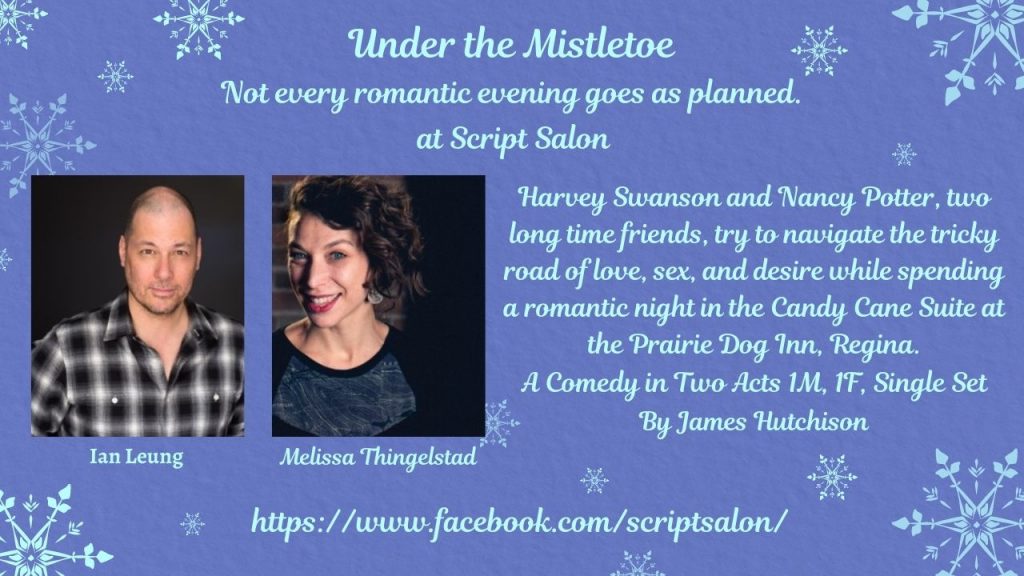

JAMES

As a person deeply involved with the creation and telling of stories why do you think people have this deep desire to hear and tell stories?

DALE

People need and want social interaction, whether it’s in person or not. Stories tell us about each other and give us a lens to look at ourselves and our behaviour. Live storytelling, like theatre, brings groups of people together, entertains us, and lets us share in emotional experiences without being personally involved. It’s safe and it feels good to laugh with others, and shed a tear with these sudden communities and friendships. Telling and hearing stories keeps us in the emotional and intellectual company of one another. I think deep down, people desire to know they can rely on other people, and stories and theatre can offer that by creating a like-minded culture.

JAMES

You had a table read with all the actors a few weeks ago where all twenty-four plays were read. What was that experience like for the people involved in the festival?

DALE

The full company table read was super! There are actors who would never have met each other during the festival because of different schedules so it worked as an introduction. It gave a depth and shape to what a huge commitment and undertaking it is to put this festival together. It gave an overview of all of the terrific writing and talent involved. Everyone loved it!

JAMES

What do you find most inspirational about the NNPF and want people to know about the festival?

DALE

The Newmarket play festival preparations are incredibly professional, and having everything creative in one place: rehearsals, set design, wardrobe, staging, props, it all just buzzes like a beehive on certain days. Most inspiring is the growing presence of the magic of theatre, of numerous people working together to build something visual, thought-provoking, heart-grabbing and grand from the words on the page. Excitement grows a little day by day as we near opening night.

***

The Newmarket National 10 Minute Play Festival runs from July 25 to July 29th. Tickets are just twenty bucks per show and there are four shows of six plays based on a common theme available to see. You can get tickets and check out the complete festival schedule at the Newmarket National Play Festival Website.

***

Man, I wish I could be there. I’d love to see all the plays and meet the other playwrights and actors and directors and I’d definitely be heading to the Chip+Malt for some fish and chips. The Chip+Malt is just one of the many restaurants and retailers offering discounts during the festival. But that’s what festivals are – they’re about going out with friends, making new friends, seeing some shows, talking about those shows, having something to eat, and exploring the community. And the great thing is the world wide web expands that community and it lets me offer my support to the festival and help spread the word. In fact, anyone with a Twitter, Facebook or Instagram account can help support the arts by just letting people know about the festivals they attend and the theatre they see. I have no doubt this year’s festival will be a huge success and Michael’s plans to grow the festival beyond the ten-minute format to a celebration of all theatre formats is an exciting prospect for Candian playwrights. In the meantime, I want to acknowledge the creative talent working on my show and all the actors, directors, designers, stage managers, and volunteers that make this festival possible. Bravo!

***

Cast and Director for Valentine’s Day

Dan Karpenchuk – Old Age and Treachery; The Other Side; Valentine’s Day: After spending a lifetime as a broadcast journalist in Canada and Europe, about fifteen years ago, Dan turned to his other great love, acting. His film credits include: MurdochMysteries, Taken, Forensic Factor, Mayday and Masterminds. His most recent theatre credits include; Oakes in The Prince of Naples at the Kingston Fringe Festival, Kris Kringle in Miracle on 34th Street at Upper Canada Playhouse in Morrisburg, Falstaff in the Merry Wives of Windsor the Humber River Shakespeare, Ivan in Drinking Alone at the Rose Theatre, Brampton, and Andrew Wyke in Sleuth also at the Rose. Dan’s Shakespeare credits include Othello, As You Like It, The Taming of the Shrew, A Midsummer Night’s Dream, Macbeth, Much Ado About Nothing, and All’s Well That Ends Well. Dan heads back to Morrisburg this winter for the Upper Canada Playhouse production of The Christmas Express which opens on November 30. Dan is thrilled and grateful to be a part of this year’s Newmarket National 10 Minute Play Festival.

Kyra Van Den Enden: Daphne of Evora; Late Romances; Valentine’s Day: Kyra Van Den Enden is a Ryerson University Theatre Performance graduate. She is thrilled that she will be continuing her theatre education at the Ecole Internationale De Theatre Jacques Lecoq this fall. Her Acting credits include: The Rover (Dir. Banuta Rubess, 2018); Jack and the Beanstalk (dir. Andrew Lewis Smith, 2017); Eurydice (dir. Robynne Harder, 2017); The Artful Widow (dir. Adam Paolozza, 2017). She also performed in several original works as a part of the 2018 New Voices Festival including two of her own works, DINGBAT DODO DOWN DISCO! which she co-created and directed with Veronica Hortiguela, and Now Presenting the Really Cool, and Totally Awesome Girl On Fire: ANALEISE. She couldn’t be happier to be performing in the Newmarket National 10 Minute Play Festival for a second year.

Ilya lyashyk – For the Love of Austen; Valentine’s Day: Born in Poltava, Ukraine, Ilya Marvin Ilyashyk, is an actor living in Toronto. He has recently graduated with a BFA-Acting degree from the University of Windsor. Previous credits: Pete- On the Rocks (Small But Mighty Productions), Earnest- The Anger in Earnest and Earnestine (OPIA), Nick- The Plausibility of Teleportation in an Oxygen Deprived Environment (Get-Go), Man- Best Before (Hamilton Frostbites Festival). At the University of Windsor: Bill- The Driver (self-written), Gerry- Dancing at Lughnasa, Fire chief – The Bald Soprano

Tiffany Deobald – Daphne of Evora; The Pipe Test; Valentine’s Day:  Tiffany Deobald is an actor from North Battleford, Saskatchewan. She holds an advanced diploma from George Brown College’s Theatre Arts Program (2014). Theatre credits include: Sex&This (Aim for the Tangent), Much Ado About Nothing (Single Thread), The Tempest (Theatre Calgary) and The Mourning After the Night Before (Alumnae Theatre). Film credits include: A Walk in the Park (Aries 6), Outfield (York University), #R.I.P. (Eden Films), INCONTROL (Umbrella Collective Films), Cody Fitz (Umbrella Collective Films). Tiffany is very excited to be working with these new pieces in the Newmarket National 10 Minute Play Festival and she hopes you enjoy the shows!

Dale Sheldrake: Director – For the Love of Austen; Hero; Pausing at the Fringe; Valentine’s Day: An ADR Supervisor in film and television for over 30 years, Dale works closely with incredible writers and actors on productions such as Vikings, The Tudors, The Borgias, Crash, Barney’s Version, Penny Dreadful, and The Handmaid’s Tale. He’s won several awards for his work and loves that theatre direction and ADR are such compatible aspects in entertainment, both building on the importance of performance, dialogue, storytelling and emotion. He is also a playwright, published poet, author, screenwriter, documentary filmmaker (Helldrivers, OLN 2007), singer and musician, and makes a mean Tex-Mex chili. Theatre directing credits: Of Mice and Men; Standing at The Edge of the Universe of Disunity; The Author; Crazy; Day Care; Brother, Brother (InspiraTO Theatre Festival); Tuesdays With Morrie (Theatre Aurora). Dale is thrilled and inspired to be part of the 2018 Newmarket National Play Festival. He thanks Michael Halfin for the wonderful opportunity, the marvellous crew and actors for their amazing energy, professionalism and talent, but most of all, his wife, Petra, for her love, patience and keeping the fire going at the Newmarket National 10 Minute Play Festival


Uncensored, Unexpected, Unforgettable Theatre: Calgary Fringe 2018 – Festival Director Michele Gallant

Michele Gallant and Jane Mackinnon at the Calgary Fringe
Calgary Fringe Festival Board VP, Jane Mackinnon and Calgary
Fringe Festival Director and Producer Michele Gallant out promoting The Calgary Fringe Festival.

We’re only a few weeks away from the Uncensored, Unexpected, and Unforgettable Calgary Fringe and I’ve just finished making my list of want-to-see theatre. The Calgary Fringe has become part of the cultural fabric of the city and is a welcome addition to the theatre season providing Calgarians with the opportunity to see and experience local, national and international artists. I spoke with the current Festival Director and Producer of the Calgary Fringe Michele Gallant.

JAMES HUTCHISON

What is it about the Calgary Fringe that you personally love and keeps you motivated to do all the work and organizing required to present the festival every year?

MICHELE GALLANT

I love the fact that the fringe is all-inclusive, embracive, and that there’s no segregation. Everyone from all backgrounds of life can be involved and participate. All are welcome. I love that artists are free to choose what they want to perform, in what style, and on what topic. I love that patrons have a wide variety of acts to choose from, and how willing they are to take a chance on something new. I love the passion of our volunteers to support the arts and to have fun while doing it. I love that the artists support each other and that one hundred percent of the artist’s set ticket price goes directly back to the artist.

Calgary Fringe performers from 2014 - Rory Ledbetter, Penny Ashton, and Deanna Fleysher
Calgary Fringe Festival Artists, Rory Ledbetter from a Mind Full of Dopamine, Penny Ashton from Promise and Promiscuity: A New Musical by Jane Austin and Penny Ashton, and Deanna Fleysher from Butt Kapinski – Calgary Fringe Festival 2014 – Photograph James Hutchison

JAMES

These are tough times for the Calgary Arts Community. I know a number of Arts Organizations have struggled with funding and have had to adjust how they do business. How is the Fringe doing in these tough economic times and how have you had to respond to the downturn in the economy and what solutions have you been able to implement in order to continue the festival?

MICHELE

It has been a struggle for sure, and it’s meant being smarter and more creative about how we spend our money. We have a rainy day fund set up for situations just like this, but we know that can only go on for so long. We’re currently researching other business ventures and looking for models to help support and augment what we do by creating opportunities for reoccurring revenue streams while spreading the gospel of the fringe to outlying communities.

Of course, as a non-profit, any contributions and donations are always appreciated whether in kind or in cash. You can donate by visiting Canadahelps.org and searching for the Calgary Fringe Festival or donors can contact me directly by e-mail if they’d like to discuss making a donation. (michele@calgaryfringe.ca)

JAMES

The fringe festivals are great places for young artists to get a start. What advice would you give a young artist starting out about getting into the fringe festival circuit and maybe the Calgary Fringe specifically?

MICHELE

I don’t think it’s just a great place for young artists. I think it’s a great place for any artist of any age to get their start. The best advice I can give newbies is to plug themselves into the collective fringe hive minds via fringe festivals such as Calgary and others around the world. Talk with other fringe artists and don’t be afraid to ask questions about how they got started and what works or doesn’t work. Then plan a production and figure out a travel budget and start putting money towards that. Do some research and find out what funding is available to support what you do. Learn how to market and promote yourself. And apply to the Canadian Association of Fringe Festivals (CAFF) touring lottery in early fall. It’s a great way to apply to multiple fringe festivals all at once.

Calgary Fringe Artist Mark Ikeda
Festival Artist Mark Ikeda out promoting his festival show Sansei: The Storyteller – Calgary Fringe Festival 2014 – Photograph James Hutchison

JAMES

The Fringe festival couldn’t operate without its volunteers. What kind of volunteer opportunities are there for people who want to get involved with the Fringe?

MICHELE

There are so many and varied volunteer opportunities available. Everything from ushering to box office staff to concessions to Lounge monitor to fringe ambassadors to being on the Board of Directors or the Management Committee. If you have a specialized skill like marketing or legal services and you want to help support the fringe I’d love to hear from you. And we’re still currently looking for some volunteers to help out with this year’s fringe. You can find more information on our website.

JAMES

What advice to have to first-time fringers and what can they expect?

MICHELE

Expect the unexpected! Be open for anything. Leave no stone unturned! There’s something for everyone. The number one thing I consistently hear from patrons is how passionate the artists are about what they do and their shows. They may not always like what they see but that never deters patrons from seeing more shows, in my experience. You can expect to see some amazing shows, meet some great people, and feel good that the money you’re paying goes back into the artists’ pockets.

Calgary Fringe Artists Ian McFarlane, Ryan Reese, and Geneviève
Frivolous Fools, Ian McFarlane, Ryan Reese, and Geneviève Paré out promoting their show The Hudson Bay Epic – Calgary Fringe 2014 – Photograph by James Hutchison

It’s never easy to pick what you want to see and this year is no exception. I like to try and see a variety of shows, so I’ll build my list to include some mask or clown shows, dance if there is any, a monologue or two, musical storytelling and even a conventional one-act play if one is being presented. And then of course when you attend the festival you get a chance to meet some of the performers who are out and about promoting their own shows and sometimes that will be a deciding factor. It’s always a fun way to spend a day or two during the summer.


Interview with Actor Braden Griffiths: 21st Annual Betty Mitchell Awards

“We’re also a night where everybody in the theatre community comes together to celebrate the work which we’ve done throughout the year. And whether they’re nominated for a Betty or not – whether they win a Betty or not – we are all there to celebrate the outstanding work that has been done throughout the theatre season, because it’s a hard thing to create theatre. It’s a hard thing to create art. They are a celebration that we have a community and that we are a group of four hundred to five hundred people who have come together and decided that this is our life’s work – hence the professional thing – this is our life’s work, this is what I chose to do for a life and the gift of my art is something that has value.” – Braden Griffiths

Actor Braden Griffiths in Vertigo Production
Kathryn Kerbes as Mrs. Hudson, Braden Griffiths as Sherlock Holmes and Curt McKinstry as Dr. Watson in the Vertigo Theatre Production of Sherlock Holmes and the American Problem by R. Hamilton Wright. Photo by Tim Nguyen

On Monday, June 25th the Calgary Theatre community came together to celebrate the Twenty-first annual Betty Mitchell Awards.  I sat down with actor, playwright, and current President of the Betty Mitchell Board Braden Griffiths, who was just finishing his run as Sherlock Holmes in the Vertigo Theatre production of Sherlock Holmes and the American Problem, to talk about the awards and theatre in Calgary.

JAMES HUTCHISON

What is the purpose of the Bettys?

BRADEN GRIFFITHS

The awards were started by Grant Linneberg , Johanne Deleeuw, Mark Bellamy, Donna Belleville and Doug McKeag those five, and Diane Goodman might have been there as well. One of them joined in the second year. They started it as a way to recognize the excellence that they saw happening in this community and as a way to earmark that excellence in a more official way so that the Calgary theatre community could be a bigger player in Canadian Theatre either by exporting that excellence or by becoming a destination for excellence to be imported into Calgary.

Kate Dion-Richard as Helen Schmuck, Gili Roskies as Marm (Margaret) Schmuck, Katie Ryerson as Hilda Ranscombe, and Morgan Yamada as Nellie Ranscombe in the Alberta Theatre Projects in Association with Western Canada Theatre production of GLORY by Tracey Power. Photo by Barbara Zimonick

JAMES

There’s a lot of recognition across the various companies in this year’s nominations.

BRADEN GRIFFITHS

We’ve considered splitting the second-tier and the first-tier theatres into separate categories, but there is something beautiful about having smaller theatre companies like Handsome Alice nominated or Verb Theatre recognized in the best production category this year alongside the artistic output from larger theatre companies like Theatre Calgary and ATP because I think when we boil all this down, all we’re trying to do in theatre is illuminate something about this messy existence we lead as human beings. We’re trying to illuminate something about what it means to be human and that can happen anywhere and you can be affected just as profoundly in the Motel Theatre as you can in any of the big theatres in Calgary. And so, I love how the Bettys safeguard this idea that we are a community of artists, and we all have the same goals regardless of whether we are working at TC or whether we are working at Handsome Alice or Sage or one of the smaller companies in town. We all have this same goal to tell a story and hopefully illuminate something about what it means to be human.

Camille Pavlenko as Una and Curt McKinstry as Ray in Verb Theatre’s production of Blackbird by David Harrower. Photo by Rob Galbraith/Little Guy Media.

JAMES

What do you think the awards mean to the local theatre community?

BRADEN GRIFFITHS

The value of a Betty, at this point I think, is a thumbs up that you’re creating something that did affect somebody in some way. And then beyond that we hope that a Betty Mitchell award matters on a grant proposal let’s say, or we hope that a Betty Mitchell award nomination might help somebody get into an audition room that maybe they weren’t able to get into before, or maybe it helps a playwright to get a commission. It gives that one little extra push to get that commission that maybe they wouldn’t have been considered for before.

And I don’t think the Bettys are the only benchmark we have for excellence in theatre in this community, because there are a lot of people who aren’t on that list who did outstanding work this year, but I think every artist wants to be recognized in some way for what they do as an artist, and this is a nice official way that you can do that and put it down on a ledger and say, I was nominated for a Betty.

Joel Cochrane as Don Pedro in The Shakespeare Company with Hit & Myth Productions Production of Much Ado About Nothing – Photo by Tim Nguyen

JAMES

And it means something now because we’re twenty-one years in. So, there is a history and a legacy to the Bettys that didn’t exist that first year. And the nice thing is, it does offer a certain record to the performance history of Calgary.

BRADEN GRIFFITHS

Without a doubt. I was going through all the past nominations and there were productions in 1998 when I would have been in grade ten, I believe, and I can remember going to at least two productions that were nominated for Bettys on that list. And it was a bit of a time capsule for me, so the Bettys end up being a marking of our history. It’s saying, we were here. And there are people who are nominated whose names I don’t recognize, which is shocking to me, because we are a fairly small community, so I do wonder what happened to them, but that person was an important part of our theatre community at some point. And they made a difference

JAMES

They’re remembered, in a way. Their work is acknowledged. And that’s not insignificant.

BRADEN GRIFFITHS

It’s not.  There’s a tradition in masonry of masons – when they build a big building or whatever out of stone – they’ll leave a little card with their name on it and the year that the building was built, and that card may never be found but its a little statement of I was here. And if theatre is about building a bridge between the artist and the audience then these artists who were nominated for their work but might not be here anymore are still an important stone in the bridge that the Calgary theatre community has been building to the audience of Calgary.

The cast of Sage Theatre’s production of Legislating Love: The Everett Klippert Story by Natalie Meisner. Matt McKinney as Everett Klippert, Jenn Forgie as Tonya, Kathy Zaborsky as Maxine, and Mark Bellamy as Handsome. Photo by Jason Mehmel

JAMES

When the awards started in ninety-eight the world population was 5.9 billion. Jean Chrétien was Prime Minister. Bill Clinton was President. The Tony Award for best musical was The Lion King. And on September 4th, 1998 Google was founded. Here are the type of plays that Calgary was producing at the time. A Delicate Balance, Glengarry Glen Ross, Assassins, Fiddler on the Roof, The Complete Works of William Shakespeare (Abridged)

BRADEN GRIFFITHS

…which I’ve done four times…

JAMES

…and A Christmas Carol.

BRADEN GRIFFITHS

There you go.

JAMES

Let’s jump twenty-one years. The world population is now 7.6 billion. Almost two billion more in twenty-one years.

BRADEN GRIFFITHS

Holy moly.

JAMES

Justin Trudeau is Prime Minister. Donald Trump is President.

BRADEN GRIFFITHS

Oh, man.

JAMES

The Tony Award for best musical – just decided – The Bands Visit. Google’s Brand value is 120.9 billion. They’re behind Apple and Amazon. And so here are the plays we’re seeing this year. We saw The Humans, The Last Wife, Inner Elder, Much Ado About Nothing, Blackbird, The 39 Steps, and A Christmas Carol.

BRADEN (Laughs)

Christmas Carol, our one big constant.

Stephen Hair as Ebenezer Scrooge, Jamie Konchak as Mrs. Cratchit, Tia Rose Woodruff as Tiny Tim, Eleanor Braitenbach as Belinda Cratchit, Graham Percy as the Spirit of Christmas Present, Karl H. Sine as Bob Cratchit and Evan Andersen Sterns as Peter Cratchit in the Theatre Calgary Production of A Christmas Carol by Charles Dickens. Adapted for the Stage by Dennis Garnhum. Photo by Trudie Lee

JAMES

So, how do you think the plays we’re producing at a particular time reflect the times we live in?

BRADEN GRIFFITHS

I’m always mystified by how Christmas Carol just sells out every year, but at its core, Christmas Carol, is a simple message about man’s ability to change and so there is still a desire for that simple hope. So, Christmas Carol or shows of that ilk and ilk sounds like a negative word but it’s not, I love Christmas Carol. I adore it. I wouldn’t have done it for seven years if I didn’t. But there is still a desire, and I think there always will be a desire, for that simple human message of hope. And yet theatre is starting to change. We are starting to be a more interactive society because of platforms like YouTube and Twitter where you can send a Tweet to Brad Pitt and he might respond to that Tweet.

Ron Pederson as Man 2, Tyrell Crews as Richard Hannay, Andy Curtis as Man 1, and Anna Cummer as Annabella/Margaret/Pamela in the Veritgo Theatre Production of The 39 Steps adapted by Patrick Barlow from the novel by John Buchan from the movie by Alfred Hitchcock. Photo by Tim Nguyen

BRADEN GRIFFITHS

And so, there’s a desire for more interactivity in the art or the media that we indulge in. I think to a certain degree, the magic of a play like The 39 Steps is that we’re all in on the joke. That this is just two ladders and a bunch of crates on a stage and yet those things will become a plane chasing someone through a field, or the crates will become the boxcars in a train or whatever it is, and so we’re all in on the joke and so there’s a greater sense of interactivity. Which is why I think 39 Steps, even though it’s an old play now, has great relevance because the audience is involved in creating that joke.

And then you have things like Inner Elder by Michelle Thrush which talks about what it means to be a first nations member of the Canadian Zeitgeist. What it means socially to be a first nations member. And to actually hear that story told by the person who should be telling that story. The first nation’s experience is not my lived experience. Their lived experience informs my lived experience, and it may not shine the most desirable light on my lived experience, but I need to know as a person who’s a six-foot-tall white male, and I live with such great privilege that it’s insane, but that is my lived experience, and sometimes I can’t see it. And so, if theatre is holding a mirror up to nature then by watching Inner Elder I learn something about what it means to be Braden by watching and hearing the story of someone who is living with much, much, much, less privilege than I. And then hopefully, if I’m open to that…if my ears are open to that…and if the theatre companies are providing a platform for those stories to be told then I will become a more complete human, and a I will become a better community member, and by community, I mean the community of the world by understanding the stories of those who are around me and understanding something greater about myself.

Inner Elder created and performed by Michelle Thrush and presented by Lunchbox Theatre and One Yellow Rabbit as part of The High Performance Rodeo. Photo by Benjamin Laird.

JAMES

Well that’s what art does, doesn’t it? It makes us look in the mirror. It reflects who we are as a people, culture and society and it looks at both the good and the bad.

BRADEN GRIFFITHS

Hopefully. I was doing, Alls Well That Ends Well, with Peter Hinton at The Shakespeare Company two years ago, and this isn’t a name drop, I just want to give credit where credit is due. He said, at some point in that rehearsal process, “There’s not a lot of plays out there where two people sit on a bench both enjoying their own sandwiches, and then they go home. There’s a lot of plays out there where two people are sitting on a bench where one person has a sandwich and the other person is starving. There aren’t a lot of plays out there where we see mankind at peace. We’re always meeting these people in these stories at a time of crisis. At a life-defining moment.”

Elinor Holt as Deirdre Blake, Shekhar Paleja as Richard Saad, Lili Beadoin as Brigid Blake, Ric Reid as Erik Blake, and Ayla Stephen as Aimee Blake in the Theatre Calgary Production of The Humans by Stephen Karam. Photo by Trudie Lee

BRADEN GRIFFITHS

And I feel that’s a really apt quote because, speaking personally, I’ve always much preferred playing the very flawed individual, because we spend so much time in our lives hiding those flaws that we have from the rest of society because that’s the social agreement that we make. We all have our own shit and everybody’s life is complicated, but if you and I are not best friends we’re not going to throw our complications at the other person or that’s the hope of the social agreement we make every day.

And so, the flaws are where the real meat of storytelling and theatre happens. Sherlock Holmes, for example, who is a superhero in terms of his mental acuity is also a morphine addict and a cocaine addict. That I think is where theatre becomes accessible – it’s in the flaws. So, if theatre is holding a mirror up then we can see something of those things we are struggling with in these people on stage. Braden Griffiths as Sherlock Holmes is not dealing with the same things that Sherlock Holmes is, but I become a conduit to talk about those flaws, and I think that’s why theatre is valuable, because it provides a safe space for us to look at the worst and then to ruminate on the worst and know that at the end of the night we’re all going to get in our car and we’ll all safely drive home.

JAMES

What are your ambitions for the Bettys?

BRADEN GRIFFITHS

The board is always trying to safeguard the most unbiased process possible. That’s really what the guidelines are there for. So that we can award these 18 to 20 statues and it is representative of the twelve voices on the jury as opposed to one single voice. It’s a big thing to try and create a list of twelve that has a range of ages, that has a range of sexuality, and has a range of artistic niche. We try to have actors, directors, playwrights, educators, technicians and designers. We want that twelve ideally to be representative of the whole community so that it can be the most unbiased it possibly can be. That’s always going to be, for the board, at the top of the list.

Eric Wigston, Tenaj Williams, Madeleine Suddaby, and Selina Wong in Touch Me: Songs for a (Dis)connected Age by Forte Musical Theatre. Presented by Theatre Calgary. Photo by Trudie Lee

BRADEN GRIFFITHS

There’s also a responsibility for the Bettys to be as inclusive as possible as production models change and as the equity guidelines change to include different types of theatre being created. There are different contracting forms now that weren’t available seven or eight years ago where theatre companies can gather an ensemble of seven and create a show and be protected by equity and be considered a professional show. And so, there is a responsibility for the Bettys to foster a growth in the community by being as inclusive as possible so that those smaller companies that are trying to make their name in the theatre community are included within the professional theatre community. The more inclusive we can be, I think, the greater array of theatre production we’re going to see in this town.

A Chitenge Story created and performed by Makambe K. Simamba. A Handsome Alice Theatre Production. Photo by Tim Nguyen, Citrus Photography.

BRADEN GRIFFITHS

We’re also a night where everybody in the theatre community comes together to celebrate the work which we’ve done throughout the year. And to a certain degree that is sacred as well, because as we’ve seen unofficial community meeting places like the Auburn disappear building that sense of community has become more difficult in some ways, and so the Bettys are a night that’s guaranteed to happen every year where two hundred or so of our theatre community will come together. And whether they’re nominated for a Betty or not – whether they win a Betty or not – we are all there to celebrate the outstanding work that has been done throughout the theatre season, because it’s a hard thing to create theatre. It’s a hard thing to create art. They are a celebration that we have a community and that we are a group of four hundred to five hundred people who have come together and decided that this is our life’s work – hence the professional thing – this is our life’s work, this is what I chose to do for a life and the gift of my art is something that has value.

Back Left to Right: Lee-Anne Galloway, Rachel Delduca, Bracken Burns as Elle Woods, Kyla Musselman, Laura Tremblay, Victoria Whistance-Smith Front Left to Right: Amber Bissonnette & Sash Striga in the Stage West Theatre production of Legally Blonde The Musical, Music and Lyrics by Laurence O’Keefe & Nell Benjamin, Book By Heather Hach based on the novel by Amanda Brown and the MGM Motion Picture. Photo by John Watson Photography

JAMES

That’s what the Bettys are doing for the artist but what about the Bettys in terms of their ability to be an ambassador to the city for our arts community.

BRADEN GRIFFITHS

Well, I don’t know that the community at large knows what the Bettys are. And I think the work of the Bettys in the future is, how can we as the awarding body in town support those producing companies in town over the course of the season as opposed to just on that one night? That’s a conversation that needs to happen between us and the producing companies.

Gregory Dahl as Scarpia and Ambur Braid as Tosca in the Calgary Opera production of Tosca by Giacomo Puccini. Photo by Trudie Lee.

JAMES

So, one of the challenges is how do we get new audiences in there. How do we foster that? How do we reach these people?

BRADEN GRIFFITHS

I think people are more liable to go see themselves, and so I think part of the reason we see a lot of white middle-class, upper-middle-class human beings in theatres is partially because it requires a certain amount of disposable income to go to theatre and partially because those are the stories that for a very – very long time were being told. And so, when we talk about Inner Elder I think it’s more likely that someone of first nations decent might go and see Inner Elder because they see something very specifically that is their story being told in a theatre. And once somebody has seen something in a theatre that has affected them profoundly it’s far more likely that they’re going to go to the next show that may not tell a story that specifically speaks to their lived existence, but like I said earlier, me seeing Inner Elder speaks to my existence whether it speaks to it specifically or not. I think we need to do a better job of telling a wider array of stories in the theatre and if we’re producing Shakespeare we need to start casting artists that come from different lived experiences. And I think the fact that we’re seeing Michelle Thrush direct Honor Beat by Tara Beagan as the first show of the season at Theatre Calgary means we’re moving in the right direction, but we need to continue to do the hard work of providing those opportunities so that we can create a theatre community that is representative of the greater community and the Bettys is a part of that, I think.

***

2018 Betty Mitchell Awards Nominees

Winners in Bold.

OUTSTANDING PERFORMANCE BY AN ENSEMBLE

  • Glory – Alberta Theatre Projects, in association with Western Canada Theatre
  • The Humans – Theatre Calgary
  • inVISIBLE – Handsome Alice Theatre
  • Touch Me: Songs for a (Dis)connected Age – Forte Musical Theatre Guild, presented by Theatre Calgary
  • Undercover – Vertigo Theatre & Tarragon Theatre

OUTSTANDING PERFORMANCE BY AN ACTRESS IN A SUPPORTING ROLE

  • Kathryn Kerbes – Sherlock Holmes & the American Problem – Vertigo Theatre
  • Helen Knight – The Last Wife – Alberta Theatre Projects
  • Chantelle Han – Ai Yah! Sweet & Sour Secrets – Lunchbox Theatre
  • Esther Purves- Smith – Baskerville: A Sherlock Holmes Mystery – Stage West

OUTSTANDING LIGHTING DESIGN (Tie)

  • T. Erin Gruber – Easter Island – Verb Theatre
  • Jessie Paynter – Extremophiles – Downstage
  • Anton de Groot – Nine Dragons – Vertigo Theatre, Royal Manitoba Theatre Centre & Gateway Theatre
  • Narda McCarroll – To the Light – Alberta Theatre Projects
  • Bonnie Beecher – The Secret Garden – Theatre Calgary

OUTSTANDING SET DESIGN

  • The Old Trout Puppet Workshop – Twelfth Night – Theatre Calgary
  • David Fraser – Sherlock Holmes & the American Problem – Vertigo Theatre
  • Scott Reid – Nine Dragons – Vertigo Theatre, Royal Manitoba Theatre Centre & Gateway Theatre
  • David Fraser – Constellations – Alberta Theatre Projects
  • Caitlind r.c. Brown and Wayne Garrett – Extremophiles – Downstage

OUTSTANDING PERFORMANCE BY AN ACTOR IN A SUPPORTING ROLE

  • Trevor Rueger – Much Ado About Nothing – The Shakespeare Company with Hit & Myth Productions
  • Mark Bellamy – Legislating Love: The Everett Klippert Story – Sage Theatre
  • Stafford Perry – The Lonely Diner – Vertigo Theatre
  • Kevin Rothery – Sherlock Holmes & The American Problem – Vertigo Theatre
  • Nathan Schmidt – Sherlock Holmes & The American Problem – Vertigo Theatre

OUTSTANDING PROJECTION OR VIDEO DESIGN

  • Jamie Nesbitt – Nine Dragons – Vertigo Theatre, Royal Manitoba Theatre Centre & Gateway Theatre
  • Remy Siu – Empire of the Son – Alberta Theatre Projects, part of the 32nd Annual High Performance Rodeo, a Vancouver Asian Canadian Theatre Production
  • T. Erin Gruber – Easter Island – Verb Theatre
  • Corwin Ferguson – Julius Caesar – The Shakespeare Company, Ground Zero Theatre, and Hit & Myth Productions
  • Amelia Scott – To the Light – Alberta Theatre Projects

OUTSTANDING COSTUME DESIGN

  • The Old Trout Puppet Workshop – Twelfth Night – Theatre Calgary
  • Heather Moore – The Last Wife – Alberta Theatre Projects
  • Cory Sincennes – The Secret Garden – Theatre Calgary
  • Cindy Wiebe – Glory – Alberta Theatre Projects, in association with Western Canada Theatre
  • Mérédith Caron – Sisters: The Belles Soeurs Musical – A Copa de Oro Production Ltd. And Segal Centre for Performing Arts production, presented by Theatre Calgary

OUTSTANDING SOUND DESIGN OR COMPOSITION

  • Steve Charles – Glory – Alberta Theatre Projects, in association with Western Canada Theatre
  • Peter Moller – The 39 Steps – Vertigo Theatre
  • Andrew Blizzard – Nine Dragons – Vertigo Theatre, Royal Manitoba Theatre Centre & Gateway Theatre
  • Andrew Blizzard – Sherlock Holmes & The American Problem – Vertigo Theatre
  • Bryce Kulak – To The Light – Alberta Theatre Projects

OUTSTANDING CHOREOGRAPHY OR FIGHT DIRECTION

  • Tracey Power – Glory – Alberta Theatre Projects, in association with Western Canada Theatre
  • Phil Nero – Legally Blonde: The Musical – Stage West
  • John Knight – Julius Caesar – The Shakespeare Company, Ground Zero Theatre, and Hit & Myth Productions
  • Laryssa Yanchuk – Sherlock Holmes & the American Problem – Vertigo Theatre
  • Linda Garneau – Sisters: The Belles Soeurs Musical – A Copa de Oro Production Ltd. And Segal Centre for Performing Arts production, presented by Theatre Calgary

OUTSTANDING MUSICAL DIRECTION

  • David Terriault – Sisters: The Belles Soeurs Musical – A Copa de Oro Production Ltd. And Segal Centre for Performing Arts production, presented by Theatre Calgary
  • Jacques Lacombe – Tosca – Calgary Opera
  • Konrad Pluta – Legally Blonde: The Musical – Stage West
  • Joe Slabe – Touch Me: songs for a (Dis)Connected Age – Forte Musical Theatre Guild, presented by Theatre Calgary
  • Don Horsburgh – The Secret Garden – Theatre Calgary

OUTSTANDING PERFORMANCE BY AN ACTRESS IN A COMEDY OR MUSICAL

  • Jamie Konchak – Miss Caledonia – Lunchbox Theatre
  • Myla Southward – Much Ado About Nothing – The Shakespeare Company with Hit & Myth Productions
  • Anna Cummer – Twelfth Night – Theatre Calgary
  • Anna Cummer – The 39 Steps – Vertigo Theatre
  • Bracken Burns – Legally Blonde: The Musical – Stage West

OUTSTANDING PERFORMANCE BY AN ACTOR IN A COMEDY OR MUSICAL

  • Tyrell Crews – The 39 Steps – Vertigo Theatre
  • Tyrell Crews – Much Ado About Nothing – The Shakespeare Company with Hit & Myth Productions
  • Devon Dubnyk – The Santaland Diaries – Lunchbox Theatre
  • Christopher Hunt – Twelfth Night – Theatre Calgary
  • Eric Wigston – The Secret Garden – Theatre Calgary

OUTSTANDING NEW PLAY

  • Glory – Tracey Power
  • Nine Dragons – Jovanni Sy
  • Flight Risk – Meg Braem
  • Inner Elder – Michelle Thrush
  • Legislating Love: The Everett Klippert Story – Natalie Meisner

OUTSTANDING PERFORMANCE BY AN ACTRESS IN A DRAMA

  • Michelle Thrush – Inner Elder – Lunchbox Theatre
  • Myla Southward – The Last Wife – Alberta Theatre Projects
  • Camille Pavlenko – Blackbird – Verb Theatre
  • Makambe K. Simamba – A Chitenge Story – Handsome Alice Theatre
  • Jamie Konchak – Constellations – Alberta Theatre Projects

OUTSTANDING PERFORMANCE BY AN ACTOR IN A DRAMA

  • Christopher Hunt – Flight Risk – Lunchbox Theatre
  • Stephen Hair – Blow Wind High Water – Theatre Calgary
  • Curt McKinstry – Blackbird – Verb Theatre
  • Braden Griffiths – Julius Caesar – The Shakespeare Company, Ground Zero Theatre, and Hit & Myth Productions
  • Michael Tan – Constellations – Alberta Theatre Projects

OUTSTANDING DIRECTION

  • Jillian Keiley – Twelfth Night – Theatre Calgary
  • Ron Jenkins – The 39 Steps – Vertigo Theatre
  • James MacDonald – Glory – Alberta Theatre Projects, in association with Western Canada Theatre
  • Glynis Leyshon – The Last Wife – Alberta Theatre Projects
  • Vanessa Porteous – The Humans –Theatre Calgary

OUTSTANDING PRODUCTION OF A MUSICAL

  • Sisters: The Belles Soeurs Musical – A Copa de Oro Production Ltd. And Segal Centre for Performing Arts production, presented by Theatre Calgary
  • Legally Blonde: The Musical – Stage West
  • Touch Me: Songs for a (Dis)connected Age – Forte Musical Theatre Guild, presented by Theatre Calgary
  • Tosca – Calgary Opera
  • Murder for Two – Stage West

OUTSTANDING PRODUCTION OF A PLAY

  • Glory – Alberta Theatre Projects, in association with Western Canada Theatre
  • Inner Elder – Lunchbox Theatre and One Yellow Rabbit
  • Twelfth Night – Theatre Calgary
  • The 39 Steps – Vertigo Theatre
  • Blackbird – Verb Theatre

***

  • Alberta Theatre Projects:  Contemporary, clever & cutting edge live theatre in the heart of Calgary.
  • Birnton Theatricals: Producing theatre that will entertain and show the world from a different view.
  • Calgary Opera: Our BOLD new 2018-19 season starts with Roméo & Juliette, followed by the Canadian premiere of Everest, and ends with Rigoletto.
  • Downstage:  Canadian theatre that creates meaningful conversation around social issues.
  • Forte Musical Theatre Guild: A Canadian not-for-profit company dedicated to the professional development and production of new musical theatre works.
  • Green Fools Theatre: Not-for-profit Theatre specializing in masks, puppets, stilts.
  • Handsome Alice Theatre Company: Devoted to unleashing the female voice through the development, creation, and production of inclusive, curious, and rebellious theatre works.
  • Lunchbox Theatre: One of the most successful noon hour theatre companies in the world.
  • One Yellow Rabbit: Performance artifacts for the seriously curious.
  • Quest Theatre:  An Award-winning Theatre for Young Audiences company based in Calgary.
  • Sage Theatre:  Creates bold, intimate, thoughtful plays exploring the human condition. We showcase talented Albertan artists.
  • The Shakespeare Company: Calgary’s lean and mean classical theatre company
  • Stage West Theatre Restaurants: We bring you the greatest entertainers from the stage, the screen and the music world along with our 120-item gourmet buffet! Play With Your Dinner!
  • Theatre Calgary: Our 2018-19 season includes Honour Beat, Mary and Max – A New Musical, A Christmas Carol, BOOM X, The Scarlet Letter and Billy Elliot The Musical
  • Verb Theatre: Tomorrow’s theatre, today.
  • Vertigo Theatre: The only professional theatre in Canada producing a series of plays based on the mystery genre.

***

BETTY MITCHELL:  After working for ten years in Calgary schools, the University of Alberta graduate moved to Western Canada High School in 1934. Drama was introduced into the curriculum in 1936 and the former biology teacher found herself Director of the Drama Department. Betty had discovered the great love of her life.

She received the Rockefeller Fellowship in 1942, an M.A. from the State University of Iowa in 1944, followed by a National Research Fellowship from the Cleveland Playhouse. That same year, Betty and her students founded their infamous Workshop 14 which would go on to win nine Dominion Drama Awards and become a training ground for future theatre professionals.

Throughout the fifties and sixties, Betty was a force behind MAC 14 (after a merger of Workshop 14 and the Musicians’ and Actors’ Club), which eventually became Theatre Calgary. As producer, director, and teacher, Betty helped to build a vibrant stage community in Calgary and became sought after as an adjudicator and speaker across Canada.

As achievements mounted, so too did awards, including a City of Calgary citation for her contribution to culture and art. She received an Honourary Doctor of Laws Degree from the University of Alberta in 1958 for her achievements in amateur theatre, the only such doctorate awarded in Canada. Anyone for whom theatre is a passion owes a huge debt of gratitude to Calgary’s first lady of theatre.

Actor Braden Griffiths as Sherlock Holmes
Braden Griffiths as Sherlock Holmes in the Vertigo Theatre Production of Sherlock Holmes and the American Problem by R. Hamilton Wright. Photo by Tim Nguyen

BRADEN GRIFFITHS: Braden Griffiths has been an actor and playwright in Calgary for 14 years. He has performed in over 60 professional productions predominantly in Calgary but also, on various stages in Western Canada and occasionally, when he’s very fortunate, in Asia and Australia. His play My Family and Other Endangered Species, written with Ellen Close, was published by Playwright’s Canada Press. He has multiple Betty Mitchell Award Nominations for both acting and playwriting, taking home the Betty in 2015 for his performance in The Last Voyage of Donald Crowhurst. This is his 11th year on the Betty Mitchell Awards Board.

THE BETTY MITCHELL AWARDS: The Betty’s were founded by Grant Linneberg, Mark Bellamy, Donna Belleville, Johanne Deleeuw and Dianne Goodman. Named after one of the great arts educators and a pivotal member of the community of artists that founded Theatre Calgary (just over 50 years ago) the Betty Mitchell Awards were started in order to celebrate the excellence of Calgary’s theatre community 21 years ago. Many aspects of the Betty Mitchell Awards have remained constant over the years: the Board (formerly called the Steering Committee) has always been peopled by volunteers from within the community; the Nominating Committee has always been comprised of a group of twelve individuals and that jury changes every year; the guidelines have remained remarkably intact from the first year of the Betty’s (the semantics have evolved but, their spirit remains the same) and (until this year) the Awards have always been disseminated in August. However, as the Calgary Theatre Community continues to change and grow so too have the Betty’s: multiple Awards have been added over the years (most recently Outstanding Projection Design and Outstanding Performance by an Ensemble); the Awards venue has recently moved away from it perennial home at Stage West and they are now presented in the Vertigo Playhouse; since the closing of the Auburn, the after party has officially become a part of the Betty’s Board planning and arrangements for the night. As much as the Bettys (the statues themselves) are a professional theatre Award, the Bettys (the evening of the awards) have become the one night a year where the community comes together to celebrate all that we have been, all that we are and all that we hope to become.

***

This interview with Braden Griffiths has been edited and condensed for clarity.

This article has been updated to include the winners in each category. The opening has been rewritten slightly to reflect that the awards happened. The initial article was written before the awards and linked to tickets for the event.


Interview with Lunchbox Theatre Director of Marketing & Communications Lauren Thompson

Lauren Thompson – Director of Marketing & Communications – Lunchbox Theatre

“Have fun and be creative. If you won’t find it interesting to read why is your audience going to find it interesting to read? If you don’t like the way it looks, chances are your audience won’t like the way it looks. So, trust you and do what you want to do. Marketing is the place where you can be creative and do your own things. Financial people have to follow a budget – have to follow numbers, but marketing is that world where you can have your creative juices flow, if you will.” – Lauren Thompson Director of Marketing & Communications

You know it’s not true. The whole idea that all you have to do is build it and they will come. That idea only works in metaphysical baseball stories. In the real world, if you build it – you have to tell them about it – and then they’ll come.

Maybe.

Marketing is the process of telling people your story and why they should buy your product or service, and in the theatre world that means finding ways of reaching people and telling them why they should come and see your show.

I sat down with Lauren Thompson, shortly before she left her position as the Director of Marketing & Communications for  Lunchbox Theatre, to talk with her about her approach to marketing and some of things she’s done during her time at Lunchbox.

JAMES HUTCHISON

So tell me what you noticed when you first started as the marketing manager for Lunchbox Theatre three years ago.

LAUREN THOMPSON

When I first started I noticed that although Lunchbox had moved into the Calgary Tower location in 2008 a lot of people still didn’t know we were there. The theatre people did. The theatre community people did. But our normal audience, of the downtown working crowd, either thought we’d shut our doors or knew that we’d moved, but they didn’t really know where we were, or they had stopped paying attention.

JAMES

Lunchbox Theatre in the heart of Calgary under the Tower

The move really hurt Lunchbox in terms of people going to it?

LAUREN THOMPSON

It wasn’t convenient for the typical audience that they were seeing. And convenient in the sense that before the move they were in Bow Valley Square. There were five other buildings, or whatever, connected through the plus 15s and it was right in the middle of a food court and there was a lot of foot traffic. There were a lot of positives going on over there. And there are so many positives that have come out of the move here, but the audience, and the traffic, and the regular patrons, and what defined Lunchbox was changing.

JAMES

Okay then, what is Lunchbox? And what does it mean to the community?

LAUREN THOMPSON

Well, I really think Lunchbox has changed. It’s not this convenient stop in for one hour, and you don’t really know what you’re going to get, but it’s here, and you’ll have your lunch. It’s now a destination. We have to program shows to make people want to put in that extra five-minute walk down Stephen Avenue to come see us.

And I think now we’re really focused on Lunchbox as an incubator of sorts. We workshop new plays, but we’re also a company for emerging artists, new designers, and new directors through our RBC emerging directors program and our Stage One Festival, and all these things give a place for these emerging artists to really grow, and then to move onto the Theatre Calgary stages, or the Vertigo stages, or the ATP stages.

JAMES

I was doing a little reading and it was talking about people needing to think about the theatre experience beyond the performance. It’s not just the show. It’s the whole atmosphere. It’s everything.

Ben Wong as Charlie, Jamie Matchullis as Jennifer, Kelsey Verzotti as Jade and Chantelle Han as Lilly in the Lunchbox Theatre production of Ai Yah! Sweet and Sour Secrets – Photograph by Benjamin Laird

Lauren Thompson – Having fun with Ai Yah! Sweet and Sour Secrets

LAUREN THOMPSON

It is everything. I had a lot of fun with Ai Yah! Sweet and Sour Secrets this year. That was Dale Lee Kwong’s play that went up over the Chinese New Year. I specifically remember that one because it was this culture that I didn’t know a lot about. And it was so specific to Chinese New Year and those traditions. Dale was super supportive and taught us everything, and she gave me this forty-page document about all the traditions that they do and what red and gold means and what these symbols mean and why they do these things. I really wanted people to enter the theatre and read these quotes and fun facts along the wall about Chinese New Year and just be immersed in this new culture and this new experience. And on Instagram I did little fortune cookies, so you had a little image of a fortune cookie and you had to slide the image and it would be a different fortune every day. It was just fun posts that aren’t directly promoting the show, but it’s creating awareness and fun and excitement.

JAMES

You have a ten-dollar Thursday night. What was the genesis of that?

LAUREN THOMPSON

The first Thursday night show of every run was our lowest-selling show. So, we were hey, what can we do to entice people to come see the show and see what works? We didn’t know if it was going to work the first year we did it, but it did, and it blew up, and now it’s consistently the first show that sells out.

JAMES

Why do you need a full audience in there?

LAUREN THOMPSON

In Calgary, people are waiting for word of mouth. So, we need full theatres that first week to help get the word out, and by the time the first week’s over and the word of mouth has gotten out our second and third weeks fill up.

JAMES

Of course, nowadays social media is one of the main ways to help spread the word. How do you incorporate social media into your marketing?

LAUREN THOMPSON

Social media is basically doing some of our word of mouth for us, but we can help facilitate that word of mouth a little bit. We can put out a photo, or we can put out a comment and people will share that comment or photo with their own tag and their own comment in it.

JAMES

So, what types of content are you creating? Because I notice, just for an example, The Shakespeare Company will do an interview with one of their actors and post it on their website and then promote it through their social media.

LAUREN THOMPSON

Well, this year I found that the traditional media calls were not always happening. We’ve had a media call planned and the media has had to cancel, last minute, because there was an accident, or something else came up, or whatever, right? So, this year I said to Samantha MacDonald, our Artistic Producer, that we need to do it ourselves. I can’t rely on the media to get the story of our show out there. So, I started the coffee chats that I post on Facebook and Instagram.

I would interview two people from the production. Typically, the playwright or director and then an actor from the show and ask them questions about the process, about the play, and about their characters – what would typically come out in a media call. And then I put it out in the world so we’re not relying on something we have no control over. And it’s worked in our favour. And we’ve had media coverage this year, but I think those coffee chats opened up a different side. A more casual side. A different conversation about the play that a poster or a typical social media post won’t do for you.

JAMES

You know what I’m seeing that I really like? I’m seeing you and Theatre Calgary, and ATP, and The Shakespeare Company, and Vertigo are all using your social media to help each other.

LAUREN THOMPSON

This past season a few of the marketing directors from the different companies Theatre Calgary, ATP, Lunchbox, Vertigo, and I think Stage West just got together to chat and see how things were going and what are the trends and we realized – the same thing is happening across the board – and that we weren’t alone. And then the conversation turned to how do we support each other and get the word out about your show even though our shows on. Our show has the same actor that is in your next show coming up, so how do we do something about that, and let’s talk about that, and it’s become so wonderful to have that community of people who want to see all of us succeed.

JAMES

When you’re making your marketing decisions how much of your decisions are based on instinct and how much on research?

LAUREN THOMPSON

I personally am a much more instinctive person. I go with my gut, a lot. We tagged this season as, “What are you hungry for?” You know, are you hungry for culture? Are you hungry for family stories? Are you hungry for Canadian stories? And along with that – I don’t even know where it came from – I heard about the importance of taking time to take a break and getting away from your desk and taking an hour to take in arts and culture. And I ran with that idea before the season started. Yes, Lunchbox is one hour, it’s not expensive, it’s great theatre, but really like what is it doing for your life? It is giving you one hour of culture. It is giving you a one-hour break from a screen. It is giving you an hour to be with people and to watch live theatre and that has so many positive effects on you as a person. And I did all this research on workplace mental health and taking breaks and the importance of that but then channeling that into easily fun digestible posts or ads. And one of the ads – we did a bunch of ads in surrounding corporate towers and literally my promo was Lunchbox is a five-minute walk and it’s 621 steps. Get your steps for the day. Come to Lunchbox for an hour. And get your steps on your way back to the office.

JAMES

One of the things we talked about before the interview was based on your experience do you have any tips or lessons learned that people could take away in regards to marketing?

LAUREN THOMPSON

I do, but there are a million others. I would say, be open to ideas is number one. Be open to exciting new technology that’s coming out to apps to trends. The trends that are coming out are trends for a reason. Try them and see if they work for your company and your audience. Everything moves quickly. So, react to it all. And take it on your own spin.

Tip number two would be to have fun and be creative. If you won’t find it interesting to read why is your audience going to find it interesting to read? If you don’t like the way it looks, chances are your audience won’t like the way it looks. So, trust yourself and do what you want to do. Marketing is the place where you can be creative and do your own things. Financial people have to follow a budget have to follow numbers, but marketing is that world where you can have your creative juices flow, if you will.

JAMES

It’s a bit of magic.

LAUREN THOMPSON

Totally. My third one is to have a consistent voice. Know your brand. Know your company and your voice regardless. It might have a different tone for your different mediums. Our Instagram has a different tone than our Facebook, but it’s still a consistent voice, and I still know what the brand is and you’re always pushing that. Whatever you do it has to fall under that umbrella.

JAMES

Alright, lets talk about the importance of a healthy box office. How much do you think having a healthy box office impacts the overall company specifically your ability to get donations and other funding?

LAUREN THOMPSON

I don’t think it’s a secret that arts in Calgary are suffering. And we’re very aware. Sam does a preshow chat to the audience before every single show, and in the later half of the year we started to add in – you know obviously we’re struggling like everyone else, and it was just an awareness of it, and if you want to ask more questions and you want to help please come find us after the show. It’s just being transparent about it, and then people come and see the shows and support the shows and leave the shows talking about how much they love it and how much they want it to be around. We had some people come to Girl Crush with Sharron Matthews which was the first Lunchbox show they had ever seen, and the next thing you know we’re getting cheques of money because they loved it so much.

Sharron Matthews in Girl Crush at Lunchbox Theatre Photograph by Benjamin Laird

JAMES

Now, Girl Crush, just because you mentioned it, was a really interesting show.

LAUREN THOMPSON

Yes.

JAMES

Because it turned Lunchbox into a cabaret.

LAUREN THOMPSON

It did.

JAMES

And it did very well.

LAUREN THOMPSON

It was a gamble and it paid off.

JAMES

It was an entertaining and successful show and it showed that you can do a lot in that space. It expands in the consumer’s mind your venue as an entertainment venue rather than just theatre. Are there plans to do more?

LAUREN THOMPSON

Yes, we have a cabaresque show starting the season called Mickey and Judy by Michael Hughes.

JAMES

Traditionally September is a tough sell. Is that one of the reasons you’re going with the cabaret to see how it does?

LAUREN THOMPSON

Yes. September is hard on every theatre. This year we had Book Club II. The sequel to Book Club by Meredith Taylor-Parry. And it did well, but it also struggled just with it being in the September slot – nothing to do with the show. Mickey and Judy is a show that we’re really excited about – it being a musical and having a different style to it – the Cabaret feel you know. It’s a different exciting start to things.

Arielle Rombough, Cheryl Hutton, Kira Bradley, Curt Mckinstry, Anna Cummer – in the Lunchbox Theatre Production of Book Club II: The Next Chapter by Meredith Taylor Parry. Photograph by Benjamin Laird

JAMES

Okay then, lets talk about next season. I really like the artwork.

LAUREN THOMPSON

I am obsessed with the artwork.

JAMES

Tell me the story behind this.

LAUREN THOMPSON

So, last season we found a new graphic designer. And she did all of the artwork for the 17/18 season. The two-tone kind of colours and the single image kind of graphic look and it was similar to what Lunchbox had been doing but just a little more mature a little more modern. And this year our programming is taking a new shift, and we’re doing different styles and kinds of shows, and this is Sam’s first programmed season as artistic producer, and so we sort of chatted with her and said we’re open to new ideas.

JAMES

So, you went to the graphic artist?

LAUREN THOMPSON

We went to the graphic artist. Her name is Kimberly Wieting, and she’s young, and she’s so good at what she does.

JAMES

She has her own company?

LAUREN THOMPSON

Yeah, she’s an individual contractor, and she’s incredible. Her company is Gritt Media. We sat down with her, and Sam and I chatted about the season. We gave her a brief synopsis of everything and said, “Tell us what you want to do.” And she pitched this concept of this image on image and black with a pop of colour and it was a lot of work, but it was so worth it. And it’s just a totally different look for Lunchbox.

And it’s like we’ve said, Lunchbox has been around forever. Everyone knows Lunchbox, but now you’re looking at it differently. And we want them to. Our shows are different. Our production quality is different. Our outlook on what we’re doing, the projects we’re taking on, the scripts we’re developing, everything is different, and we’re shifting, and we want the imagery of Lunchbox to shift with us, and we think it’s gone in the perfect direction.

JAMES

Sounds like such an exciting time to be a part of Lunchbox, so what’s going on with you?

LAUREN THOMPSON

And ahhh – I’m going to leave!

JAMES

So, tell me what’s the opportunity for you?

LAUREN THOMPSON

I’m moving to Amsterdam this summer. And I really just needed a change. I don’t know how else to explain it. It was this whim in February. I just sort of was like – I need to go do this. I looked into visas, and most visas in most countries are the working holiday visa, and they’re only valid until you’re thirty. So, I said, I don’t have a mortgage. I don’t have a partner. I don’t really have anything tying me down. I can come back to this wonderful community – that I know will take me back when I come back – and I just need to go. I need to do this.

JAMES

What are you going to do?

LAUREN THOMPSON

I have no idea. (Laughs) Step one is find a place to live. I just want to work when I’m over there. I want to travel. I just want to meet people.

JAMES

Well, good for you for doing this. Do you think this explains part of your success as a marketer? I mean just even in your own life the willingness to take a risk – to try something new – to see how it works?

LAUREN THOMPSON

Maybe. And I’m realizing more and more, I react on my gut a lot. I follow my gut, and looking back on things and the decisions I’ve made – even the gut decision to take the job at Lunchbox – I’ve always followed that, and it’s always led me in the right direction. And my gut is telling me to go to Amsterdam, and so I’m just going to do it. And we’ll see what happens.

***

Lunchbox Theatre is located at the base of the Calgary Tower. Regular season shows run Monday to Saturday at 12:00 pm with a 6:00 pm show on Thursday and Friday. Individual tickets are just $25.00. Group discounts, play passes and regular tickets can be purchased online at Lunchbox Theatre or by calling the box office at 403-265-4292 x 0.

***

Lunchbox Theatre 2018/19 Season

Mickey & Judy – September 17 to October 6, 2018

Playwright Michael Hughes
Performer Michael Hughes

As a young boy, Michael Hughes was obsessed with musicals and liked to dress in women’s clothing. His parents, confused by his behaviour and determined to cure him, sent him to the Clark Institute in Toronto. Mickey & Judy offers a wildly funny and touching account of Michael’s real-life journey from the psychiatric ward to Off-Broadway. With a score that spans from Broadway classics to the best of the Judy Garland songbook, this inspiring cabaret show will have you laughing, crying, and singing along like no one is listening.

Brave Girl – October 22 to November 10, 2018

Playwright Emily Dallas
Directed by Valmai Goggin
Musical Direction by Joe Slabe

In 2002, Sam and Amy lose their father to the war in Afghanistan. Determined to follow his legacy and do their father proud, the sisters enlist and support each other through the joys and hardships of military training. As the two girls advance, their individual journeys take a very different course. Will their friendship survive? At what cost? Taking its inspiration from the life of Sandra Perron, Canada’s first female infantry officer, this beautiful new Remembrance musical examines the life of women in power and the sacrifices that must be made.

It’s a Wonderful Life: A Live Radio Play – November 26 to December 22, 2018

Playwright Joe Landry
Directed by Craig Hall

Back by popular demand! It’s Christmas Eve and the unimaginable has happened. George Bailey is on the edge of ruin; thousands of dollars are lost and with seemingly no way to save the old Bailey Savings & Loan, George wonders if the world would be better off had he never lived? With the help of a rookie angel and a cast of charming characters, It’s a Wonderful Life reminds us that we are each precious and important. Conceived as a live 1940s radio broadcast, this classic holiday story of love and redemption will be brought to life on stage by our Betty Mitchell Award-winning ensemble.

Sansei: the Storyteller – January 14 to 26, 2019

Playwright Mark Kunji Ikeda
Performer Mark Kunji Ikeda

On December 7, 1941, an attack on Pearl Harbour triggered events in Canada that may easily be described as among the darkest in our history – the internment and dispossession of tens of thousands of Japanese Canadians. Through an engaging blend of dance, spoken word and loads of humour, Mark Ikeda weaves a tale that is illuminating and profoundly personal. Sansei: The Storyteller offers Ikeda’s observations about the internment, his own discovery of where he came from, and how Japanese Canadians found peace.

Assassinating Thomson – February 11 to March 2, 2019

Playwright/Performer Bruce Horak
Directed by Ryan Gladstone

Bruce Horak is a critically acclaimed visual artist, actor and playwright who lives with just 9% of his vision. In this, his one-man tour-de-force, Horak delves into the mysterious death of famous Canadian painter Tom Thomson and the subsequent rise of the Group of 7. Art, politics, ambition, love and murder all take the stage in Horak’s compelling work. As he explores the facts and fictions around Thomson’s death, Horak shares his own story and the unique way in which he sees the world. And if that weren’t enough – while mesmerizing them with his words, Horak paints an original portrait of the audience at every show.

Gutenberg the Musical – April 1 to 20, 2019

Playwright Scott Brown & Anthony King
Directed by Samantha MacDonald

Bud and Deb are aspiring playwrights about to give the performance of their lives. It’s a backer’s audition, and in a desperate, bravely hopeful bid to fulfill their dreams of a Broadway production, Bud and Deb, with an overwhelming supply of enthusiasm will sing all the songs and play all the parts in their “big splashy” musical about Johann Gutenberg, inventor of the printing press. Will all their dreams come true? Gutenberg! The Musical! is a raucous spoof of all things musical and is guaranteed to mildly offend everyone equally.

***

Lunchbox Theatre was founded in Calgary, Alberta, Canada by Bartley and Margaret Bard and Betty Gibb in 1975. Lunchbox produces one-act plays that deliver a fun and unique theatre experience in an intimate and comfortable black box theatre space. Patrons are encouraged to eat their lunch while they enjoy the show. Lunchbox is one of the most successful and longest-running noon-hour theatre companies in the world.

***

Lauren Thompson has a degree in Tourism Management and Marketing from the Haskayne School of Business at the University of Calgary. She grew up singing and performing with the Youth Singers of Calgary and is now a teacher for the Youth Singers as well as a choreographer and performer who has worked with numerous local companies including Storybook Theatre, Lunchbox Theatre, Forte Musical Theatre, The Shakespeare Company and Theatre Calgary. Lauren became the Director of Marketing and Communications for Lunchbox Theatre in 2015 which has allowed her to utilize her degree and educational background with her love for the arts.

***


Urban Stories: Social Justice Issues for the Stage

Poster for Urban Stories Theatre - Just Acts Youth Edition 2018

Urban Stories Theatre supports local playwrights who write about social justice issues and helps these playwrights go from first draft to finished production. The company is made up of a core group of local artists who oversee all productions and workshops.

Urban Stories and the Knox Theatre Collective are presenting, The Just Acts Youth Edition from June 5th to 8th at Knox United Church. The Just Acts Youth Edition is a showcase for young writers to develop and present their work on stage.

Helen Young is the Artistic Director and one of the founders of Urban Stories Theatre. Her theatre, film, and television work goes back more than 30 years and includes acting, singing, dancing, stunt work, writing, teaching, and directing. I spoke to Helen about her thoughts on theatre’s place in our culture and this year’s festival. 

JAMES HUTCHISON

I’m wondering where you think theatre fits into our society and culture now that we have so many other ways of communicating ideas and engaging in conversations with others such as Twitter, Instagram, YouTube, and of course Facebook.

Photograph of Helen Young from Urban Stories Theatre

HELEN YOUNG

I think theatre will always be important and necessary, because we need to connect in person. I do and see a lot of theatre, and nothing beats an audience reacting to live theatre. Or leaving the theatre and hearing people discussing what they’ve just seen. I would rather see a live show than a movie. We need human contact, and that’s one of the things that’s driving Urban Stories Theatre to move towards a more socially aware focus starting now.

JAMES

People go to the theatre to be entertained, but they also go to be enlightened about some aspect of humanity. However, if a show isn’t entertaining it won’t draw an audience. How do you balance your desire to entertain an audience with your desire to deliver a message?

HELEN

That’s a good question. It’s a fine line to walk. We have a couple of shows that have been submitted that are very dark. They’re good plays about important issues, but a play like that has to be handled very carefully. We try to find a balance with the shows we do. The play fests are a bit easier because we can do a dark play followed by a lighter one, it allows the audience a chance to breathe. But sometimes, a very dark play can take the audience on a journey that they would never normally experience so that’s a good thing. Amanda Wheeler (my voice of reason) and I decide together what plays we will do, so we look at all sides of the play before moving forward.

JAMES

You have a play festival coming up called Just Acts Youth Edition. What is the Just Acts Youth Edition?

HELEN

Every year we do the Just Acts Play Fest in February where we invite playwrights to submit short plays on a common theme that changes each year. It has been running for about 8 years now and is very popular. So, we decided to do a Youth Edition for younger writers. UST works with the Encore Junior High Drama Fest each May and we perform the student written plays. Last year we did a show of the plays from the festival. This year we are moving to a more social justice, humanity theme. So, we looked for more socially aware plays and performance pieces.

JAMES

Where did the idea for the festival come from?

HELEN

Young voices are often taken for granted or not heard at all, so we wanted to offer a platform for them to be heard. I have been going to Youth Riot for a few years now and watching the faces of the writers and performers when an audience reacts to a piece they wrote. I wanted to offer another avenue for these creative young artists to express themselves.

JAMES

What was the response to the first year?

HELEN

Our first year we didn’t really have the advertising in place so we didn’t get as many people as we had hoped for. The feedback was very positive and the young writers were thrilled. This year we are more focused on getting the word out and getting more audience feedback.

JAMES

You have two very different offerings this year. First up is The Make Believer Project which is being created and performed by the girls in this year’s festival. What is that show about?

HELEN

The Make Believer Project is a spoken word piece that the girls have been working on with playwright Eugene Stickland over the past few months. They have been journaling and reading the pieces to each other. Eugene put all the pieces on paper and handed them to me. I gave the girls parts to read and divided the show into three parts. So, the show is about their lives and their hopes and dreams. It’s very moving and sometimes a bit hard to listen to.

Production Still from Urban Stories Theatre Production of The Make Believe Project.
The Make Believer Project: a spoken word, poetry and storytelling performance written and performed by Summer, Savannah, Nicole, Gemini, Shelby, Krisdena, Maegan, Sapphire, Aurora, Kailynn, Kiara, Tamika, Rayanna, Kaylie, Aaliyah, Brooke, Halona, Lyric and presented by The Stardale Women’s Group.

JAMES

What do you think audiences will take away from the show?

HELEN

These twelve to sixteen-year-old girls have lived through so much in their young lives. As aboriginal girls they are often stereotyped and/or ignored. But they have hopes and dreams and wants and needs just like any other girl. I want audiences to see them and hear their stories. Maybe we’ll think twice before judging someone on their appearance. That’s what I would like to happen, to have people walk away thinking about them as girls first.

JAMES

The second offering is a play you’ve written called, Touch of Grace, which deals with the teen sex trade. How did this project evolve?

HELEN

I have a degree in sociology, and my focus was woman’s correctional facilities. Many of the women I spoke with were forced to grow up too fast. That’s where Grace began, girls growing up too fast and doing whatever it takes to survive. I also focused on the people who help these girls. Social workers who burn out fast. The play doesn’t deal with facts, it deals with an almost mystical sense of love and empathy that Grace has towards others. Something that touches them and allows them to open up their hearts and souls. The people at the group Home need Grace as much as she needs them.

JAMES

What do you hope audiences will take away from this show?

HELEN

We’re all in this world together, and it’s always easier to deal with what life throws at you when you have a good support system. Many of us take our friends and families a little bit for granted. If people walk away from this show and talk about it or go hug a friend, then I’ve done my job.

***

Urban Stories Theatre and the Knox Theatre Collective present The Just Acts Youth Edition from June 5th to June 8th at 7:30 pm at Knox United Church. (506 – 4th Street SW)  Tickets are just $10.00 and available at the door or can be reserved by e-mailing urbanstoriesyyc@gmail.com.

The Just Acts Youth Edition

The Make Believer Project: A 20-25 minute performance of spoken word, poetry and storytelling. The Make Believer Project gives these young aboriginal girls a much deserved and sorely lacking voice. Written and Performed by Summer 16, Savannah 17, Nicole 17, Gemini 17, Shelby 14, Krisdena 14, Maegan 15, Sapphire 12, Aurora 12, Kailynn 12, Kiara 14, Tamika 15, Rayanna 13, Kaylie 11, Aaliyah 13, Brooke 12, Halona 14, Lyric 11 and presented by The Stardale Women’s Group.

A Touch of Grace by Helen Young is a play that tackles the teen sex trade by showing how the tragedy of a 14 year old sex worker helps a case worker find a sense of hope and belonging. This is a sneak peak at a section of the play. Cast:  Belanna Internoscia, Krista Stephens, Adrianna Rabeda- Kowalczak,Emily Sharp, Ben Wild, Brandan Severtson

***


Link Graphic to Old Stock: A Refugee Love Story at Alberta Theatre Projects - Review James Hutchison

Interview with Playwright Neil Fleming: Spare Parts

Neil Fleming – Playwright, Designer, Television Writer/Producer

“There’s an artistic epiphany in my play John Doe Jack Rabbit. There’s a moment where the TV’s broken and they’re stuck in this cabin and they’re on the lam and this one guy Gordy is reading a book – it’s this trashy horrible romance novel called Ravaged at Rush Hour. But then he gets so sucked into this book – as if he’s never read a book before – and he has this moment where he’s like, the person who wrote this book wrote it down so I would know what it feels like to be Jessica in the cab or whatever it was, right? And that was one of those things. That’s what playwriting is about. What art is about. This is what it’s like to feel like I feel, and I put it into this painting for you to grasp that concept, or I put it in this play for you to go – wow that’s what’s going on in your head.” Neil Fleming

***

Neil Fleming is a multi-talented, award winning Calgary designer, playwright and television producer. In our hour and a half chat last Friday Neil and I talked about all kinds of things including playwriting, depression, Chuck Wendig, poltergeists and ADHD. The purpose of our getting together was to talk about Neil’s playwriting and specifically his current play, Spare Parts, which is being workshopped at the Stage One Festival of New Canadian Work at Lunchbox Theatre this week.

JAMES HUTCHISON

As a writer we spend long hours alone at the writing desk and sometimes we find ourselves facing internal or external resistance to a particular writing project or even our own writing career. Who in your life gives you the support and feedback you need that lets you continue on your journey?

NEIL FLEMING

Well my first sounding board has always been Jane, my wife. When I’m done a draft, I’ll be like, can you take a second to read this? And bless her, she’ll drop everything and go in the other room and I’ll sit there and listen to her while I’m trying to distract myself, but really I’m listening to her reading it and asking her what she’s laughing at if she’s laughing just to make sure she’s not laughing at an inside joke between the two of us that I intended for a larger group.

JAMES

Are you more nervous giving her the first draft to read, do you think, than when it’s ready for an audience?

NEIL

No, I don’t think so. I trust her. We have similar taste in story and content, but she likes things that are a bit darker than I do.

JAMES

And you’re pretty dark at times.

NEIL

I can be. But I think humour has always been a defense mechanism for me. It’s my way of not going to the dark place. More recently I’ve been trying to challenge myself to have something to say and not just be silly.

Karen Johnson-Diamond, Nicole Zylstra, Miles Ringsred, Tim Koetting in the Lunchbox Theatre Production of Last Christmas by Neil Fleming – Photograph by Benjamin Laird

JAMES

But when you did Last Christmas that was dealing with someone dying of cancer. It was a comedy and a Christmas show.

NEIL

Sure. Pam Halstead at Lunchbox had commissioned me to write that. She wanted it to be a dysfunctional family at Christmas made up of people’s Christmas horror stories. So, there’s some Pam Halstead in it. The inflatable husband. One of her siblings bought her an inflatable husband one Christmas, and she opened it in front of everyone, and it was horrible and awful and fun but real, right?

I tried to come up with a family that didn’t resemble my own and didn’t resemble my wife’s where I could use details from real people but no one was able to accuse me of writing about my brother-in-law or whatever. They were fictional characters, but then so many people came up to me after the show because those characters resonated so strongly, and they’d say, “Oh that’s like my sister-in-law, and I can’t believe she’s in your play.”

JAMES

So, it touched on some universal characteristics.

NEIL

For sure. What I like to do is find little bits of truth and craft around those. Last Christmas started because one of my wife’s best friends worked at a dispensary in Vancouver, and her job was to teach old people how to roll a joint because they’d been given medicinal marijuana with a prescription, and they’d never smoked a joint before. And that’s just such an awesome image. So, I wanted the pot smoking grandpa. I just thought what a great start.

JAMES

And then there’s a lovely part of that play where the grandson and the grandfather have a bonding experience. Where they’re sharing the marijuana.

Tim Koetting and Miles Ringsred in the Lunchbox Theatre Production of Last Christmas by Neil Fleming – Photography by Benjamin Laird

NEIL

I think that’s a favourite moment for the audience. It’s Christmas Eve, and the grandfather and the grandson are listening to Nat King Cole, and grandpa is experiencing being high for the first time. But they’re just having one of those philosophical conversations.

I love the absurdity of real things. One of my favourite things to do when I was looking for something fresh or new is I’d go to the news of the weird, and I have a play called Gnomes about garden gnomes and literally there was a news article about the Garden Gnome Liberation Front, I think, in Paris and they had broken into a garden show, and they stole all these antique gnomes, and then in the town square spelled out, Free the Gnomes with the gnomes.

And so, my concept for that play was there were three characters. Character one was a collector, and his parents had this massive collection of gnomes, and there was an incident where somebody came and smashed a bunch of them. And then here’s a woman from The Garden Gnome Liberation Society. I changed that. And then the last guy was from a group called DAMAGE which was defending all mankind against gnome evil, because he believed that gnomes were secretly evil, and that they come to life. And so, it became this argument between the three characters – were gnomes good, or evil, or ceramic?

JAMES

The new play you’re working on with Lunchbox Theatre is called Spare Parts and has three characters. There’s Martin a widower living alone in the haunted apartment his wife Sarah convinced him to buy, and on the anniversary of the accidental death of his wife and daughter Emily, Martin decides to take an overdose of anti-depressants.

Then there’s Eric, Martin’s upstairs neighbour, and a former human guinea pig for pharmaceutical companies, who is now developing and promoting a new Life Style System that focuses on exercise, recreation, and meditation through colouring as a pathway to an enjoyable life.

And finally, there’s Sarah, Martin’s dead wife. As Martin trips through his various symptoms, side-effects, and visions, we meet Sarah as a memory. In life, Sarah had a business taking people on tours of haunted buildings. She knew the story of Lester – who had been found dead in a heritage building – presumably payback for a romantic tryst. When she heard the apartment was coming on the market, she knew she had to convince Martin to buy it and move in. These three characters…

NEIL

Well, four if you count Lester.

JAMES

Four characters are caught up in a story about suicide, depression, guilt, religion, and the supernatural. First question, how much of that is based on personal experience?

NEIL

Well I didn’t know this at the time, but I did struggle with anxiety and depression. It was more anxiety, I think. Depression I didn’t know how to define. I didn’t know anything about mental health really. Depression to me was sadness, as a writer. As a clinical term it’s something else. What I was struggling with was my inability to focus and accomplish things and constantly feeling like I was getting lapped by younger writers or whatever. I was like why can’t I get anything done?

Recently I’ve been diagnosed with ADHD and it was such a relief to finally know what I’ve been struggling with my entire life really. But, before I was diagnosed I was buying a book by Peter Shankman called Crazy Publicity Stunts and Why Your Company Should Do Them because I was thinking of doing a street theatre project that was sort of a social media experiment. And beside that book, in the people who bought this book also bought section, was another book by Peter Shankman called, Faster Than Normal. How to hack your ADHD brain and unleash your super power. And I was like, I want to read that. I ordered both of them. And that book  explained my entire life, my entire history, and I was like Oh, my God. That’s my childhood. This is high school. University. All of those things, and I could see how things went sideways

And when you’re a writer and you sit down to write something it’s work. The first draft is always fun, but fixing it and fine tuning it that’s work, and if nobody’s breathing down your neck waiting for a draft then it’s easy to just let that one sit there and start something new. So, I have a lot of different projects that haven’t seen the light of day because I haven’t been able to focus. I started Spare Parts years ago, and it was part of my mental health journey.

The other thing with ADHD is that when I need to focus I can hyper focus. That’s the H part. As an adult it’s not hyper activity it’s impulse control. And so, yesterday I was writing solid for five to six hours on the play because I have to give them something to read by Monday so we can start to work on it.

JAMES

Who are you working with.

NEIL

Col Cseke is the director. Graham Percy is playing Martin. Matt McKinny is Eric, and Julie Orton is Sarah. And some things have changed already from your introduction. I’ve cut the daughter. They rent the place they don’t buy it. I know I’ve made that note before about Eric being a Guinee pig so he knows what the prescription is and what it does, because I need somebody in there to help detail what’s going on for the audience because your brain is a complex machine. That’s what fascinated me about this idea in the first place, because when I was struggling with those anxiety issues I talked to my doctor about it – this was years ago – and she gave me a trial prescription of Escitalopram which is a serotonin inhibitor in a way. And when I got the pills they came with warnings.

JAMES

The side effects?

NEIL

It was a crazy.

JAMES

Scary list?

NEIL

It’s supposed to help you, but like how could it maybe do that to you.

JAMES

Do the exact opposite.

NEIL

Well if you have suicidal tendencies it could amplify that.

JAMES

That’s frightening.

NEIL

Yeah, and I’m like, do I want to take this, and so you know I decided at the time I don’t think this is for me. But I kept the information and that’s what started it.

JAMES

That’s what started this play six or seven years ago?

NEIL

More than that – I think, 2007 is what my hard drive tells me was a first draft. So, I’ve learned a lot in the last eight or nine years. Mostly in the last year. What’s always interested me as a writer are the odd outlying people. Spare Parts is kind of about that. It’s about people just on the outskirts of regular society. Like the neighbor, Eric’s character. He’s trying to rediscover his purpose by starting this sort of life style system.

JAMES

It’s kind of a religion he’s working on?

NEIL

It’s open to all religions, because in his theory religion is part of the problem because of people bickering over the differences between theirs, and yours, and whatever.

JAMES

So, his philosophy could be placed over any faith?

NEIL

Yeah, his philosophy of life is to find the things that make you feel good because you’re only here for a finite amount of time.

JAMES

What are you hoping to accomplish in next week’s workshop?

NEIL

What I love about playwriting is it’s all about questions. Dramaturgy is all about questions, hopefully. And I don’t mind suggestions, but questions are great because I will write them all down, because a question from anyone – whether it’s from an actor, or a stage manager, or an audience member, represents a certain percentage of that population. There’s a lot more people who will have that same question. I lost you for two or three lines because you were hung up on something, so I always feel like you have to address those with what’s the simplest way for me to make that question go away. If it’s that kind of question.

I was just reading this book, Damn Fine Story, by Chuck Wendig who’s a novelist and a writing blogger. Terrible Minds is his blog. In his book, which is about story telling more than anything else, he uses Die Hard as an example. And at the root of it he says stories are about characters. Stories are rooted in character, and so a character has a problem, and then how they try to solve that problem is the story.

JAMES

And they either solve it, or they don’t.

NEIL

But what he pointed out – Bruce Willis’s character’s problem, John McClain – I only know that because he keeps referring to him in this book, but his problem is that his wife left him for this job in LA, and he’s a New York City cop, so he’s flown out at Christmas time to convince her to come home to get his family back together. And coincidentally all of this stuff goes down with Alan Rickman, and terrorists, and the tower, and him not having his shoes on – those are all coincidental pieces of the puzzle of I’m just trying to get back together here with my wife.

JAMES

And that’s what makes it work – the human element. You mentioned something in a previous interview when you were asked, “What do you think art is?”  You said, “I suppose art is an expression of human emotion.”  Why do you think we have this need to examine our emotional connection and reaction to other people, the world, and ourselves?  

NEIL

I think that there are so many unanswered questions that we have. You know I took first year philosophy when I was at University and it was all Plato’s Republic and you couldn’t make me read that book – it was like painful. If it had been a survey course of all the philosophers I think I would have really gotten into it with different perspectives and stuff.

JAMES

Maybe theatre is philosophy on stage?

NEIL

Yeah, kind of. It’s trying to explain what it means to be a person, because we don’t know what happens after we die. As artists I think we’re always trying to reflect back, and sometimes it’s a fun house mirror reflection, but you know it’s also a compulsion. And I think the ADD is part of it too. I just started doing collage work with my photography. A few years ago we were in Paris for my wife’s 50th birthday and I saw all these numbers every where, and I just started taking pictures of numbers – like address numbers and here and there, and I bought one of those big cheap print things for ten bucks form Homesense or whatever, and I pasted all of these photographs over top of it as a present for my wife, and here’s our entire Paris trip on one canvas, and you could see us in some of them, and some of the pictures were tiny, and I have no idea the compulsion that drove me to do that, but it felt like something I needed to do.

JAMES

It tells a story.

NEIL

Yeah, for sure and it’s something you can spend some time with it’s not just like, “Oh yeah, I’ve seen that.” You can really sort of dive in and look at all those little details

JAMES

Do you think that’s what your plays are like? Like in terms of your process it reflects what you’re doing with your photography, because you’ve got all these different ideas, all these little bits, and now you’re putting them together, and the play itself when the audience comes to it is the experience of all these little pieces.

NEIL

Yes, and the takeaway will be different for everyone, you know, I think. Especially with this. There’s so much crazy content in this play. There’s an artistic epiphany in my play John Doe Jack Rabbit. There’s a moment where the TV’s broken and they’re stuck in this cabin they’re on the lam and this one guy Gordy is reading a book – it’s this trashy horrible romance novel called Ravaged at Rush Hour. But then he gets so sucked into this book – as if he’s never read a book before – and he has this moment where he’s like, the person who wrote this book wrote it down so I would know what it feels like to be Jessica in the cab or whatever it was, right? And that was one of those things. That’s what playwriting is about. What art is about. This is what it’s like to feel like I feel, and I put it into this painting for you to grasp that concept, or I put it in this play for you to go – wow that’s what’s going on in your head.

***

Spare Parts is one of eight new plays being developed through The Stage One Festival of New Canadian Work at Lunchbox Theatre from May 25th to June 9th.

2018 Stage One Festival of New Canadian Work Free Reading Schedule

Spare Parts by Neil Fleming – Friday, May 25, 12:00PM
The Happiness Equation by Peter Fenton & Scott White  – Friday, May 25, 6:00 PM
The Art of Kneading by Helen Knight – Saturday, May 26, 12:00 PM
Paul’s Grace by Anna Cummer – Friday, June 1, 12:00 PM
Candemic by Arun Lakra – Friday, June 1, 6:00 PM
Wo De Ming Shi Zhang Xin En by Kris Vanessa Teo – Saturday, June 2, 12:00 PM
Go for Gold, Audrey Pham by Camille Pavlenko – Friday, June 8, 12:00 PM
Reprise by Mike Czuba – Saturday, June 9, 12:00 PM


This interview has been edited for length and condensed for clarity.

An Interview with Playwright Dale Lee Kwong: Ai Yah! Sweet and Sour Secrets

“It’s been my goal to have a play at Lunchbox Theatre since 1978. I was in grade twelve when the Stage One program first started, and I don’t even know how I ended up going to all the Stage One readings but I did, and I made a mental note to myself that someday I would like to have a play at Lunchbox.” – Dale Lee Kwong

Calgary Playwright Dale Lee Kwong
Calgary Playwright Dale Lee Kwong – Photo by: Tung Bui – illusionistproductions.com

One of the things I love about Lunchbox Theatre is that many of the productions you see on their stage feature local playwrights whose work was developed through the Stage One Festival of New Canadian Work. This season alone features several plays that were developed through the festival including Book Club II: The Next Chapter by Meredith Taylor-Parry, Flight Risk by Meg Braem, and the upcoming and very funny Ai Yah! Sweet and Sour Secrets written by Dale Lee Kwong.  

Dale not only writes plays but also writes poetry, essays, and creative non-fiction. Her essays have been published in Somebody’s Child: Stories of Adoption, A Family By Any Other Name: Exploring Queer Relationships, and the Malahat Review. Her poetry has appeared in Canadian Literature, Modern Morsels, and The Calgary Project: A City Map in Verse and Visual. Dale often performs at local literary events and sometimes speaks at inclusive churches and organizations like PechaKucha, TALES and The Coming Out Monologues.

I spoke to Dale about her dream of having a play performed at Lunchbox and the journey her play, Ai Yah! Sweet and Sour Secrets, took to go from page to stage.

Jamie Matchullis as Jennifer, Chantelle Han as Lilly, Ben Wong as Charlie, and Kelsey Verzotti as Jade in the Lunchbox Theatre production of Ai Yah! Sweet and Sour Secrets – Photograph by Benjamin Laird

JAMES HUTCHISON

When did you get into writing?

DALE LEE KWONG

I’ve always been a writer. I have poems framed in cardboard and typed on Manila paper from 1971 that I gave to my family at Christmas. I wrote a community column for about ten years when I lived in Crescent Heights that was told from the point of view of my dog, Magoo. And in my family I’m always the one that gets called upon to do the toast to the bride or the speech. But my real writing career started about fourteen years ago at the end of a relationship. I went to a writing workshop in Edmonton called Women Who Write and took some introductory writing classes. Classes which didn’t actually critique your material so much as just read it back to you and say what struck them.

JAMES

So, it’s a workshop to encourage the writing process?

DALE

Yes, it’s very much for emerging writers. And I realized I had things I wanted to say and so, the first year after my break up I started enrolling in creative writing courses at the University of Calgary. I took three poetry classes with Tom Wayman, and he’s an awesome professor. During that time I won the CBC Poetry Face Off in Calgary, and that got recorded and aired nationwide, and that got voted on by listeners, where it placed third.

JAMES

What a fabulous boost for the ego.

DALE

It was. At the same time Alberta Theatre Projects and the Alberta Playwrights’ Network ran a 24-hour playwriting competition. I entered, and my first play, which was really just a scene, was called – Is Normie Kwong Your Uncle? And it won a special merit award which gave me a free dramaturgical session with Ken Cameron at the Alberta Playwrights’ Network.

I wasn’t even sure what APN was, but after I met with Ken I sent a proposal for an as-of-yet unwritten play to Rona Waddington at Lunchbox Theatre and she commissioned the play in the fall of 2005. I wrote notes and outlines, but I didn’t actually write the play until February 2006 in another 24-hour playwriting competition, which is so well suited to me because I worked in television as a news editor. In television we don’t start cutting the news for the six o’clock show until around three in the afternoon. And then from three to six you hit the ground running, and it’s intense, and that’s the kind of scenario I love. So my writing is always last minute and rushed. I’ve tried to change that, but it’s just part of my process.

JAMES

So, was that the play that became the play being produced at Lunchbox this season?

Dale Lee Kwong Playwright, Steve Gin, Brenda Finley, Michelle Wong, Francine Wong, Pat Mac, Nicola Zylstra
Dale Lee Kwong, Steve Gin, Brenda Finley, Michelle Wong, Francine Wong, Pat Mac, Nicola Zylstra – at the Glenbow Museum for the Alberta Playwrights’ Network Discovery Prize workshop and reading, November 2006
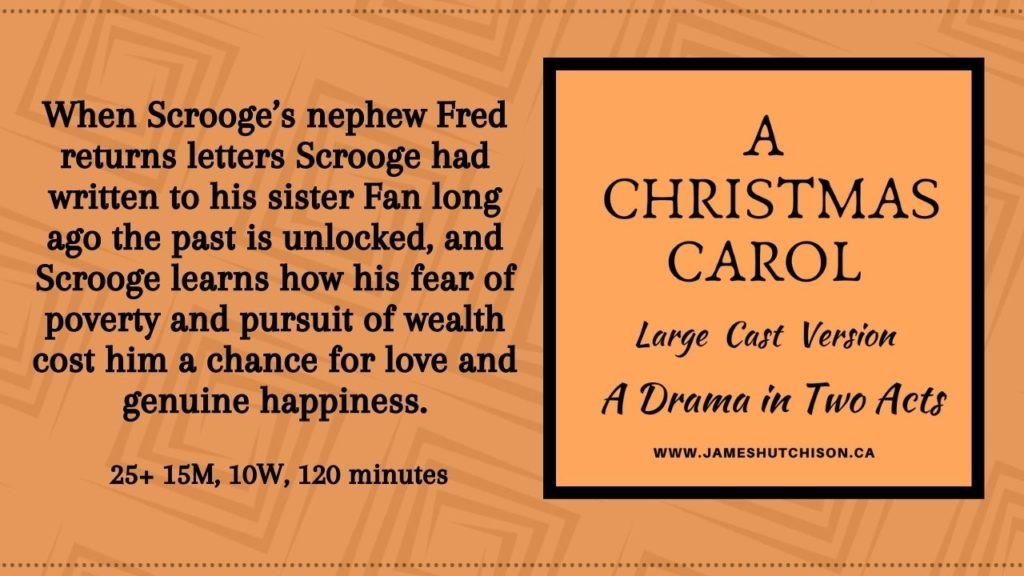
DALE

Yes, this play has been in development since it was first commissioned in the fall of 2005 and written in February 2006. It’s taken twelve years to get to the stage. And some people think it’s autobiographical, but it’s actually not. There are elements of truth in it, and there are true stories in it.

JAMES

So, what you’ve done is taken personal experience as an inspiration and then created the play out of that. What are some of your thoughts about this twelve-year journey?

DALE

Well, when I started I didn’t know what the hell I was doing. I’d never written a play before. But one thing that worked to my benefit as a playwright was my day job as a news editor. A news editor takes the raw material that a reporter shoots with her photog (cameraman) and helps it become a better product. And one of the things that entails is taking interviews that are five to twenty minutes long and pulling out 20-second sound bites. So in a sense – I’ve been working with dialogue for twenty-six years.

I’d also taken a writing workshop at the Banff Centre from Fred Wah about a form of Japanese poetry called Utanikki. In Utanikki you take two pieces of text and chop them up and then you put them back together in some form, and just by taking two completely different subjects – for example, a recipe for making scrambled eggs and a piece about coming out to your family and mashing them together a relationship is created between these two topics that didn’t previously exist. Many of my writings employ this method. Two types of writing blended together. I have poems where there’s haiku blended with free form.

Jamie Matchullis as Jennifer and Kelsey Verzotti as Jade in the Lunchbox Theatre production of Ai Yah! Sweet and Sour Secrets By Dale Lee Kwong – Photograph by Benjamin Laird

In the play I had this story about a lesbian and her girlfriend, and eventually they decide to move to Vancouver to get away from her family. But in between those scenes I had another entire play. It was a reality game show like Survivor where the lesbian girlfriend was being forced to come out to her family through a competition. There was a character like Jeff Probst, and there was this ancient Chinese sage character named Connie-fucius who would spout out fortune cookie lines.

Over the years I worked with a lot of different directors and dramaturges who encouraged me to remove the Survivor scenes from the play, but it was honestly my favourite part. I loved it! And I loved the character of Connie-fucius.

Lunchbox Theatre – The Early Days – Bow Valley Square

Rona Waddington never scheduled it for a production, and after she left Lunchbox I resubmitted it to Pamela Halstead when she was artistic director, and she was really interested in it, but by then she had already submitted her own resignation. So she set up a meeting between me and Glenda Stirling who was the incoming artistic director. Glenda had already programmed her first season,  but she was interested in it for the following year, but then Glenda left. So I’d submitted the play to three different artistic directors and it had fallen through the cracks each time.

The other thing you need to know is that it’s been my goal to have a play at Lunchbox Theatre since 1978. I was in grade twelve when the Stage One program first started, and I don’t even know how I ended up going to all the Stage One readings but I did, and I made a mental note to myself that someday I would like to have a play at Lunchbox.

JAMES

But isn’t that fascinating – that there’s that connection from thirty years ago – no forty years ago.

DALE

78, 88, 98, 2008 – oh my God, forty years!

JAMES

Four decades.

DALE

That makes me tear up thinking about that. That’s why this play is so special to me. Lunchbox is my favourite theatre company, and I make no bones about saying that. I’ve been donating to them for years, and I’ve been volunteering there, and I think they’re one of the best treasures in Calgary.

Chantelle Han as Lilly and Ben Wong as Charlie in the Lunchbox Theatre production of Ai Yah! Sweet and Sour Secrets by Dale Lee Kwong – Photograph by Benjamin Laird

JAMES

So what happened next?

DALE

After Glenda left, in comes Mark Bellamy. I knew Mark vaguely from Vertigo Theatre – and you’d think I’d show him my script right away, but I was gun shy having experienced several disappointments. So, I got to know Mark better, and he got to know me better, and I finally said to Mark, “You know, I’ve got this script that was workshopped here, and it kind of fell through the cracks.” He asked me what it was about and after I told him he said, “Send it to me.” So then I had this opportunity to send it to him, and do you think I sent it to him? No, because by that time it had been workshopped so much I didn’t know where I was at, and I thought I should get him a clean version. So, it took me a year to revise it and send it to him and he got back to me within a month, and gave me a workshop.

At the workshop Mark gave me the choice of a couple of directors and I chose Trevor Reuger from APN whom I had prior dealings with. He had helped me with another script I had started. I told Trevor my creative process and how I’m late with everything and not to worry because I was a news editor, and I’m used to tight deadlines, but before we started the workshop, Trevor suggested, that for the sake of time, we leave the Survivor bits out for now and he said, “If you can show me how they advance the storyline then we’ll start putting them back in.” I was sort of reluctant to do that.

JAMES

Sounds like a clever strategy from your dramaturge.

DALE

Yeah, so the first day we missed two Survivor scenes, and they were funny, and I was like – how can I justify getting them in?

JAMES

So, for the whole workshop you were trying to push them back in?

DALE

Well by Thursday I knew Survivor wasn’t coming back. The play had changed. Everything was fluid. I was doing rewrites every day. But there was this fight scene between Jade and her mother which I’d always struggled with because I didn’t have that fight with my mother in real life when I came out.

Ben Wong as Charlie, Jamie Matchullis as Jennifer, Kelsey Verzotti as Jade and Chantelle Han as Lilly in the Lunchbox Theatre production of Ai Yah! Sweet and Sour Secrets – Photograph by Benjamin Laird

DALE

When I first came out it was in ’93, and I wrote the play twelve years later. I came out before Ellen Degeneres came out, and that was big news. She came out on the cover of TIME magazine. I came out to my family – all in one day – at my mom’s house. I told my cousins first, and at dinner I told everybody’s parents. The ones who had the most trouble with it were the cousins in the 50 to 70 year range, but everyone over 70 was fine with it. In my experience of coming out – senior citizens don’t care that much – you know – life’s too short – do what you want. I had one relative who was ecstatic to finally have a lesbian in the family – that was surprising too.

So, anyway, I had written the play forward to the fight scene and written the play backwards from the fight, but I couldn’t actually write the fight scene. There was just a blank page.

And we got to Friday, before the public reading, and we were reading the script, like we did every morning, and the actor basically went from the last line before the blank page to the first line after the blank page and I went, “No wait. There’s a fight scene there.” And they all went, “What?” And I said, “Well that’s what the blank space is.” And Trevor said, “Where are the words?”

And I said, “I was hoping we could workshop this and get something out.” And Trevor said, “Dale, there’s an audience coming in an hour and a half to see your play. You have to have some words there.” And I said, “Well yeah, but I’ve struggled all the way forward and all the way back – I just need some help.”

Finally Chantelle Han who was playing the mother said, “I think I would ask them to leave, but I need to say something first.” Then the actor playing Jennifer or Jade said, “Well maybe such and such could happen.” And that gave me a little bit. And I think we all worked it out together. I was scratching out lines and adding lines and telling them things. I have no idea what that page looked like on their scripts, and when they actually read it at the reading it wasn’t typed. It was just hand written notes. That script literally got written an hour before it was read.

JAMES

But the audience didn’t know that, and I saw that reading, and it was a lot of fun. There were a lot of laughs. People loved the play, and I remember mentioning to you how much clarity had come into the play from when I had read it probably a year and a half to two years before that if not more. So now that the play is being produced are you excited about going into the rehearsal process?

DALE

Even though I’m not as much of a green horn as I was twelve years ago I’m still a newbie. This is my first big production. So, there’s a bit of a learning curve, but I’m really lucky because one of my mentors in the theatre community is Sharon Pollock whom I’ve known since 2006, and over the last few years we’ve become really good friends because we walk our dogs together.

Rehearsal for Ai Yah! Sweet and Sour Secrets
Jamie Matchullis, Kelsey Verzotti, Ben Wong, and Chantelle Han rehearse a scene from Ai Yah! Sweet and Sour Secrets

Sharon is wonderful. Last year she had her own new play Blow Wind High Water at Theatre Calgary and she had a revision happening on another play at Stratford and I was going through stuff on my end and so I could ask her questions like, “Should I go to the rehearsals?” And Sharon was the first to say, “It’s your right to go to the rehearsal. Not all playwrights do. In fact, most directors would probably discourage it, but you’re emerging – you’re a rookie – you should go to them all.” She said, “Just take a book, and be there if they need you, and listen once in a while, and see what things they struggle with, and you’ll learn.”

You know I always say to emerging artists, particularly artists in their 20s, I say, “You have age on your side. You can plead complete ignorance. You can say, I don’t know. I’ve never been to a dress rehearsal? Can I come to your dress rehearsal? I’ve never been to a first read. Can I come to your first read?”

Ben Wong as Charlie, Jamie Matchullis as Jennifer, Kelsey Verzotti as Jade, and Chantelle Han as Lilly in the Lunchbox Theatre production of Ai Yah! Sweet and Sour Secrets – Photograph by Benjamin Laird

DALE

The other thing you can do if you’re an emerging writer or artist is volunteer. I have been ushering at Calgary theatres for more than ten years. Almost every theatre company in the city uses ushers, and if you usher you get to see the play for free, and you meet the people behind the scenes. So there are all these people that I’ve met along the way, and I’ve been supporting them for ten years, and I finally have something they can come to.

JAMES

Playwright Dale Lee Kwong at Lunchbox Theatre 2017/18 Season Launch
Dale Lee Kwong at the Lunchbox Theatre 2017/18 Season Announcement with former Lunchbox Artistic Producer Mark Bellamy Photograph by Carol F. Poon

And genuine friends are happy for you.

DALE

Yes, I get that. I feel the love. At the official season announcement last February I just burst into tears. My best friend got a picture of it, and it’s one of my favourite pictures. Like you say it was a forty year journey. I didn’t even do the math. I’m bad at math. I’m not a good Asian.

JAMES

You can say that joke, I can’t.

DALE

You can credit it to me.

***


Dale also wanted to take this opportunity to thank the many people who have contributed to the development of her play over the years. Here is a list of the actors, directors, and dramaturges who have offered their time, talent and support in the creation of Ai Yah! Sweet and Sour Secrets.

Lunchbox Theatre – Stage One workshop, May 2006

  • TV Host/Charlie Wong – Steve Gin
  • Lillian Wong/Connie-fucius – Jacey Ma
  • Jade Wong – Elyn Quan
  • Jennifer Smith – Karen Johnson Diamond
  • Dramaturg/Director – Ken Cameron

Alberta Playwrights’ Network – Writing in the Works excerpt, Oct 2006

  • TV Host – Grant Lunnenburg
  • Lillian Wong/Connie-fucius – Sharon Pollock
  • Jade Wong – Laura Parken
  • Jennifer Smith – Francine Wong
  • Director – Sharon Pollock

Alberta Playwrights’ Network – Discovery Prize workshop and reading, Nov 2006

  • TV Host/Charlie Wong – Steve Gin
  • Lillian Wong/Connie-fucius – Michelle Wong
  • Jade Wong – Francine Wong
  • Jennifer Smith – Nicole Zylstra
  • TV Host/Stage Manager – Patrick MacEachern
  • Dramaturg/Director – Brenda Finley

filling Station Magazine – flywheel reading for Chinese New Year, Feb 2008

  • Charlie Wong– Ben Tsui
  • Lillian Wong– Jasmin Poon
  • Jade Wong – Francine Wong
  • Jennifer Smith – Elan Pratt
  • Connie-fucius – Jade Cooper
  • TV Host – Emiko Muraki
  • Director – Dale Lee Kwong

Lunchbox Theatre – Stage One workshop, June 2016

  • Charlie Wong – Mike Tan
  • Lillian Wong – Chantelle Han
  • Jade Wong – Ali DeRegt
  • Jennifer Smith – Julie Orton
  • Dramaturg/Director – Trevor Rueger
Poster for Ai Yay! Sweet and Sour Secrets at Lunchbox Theatre

Dale Lee Kwong writes poetry, plays, and creative non-fiction. Third-generation Chinese-Canadian, her work explores Chinese-Canadian history, diversity & inclusion, adoption, and LGBTQ issues. Dale is passionate about the importance of Chinatowns across North America, and the fight to save them from gentrification. Dale plans to keep writing about the past and present, in hopes of shaping the future! 

Lunchbox Theatre is one of the most successful noon-hour theatre companies in the world and produces one-act plays that provide patrons with an engaging and entertaining theatre experience. Lunchbox produces seven plays per season, as well as the Stage One Festival of New Canadian Work where many of the plays produced by the company are developed. Lunchbox is one of Calgary’s longest-running professional theatre companies and is located in downtown Calgary at the base of the Calgary Tower.

Tung Bui is a Calgary photographer and videographer that is passionate about visual storytelling. He loves the challenge of trying to shoot outside the lines of the viewfinder. So if you’re looking to capture your memories in a unique way…let his imagination work for your vision.


This interview has been edited for length and condensed for clarity.

DOWNLOAD: James Hutchison Interviews Playwright Dale Lee Kwong – Ai Yah! Sweet and Sour Secrets


A Christmas Carol by James Hutchison premieres at the Carriage House Theatre

I get a very special gift this year because A Christmas Carol by James Hutchison Premieres at the Carriage House Theatre in Cardston Alberta this December. Santa certainly outdid himself this year and so here’s an interview with some of the wonderful people bringing my adaptation of the famous story to life.

“But Uncle I have always thought of Christmas time as a kind, forgiving, charitable time. It is the one time of the year when men and women open their hearts and think of all people as fellow passengers to the grave, and not as another race of creatures bound on different journeys. And therefore, though it has never put a scrap of gold or silver in my pocket, I believe that it has done me good, and will do me good; and I say, God bless it!”

***

And so do I! That’s Fred talking to his Uncle Scrooge about why he values Christmas so much. Christmas continues to be a time of celebration, reconciliation and compassion. There are so many wonderful and inspiring stories to enjoy this time of year. It’s a Wonderful Life starring Jimmy Stewart and Lionel Barrymore is one of my all-time favourites. And I never miss a chance to catch The Bishop’s Wife starring Cary Grant, David Niven and Loretta Young. And of course, no Christmas would be complete without a telling of Charles Dicken’s classic tale A Christmas Carol.

When I sat down seven years ago, this very Christmas, to write my own adaption of A Christmas Carol, I discovered that I didn’t really have anything new to bring to the story, so I decided to write another play instead called What the Dickens!

What the Dickens! is a play in the tradition of Noises Off by Michael Frayn or Moon Over Buffalo by Ken Ludwig. It’s basically a play within a play and in this case it’s about the Pine Tree Player’s disastrous production of A Christmas Carol.

But as a result of working on that play I had spent a lot of time with the text of A Christmas Carol and I gained a lot of fresh insights into the story and so once I had finished What the Dickens! I was finally ready to begin writing my own adaption of the original story.

 Peter Hauge who plays Scrooge in A Christmas Carol by James Hutchison Premieres
Peter Hague as Scrooge in A Christmas Carol Photograph by Kelsey Pankhurst

One of the things I wanted to do in my version of A Christmas Carol was show how Scrooge was shaped into the man he became. We all live in societies and all societies influence and shape the values and opinions of its members. So, I’ve expanded the role of Jacob Marley, which was Scrooge’s business partner and mentor, and I’ve added another business associate of Scrooge’s named Mr. Bentley in order to illustrate how Scrooge was shaped into the man he became and not alone in his disdain for Christmas.

As Fred, Scrooge’s nephew says, “There are those who see Christmas as a waste of time and energy and my Uncle Scrooge was not only a member of that tribe but in all likelihood their loudest cheerleader and most ardent supporter. He hated Christmas. He hated anything that did not make him richer and so he hated Christmas most of all.”

The production is being directed by Juliann Sommerfeltd who says that A Christmas Carol is a story about hope. “We all have Scrooge-like moments and so that makes him a relatable character whom we pity. His overnight transformation gives us hope that we can alter our own bad habits.”

“The reason I love the story so much and keep coming back to it is because I love the opportunity it shows that people have a second chance. There’s so much depression in the world that being able to realize that there is another day and that you can write on a brand-new page tomorrow and that no matter where you’ve been you can turn things around and start over is an important message.”

“Also, watching Fred’s kindness to his mean Uncle inspires hope that our own kindness can ignite change in the ones we love the most. All that, and a Christmas story as well.”

Over the year’s Scrooge has been played by an assortment of actors including Alistair Sim, George C. Scott and now here in Cardston by Peter Hague. Juliann says she chose Peter because “He has the ability to give Scrooge the edge he needs at the beginning of the play and then end the play with the audience smiling at Scrooge’s bouncing enthusiasm over his changed ways. He goes from bear to teddy bear and you just want to hug this teddy bear of a man.”

Peter says that “There’s some Scrooge in all of us and that’s why this time-honoured character is so compelling. Wealth is very important to Scrooge because he feels it brings him respect and power in his community.”

As Scrooge says to Mr. Harrington who has come to Scrooge’s office on Christmas eve asking for an extension on his loan, “You may find me cold and unfeeling sir, but I would venture to say I am a man of my word; a man whose word carries weight; a man whose word allows him the ability to strike a deal and back it up with his signature. My signature is worth something. Yours it would appear – if you continue to treat your financial obligations and business dealings in this manner – will soon be worthless.”

“Many people in this world, like Scrooge, are too self-absorbed to feel sympathy for others because they evaluate life as the world affects them instead of how they might affect the world.” says Peter. “It’s not until Scrooge sees life from the perspective of others that he has an epiphany that makes him feel that he has missed the mark. The “mark” being people, love and the relationships built in life. As audiences watch the show I hope they will consider what might be amiss in their lives and make changes that will make their lives and the lives of their fellow men more fulfilling.”

“The Carriage House Theatre,” according to Alonna Leavitt, Managing Director of the Carriage House Theatre Foundation, “is an integral part of the Cardston Community.”

Production still - A Christmas Carol by James Hutchison premieres
Michael Holthe as Dick Wilkens and Cassidy Duce as Belle in A Christmas Carol – Photograph by Kelsey Pankhurst

“For some people, it’s the place they go to see their children and grandchildren perform in the school choir concert. For some, the Carriage House Theatre is the place they take their family to attend a movie. And then many people look forward to seeing the next live theater production – whether it’s a Summer Theatre show, a Junior High production or a Community Theatre production. And for many people, the theatre becomes an extension of their home where they feel safe. They involve themselves on the stage or behind the scenes in a production role and feel satisfaction and joy from that experience.”

“When a production such as A Christmas Carol is presented – where the cast and crew are all members of the community, the community spirit and enthusiasm is exciting. The Carriage House Theatre is a happening place for a small community like Cardston. We are so fortunate and feel so blessed to have this facility in our town.”

Dr. Robert Russell says the The Carriage House Theatre is the result of a dream that started thirty years ago when he along with two other business partners bought the local Cardston movie theatre, The Mayfair, in 1990. The Mayfair was completely gutted and renovated and reopened in 1992 as a 333 seat live theatre and movie venue. Dr. Russell’s two partners dropped out early and he’s had the whole thing for the last twenty-eight years. “The theatre is here to serve people and to educate, enrich and enjoy. And when we talk about educate we’re not just talking about the mechanics of theatre production but to educate people to think and think seriously about what they’re seeing.”

A Christmas Carol by James Hutchison Premieres

“In A Christmas Carol you have Scrooge who has wealth and materialism but no spirit. And if I can – with my limited means – present a story about change and the transition to a more Christ like type of attitude maybe people will leave the theatre with some idea of incorporating away from materialism and money, in their own lives, which are the two main things that drive a secular society. That’s what A Christmas Carol is – Scrooge becomes a Christian. He transitions from a miserly old unhappy man and finds joy by extending himself and his resources to other people – which is the very premise of Christianity. To me that’s the biggest thing. My whole premise in my life has been service to other people. I was a physician and my whole attitude of being a physician was to serve my fellow man with skill and expertise to make their lives longer and better.”

Scrooge echos Dr. Russell’s premise when he says, to his nephew Fred, at the end of the play, “You’re right. Christmas is a kind, forgiving, and charitable time. A time when men and women open their hearts and think of their fellow man. A time for mercy, charity, and benevolence. And so, in the memory of your dear mother, I will honour Christmas and keep it all the year – and I say along with you, God bless it!”

And so, this Christmas, might I suggest, you gather up the family and friends and head on over to the Carriage House Theatre and catch this fresh, fun and lively adaptation of A Christmas Carol where you’ll meet Mr. Bentley, learn all about the letters Scrooge wrote to his sister Fan, and find out who Mr. Newbury is. You’ll still find all the ghosts of Christmas Past, Present, and Future along with Tiny Tim, Bob Cratchit, the Ghost of Jacob Marley, Old Fezziwig, Scrooge’s nephew Fred, and the love of Scrooge’s life, Belle. There are some new scary bits, a few good laughs, a tender moment or two and some surprises! It’s a fresh take on an old tale sure to thrill young and old alike.

The entire cast of A Christmas Carol by James Hutchison Premieres
Cast & Crew of The Carriage House Theatre Production of A Christmas Carol by Charles Dickens. Adapted for the stage by James Hutchison – Photograph by Kelsey Pankhurst

***

A CHRISTMAS CAROL BY JAMES HUTCHISON PREMIERES

CAST OF CHARACTERS

Peter Hague as Ebenezer Scrooge
Rob Crawford as Mr. Bentley
Mike Morphis as Bob Cratchit
Grant Comin as Fred
Blake Bevans as Mr. Granger and the Headmaster
Ben DeVuyst as Mr. Harrington and a Business Man
Levi Mason as Mr. Murdock and Old Fezziwig
Luke Credd as a Poor Boy and Cousin Herb
Sawyer Pawlenchuk as Mr. Newbury, Topper and Thomas
Esther Leighton as Mrs. Dilber
Darren Cahoom as Ghost of Jacob Marley
Candace Perry as the Ghost of Christmas Past, Rose and Caroline
Max Bevans as Scrooge as a young boy and Belle & Dick’s Child
Brad Peterson as Scrooge as a young man
Ellandra Leighton as Fan and Fezziwig’s Child
Jennica Williams as Mrs Fezziwig
Madisyn Bevans as Fezziwig Child and Caroler
Emma Schneider as Fezziwig Children and  Belle and Dick’s Child
Mike Devuyst as Jacob Marley and Old Joe
Cassidy Duce as Belle
Michael Holthe as Dick Wilkens and a Business Man
Jack Crawford as Belle and Dick’s Child, Ignorance and a Boy on the Street
Emma Quinton as Belle and Dick’s Child and Want
Emma Bevans as Belle and Dick’s Child
Asa Verdon as the Ghost of Christmas Present and Spirit
Marie Morphis as Mrs Cratchit
Isaac Morphis as Cratchit child and Fezziwig Orchestra
Alexi Morphis as Cratchit child and Fezziwig Orchestra
Josh Morphis as Cratchit child and Fezziwig Orchestra
Julie Anne Morphis as Cratchit child and Fezziwig Orchestra
Adam Morphis as Cratchit child and Fezziwig Orchestra
Nathan Morphis as Tiny Tim
Ashtyn Lybbert as Emma
Dominic Caravaggio as the Ghost of Christmas Future
Anica Baff as a Business Woman
Daniel Atwood as a Spirit
Synevie Wilde as a Spirit
Shelby Robson as a Spirit
Capri Powlesland as a Spirit
Vicky Powlesland as a Caroler
Mika McCarty as a Caroler
Brianne Watson as a Caroler
Savannah Hunter as a Caroler

PRODUCTION STAFF

Producer – Alonna Leavitt
Director – Juliann Sommerfeldt
Musical Director – Alonna Leavitt
Stage Managers – Samantha Atwood & Eden Atwood
Lighting Design – Jim Fletcher
Costumes – Val Jensen & Alonna Leavitt
Costume Construction – Doreen Card, Marina Leavitt, Sheila Hague, Janet Crapo, Darren Cahoon
Set Construction – Don Pierson
Set Painting – Janet Mein, Esther Leighton, Josh Creason, Paige DeVuyst, Levi Mason, Anica Baff
Box Office – Norma Reeves
Lighting Technician – Evy Schnoor
Make-up & Hair Design – Dalys Fletcher
Make-up & Hair Assistants – Kim Schneider, Tonnia Watson, Lacey Quinton, Teagan Perry, Ivy Schnoor, Katia Van Dysse, Beth Holthe, Krystin Bevans, Emma DeVuyst
House Manager – Debbie Fletcher

The Carriage House Theatre: The Carriage House Theatre has been providing the town of Cardston and Southern Alberta with live family-oriented entertainment for more than twenty-five years. The Theatre produces a regular season of plays as well as its popular summer musical festival while providing opportunities for talented local youth to participate in live theatre productions.

The Alberta Playwrights Network:  The Alberta Playwrights’ Network exists to nurture Alberta playwrights and provide support for the development of their plays. APN promotes Alberta playwrights and plays to the theatre community, while building and fostering a network of playwrights through education, advocacy and outreach. A Christmas Carol was partly developed and workshopped through the Alberta Playwrights Network Wordshed Program in 2015 with the participation of Trevor Rueger, Laura Parken, Roberta Mauer-Phillips and Julie Orton.

  • Interviews have been edited and condensed for clarity.
  • Background information for this post included the article, Yesterday Once More, by James Frey in the summer 2005 edition of Lethbridge Living magazine.

Link to A Christmas Carol by James Hutchison

Link to What the Dickens by James Hutchison

An Interview With Playwright Maria Crooks: The Mary Mink Story

Photograph of Playwright Maria Crooks
Playwright Maria Crooks – Photograph by James Hutchison

“Frankly as human beings we all have a tendency to be more wary and distrustful of anyone who is not like ourselves. Also there has recently been a lot of discussion about who has the right to tell other cultures’ stories and my play touches on that topic. As our society becomes more diverse it is important to talk about this and to understand how to respectfully approach the telling of stories about other cultures. I don’t think it is wrong to write stories or make movies about others but one should always think about how to do so in a respectful and mindful manner.” – Playwright Maria Crooks


Maria Crooks is an emerging Calgary playwright who began writing plays after retiring from a corporate job in the oil industry in 2011. She describes her most recent play, The Mary Mink Story, as a play about untrammeled ambition, ruthlessness and deceit and one man’s relentless efforts for the truth to be told.

JAMES HUTCHISON

Maria, what attracted you to playwriting as opposed to novels, short stories, poems or other forms of writing?

MARIA CROOKS

I’ve always had a passion for writing and in the past I’ve taken a number of writing courses including poetry and short story writing. I decided to try playwriting because it was a new kind of writing for me and because I don’t like doing research and I mistakenly thought that writing plays wouldn’t require doing much research. Despite discovering that I was wrong about the amount of work it takes to write a play, I was hooked when at the end of the first course, the instructor brought in two professional actors to read scenes from the plays we had written in class. It was so thrilling to have the characters I had created, in my head, come to life before me that I’ve been writing plays ever since.

JAMES

You know I find it inspiring that you’ve come to playwriting later in life and I think that’s a great thing. I think people should go after their dreams no matter what their age. What motivated you to go after this dream?

MARIA

I love the theatre and I love acting and in fact after retiring I started taking acting courses and I’ve acted in a couple of plays since then. I also love words and writing and so the acting led to the writing of plays and somehow the writing has taken centre stage as it were, at least for the time being.

JAMES

A few years ago, I went to When Words Collide, an annual writers and readers conference here in Calgary, and heard American fantasy and science fiction author Brandon Sanderson talk about writers being either gardeners or architects. Gardeners are writers who plant seeds and see what grows. In other words, they just sit down and start writing. Architects are writers that like to make a blueprint before they start writing. Which are you?

MARIA

I believe I’m naturally a gardener. Even at university when I had to write papers I had difficulty following structure and pattern. I find following a blueprint a bit confining. However, over the years, I’ve discovered the usefulness of having a blueprint. It’s particularly important when writing a play where you have to know everything about the background of the characters you’re writing about before you start writing because it grounds them and informs their choices and will make your play and the characters more realistic and believable.

JAMES

Okay I have to ask, one of your earlier plays is a play called Age of Love – and it’s about a romantic relationship between a younger man and a much older woman – where did that story come from?

MARIA

I was listening to the program As It Happens on CBC radio about two years ago when they were rebroadcasting episodes from their archives. I heard an interview with a young man who in 1976 was 21 years old, and had fallen in love with his 76 year-old step-grandmother who had recently been widowed and he was determined to marry her despite his parents’ protests. At the time I was looking to write a play examining sexuality and I thought the story of love between two people with such a huge age difference would be intriguing to explore and write about.

JAMES

As you were writing that play what did you discover about your own thoughts and society’s thoughts concerning love, sex and age.

MARIA

I wrote the play as a comedy: I thought it was very funny and odd for a young man to fall in love with wrinkles and false teeth, but as I wrote it, I fell in love with my characters and I realized that romantic love comes in different forms and the usual pattern of boy meets girl who is young and beautiful is only just one of many ways for people to fall in love.

Ryan Gray as Ash and Diana-Marie Stolz as Olivia in the Urban Stories 2015 Production of The Age of Love

JAMES

It was produced so I’m curious what the audience’s reaction to the play was.

MARIA

I was very pleased with the reaction of the public, in fact it got good reviews* and elicited a lot of laughs. To this day, I will be at a dinner party or be at some other social function and friends or other people who have seen the play will approach me and want to talk about it. This happens way more often than with any other play I’ve written. Many wonder if perhaps I had been in a relationship with a younger man and that is the reason I wrote the play.

I also did research on gerontophilia, which is a little-known sexual preference for the elderly, and I printed an article to post at the theatre for the audience to read so they would know that this sort of love is possible and that I didn’t just write it out of wishful thinking.

JAMES

You mentioned that people thought the story for Age of Love came from personal experience but even though the specifics of that story aren’t about your life how much of your own life experience do you find you put into your writing?

MARIA

I think it’s inevitable that my own experiences will seep into my writing consciously or unconsciously.

When I was a child we moved from Cuba to Jamaica and after the move my parents couldn’t find an item, it’s been so long now I can’t remember what it was, but they immediately assumed it had been stolen by the woman who had been helping with the packing. This woman had been a family friend and my parents never responded to her letters because of the assumption that she had stolen from them. Many years later they found the missing item but by then it was too late, the friendship had been broken.

That story became the basis of my first play, The Servant, which is a story about a servant who is accused of having stolen a valuable ring which was subsequently found. I wanted to examine the nature of trust and how quickly it can be eroded when we jump to conclusions. In that same play I included a scene from a revival church meeting I witnessed as a child with a woman getting into the spirit and whirling around while speaking in tongues.

So yes, my experiences do enter my plays from time to time.

JAMES

Your current play is The Mary Mink Story. What is that play about?

MARIA

The Mary Mink Story is about a black woman who lived in Toronto in the mid-19th century. Her father, James Mink, was a prosperous businessman who owned a hotel and livery stables and had several lucrative government contracts delivering mail and so forth. According to several historical accounts, which I found online and in books, James Mink placed an ad in the Toronto papers offering $10,000 for a white man to marry his daughter. A white man married her and promptly took her across the border to the US where she was sold into slavery. The story was so intriguing that I felt compelled to write a play about it, however my research led me to a researcher from York University in Toronto who has done extensive work on James Mink and his family and she provided me with information which disproved the story.

JAMES

After doing your research and finding out the real story – how did that impact your play?

MARIA

I found myself in a dilemma. I felt the story was so dramatic that I wanted to tell it, but at the same time I didn’t wish to perpetuate the myth which is based on racism and bigotry and I didn’t want to be a part of that. I, therefore, decided to tell the myth while at the same time debunking it. This has been my most difficult play to write and my hope is that I have succeeded in exposing the myth while at the same time telling an interesting Canadian story.

JAMES

Why do you think this story needs to be told?

MARIA

I felt this was a story about a black family that needed to be told and I had a responsibility to set the record straight. A TV movie about the Minks was made in the 1990s and it too recounted the myth as if it were true. Wikipedia has an account of James Mink and that account does not say that it is a myth either so anyone coming across the movie or reading the Wikipedia account will come away believing it to be true.

JAMES

Why do you want to set the record straight? To tell the truth about what really happened?

MARIA

I feel a responsibility to James Mink and to his daughter to set the record straight because both were real people who were respectable and hard-working intelligent folk who do not deserve this continued insult to their memory. James despite his humble beginnings rose to become a prominent citizen of his community both he and Mary were proud of their African heritage and it is inconceivable that he would have made the offer he was purported to have made in order to get his daughter married.

JAMES

You’ve been able to work with Urban Stories a local theatre company here in Calgary on the development and production of your plays. What’s that been like?

MARIA

As an emerging playwright, collaborating with Urban Stories Theatre has been really advantageous. I met the founder and Artistic Director, Helen Young at an actors studio a few years ago and she encouraged me to expand a short play I had written into a full-length play which she then produced and presented as a main stage play. Urban Stories has a mandate to promote and support local playwrights and to that end they put on playwriting workshops, help budding writers through the dramaturgical and workshop process and will produce works which they feel fulfill their mandate of examining social justice issues.

Urban Stories has produced two of my full-length and two of my short one-act plays and we’re planning to produce the The Mary Mink Story at some point in the future. I originally had no intentions of offering this play to Urban Stories or anyone else for that matter because I had reached an impasse with the play and didn’t know how to move forward with it. I knew I wanted to expose the myth but I didn’t know how to do it, so I had put it away. Then I happened to mention to Helen that I had this play that I had more or less discarded and she asked to read it. She did and next thing I knew she said she wanted to produce it. So now I’m working with Urban Stories as well as dramaturge Caroline Russell-King, so that the play can be produced.

JAMES

Speaking of Urban Stories’ mandate to examine social justice issues what are you hoping audiences will get out of your telling of The Mary Mink Story?

MARIA

First of all, I hope they will find it entertaining and enjoyable but I also want people to see how easily lies can be created and perpetuated. This myth was born out of jealousy and dislike of the “other” and it persists even today.

JAMES

I assume you’re referring to the “other” as in immigrants or people of different race or nationality.

MARIA

Yes, I’m referring to immigrants and minorities but frankly as human beings we all have a tendency to be more wary and distrustful of anyone who is not like ourselves. Also there has recently been a lot of discussion about who has the right to tell other cultures’ stories and my play touches on that topic. As our society becomes more diverse it is important to talk about this and to understand how to respectfully approach the telling of stories about other cultures. I don’t think it is wrong to write stories or make movies about others but one should always think about how to do so in a respectful and mindful manner.

JAMES

Anything else you’d like to add about the play or writing or art or who you think is going to win the Grey Cup this year?

MARIA

I think theatre is important and it’s very pleasing how much good theatre there is to see in Calgary. We live so close to the US and their plays and playwrights tend to dominate so I think it’s very, very important to foster our own Canadian playwrights and their work. As for who will win the Grey Cup, I’m afraid I know nothing about football so, I won’t even hazard a guess.

***

Maria Crooks is a Calgary playwright whose plays are often inspired by real events which she uses as a starting point for her fictional work. You can contact Maria by at catalinaver13@gmail.com if you’d like more information or if you’d like to obtain copies of her plays.

FULL-LENGTH PLAYS

  • The Servant is a play set in early 1960s Jamaica and Canada. It’s about a poor servant woman and her desperate efforts to achieve a better life for herself and her children despite the many forces arranged against her.
  • The Age of Love is a wacky comedy about an inheritance, a free-spirited step-grandma, a libidinous young man, his jealous mama, a weirdly eccentric German doctor and a ruthlessly ambitious talk show host. Non-stop hilarity ensues when these unlikely characters come together on a tabloid TV show.
  • The Mary Mink Story is a play about untrammelled ambition, ruthlessness and deceit and one man’s relentless efforts for the truth to be told.

SHORT PLAYS

  • Dreamboat is a 15 minute play about a plain young woman’s dreams of finding true love
  • La Mère, La Mer is a short play about a young mother’s descent into insanity and the unfathomable act she commits after the birth of her child.

* Review: The Age of Love Turns the Taboo Into Something Sweet by Rodrigo Flores

***

Urban Stories Theatre is focused on supporting local playwrights writing about social justice issues by nurturing their ideas from first draft to finished production. The company is made up of a core group of local artists who oversee all productions and workshops. Budding actors, directors, stage managers and designers are encouraged to share their ideas by becoming part of the team on a show by show basis.

Vision: To give local artists a voice in creating theatre that tells real stories about real life.

***

This interview has been edited for length and clarity.


An Interview with Playwright Meredith Taylor-Parry: Book Club II

Playwright Meredith Taylor-Parry – Photograph James Hutchison

“I enjoy writing humour and I like the challenge. At the same time, if the story doesn’t have heart, if nothing serious is going on underneath the humour….what’s the point really? I want my plays to address some aspect of the human struggle that hopefully people can relate to. That’s what I want to see when I go to a play so naturally I aspire to that in my writing.” Meredith Taylor Parry interview Book Club II

***

Meredith Taylor-Parry is a Calgary-based actor and playwright whose fun and insightful comedy Book Club was a runaway hit for Lunchbox Theatre back in 2016. At that time I did a two-part interview with Meredith. In Part One we talked about Meredith’s play Survival Skills which won the New Works of Merit Playwriting Contest in 2013 and was produced Off Off Broadway by the 13 Street Repertory Company. In Part Two we talked about Meredith’s play Book Club which was a funny and insightful look at motherhood and the joys and disappointments of life. Now in this third interview, Meredith and I talk about her very funny and moving sequel to Book Club – Book Club II: The Next Chapter, which premieres at Lunchbox Theatre and runs from September 18th to October 7th.

***

JAMES HUTCHISON

The first Book Club was a big hit for Lunchbox Theatre and ended up having an extended and sold-out run. Audiences loved it! Why do you think the play resonated so well with audiences? And did you notice any difference in how men and women reacted to the play?

MEREDITH TAYLOR-PARRY

I knew I had a dream team as far as our director, actors, production and design team, but I never once imagined it would do so well! I can’t even tell you how much fun it was sitting in the audience listening to the laughs and waiting for the responses to my favourite moments. That was so exciting for me and unexpected.

I really think the reason the play resonated so well with people was because of the chemistry we had together as a group of artists. Everyone contributed so much to that script in the Stage One workshop process. There wasn’t one person in that room who didn’t add value to the script because everyone was brave enough to share themselves with me. I think that process and the generosity of the artists I was working with allowed me to find authenticity in the script along with the humour.

And, I think, the audiences liked it because they could relate to human beings, regardless of gender.  One of the best comments I got was from a man who said, “good comedy is good comedy.”

Anna Cummer, Cheryl Hutton, Kira Bradley, Arielle Rombough and Kathryn Kerbes in the 2016 Lunchbox Theatre Production of Book Club

JAMES

How soon after Book Club did you start thinking about a sequel?

MEREDITH

I was watching performances of Book Club sell out and I was thinking, better strike while the iron is hot Meredith! I didn’t want to miss the opportunity to approach Mark Bellamy, Lunchbox Theatre’s Artistic Producer, when things were going well, and I had already been working on an idea for a sequel based on a weekend I had spent in Banff with my girlfriends.

I have the BEST group of girlfriends. We’re all moms and we have a lot of laughs together, and I’m constantly writing down ideas when I’m with them. They don’t mind either, they’re very supportive of my writing.

So, I took my idea and managed to scrape together 20 pages of Book Club II and a rough outline and I submitted it to Mark pretty much as soon as Book Club closed.

He was thrilled and considered it for the 2016 Stage One workshop but, due to scheduling issues, we couldn’t get the same team together to work on it. So, he scheduled me in for the 2017 Stage One series AND programmed it for the beginning of this season. He let me know at the beginning of this year and it was very exciting and of course a bit terrifying because I didn’t have a full script yet.

JAMES

What is Book Club II about?

MEREDITH

I wanted to further explore the nature of really good female friendships and examine how that works within one’s marriage.

There’s a special kind of intimacy I share with my girlfriend’s and I’ve questioned how that affects my relationship with my husband. Does he feel left out because I rely on them so much? What about my girlfriend’s spouses? How do they feel?

The first play was all about good girlfriends supporting each other through the messy business that is motherhood. I wanted Book Club II to explore the toll parenthood takes on a marriage and examine where the character’s husbands fit into the complicated lives of these women.

Anna Cummer, Cheryl Hutton, Kira Bradley and Arielle Rombough in a scene from the Lunchbox Theatre production of Book Club II: The Next Chapter – Playwright Meredith Taylor Parry Book Club II

JAMES

Even a good marriage has rough patches and, I think, unfortunately, our society places a lot of unrealistic expectations on our relationships. For example, there’s the idea that our romantic partners should know what we want and feel and think without us actually having to tell them. That’s a romantic notion that doesn’t reflect the reality of marriage or relationships. To make any relationship work, romantic or otherwise, you have to communicate. You have to tell your partner – when you’re hurting – what you need – what’s going on in your life – otherwise they won’t know. So, I guess what I’m asking is whether or not you think that some of the problems people face in their marriages are because the reality of marriage doesn’t live up to the romantic fantasy of marriage? And maybe – now that I think of it – men and women have different expectations of what marriage is?

MEREDITH

Yes, and yes! We are raised on a certain brand of romance. Cinderella has been around for a long, long time! I think we are both unrealistic in our expectations and I think men and women have different expectations for their romantic relationships. I also agree that communication is key. Humans are terrible mind readers yet we easily make assumptions about our partner’s thoughts and behaviours and communicate our needs in cryptic ways.

In the workshop, we did discuss the typical “husband on the couch while wife slams dishes into the dishwasher” scenario. Why doesn’t she just ask for help? Why doesn’t he pitch in without being asked? We also talked about the different expectations for men and women when it comes to emotional vulnerability in communication. I think we’re improving but there’s still a culture of emotional toughness when it comes to boys.

JAMES

Where did the actual story for Book Club II come from?

MEREDITH

It started with the original idea of the characters getting away for the weekend and talking about their marital woes. I talked with lots of girlfriends and a few male friends about their marriages and I also did a lot of reading. There’s a lot of material out there about marriage and relationships! I went back as far as Men Are From Mars and Women Are From Venus, remember that one?

One of my favourites was “How Not to Hate Your Husband After You Have Kids” by Jancee Dunn. So, the story of Book Club II contains bits and pieces of all the research I did and of course it evolved greatly in the Stage One workshop this past June. Curt Mckinstry was extremely helpful with developing the husband character. Once again, I was blessed with a generous artist who was willing to share himself. And, of course, I got the rest of my dream team back as well.

Cast of Book Club II – Anna Cummer, Cheryl Hutton, Kira Bradley, Arielle Rombough and Curt Mckinstry Playwright – Meredith Taylor Parry Book Club II

JAMES

Did you feel any pressure writing the sequel? Were you able to focus on the writing without worrying about it being as big a success?

MEREDITH

The pressure made me sick to my stomach to tell you the truth.  What if number two sucks? But the great thing about a deadline is, you have no choice. I wasn’t going to walk into the workshop empty handed. It was a very intense week, the script was rough and I spent a lot of late nights writing so that I could address the issues that had come up during the day. That kind of intense writing leaves no room for your inner critic to get in the way. I did breathe a sigh of relief at the reading however when the audience seemed to like it. I also completely trust Shari Wattling, my dramaturg/director. She keeps me truthful and she keeps me focused and tells me when I’m drifting off course.

JAMES

I think one of the things that worked so well in the first play was the mix of humour and drama all brought to life by a wonderful cast and a terrific production. And I’d say based on the reading for Book Club II, which I saw back in June, I think you’ve managed to capture that same mix of humour and drama. So, I’m curious when you’re writing is the mix between humour and drama something you do intentionally or is it more of an intuitive process?

MEREDITH

I guess when I’m working I’m always looking for ways to work in funny or quirky bits. I enjoy writing humour and I like the challenge. At the same time, if the story doesn’t have heart, if nothing serious is going on underneath the humour….what’s the point really? I want my plays to address some aspect of the human struggle that hopefully people can relate to. That’s what I want to see when I go to a play so naturally I aspire to that in my writing.

Arielle Rombough, Cheryl Hutton, Kira Bradley, Curt Mckinstry and Anna Cummer in a scene from the Lunchbox Theatre production of Book Club II: The Next Chapter – Meredith Taylor Parry Book Club II

JAMES

It’s been a couple of years since you wrote the original Book Club. In what ways do you think you’ve evolved as a playwright?

MEREDITH

I’m learning more about structure and I’m learning more about the practice of writing. I was an on again off again kind of writer, creating in fits and starts and then buckling down when I had a deadline. But now, I write every day. A play is kind of like a lover, you need to give it attention so that it will give something back. If I give a play attention every day it seeps into my unconscious mind and feeds me new ideas constantly, even when I am not sitting at the computer. And hopefully on opening night, your lover doesn’t screw you over. Ha ha!

JAMES

If you loved Book Club you’re definitely going to love the sequel, but the great thing is you don’t need to have seen the first play in order to enjoy the second play. Both plays stand as full stories on their own. What do you want audiences to take away after they see the new story.

MEREDITH

My hope is that the audience will see a story they can relate to and enjoy a great night of theatre. I hope they will leave with a desire to see more theatre! There are so many spectacular offerings this season in Calgary!

JAMES

Are the girl’s stories going to continue? Is there a full-length play in the works?  A book maybe? A possible television series?

MEREDITH

Good lord, you’re getting way ahead of me. Let’s see how this one goes first, shall we?

***

Book Club II: The Next Chapter runs from September 18th until October 7th at Lunchbox Theatre. Performance times are Monday to Saturday at 12:00 noon plus a 6:00 pm show on Thursdays and Fridays. Tickets are $26.00 for adults and $21.00 for students and seniors. Tickets can be purchased on-line at Lunchbox Theatre or by calling the box office at 403-265-4292 x 0.

Lunchbox Theatre 2017/2018 Season

Book Club II: The Next Chapter by Meredith Taylor-Parry
Book Club is back. Get ready for another page turner.
September 18 – October 7, 2017

During a weekend getaway where the girls talk about creating a Mommy Commune and Lisa runs into an old boyfriend, the girls of Book Club have to examine what marriage and sisterhood truly means to them.

CAST

Kira Bradley – Kathy
Anna Cummer – Ellen
Cheryl Hutton – Lisa
Arielle Rombough – Jenny
Curt Mckinstry – Barry / Bartender / Colin

CREATIVE TEAM

Meredith Taylor-Parry – Playwright Book Club II
Shari Wattling – Director
Chris Stockton – RBC Emerging Director
Terry Gunvordahl – Scenic & Lighting Design
Rebecca Toon – Costume Design
Allison Lynch – Sound Design
Ailsa Birnie – Stage Manager
Ava Bishop – Production Assistant

Flight Risk by Meg Braem
One man’s heroic journey to find peace.
October 23 – November 11, 2017

World War II veteran Hank Dunfield is about to celebrate his 100th birthday, but painful memories of his time as a tail gunner during the war don’t make him feel much like celebrating. Only his new nurse Sarah is finally able to get to the heart of Hank’s pain and sorrow and help Hank find peace with the past.

The Santaland Diaries by David Sedaris, adapted by Joe Mantello
The is one elf that won’t make the nice list.
November 27 – December 23, 2017

An out-of-work actor in New York city takes a job as an elf in Macy’s Santaland Village and reveals all the crazy and hilarious behind-the-scenes shenanigans of the holiday season. A Christmas comedy for the little bit of humbug in all of us.

Inner Elder created and performed by Michelle Thrush
One woman show for all people.
Co-Presented with the High Performance Rodeo
January 15 – 27, 2018

Using real memories about her Grandmother’s impact on her life, award winning Calgary actress, Michelle Thrush takes audiences on a journey of discovery. A journey where we see the transformation from child to elder and learn that for everyone laughter is the best medicine.

Ai Yah! Sweet & Sour Secrets by Dale Lee Kwong
Dinner is served. So are juicy family secrets.
February 19 – March 10, 2018

When her father invites a surprise guest to celebrate Chinese New Years more than one family secret comes out of the closet and Chinese-Canadian Jade Wong is caught between being true to herself and living up to her family’s cultural expectations. A funny heart-warming story for anyone who has ever faced an awkward family dinner.

Miss Caledonia by Melody Johnson
This story will be over in an hour. Her Hollywood dreams may be too.
April 2 – 21, 2018

Peggy Ann Douglas dreams of becoming a Hollywood movie star and leaving behind all the stall cleaning, hay-baling drudgery of her 1950’s life on Rural Route 2. Step one is to sing, twirl and pivot her way to being crowned Miss Caledonia in the local pageant!

***

Playwright Meredith Taylor-Parry

Meredith Taylor-Parry is a playwright based in Calgary, Alberta. Her plays include So Long, a TYA play which toured Calgary and area schools in 2012 with Sandbox Children’s Theatre, Survival Skills (Winner New Works of Merit Playwriting Contest 2013) which was produced Off Off Broadway in 2014 by the 13 Street Repertory Company NYC and Devices which was produced as part of the 27th annual New Ideas Festival presented by Alumnae Theatre in Toronto. Her one act comedy, Book Club, received its world premiere at Lunchbox Theatre in Calgary in 2016, performing for a majority of sold-out audiences and held over due to the play’s popularity. She is looking forward to returning to Lunchbox with the sequel this September: Book Club II: The Next Chapter. Meredith is a co-founder of Bigs and Littles Theatre Society and a stay-at-home mom to 11 and 12-year-old girls. She is currently pursuing her MFA in Playwriting at the University of Calgary.

Lunchbox Theatre

Bartley and Margaret Bard and Betty Gibb founded Lunchbox Theatre in Calgary in 1975. Lunchbox delivers a fun and unique experience to its audience – upbeat performances in an intimate and comfortable atmosphere. Patrons are encouraged to eat their lunch while they enjoy the show. Lunchbox Theatre focuses on the development and production of original one-act plays; many of which are written by local Calgarians.


Montparnasse with Kathy Zaborksy and Carolyn Ruether is Must See Theatre

Carolyn Ruether & Kathy Zaborsky in Montparnasse – Photo: Jaime Vedres Photography

We go to the theatre to experience something about the complexity, beauty, heartache, joy and tragedy of life. So when you see a play that delivers…that has a wonderful script, mesmerizing performances and takes you along for a ride, where you completely forget about the time, you have to tell others. You have to share the news. You have to let people know they need to go and see this show before it closes.

So, before you do another thing go see Montparnasse by Lethbridge’s Theatre Outré at the Motel Theatre in the Arts Commons.  The play runs 75 minutes without an intermission and does contain nudity, strong language and mature themes – so it’s for an adult audience. But it’s also for an audience that loves theatre. An audience that wants to see a play that dives into ideas about the creation of art with complex characters presented in a wonderfully theatrical way.

The play takes place in the Paris of the 1920s. A Paris that has survived the death and devastation of the First Great War and the ravages of the Spanish flu. Millions have died and Paris is being reborn – it’s an era of Jazz where writers like Hemingway and Fitzgerald mingle with painters such as Picasso and Matisse. 

Nicolas Bohle & Carolyn Ruether in Montparnasse Photo: Jaime Vedres Photography

The story focuses on Margaret (Mag) and Amelia two Canadian girls who find themselves part of this hedonistic and artistic world. Mag has been living in Paris and earning her living as a model. Amelia arrives from Canada intent on pursuing her dream of becoming a painter. Eventually, Amelia also ends up modelling, but both women see themselves as more than simply models. Instead, they see themselves as collaborators in the creation of art. Eventually, Amelia gets an opportunity to present a painting at an exhibition but she struggles to find inspiration and subject matter for her painting until Mag says, “paint me.” And while the play is about the creation of art it’s also about the complicated relationship between Mag and Amelia and their feelings of love and friendship towards each other.

Both Kathy Zaborsky as Mag and Carolyn Ruether as Amelia give rich and emotionally true performances.  The play is wonderfully staged making use of four main acting areas that divide the audience into four sections. The Motel is a small theatre and that simply works to make the experience of the play even more intimate.  The script is rich and layered and filled with humour and passion. Plus, there’s music! Live music. From the moment we enter the theatre and throughout the play, Nicolas Bohle, who also plays a number of characters, has composed a beautiful score that enhances the overall experience of the play. This is a great ensemble production and director Jay Whitehead has brought all the elements together to create a memorable and moving piece of theatre.

So, if want to see a great show at a fantastic price hurry down to The Motel Theatre at the Arts Commons and catch Montparnasse. The show runs until September 2nd at 8:00 pm nightly with a Saturday matinee at 2:00 pm. Tickets are just $25.00 for adults and $20.00 for students – cash only.

MONTPARNASSE

Created by Maev Beaty and Erin Shields with Andrea Donaldson

CAST: Katharine Zaborsky as Margaret/Sylvia – Carolyn Ruether as Amelia/Queen – Nicolas Bohle as Artists & Writers

CREW: Director Jay Whitehead – Designer Deonie Hudson – Sound Designer Nicolas Bohle – Technical Support Conner Christmas – Dialect Coaching Douglas MacArthur


QUOTA Gets a London Production in the British Theatre Challenge

Quota gets a London production and wins the Audience Choice Award as part of the British Theatre Challenge.

“All societies are based on codes of behaviour and when someone deviates from that code there has to be a way to handle the situation otherwise chaos would reign supreme, and we don’t want that now do we. We want everything nice and tidy. All the socks in the sock drawer and all the undies in the undie drawer.”

That’s a line from my play QUOTA. It’s what Dave Dixon gets told by Kathie, the Civic Census taker, after he gets flagged for corrective action.

I wrote QUOTA while I was doing a little research for another play about the internment camps that the Canadian government ran during World War One and World War Two.* It’s always bothered me that we were fighting dictatorships that put people in camps while we were doing the same thing. Of course our camps weren’t concentration camps but once you have a different set of laws and rules applied to one group in your society – how do you keep it from going to the extreme?

Maybe you keep it from going to the extreme by making sure the rule of law applies to everyone equally regardless of race, gender, religion, sexual orientation, or ethnicity.

Of course that’s only if you believe that everyone is equal. Not everyone believes this. And if you’ve seen Avenue Q you know that we’re all a little bit racist. We’re all human and we make assumptions and have distorted beliefs about people and sometimes we’re not even aware of our own prejudice. But that’s a lot different than laws being enforced by a government that are intended to limit the rights and freedoms of a particular group simply because of of that group’s differences.

But governments are not composed of robots. Governments and Prime Ministers and Presidents and Kings and Dictators are all people. And so I have to wonder what kind of people are they? Are they good leaders? I think not if they allow such laws to be passed and enforced.

But what makes a good leader? I think good leaders don’t seek power for themselves but instead seek to empower others. Bad leaders are afraid of diversity. They’re afraid of others having power. They see the cup as half full and they want what’s in the cup all for themselves. And while I know there are lots of different definitions of leadership I think great leaders enlarge the world they don’t limit it. They share.

You know one of the purposes of theatre and story is to provoke discussion. Discussion about politics, morality, relationships, love, religion, and power. And comedy allows us to shine a light on attitudes and behaviours in a way that drama doesn’t. That’s why I wrote QUOTA. I wanted to take a look at how individuals go from being a member of society to becoming an identified minority and having their rights violated.

So, I’m excited to announce that QUOTA gets a London production and is being produced by Sky Blue Theatre as part of The British Theatre Challenge – Act II.  The British Theatre Challenge is an annual international playwriting contest run by the Sky Blue Theatre Company and this year, in addition to the ten winning plays produced in December 2016, an additional six plays will be produced on Friday April 7, 2017 at the Lost Theatre in London, England.  If you happen to be in London check it out.

Quota by James Hutchison

QUOTA is the story of Dave Dixon who – while looking for a job on-line – is interrupted by the Metro City Census Taker. This is unlike any census Dixon has ever taken and when he’s asked whether or not he was spanked as a child he refuses to answer. That causes the Census taker to call for police back up and Dixon finds himself being targeted for corrective action because of his unemployment and the fact that he’s left handed. When a 2 kilo bag of white sugar is found on the premises and Dixon is facing jail time for trafficking he has to make a moral choice between naming names and protecting himself.

QUOTA gets a London Production

Guilty by Pete Barrett: Guilty takes Alice Golding one step through the looking glass into a bizarre courtroom scene, peopled by men, where she is tried for her many failures: her failure to get on with her own mother, her neglect of her children, her failure to find a job and contribute to the family budget, her failure to maintain her looks and figure and the consumption of an entire cheesecake in one go, thereby robbing her family of a Sunday treat and leaving them bereft. Of course, there can only be one sentence: life.

About Michael by Peter Anthony Fields: A first-year high school English teacher meets with the school’s administrators for what he believes is his mid-term job evaluation. However, as the meeting progresses, he soon discovers that the evaluation is actually an interrogation…

Threatened Panda Fights Back by Rex McGregor : As the World Wildlife Fund’s poster boy for endangered animals, Ling enjoys a comfortable life full of adulation and all the bamboo he can eat. But when a rival species challenges him for the role, he risks losing everything.

Mother’s Ruin by Michelle McCormick: As new parents, life for Esther and Tom has become a continuous cycle of miscommunication and long waits for invitations that never arrive. Then one simple question threatens to change everything. ‘Where’s the baby?’

The Waiting Room by Steve Shapiro: This is the place where you wait between lives. Barbara and Helmut arrive separately and must be assessed to see if they have fulfilled their pre-incarnation pledges, and while The Girl and Dinesh negotiate a better life next time. One of them is destined to make a mark in history.

Sky Blue Theatre strives to produce diverse and relevant works as well as being a hub of creativity and professional development for emerging artists. Lost Theatre is dedicated to promoting and developing young and emerging talent through regular productions, festivals, training, workshops and showcases in addition to year-round education and outreach activities.

***

* Internment in Canada – World War I & World War II

At the beginning of World War I, the Government of Canada enacted the War Measures Act which gave it the power to suspend and limit civil liberties as well as the right to incarcerate “enemy aliens”. Enemy Aliens were citizens of states at war with Canada and who were living in Canada during the war. The camps were operated from 1914 to 1920. Twenty-four camps housed 8,579 men which included 5,000 Ukrainians and 2009 Germans. The camps provided forced labour which was used to build infrastructure as well as some of Canada’s best-known landmarks such as Banff National Park.

During the Second World War 40 camps held an estimated 30,000 to 35,000 prisoners. This included Germans and Italians and after Pearl Harbor approximately 20,000 Japanese Canadians were taken from their homes on Canada’s West Coast without any charge or due process and placed in remote areas of eastern British Columbia. The Canadian Government stripped them of their property and pressured them to accept mass deportation after the war ended. Most of the Japanese Canadians that were placed in camps were Canadian Citizens.

Links & Sources:


6 Guitars by Chase Padgett is a Fun and Uplifting Tribute to Music

6 Guitars by is a one-man, six-character fun and uplifting tribute to music with plenty of laughs and lots of heart. The one-man standing on stage playing six characters and six different styles of music is Chase Padgett. Chase is a multi-talented musician, actor and storyteller who switches effortlessly between this cast of diverse characters as they tell their stories and play their kind of music.

Chase Padgett as Rupert

There’s 87-year-old blues guitarist Tyrone; heavy metal rocker Michael; country-loving Rupert; jazz guitarist Wesley; classical guitarist Emmanual; and Peter who just loves to sing and play folk music.

Who wouldn’t want to see that show? I’ve seen it twice. Once at the Calgary Fringe back in 2013 and then again in 2015 when Chase performed his show at the Bert Church Theatre in Airdrie. And now, I’m happy to report, 6 Guitars will be at Lunchbox Theatre in Calgary from January 9 to 28th as part of One Yellow Rabbit’s High Performance Rodeo.

The good news is I don’t have to wait until the show opens to recommend it. Like I said, I’ve already seen it – and I’ll be seeing it again. In fact, I’ve already got my tickets and I’ve been hounding some of my friends about going to see this show for some months now because – well – it’s just that damn good!

And I’m not the only one who thinks so. Since 6 Guitars premiered at the Orlando Fringe in 2010 it’s been winning awards, getting rave reviews and selling out.

Jim Murchison of the Charlebois Post said, “The writing is terrific. The storytelling is personal and brilliant. It is great fun. With a shift in posture or a change in the eyes Padgett becomes a completely different character in an instant and he can capture the soul of music in his guitar and voice as well.”

Brad Oswald from The Winnipeg Free Press said, “Talk about hitting all the right notes — this energetic and exhilarating solo show by Portland, Ore., musician-actor Chase Padgett is a jaw-dropper on every level. The acting is superb, the stories are smart and funny, and the music is flat-out stunning. All the right notes, indeed.” 

Chase Padgett as Emmanuel

So if you want to see a terrific show that will make you feel good about life I can’t think of a better way to start 2017 than going to see 6 Guitars with Chase Padgett at Lunchbox Theatre.

Well, winning the lottery would be a pretty cool way to start 2017 too, but next to winning the lottery I can’t think of a better way to start 2017 than going to see 6 Guitars at Lunchbox Theatre from January 9th to 28th.

Unless, of course, you could build a functioning fusion reactor and solve the world’s energy problems. I mean that would be an amazing way to start the new year, but still – next to winning the lottery or building a functioning fusion reactor I can’t think of a better way to start 2017 than going to see 6 Guitars at Lunchbox Theatre during the High Performance Rodeo.


Twelve Thumbs Up – It’s a Wonderful Life at Lunchbox Theatre

Andy Curtis, Devon Dubnyk, Arielle Rombough, Kevin Rothery, Katherine Fadum. PHOTO CREDIT: Benjamin Laird Arts & Photo

Gather up the family and invite your friends, coworkers and neighbours to come experience the true spirit of Christmas at Lunchbox Theatre’s production of It’s a Wonderful Life. Presented as a radio play from the 1940s this production is a fun, energetic and inventive retelling of the classic story.

The Lunchbox production features an outstanding cast, brilliant direction, a beautiful set and an amazing mix of sound – both recorded and created live – to bring the story of George Bailey and the town of Bedford Falls to life.

I give it  two thumbs up. Although I went to see the play with my sister, her husband, my niece, her boyfriend, and his mom and we all gave it two thumbs up so that’s twelve thumbs, right? How can you argue with twelve thumbs? That’s got to be as good as, if not better than, four stars or five sugarplums.

It’s a Wonderful Life asks the question: Does your life matter? Can one man or woman make a difference?

Devon Dubnyk, Arielle Rombough. PHOTO CREDIT: Benjamin Laird Arts & Photo

I think there’s a fundamental human need to live a meaningful life. When we reach the end we want to feel, in some way, that we’ve made a difference – that we’ve made the world a better place.

But of course sometimes when we face a crisis in our life we feel lost. We feel like nothing matters. We feel like we don’t have a friend in the world, and if you’ve ever felt like that then you can relate to George Bailey as he stands on a bridge thinking about jumping into the icy waters below and ending it all.

Luckily for George he has a guardian angel. An angel named Clarence. And Clarence shows George what the town of Bedford Falls would be like had George never been born.  Let’s just say that George made a big difference in the lives of a lot of people.

That’s the story in a chestnut shell and the Lunchbox Theatre production does an amazing job of telling that story. I love the fact that we’re transported back to a Christmas Eve in the 1940s to hear and be a part of a “live” radio broadcast.

Katherine Fadum, Arielle Rombough, Devon Dubnyk, Andy Curtis. PHOTO CREDIT: Benjamin Laird Arts & Photo

The production stars a talented and versatile cast that includes:

  • Kevin Rothery as Freddie Filmore playing Clarence & others
  • Devon Dubnyk as Jake Laurents playing George Bailey
  • Arielle Rombough as Sally Applewhite playing Mary Hatch
  • Katherine Fadum as Lana Sherwood playing Violet Bick & others
  • Andy Curtis as Harry Heywood playing Uncle Billy & Others
  • Connor Pritchard as the Studio Assistant Edward Irvine

The entire ensemble captures beautifully the feel and energy of a live radio show while bringing humour and warmth to a classic Christmas story.

And if you like Vertigo Theatre then you’ll be familiar with  Craig Hall and his inventive staging of noir thrillers from the 40s and 50s. His affinity for that time period shines in this production and even though it’s a “radio play” there’s never a dull moment. The actors are kept moving as they participate in creating the story and jumping from character to character.

Kevin Rothery. PHOTO CREDIT: Benjamin Laird Arts & Photo

The script for It’s a Wonderful Life is an adaptation of the original 1946 film written and directed by Frank Capra and starring Jimmy Stewart. And even though this version of the story is less than half the length of the movie playwright Joe Landry manages to skillfully keep much of the plot without losing any of the heart of the original film.

The costumes by Deitra Kalyn and the set and the lighting design by Anton de Groot only add to the nostalgia and drama of the story.

And the sound design by Aidan Lytton – much of it created live on stage by Connor Pritchard and the rest of the cast – is a marvel to watch and experience because – as this production proves – you can build an entire world with sound. You can be transported to any time or place. And the Lunchbox Production of It’s a Wonderful Life not only transports us to Bedford Falls but it takes us on a journey where we are reminded about the truly important things in life and the real spirit of Christmas.

***

After you see the show you can help spread the word by Tweeting about it, sharing an update to Facebook, posting about it on Instagram or writing a blog post. At the end of every Lunchbox Theatre Show the cast poses for photographs so you can add a photo to your social media shares. It’s a great idea and one that more theatre’s should be doing. Here’s my photo from when I saw the play:

Connor Pritchard, Andy Curtis, Devon Dubnyk, Kevin Rothery, Katherine Fadum, Arielle Rombough.

***

And one final thought, that I have contemplated long and often on many a Christmas Eve as I’ve sat waiting for Santa to arrive: Why on earth did George and his wife Mary name their daughter Zuzu?

***


Theatre: The Original Social Media – World Theatre Day

Graphic for World Theatre Day - The Original Social Media.

Look in the Mirror

Every year on March 27th the International Theatre Institute celebrates World Theatre Day. On that day a figure of world stature is asked to share his or her reflections on the theme of Theatre and a Culture of Peace. Past contributors have included John Malkovich, Edward Albee, and Eugéne Ionesco.

Art makes us look in the mirror. It reflects who we are as a people a culture and a society. The mirror does not hide the scars and neither should our art. We should reflect on the whole: both the good and the bad.

And one of the ways we reflect on who we are as humans is through story and one of the ways we present story is on stage. And that’s why we still gather in groups to experience the comedy and tragedy of life. Theatre has a place in society. It always will. It will not die. We are social creatures and theatre is one of the original social medias.

I thought it might be interesting to dive into the archives, beginning with the first World Theatre Day message delivered by Jean Cocteau in 1962, and see whether or not these messages from the past still have relevance in today’s world.

***

“It is the nature of the theatre to breed this paradox: that history, which as time goes on, becomes deformed, and mythology, which, as time goes on, becomes established, have their only true moment of reality upon the stage.”

Jean Cocteau World Theatre Day 1962

***

“In a time when diplomacy and politics have such terribly short and feeble arms, the delicate but sometimes lengthy reach of art must bear the burden of holding together the human community.”

Arthur Miller World Theatre Day 1963

***

“The theatre and its sister arts cannot aim high enough in their responsibility towards society. Our effectiveness is great, and transcends national boundaries. We invite people to our theatre to present to them an image of reality in an entertaining, wise and agreeable form, thus enabling them to recognize reality. We, the people of the theatre, try with our work to make our planet at last fit to live: and that still means above all, that we must create a theatre for a peaceful present and a friendly future, in which man is a helpmate to man.”
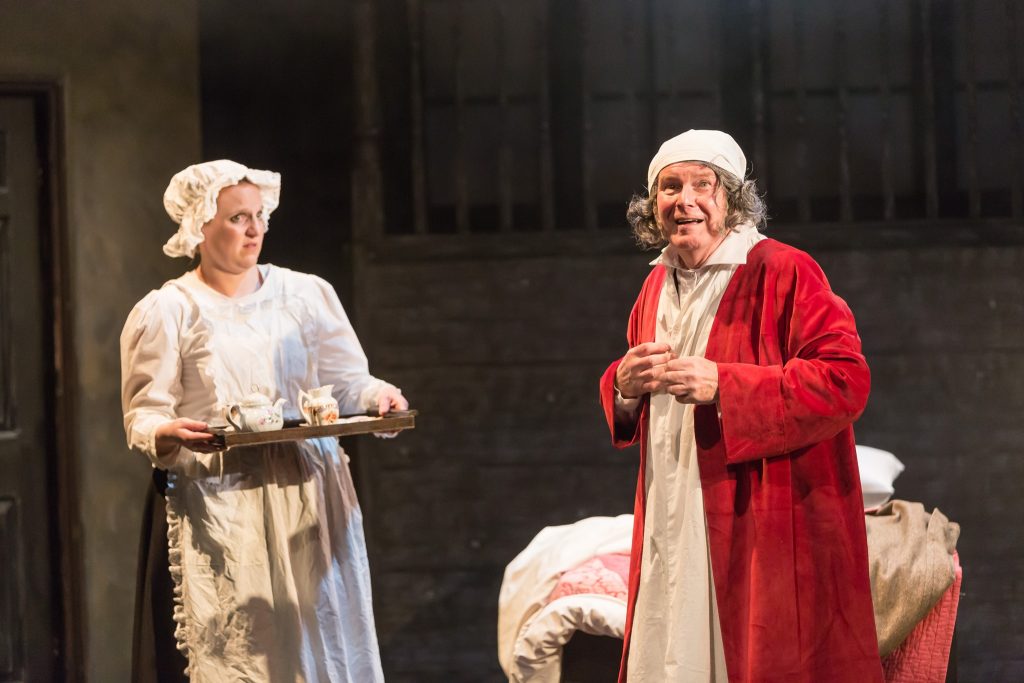
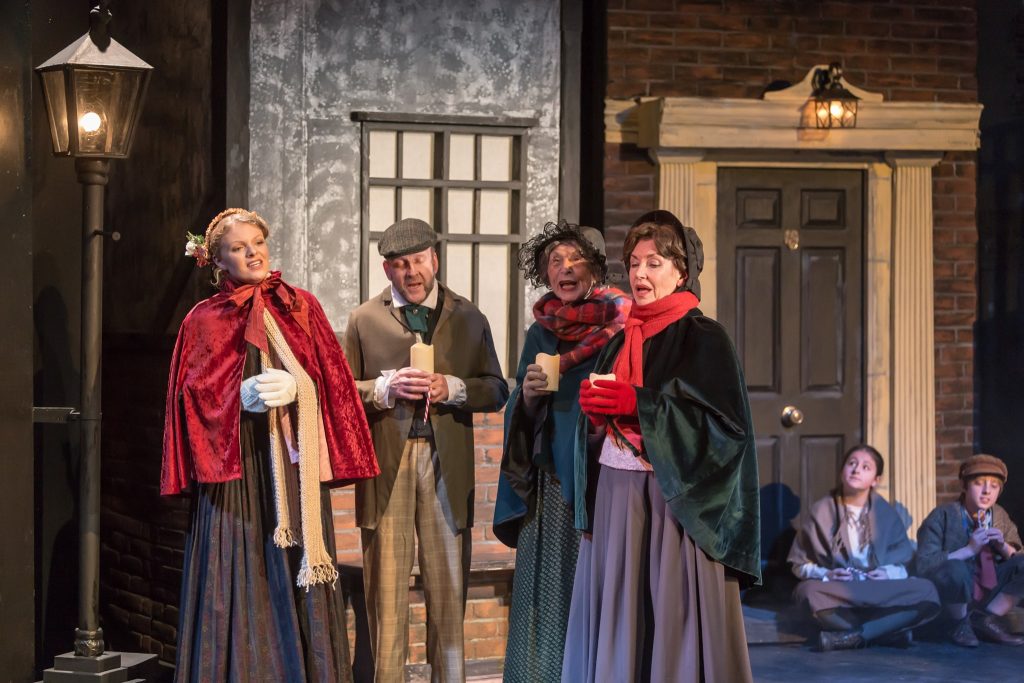
Helene Weigel World Theatre Day 1967

***

“Art, as the saying goes, knows no frontiers. The theatre should have no frontiers either. Transcending ideological divergencies, caste, race, national outlook and individual countries, the theatre should be a universal country, the meeting place of all men who share the same anguish and the same hopes revealed by the imagination, and should be neither arbitrary nor realistic but an expression of our identity, our continuity and our oneness.”

Eugéne Ionesco World Theatre Day 1976

***

“The theatre taught man to face himself honestly, with infinite scrutiny; to confront his guilt and assume responsibility for himself; it taught him to consider and rise to what he could be rather than bow to limitations he has been led to accept. It taught him equality through protest and how one man alone is an entire universe.”

Radu Beligan World Theatre Day 1977

***

“…not a day goes by without learning of increasingly cruel acts of violence and terror, of dangerously tense situations and armed conflict. Every day we witness the growing hatred of one human being for another, mutual intolerance and brutal violations of human rights which, in the field of international relations become transformed into threats of catastrophe.

A self-destructive fever seems to have humanity in its grip. In our attempt to prevent these catastrophes we have resorted to a tragic and paradoxical form of therapy; struggling to maintain life we undermine its roots; declaring peace we accelerate the insane arms race, protecting people’s freedom we violate their sovereignty; solemnly proclaiming the Charter of the Rights of Man we trample human dignity underfoot. The UNESCO Constitution asserts that wars begin in the minds of men and that it is in their minds that peace must be built – a lasting peace founded on the intellectual and moral solidarity of humanity.”

Janusz Warminski World Theatre Day 1980

***

“This day enables us to focus on all that unites us, that links us to one another, through our daily joys and cares. But above all, it provides an opportunity to look on the other, on another culture, at the other end of the planet. If, kindred in poetry, theatre artists often anticipate the reality of tomorrow and have a foreboding of the destiny of humanity, they also represent its memory!

The Second World War ended 40 years ago. The world of theatre remembers. Theatre, so often harassed, persecuted throughout the ages, has become the symbol of resistance to all types of oppression; theatre which identifies itself to life, for creation is life, is witness to this renascent life.

From the end of the nightmare a great hope emerged: that of mutual understanding between peoples.”

André-Louis Perinetti World Theatre Day 1985

***

“Today, as in the past, Theatre must contribute to enlightening our minds, and to giving battle on all fronts against barbarity on our planet. Now, more than ever, it needs to make its presence felt in our societies, caught up as they are in a web of racist and exclusive attitudes and practices; it must make people think and arouse solidarity, all things which contribute to human dignity. Theatre must act as a precursor, illuminating people’s self-awareness and their conscience.”

Jorge Lavelli World Theatre Day 1992

***

“I have been in totalitarian societies where people have been imprisoned, have died for access to the arts, and I live in a society where the self-censorship is as ruthless as any imposed from without. The paradox is uglier than we should have to consider.”

Edward Albee World Theatre Day 1993

***

“Ethnic fanatics and thugs are casting the world back into its darkest past. People of the theatre who engage their audiences in dialogue about the dramas of the world of today and the dramas of the human spirit point the way to the future. There is another war going on in Sarajevo beside the one we see on television. It is an unarmed conflict between those who hate and kill others only because they are different, and people of the theatre who bring the uniqueness of human beings alive and make dialogue possible. In this war the people of theatre must win. They are the ones who point towards the future as a peaceful conversation between all human beings and societies about the mysteries of the world and Being.

These people of the theatre are serving peace and they remind us that theatre still has meaning.”

Vaclav Havel World Theatre Day 1994

***

“Both the theatre and the international arena demand care and concern, but no less do they demand optimism. Without optimism, mixed with a good helping of realism, no theatre can survive. The theatre, as a microcosm of our society, reflects and sometimes reinvents what we do in the outside world. All human conflict and strife, ambitions and dreams are generously depicted there. The entire world’s a
stage, as a rather well-known English dramatist put it, and on that stage, the actor becomes the symbol of man with all his shortcomings and frailties, with all his high hopes and ideals.”

Vigdis Finnbogadottir World Theatre Day 1999

***

“Theatre subtly permeates the human soul gripped by fear and suspicion, by altering the image of self – and opening a world of alternatives for the individual and hence the community. It can give meaning to daily realities while forestalling an uncertain future. It can engage in the politics of peoples’ situations in simple straightforward ways. Because it is inclusive, theatre can present an experience capable of transcending previously held misconceptions.”

Jessica A. Kaahwa World Theatre Day 2011

***

“May your work be compelling and original. May it be profound, touching, contemplative, and unique. May it help us to reflect on the question of what it means to be human, and may that reflection be blessed with heart, sincerity, candor, and grace. May you overcome adversity, censorship, poverty and nihilism, as many of you will most certainly be obliged to do. May you be blessed with the talent and rigor to teach us about the beating of the human heart in all its complexity, and the humility and curiosity to make it your life’s work. And may the best of you – for it will only be the best of you, and even then only in the rarest and briefest moments – succeed in framing that most basic of questions, “how do we live?” Godspeed.”

John Malkovich World Theatre Day 2012

***

“Under trees in tiny villages, and on high tech stages in global metropolis; in school halls and in fields and in temples; in slums, in urban plazas, community centres and inner-city basements, people are drawn together to commune in the ephemeral theatrical worlds that we create to express our human complexity, our diversity, our vulnerability, in living flesh, and breath, and voice.”

Brett Bailey World Theatre Day 2014

***

“We need every kind of theatre.

There is only one theatre which is surely not needed by anyone – I mean a theatre of political games, a theatre of a political “mousetraps”, a theatre of politicians, a futile theatre of politics. What we certainly do not need is a theatre of daily terror – whether individual or collective, what we do not need is the theatre of corpses and blood on the streets and squares, in the capitals or in the provinces, a phony theatre of clashes between religions or ethnic groups…”

Anatoli Vassiliev World Theatre Day 2016

***

“More than literature, more than cinema, the theatre —which demands the presence of human beings before other human beings— is marvellously suited to the task of saving us from becoming algorithms, pure abstractions.

Let us remove everything superfluous from the theatre. Let us strip it naked. Because the simpler theatre is, the more apt it is to remind us of the only undeniable thing: that we are, while we are in time; that we are only while we are flesh and bone and hearts beating in our breasts; that we are the here and now, and no more.

Long live the theatre. The most ancient art. The art of being in the present. The most wondrous art. Long live the theatre.”

Sabina Berman World Theatre Day 2018

***

“As the world hangs by the hour and by the minute on a daily drip feed of news reportage, may I invite all of us, as creators, to enter our proper scope and sphere and perspective of epic time, epic change, epic awareness, epic reflection, and epic vision? We are living in an epic period in human history and the deep and consequential changes we are experiencing in human beings’ relations to themselves, to each other, and to nonhuman worlds are nearly beyond our abilities to grasp, to articulate, to speak of, and to express.

This is a time for deep refreshment of our minds, of our senses, of our imaginations, of our histories, and of our futures. This work cannot be done by isolated people working alone. This is work that we need to do together. Theater is the invitation to do this work together.”

Peter Sellars, World Theatre Day 2022

***

“I am speaking to you today, not just to speak, or even to celebrate the father of all arts, “theatre,” on his world day. Rather, I invite you to stand together, all of us, hand in hand and shoulder to shoulder, to call out at the top of our voices, as we are accustomed to on the stages of our theatres, and to let our words come out to awaken the conscience of the entire world, to search within you for the lost essence of humanity. The free, tolerant, loving, sympathetic, gentle and accepting human. And to let you reject this vile image of brutality, racism, bloody conflicts, unilateral thinking, and extremism. Humans have walked on this earth and under this sky for thousands of years, and will continue to walk. So take your feet out of the mire of wars and bloody conflicts, and leave them at the door of the stage. Perhaps then our humanity, which has become clouded in doubt, will once again become a categorical certainty that makes us all truly qualified to be proud that we are humans and that we are all brothers and sisters in humanity.”

Samiha Ayoub, World Theatre Day 2023

***

Wooden Bridge at the Nikka Yuko Japanese Garden in Lethbridge Alberta

More than ever we need to build bridges of understanding between nations and people and theatre is one of the ways we can do that. And maybe the future of theatre is to be found not just in the performing spaces of basements and churches and theatres but in our ability to share thoughts and ideas across new forms of social media. And maybe the future of theatre, in combination with today’s social media, is one of the ways we can help to promote understanding and compassion throughout the world.

I suppose now more than sixty years after the first International Theatre Day the message is still the same. The echoes of the past reach us in the present and while we can never eliminate violence we can certainly help to reduce the amount of violence in the world.

***


Interview Playwright Meredith Taylor-Parry – Part One: Survival Skills

Survival Skills by Meredith Taylor-Parry won the New Works of Merit Playwriting Contest in 2013 and was produced Off Off Broadway by the 13 Street Repertory Company, in New York City in April 2014.

“You want to write the kind of play where people are going to go home and talk about it, and think about it, and talk about themselves a little bit. You know, my God, if it got people to think about their own mortality a little bit, how could that be a bad thing? We all run around scared to talk about it, but we’re fascinated by it at the same time. The idea that we’re mortal. Just to have that discussion opened up wouldn’t hurt.”

Playwright Meredith Taylor-Parry Survival Skills
Playwright Meredith Taylor-Parry – Photograph by James Hutchison

Her most recent work, Book Club was developed as part of the Suncor Stage One Festival at Lunchbox Theatre and will receive a world premiere at Lunchbox in February.

I sat down with Meredith, while her four-month-old Beagle Tucker, lay happily nearby chewing puppy toys, to talk with her about Survival Skills and Book Club, as well as her writing process.

***

JAMES HUTCHISON

When you go to a play what is it you go for? What is it you hope to get out of it?

MEREDITH TAYLOR-PARRY

I guess I want to be moved emotionally, always. I like Opera. I always write while I listen to Opera. I want to be moved. I like the tragic. I like stories where you watch people getting put through the wringer. Watching characters go through hell and then some. And I like stories and plays with some expression of hope at the end. That’s very important. It doesn’t need to be wrapped up perfectly, but just something.

JAMES

Tell me about the reason you wrote Survival Skills.

MEREDITH

Well, my Dad committed suicide in two thousand and two after being diagnosed with terminal cancer, and I always knew that I wanted to write about it. I never thought about writing a novel – I always thought it would be a play.

JAMES

How difficult was it to put that out into the world? Because that’s a very personal thing.

MEREDITH

It was difficult, but when an experience like that happens to you – or at least my experience is – you’re compelled to tell that story over and over and over again.

And I’ve heard some people say, yeah but some people never want to talk about it again – but that wasn’t me. I was compelled to tell that story to friends – to grief groups –I’m just compelled to share it. I don’t know how many times my mom and I would get on the phone after it happened and we’d end up retelling that day – the actual event – when we found the suicide note – when we called the police – when my brother went out to look at the body that afternoon.

And I originally thought the play was going to open with that scene, but then I went to a Playworks Ink Conference in 2011 and I signed up early and got into Daniel MacIvor’s workshop. And he started the workshop by reading the scene you’d submitted. And he’s a pretty fantastic actor and he did all the different parts. I had my sister there, my brother there, my mother in the scene, and the character that represented me. We were all there and he just read through that first scene from beginning to end and when he finished – it was silent and he said, “That’s a hell of a way to start a play. People discovering a suicide note.”

And I went, “Yeah, yeah I guess it is.  I wasn’t really thinking about that.”

He said, “We’re going to end the scene right here where your brother hangs up the phone and I want you to write the next scene.”

And I wrote the next scene and that became the first scene of the play because I took his advice – that is a hell of a way to start a play. But I think I needed to write the suicide scene first because that was the hardest scene to write – bar none – and to go back and remember those moments in specific detail.

JAMES

How much do you credit that workshop with moving forward on the play?

MEREDITH

Huge. He looked at me and said, because I had some humour in there, “Meredith, any play that can bring levity to the topic of death needs to be written.” He said, “I myself am terrified of the medical system. I’m not afraid of dying – I’m terrified about becoming a patient of the medical system.”

And here’s this man who has written all these beautiful plays with all this fabulous experience and wisdom but at the same time he’s a really good teacher too. He really has the right touch. And I think he just knew the right thing to say to help keep me going. He also made us promise, before we left the workshop, to send him the first draft by a certain date. And I did, because it’s Daniel MacIvor, right. I wasn’t not going to do it. I was two weeks late, but it made me finish it.

JAMES

You worked on the play for a couple more years and then entered it into the New Plays of Merit Contest in 2013 and won. What was it like getting the phone call that the play had won?

MEREDITH

That’s what my dream was up to that point. That someone was going to phone me up and tell me that I was good enough to win a contest. And I felt really good about it because it was New York. Because to me that was the place where all the good playwrights go. So, that was a real shot in the arm – no question. I felt pretty good about that – but I was stunned.

JAMES

What was it like to go see your play on stage?

MEREDITH

I vowed that I wasn’t going to be critical of my work because I don’t know if this is ever going to happen to me again. The idea of going to New York to see your play – Off Off Broadway in a little old theatre with a little old 92 year old Broadway performer running it. I mean this theatre had a lot of history. Tennessee Williams’ plays were performed there. And I thought, don’t ruin it by sitting there thinking about all the things that are wrong with your play. It wasn’t perfect, and I still think there are things that can be improved about the play, but I just vowed I was going to go and enjoy it.

JAMES

It’s interesting to me because there’s a certain completion to the journey. From the experience of your father having committed suicide, to writing the script, to winning the contest, to getting it produced. How you would sum up the whole experience as you were watching the production with your family?

MEREDITH

Well the first word that popped into my mind was surreal, and the second thing was how much I enjoyed the performances, and how much the actors brought to it. I just vowed I was going to go and enjoy it and I wasn’t going to worry about my family as far as taking care of them or worry about their reactions to it either. But you know, I also worked through a lot of stuff with that play.

When dad was suspecting a bad diagnosis – this was three days before he completed suicide – I phoned his room at the Moncton Hospital from Calgary. And he said, “Oh they’re going to do some tests and things.” Because at first they thought it might be a bowel infection and a reaction to antibiotics. But there was a moment where he hesitated on the phone and in my mind I wondered what was he was going to say next. To me there was something that he meant to say and tell me. Like he opened his mouth to say it and it didn’t come out and I wondered if it was, “Listen if it’s a bad diagnoses this is what I’m going to do.” But he didn’t say anything, and I heard this kind of breath, or hesitation, and I wondered, and wondered, and wondered about that afterwards.

And then I thought, well what would you have done if he had said, you know, this is not going to go well…would I have suspected…because we knew his philosophical stance on end of life.  He always said, “If I ever got a bad diagnosis that would be it.” But it’s a leap in your mind to hear those words and really imagine your father actually doing that.

So I thought, in my state of mind, what would I have done? I probably would have called mom and told her not to leave him for a minute. And then there’s a part of you that would have said, “Okay – whatever you need – I’ll do it – I’ll help you.”

And I did end up inadvertently helping him complete the act by flying to the Maritimes, because when my mother came to pick me up at the airport that’s when he completed. So I felt complicit in that, and that bothered me for a long time, even though it was inadvertent. It was a window of opportunity, and he took it, and I provided that. So, in a way I helped whether I wanted to or not.

I changed the play so that the character who plays me actually does make the decision to fly home to get her mother out of the house so that her father will have the window of opportunity very knowingly not inadvertently.

JAMES

Dramatically that’s a good choice.

MEREDITH

Dramatically it was a hell of a lot better choice than what really happened.

JAMES

Because then the character is active.

MEREDITH

Yes.

JAMES

What do you think your dad would think of this play?

MEREDITH

Wow. I just think he’d be horrified, because he was such a private person. I had to struggle past that a little bit because he’d be so horrified that I laid it all out. But you know what? Whatever form – and I do believe there is some kind of spiritual form that he takes now – I don’t think he has those same opinions any more.

And after he was gone, I pretty quickly said this is more about me than it is about him. This is more about us. And that’s how I was able to write it. I was lucky, because my family wasn’t upset. But dad would have been. I think for sure. But I wouldn’t have had to write it – you know what I mean – unless it had happened.

JAMES

Was it cathartic for your family in some ways?

MEREDITH

Maybe in some ways. I sat right beside my mom and my aunt and I could feel the seat shaking because they cried and cried and they laughed too, but there was a lot of tears you know. I know that my aunt and mom told me they sat up all night in the hotel room talking about it. My brother said, “Man it’s weird to see your life up on stage like that.” But it was probably not as cathartic for them as it was for me

JAMES

What are your hopes for the story?

MEREDITH

I would love to see it produced again, of course. Published and produced. Those are the things that I’m looking for with all my plays. I don’t really want them to just sit stagnant. You want to write the kind of play where people are going to go home and talk about it, and think about it, and talk about themselves a little bit. You know, my God, if it got people to think about their own mortality a little bit, how could that be a bad thing? We all run around scared to talk about it, but we’re fascinated by it at the same time. The idea that we’re mortal. Just to have that discussion opened up wouldn’t hurt.

***

Next week, in Part Two, I talk with Meredith about her play Book Club, and its upcoming production at Lunchbox Theatre.

***

Meredith Taylor-Parry Survival Skills - Survival Skills Poster

Survival Skills by Meredith Taylor-Parry

A father takes his life.  The family gathers to mourn.  Only one saw the body.  Only one knows what really happened.

Winner: 2013 New Works of Merit Playwriting Contest

Premiered at 13th Street Repertory – NYC April 3 – May 1, 2014, with the following cast and crew.

  • Directed by Leanora Lange

Cast

  • Kathleen – Aimee Thrasher
  • Annalise – Kristen Busalacchi
  • Eliza – Mary Ruth Baggott
  • Oscar – Jason Kirk
  • Len – Danny Sauls

Crew

  • Stage Manager – Alex Bishop
  • Properties Assistant – Aimee Thrasher
  • Dramatrug – Kurt Hollender
  • Producer – Sandra Nordgren

***

Playwright Meredith Taylor-Parry

Meredith Taylor-Parry is a playwright based in Calgary, Alberta. Her play Survival Skills won the New Works of Merit Playwriting Contest in 2013 and was produced Off Off Broadway by the 13th Street Repertory Company, NYC in April 2014. Her play Devices received a production in Week One of the New Ideas Festival at Alumnae Theatre in Toronto in March of 2015. Her most recent work, Book Club, was developed as part of the Suncor Energy Stage One Festival of New Canadian Work at Lunchbox Theatre in Calgary in 2014 and will receive a world premiere at Lunchbox in February 2016. Meredith is Co-Artistic Director of Bigs and Littles Theatre Society and also enjoys writing and performing for young audiences.

You can contact Meredith at LinkedIn by clicking the link above or by email at: mtaylorparry@gmail.com

***

Survival Skills by Meredith Tyalor-Parry – Synopsis

“He saw a window of opportunity.”

A man diagnosed with terminal cancer commits suicide, leaving his family behind to struggle with the aftermath. Our journey begins 20 years later as Annalise and her sister sit at their dying mother’s bedside. The daughters are compelled to relive with the audience the horrible days following their father’s death when those closest to him came together to mourn and try to understand his choice. The play moves between past and present.

Their father’s decision is a controversial one. It was terribly painful for his wife and children to experience such a sudden, violent loss. But as we watch the sisters sit with their mother we begin to understand the motives behind his action. Is the choice to let death come in its prolonged and often agonizing way any less traumatic for those involved? Should we have the right to choose?

As in any time of family crises, personalities clash and sibling rivalries are revisited. Annalise’s frustration grows as her father is both accused of being a coward and applauded as hero. Finally she reveals an awful secret; her father needed her help. It is only by sifting through the memories that haunt her, that she will find forgiveness.

New Works of Merit Playwriting Contest

New Works of Merit is an international playwriting contest developed in 2003 to bring works of social significance to the general public.

13th Street Repertory Company

The 13th Street Repertory Company, founded in 1972 by Artistic Director Edith O’Hara, provides a place for actors, directors, playwrights, and technicians to develop their craft in a caring, nurturing, professional environment.


Link to Interview with Juliet Liraz
Link to The Hemingway Solution Parts Unknown, and Anthony Bourdain

Creative Process – Playwrights – Actors – Directors

Welcome to my corner of the world where you can download my plays and read them for free. You can also read my interviews with other playwrights, actors, and directors about their work and creative process.

Way way back in the early days of community cable television myself and a group of friends used to produce a show called Profile. We did exactly what I do in this blog – talk with creative people about their work and process.

My very first guest on Profile was a guy named David Cassel. A quick Google search shows he’s been a busy guy over the last forty-plus years. He was a mime artist. Is a mime artist – as well as a designer, writer, producer, and director.

Other guests included Playwright Sharon Pollock, Theatre Director Louis B. Hobson, and Vicki Adams Willis from Decidedly Jazz Dance Works.

When I got back into theatre and started writing plays, I also wanted to include the occasional interview on my website with other creative people.

Link to interview with Christopher Hunt about his work and creative process.
Link to interview with Ahad Raza Mir about his work and creative process.
Link to interview with Meredith Taylor-Parry about her work and creative process.

Check out some of my more recent interviews over the past few years with such wonderful and talented individuals as film and television director David Winning, playwright Caroline Russell-King, theatre photographer Tim Nguyen, Artistic Director of Lunchbox Theatre Bronwyn Steinberg, and playwright Kristen Da Silva.

***

If you enjoy listening to great interviews with creative people then check out Q with Tom Power and this terrific interview with John Irving. Or this interview from the Dramatists Guild Foundation between playwrights Christopher Durang and David Lindsay-Abaire. Or this raw and uncensored interview from the Writers Guild Foundation with author and screenwriter William Goldman.