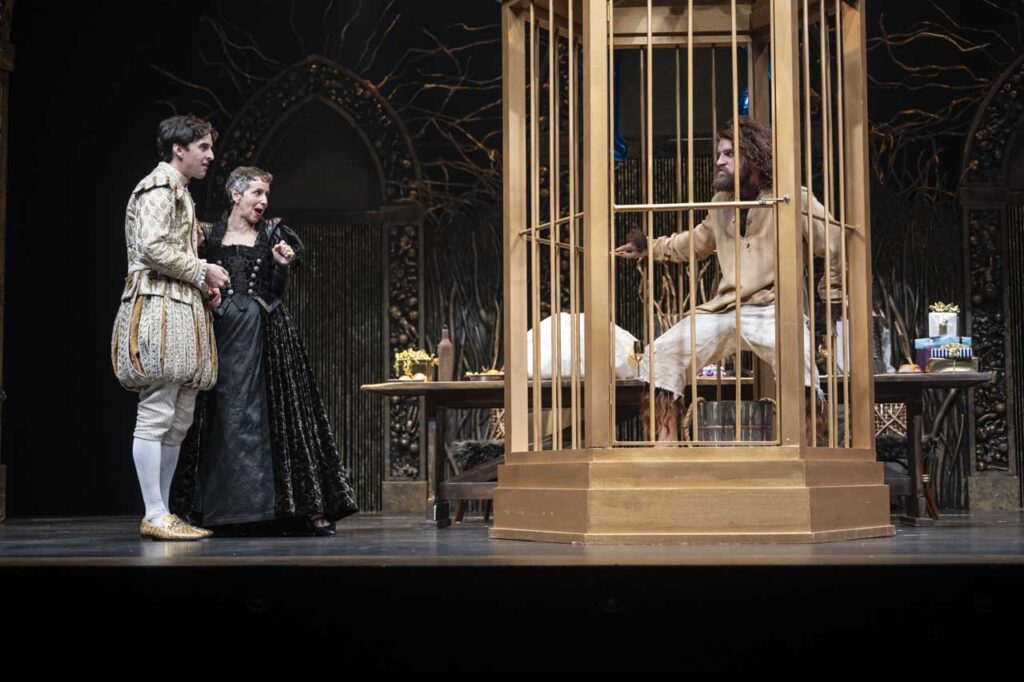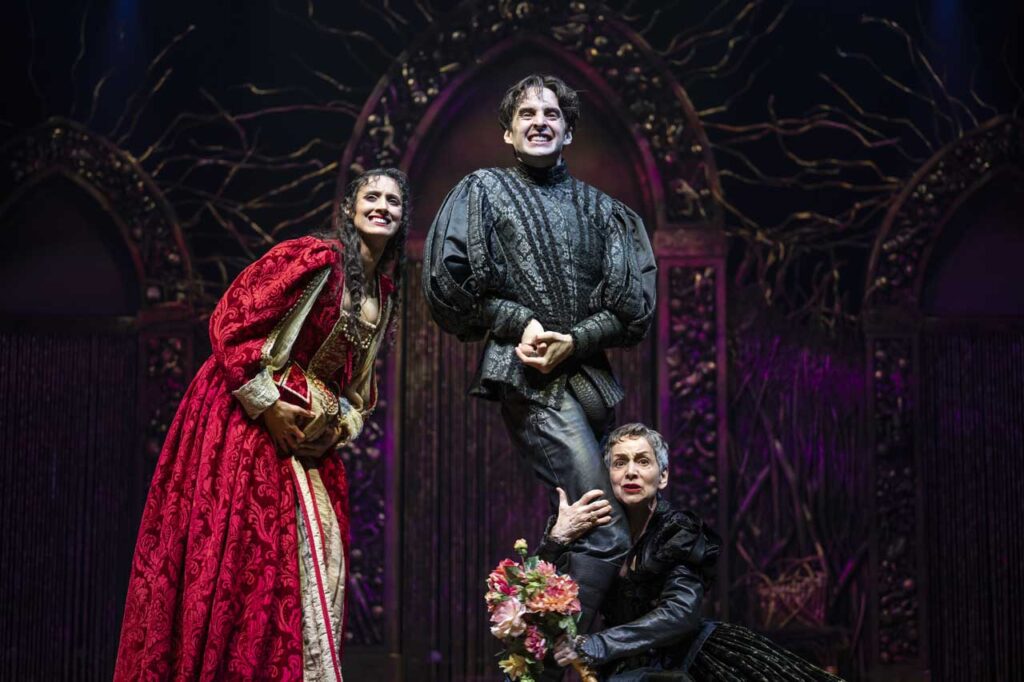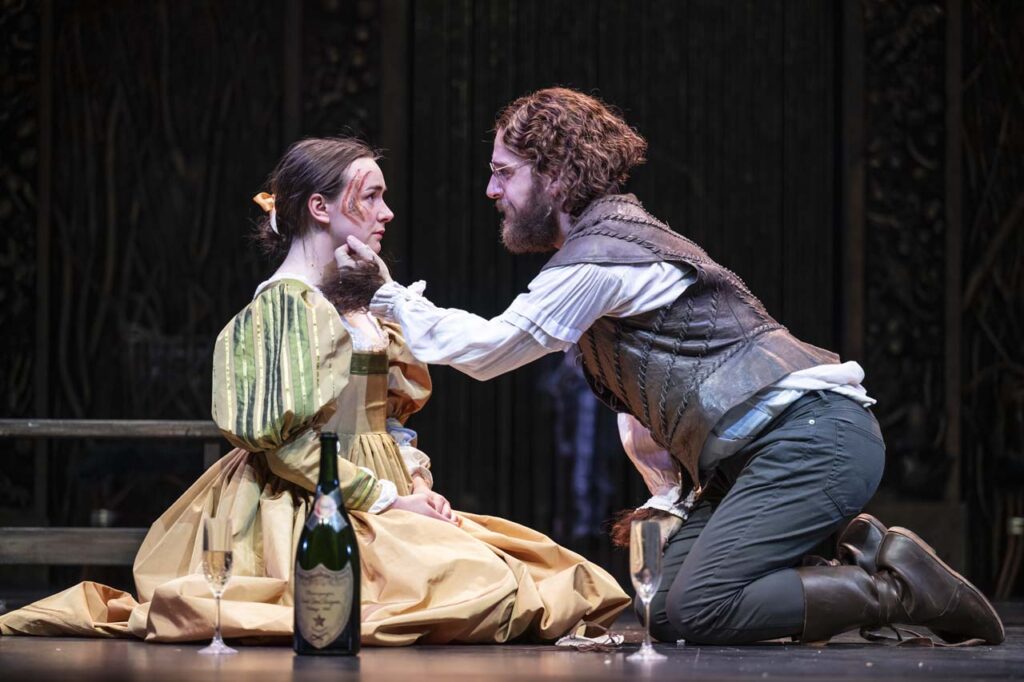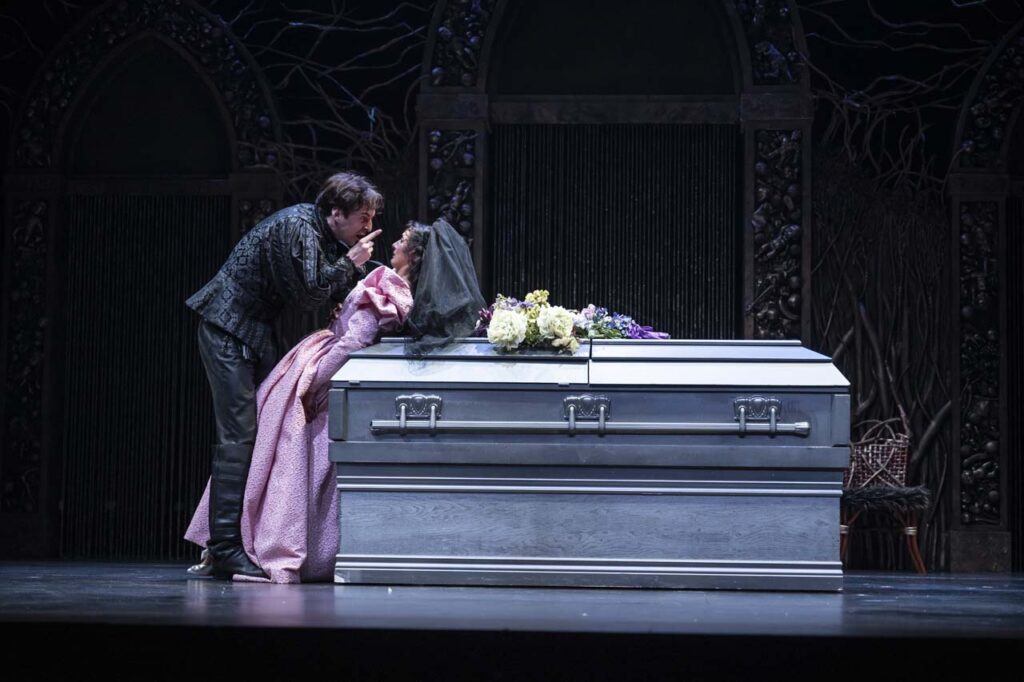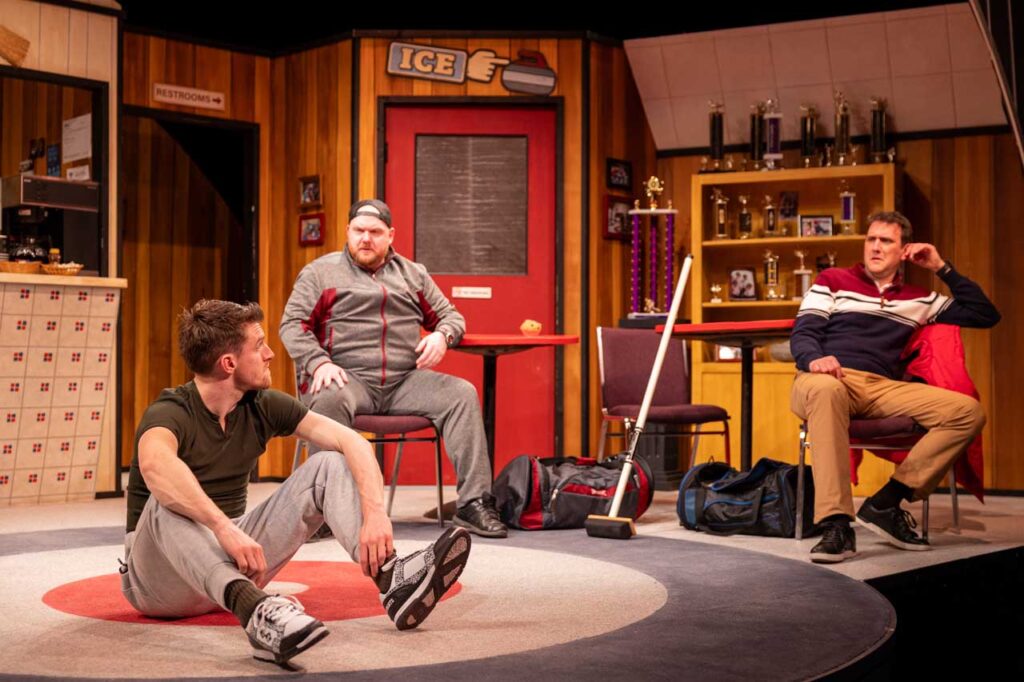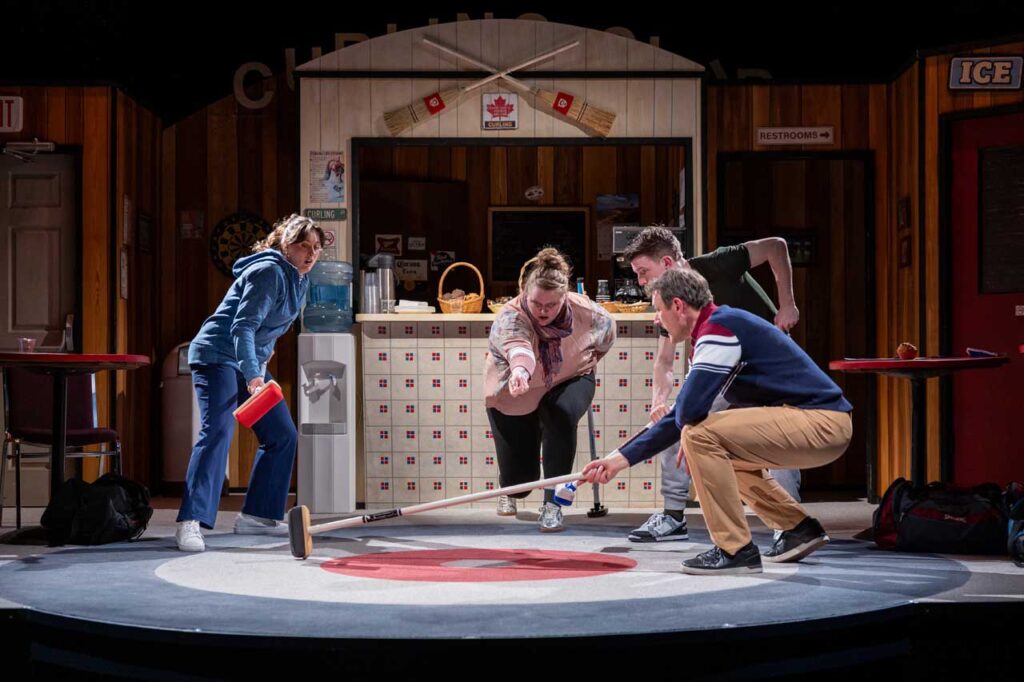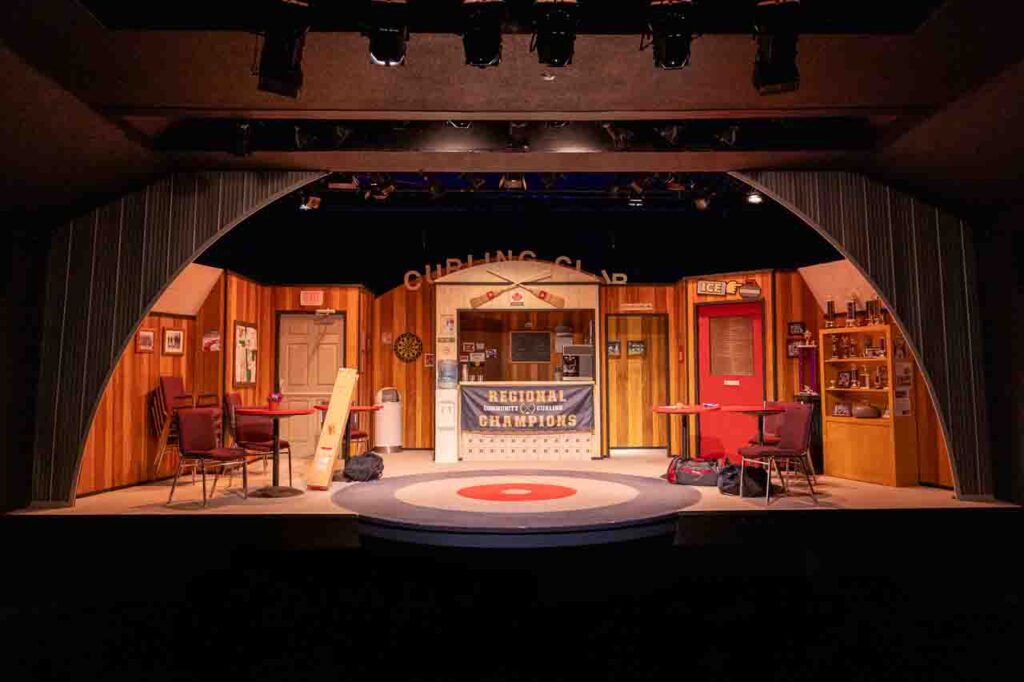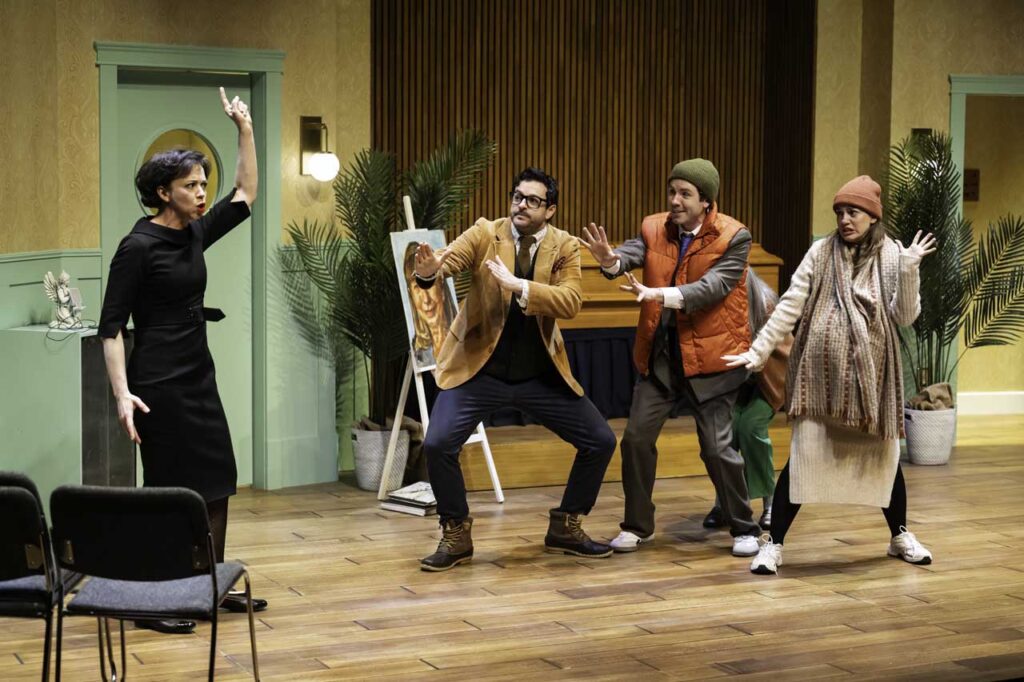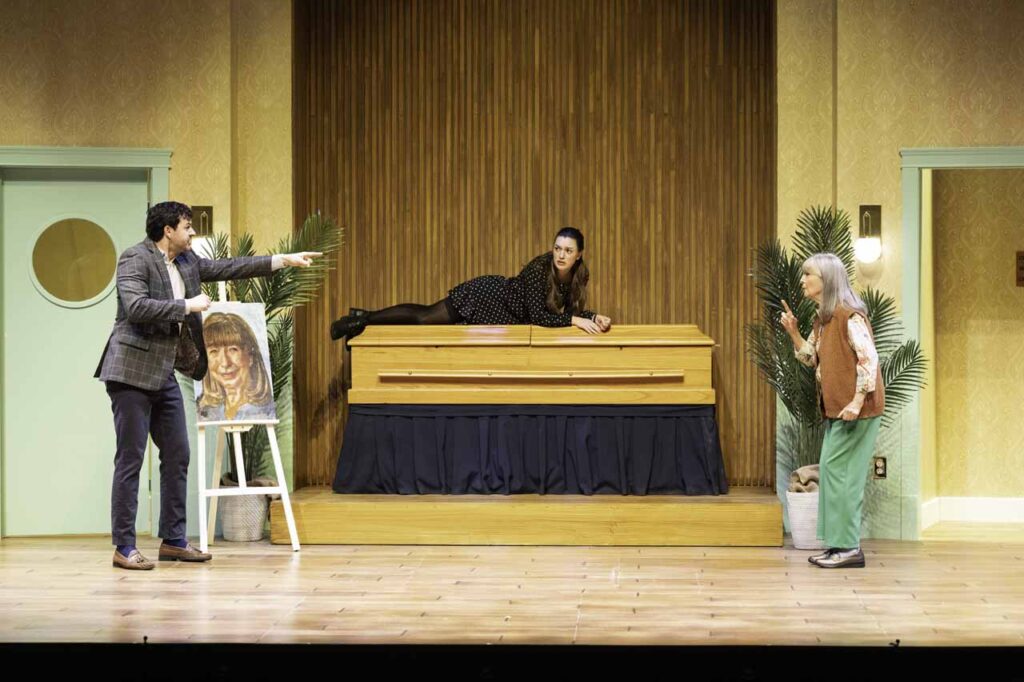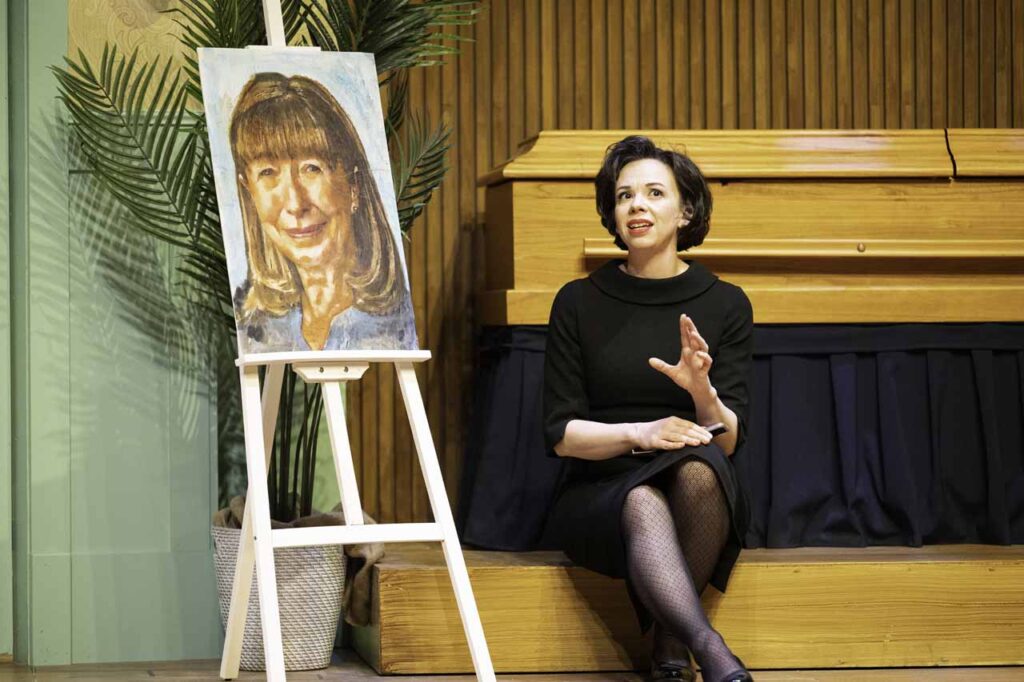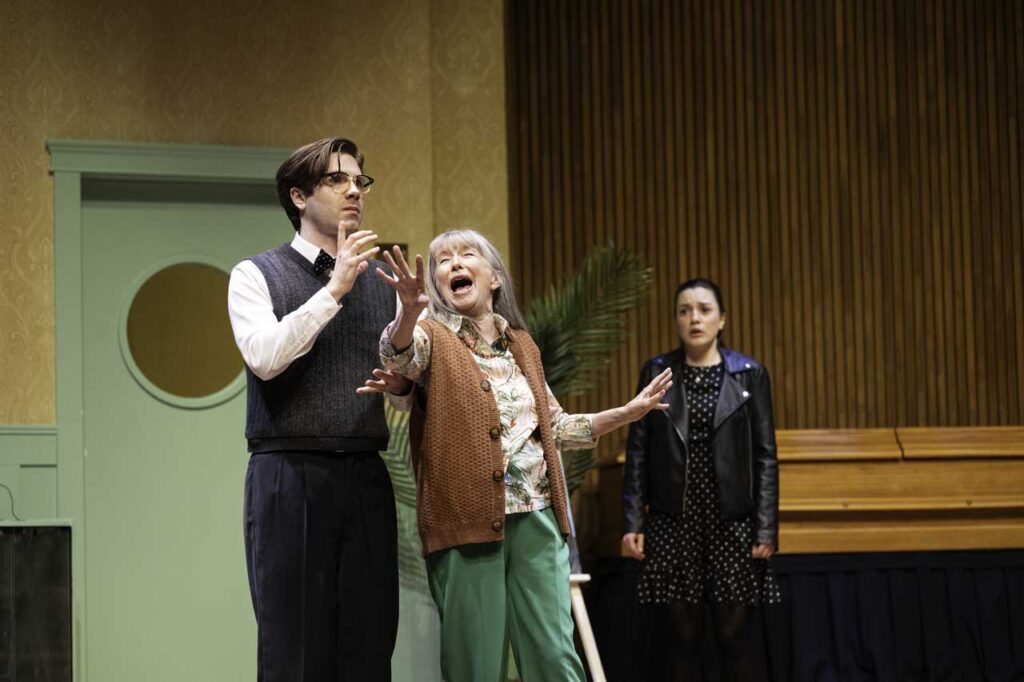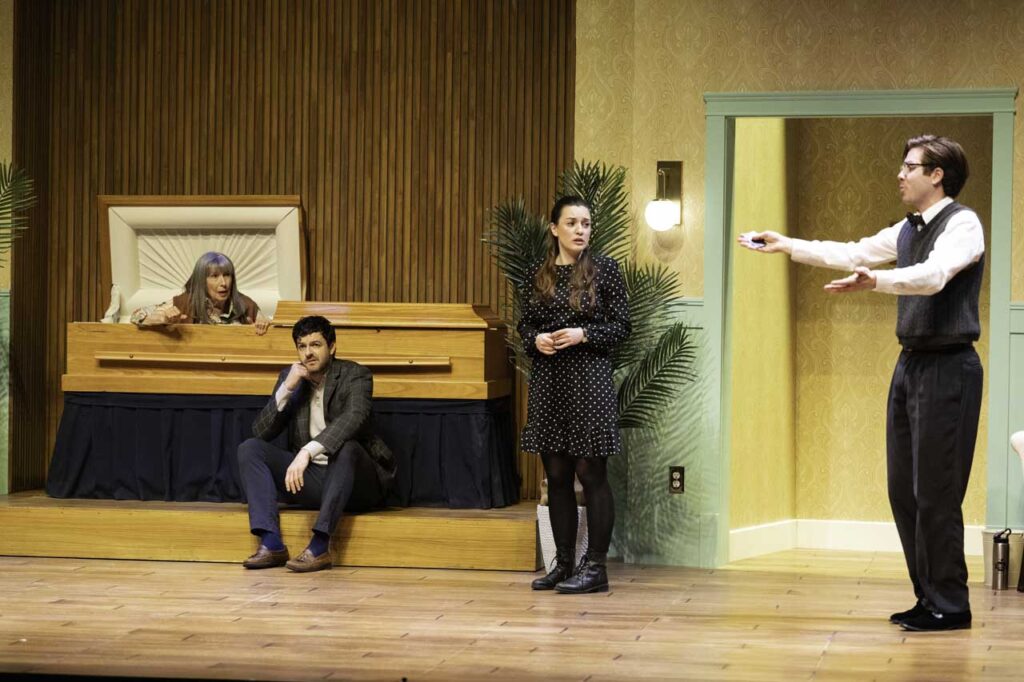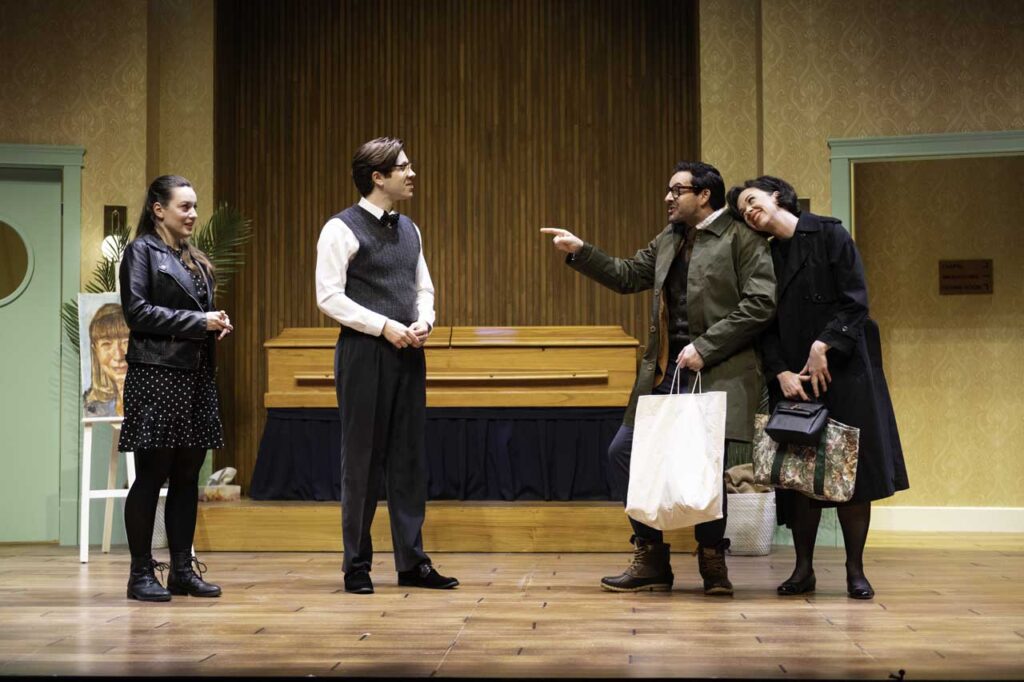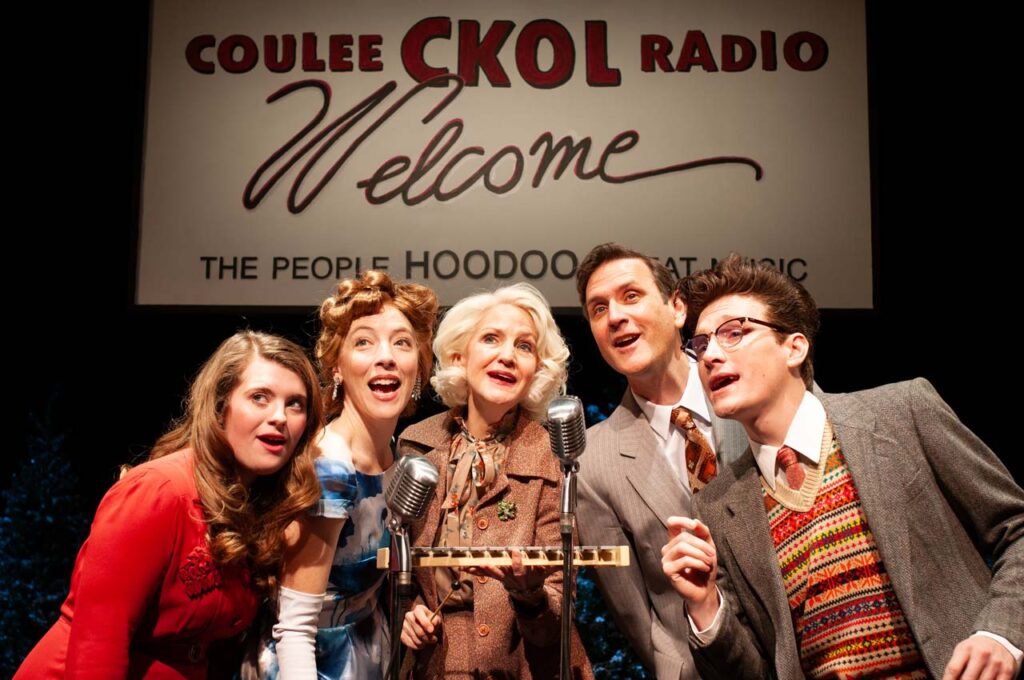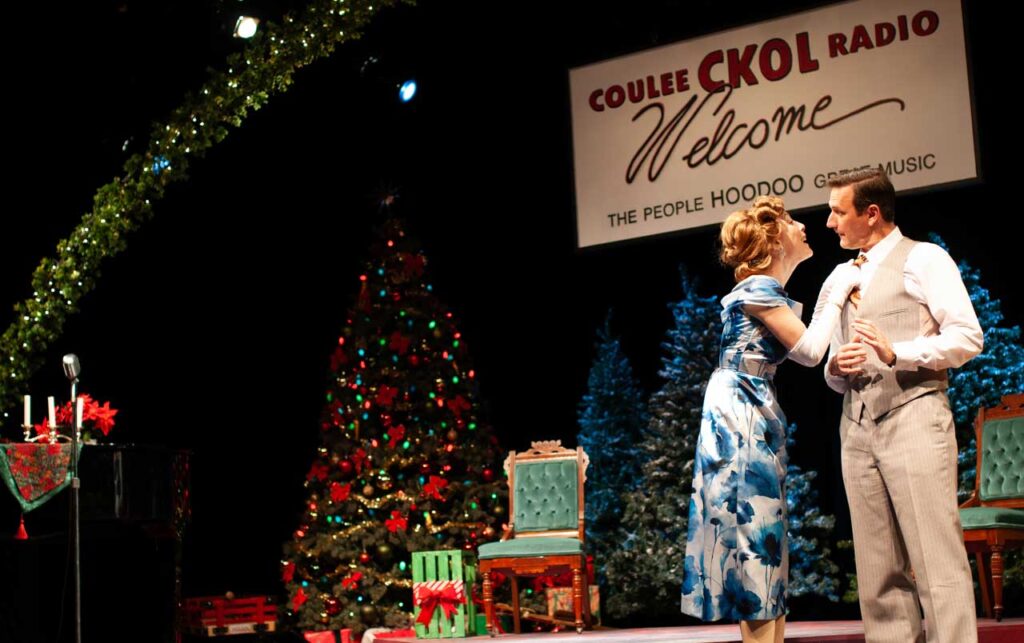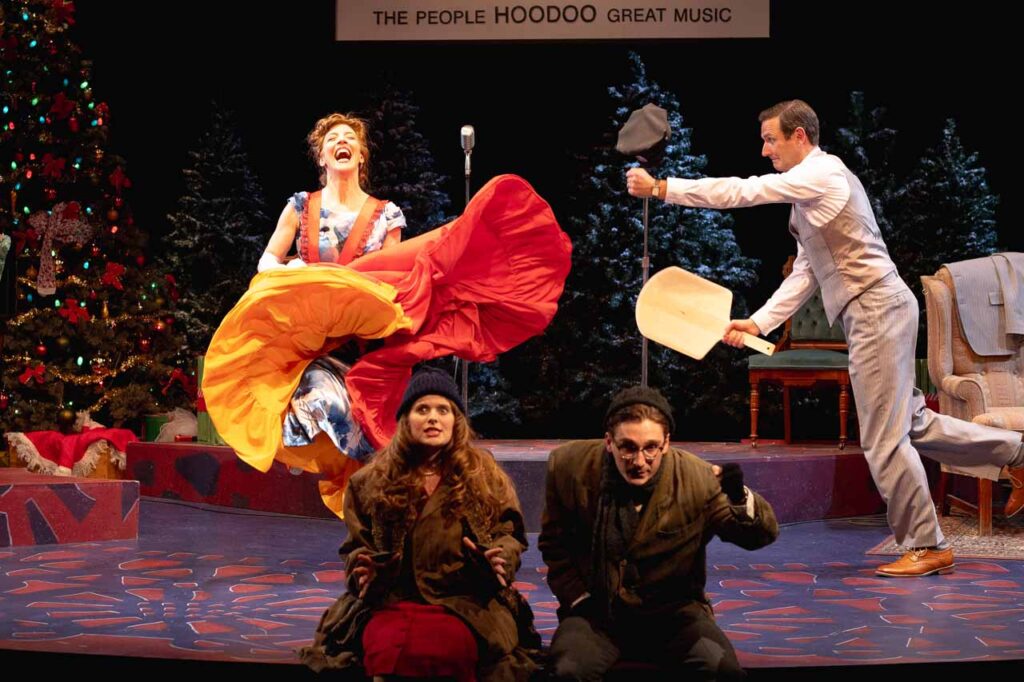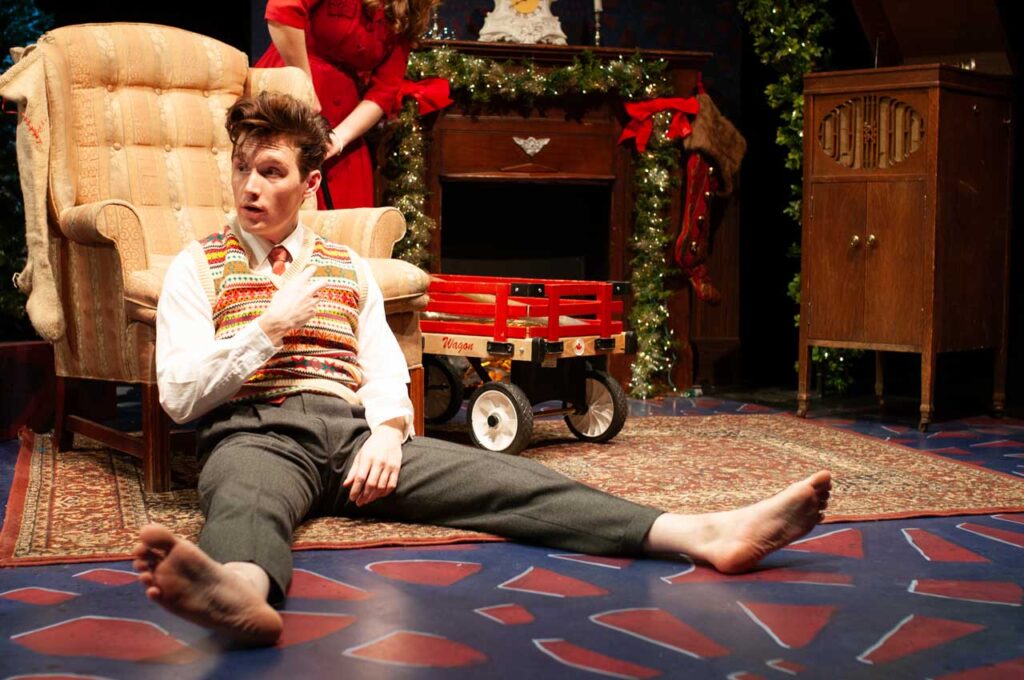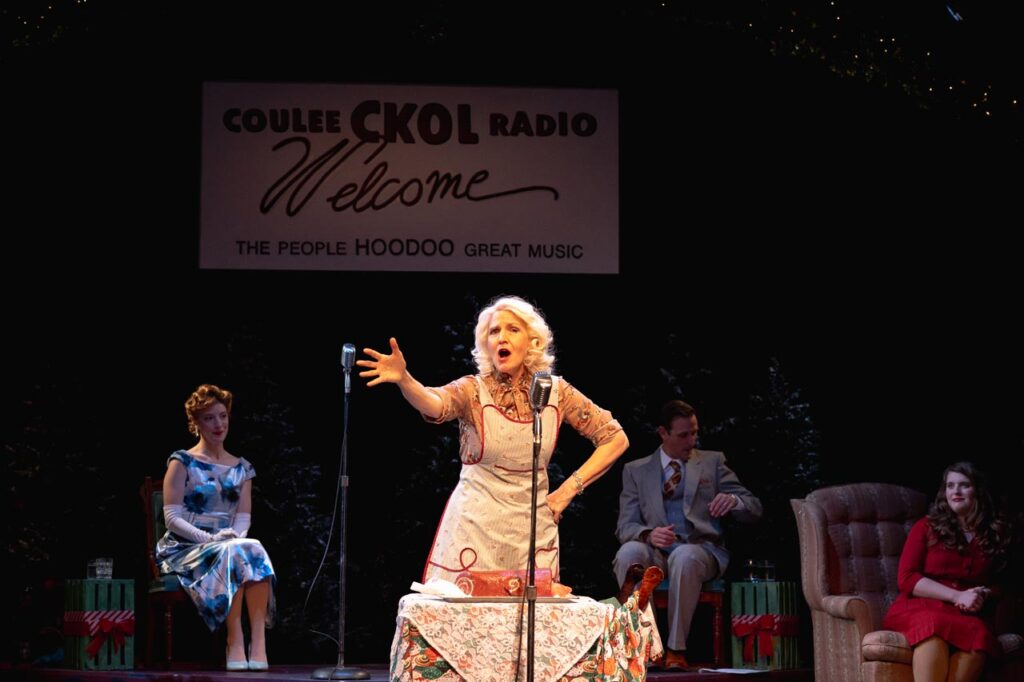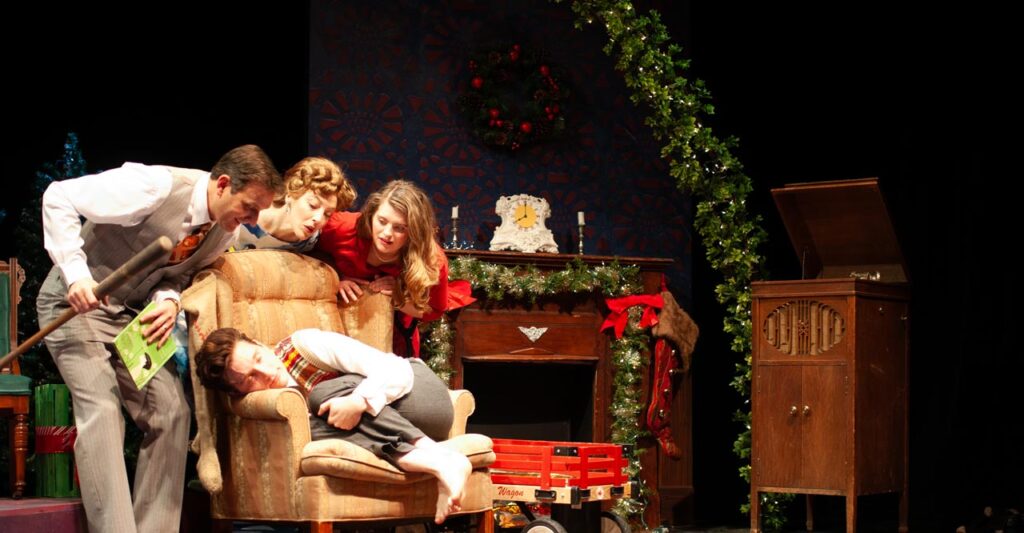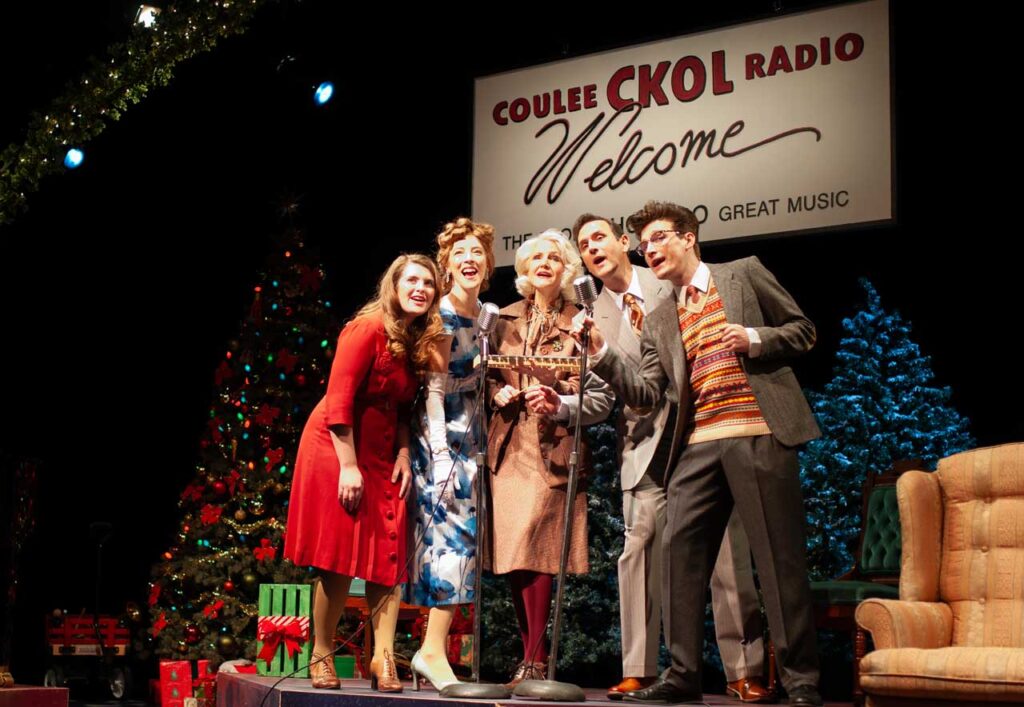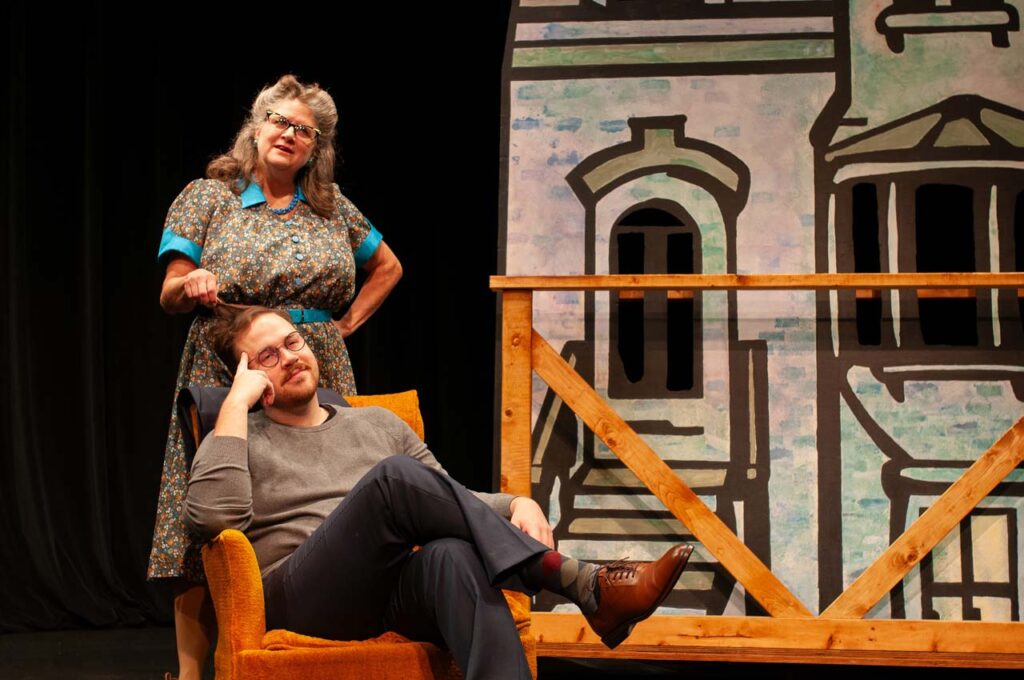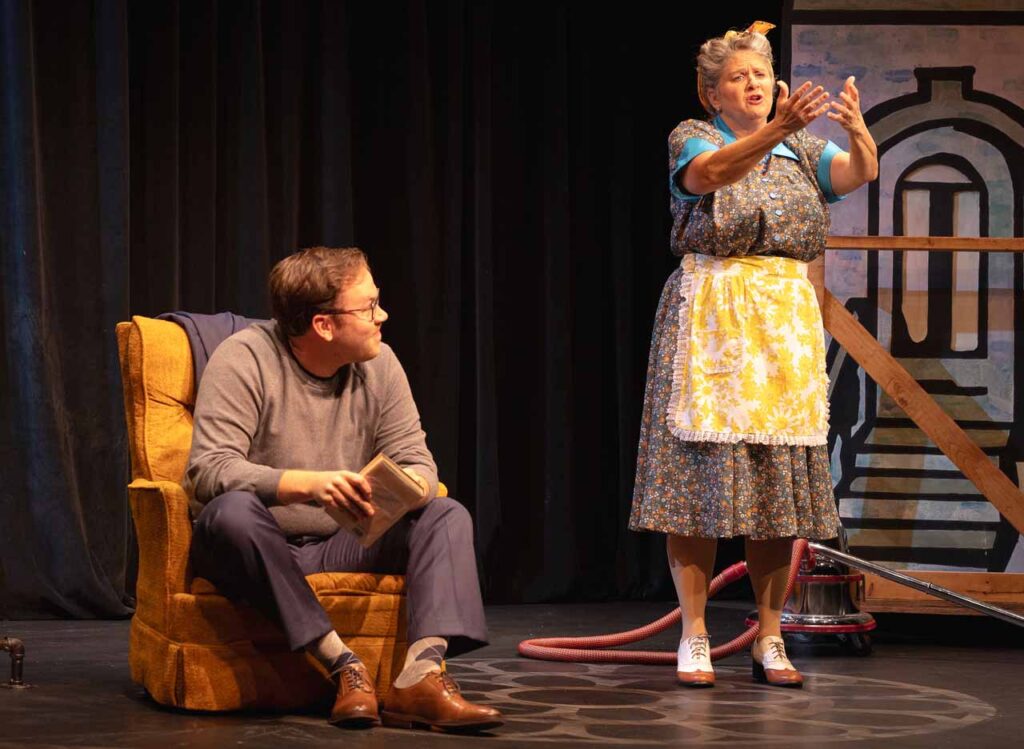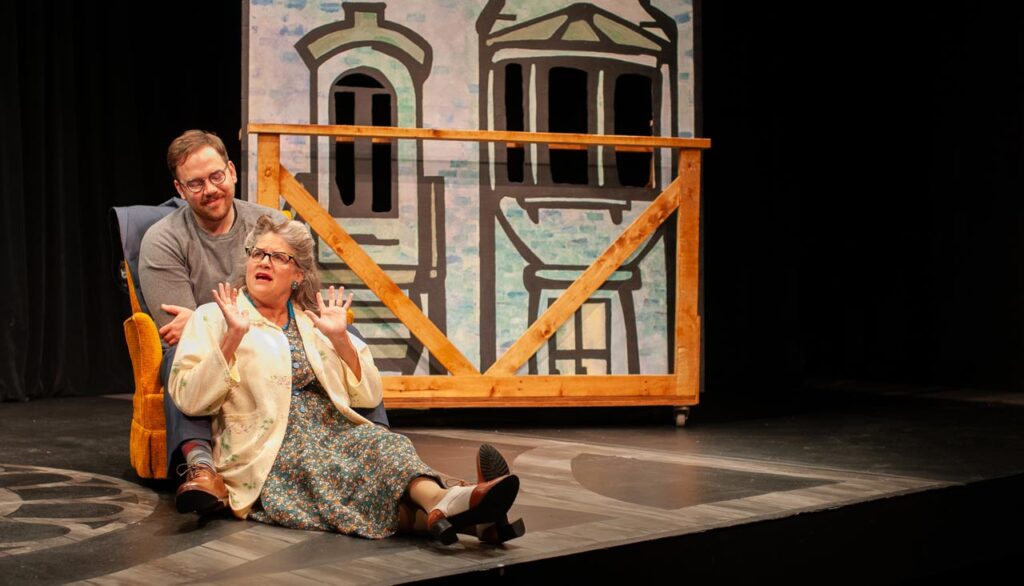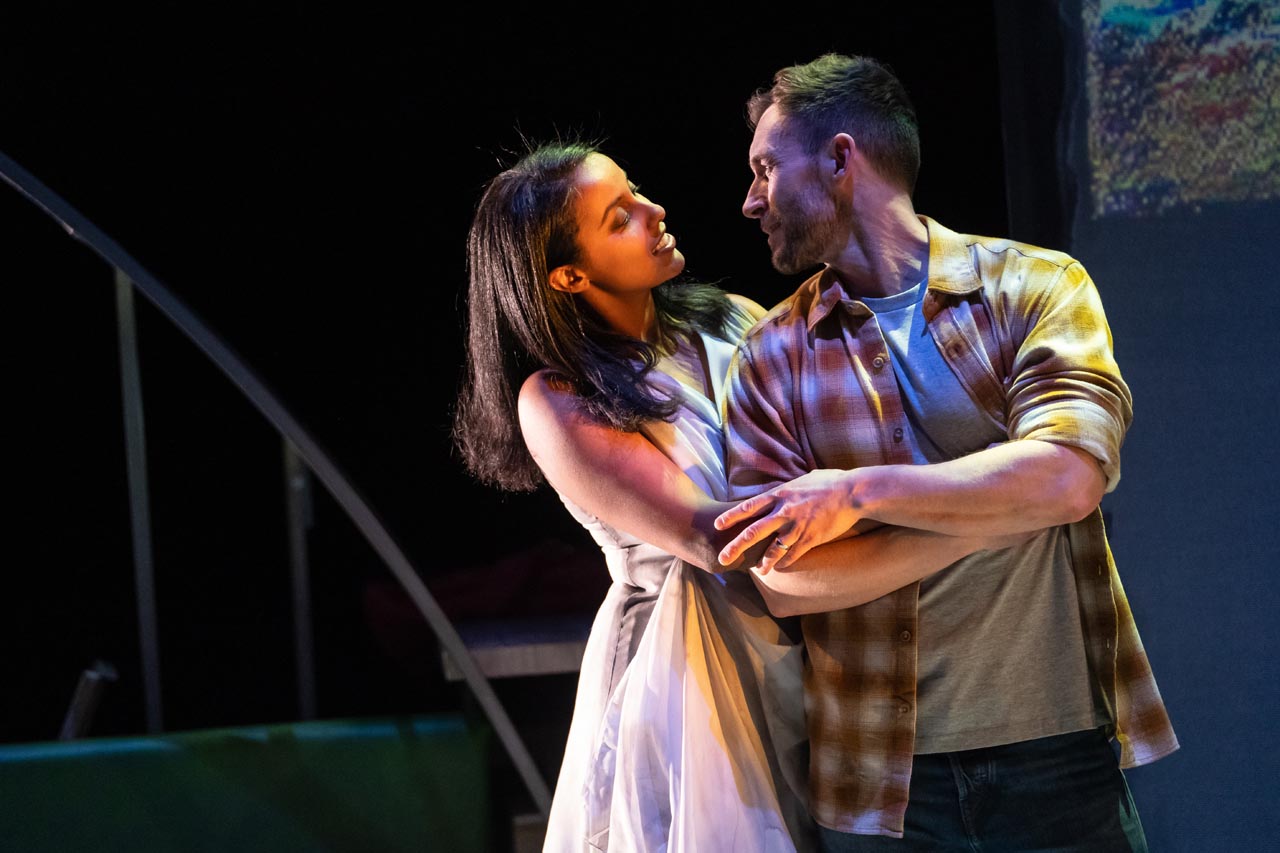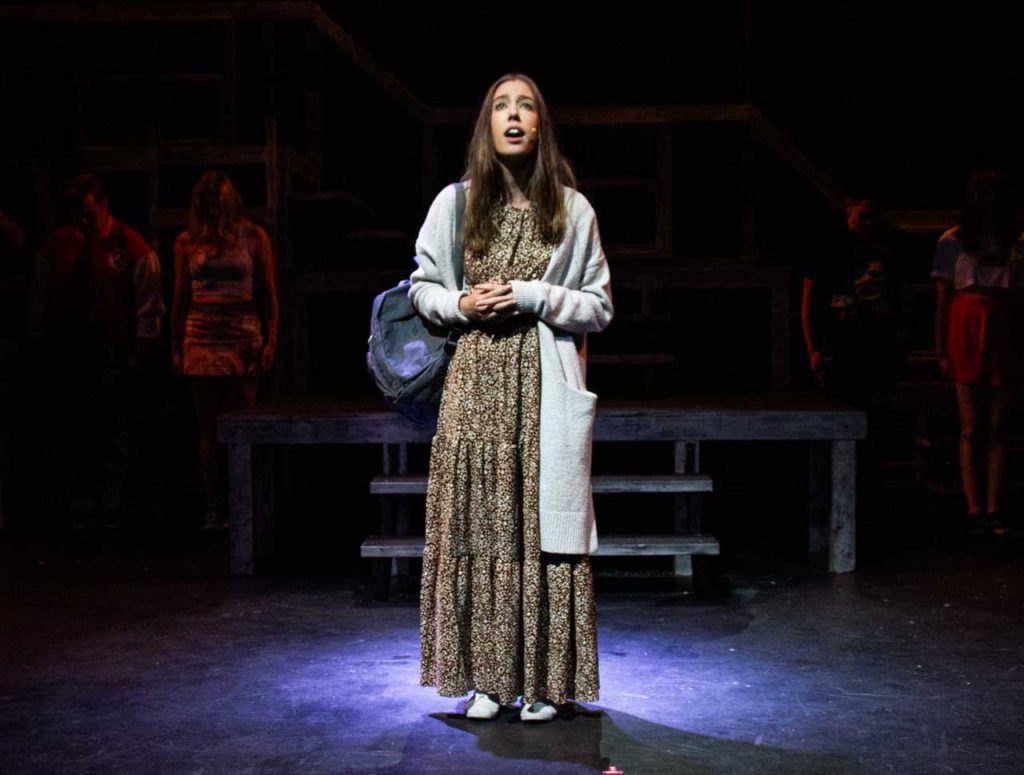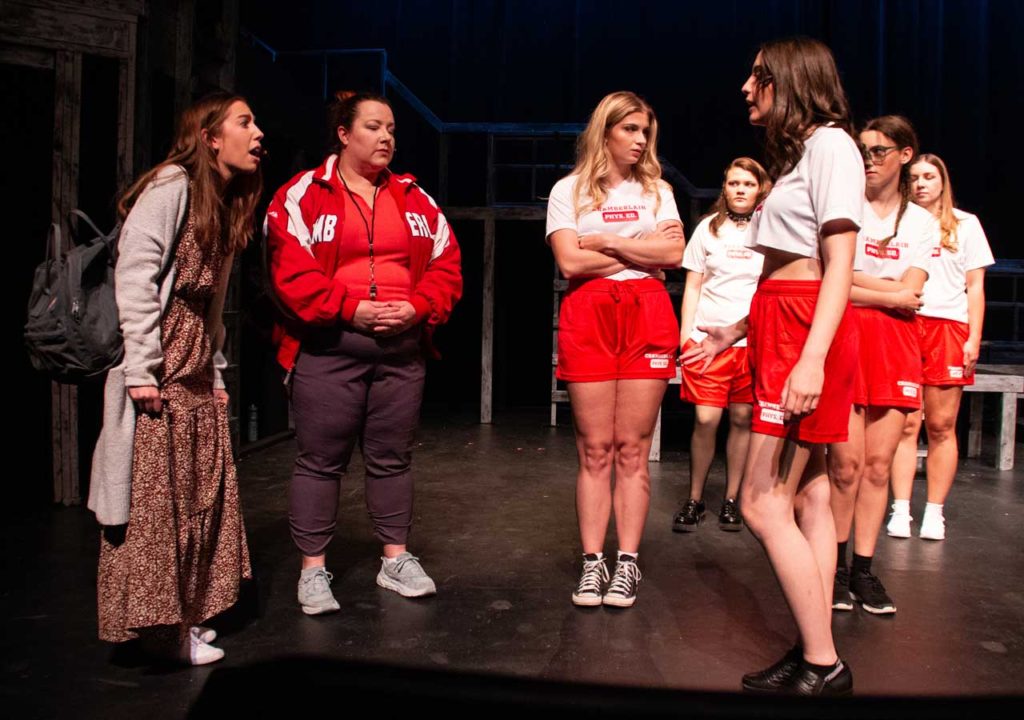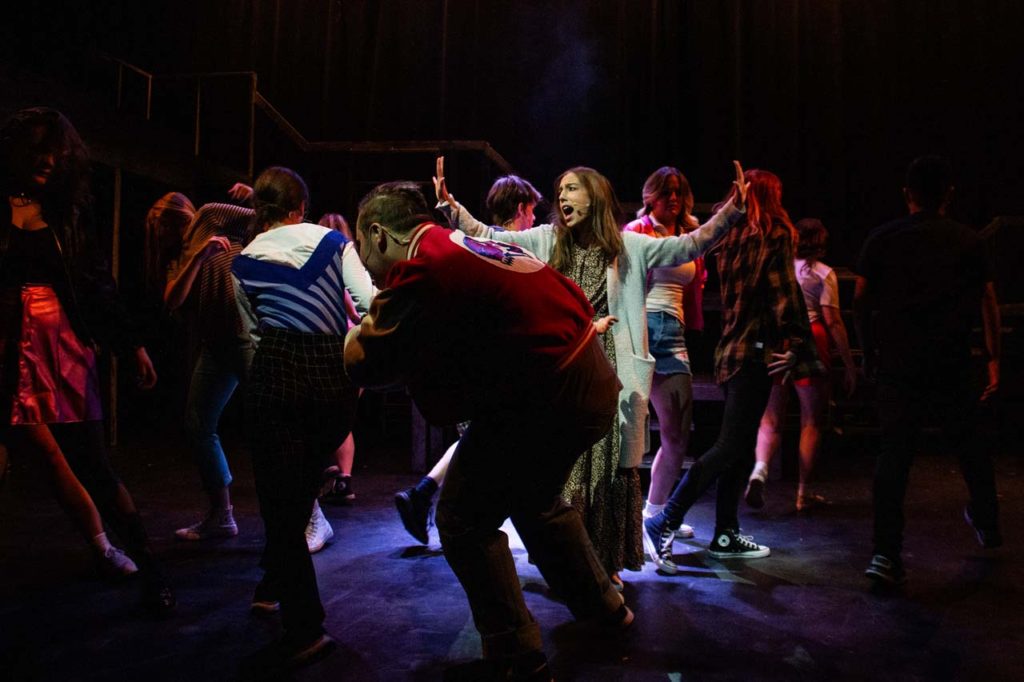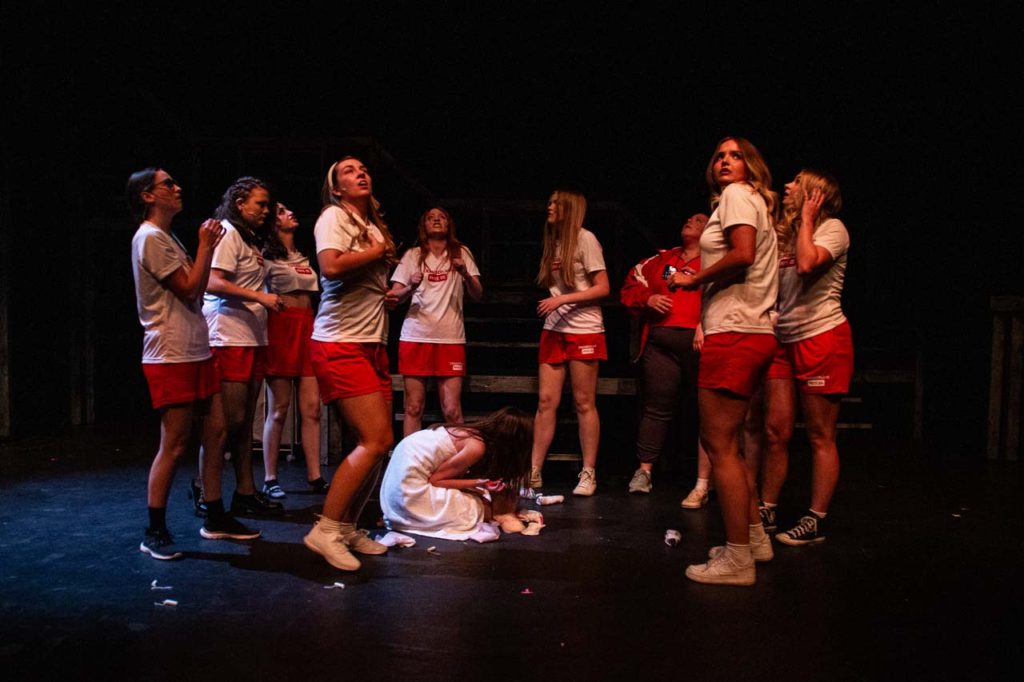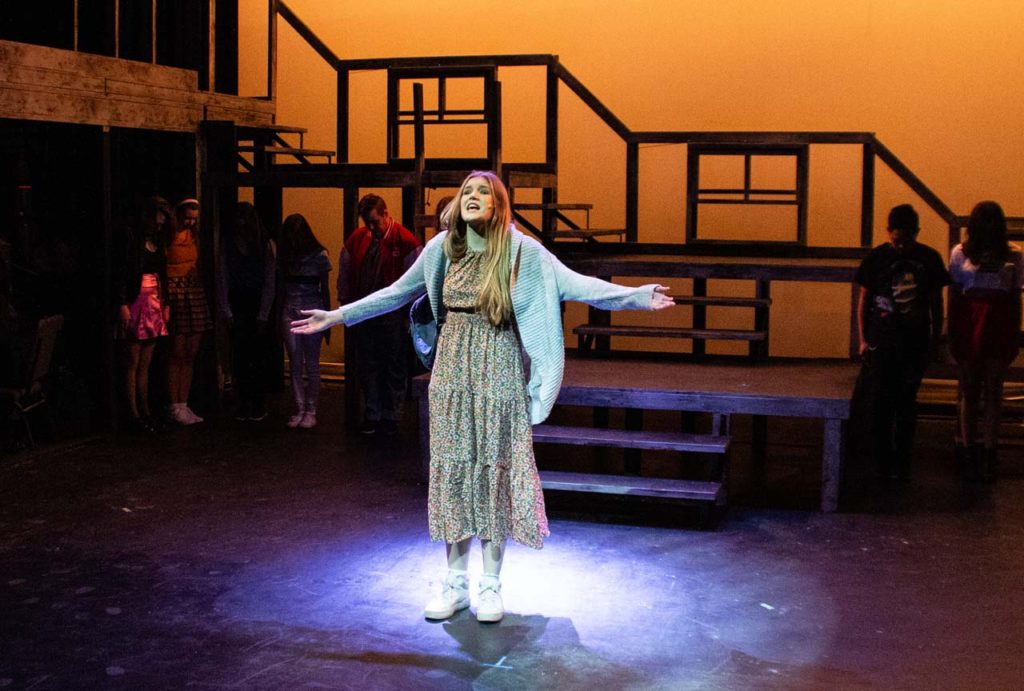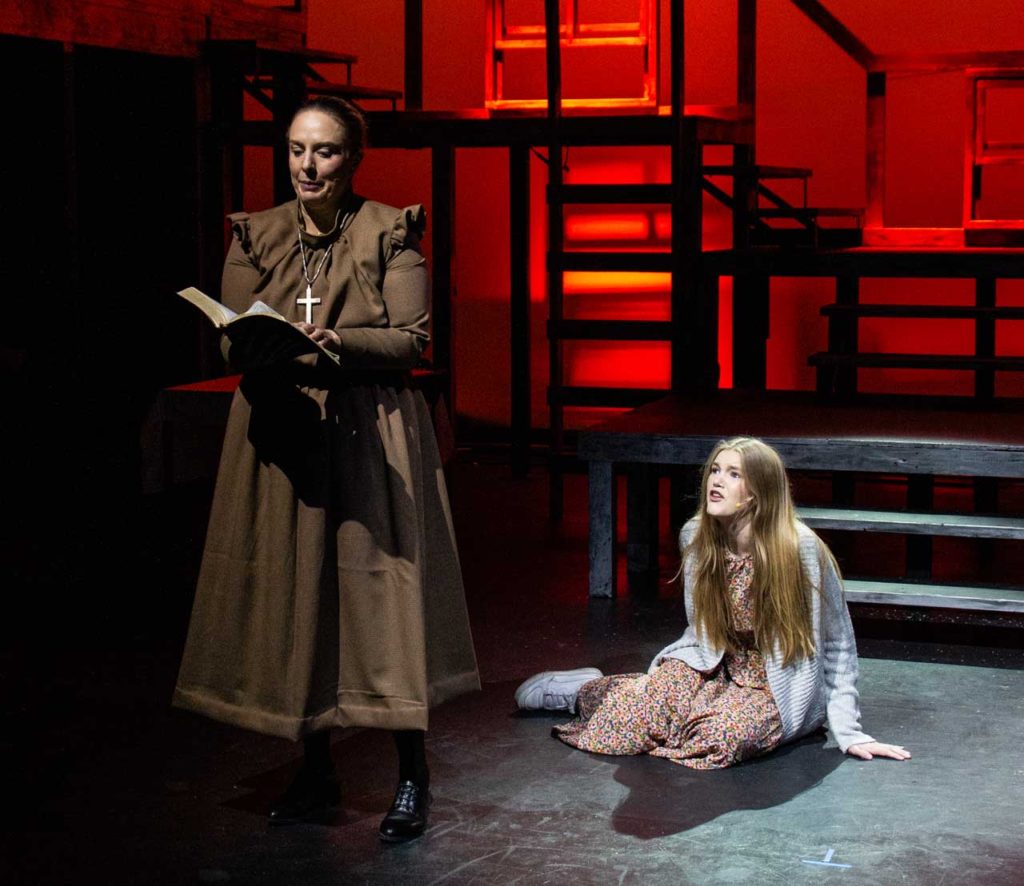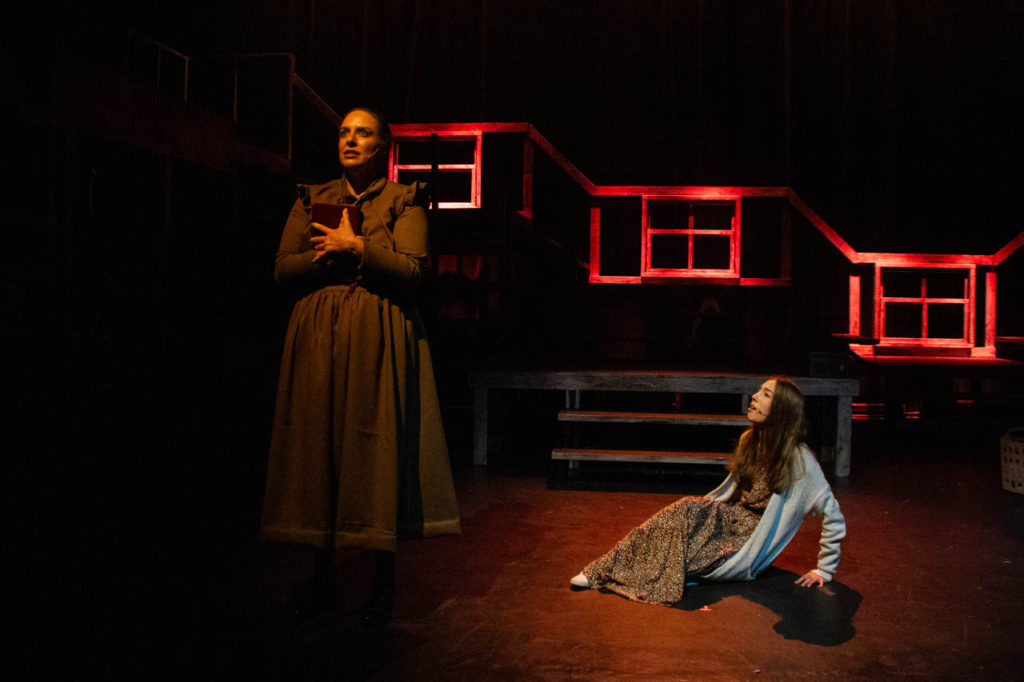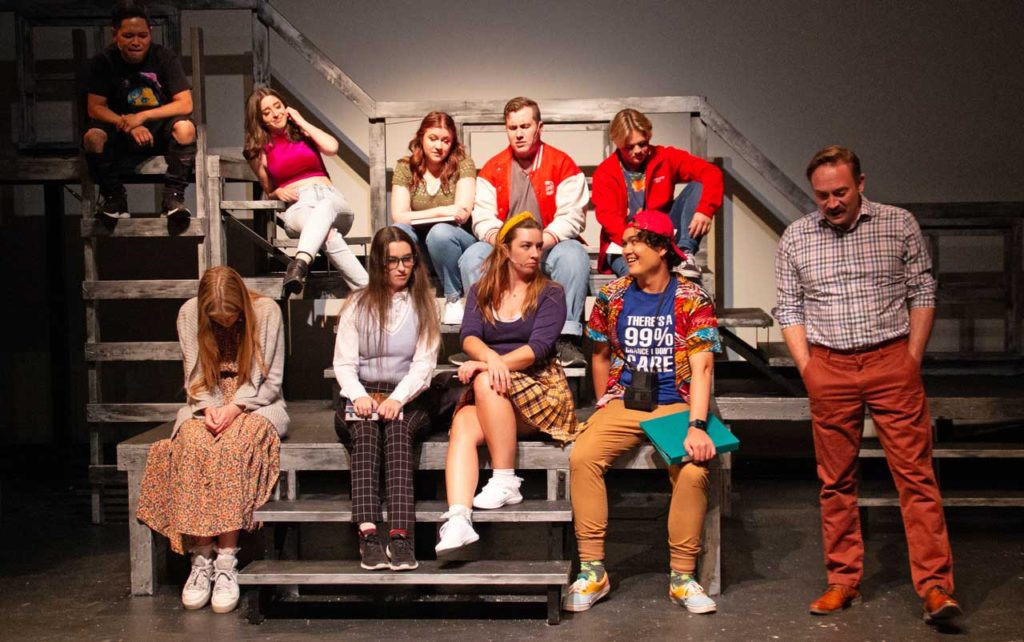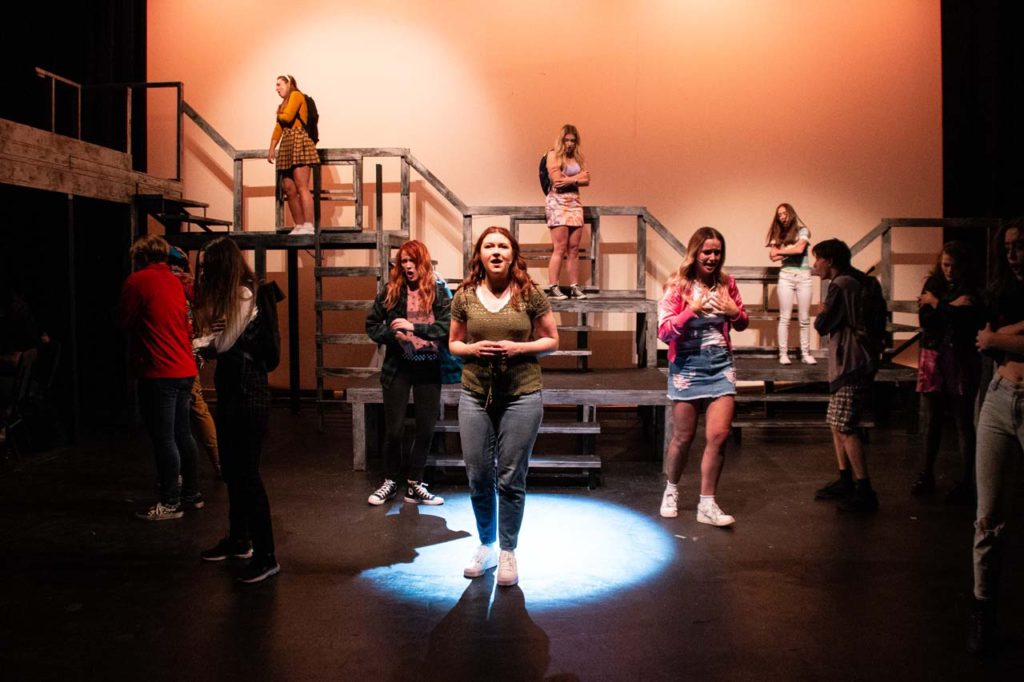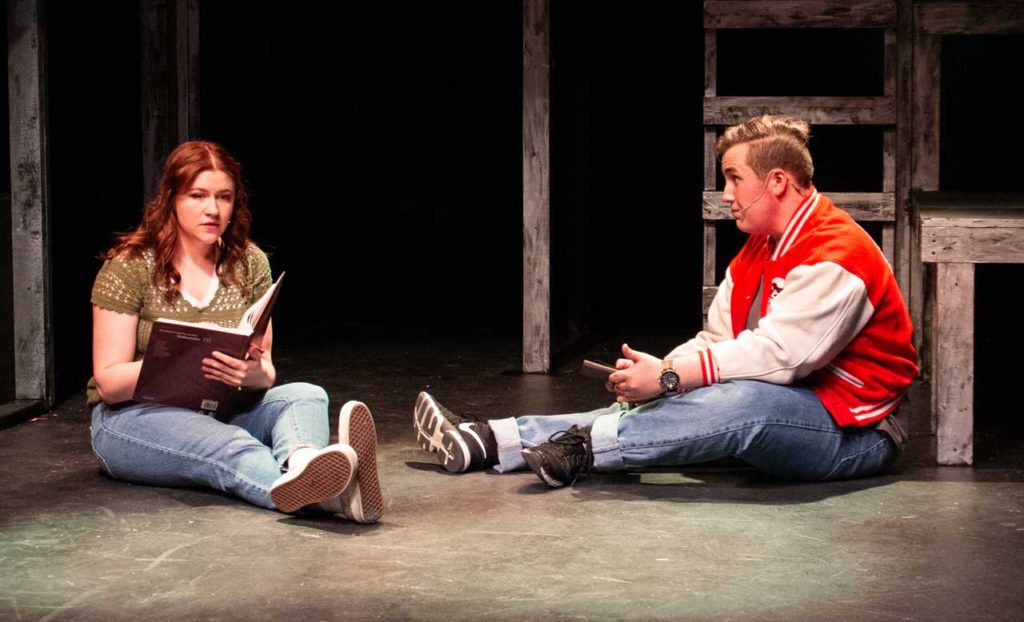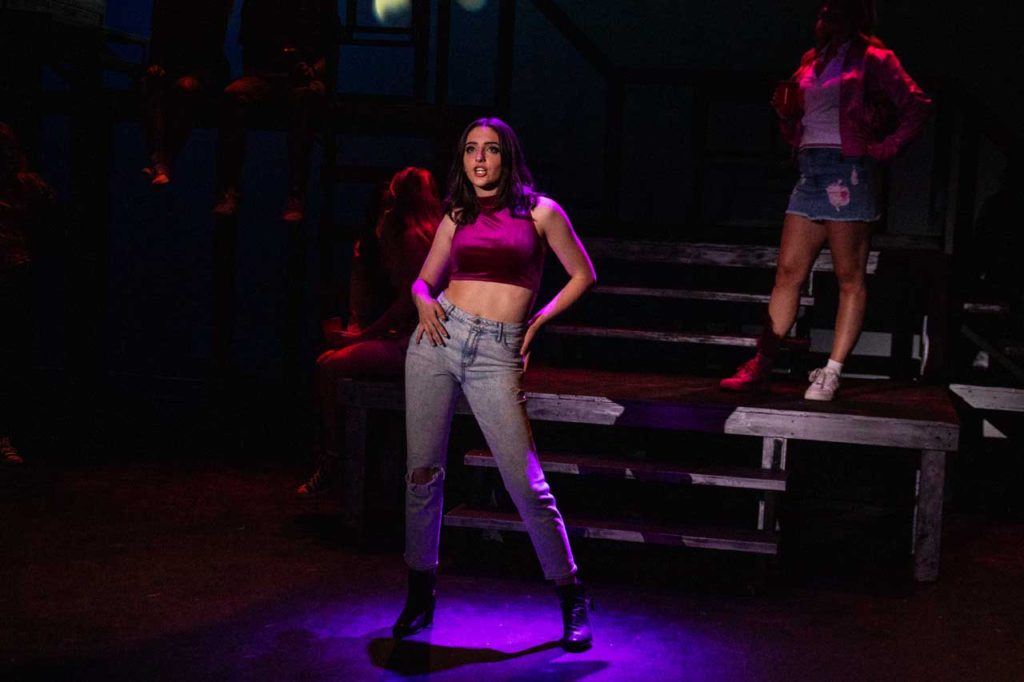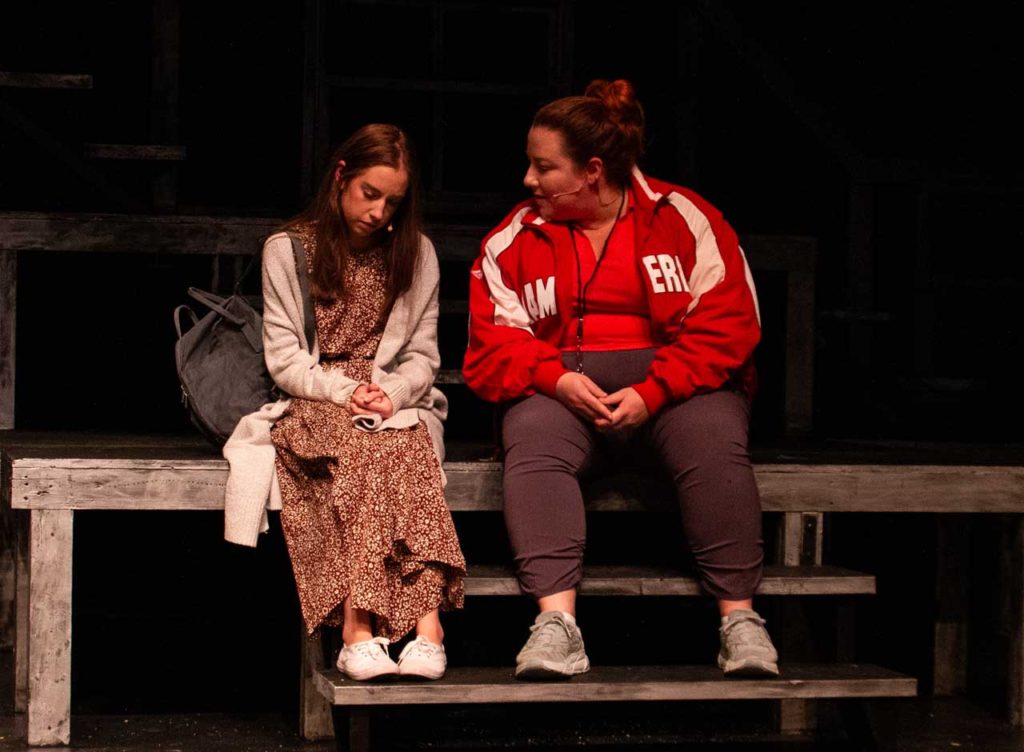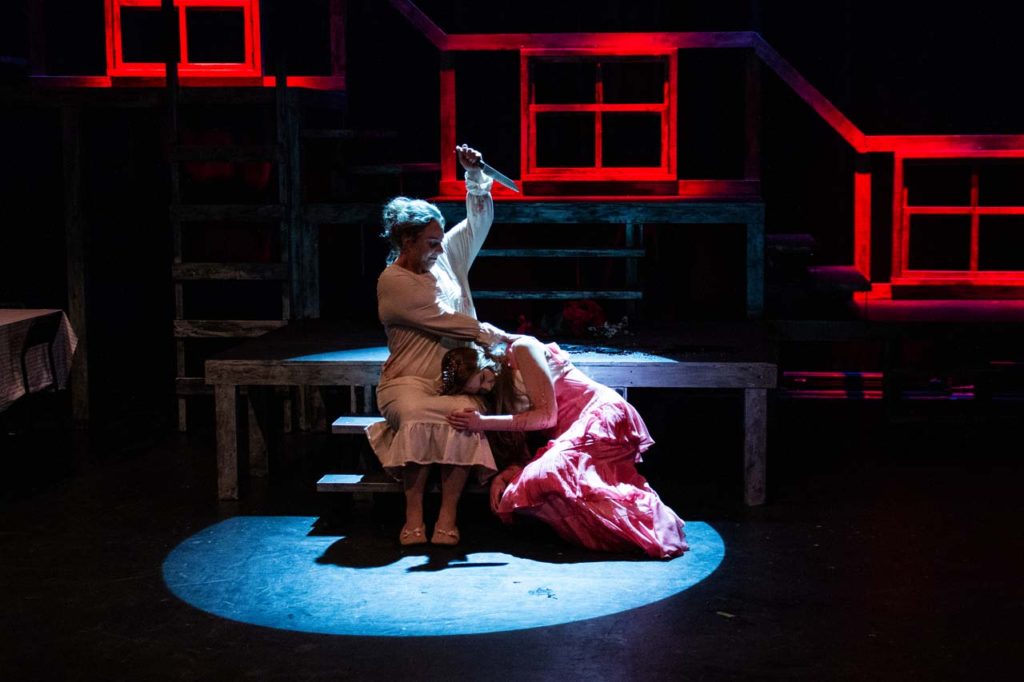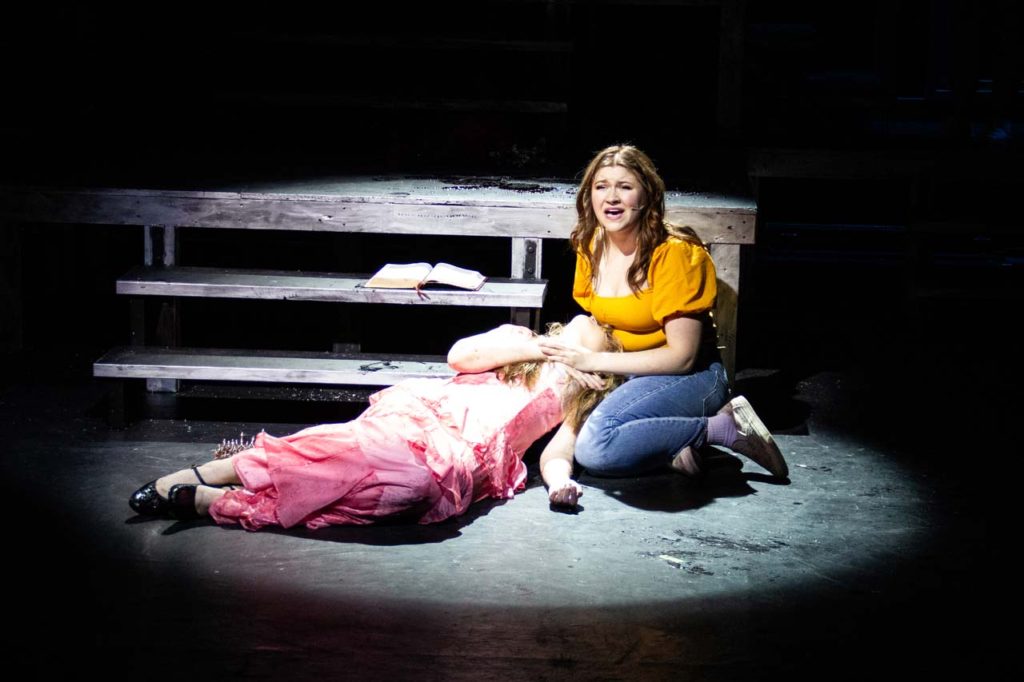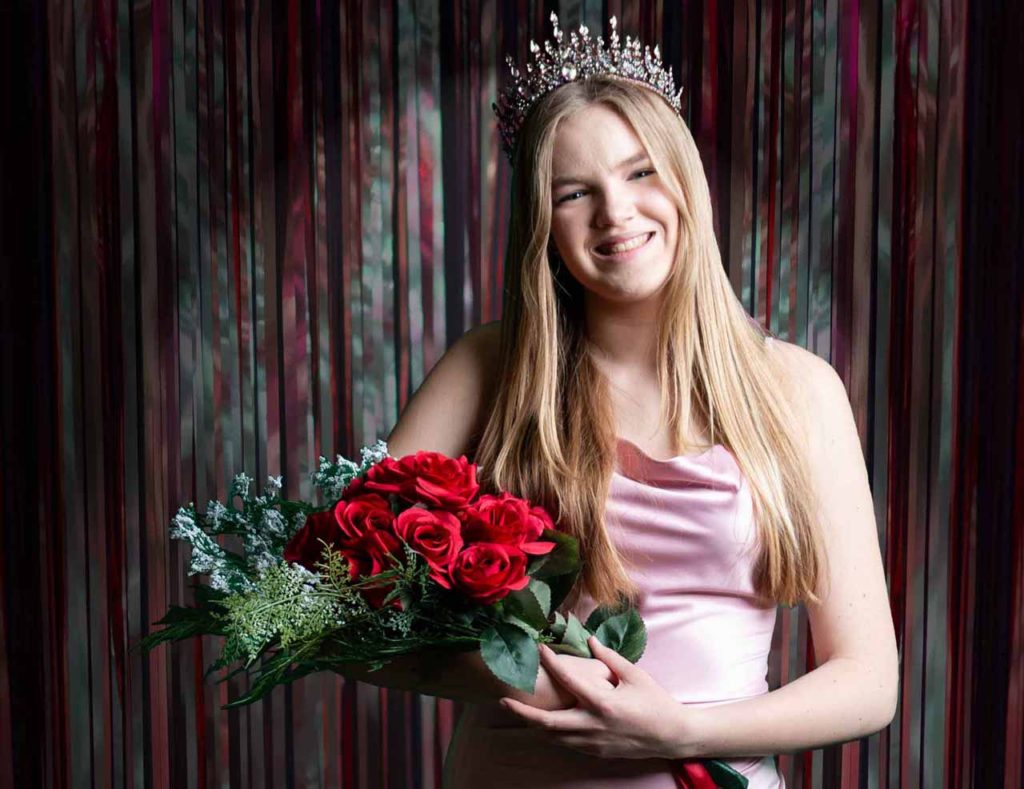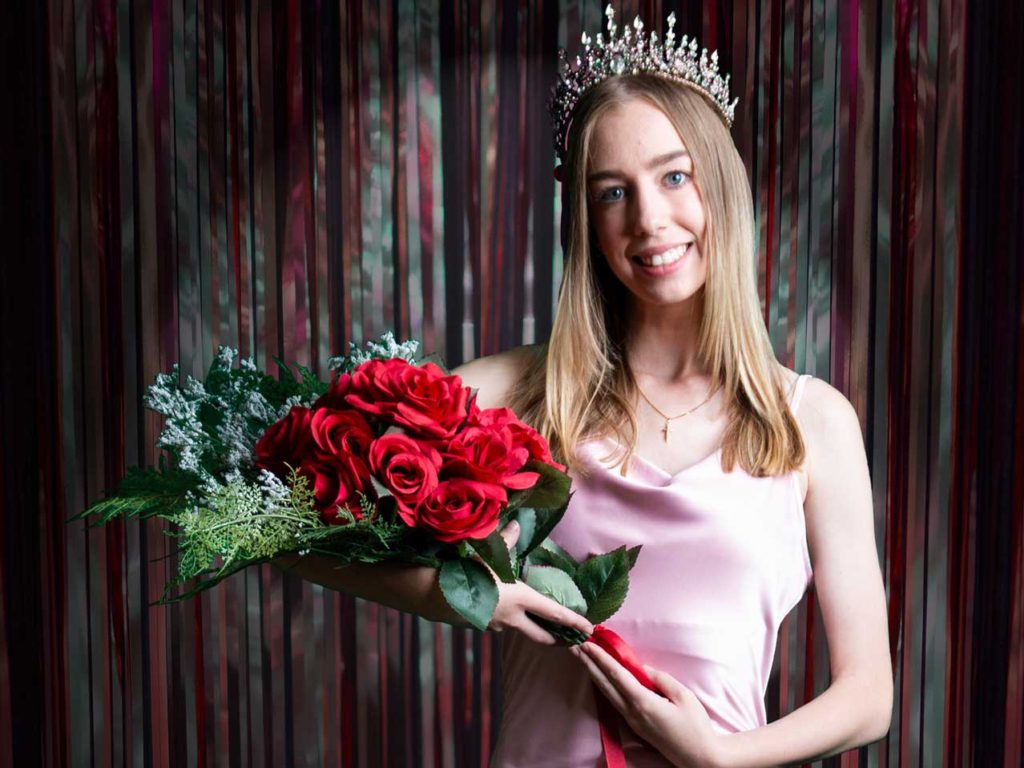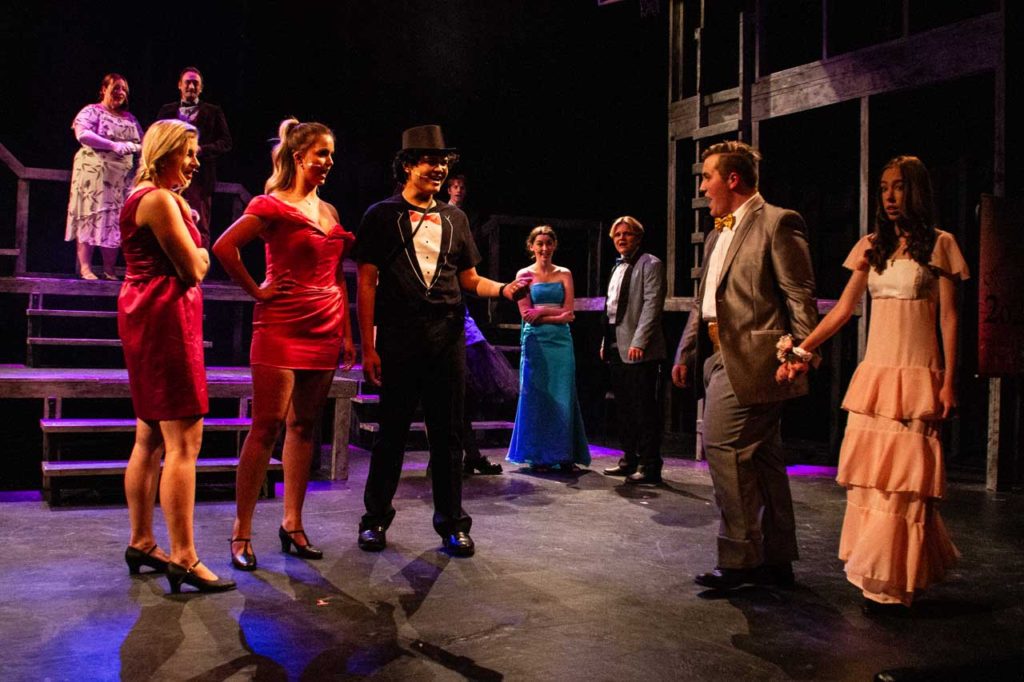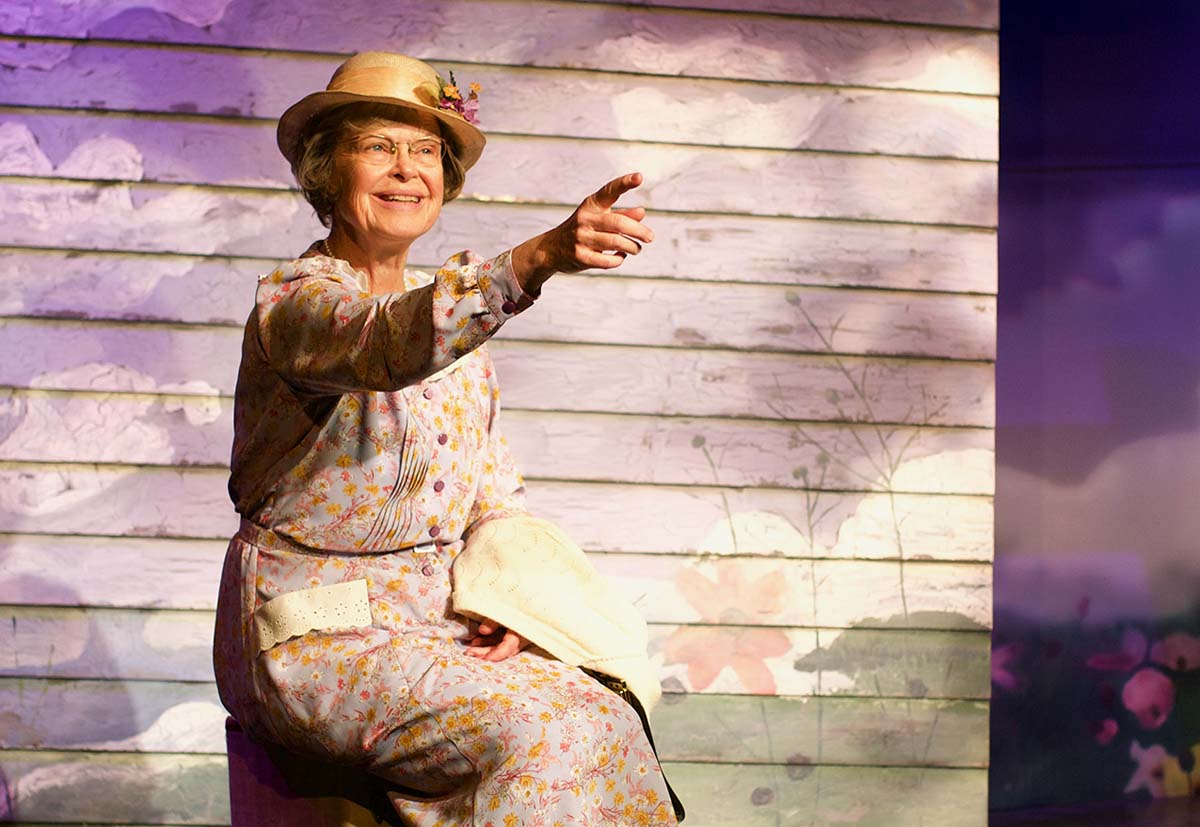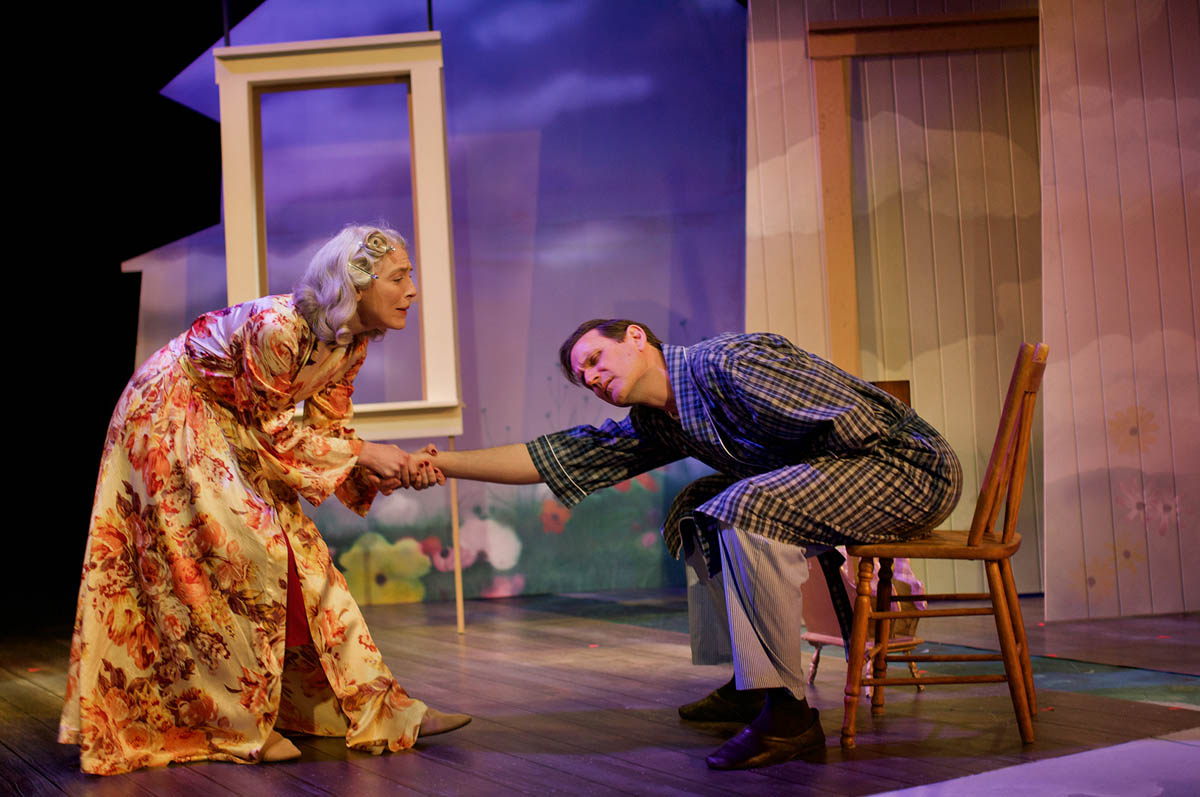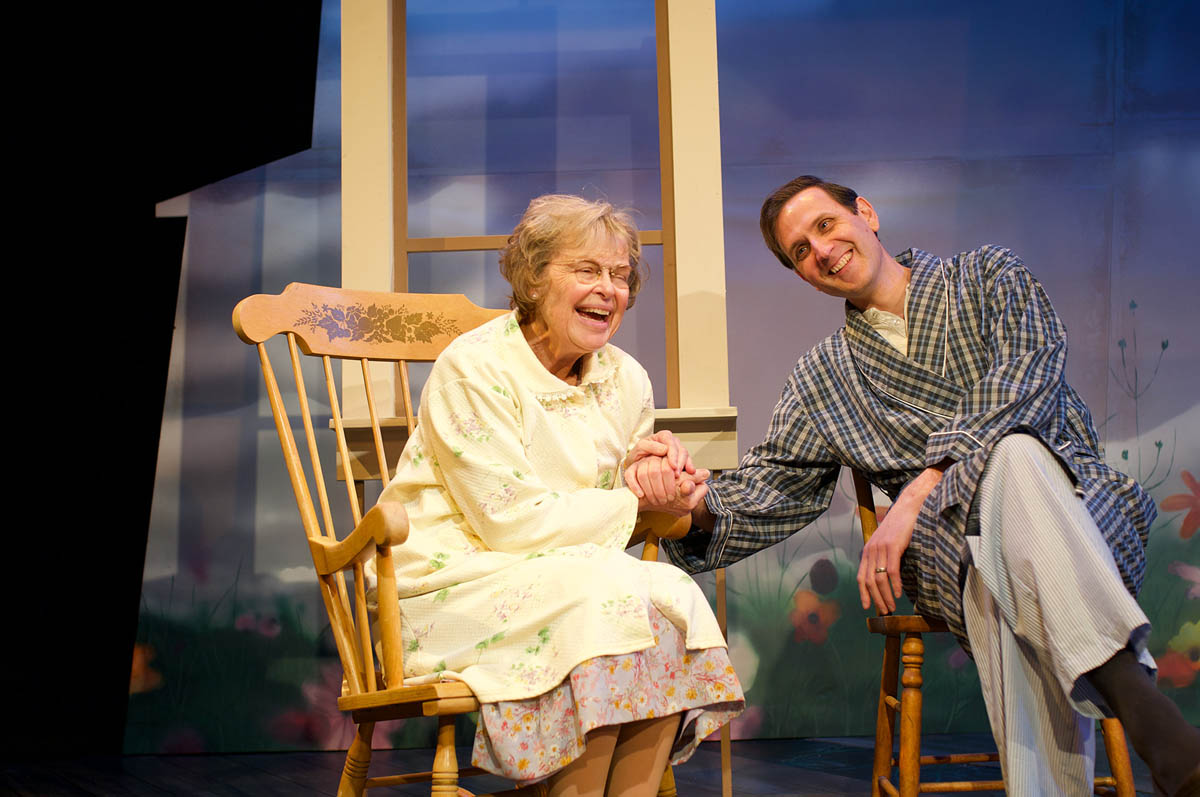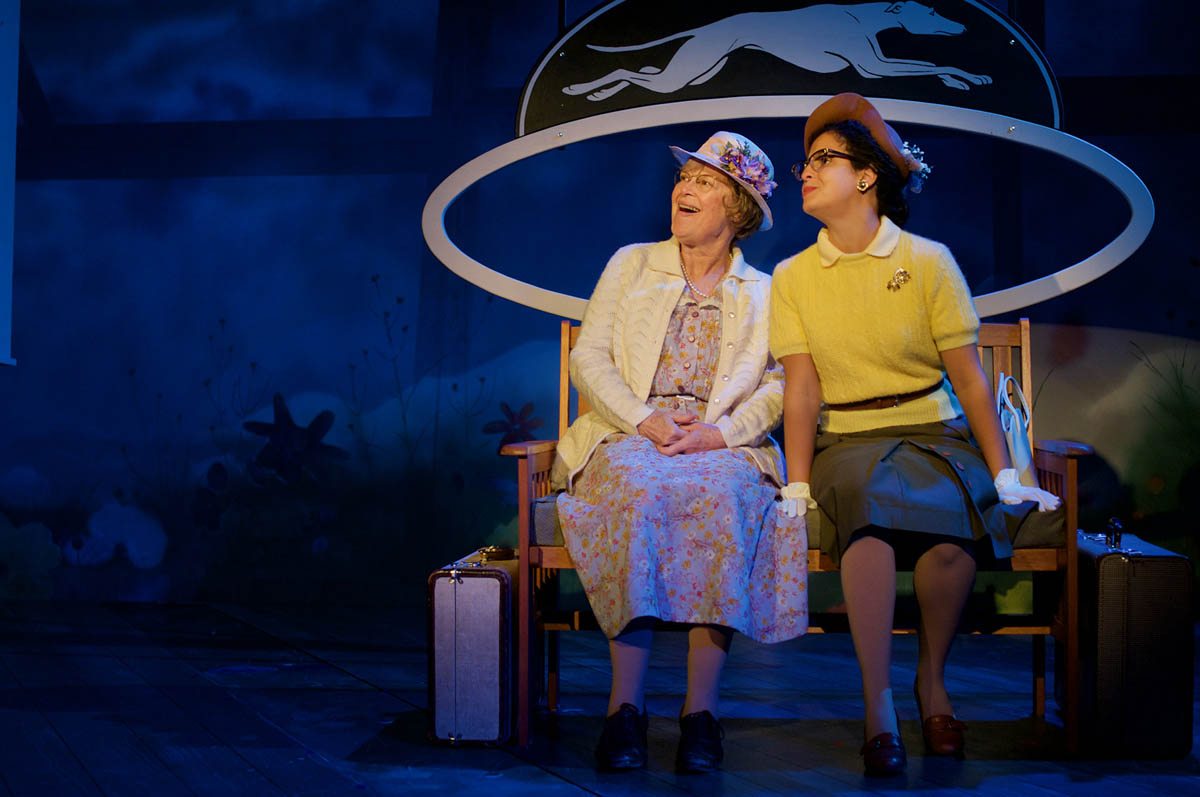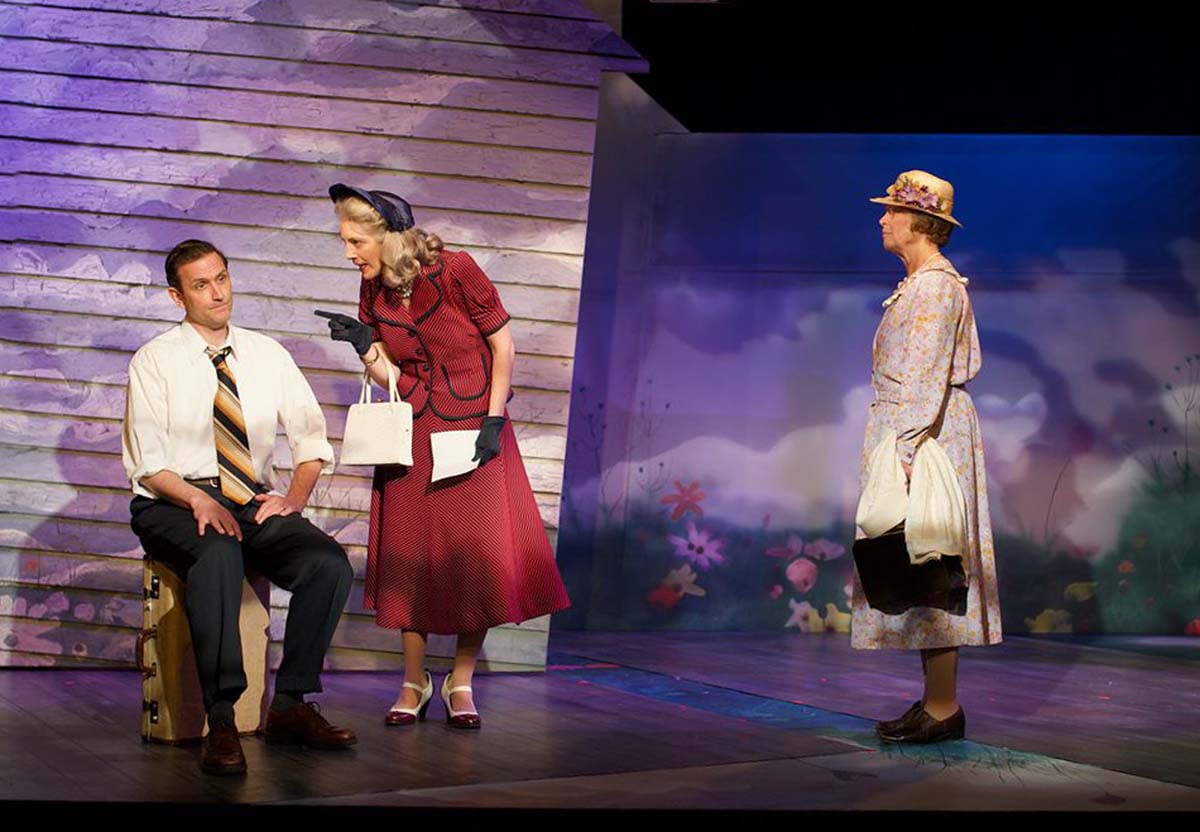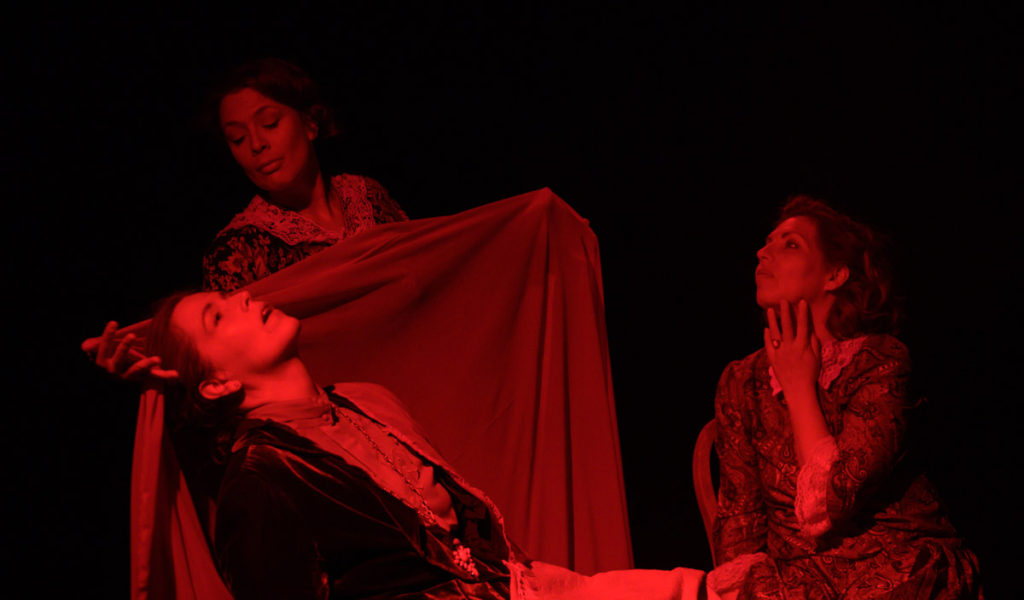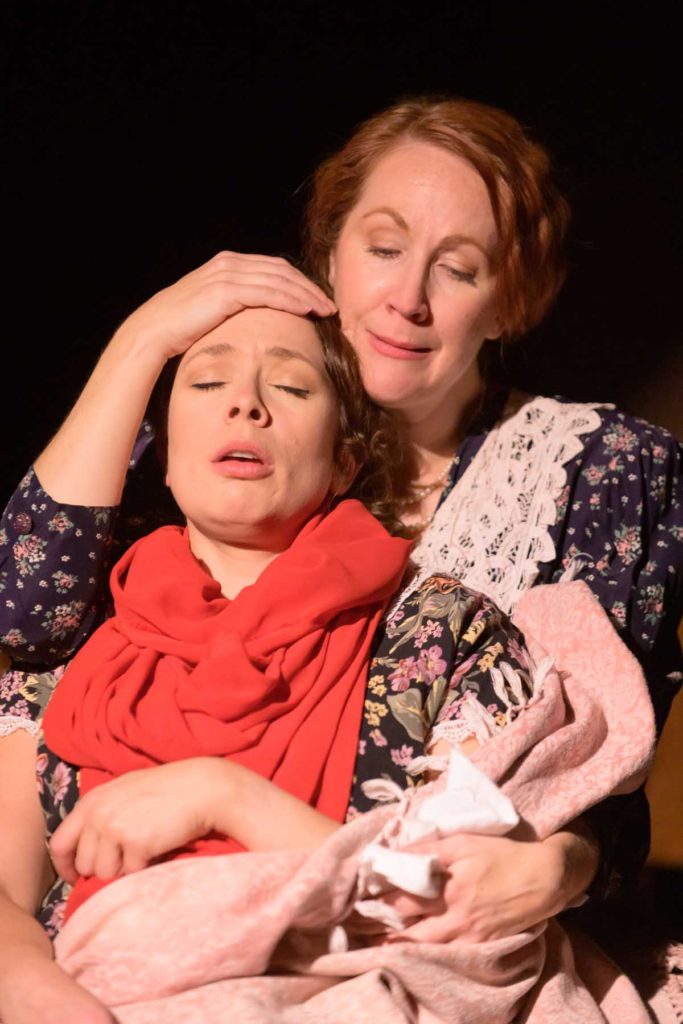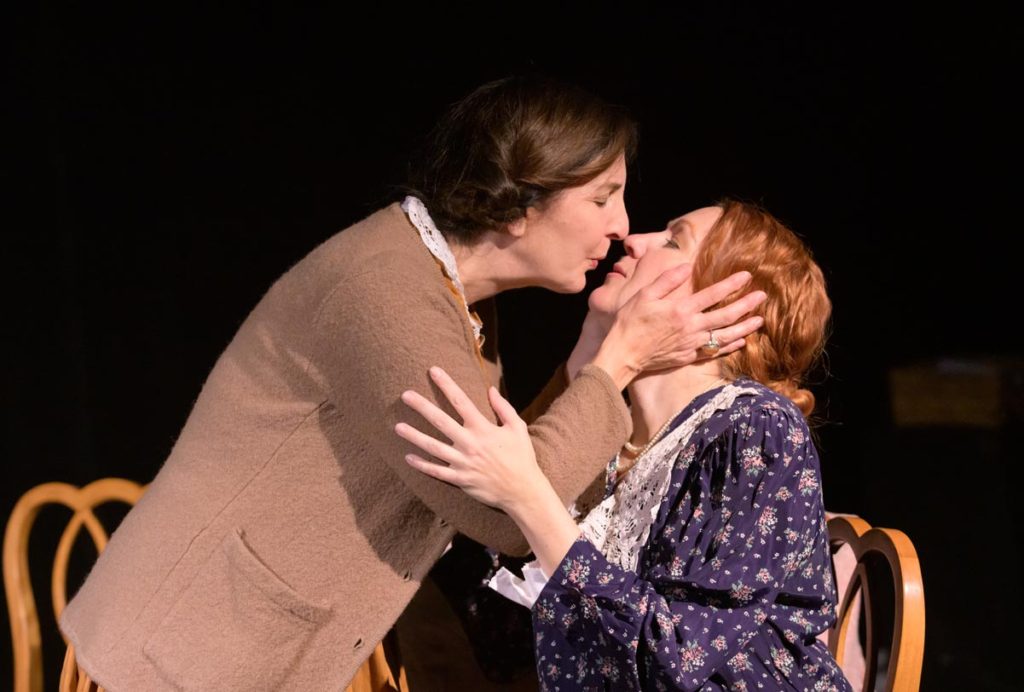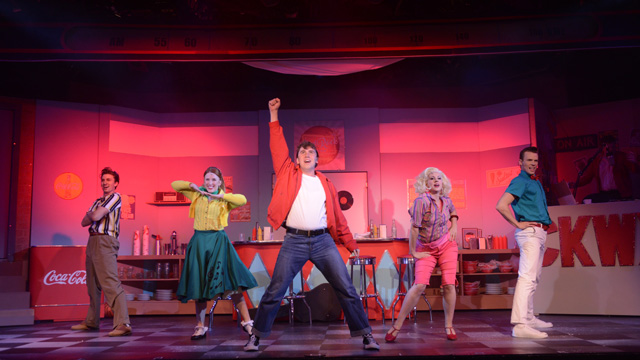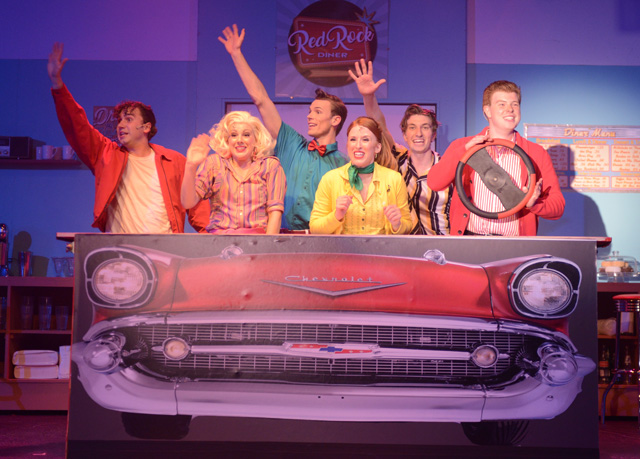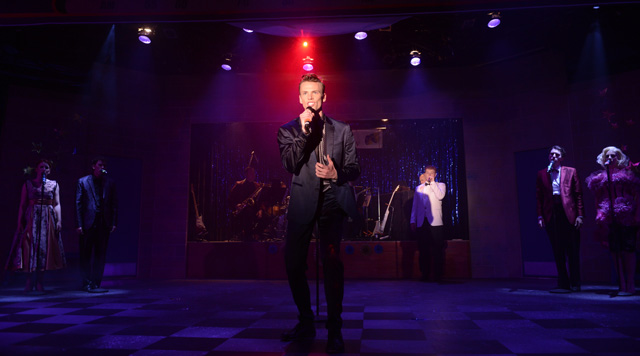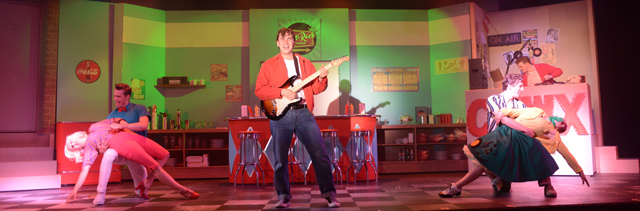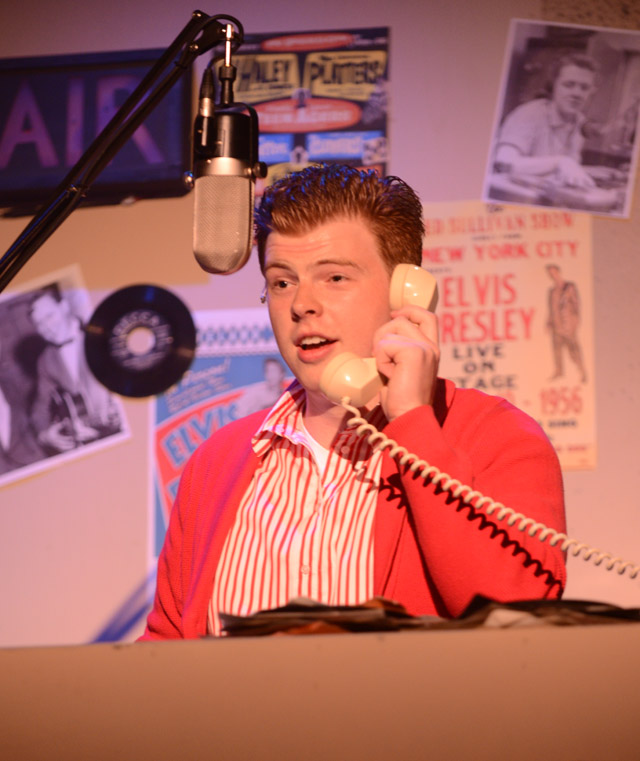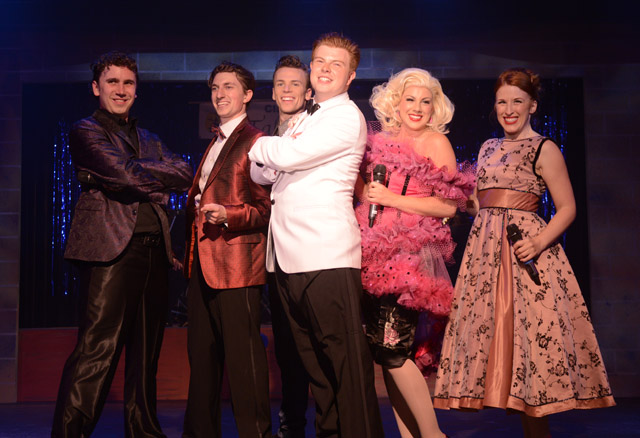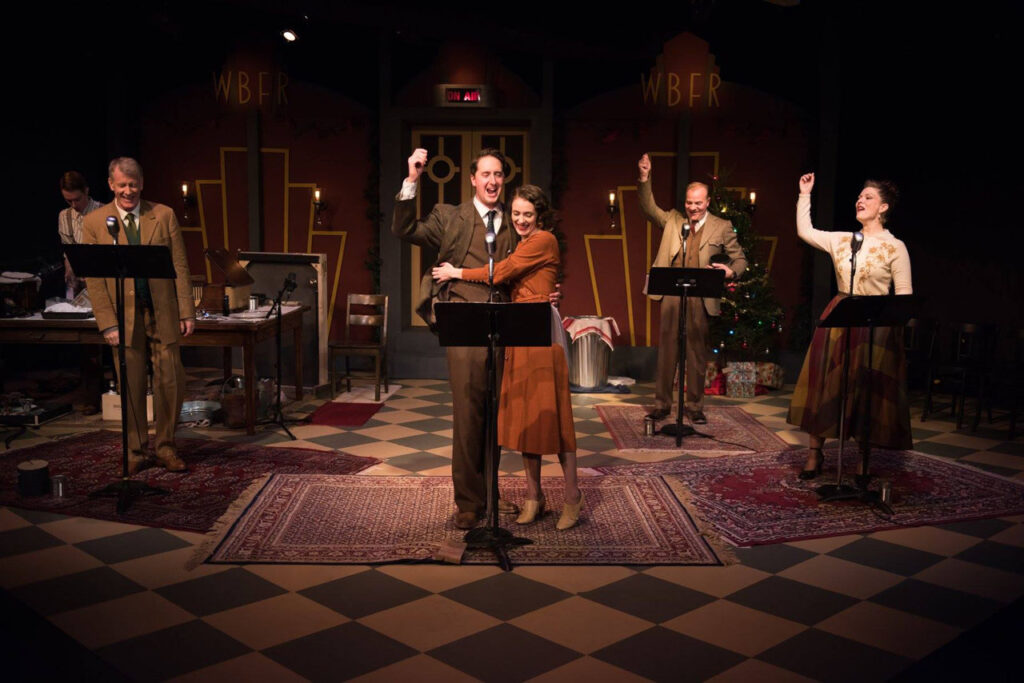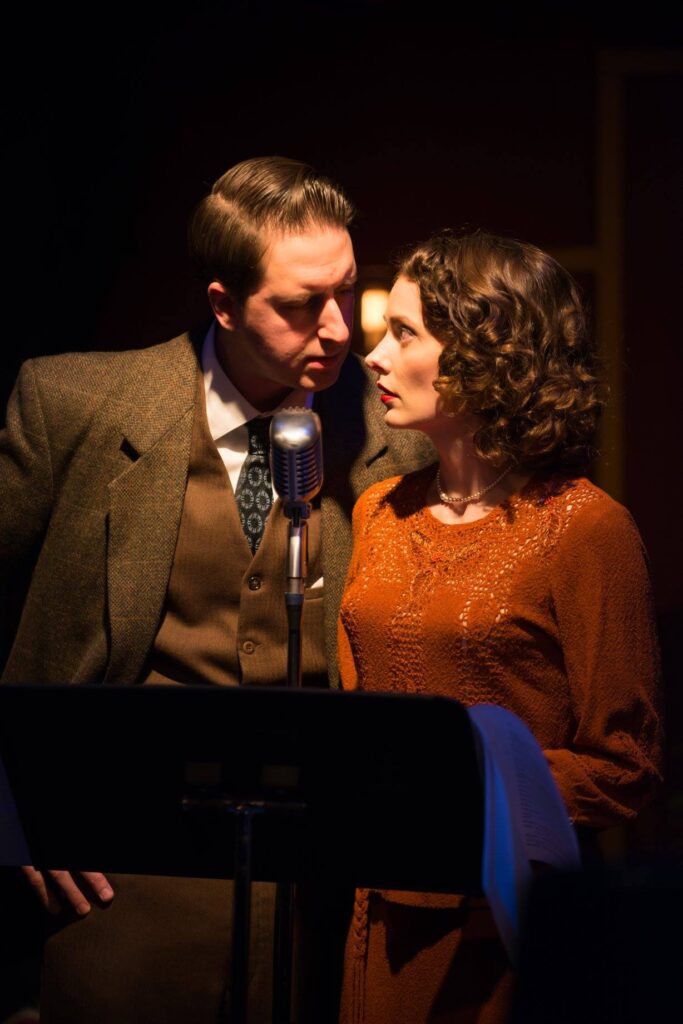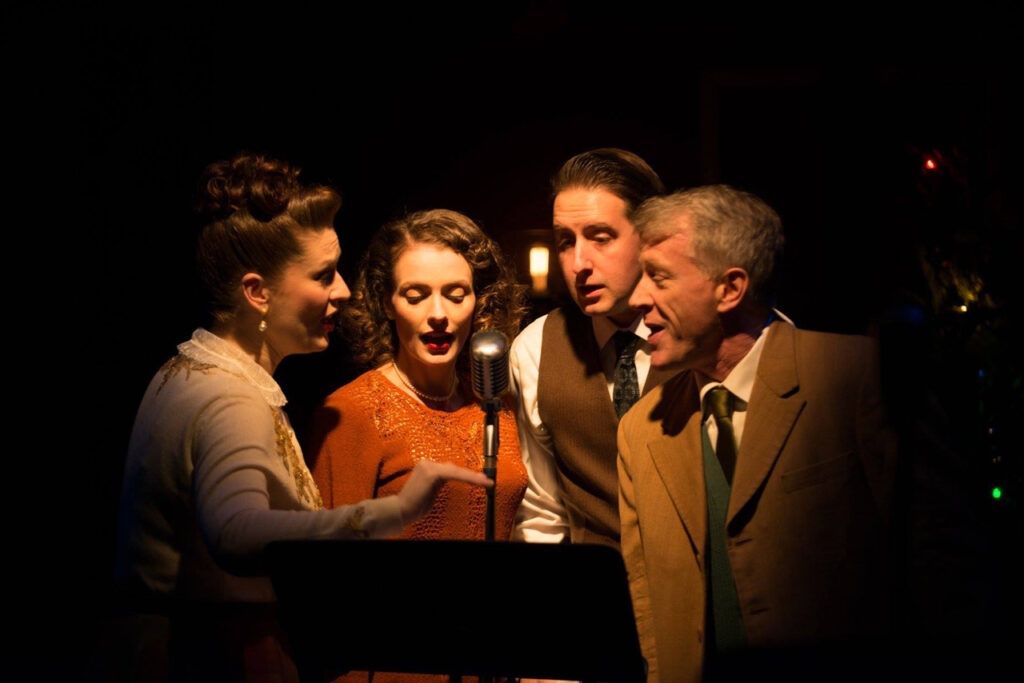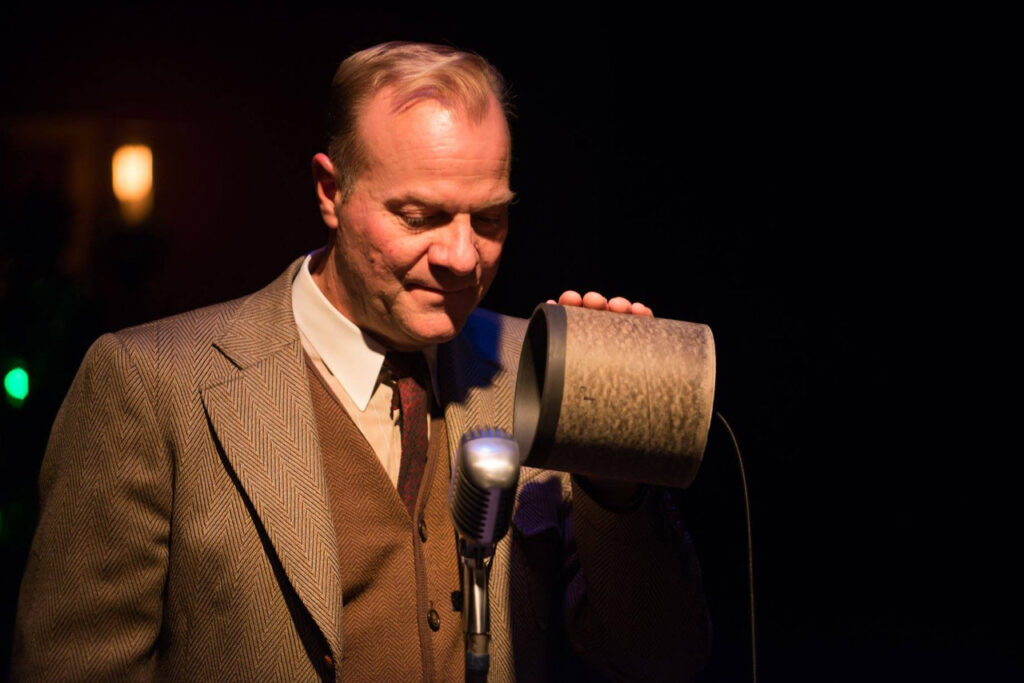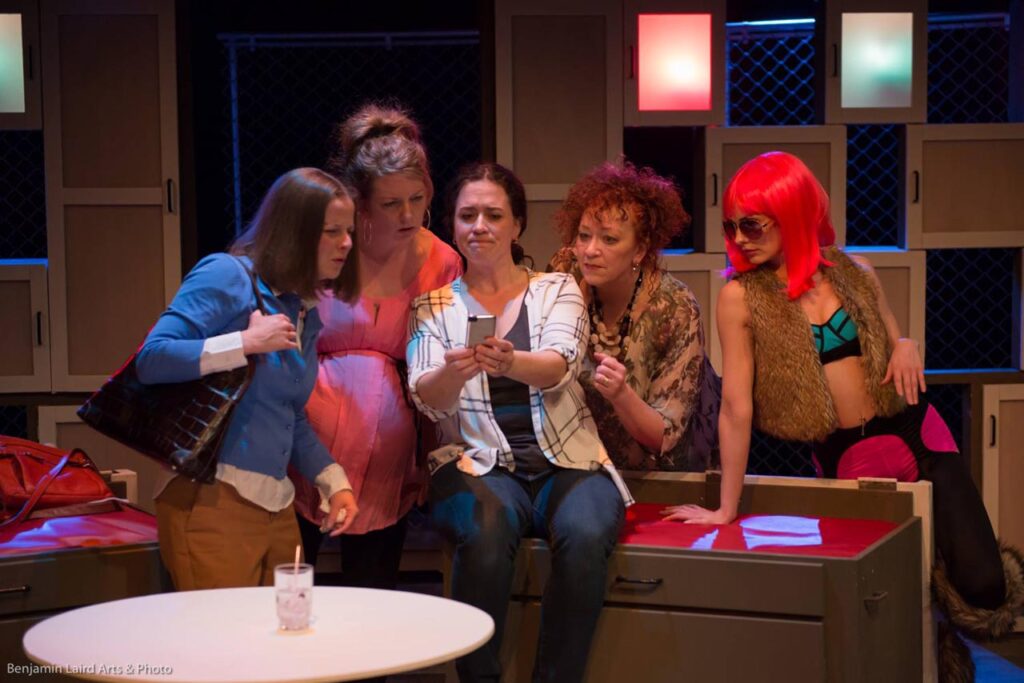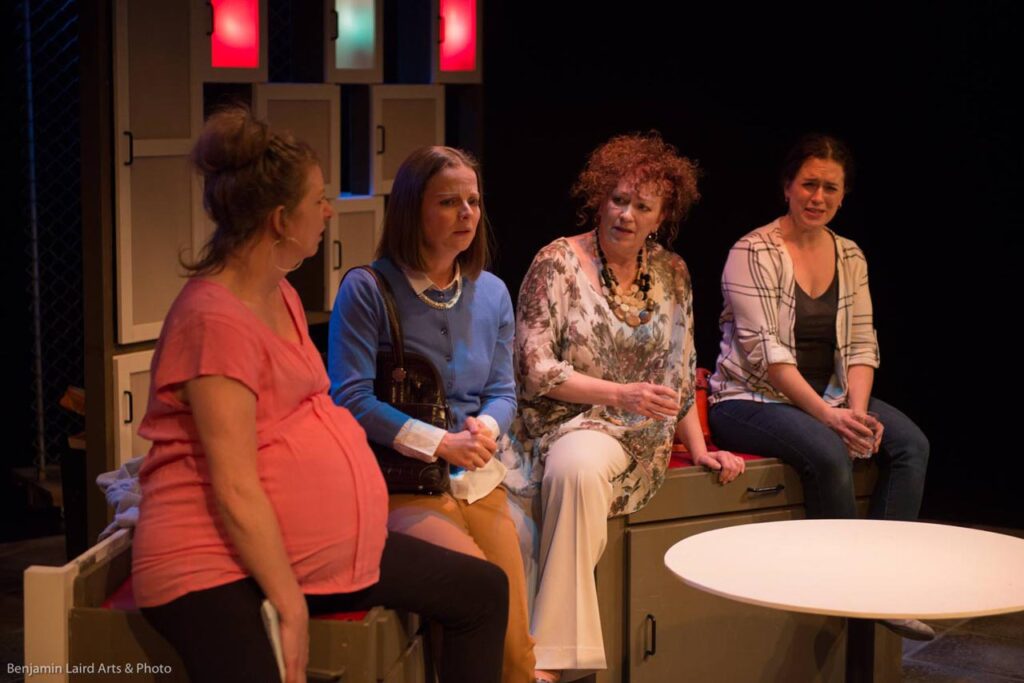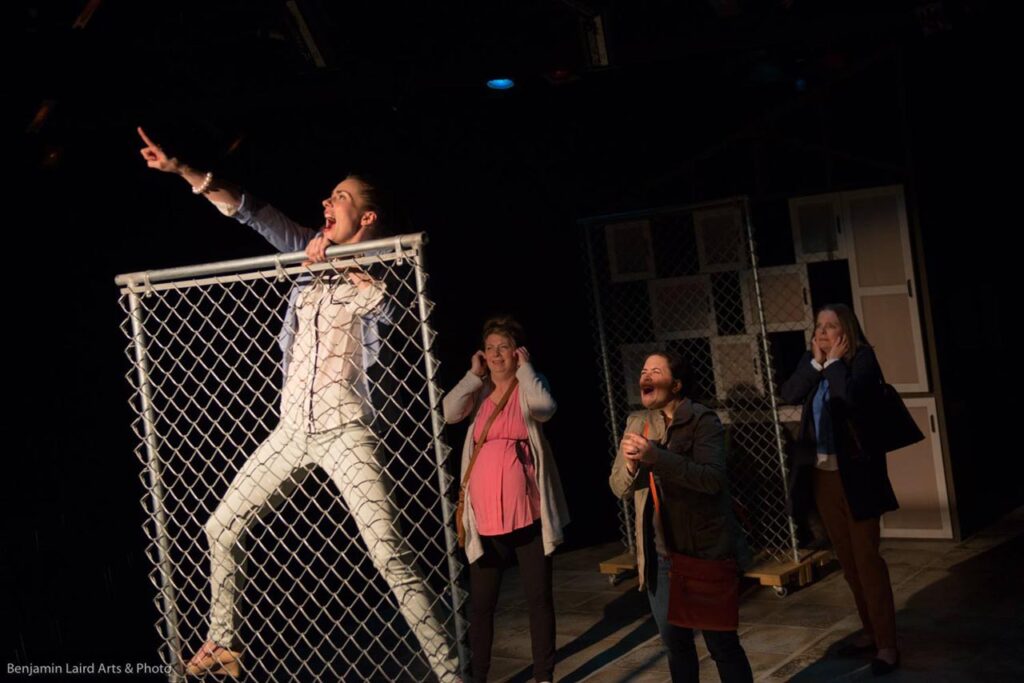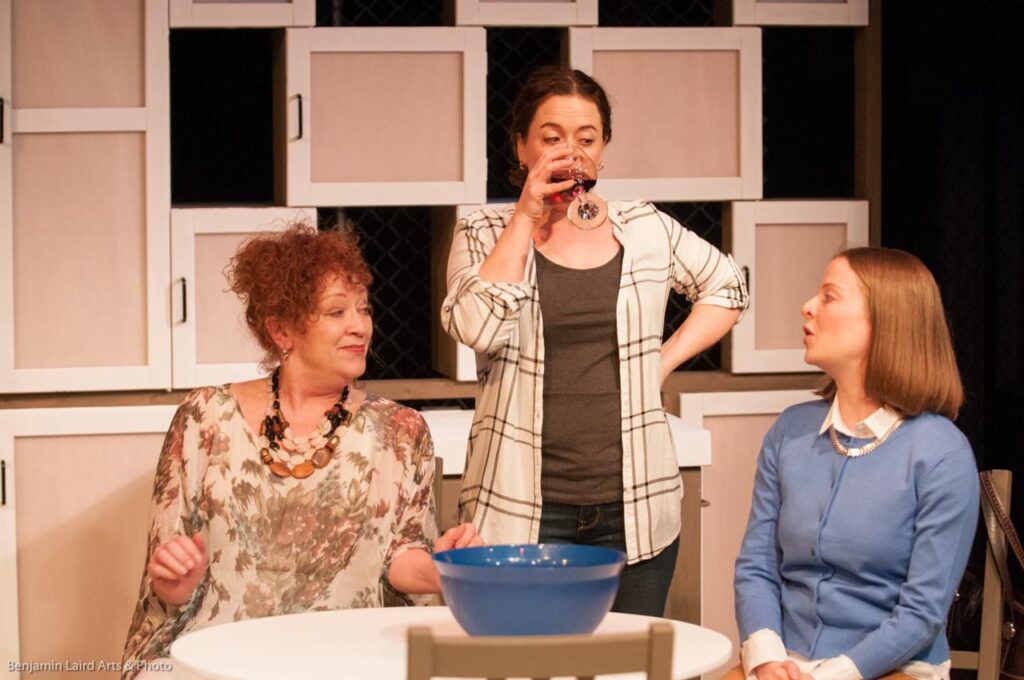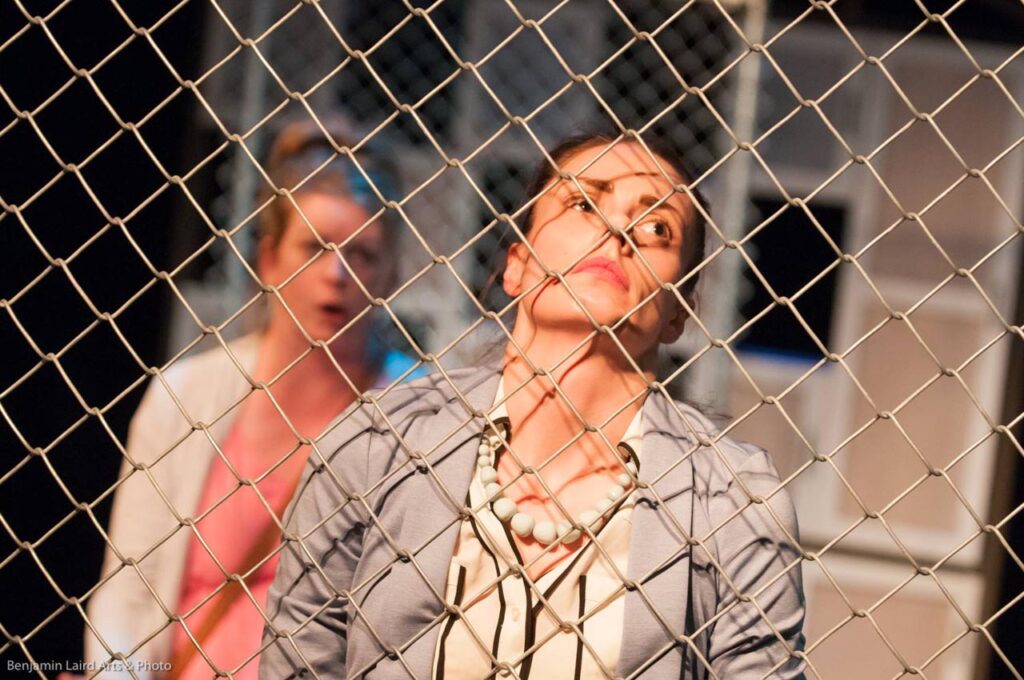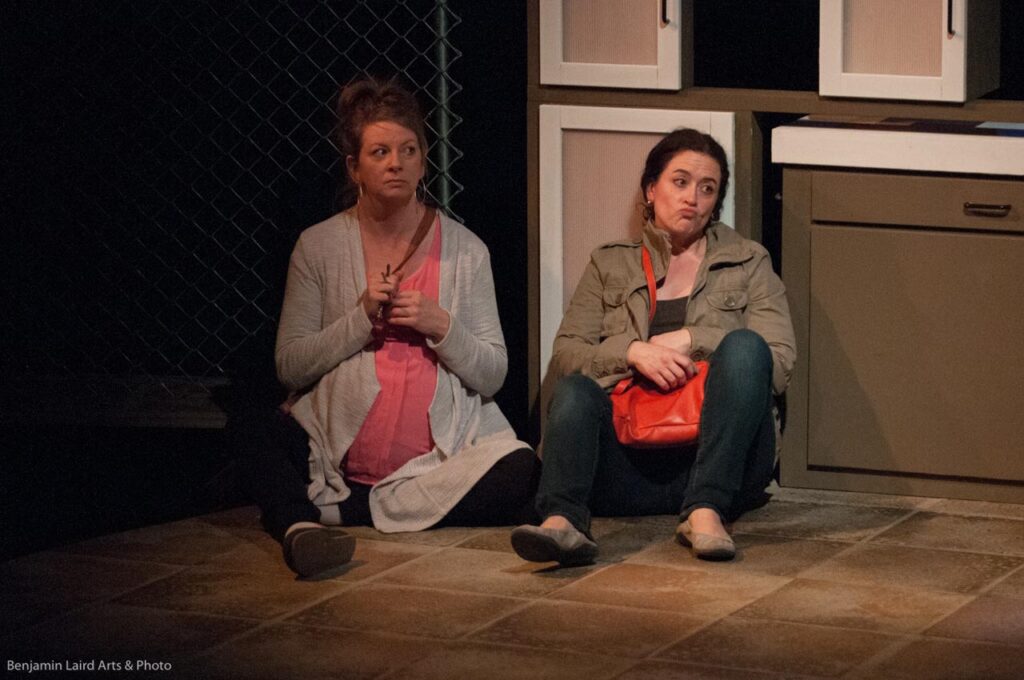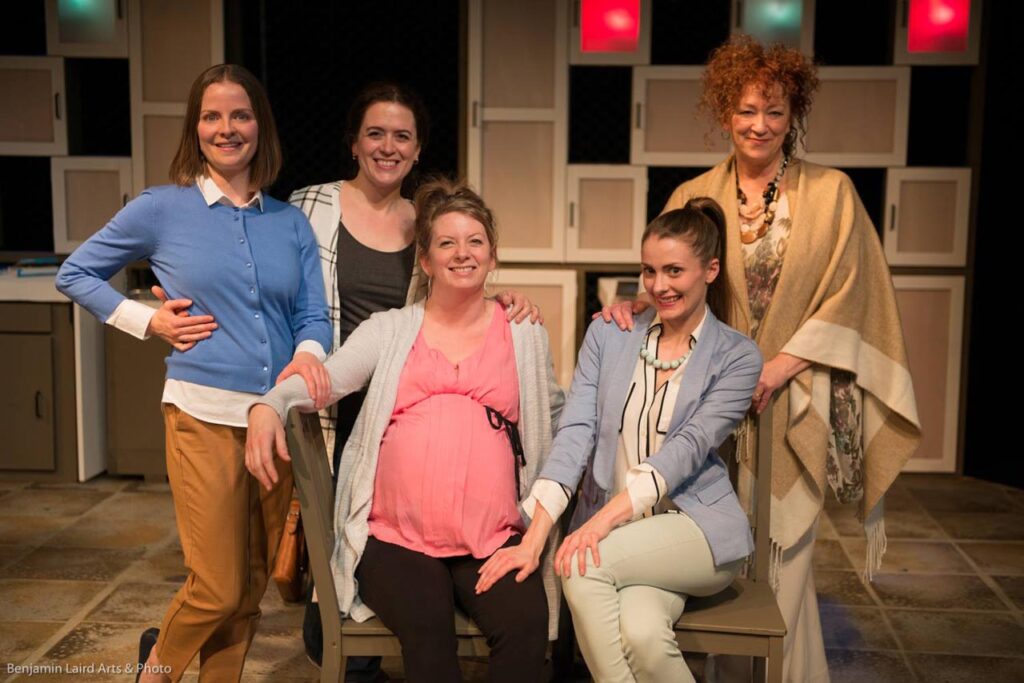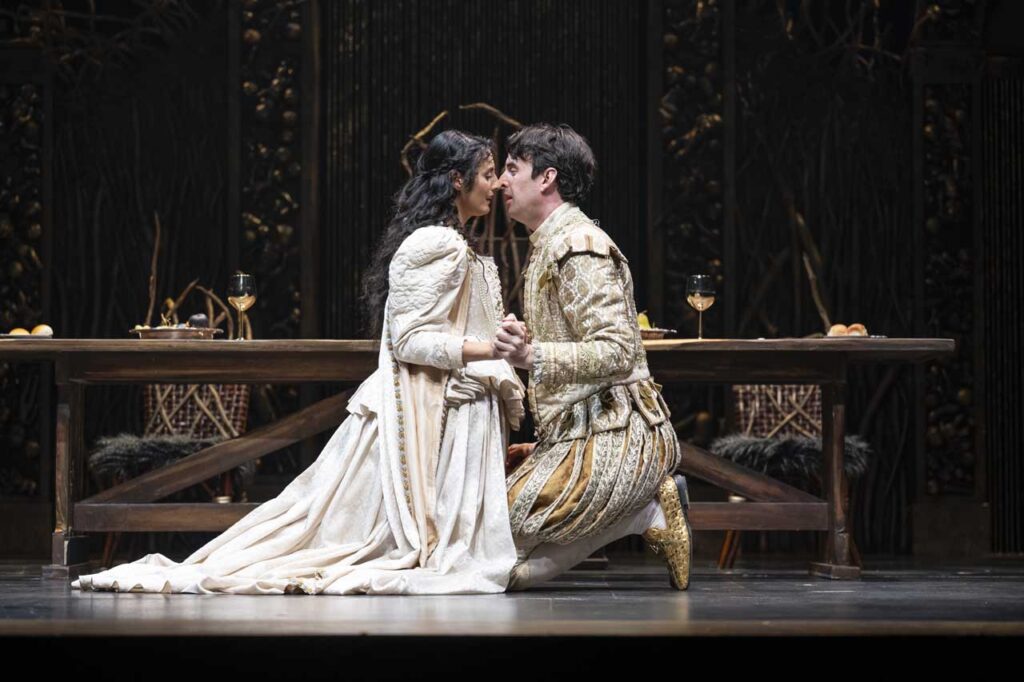
Hayley Rosenau, Sarah Joylyn Irwin, Brent Gill, Matthew Mooney, and Nathan Schmidt in the Rosebud Theatre Production Hurry Hard by Kristen Da Silva. Photo by Lauren Hamm Photography
In search of some lighthearted fun and plenty of laughs, then head out to Rosebud Theatre and catch Kristen Da Silva’s very funny and crowd-pleasing comedy Hurry Hard. The show runs until May 23rd and includes Chef Mo’s always delicious buffet. Tickets are available at www.RosebudTheatre.com or by calling the box office at 1-800-267-7553.
As the play opens, we are introduced to Terry and Bill, two bickering brothers from Didsbury with a complicated history. Bill is the quiet one hesitant to stand up for what he wants, and Terry appears to be the screw-up of a brother who can’t keep a job while focusing all his dreams and ambitions on winning the Regional Bonspiel so that he can finally have bragging rights over the current champions – that annoying team from Olds. This is the last chance for Didsbury as the town is planning to tear down the curling rink leaving the local teams without a place to play. Unfortunately, the team finds themselves short a man and in need of a replacement or they’ll have to forfeit the game.
Matthew Mooney, Brent Gill, Nathan Schmidt in the Rosebud Theatre Production of Hurry Hard by Kristen Da Silva. Photo by Lauren Hamm Photography
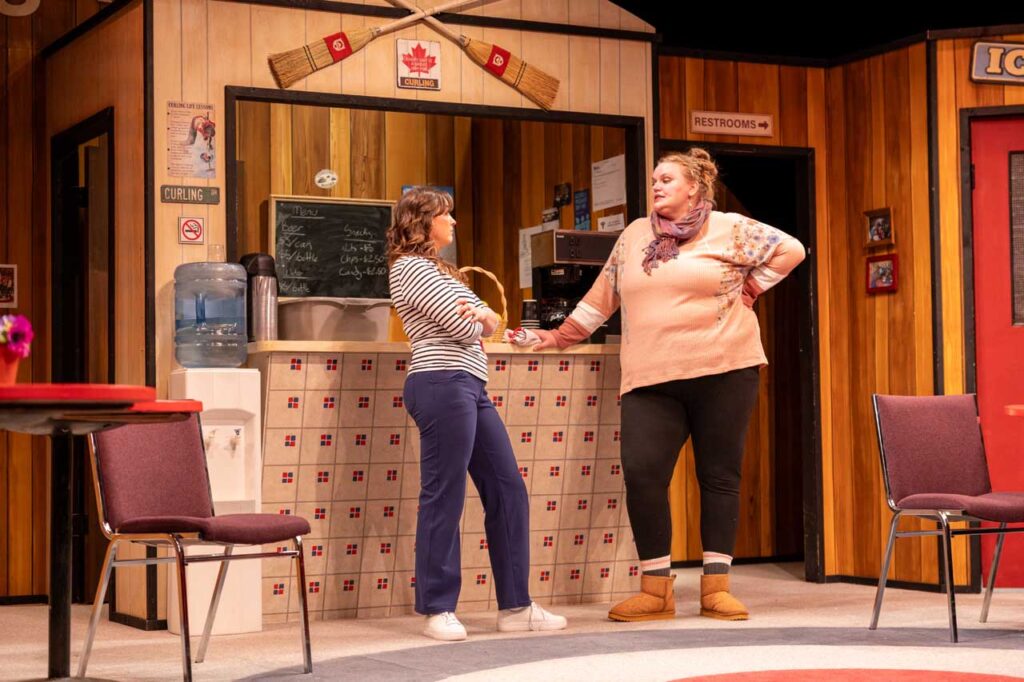
Also sharing the curling rink is the women’s team which also finds themselves short a player. That’s where we meet Sandy, Bill’s ex-wife who happens to be a pretty good curler and who’s currently attempting to teach her friend Darlene, the local hairdresser, how to play the game. Of course, you can see where this is heading. The men and the women will have to team up and play as a mixed team in order to keep their dream of being regional champions alive. Adding to the mix is Johnny , a handsome, six-pack-sporting new member of the men’s team whose mere presence can cause women to swoon like schoolgirls over their favourite boy band.
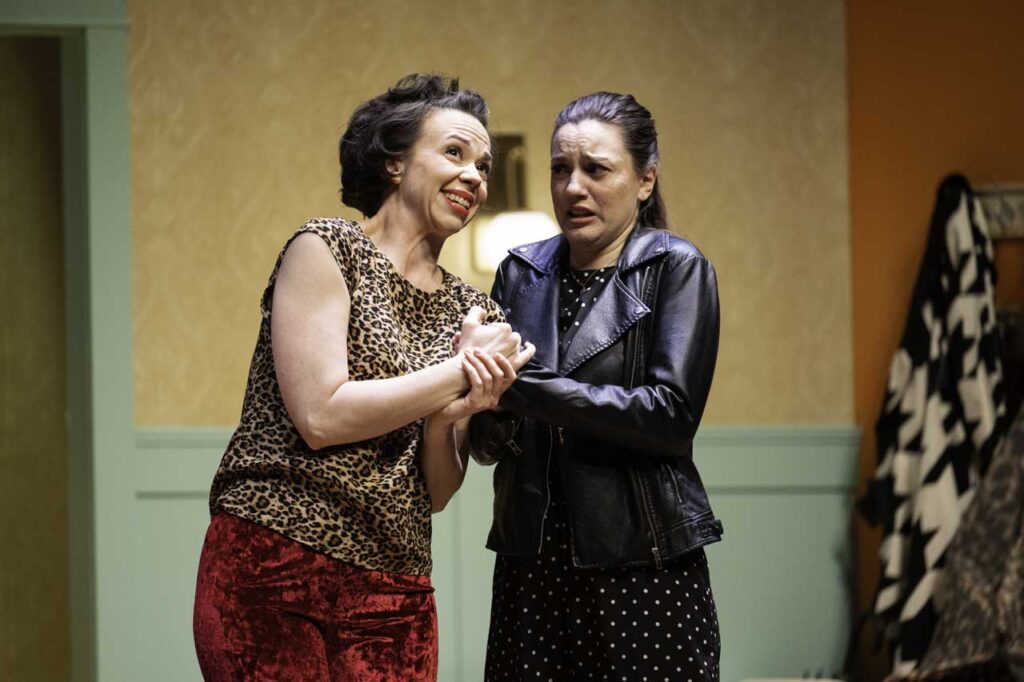
Sarah Joylyn Irwin and Hayley Rosenau in the Rosebud Theatre Production of Hurry Hard by Kristen Da Silva. Photo by Lauren Hamm Photography
Of course, Hurry Hard isn’t the first Canadian play to use curling as a setting for a story. The New Canadian Curling Club by playwright Mark Crawford, which graced the Calgary stages at Alberta Theatre Projects a few years ago is another one, and there’s W.O. Mitchell’s classic tale, The Black Bonspiel of Wullie MacCrimmon, which was originally produced by Theatre Calgary back in the ’70s and more recently by Alberta Theatre Projects in 2024. That had me wondering if writing a play about curling is a rite of passage for Canadian playwrights and so I contacted Kristen and asked her what she thinks is the appeal of the game as a background for these different stories and her story in particular.
KRISTEN DA SILVA
It’s a funny story about Mark’s play and mine.
Hurry Hard was commissioned by Lighthouse Festival Theatre at the same time as Mark was writing The New Canadian Curling Club for Blyth Festival Theatre. Neither of us knew the other was working on a curling play until the season announcements came out. Now we jokingly check with one another before starting a new script.
Personally, I’ve never been able to pass up a good sports story, especially any kind of underdog story. I chose curling, specifically, because it’s a very cool part of our Canadian tradition. It’s a sport that attracts all ages and all skill levels and, in small towns especially, curling clubs become these community hubs. I think there are nearly endless story-telling possibilities, which is why these three plays can share a setting and be so different from one another.
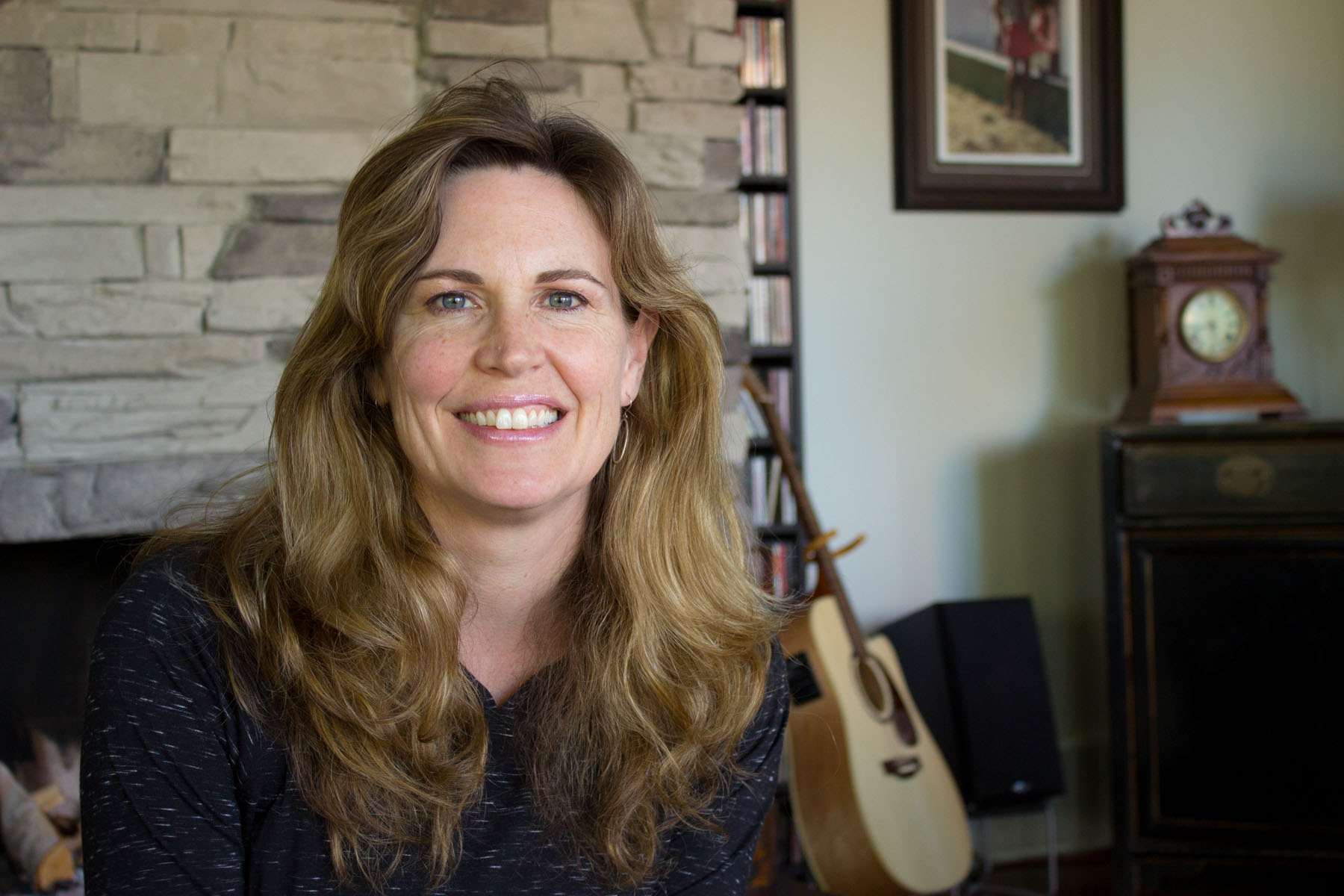
Playwright Kristen Da Silva
JAMES HUTCHISON
So, last year Lunchbox Theatre in Calgary did a marvelous production of your play Beyond the Sea which I saw and thought was fantastic. And now here we are in Rosebud, and they are producing what I’m sure won’t be their last Kristen Da Silva play – your full-length romantic comedy Hurry Hard. So, I’m wondering with that success and as you get more productions around the world and audiences see your work has your relationship with the work and industry as a playwright changed? Are some things easier? Harder? Unexpected?
KRISTEN
Thanks so much! I wasn’t able to get to Calgary to see it myself but it looked terrific.
And thanks for the invitation to look back a bit with this question. I guess my first thought is just how fortunate and surprised I feel. In the beginning, I flew by the seat of my pants more. I think more about the craft now. I work harder at it. There have been so many opportunities given to me and I collaborate with such amazingly talented people; I want to work really hard to live up to them. It’s a gift to get to do this job every day. It’s the best job I can imagine.
JAMES
Okay, I have to ask the question, because it is a major topic of discussion in the arts. Any thoughts on AI and its impact on the arts and theatre in general.
KRISTEN
When it comes to writing, I don’t understand it at all. We have so many gifted writers on this earth. We should invest in them, because I’ve personally never left the theatre wishing the play felt less human.
JAMES
And finally, why go to Rosebud and see Hurry Hard? What do you hope audiences take away from the experience of seeing your play and this production?
KRISTEN
I hope audiences go to Rosebud, leave their troubles at the theatre door, spend a couple of hours laughing, and leave with a little more hope and joy in their hearts.
Sarah Joylyn Irwin, Hayley Rosenau, Matthew Mooney, Nathan Schmidt, in the Rosebud Theatre Production of Hurry Hard by Kristen Da Silva. Photo by Lauren Hamm Photography
After seeing the show, I can guarantee that audiences are definitely laughing and coming away from the experience with a more positive and happier feeling about the world. Director Craig Hall expertly balances the comedy and heart of the play by assembling a terrific ensemble that brings these characters to life while Da Silva’s script is filled with smart and clever dialogue that keeps the pace moving and the laughs coming.
Brent Gill is great fun as Terry playing him with a blustery male energy that masks his true feelings and desires. Nathan Schmitt portrays his brother Bill as a man clearly with more than curling on his mind as he awkwardly tries to reconnect with his ex-wife Sandy. Sarah Joylyn Irwin plays Sandy as a woman debating which path to follow as she reviews her life choices and considers her future options. Hayley Rosenau brings a mischievous energy and sparkle to Darlene who must rise to the challenge as the Didsbury team comes together for the final game against Olds. And Matthew Mooney is a charming, friendly, take life as it comes presence who’s just happy to be a part of the team.
Hurry Hard by Kristen Da Silva at Rosebud Theatre, Scenic Designer Dale Marushy, Costume Designer Amy Castro, Lighting Designer Becky Halterman, Sound Designer/Composer Joy Robinson. Photo by Lauren Hamm Photography
One of the nice things about the play is that there are no villains, unless of course you’re referring to that team from Olds. These are nice people facing challenges and trying to navigate complicated feelings. That’s what humanizes the story more than anything because we’ve all been there trying to figure out our next step in life or have known friends facing these same kinds of life situations. Adding to the relatable feeling of the play the set design by Dale Marushy, costume design by Amy Castro, lighting design by Becky Halterman, and sound design by Joy Robinson create a realistic playground for all the action to take place.
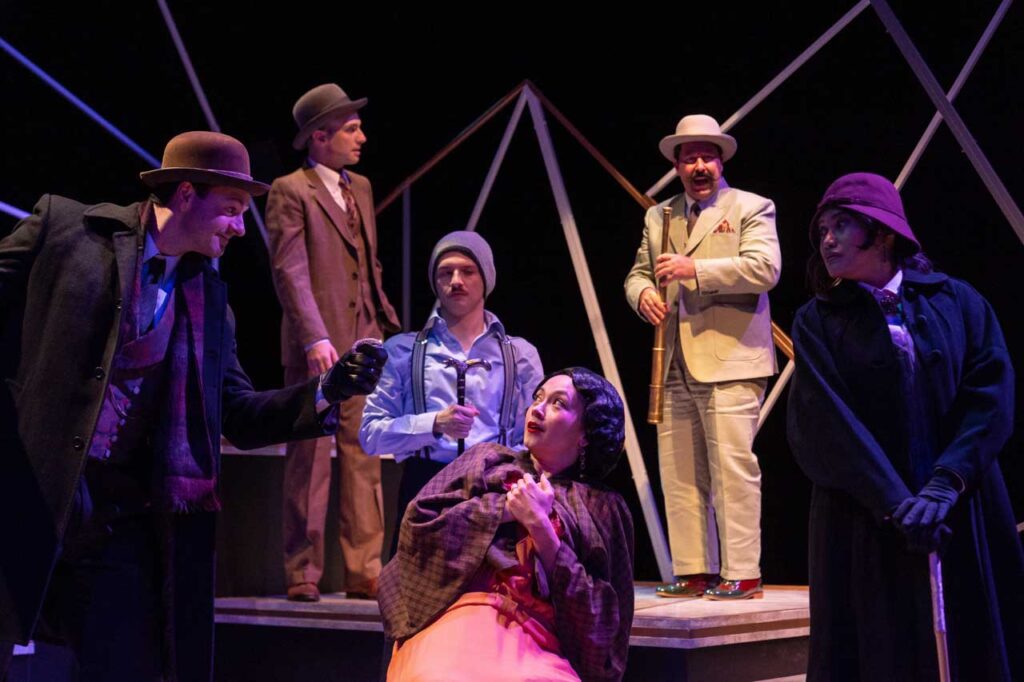
Hurry Hard is a play filled with laughter about lost dreams, second chances, and learning to speak from the heart. The lady behind me not only laughed throughout the entire play but also added the occasional comment about how the play was hilarious. So well written. And filled with laughter. This live endorsement in no way detracted from our enjoyment of the play and I have no doubt expressed the feelings and thoughts of the less vocal members of the audience.
Hayley Rosenau, Sarah Joylyn Irwin, Brent Gill, Matthew Mooney, and Nathan Schmidt in the Rosebud Theatre Production of Hurry Hard by Kristen Da Silva. Photo by Lauren Hamm Photography
Hurry Hard by Kristen Da Silva runs until May 23rd with matinee performances Wednesday to Saturday and evening performances on Friday and Saturday. The show is just over two hours long including an intermission. Matinee performances begin at 1:30 pm and the evening shows start at 7:30 pm. Patrons enjoying a meal before the show are advised to arrive between 11 am and 12 noon for the afternoon performance and between 5:00 pm and 6:00 pm for the evening performance. For complete details and to purchase tickets visit www.RosebudTheatre.com or call the box office at 1-800-267-7553.
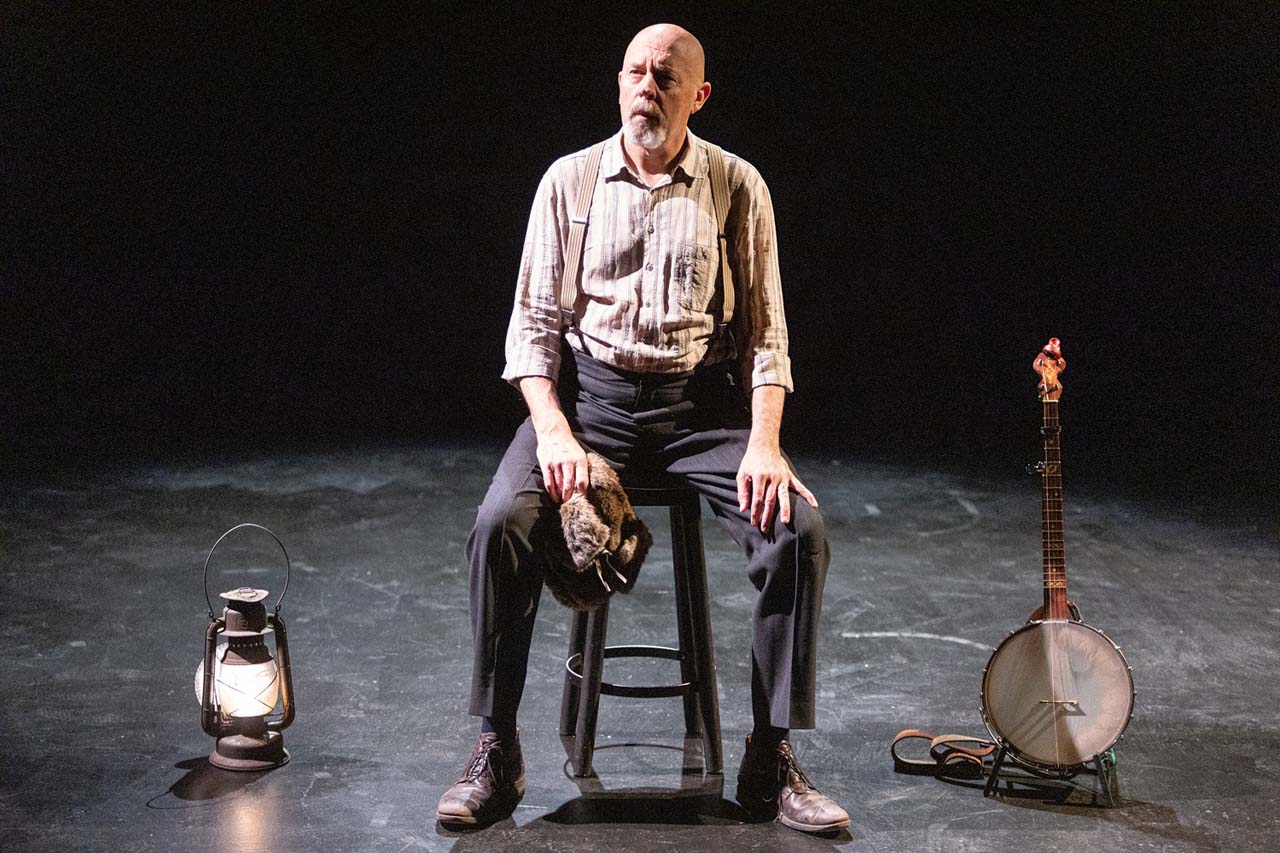
Christopher Hunt in RIBSTONE. Photo by Hannah Kerbes
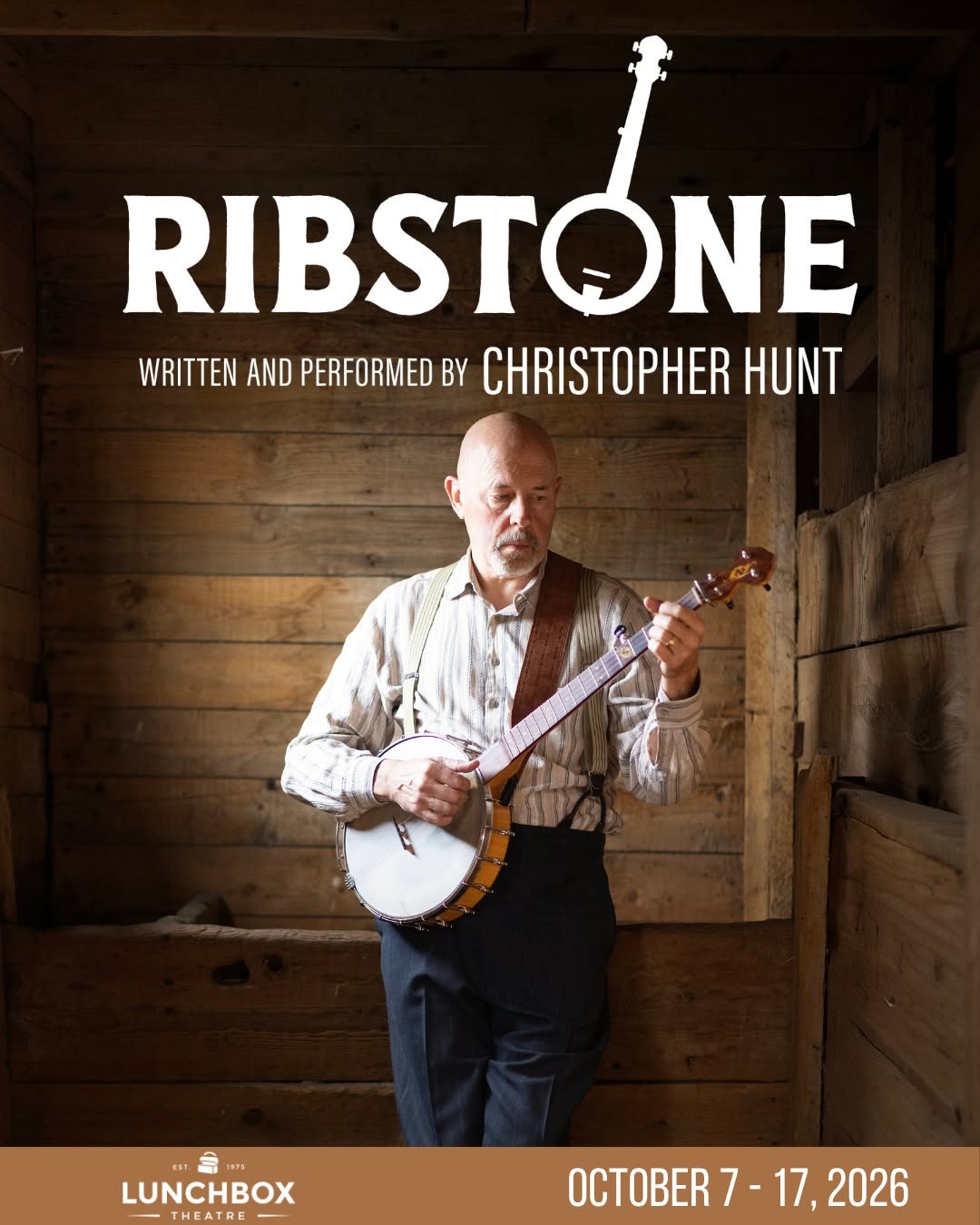
Christopher Hunt’s Ribstone is a richly entertaining and personal reflection about family, storytelling, our connection to the land, and our changing relationship to the past. It’s packed with stories, both tragic and humourous as well as the occasional song. And while the current run at Lunchbox Theatre is sold out, I’d recommend you keep an eye out for a return engagement so you can grab those tickets and see the show – because I guarantee – you won’t be disappointed.
Hunt is our guide for the evening. And the casual, friendly feel of the show begins when he takes his place onstage and begins to quietly strum on the old banjo while the audience is still coming into the theatre.
To his right, is the crankie.
What is a crankie?
Well, it’s the IMAX of the 1800s albeit on a much smaller scale. It’s a visual storytelling device. Basically, it’s a box with a display window cut into the front. On either side of the box are cranks that you turn to move a scroll across the window. That scroll can contain drawings or titles or anything else you want to draw on it to help you tell your story.
Directly behind Hunt is a barn-like structure containing a window where you can hang a lantern and a number of hooks with some of the relics that Hunt uses during the show. The set is built entirely from weathered wooden planks. Each board bears the marks of time having been aged grey from the sun and grooved by the wind and rain. These boards not only show the mark of time passing but contain the initials and carvings of those whose stories we are about to hear. (Please note the production photos in this blog were taken before the set was finished and in place.)
So, what exactly is a Ribstone and why is that the title of the show? Well, a Ribstone is an ancient and sacred artifact to the Indigenous Nations, such as the Blackfoot, that lived on this land long before we arrived. There are about a dozen of them in existence today. The stones have grooves carved into them that represent the ribs of the buffalo as well as other markings. When Hunt’s grandfather came to Alberta the land he ranched included one of these Ribstones on the top of a hill. So, the stone is the namesake of the ranch, and it was also the namesake of the butcher shop Hunt’s family ran in Calgary for many years.
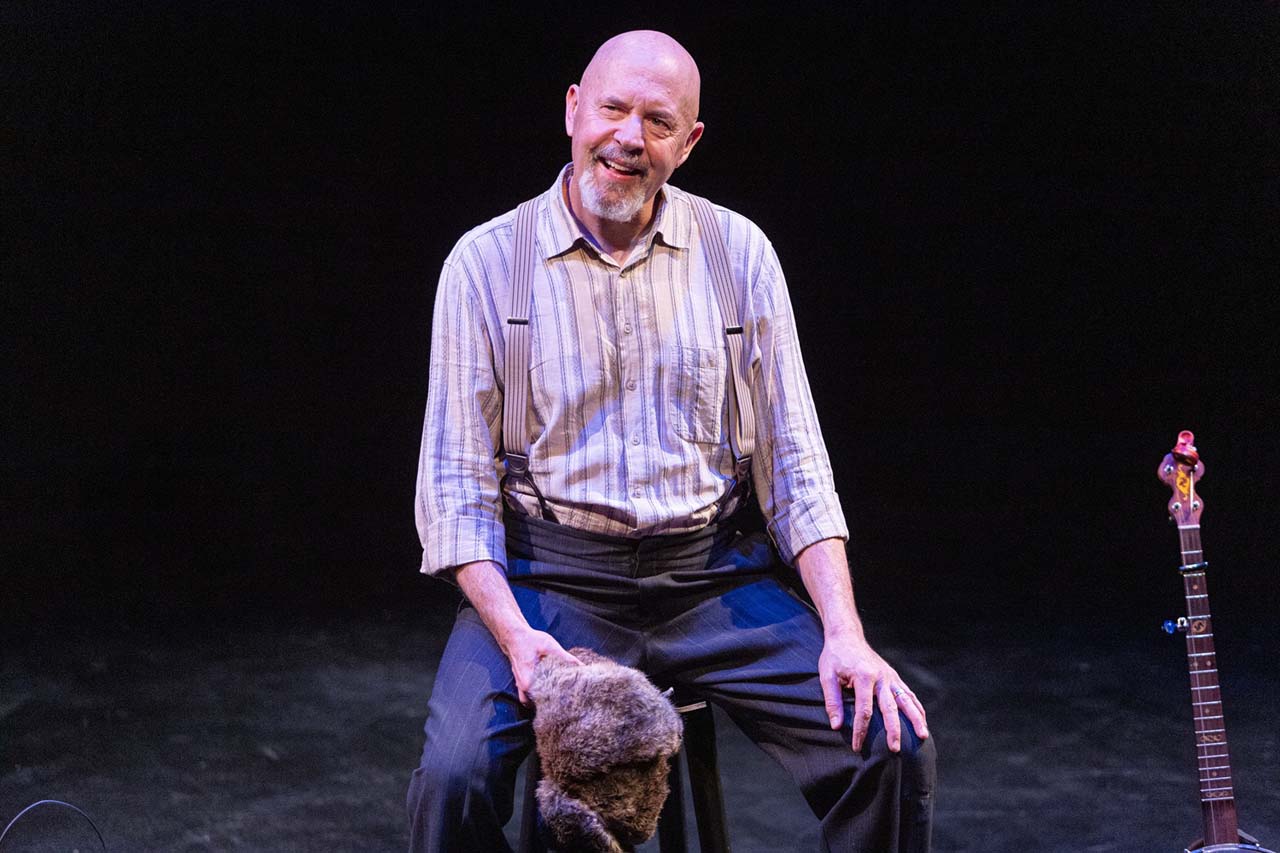
Christopher Hunt in RIBSTONE. Photo by Hannah Kerbes
There are a dozen or so characters we hear from through the course of the play and Hunt jumps easily from one character to another as he tells us stories and reflects on his family’s history. We learn about the importance of talking to your elders, old-time music, and the story of Lee Brainard who moved his cattle herd up from Montana into Alberta during the winter of 1906/07 with the mistaken belief, that Chinook winds would regularly melt all the snow, so his cattle could feed on the prairie grass over the winter.
One of the most enjoyable things about Hunt’s performance is the unhurried but deeply engaging way he speaks to us. Whether he’s telling us a story about trying to work up the courage to ask a girl out or gaining new insights about Residential Schools from an Indigenous perspective he knows how to use a pause to convey meaning. To land a joke and give us a chance to laugh. To ponder a question about our place in the universe and give us room to explore our own thoughts.
I find so much of the media we consume today is focused on speed and pace and cutting out the pauses. How many badly edited YouTube videos have you seen where they’ve cut out the breaths in order to speed up the delivery?
Why would you do that?
The breath is one of the key things that makes speech human.
And it’s when we get to experience live theatre with a performer as gifted as Hunt that we once again get to experience the magic of words. The magic of the moment. How a hesitation between two spoken words can be filled with meaning and weight.
To help bring the story to life, Hunt has assembled a talented team of artists including director Jamie Dunsdon, whose work always reflects her ability to capture authentic human moments. Not only did Jamie direct the show, but she also did the lighting and the emotional shifts in tone and story are reflected in gentle changes to the lights. Plus, there is, later in the play, a wonderful and entrancing image achieved through a simple backlighting effect that drives home the complicated emotions and questions we’re dealing with today as we move forward with Truth and Reconciliation.
Christopher Hunt in RIBSTONE. Photo by Hannah Kerbes
The set design is by Hanne Loosen, and like I said earlier, I found the use of the aged wood a perfect backdrop for telling these stories. It’s much more than just the side of a barn. It’s living history. And it frames the entire show by making us feel like we’re out at the ranch on a summer night listening to stories and looking up at the night sky.
Hunt’s musical consultant for the show was celebrated blues and roots musician and Calgary musical icon Tim Williams. According to Hunt Williams showed up one day with a song he’d written for the show and told Hunt that it was his to use if he wanted. Well, of course, he wanted to include it and The Ribstone Waltz is one of the musical highlights of the show. It puts into music the feel of the entire evening. Sadly, Tim passed away last November, and so Hunt has dedicated Ribstone to the memory of Tim Williams who he notes in the program, “helped me find the heart of the piece.”
Ribstone is the perfect show to share with family and friends, because not only does it gives you something to talk about after you leave the theatre but you walk out feeling good about life. Not because every story is uplifting, although there are many uplifting stories, but because the play focuses on human connection and how exploring our history and the difficult questions of life can deepen our sense of belonging and help us to understand more about ourselves and our place in the world.
***
Lunchbox Theatre and One Yellow Rabbit present Ribstone at the 40th Annual High Performance Rodeo. Ribstone is already sold out, but if you’d like to check out the rest of the shows at this year’s High Performance Rodeo you can visit their website at www.oyr.org And be sure to check out the next Lunchbox Theatre show, Thank You For Your Order by Jessica Moss, at www.lunchboxtheatre.com.
If you enjoyed this blog and value independent theatre coverage in Calgary, please share this post. Your engagement helps keep this site active.
RIBSTONE
Christopher Hunt | Writer / Performer Jamie Dunsdon | Director / Lighting Designer Hanne Loosen | Set Designer / Crankie Images Ralamy Kneeshaw | Costume Designer Tim Williams | Music Consultant / “Ribstone Waltz” Composer Telly James | Indigenous Consultant Leo Wieser | Crankie Designer / Builder Keri Halfacre | Set Builder
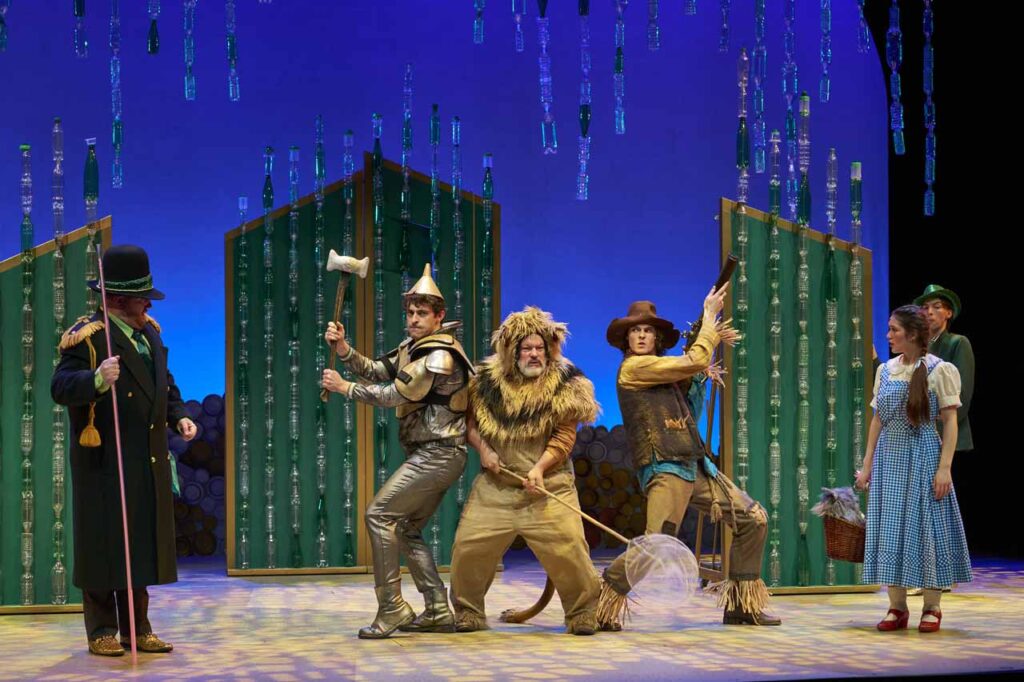
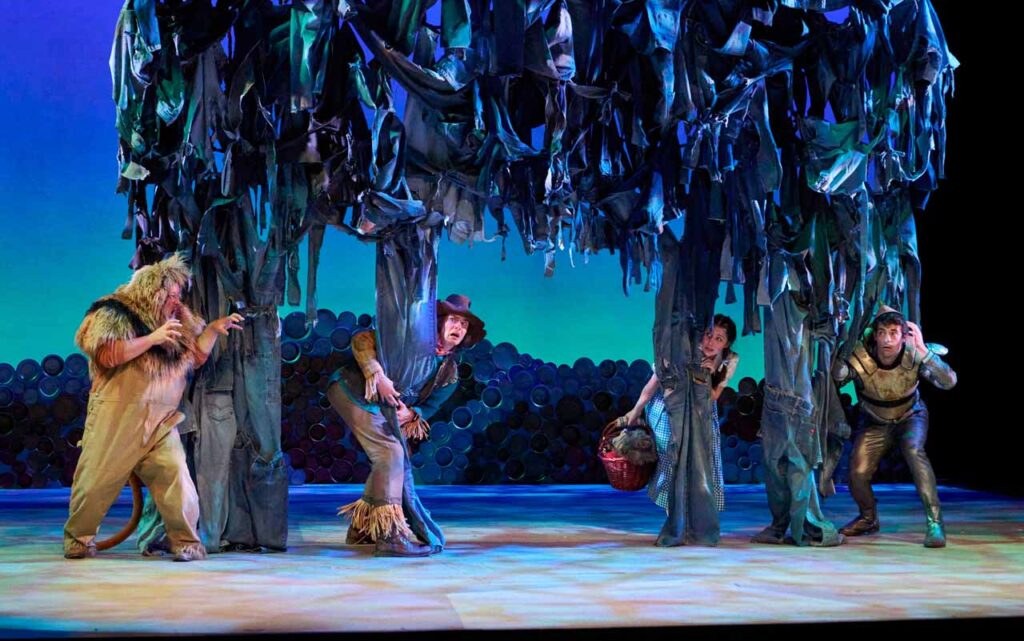
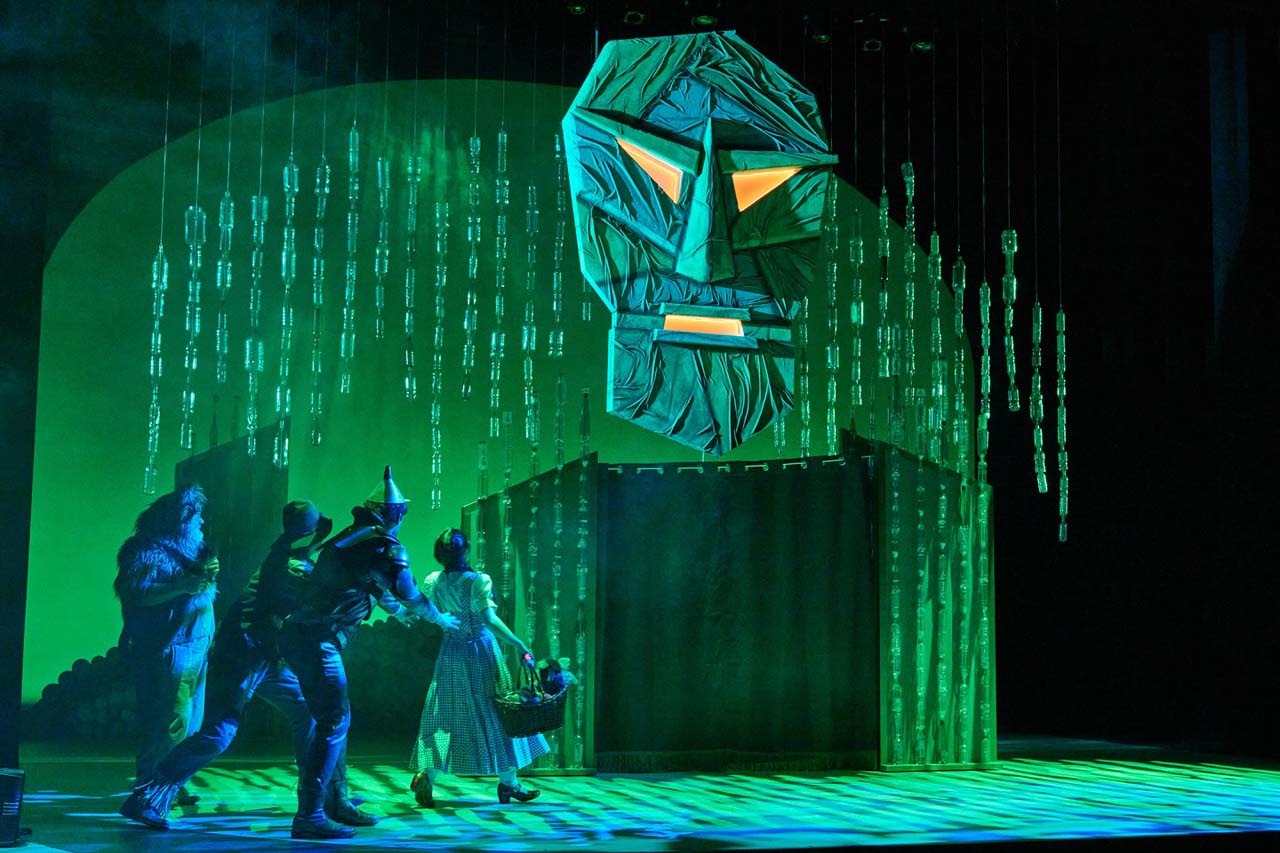
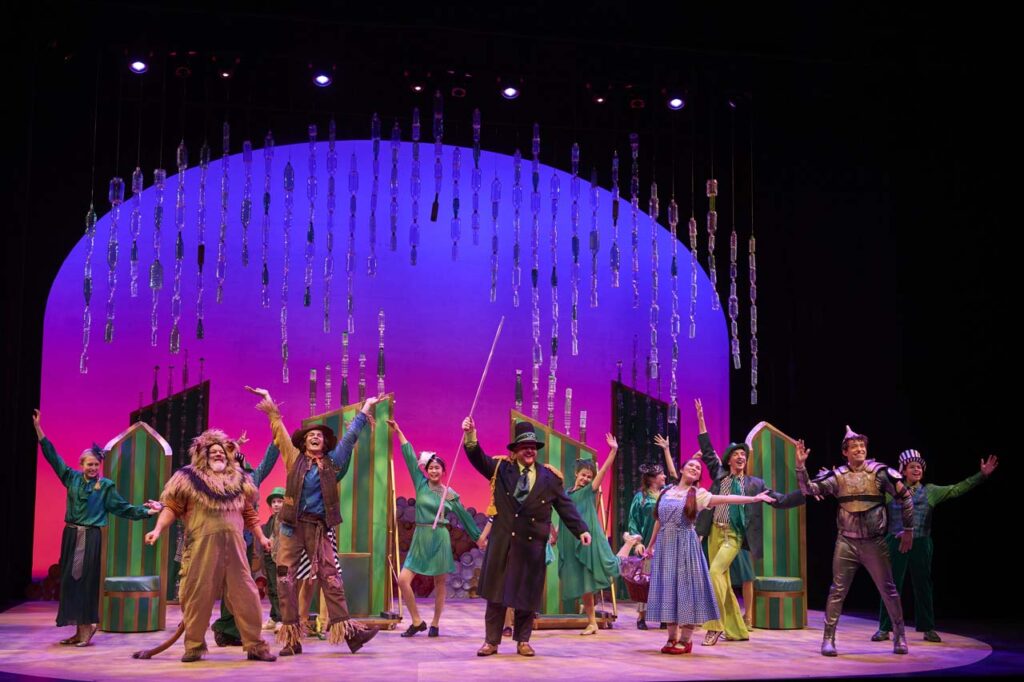
Cast members in Alberta Theatre Projects production of The Wizard of Oz. Photo by Jeff Yee. Set, Lighting and Props Design by Narda McCarroll. Costume Design by Ralamy Kneeshaw.
If you’re looking for a memorable and fun family outing to celebrate the holiday season, then be sure to catch Alberta Theatre Projects inventive and highly entertaining production of The Wizard of Oz.
This is the stage musical based on the 1939 film starring Judy Garland which was based on the books by L. Frank Baum. Few films imbed themselves as deeply into the culture as The Wizard of Oz has and so many people have an affection and love for the story, the characters, and the music.
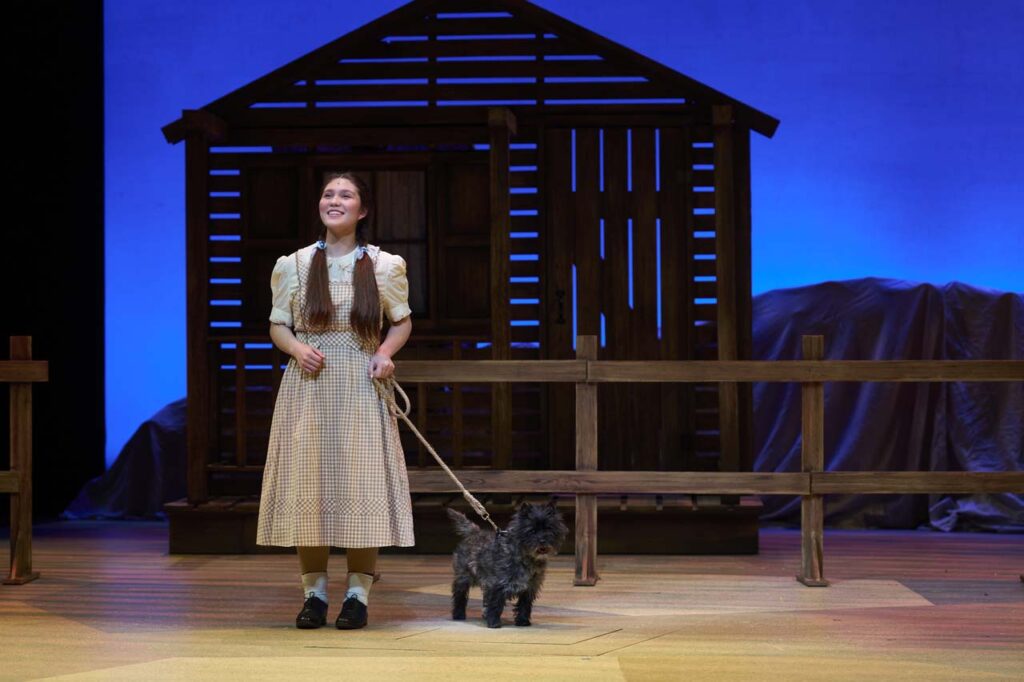
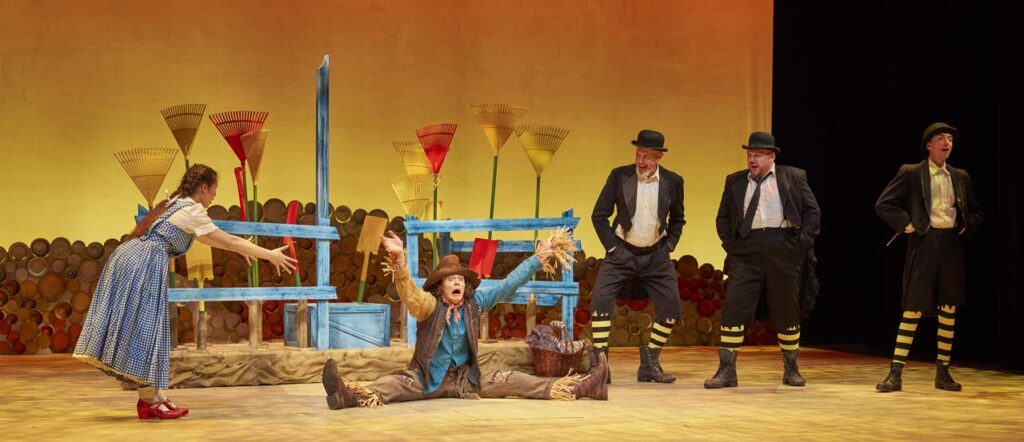
Hannah Adamson and Breezie in Alberta Theatre Projects production of The Wizard of Oz. Photo by Jeff Yee. Set, Lighting and Props Design by Narda McCarroll. Costume Design by Ralamy Kneeshaw.
The amazing thing about this story is just how many of the characters we know and remember. Often in a movie you’ll have the lead character and maybe another character or two who really define the story and become part of the culture. But in The Wizard of Oz every character adds something powerful to the journey. The Tinman, The Cowardly Lion, The Scarecrow, The Wicked Witch of the West, Glinda the Good Witch of the North, The Wizard of Oz, and Dorthy are all vivid in our minds and our memories.
Oh, and Toto. You can’t forget Toto.
Kevin Corey, Ryan Maschke, Hannah Adamson and Jason Lemmon in Alberta Theatre Projects production of The Wizard of Oz. Photo by Jeff Yee. Set, Lighting and Props Design by Narda McCarroll. Costume Design by Ralamy Kneeshaw.
All of these characters are relatable. Why? Because they’re flawed. I mean who hasn’t felt stupid or scared. Who hasn’t wanted to run away from home when life gets hard. And then there are the songs. Fun. Joyful. Happy. Sing along songs like We’re Off to See the Wizard or Somewhere Over the Rainbow that not only entertain but speak deeply to the heart of every soul who has ever spent time with their kids or their parents or grandparents watching this magical story unfold.
And so, I’m happy to report that director Tracey Power has captured some of that magic by assembling a terrific cast that embodies the spirit of the story and has the theatrical expertise and singing skills to bring The Wizard of Oz to life.
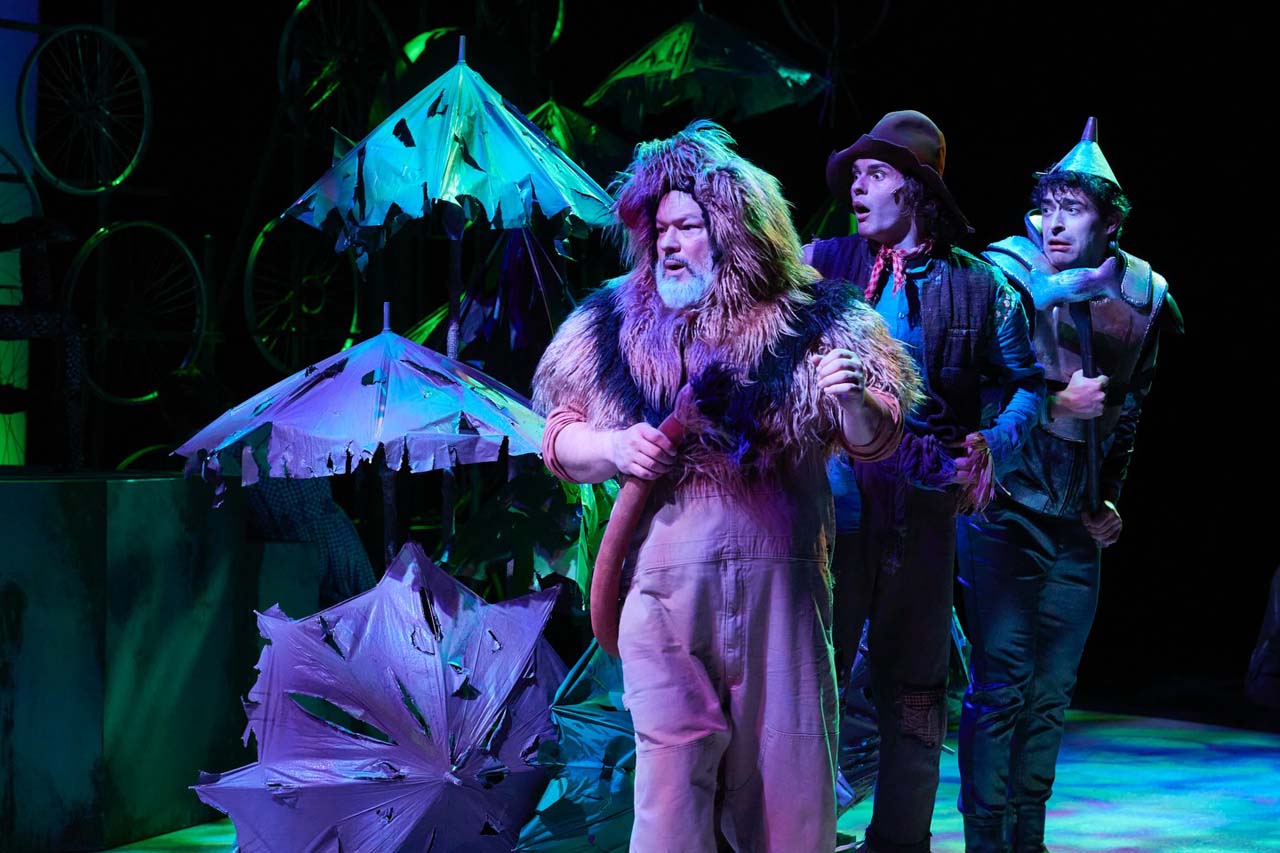
Hannah Adamson, Ryan Maschke, Christopher Hunt, Brent Gill and Ethan Vasquez Taylor in Alberta Theatre Projects production of The Wizard of Oz. Photo by Jeff Yee. Set, Lighting and Props Design by Narda McCarroll. Costume Design by Ralamy Kneeshaw.
The story for those that don’t know is about a young girl named Dorothy who along with her dog Toto runs away from home and finds herself in the magical kingdom of Oz. There she teams up with the Tinman, the Scarecrow, and the Cowardly Lion as they travel to the Emerald City to ask the Great and Powerful Wizard of OZ for help, all while being relentlessly pursued by the Wicked Witch of the West.
I would suggest that more than the books the iconic performances of the actors in the original film define what we expect when we see a stage production of the show. The trick for any actor is to honour the original performance while bringing something fresh and exciting to the role and the entire cast does exactly this. They feel familiar yet original. And by doing so we see a show we love but with a new energy and a different dimension because every actor brings to every character they play a bit of their own soul and emotional understanding of the world.
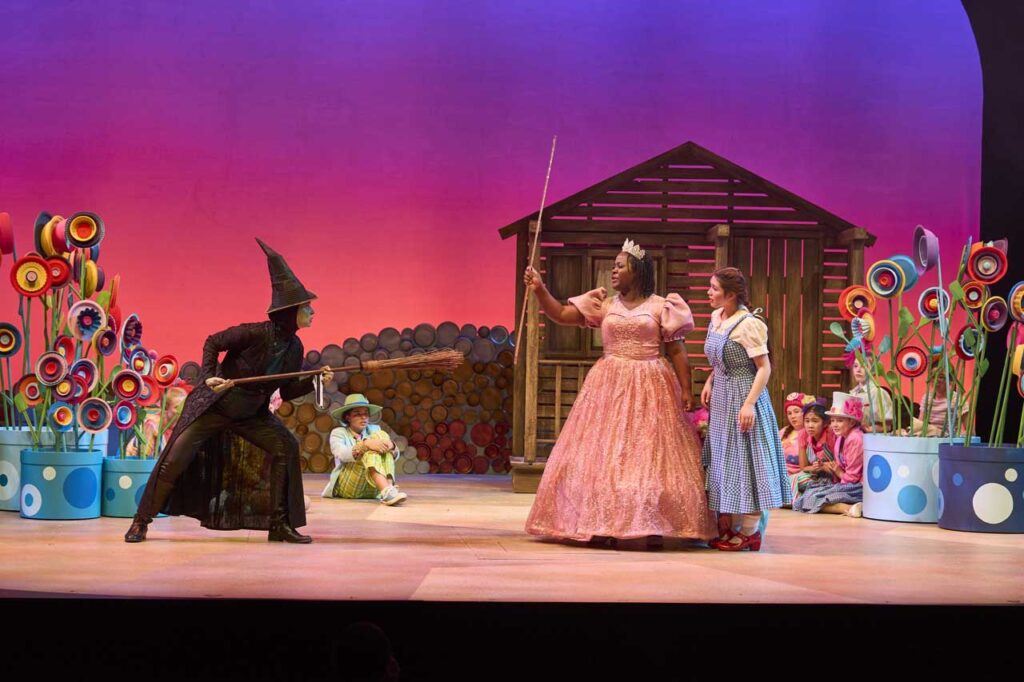
Daniela Vlaskalic, Jessica Jones and Hannah Adamson in Alberta Theatre Projects production of The Wizard of Oz. Photo by Jeff Yee. Set, Lighting and Props Design by Narda McCarroll. Costume Design by Ralamy Kneeshaw.
Hannah Adamson takes on the role of Dorothy Gale and does an admirable job bringing a youthful enthusiasm and resilient determined spirit to the role. Joining Dorothy on her journey is the kind-hearted and caring Scarecrow played with a childish innocence and an astonishingly high degree of physical flexibility by Ryan Maschke. Jason Lemmon plays the prone to tears tin man as compassionate and brave, despite his fears and insecurities.
Returning to the stage to reprise his role as the Cowardly Lion having previously played the part at ATP is Kevin Corey easily one of the best physical comedians working on the Calgary Stage. Corey’s portrayal has the right balance of comic exaggeration and genuine emotion which makes his Cowardly Lion both funny and endearing.
Cast members in Alberta Theatre Projects production of The Wizard of Oz. Photo by Jeff Yee. Set, Lighting and Props Design by Narda McCarroll. Costume Design by Ralamy Kneeshaw.
Playing the Wicked Witch of the West Daniela Vlaskalic brings a cackling and menacing presence to the role and does a great job playing the villain of the story. Jessica Jones as Glinda the Good Witch of the North is the perfect counterbalance to Vlaskalic’s Wicked Witch of the West. Jones radiates goodness and has a carefree nature about her that fits perfectly as she guides Dorthy on her journey and steps in at key moments.
Brent Gill who plays the Emerald City Guard (who in the movie has always reminded me of a deranged Gene Shalit) brings a fun mix of bureaucratic bluster and comedic self importance to his role. And last but not least Christopher Hunt does a wonderful job of playing the Wizard of Oz as both the loveable conman with a heart of gold he is while pretending to be the Great and Powerful Wizard who strikes fear in all those who dare seek him out.
Cast members in Alberta Theatre Projects production of The Wizard of Oz. Photo by Jeff Yee. Set, Lighting and Props Design by Narda McCarroll. Costume Design by Ralamy Kneeshaw.
Not only has director Tracey Powers done an excellent job of casting and directing the show but she’s assembled a strong design team including set, lighting, and props designer Narda McCarroll, costume designer Ralamy Kneeshaw, sound designer and keyboard #2 Van Wilmott, and Musical Director and Keyboard #1 Joe Slabe.
The production features live music which always enhances the production and adds an element of live performance that brings a vibrant feel to any musical. The sets are all made of things like umbrellas and plates and bottles and bicycle wheels and old jeans and tin cans that have been transformed into trees and forests and hills that anchor the play in the plains of Kansas and the magical land of Oz. Which leans into the theatricality of the show and the magic of theatre all of which make the production a visual treat and something more than simply replicating the movie.
Cast members in Alberta Theatre Projects production of The Wizard of Oz. Photo by Jeff Yee. Set, Lighting and Props Design by Narda McCarroll. Costume Design by Ralamy Kneeshaw.
Bottom line this is a fine production. It’s entertaining and inventive. The Wizard of Oz at Alberta Theatre Projects is a magical and family-friendly holiday production that brings this much-loved story and characters to life on stage. Tracey Powers has brought together a talented cast and show with design elements crafted from recycled materials, while featuring live musical elements that manages to capture the spirit of the original movie while creating a fresh theatrical experience for everyone to enjoy.
***
The Wizard of Oz runs until January 4th at Alberta Theatre Projects. Please note evening performances from Tuesday to Saturday have family friendly start times of either 7:00 pm or 7:30 pm depending on the date of the performance. Saturday and Sunday matinees start at 2:00 pm. Tickets are available at albertatheatreprojects.com or by calling the box office at 403-294-7402
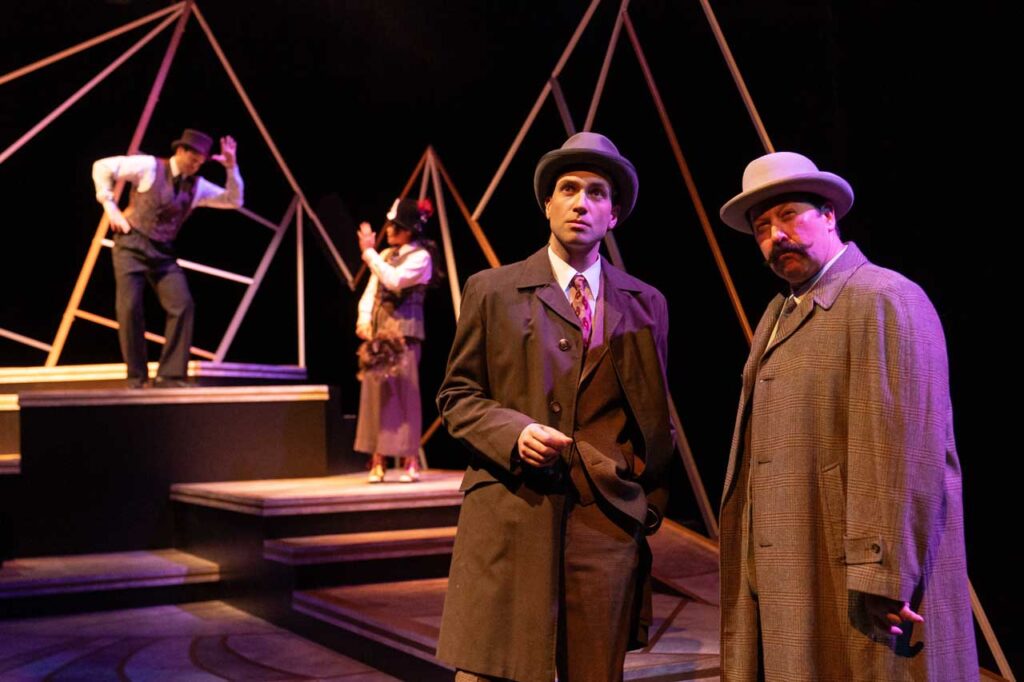
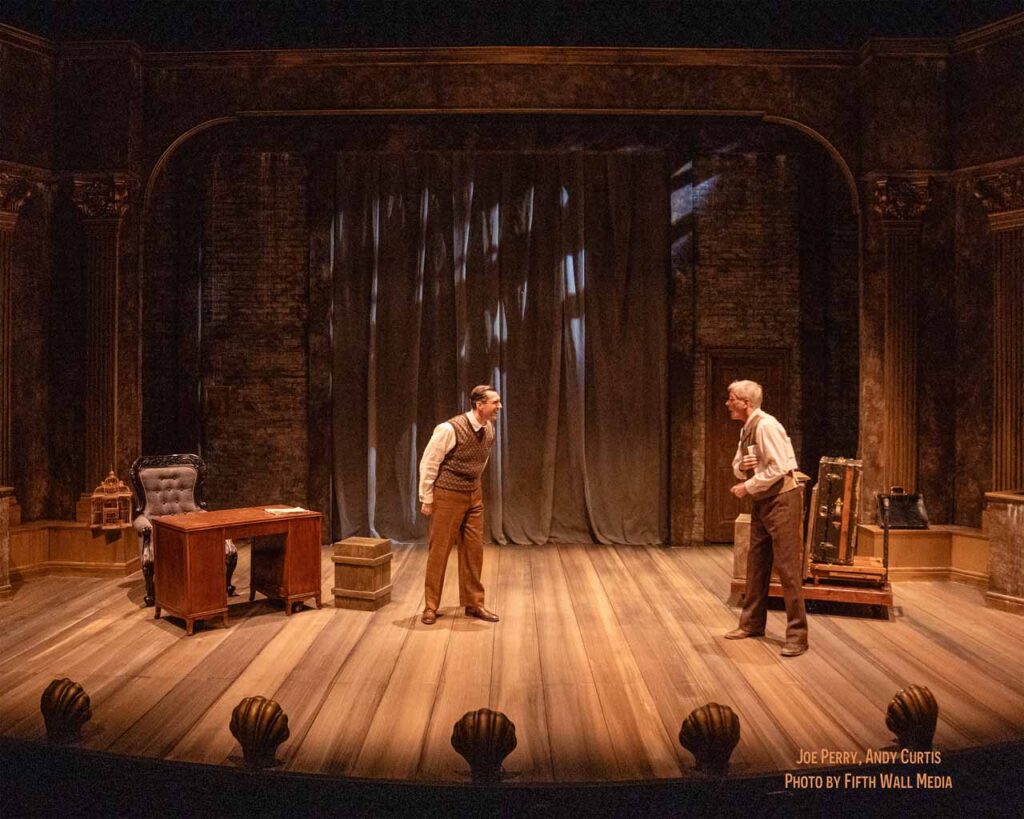
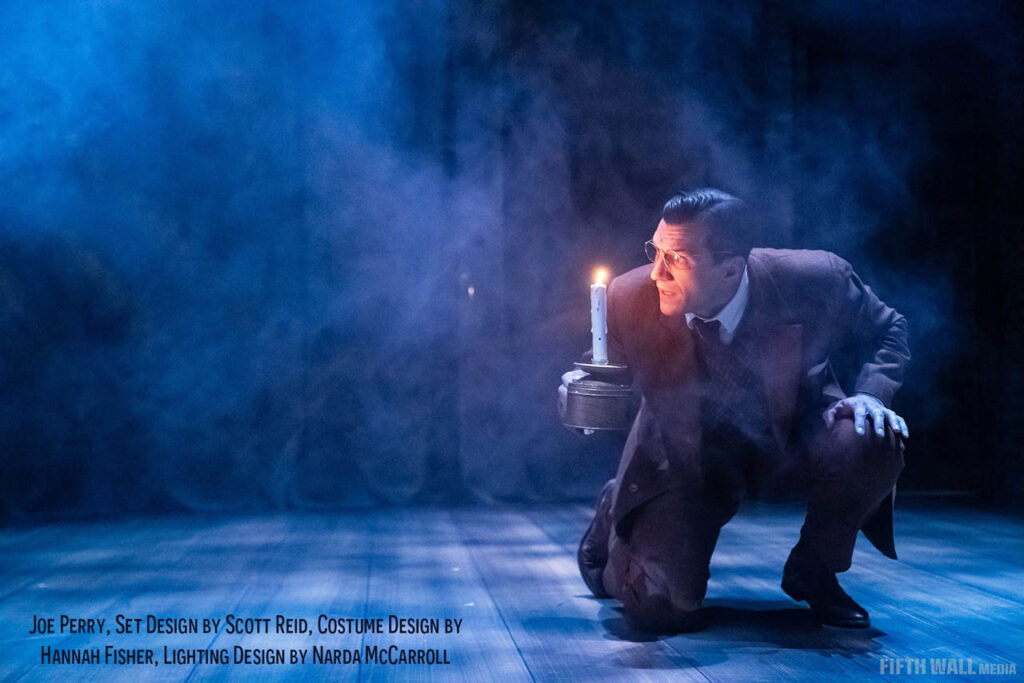
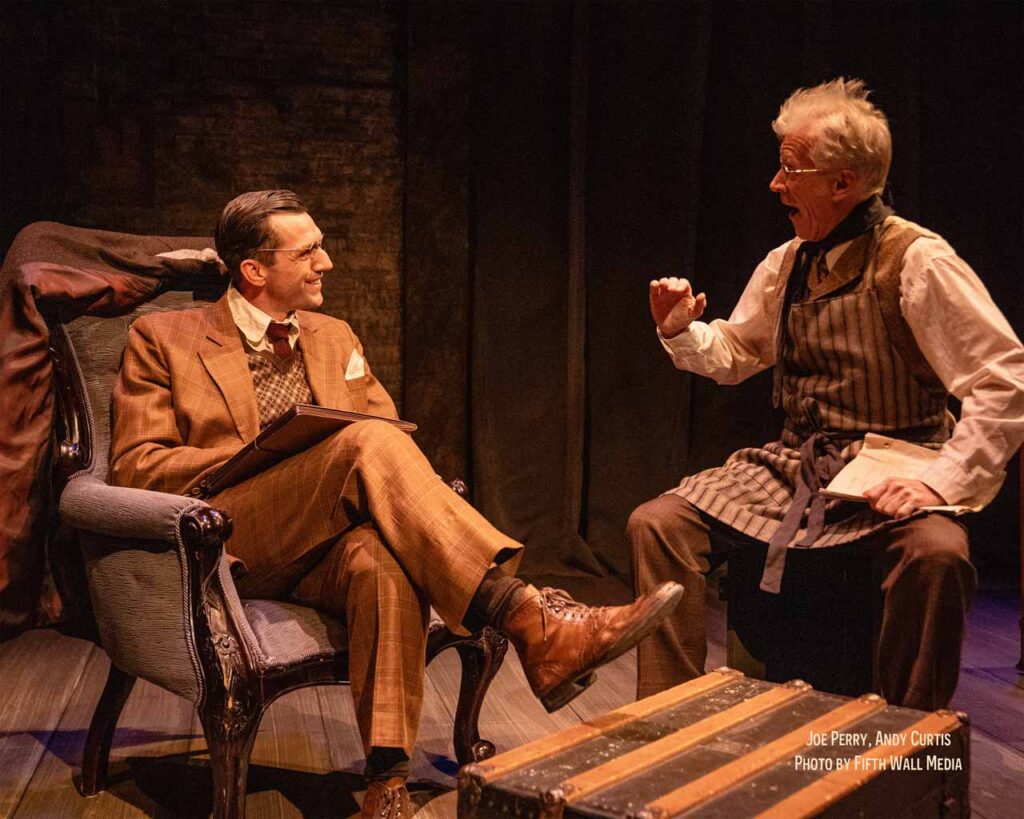
Austin Halarewich, Graham Percy, Photo by Fifth Wall Media
Kidnapping, blackmail, and murder are all being served up in the Vertigo Theatre production of Peril in the Alps by Steven Dietz.
Bella Duveen has vanished, and Arthur Hastings can think of no one better to find his sister-in-law than his good friend Hercule Poirot – a master sleuth who has saved Bella once before. Coincidentally, Poirot has just taken on a missing persons case that seems eerily similar – are they connected? And how are these disappearances intertwined with past mysteries that have already been solved? With the suspicion of a greater scheme at play, Poirot must travel to the snow-capped Alps, where the famed Belgian detective may finally meet his match. Six actors bring to life dozens of eccentric characters and clever suspects in this diabolically funny mystery romp.
The only question is – are you able to match wits with our famous Belgium detective and solve the mystery before he does? To find out catch Peril in the Alps from November 15th to December 14th and get your tickets from the Vertigo Theatre Box Office by phone at 403.221.3708 or online at vertigotheatre.com.
I contacted the director of the play Clare Preuss, who was in the middle of rehearsals, in order to talk with her about the enduring appeal of Poirot and the magic of theatre.
Clare Preuss Director of the Vertigo Theatre production of Peril in Paris
JAMES HUTCHISON
So, lets talk a little bit about the cast. You’ve got Graham Percy playing Hercule Poirot and Austin Halarewich playing Hastings. Rounding out the cast you’ve got Tyrell Crews, Linda Kee, Heidi Damayo and Aiden Laudersmith all of who are playing multiple roles in the production. So, tell me about the cast you’ve assembled for this production and what sort of an ensemble you’ve put together.
CLARE PREUSS
They’re just fantastic. And to fully manifest a show like this the actors have to be virtuosic. There’s a level of skill that is needed. The ability to drop into characters really quickly and the ability to play a character with authentic intentions and with authentic tactics and then to also play something that’s arched because there’s an arched element to the show. So, I think being able to find folks who have that dexterity is really incredible.
And then for me I always want to hire people and work with people that are generous. That are willing to take risks. And all of them are. And they’re all so funny. I mean there are so many moments that they’ve come up with in the room where they just play off each other and they’re willing to be vulnerable. And that’s really important. They’re an incredible cast and every single one of them has shining moments in this story.
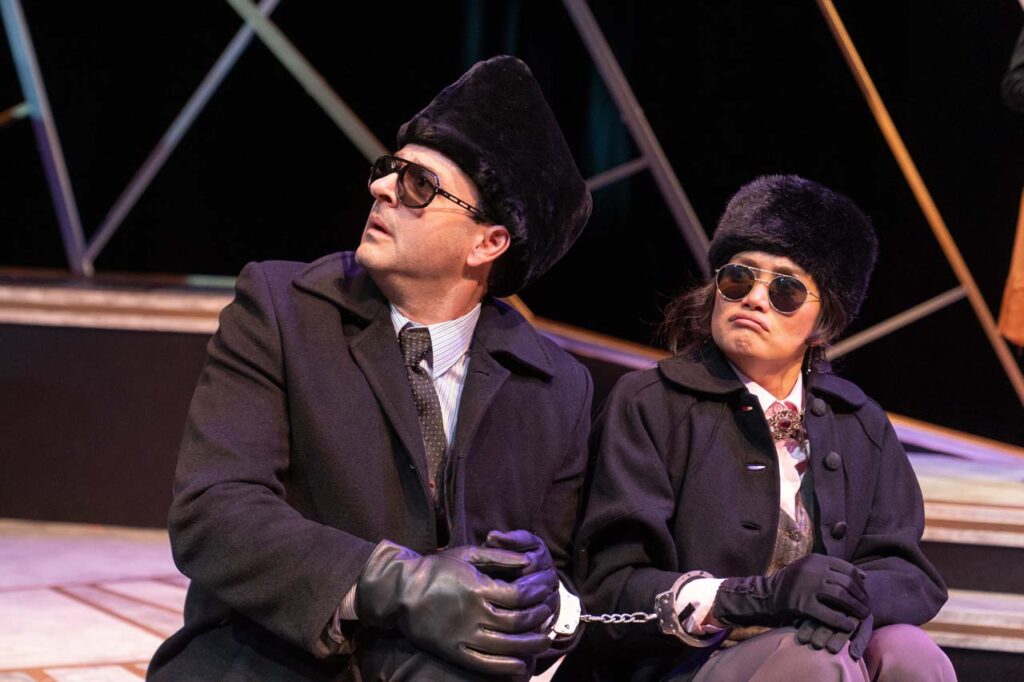
The Cast of PERIL IN THE ALPS, Photo by Fifth Wall Media
And then Austin and Graham really have to carry the show, and they have to play friends that have known each other for many years and it’s incredible what they’ve come up with.
And if anyone knows Graham Percy’s vast experience in the community and the roles, he’s played watching his Poirot is something stunning. He’s got this balance. You just believe he’s that smart. That he puts together the clues the way Poirot does. And then you also feel this heart.
I said to him the other day in rehearsal, “Your Poirot is so smart and also has a heart the size of a mountain.” And I think that’s really beautiful because Poirot is in service to people. But he’s also conceited as hell. He knows he’s smart. And so, I think having that edge – someone who’s very sure of themselves and also someone who can be very generous and care is again really special.
And Austin is fresh out of the gate. I mean he’s such a youngster but wow stunning. A stunning, nuanced, generous, present performance. I think he’s got a huge career ahead of him.
Graham Percy, Linda Kee, Austin Halarewich, Photo by Fifth Wall Media
JAMES
Some of the best comedies in the world center around murder and mayhem such as Arsenic and Old Lace or Dr. Strangelove. What is it about these high stakes stories where death looms that makes them such an ideal vehicle for laughter and farce.
CLARE
The one thing we know when we come onto planet earth is that we’re going to die. And it’s something that we don’t talk about that often, so these stories take that taboo and make fun of it. And even though we can be killed so easily – as a society most of us agree we’re not going to kill each other. So, I think there’s something fun in bringing up a completely immoral, illegal, taboo act and laughing at it. And to think about it in a playful way because we know we’re not allowed to do it. But there’s something tantalizing about the forbidden fruit idea of it. And I love laughing at things that are deeply serious. It’s naughty and cathartic and I think people like being naughty.
Tyrell Crews, Linda Kee, Photo by Fifth Wall Media
JAMES
You know I saw Liars at a Funeral which you directed at ATP last year and it was a very funny show but one of the parallels between that play and this play and a lot of plays these days is they might have one or two people who play a single character and then they’ve got a cast that are playing multiple characters and that seems to be very common now and I’m wondering what sort of elements to a production does that type of casting and that type of story telling create?
CLARE
That’s part of the fun, right. Watching people transform. And this particular show is written for the TikTok generation. I say that because the scenes are short. There’s lots of stuff to look at all the time. And that’s the play written and then we’ve leaned into that with the production where there’s so much happening on stage all the time. In a good way. And it’s still focused.
Obviously, budgets have influenced the desire for actors to take on multiple characters. But I also think in a world where we can see so much on TV and on our phones at the drop of a hat where we see big casts and people playing specific characters all the way through – that there’s something fun about the poetic nature of theatre that really lends itself to people taking on different roles. And that’s certainly true with this show with the number of costumes and quick changes happening. It’s like watching a high wire act, right. There’s a joy in watching that kind of stuff.
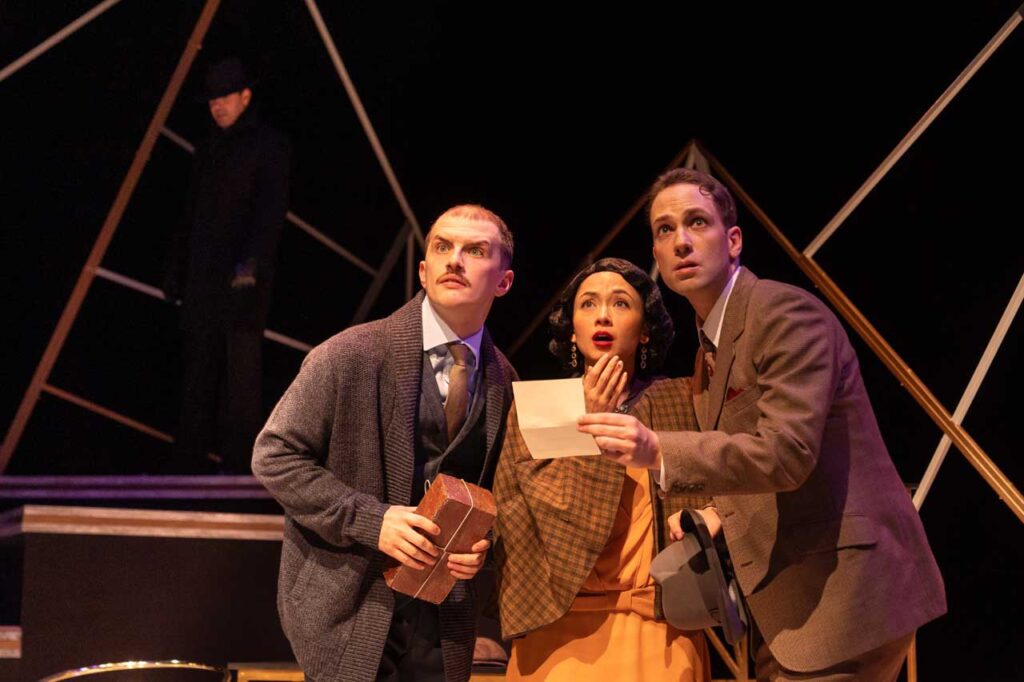
Tyrell Crews, Aidan Laudersmith, Heidi Damayo, Austin Halarewich, Photo by Fifth Wall Media
JAMES
So, Peril in the Alps by Stephen Dietz is a sequel to last year’s Murder on the Links and both plays focus on Hercule Poirot. And even though the plays have a lot of laughs they maintain the core characteristics of Poirot, and I wonder what are those qualities of Poirot in the plays that make him such an enduring and loved character in the world.
CLARE
Well, I think it’s his psyche. His ability to be present. To not just be witnessing something but to be really aware of it. Aware of the minutiae in a moment in a case. To follow the evidence and not his emotions. To remain somewhat detached and to be able to piece together very simple clues that other people skip over because they’re not actually paying attention. They’re just watching. So, his ability to be so fast and put things together so quickly is lovely. And his desire to serve people is I think something that’s endearing.
And then I think we love a character that’s a bit conceited. We love a character that is sure of himself. We love a character like that because we are taught that you shouldn’t do that in the world. We should be modest and not toot our own horn. So, I think a part of what we enjoy about Poirot is that he has the courage to sit in pleasure. This brings me pleasure and I’m doing it. So, he does that very clearly. And then to know that you’re good and to know and be clear about knowing that you’re brilliant. And he knows he’s the best.
He’s also very solitary. Never been married. He’s kind of a mystery at home. There’s something about that containment that’s magic. Mystery is magic. So, his life is magic and there’s something I think about the lone wolf part of him that I find very attractive too. Like this interesting guy who is able to go into other worlds, but his world is actually quite private. So, there’s something cool about that.
Tyrell Crews, Linda Kee, Austin Halarewich, Graham Percy, Photo by Fifth Wall Media
JAMES
For audiences coming to see Peril in the Alps which blends suspense and comedy and includes a cast playing multiple characters what kind of an evening can they expect as they take their seats, and the curtain rises, and the story unfolds.
CLARE
It’s amazing. I mean Naomi is right over here and we just had a run through. She’s the stage manager. She’s brilliant. We just had a run through earlier today and we both looked at each other after the run through and we’re like it goes so fast and it’s really like a roller coaster ride. You get on at the beginning of Act I and it just comes to life so quickly and with so much detail and the precision of it is so entertaining.
So, it’s fast paced and I say it’s great for all generations. There are some people who are going to know Poirot and are going to know his cases in depth. But you can bring your kids, and they’ll be like – “Oh, my God. That’s amazing! Oh, lights. Flashing. Sound. Oh, I learned something. Oh, there’s a bit of a mystery here I can follow. Oh, it’s funny.” Like it’s very poppy in that way.
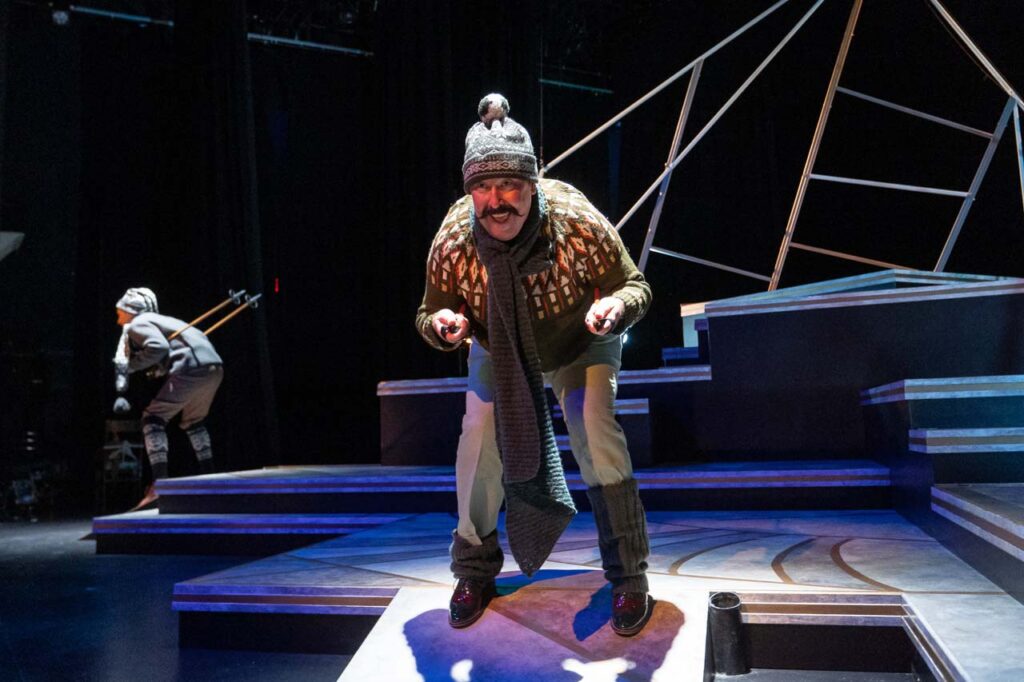
And it’s a totally solvable mystery and people like to peace together clues. And it’s just so fast paced and funny and the characters are so charming. The set design is gorgeous. And the lighting is by Anton deGroot who is amazing. And we have Peter Moller one of our iconic sound designers in town creating the sound. And then watching people get in and out of all these costumes is fun. So, it’s like getting on a roller coaster and watching a high wire act where you throw in a solvable mystery and laugh your butt off and there’s a night at the theatre I’d pay for.
Austin Halarewich, Graham Percy, Photo by Fifth Wall Media
JAMES
Hey – before I let you go – you know these days we have things called social media.
CLARE
Oh yeah.
JAMES
And I follow you on Instagram.
CLARE
Oh, you do. I should follow you back. Do I follow you back?
JAMES
You do actually. But I’ve got to tell you, I like looking at your Instagram feed because it shows all the amazing people you work with and all the amazing work you’re doing, and I was wondering if you can help me with one thing. On your Instagram account you describe yourself as an Artistic Director / Director / Actor / Creator / Meditator / and an Eternal Optimist.
CLARE
Yes.
JAMES
That’s what I need help with. I tend to see the dark side of things. So, how do you become an eternal optimist? Is it your nature? Is it something you foster? Is it an attitude?
CLARE
I’ve always had a very buoyant personality, but I’ve also had some really really tough stuff that came my way at a very young age. And it’s interesting because when I started theatre school my classmates were like, “Ah she’s the youngest in the class. She’s so irritating. She’s always so happy.” And I was like – well I can tell you my life story – this is earned happiness. And I won’t go into it now, but life has thrown me many curveballs, and I think the only way to get through it with a sense of joy is to believe – not just believe at this point – but to know that everything is always going to work out. And don’t take things too seriously. What’s the worst thing that’s going to happen? You’re going to die. And we’re all going to die anyway. So maybe it’s just my dark side that makes it deeply macabre and funny. (Laughs) I don’t know.
The Cast of PERIL IN THE ALPS, Photo by Fifth Wall Media
JAMES
Well then how do you think theatre help us find joy and optimism.
CLARE
I love everyone that creates theatre. The people who actually put their bodies on that stage – like the actors who get up there every night – they are front line workers. Because what we’re doing in theatre I think is showing people that you can have the courage to live beyond the mundane. And for me that is just huge because I think rather than compare yourself with everybody on social media and to constantly be putting yourself in boxes you should free yourself and imagine something beyond the mundane.
And I think there’s something beautiful about the liveness of theatre that you can be present with other people in this dark space. It’s magical. It can change the way you think about the world. It can change the way you feel about yourself. It can help you process really hard things. It can also help you laugh at life and escape some of the drama that feels so serious around us. So, I think theatre offers a lot of different things and I think this particular show stokes the whimsey in us. It stokes the child like nature in us. It stokes our sense of imagination and possibility. And there’s a lot of daring in the show and so, I think it makes us a bit more daring.
***
Vertigo Theatre Presents Peril in the Alps by Stephen Dietz based in part on Agatha Christie’s Poirot Investigates from November 15th to December 14th. Tickets are available from the Vertigo Theatre Box Office by phone at 403.221.3708 or online at vertigotheatre.com.
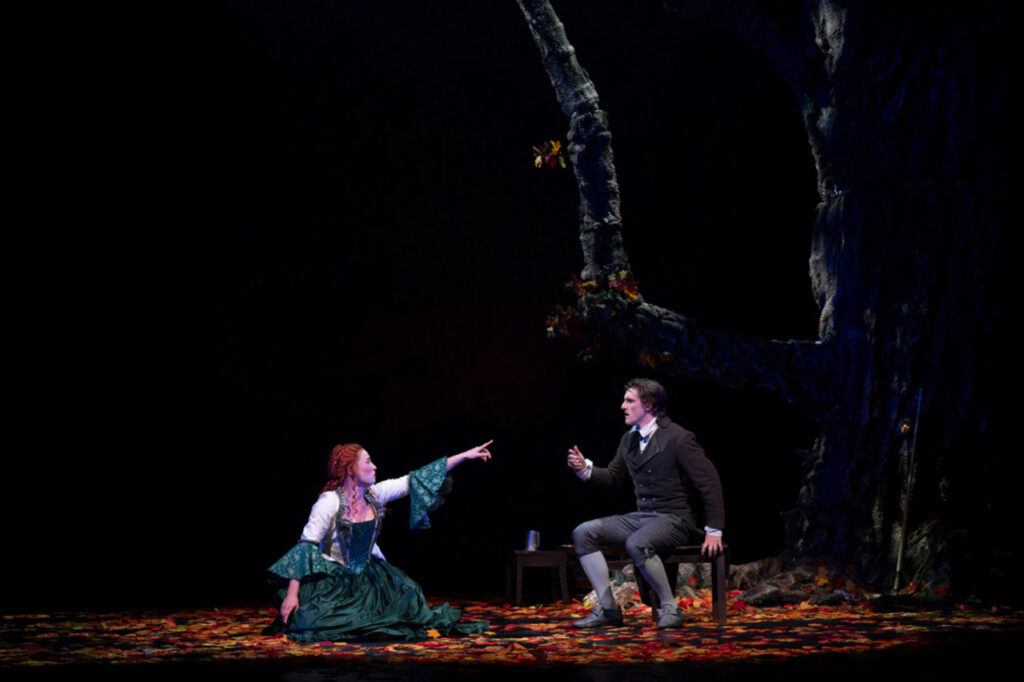
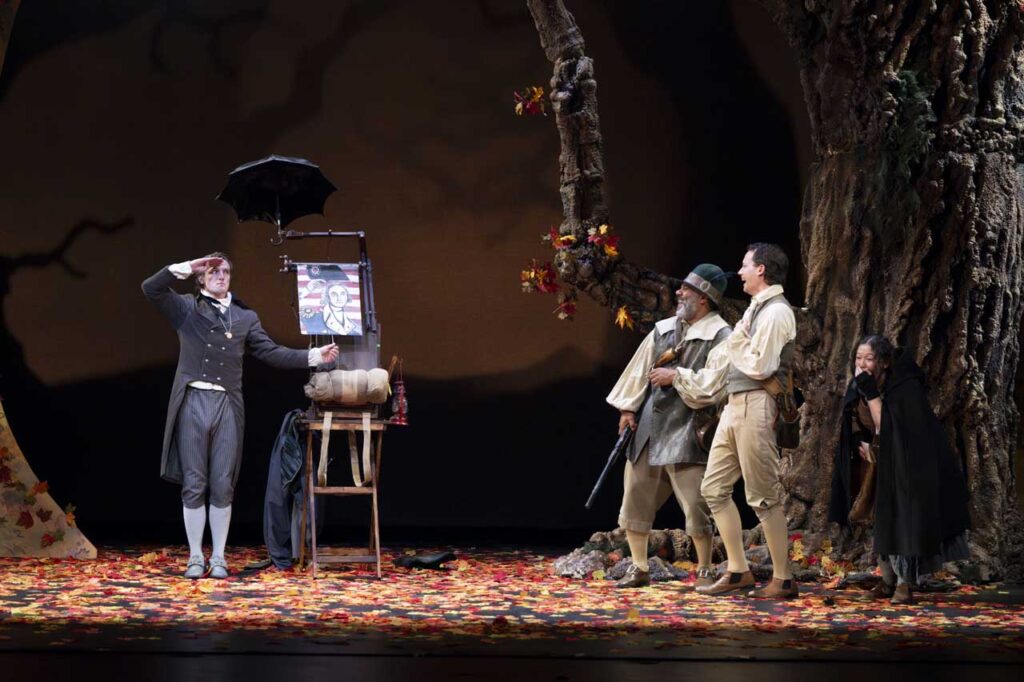
Devon Brayne, Jamie Konchak, Emily Howard and Doug McKeag in The Legend of Sleepy Hollow. Photo by Abigaile Edwards, courtesy of Banff Centre for Arts and Creativity. Set, Puppet & Costume Design by The Old Trout Puppet Workshop. Lighting Design by Sonoyo Nishikawa.
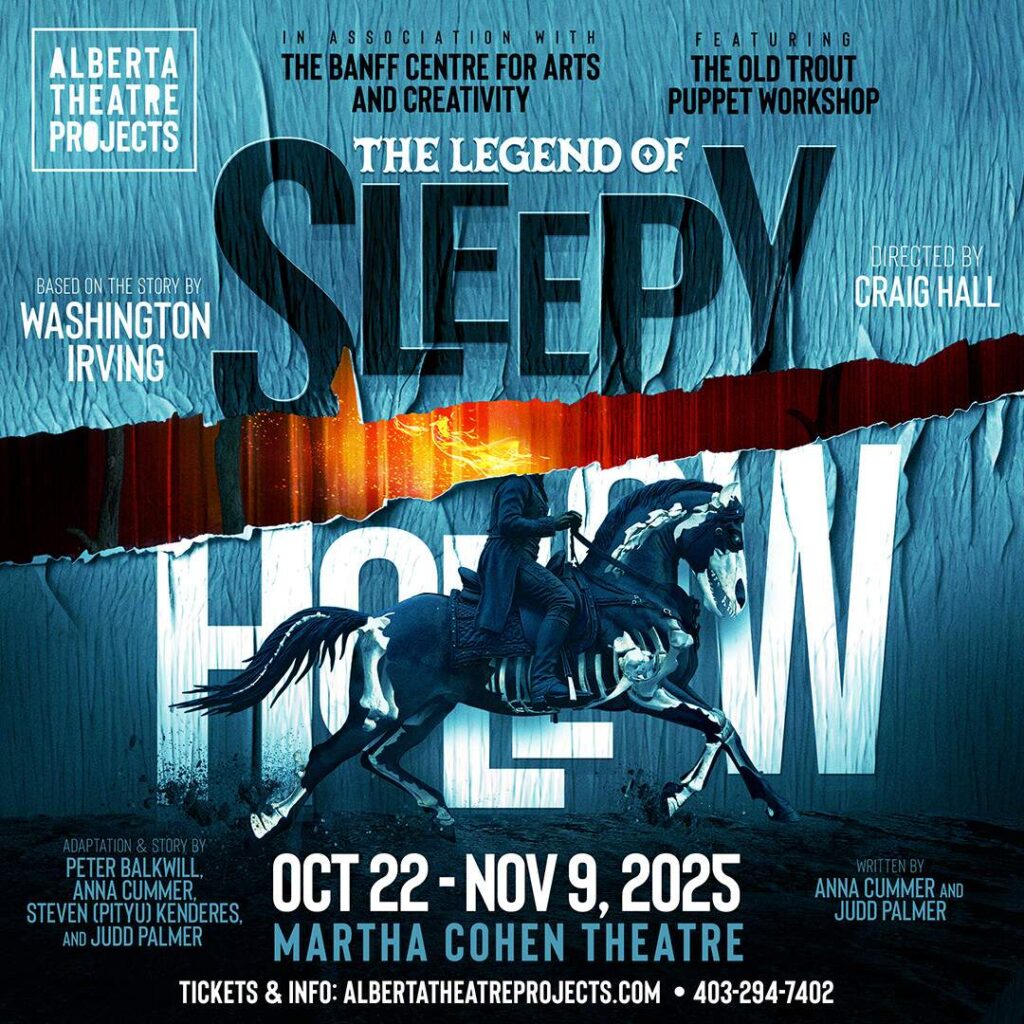
This October The Legend of Sleepy Hollow comes alive on the Alberta Theatre Projects stage featuring all your favourite characters including Ichabod Crane, Katrina Van Tassel, Brom Bones and of course the Headless Horseman. The story has been expanded to dive deeper into the murky waters of post-Revolutionary America and the politics and superstitions of the time. The play is being penned by Anna Cummer and Judd Palmer and features Matthew Mooney as Ichabod, Emily Howard as Katrina, and Devon Brayne as Brom. Rounding out the cast is Christopher Clare, Jamie Konchak, Doug McKeag, and Alice Wordsworth.
The play is being produced in association with the Banff Centre for Arts and Creativity and is being brought to life by the twisted genius of The Old Trout Puppet Workshop which includes Judd Palmer, Pete Balkwill, and Pityu Kenderes along with the rest of the design team including lighting designer Sonoyo Nishikawa and sound designer Andrew Blizzard.
The play runs from October 22nd to November 9th at the Martha Cohen Theatre in the Werklund Centre which was formally known as Arts Commons. Tickets are available at albertatheatreprojects.com or by calling 403-294-7402
***
I contacted the director of the play Craig Hall, who was out in Banff along with the entire creative team making final preparations for the play’s premiere, in order to ask him about this particular adaptation and how it evolved.
JAMES HUTCHISON
So, stories like Dr. Jekyll and Mr. Hyde, Dracula, and The Legend of Sleepy Hollow continue to be retold and reimagined even centuries after they were first shared with people. What is it about these myths, ghost stories, and tales of the supernatural that allows them to transcend their original time and place and still resonate with a modern audience?
CRAIG HALL
I think it’s good storytelling. You know with all the right tension and with all the right sort of secrets and mystery. And audiences love being scared. And I don’t just mean theatre audiences. Look at the horror genre. It’s massive. And so these stories are classics because it’s great storytelling and because audiences love to be scared.
JAMES
Who hasn’t hidden around the corner and gone boo at one of their unsuspecting family members.
CRAIG
Exactly. It’s in us. That love of being surprised and the adrenaline rush that is caused by something being unknown or unexplainable. And the mystery genre in fiction is one of the biggest genres in the world and has been for a long time. Even if it’s a straight-ahead drama or comedy, there’s always an element of mystery in everything that I’m drawn to because it’s more than just an intellectual experience, it’s a physical experience as well. And it makes us active. We’re an active participant in the story. And I would suggest that every ghost story is a mystery although not every mystery is a ghost story.
Doug McKeag, Matthew Mooney, Jamie Konchak and Emily Howard in The Legend of Sleepy Hollow. Photo by Abigaile Edwards, courtesy of Banff Centre for Arts and Creativity. Set, Puppet & Costume Design by The Old Trout Puppet Workshop. Lighting Design by Sonoyo Nishikawa.
JAMES
This is a new play and it’s an adaptation of an existing story so as the director I’m wondering how you see your role first in working on the script and the story with the playwrights Anna Cummer and Judd Palmer. How did that process work.
CRAIG
It’s been a long process. Anna and Judd have been working on this since Covid. They were looking for something to tackle and they went with The Legend of Sleepy Hollow because it had the intrigue that they were looking for. It had the potential for the style that they were looking for. And it’s a story that’s in the public domain so they could do what they wanted with it.
I’ve been in and out of the process as a bit of a dramaturge with a directorial eye. And I’ve been involved in the workshops as we’ve gone along and that role kind of transforms from dramaturge to director through the course of the process. So, it’s been a real luxury to be involved with it from its inception.
Often as a director you’re coming into it just as somethings heading into production. But to be involved since the inception and to be able to nudge and contribute has been great. Anna and Judd are certainly the leads, but we’ve all had a little bit of input here and there and it’s been great working with the Old Trout Puppet Workshop and with Anna who is my partner of course.
And because the Trouts are so heavily involved the design almost develops alongside the play. Your usual process is the designers come in as you’re heading into production, but this play has had a design dramaturgy kind of lens, so the design evolved very organically. So, we’ve been able to create the play with the design in mind.
Alice Wordsworth, Devon Brayne, Jamie Konchak, Emily Howard, Christopher Clare. and Doug McKeag in The Legend of Sleepy Hollow. Photo by Abigaile Edwards, courtesy of Banff Centre for Arts and Creativity. Set, Puppet & Costume Design by The Old Trout Puppet Workshop. Lighting Design by Sonoyo Nishikawa.
JAMES
As you mentioned a core component of this adaptation of Sleepy Hollow is the The Old Trout Puppet Workshop who are bringing their puppetry and storytelling talents to the adaptation. In what ways does having puppetry expand the storytelling possibilities?
CRAIG
It’s interesting, I mean, because it’s the Trouts everybody assumes that it’s puppet-forward but in this case it’s more about the esthetic of the whole show. The Trouts are doing the costumes. They’re doing the props. They did the set. There’s some puppetry in the piece and everyone knows that the Headless Horseman is going to make an appearance at some point, but it’s less a puppet show than it is a Trout-driven esthetic. It’s almost like the humans are the puppets in a way. They act as narrators. They act as characters. And everything from their costumes to how they move through this world is a very Trout-driven esthetic.
Alice Wordsworth and Matthew Mooney in The Legend of Sleepy Hollow. Photo by Abigaile Edwards, courtesy of Banff Centre for Arts and Creativity. Set, Puppet & Costume Design by The Old Trout Puppet Workshop. Lighting Design by Sonoyo Nishikawa.
JAMES
So, as part of the process of bringing The Legend of Sleepy Hollow to the stage ATP teamed up with The Old Trout Puppet Workshop along with the Banff Centre for Arts and Creativity. In fact, as we’re doing this interview, you’re currently in Banff in rehearsals getting the play ready for its premiere. How did the opportunity to bring the play to the Banff Centre contribute to the development of the play both artistically and from a practical perspective.
CRAIG
I shouldn’t speak out of turn here, but the Banff Centre made this possible. Without the Banff Centre I’m not sure that ATP could have taken this project on. It was when the Banff Centre came on board that everything lurched forward and got under way. And last night Doug McKeag took us all out on a night time walk through the forest that he’d planned and the group recreated one of the ritual scenes that’s in the show and they came out of the forest with lanterns and you don’t get that kind of bonding beyond the rehearsal hall when everybody is living in their home and going home directly after work. So, it’s been such a privilege to be out here in such an extraordinary facility as an ensemble and to concentrate on the work.
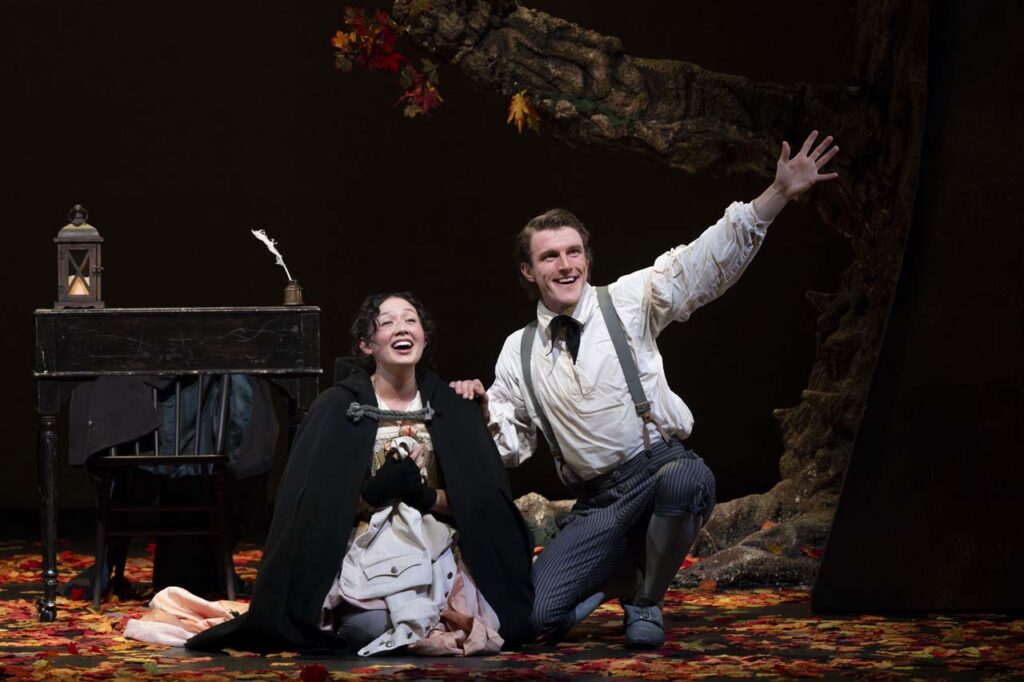
Emily Howard and Matthew Mooney in The Legend of Sleepy Hollow. Photo by Abigaile Edwards, courtesy of Banff Centre for Arts and Creativity. Set, Puppet & Costume Design by The Old Trout Puppet Workshop. Lighting Design by Sonoyo Nishikawa.
JAMES
I read the original story The Legend of Sleepy Hollow by Washington Irving and one of the things that really stood out to me was just how clear and vivid the characters are in the story. Tell me about how these characters have been lifted from the page and put on stage to help tell the story.
CRAIG
It’s certainly not a traditional retelling of the story. Those basic characters of Katrina Van Tassel and Ichabod Crane and Brom Bones come from the original and the love triangle still exists but it’s an expanded world. It’s not as simple a story.
It’s got a lot of politics around the revolutionary war in it, and everybody is suffering a little bit of PTSD from the war and how the country was torn to pieces. So, Anna and Judd really dug into the history and what was happening at the time and how that parallels what’s happening now. The story goes far beyond the simple relationships of those three characters.
And Ichabod is very much a creature of survival. He will become whoever he needs to become in order to survive. You’ve got this character who’s out of his element and you’re really rooting for him but then his choices are not always correct morally. And what he believes to be true versus what’s actually true becomes this sort of interesting moral conundrum in the piece.
JAMES
You mentioned truth. Do you believe theatre’s role is to reveal truth?
CRAIG
I think its role is to wrestle with it. The most interesting theatre requires you to discern what the truth is. It offers both sides of an argument. And I think that’s what Anna and Judd have done. They want the audience to see there’s an ambiguity to it, and they want the audience to go I’m not sure who the hero is and whether or not they are a reliable narrator so that the audience is wrestling with that truth by the end. And I think they’ve put so much thought into the story and done a lovely job of it so that it ends up being a really satisfying journey and puzzle.
Matthew Mooney, Christopher Clare, Devon Brayne and Alice Wordsworth in The Legend of Sleepy Hollow. Photo by Abigaile Edwards, courtesy of Banff Centre for Arts and Creativity. Set, Puppet & Costume Design by The Old Trout Puppet Workshop. Lighting Design by Sonoyo Nishikawa.
JAMES
So, what kind of an experience are audiences going to have when they come to see the show?
CRAIG
I think at its base it’s a nice spooky experience with some beautiful ensemble storytelling. Some beautiful visuals. I think that people who know the story will love to see it expanded and to see these characters fleshed out.
And Judd and Anna are two of the smartest people I know. They both have their own fascinations. Judd loves chaos and Anna loves order. And you get to see these two things kind of battle inside of a script which makes for a really satisfying whole. I think that each of them individually would have written a very different piece, but together they wrote something that has a lot of complexity and depth.
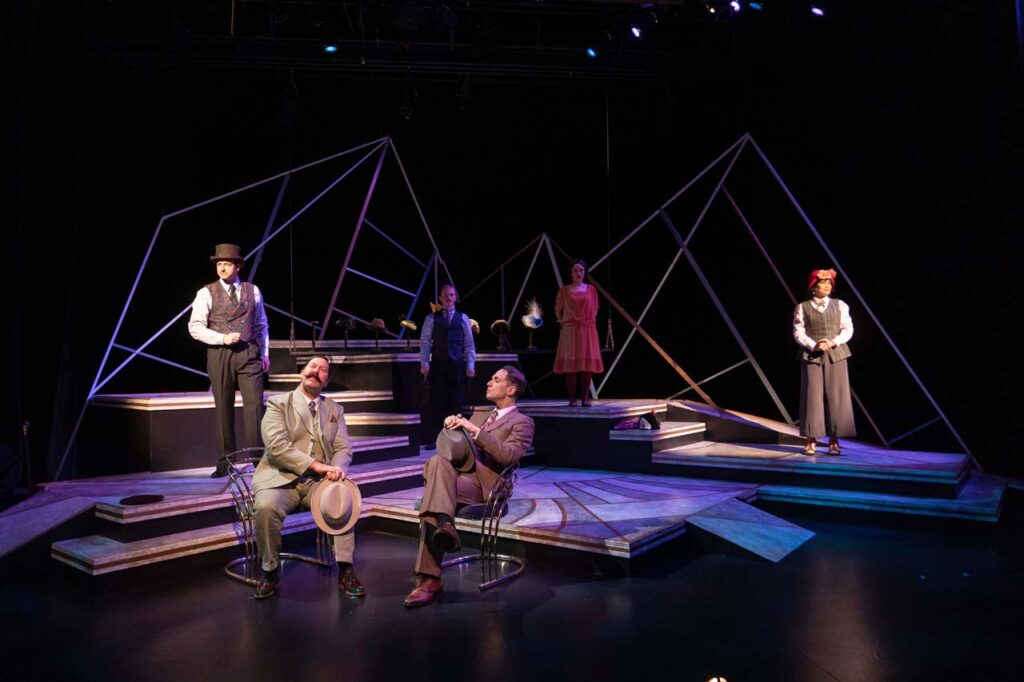
And Ichabod calls himself a poet warrior. That’s his own self-aggrandizing definition of himself but words are what he uses for battle. It’s that idea that the pen is mightier than the sword and he’s going to change the world through his words, and he does but whether it’s for better or for worse remains to be seen.
***
Alberta Theatre Projects presents the world premiere of a brand-new Canadian adaptation of The Legend of Sleepy Hollow by Washington Irving. Co written by Anna Cummer and Judd Palmer and produced in association with the Banff Centre for Arts and Creativity and The Old Trout Puppet Workshop, this production presents an exciting multi-organizational collaboration that breathes new life into the enduring and haunting tale of the Headless Horseman.
The Legend of Sleepy Hollow runs until November 9th at the Martha Cohen Theatre in the Werklund Centre. Tickets are available at albertatheatreprojects.com or by calling 403-294-7402.
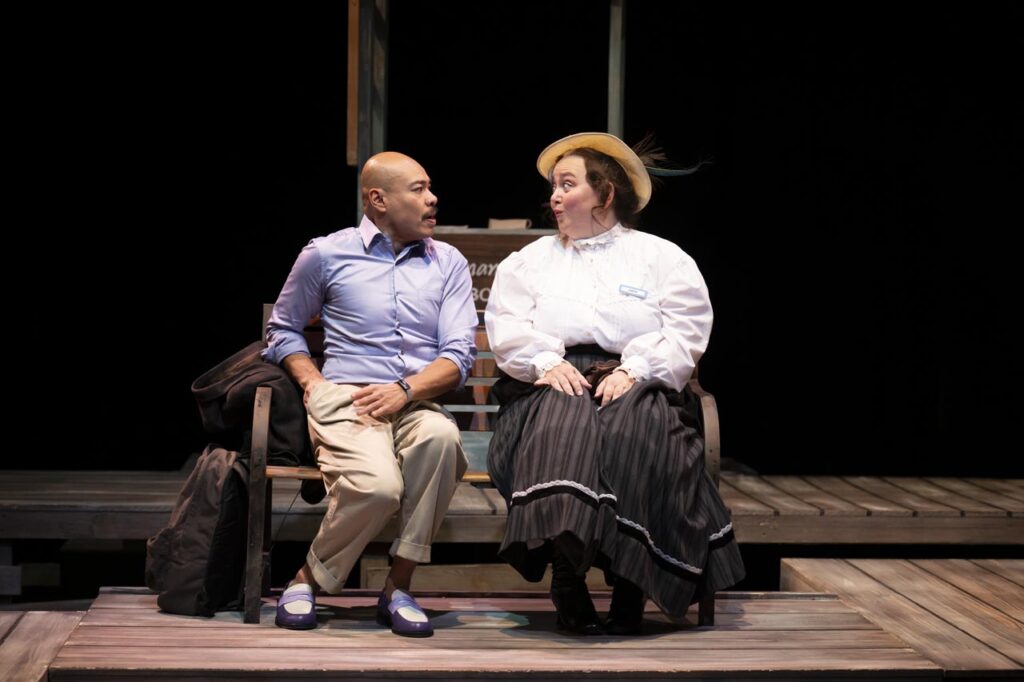
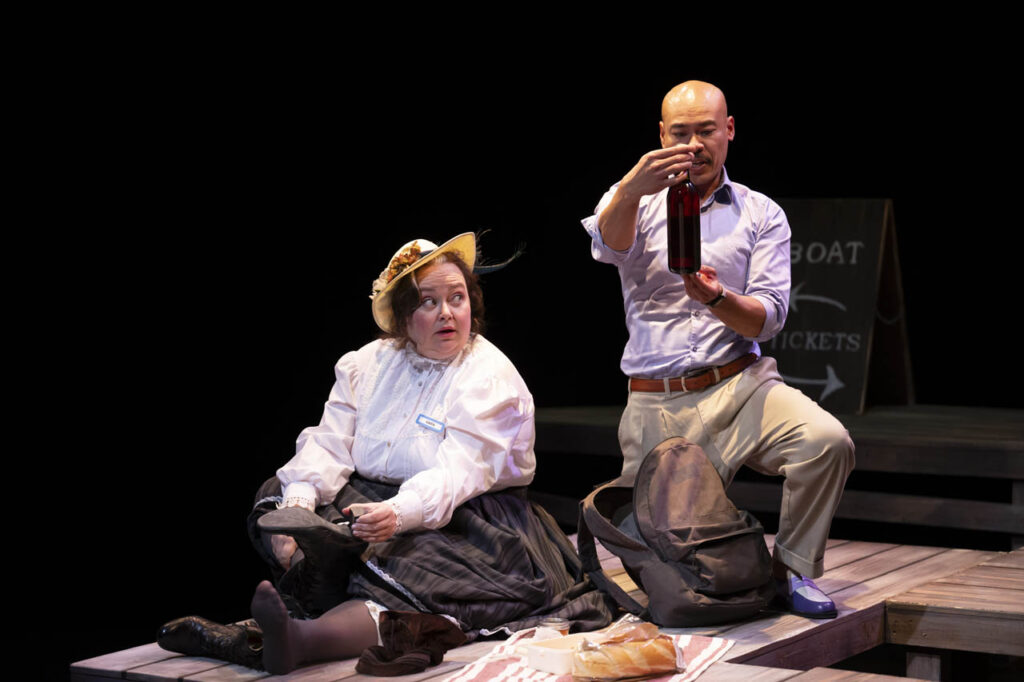
Mike Tan and Meg Farhall in Beyond the Sea by Kristen Da Silva, Directed by Bronwyn Steinberg, Photo by Benjamin Laird.
Lunchbox Theatre kicks off its 51st season with the very funny and heartfelt Beyond the Sea by Kristen Da Silva running from October 14th to November 2nd. Playpasses and tickets are available online at lunchboxtheatre.com or by calling the box office at 403-221-3708.
***
Every stranger we meet has the potential of influencing our lives in a deep, meaningful, and powerful way. Of course, that does require a level of vulnerability and often I would suggest the sharing of pain. The painful aspects of life. The struggles. And those struggles can be individual short falls or life’s unfair circumstances. No life is without its challenges.
How’s that for a comic premise?
It’s a pretty darn good one actually.
And playwright Kristen Da Silva has crafted a genuinely funny, heartfelt, and deeply moving play that follows the evolving and deepening relationship between two strangers who by the end of the story have transformed from strangers to friends.
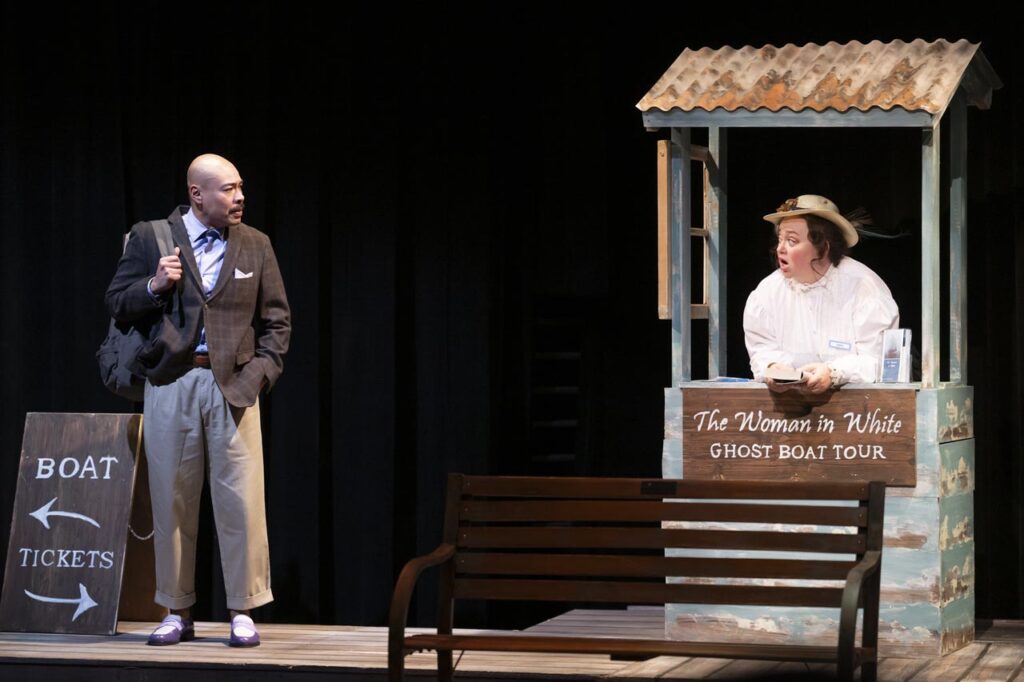
Mike Tan and Meg Farhall in Beyond the Sea by Kristen Da Silva, Directed by Bronwyn Steinberg, Photo by Benjamin Laird.
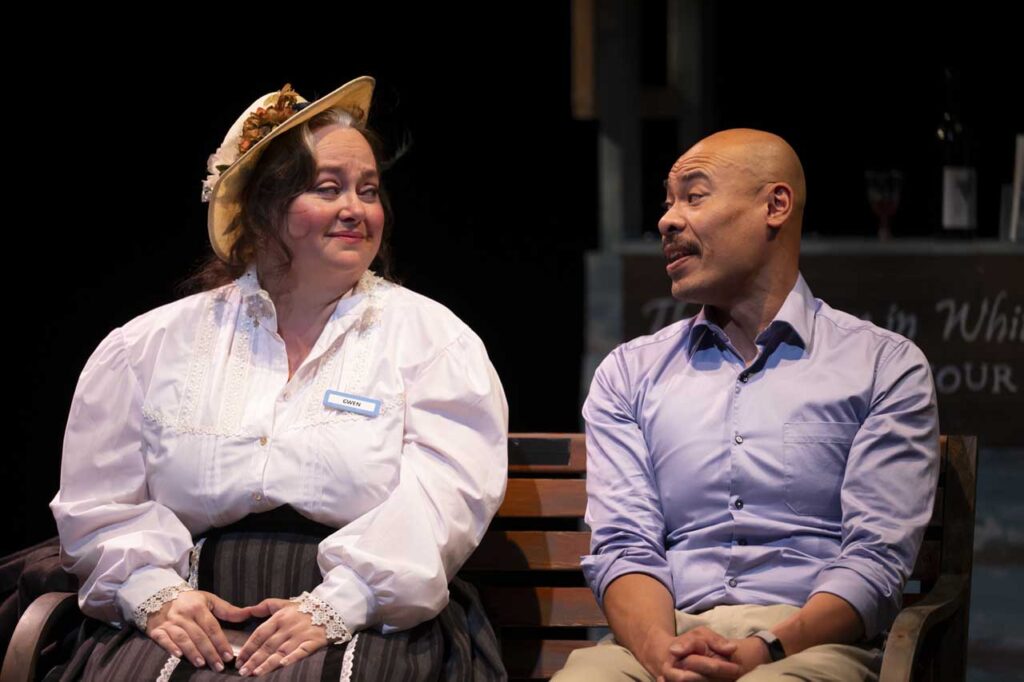
The play is brought to life with wonderful performances by Meg Farhall and Mike Tan. Mike portrays Theo as a man whose personal shortcomings and approach to life have forced a reckoning from which he is trying to emerge a better person. He’s been working on himself – let’s say. And the new Theo has arrived at the pier where he has arranged to meet a woman he met online for a first date. Needless to say, he’s nervous and vulnerable and the pressure is on because he wants to do better and be better and not mess things up like he has in the past.
Meg Farhall, always a joy to watch on stage, plays Gwen who on a very hot day dressed in heavy wool clothing of the 1800s and is the ticket seller for the lake’s ghost tour which features the story of The Woman in White seems to be a free spirit who approaches life with a smile and humour. There’s an immediate fun and playful chemistry between Gwen and Theo as they chat and joke and get to know each other on a deeper level. But of course, there’s more to the story than we first realize as secrets are revealed and intentions uncovered.
Meg Farhall and Mike Tan in Beyond the Sea by Kristen Da Silva, Directed by Bronwyn Steinberg, Photo by Benjamin Laird.
Personally, I like the intimacy of a small theatre. I like to be close to the performers. I love a theatre where the actors can be more natural and their voices more nuanced because they don’t have to project to the back of the second balcony. Not to say I haven’t enjoyed some big, bold, beautiful plays on the larger stage but when it comes to an intimate two-hander like Beyond the Sea the play works best when presented in an intimate space. And so, the play is ideally suited for the Studio at Vertigo Theatre which makes the play all that more compelling.
Beyond the Sea is a wonderfully intimate and funny play brought to life with tenderness and humour by director Bronwyn Steinberg who has a talent for these deeply human and evolving relationship stories. This is the perfect play for an afternoon or night out with friends. Or a great idea for a first date. Or a terrific option for a date night for any couple looking for an entertaining and heartwarming story about second chances that will have you leaving the theatre feeling good about life and the future.
Meg Farhall and Mike Tan in Beyond the Sea by Kristen Da Silva, Directed by Bronwyn Steinberg, Photo by Benjamin Laird.
Beyond the Sea by Kristen Da Silva runs from October 14th to November 2nd at Lunchbox Theatre. Performances are Tuesday to Saturday at 12:00 pm with evening performances on Friday at 7:00 pm and late Saturday afternoon at 4:00 pm and Sunday at 1:30 pm. Tickets are available at lunchboxtheatre.com or by calling the box office at 403-221-3708.
Helen Knight, Tyrell Crews, Joel David Taylor, Maureen Thomas and Grace Fedorchuk in Liars at a Funeral. Photo by Benjamin Laird. Set & Lighting Design by Anton deGroot. Costume Design by Abbie Brokenshire. Sound Design & Composition by Kathryn Smith. Sound Design Support by Miranda Martini.
Alberta Theatre Projects, in association with Western Canada Theatre, ends it’s 50th Anniversary season with the audience pleasing comedy Liars at a Funeral by Sophia Fabiilli.
Tyrell Crews fresh off his stint as Charles in the very funny Theatre Calgary production of Blithe Spirit by Noel Coward joins a terrific ensemble cast that includes Maureen Thomas as Mavis the Matron of the family who flutters around the chaos like a moth dancing around a flame.
Tyrell Crews, Grace Fedorchuk and Maureen Thomas in Liars at a Funeral. Photo by Benjamin Laird. Set & Lighting Design by Anton deGroot. Costume Design by Abbie Brokenshire. Sound Design & Composition by Kathryn Smith. Sound Design Support by Miranda Martini.
Helen Knight takes on the role of Evelyn who is Grace’s daughter and the estranged mother of twin daughters Dee Dee and Mia. In the opening moments of the play we discover that Evelyn is concealing a secret from her family that she fears if revealed may further damage her relationship with her daughters. Knight also portrays the insatiable Leorah the owner of the funeral parlour who is always on the look out for a good time.
Helen Knight in Liars at a Funeral. Photo by Benjamin Laird. Set & Lighting Design by Anton deGroot. Costume Design by Abbie Brokenshire. Sound Design & Composition by Kathryn Smith. Sound Design Support by Miranda Martini.
Grace Fedorchuk portrays Dee Dee and Mia, Evelyn’s twin daughters who haven’t spoken in over a decade and remain estranged due to lingering resentment over what can best be described as creative differences surrounding a production of Hamlet.
Completing the ensemble is Joel David Taylor who plays Dee Dee’s love interest and dedicated funeral parlour employee Quint, as well as Cam the energetic and always positive boyfriend of Mia.
Joel David Taylor, Maureen Thomas and Grace Fedorchuk in Liars at a Funeral. Photo by Benjamin Laird. Set & Lighting Design by Anton deGroot. Costume Design by Abbie Brokenshire. Sound Design & Composition by Kathryn Smith. Sound Design Support by Miranda Martini.
Basically, the premise of the play is that Mavis has faked her own death and is now having a funeral in order to get everyone into the same room so that the family can come together and heal and put an end to what Mavis calls the family curse.
Of course, nothing ever goes according to plan, and it isn’t long before Mavis and her charade of a funeral goes off the rails. The setting for the shenanigans is the funeral parlour with the coffin front and centre. And with all the chaos going on Mavis isn’t the only one who ends up in the coffin as events unfold.
Maureen Thomas, Tyrell Crews, Grace Fedorchuk and Joel David Taylor in Liars at a Funeral. Photo by Benjamin Laird. Set & Lighting Design by Anton deGroot. Costume Design by Abbie Brokenshire. Sound Design & Composition by Kathryn Smith. Sound Design Support by Miranda Martini.
Having one actor play two or more characters is a fairly common troupe these days and it offers comic possibilities, but it also places limits on how a story can be told depending on the style of production.
A more farcical production might have an exchange between an actor playing two roles by simply using a hat to have the actor transition from one character to the other. But in Liars at a Funeral the actors never encounter their other selves and so while it’s fun to watch the quick changes and multiple characters coming and going through entrances and exits it means dramatically you can never have certain characters interact and confront each other.
Helen Knight and Grace Fedorchuk in Liars at a Funeral. Photo by Benjamin Laird. Set & Lighting Design by Anton deGroot. Costume Design by Abbie Brokenshire. Sound Design & Composition by Kathryn Smith. Sound Design Support by Miranda Martini.
But then I take it that was the intention of playwright Sophia Fabiilli to tell the story in this manner and to let the audience in on the joke and part of the fun for example is watching Tyrell disappear out one door as Wayne, Evelyn’s ex husband and Leorah’s love interest and reemerge moments later from another door as Frank Evelyn’s gay friend who is pretending to be her boyfriend.
Now combine Tyrell’s entrances and exits with all the other actors’ comings and goings and switching roles and hiding from each other and all of the characters having multiple secrets that could at any moment be revealed and you have the basic ingredients for an amusing and entertaining farce that is packed with misunderstandings and comic misadventures. The cast’s comedic timing, quick costume changes, and their ability to play off each other keeps the energy high and makes for a fun evening at the theatre.
Grace Fedorchuk, Joel David Taylor, Tyrell Crews and Helen Knight in Liars at a Funeral. Photo by Benjamin Laird. Set & Lighting Design by Anton deGroot. Costume Design by Abbie Brokenshire. Sound Design & Composition by Kathryn Smith. Sound Design Support by Miranda Martini.
Skillfully putting all of this farcical concoction together is director Clare Preuss who along with her talented cast and design team have created an amusing and entertaining evening filled with plenty of laughter and perfectly timed comedic chaos. Liars at a Funeral by Sophia Fabiilli runs at Alberta Theatre Projects until May 11th. Tickets are available from the Alberta Theatre Projects website or by calling the box office at 403.294.7402.
Alberta Theatre Projects has also announced their 2025-26 Season which includes a vibrant range of stories from classic folklore and reimagined fantasy to Canadian history and feminist myth making all brought together by larger-than-life characters who transcend the stage.
“This season is about legacy,” says Haysam Kadri, Artistic Director of ATP. “These are stories that have endured because they challenge, enchant, and inspire us – and now, they return to the stage with fresh eyes and fierce energy.”
Alberta Theatre Projects 2025/26 season begins with The Legend of Sleepy Hollow based on the story by Washington Irving and brought to life by the twisted genius of The Old Trout Puppet Workshop. The haunting tale of the headless horseman runs from October 22nd to November 9th, 2025.
This year ATP’s Christmas show is The Wizard of Oz by L Frank Baum brought to the stage in association with Forte Musical Theatre. The production features all the iconic songs and the classic story which reminds us about the enduring power of friendship and the importance of home and runs from November 25th, 2025 to January 4th, 2026.
Next Alberta Theatre Projects in association with The Citadel Theatre brings us Casey and Diana by Nick Green. The play tells the story of when Princess Diana visited Casey House, Canada’s first free-standing AIDS hospice in October 1991, and how her compassion brought much-needed attention and understanding to the AIDS crisis. The show runs from February 24th to March 15th, 2026.
The season ends with the ATP production of Wildwoman by Kat Sandler in association with Gateway Theatre. The play is based on the shocking true story that inspired Beauty and the Beast and is a viciously bold and sexy comedy about what happens when we let the monster out. The show runs from April 21st to May 10th, 2026.
To explore Alberta Theatre Projects new season in greater depth or to buy subscriptions to the 2025/26 season visit albertatheatreprojects.com or call 403.294.7402.
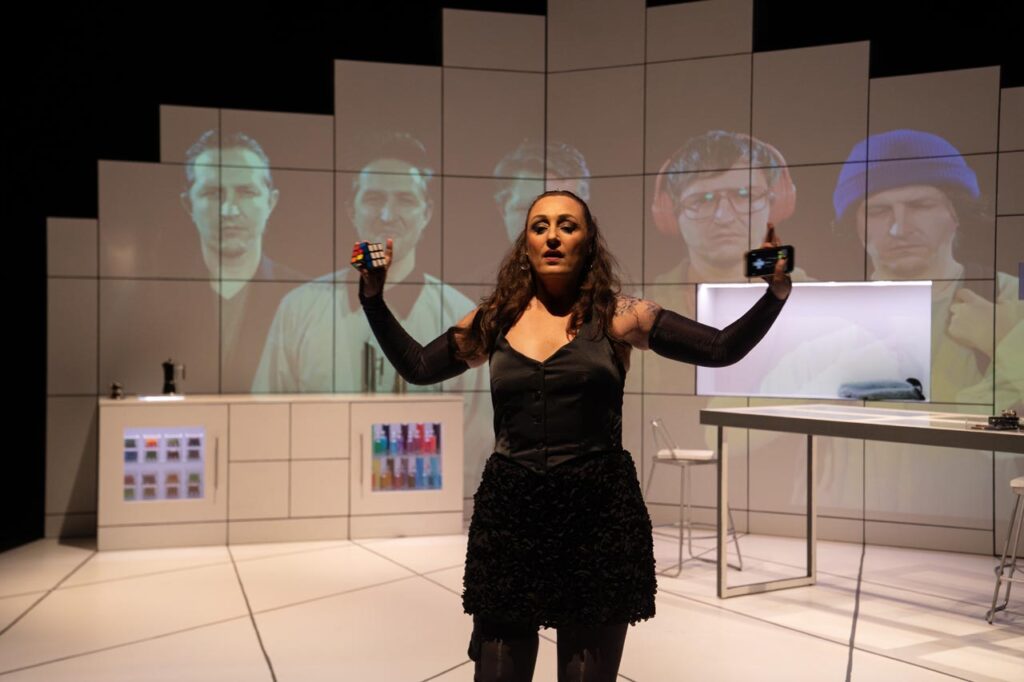
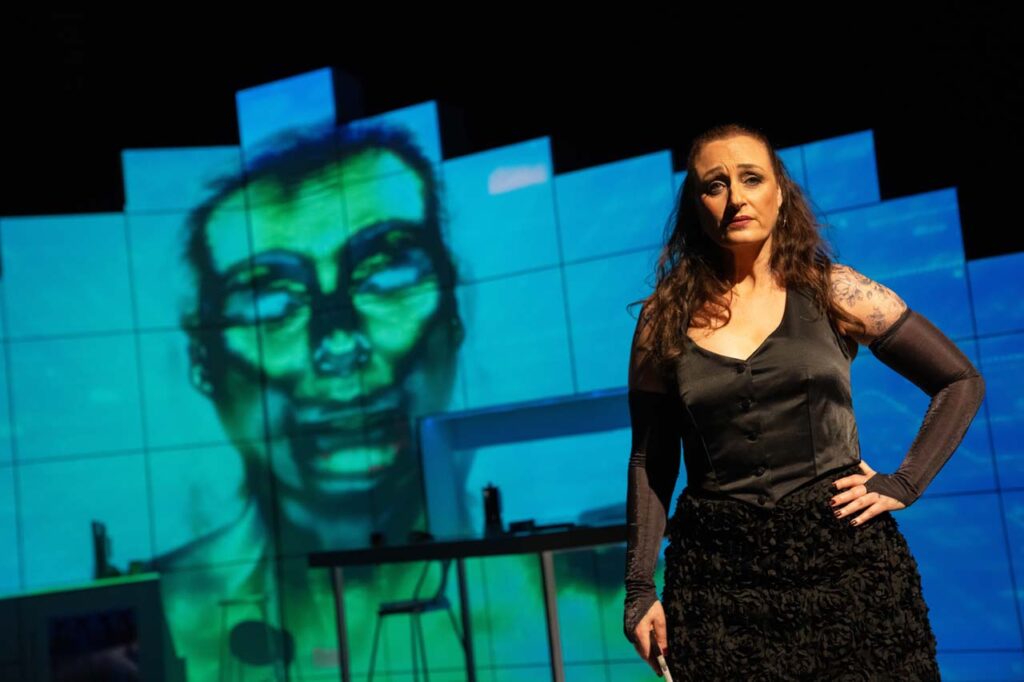
Lauren Brotman, Braden Griffiths, Set Design by Narda McCarroll, Costume Design by John Iglesias, Lighting Design by jaymez, Projection Design by Andy Moro. Photo by Fifth Wall Media.
So, what have director Jack Grinhaus, playwright Thomas Morgan Jones, and actors Lauren Brotman and Braden Griffiths been cooking up over at Vertigo Theatre? A little something called A Killing at La Cucina. A Luccia Dante Mystery.
Vertigo Theatre’s latest murder mystery takes us on a journey that delves into the realm of high-end dining, the influence of critics in our society, as well as the world of virtual reality, artificial intelligence, and our own mortality.
Introducing Lucia Dante a world-renowned espresso drinking Italiandetective hired with the task of figuring out who might have murdered Robert Carlyle one of the world’s most famous and influential food critics. A man whose opinions could make or break any dining establishment – virtual or real – and who was a frequent guest at FATE the restaurant where his life ended, and our story begins.
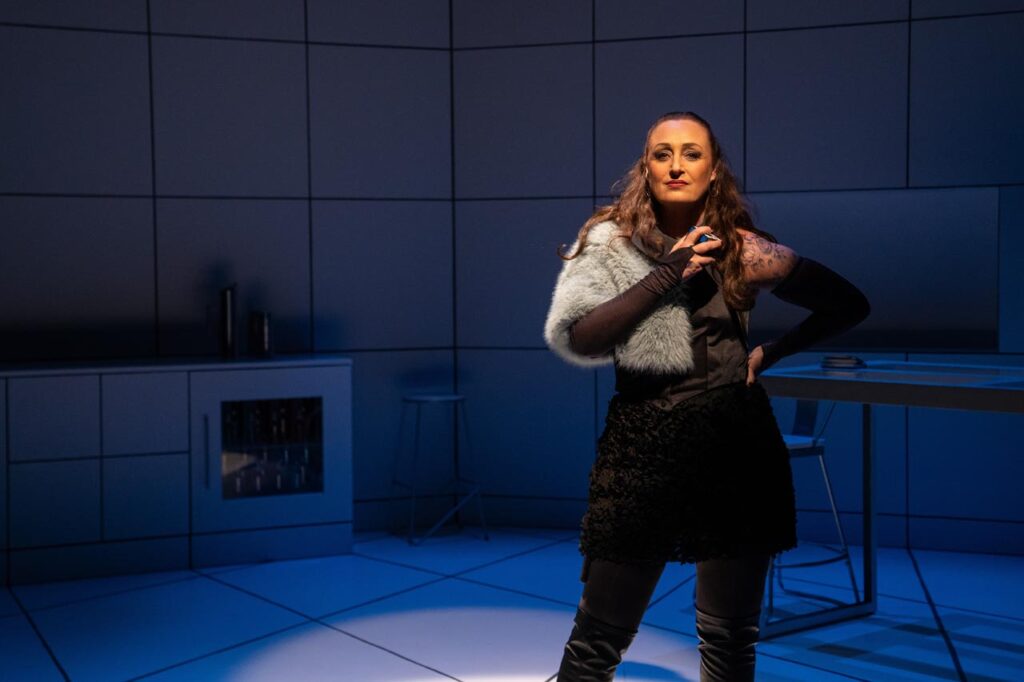
Lauren Brotman, Set Design by Narda McCarroll, Costume Design by John Iglesias, Lighting Design by jaymez, Projection Design by Andy Moro. Photo by Fifth Wall Media.
Why is the restaurant called FATE? Well, that’s because you pay $15,000 to enjoy a meal unlike any you’ve ever experienced before where the food has been reduced and transformed into a taste shattering concentrate that provides you with an unparalleled euphoric dining experience. Plus, on average one out of every one thousand diners will die.
Adding to the drama of the evening patrons are asked to prepare messages to send to loved ones that can be delivered should they be that one out of a thousand. The danger and presence of death creates an emotionally complex layer to the dining experience at FATE that no other establishment can duplicate.
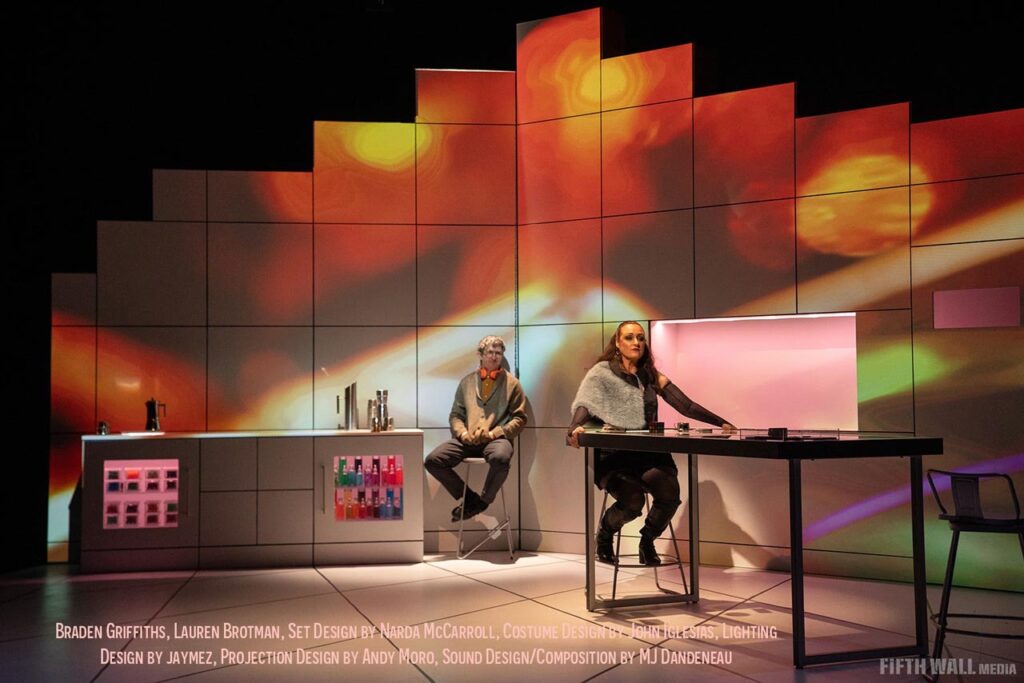
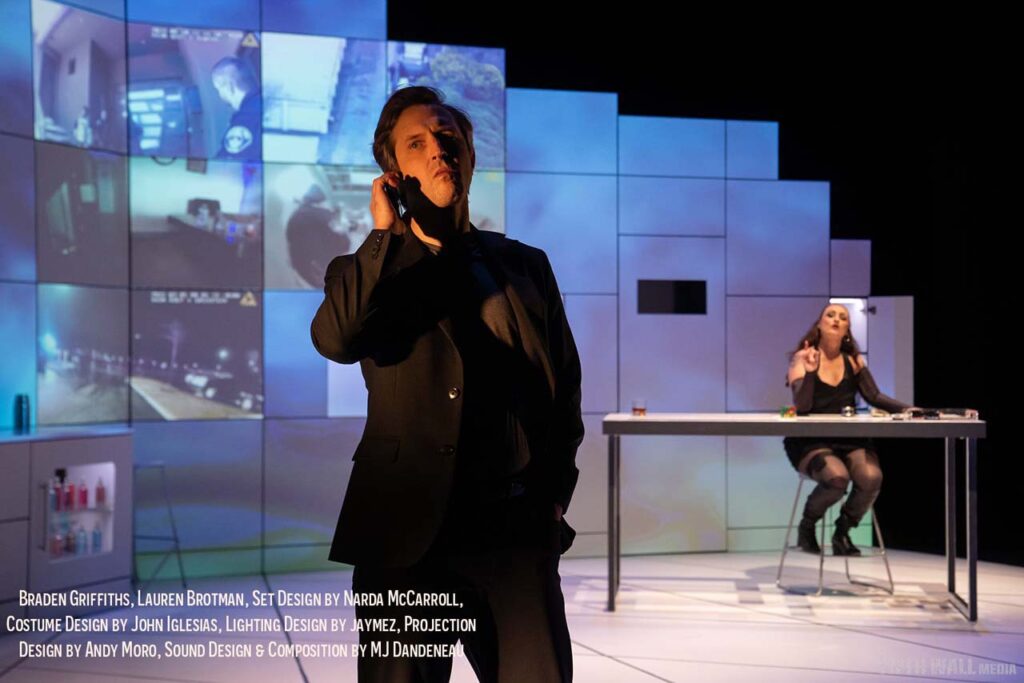
Braden Griffiths, Lauren Brotman, Set Design by Narda McCarroll, Costume Design by John Iglesias, Lighting Design by jaymez, Projection Design by Andy Moro. Photo by Fifth Wall Media.
Who are the suspects? We have Hunter the Head Waiter who considers himself the face of FATE since he’s the one who guides diners through their culinary experience. There’s the introverted and seemingly innocent Drew the dishwasher whose job is to look after, clean and account for all the glassware, cutlery, and dishes in the restaurant.
Next on our list of suspects is Dominic the Sous chef and Sebastian the Chef and owner of FATE who both have access to the food and how it’s prepared and so each had the opportunity to tamper with Richard Carlyle’s meal. Rounding out our list of suspects is Armand a billionaire and an investor in the restaurant as well as Prism a sinister developer, entrepreneur, and hacker whose online activities are not always legitimate.
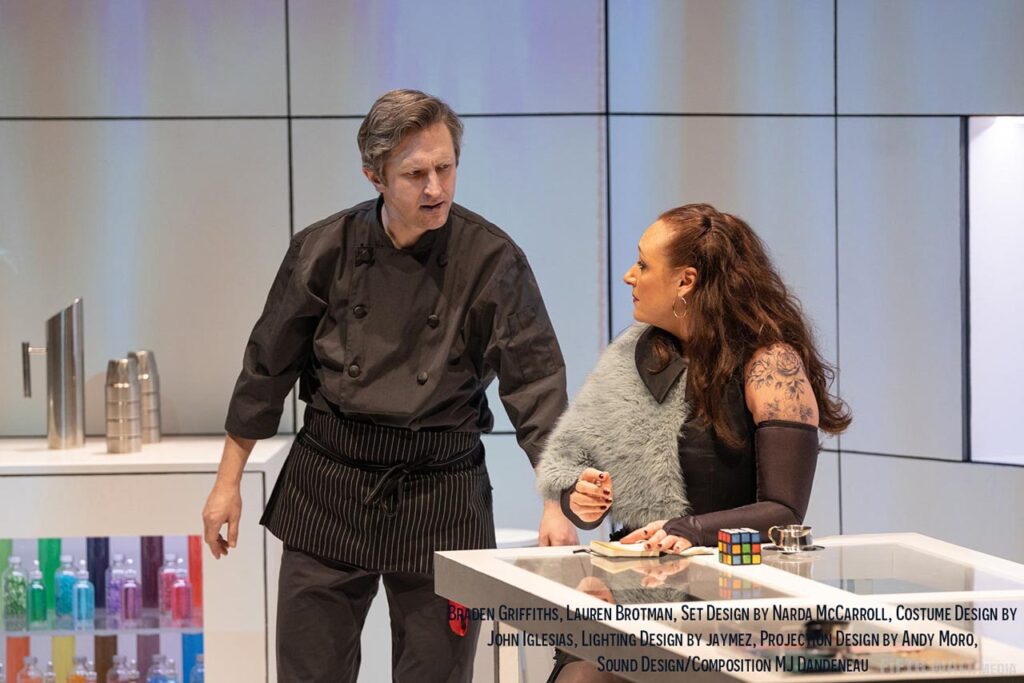
Braden Griffiths, Lauren Brotman, Set Design by Narda McCarroll, Costume Design by John Iglesias, Lighting Design by jaymez, Projection Design by Andy Moro. Photo by Fifth Wall Media.
Playing this array of characters is the versatile Braden Griffiths who uses his impressive skills to give each character a distinct voice, unique body language, and different personality while giving us an array of suspects each with their own secrets and motives making it a challenge to uncover the truth.
The play is essentially a series of interrogations as Lucia one by one questions each of the suspects searching for motives and opportunity. But she’s there not just to figure out what happened to critic Richard Carlyle but to also settle a personal vendetta against Prism the nefarious hacker whom she blames for the death of fashion designer Isabella Rouge. But in this new digital age Isabella lives on – at least virtually as an AI that Lucia has created and uses to help her solve the mystery and exact justice over the course of the story.
Lauren Brotman, Set Design by Narda McCarroll, Costume Design by John Iglesias, Lighting Design by jaymez, Projection Design by Andy Moro. Photo by Fifth Wall Media.
Bringing Lucia Dante to life is Loren Brotman who delivers a performance that masterfully conveys the complexity and depth of Lucia’s character while guiding us through her investigation where we learn more about her story while she uses her insightful interrogation techniques to solve the crime and reveal the truth.
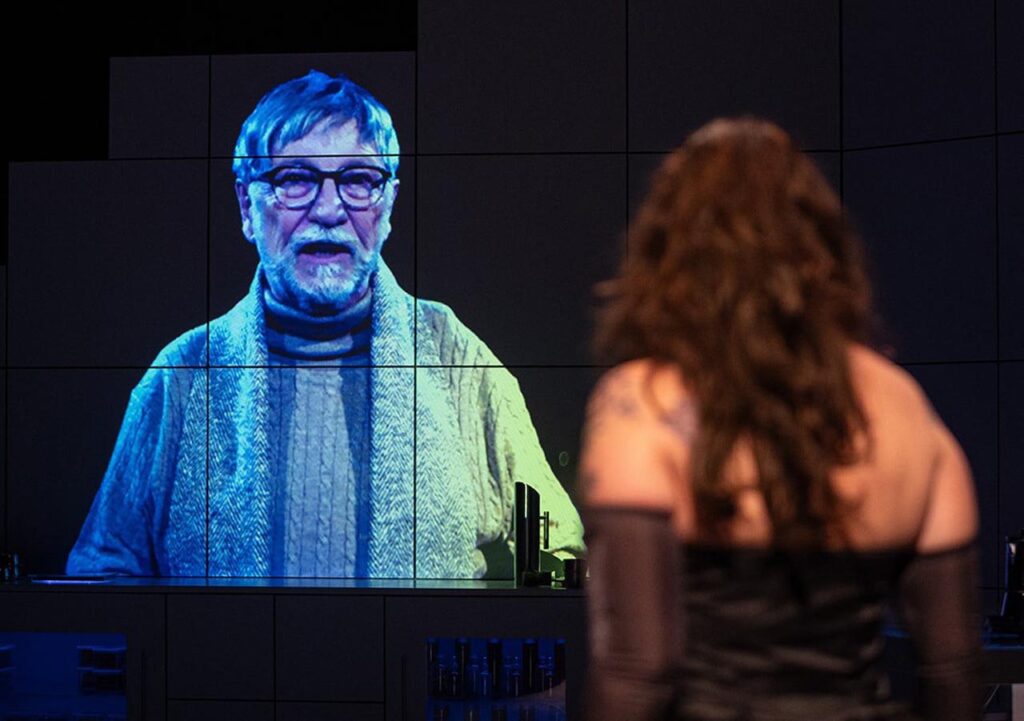
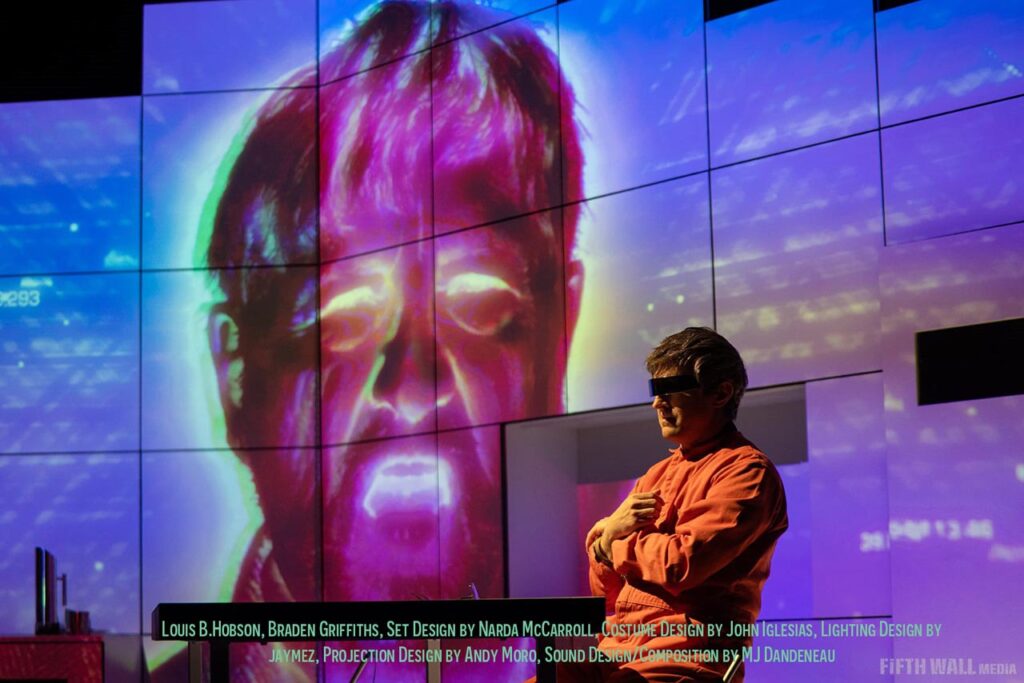
Rounding out the cast A Killing at La Cucina and playing food critic Robert Carlyle is real-life theatre critic Louis B. Hobson. I kept Louis’s appearance in the show out of my original review as I wanted audiences to enjoy his cameo and performance free of spoilers. Louis appears in the play as Robert Carlyle in recorded segments. Some of these segments were recorded on the night he died and so promise clues as to who, if anyone, might have had a hand in his demise.
Louis B. Hobson, Lauren Brotman, Set Design by Narda McCarroll, Costume Design by John Iglesias, Lighting Design by jaymez, Projection Design by Andy Moro. Photo by Fifth Wall Media.
Louis has successfully navigated the world of being a critic, a director, and a playwright for decades and so it was fun to see him on stage – playing a critic. And these days with the shortage of conventional media coverage and the disappearance of critics Louis’s reviews are very much needed to help get the word out. In fact, I personally believe the more reviews the better since plays always strike people in different ways and having a variety of opinions about a production helps those productions find their audience.
Louis of course was unable to review this show because he was in it, but you can read his other theatre reviews online at The Calgary Herald. As far as other critics go in the city you can also read Caroline Russell-King’s theatre reviews at her website Postcard Reviews where Louis also publishes long form play reviews that don’t appear in the Herald.
Louis B. Hobson, Braden Griffiths, Set Design by Narda McCarroll, Costume Design by John Iglesias, Lighting Design by jaymez, Projection Design by Andy Moro. Photo by Fifth Wall Media.
One of the most entertaining aspects and enjoyable parts of A Killing at La Cucina is the imaginative set, digital projections, and stylistic break the fourth wall moments. I loved that aspect of the play and would welcome more of those moments should Lucia return for future murder mysteries.
Creating this theatrical and futuristic feeling setting is set designer Narda McCarroll, lighting designer Jaymez, projection designer Andy Moro, costume designer John Iglesias, and sound designer MJ Dandeneau. Adding to the fun are the theatrical moments where characters use cleverly staged movement and transitions to tell the story. This illustrates a wonderful collaboration between the cast, director, and choreographer Javier Vilalta that adds a heightened sense of style and sophistication to the production.
Skilfully bringing all of these elements together director Jack Grinhaus and playwright Thomas Morgan Jones have created a culinary thriller that is both visually stunning and intellectually stimulating that will leave audiences fully satisfied yet hungry for more.
Braden Griffiths, Lauren Brotman, Set Design by Narda McCarroll, Costume Design by John Iglesias, Lighting Design by jaymez, Projection Design by Andy Moro. Photo by Fifth Wall Media.
***
A Killing at La Cucina by Thomas Morgan Jones and directed by Jack Grinhaus and starring Lauren Brotman and Braden Griffiths provides audiences with a tasty mystery presented in a highly theatrical manner that dives into the nature of the virtual world, our fascination with fate and death, and the darker side of human nature and ambition.
***
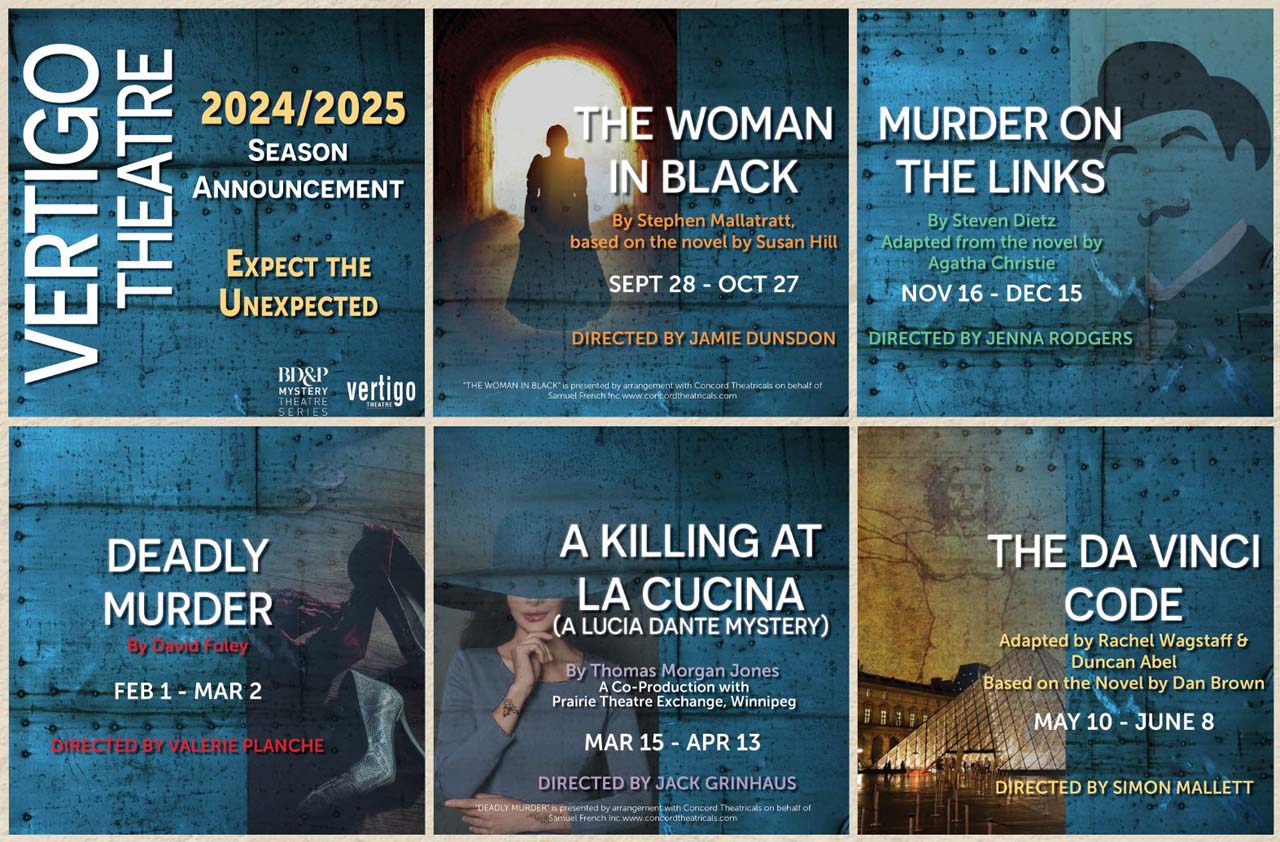
Up next at Vertigo is The Davinci Code running from May 10 to June 8, plus Vertigo has just announced their 2025/26 Theatre Season which features a wonderful selection of plays that will certainly satisfy the appetite of any mystery loving patron. To explore the new season in greater depth, click the link below. Subscriptions to the 2025/26 season start at $200 and may be purchased online at vertigotheatre.com or by phone at 403-221-3708.
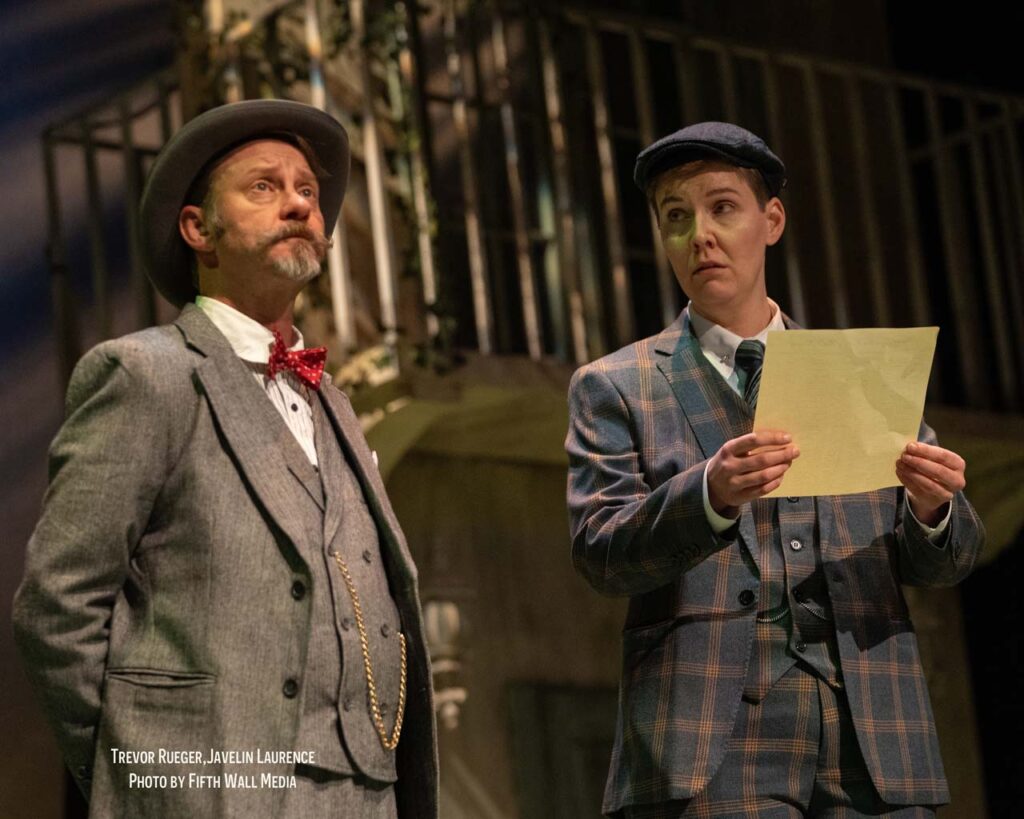
Trevor Rueger, Javelin Laurence in Murder on the Links at Vertigo Theatre. Photo Fifth Wall Media.
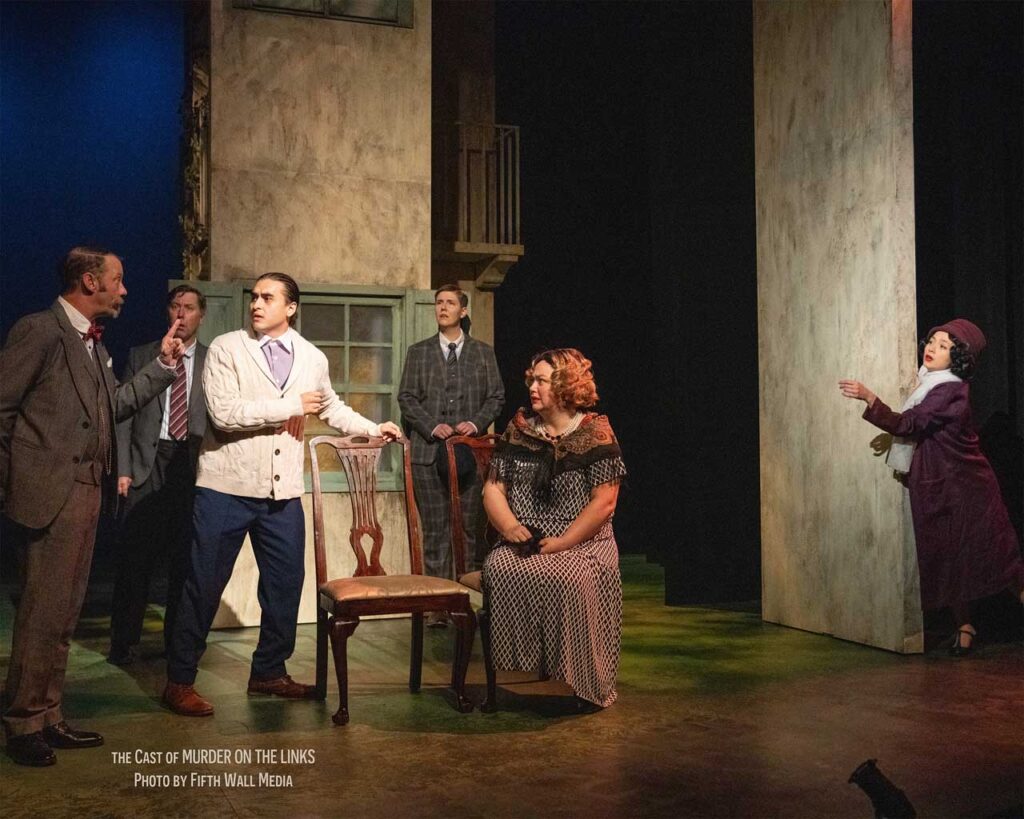
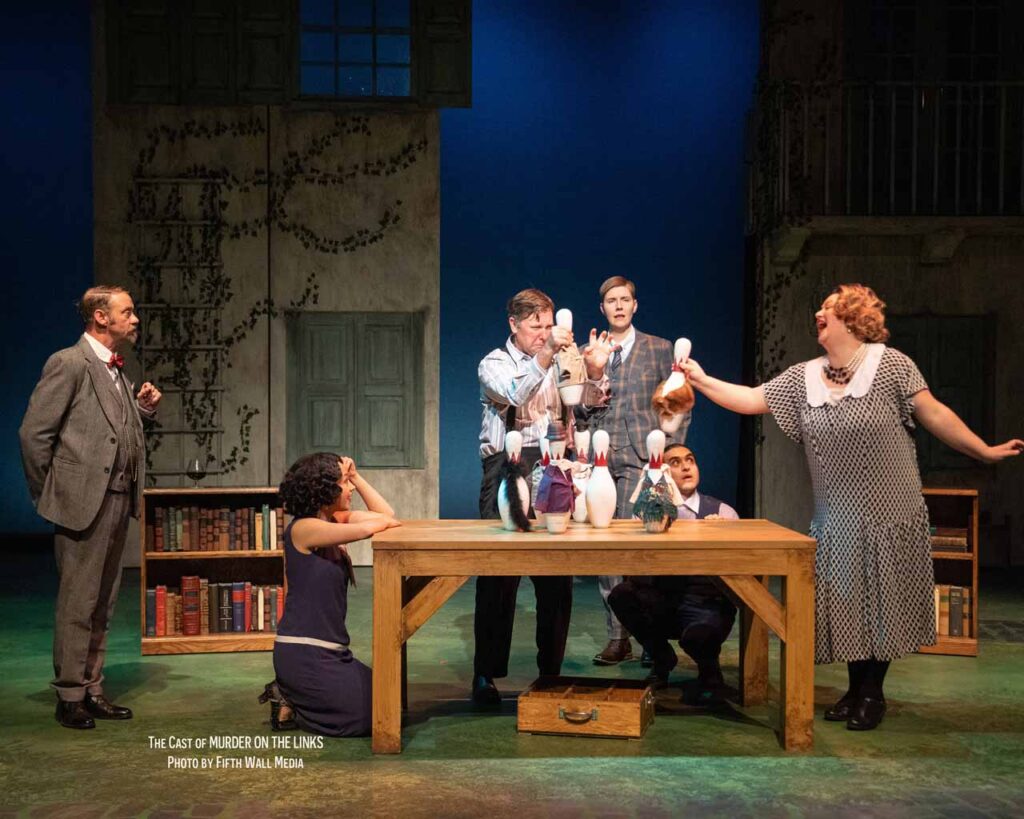
Murder on the Links by Agatha Christie and adapted for the stage by Steven Dietz is designed to not only give your little grey cells a workout but to tickle your funny bone as well. Yes, this adaptation of Christie’s story is murderously funny while still retaining all the intrigue, mystery, and appeal of the original story. The fun, and there is much of it, comes from how the production is designed and the imaginative way in which the story is told.
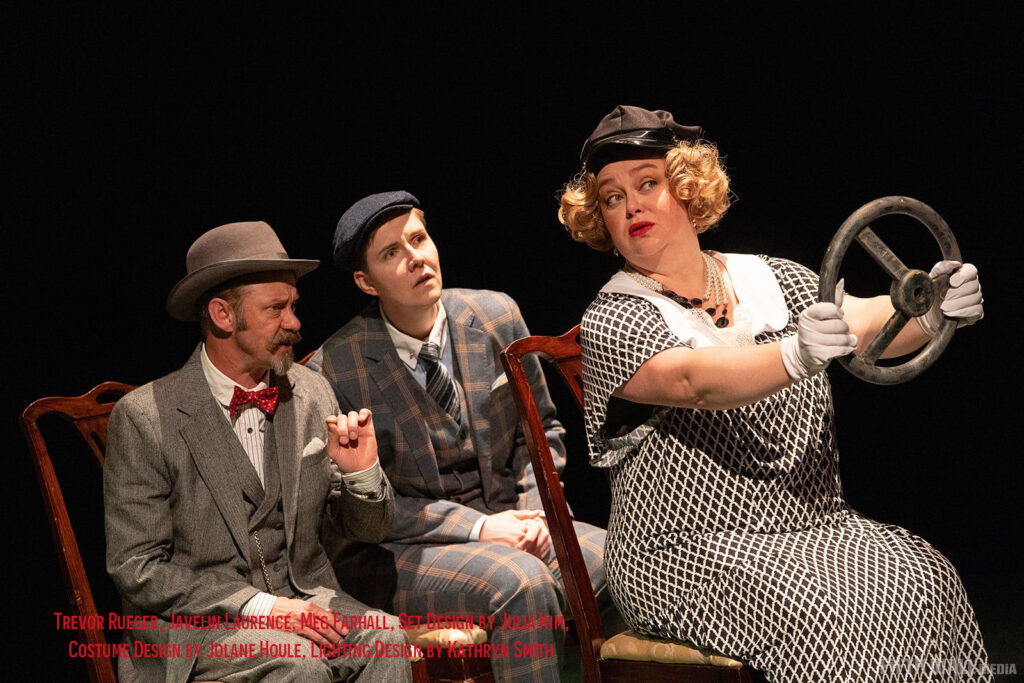
To begin with I want to say how very much I like Trevor Rueger as the world-renowned Belgium Detective Hercule Poirot and Javelin Laurence as his trusty companion and friend Captain Hastings. I would love to see more of these two in these roles on the Vertigo stage. They have a delightful chemistry and feel absolutely perfect as Poirot and Hastings. In fact, the whole cast is brilliant. And much of the success of any play is based on finding actors who fit their roles and interact with each other in a natural and appealing way and director Jenna Rodgers has certainly accomplished that and put together a terrific ensemble.
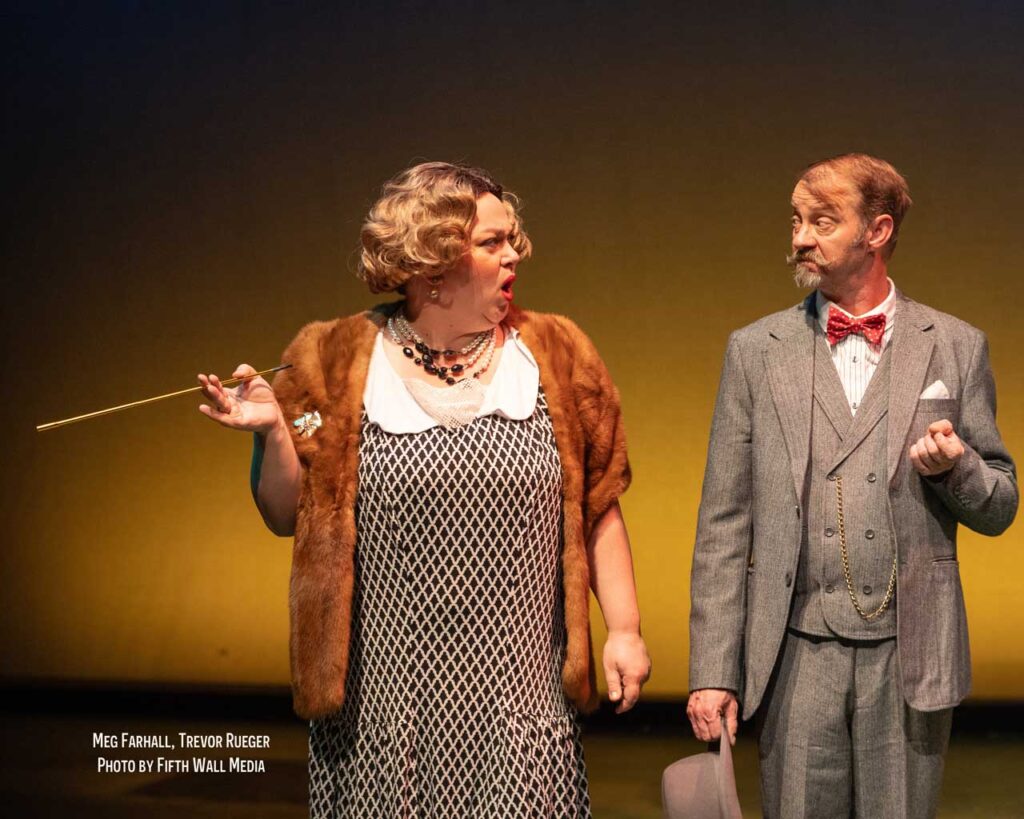
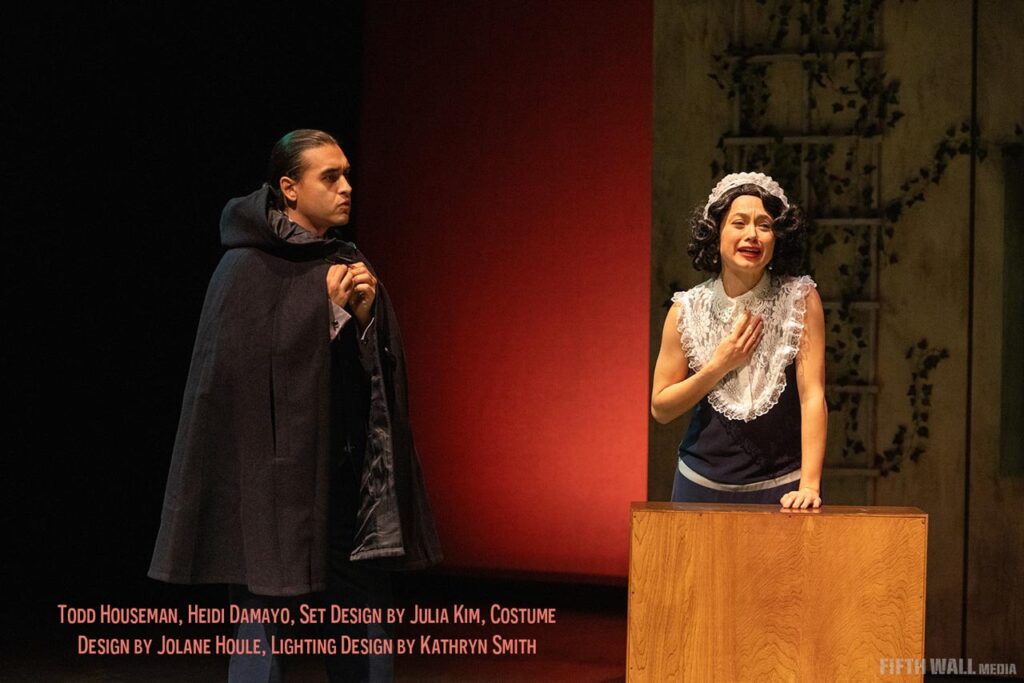
However there is one slight situation which requires a word of explanation. On the night I saw the play the very talented and well known to Calgary audiences Meg Farhall who plays Woman 1 was, due to illness, unable to perform. Stepping into the role was another well known and talented actor from the Calgary Community, Ayla Stephen. I have little doubt that Farhall is absolutely brilliant in the play, and I’m disappointed I didn’t see her performance but rest assured Ayla did a wonderful job and fit into the ensemble perfectly. Of course, we wish Farhall a full recovery and a speedy return to the stage. So, for this review I’ll be talking about Ayla’s performance, but the production stills will be of Meg Farhall.
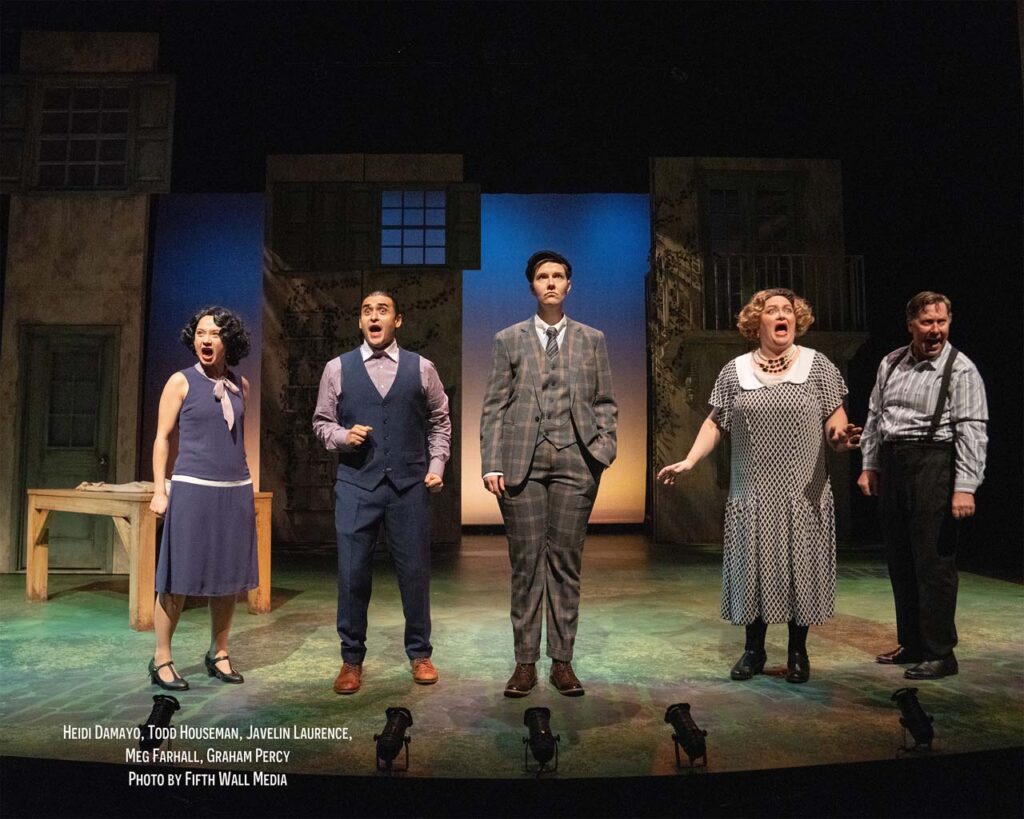
Heidi Damayo, Todd Houseman, Javelin Laurence, Meg Farhall, and Graham Percy in Murder on the Links at Vertigo Theatre. Photo Fifth Wall Media.
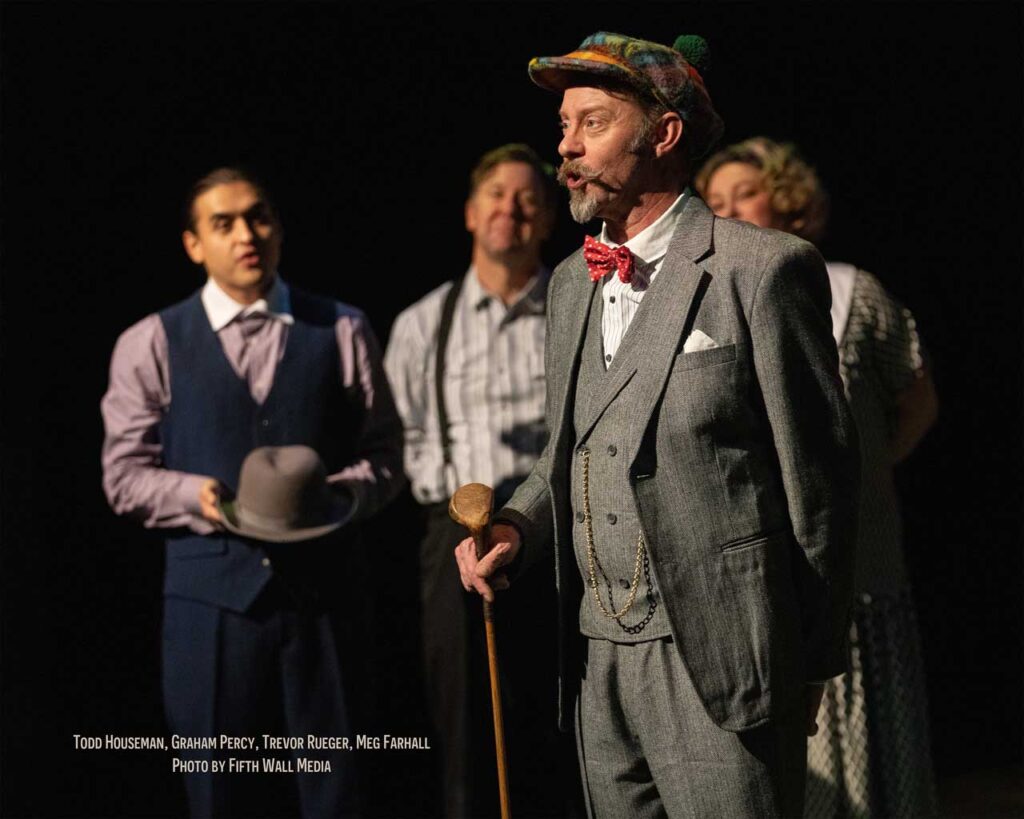
The rest of the cast is composed of the highly versatile and talented Graham Percy, Heidi Damayo, and Todd Houseman. These three bring much fun to the proceedings as they play multiple roles and illustrate a keen sense of comic timing and playful story telling. The play is designed in such a way that one actor plays Poirot, and one actor plays Hastings, and the other four actors play multiple characters.
The story begins when Hastings meets a young lady, played by Heidi Damayo on a train who will only identify herself as Cinderella. Hastings is absolutely charmed by the young lady, but she departs and Hastings heads home and finds his flat mate Poirot restless and disappointed that no new adventure has surfaced to occupy his time and challenge the little grey cells. However, Hastings notices a letter in the post from a Paul Renauld, played by Graham Percy, asking Poirot that he come urgently as Renauld fears that his life may be in danger because of a secret he possesses.
This intrigues Poirot and with the call to adventure answered Hastings and Poirot arrive in France only to discover that Renauld has been murdered! His body was found in a shallow grave on a golf course adjacent to his estate. But of course, everything is not as it seems. And as usual in a Poirot story there are some delightful twists and turns along the way before the true identity and motive of the murderer is revealed.
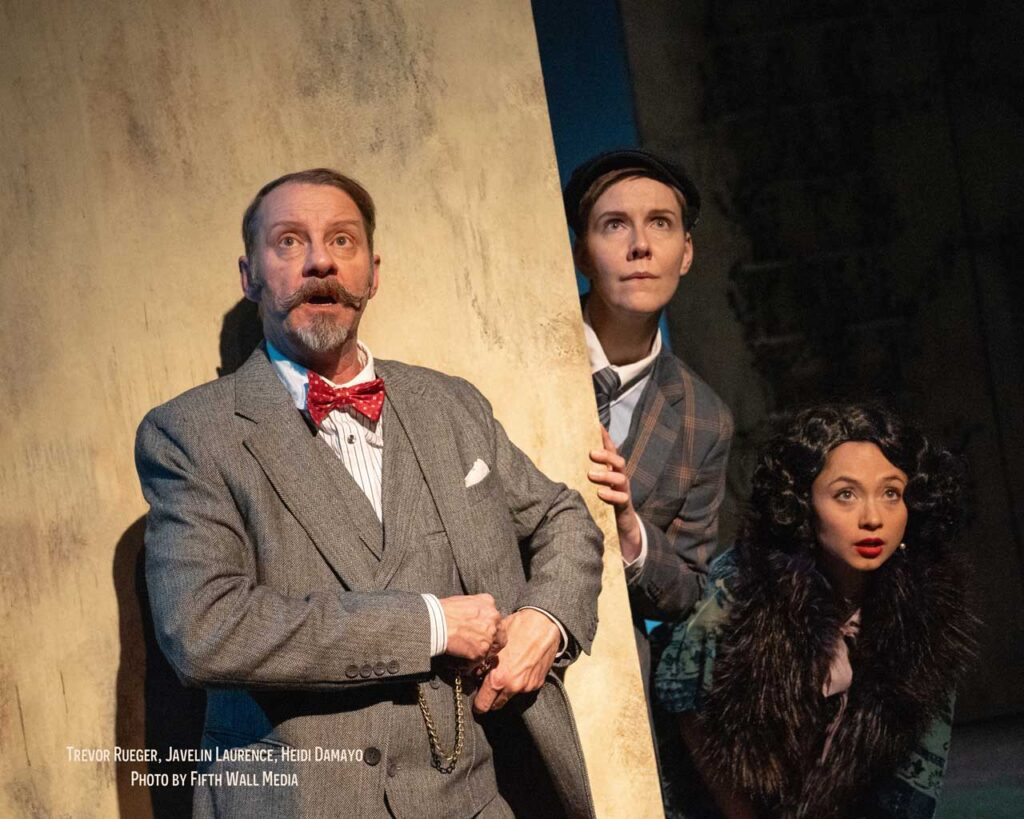
Trevor Rueger, Javelin Laurence and Hedi Damayo in Murder on the Links at Vertigo Theatre. Photo Fifth Wall Media.
The list of suspects includes Paul Renald’s wife Eloise Renald played by Alya Stephen who seems to have an alibi. There is Renald’s son Jack played by Todd Houseman who had argued with his father and made threats against him only days before. And there is Theodora Van Hoven played by Alya Stephen and Theodora’s daughter Marte Van Hoven played by Heidi Damayo who have recently moved into the neighbouring estate.
Much of the fun in a Poirot mystery comes from the fact that there are always plenty of suspects who have some connection to the murder. In this case that includs the mysterious young lady known as Cinderella and another young woman by the name of Bella Duveen who is also played by Heidi Damayo. Adding to this group of suspects there are a number of other characters including a weepy maid, Renauld’s lawyer, a judge, a station master, and a couple of characters from a previous murder similar to Renauld’s murder who may be connected in some way to the current investigation.
Javelin Laurence, Todd Houseman, Trevor Rueger, Graham Percy in Murder on the Links at Vertigo Theatre. Photo Fifth Wall Media.
Poirot is not the only one investigating the crime. There is the local police Commissary Lucien Bex, played by Graham Percy who is more than happy to have Poirot on the case and marvels as Poirot turns up clue after clue after clue that Lucien’s own men have missed. In addition to Lucien there is Monsieur Girard a detective from the Paris Sûreté, played by Todd Houseman who sees himself equal to if not better than Poirot. The two rivals, decide to make things interesting by making a gentleman’s wager as to who will be first to solve the crime.
In addition to a terrific acting ensemble director Jenna Rodgers has assembled an outstanding design team including set designer Julia Kim, costume designer Jolane Houle, lighting designer Kathryn Smith, and sound designer Tori Morrison who also created additional compositions to add to the original music compositions by Robertson Witmer.
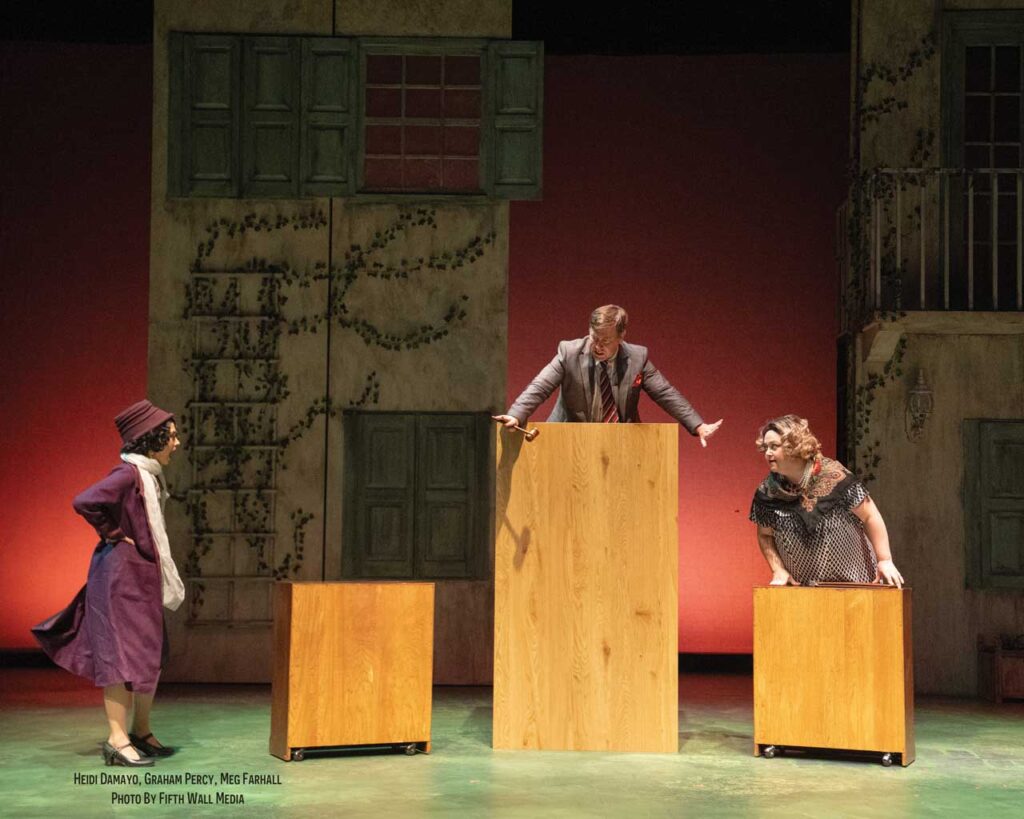
Heidi Damayo, Graham Percy, and Meg Farhall in Murder on the Links at Vertigo Theatre. Photo Fifth Wall Media.
One of the things that keeps the energy up in a play is designing smooth transitions between scenes and in order to accomplish that you have to design a set and style of production that makes the scene changes feel like a dissolve on stage instead of stopping the action, moving things about, and beginning again. When we first take our seats, we are greeted with an empty stage with two very tall panels on either side. The stage is painted in beautiful garden colours that make us feel like we are being transported to a country estate in France where a substantial part of the play takes place.
There are a variety of locations including a golf course, an estate, a garden shed, a court of law, and a train station. To facilitate the various locations a few props are used when needed. Tall flats with a door to enter or exit from and with windows on the second floor through which we can observe the shadows of the occupants in the rooms above are wheeled on and off stage to create the various locations. During these transitions the dialogue and music continue and so the action and energy never stops. Adding to the ambience is the lighting design which leads our eye to particular places on stage and creates a unique feeling for each location.
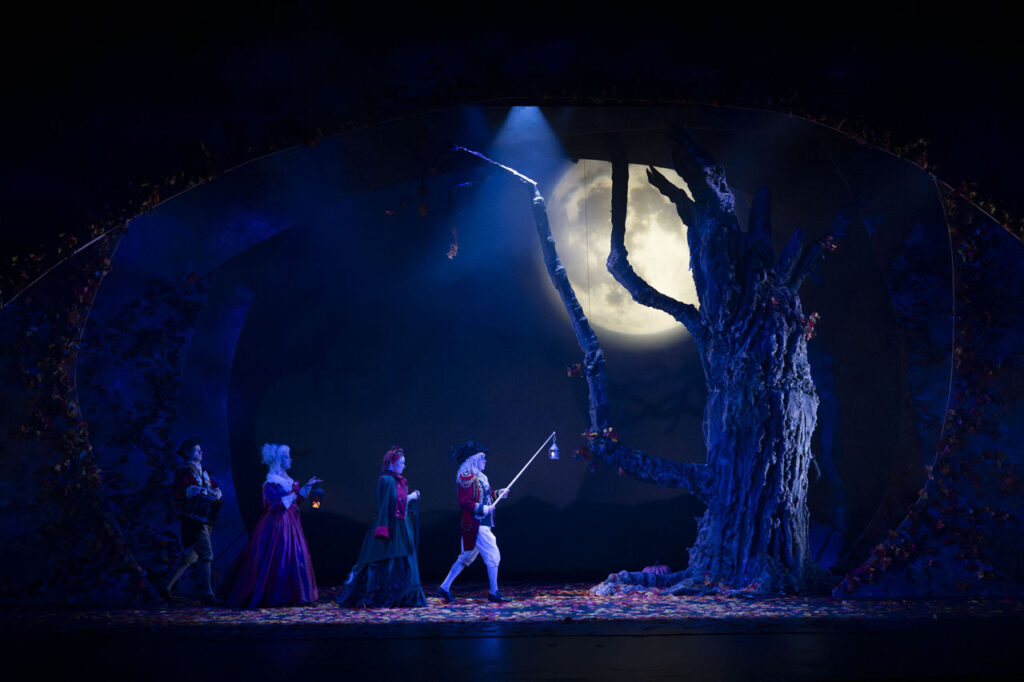
Trevor Rueger, Graham Percy, Todd Houseman, Javelin Laurence, Meg Farhall and Heidi Damayo, in Murder on the Links at Vertigo Theatre. Photo Fifth Wall Media.
The music – and there is plenty of it – is a particularly fun element. It adds to the comic moments by underscoring the sudden reveals, red herrings, and clues and plays up some of the melodrama of the murder mystery genre. The music never overpowers what’s happening on stage or being said by the characters but instead blends perfectly and naturally with the dialogue and action.
You know one of the fun things about a great fictional character is that it gets many interpretations. In fact, part of the joy of Hamlet, Sherlock Holmes, and Felix Unger is not just the written text, but also the unique qualities each actor brings to the character. So, when it comes to Poirot, I love Peter Ustinov’s portrayal of the character and in particular his version of Death on the Nile because he adds an element of comical mischief to his Poirot. I love David Suchet’s Poirot because I think he really embraces the vision that Christie had for the character, and he often seems during his investigations to ponder the morality of mankind. And Kenneth Branaugh’s egg obsessed Poirot is all about the moustache, I think. A bold choice. And moustache aficionados everywhere will be excited to know that there’s a rumour going around that Kenneth Branaugh’s moustache will be returning as Poirot for a fourth time in order to solve The Murder of Roger Ackroyd in a new movie adaptation of Christie’s classic novel.

Todd Houseman, Graham Percy, Trevor Rueger, and Meg Farhall in Murder on the Links at Vertigo Theatre. Photo Fifth Wall Media.
So, the fun of seeing a stage production is we get to see a new interpretation of the character by one of our local actors. Trevor Reuger’s performance as Poirot is a delight. Trevor is a master of comedy and like most good comic actors he also has a talent for the dramatic and he’s able to be serious when needed and playful when needed. Yes, his Poirot is obsessed with order but his drive and determination to arrive at a solution is what makes him so much fun to watch and he is often two or three steps ahead of everyone else.
Javelin Laurence as Hastings brings a feeling of immediate trust and likability to their portrayal of Hastings. Much of the play has Hastings and other characters delivering narration directly to the audience and Laurence brings a charm and slightly naive honesty to their interactions with both the audience and other characters. But that can be forgiven because Hastings is a bit of romantic and their encounter with Cinderella has left them with hopes and feelings that we’ve all felt sometimes when we’ve had a brief encounter with someone and there’s been a little spark of interest between us.
Trevor Rueger, Javelin Laurence, and Meg Farhall in Murder on the Links at Vertigo Theatre. Photo Fifth Wall Media.
The rest of the cast is just as marvelous and its so much fun to see them playing off each other and finding both the comedy and the mystery in the play. Whether she’s playing a weeping maid or the mysterious and brash and full of life Cinderella Heidi Damayo is a joy to watch. She knows how to turn a phrase or give a look to the audience that delivers a laugh or a more mysterious and sinister message.
Ayla Stephen can play big bold characters and Theodora Van Hoven the new neighbour is a big flamboyant and commanding woman who is clearly used to getting what she wants and she’s not afraid to do battle with Poirot or anyone else who stands in her way. In contrast to this powerhouse Ayla plays Eloise Renald the loving and grief-stricken widow with a sincere and emotional honesty.
Meg Farhall and Trevor Rueger in Murder on the Links at Vertigo Theatre. Photo Fifth Wall Media.
Graham Percy brings an adoring fanboy quality to his portrayal of Commissary Lucien Bex who I wouldn’t be surprised to find out has a poster of Poirot on his study wall. Percy contrasts that characterization with some wonderful deadpan moments as he plays other characters including the grounds keeper, a train agent, and a front desk clerk.
Todd Houseman’s portrayal of Monsieur Girard from the Paris Sûreté has a delightful arrogance and cheerful pomposity that contrasts nicely with his portrayal of the emotional and fiery son Jack who is one of the main suspects in the murder. Houseman also portrays the family lawyer, and he physically feels very much like a snake as he slithers in and slithers out of scenes providing Poirot with the latest version of Paul Renauld’s will.
Todd Houseman and Heidi Damayo in Murder on the Links at Vertigo Theatre. Photo Fifth Wall Media.
There are two particularly delightful parts to Steven Dietz’s inventive script that I’m going to share with you because telling you about them doesn’t dimmish how fun they are to watch, and I think they are in fact a huge drawing card that makes the evening memorable.
Since this is a cast playing multiple roles, situations arise where the actor playing one of their roles is required to play one of their other characters at the same time. For example, at one point in the play when Todd Houseman is playing Jack the son of the murder victim, he is suddenly required to also play Inspector Girard and interrogate Jack. Houseman’s quandary is shared by other cast members as they too are asked at times to double up and the resulting solutions the actors come up with results in plenty of laughter and fun.
Trevor Rueger, Heidi Damayo, Graham Percy, Javelin Laurence, Todd Houseman, and Meg Farhall in Murder on the Links at Vertigo Theatre. Photo Fifth Wall Media.
This is Agatha Christie so – yes, the plot does get complicated. There are always a lot of characters to keep track of and motives to sort out and all these characters are usually lying about who they are, where they were, and what they know. So, to help the audience understand exactly what’s going on Poirot enlists the rest of the cast and a bunch of bowling pins dressed in little costumes that match the costumes of the characters in the play to help explain what we know so far. Needless to say, not only do we clarify the case and the suspects and their motives, but we also get to enjoy a lot of good laughs along the way.
Murder on the Links at Vertigo Theatre has all the zany fun of a play like Arsenic and Old Lace but still retains all the elements we’ve come to expect from a satisfying and puzzling mystery. Director Jenna Rodgers has worked her magic by gathering together a talented group of actors and designers who bring to life an inventive and clever script by Steven Dietz that makes for a fun and entertaining evening at the theatre.
Murder on the Links runs at Vertigo Theatre until Saturday December 21st with matinee performances on Saturday and Sunday at 2:00 PM and evening performances from Tuesday to Saturday at 7:30 PM. Single tickets start at $30 and are available by calling the Vertigo Theatre Box Office at 403.221.3708 or online at vertigotheatre.com.
Karyssa Komar, Heather Pattengale, Seana-Lee Wood, Nathan Schmidt, and Mark Kazakov in the Rosebud Theatre Production of Christmas on the Air. Photo Morris Ertman.
Christmas on the Air at Rosebud Theatre is a charming way to spend an evening celebrating the Christmas spirit along with a talented cast in a light-hearted and song-filled production.
It’s Christmas Eve 1949 and we are witness to and participants in CKOL’s annual Christmas Eve radio program which consists of familiar songs and stories. When we first arrive at the Rosebud Theatre Opera House to take our seats Danny “the kid” Frank, played by Mark Kazakov is buzzing about making final adjustments and greeting people as they take their seats.
Meanwhile, Danny’s father, Percival B. Frank, played by Nathan Schmidt, seems to be lacking some Christmas cheer as he takes on the burden of producing and hosting the show. His wife Yolanda Frank, played by Heather Pattengale, just wants Percival to relax a bit and enjoy some of the spirit of the season and maybe trust their son to run things and take on some of the burden.
Heather Pattengale and Nathan Schmidt in the Rosebud Theatre Production of Christmas on the Air. Photo Morris Ertman.
Adding to this radio family is Sylvia White, played by Seana-Lee Wood, who hosts the radio station’s cooking show and is the featured musician accompanying everyone on the piano or joining the cast for some seasonal harmonies.
The final member of the ensemble is Kitty McNally, played by Karyssa Komar, the new weather girl who has caught the eye and attention of Danny but unknown to everyone is a single mom. Unable to find a sitter on Christmas Eve Kitty has opted to bring her baby to the station hoping he’ll sleep through the show.
Director Ian Farthing works with his cast to keep the action moving and his design team which includes scenic and costume designer Hanne Loosen, and lighting designer Becky Halterman have transformed The Rosebud Stage into the radio studio where the action takes place.
Heather Pattengale, Nathan Schmidt, Karyssa Komar, and Mark Kazakov in the Rosebud Theatre Production of Christmas on the Air. Photo Lauren Hamm.
The set is cheerful with a forest of Christmas Trees in the background and the CKOL sign above the stage featuring the radio station’s logo and motto, “CKOL Radio. The people hoodoo great music.”
One side of the stage is reserved for the grand piano used by Sylvia throughout the evening and on the other side of the stage is the sound effects table used to add sounds and highlight emotional moments during the show.
The stage is raked and provides a clear view of the action as characters move from performing in front of the mics to carrying on more private conversations about their personal lives — like perhaps that baby I mentioned earlier who might deserve a word or two of reflection and explanation.
Mark Kazakov in the Rosebud Theatre Production of Christmas on the Air. Photo Morris Ertman.
By gum, I liked Mark Kazakov as Danny. Mark has an infectious enthusiasm and a comic body that reminds me of the wonderful Dick van Dyck’s physical aptitudes. Kazakov brings a fun energy and youthful exuberance to his portrayal of Danny who is basically a loveable, good-hearted, goof.
Nathan Schmidt as Danny’s father P.B. Frank is a more solum soul. He’s a kind man who dives into his work even on Christmas Eve in order to cope with a personal loss that he and his wife Yolanda share. Heather Pattengale as Yolanda is always a delight on stage and she’s often teamed up with Nathan as her significant other and the two together always bring a deep sense of truth to the story. These are both talented actors who never disappoint and I’m always thrilled whenever I get a chance to see them on stage.
Heather Pattengale, Seana-Lee Wood, Nathan Schmidt, and Karyssa Komar, in the Rosebud Theatre Production of Christmas on the Air. Photo Lauren Hamm.
Seana-Lee Wood adds her immense musical talent to the production while also bringing something familiar to her portrayal of Sylvia in the story. We all know people like Sylvia. Good people who find themselves alone in later life or on Christmas Day and yet still have plenty of love and support to give to the world. In one particularly fun segment of the show, Sylvia demonstrates on radio and live for the studio audience how to prepare a festive Christmas yule log. It’s a bright fun moment in the play and Seana-Lee reveals to us that despite being alone Sylvia still has a zest for life and joy in her heart.
Being a mom is never easy. Being a single mom is hard. Being a single mom in 1949 harder still. And Karyssa Komar shows us how Kitty feels under threat that once she reveals herself to be an unwed mother, she’ll lose her job and Danny’s affections. That’s certainly a risk and Komar makes us sympathize with her situation, but of course, with this being a Christmas story there might yet be some hope of a happy ending.
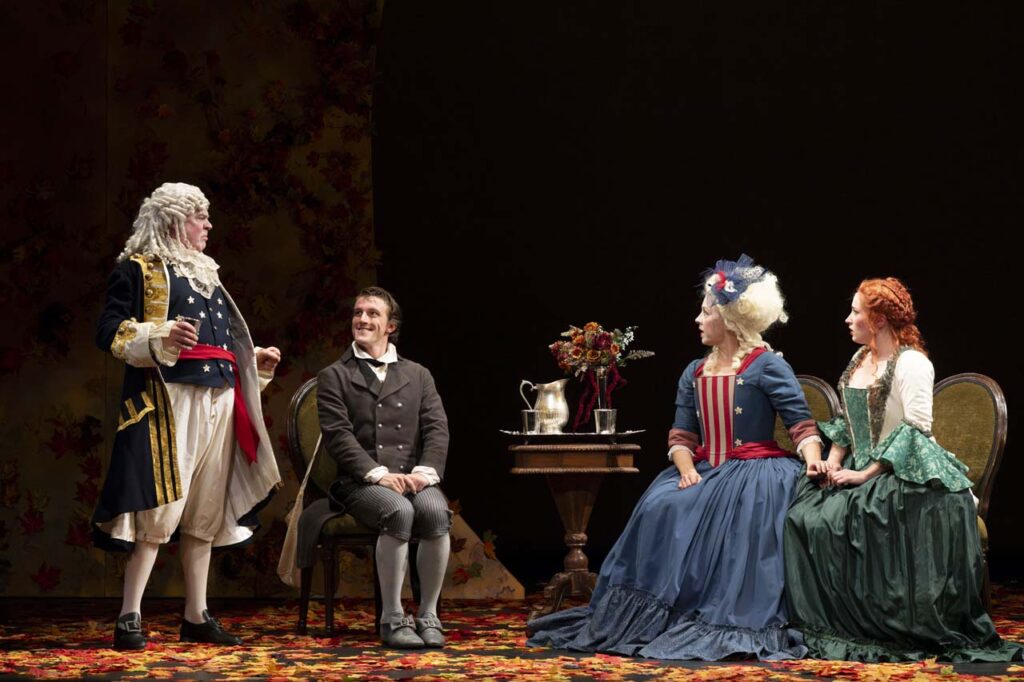
Nathan Schmidt, Heather Pattengale, Karyssa Komar, and Mark Kazakov in the Rosebud Theatre Production of Christmas on the Air. Photo Morris Ertman.
How would I describe this show? It’s sort of like showing up on Christmas morning and playwright Lucia Frangione has left us with a bunch of gifts under the tree. One gift might contain a familiar Christmas Carol such as O Christmas Tree, Joy to the World, or O Come All Ye Faithful or a more recent Christmas tune like Blue Christmas, Santa Claus Is Comin’ To Town, or I’ll Be Home for Christmas. Another oddly shaped gift might contain a favourite Christmas story such as The Gifts of the Magi by O. Henry or Clement Parker Moore’s A Visit from St. Nicholas complete with sound effects.

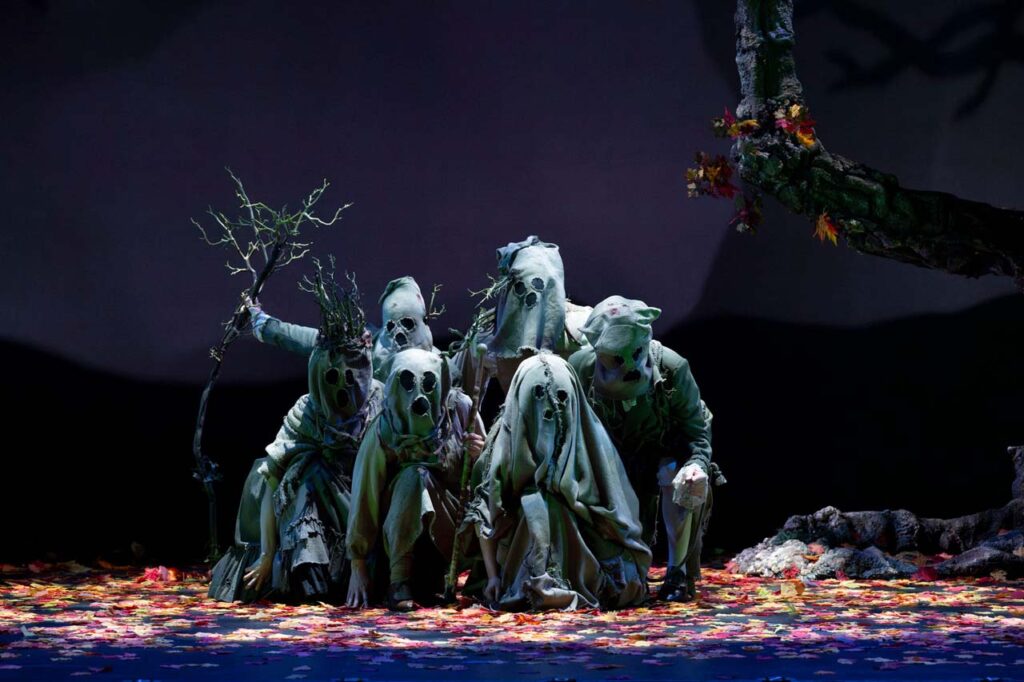
But just like Christmas day the big gift isn’t what’s under the tree it’s who you share the day with. The true gift of Christmas is connecting with our family and connecting with our fellow man and making the world a better place. That’s the real gift of theatre and the arts. They connect us. They help us to focus on our common humanity. And this Christmas you can share your hopes for peace on earth and goodwill towards all men with the good folks at CKOL Radio who just want to bring some much needed Christmas Cheer to the world.
Karyssa Komar, Heather Pattengale, Seana-Lee Wood, Nathan Schmidt, and Mark Kazakov in the Rosebud Theatre Production of Christmas on the Air. Photo Morris Ertman.
Christmas on the Air runs at Rosebud Theatre until Sunday, December 22nd with matinee performances from Wednesday to Saturday at 2:00 pm and evening performances on Friday and Saturday at 8:00 pm. Make sure you arrive at least two hours before curtain in order to enjoy Chef Mo’s delicious Christmas on the Air buffet featuring roasted turkey with cranberry sauce, butter chicken with saffron basmati rice, and sticky toffee pudding with caramel & butterscotch sauce and vanilla ice cream. Tickets can be purchased at www.rosebudtheatre.com or by phone at 1-800-267-7553.
Christopher Hunt, David Trimble, Shaun Smyth, Paul Gross and Chirag Naik in Alberta Theatre Projects’ production of The Seafarer. Photo by Benjamin Laird. Set & Props Design by Hanne Loosen. Costume Design by Ralamy Kneeshaw. Lighting Design by Anton deGroot.
Alberta Theatre Projects has set sail on its 50th Anniversary Season and the first leg of this voyage is the darkly comic and booze-driven production of The Seafarer by Conor McPherson starring Paul Gross in a triumphant return to the Calgary stage.
The play is partly inspired and named after The Seafarer a 124-line Old English poem told from the point of view of a sailor who is reminiscing on the hardships of life on a wintery sea. The oldest written version of the poem is from the tenth century and it was first translated into modern English by Benjamin Thorpe in 1842. I did go in search of that translation and I’m happy to say I found it lurking among the other dusty archives of the Internet. There are other translations of course including Ezra Pound’s 1911 adaptation and the 1970 translation by Richard Hamer that Conor McPherson references. These are all fascinating examples of how different and similar translations can make us feel since translations are always a product of their author and time.
The play also deals with some supernatural elements and in an interview on Theatre Talk with Susan Haskins and Michael Riedel from the New York Post first broadcast in 2007 McPherson while talking about the play said, “I think that life can be frightening sometimes, and I suppose I’ve always been fascinated by the supernatural because I always think it opens a door for us into a way of exploring our own darkest fears where we feel at our most loneliest and our most alienated. So, for me, people who are haunted or dealing with something which is coming from the unknown is always very powerfully dramatic. And I’ve always found that audiences tend to really tune in and really become intensely absorbed by stories to do with that. Then when you create characters around that who we care about and who are trying to deal with this stuff it can become quite potent because live theatre is a magical place and it can have an extraordinary effect.”
Paul Gross and Shaun Smyth in Alberta Theatre Projects’ production of The Seafarer. Photo by Benjamin Laird. Set & Props Design by Hanne Loosen. Costume Design by Ralamy Kneeshaw. Lighting Design by Anton deGroot.
The story takes place in Dublin on Christmas Eve and revolves around James “Sharky” Harkin and his older brother Richard Harkin, a recently blinded, hard-drinking alcoholic played by Christopher Hunt. Determined to make a new start of things Sharky played by Shaun Smyth has returned home to care for his older brother and at the beginning of the play is two days sober and struggling to remain so.
Adding to the Christmas chaos is Richard’s drinking buddy Ivan Curry played by David Trimble. Ivan got hammered the night before and ended up spending the night at Richard’s place too drunk to go home and too scared to face the wrath of his wife Karen.
Joining this ill-fated trio is Nicky Giblin played by Chirag Naik who Sharky resents because Nicky has managed to woo and is now living with Sharky’s ex Eileen. Nicky who refuses the hard stuff but is never without a beer in his hand has spent the day on a pub crawl with a well-dressed mysterious stranger played by Paul Gross by the name of Mr. Lockhart.
Lockhart and Nicky find themselves spending Christmas Eve along with the others doing some heavy drinking and playing poker. But of course, there’s more to the story and more at stake than what at first meets the eye. Who exactly is this Mr. Lockhart and what exactly does he want?
Christopher Hunt, David Trimble, Shaun Smyth (seated), Chirag Naik and Paul Gross in Alberta Theatre Projects’ production of The Seafarer. Photo by Benjamin Laird. Set & Props Design by Hanne Loosen. Costume Design by Ralamy Kneeshaw. Lighting Design by Anton deGroot.
To bring the story to life director Peter Pasyk has assembled a talented cast of actors and a first-rate design team composed of set designer Hanne Loosen, lighting designer Anton deGroot, sound designer Kathryn Smith, and costume designer Ralamy Kneeshaw.
The action of the play takes place in Richard’s rundown basement. The decor is definitely pub-inspired and the room looks like it hasn’t had a coat of paint since Vatican II. There’s a dart board along the back wall and a row of beer coasters decorating the beam that travels nearly the length of the room and a rather steep staircase leading to the basement from the upper floor that proves a challenging and comic obstacle to those who might have had one or two drinks too many.
The lighting and sound are natural feeling but when needed add an extra charge to certain key moments on stage such as when Lockhart reveals to Sharky the reality of his life and the pain he endures in a beautifully written and deeply moving monologue. It’s an entrancing moment and harkens back to the title and poem for which the play is named.
Paul Gross and Shaun Smyth in Alberta Theatre Projects’ production of The Seafarer. Photo by Benjamin Laird. Set & Props Design by Hanne Loosen. Costume Design by Ralamy Kneeshaw. Lighting Design by Anton deGroot.
This is a naturalistic play with hints of the supernatural and so the clothing feels well lived in as does the basement and this is the world our ensemble gets to play in. Christopher Hunt is marvellous as the acerbic older brother Richard who is constantly abusing Sharky but when he feels his brother might be in some kind of danger exhibits a sense of concern and brotherly love. Richard’s character drives a lot of the action and speaks a lot of the lines and so you need someone of Hunt’s calibre to carry that weight and drive the action forward.
Shaun Smyth’s Sharky is a deeply haunted man fighting to stay sober and suppress his quick-to-violence temper. Sharky is on edge, and you sense from Smyth’s performance that this is a battle Sharky has fought and lost many times before. There’s a good portion of the second act where Sharky is silent, and his plight can only be conveyed through nonverbal means. The stakes are high and his resolve to stay sober is under siege and you feel the tension and fear in the way Sharky moves about the stage like a trapped animal not yet willing to accept his fate.
David Trimble’s Ivan is adrift and hasn’t been sober a day in the last twenty years, I’m guessing. What makes Trimble’s portrayal so enchanting is a sense that if it wasn’t for the booze this guy would probably be doing okay. He’s not a mean drunk. And I like that. Often in plays the drink brings out the demons but there are those who in real life simply become happier versions of themselves. Unfortunately, the tragedy in Ivan’s case is that he drinks to excess and has become trapped by the bottle.
Christopher Hunt and Shaun Smyth in Alberta Theatre Projects’ production of The Seafarer. Photo by Benjamin Laird. Set & Props Design by Hanne Loosen. Costume Design by Ralamy Kneeshaw. Lighting Design by Anton deGroot.
Chirag Naik as Nicky feels like the one who still hasn’t quite fallen as deep into the darkness and maybe even has a chance of escaping the hell these others find themselves in. Naik portrays Nicky with a sense of faint optimism and hope that seems somewhat absent from the others but when he should be home with Eileen, he is instead spending the night playing poker and gambling away all his money and so he too slides further down the slippery slope of addiction and risks turning his entire life into ruins.
Rounding out the cast and headlining the show is the multi-talented actor, director, and producer Paul Gross who last appeared on the Calgary stage forty-two years ago in Theatre Calgary’s production of George Bernard Shaw’s Mrs. Warren’s Profession and John Murrell’s Farther West. Tall, lean, and commanding with a mane of long white hair Gross is able to embed his portrayal of Mr. Lockhart with a sense of mystery, danger, and sorrow. Is he the villain and someone we should fear and despise or is he the tragic hero whose fate is undeserved? Or is it that simple? Could he possibly be both? This is clearly a tortured soul, and Gross is able to convey Lockhart’s broken-hearted existence in a rich and compelling performance.
And yet despite the play dealing with dark topics and deeply flawed characters, there’s a great deal of laughter and fun. That’s because director Peter Pasyk has crafted a production where the cast feels so natural in their performances that it really does feel like we’ve simply dropped in and are watching the antics of a group of real-life drinking buddies stumbling through life and celebrating the Christmas season.
Paul Gross and Shaun Smyth in Alberta Theatre Projects’ production of The Seafarer. Photo by Benjamin Laird. Set & Props Design by Hanne Loosen. Costume Design by Ralamy Kneeshaw. Lighting Design by Anton deGroot.
Life as a stormy sea is certainly a relatable concept. We often find ourselves facing difficult times at various points in our lives. The loss of a job. A change in a relationship. And of course, we hurt others and are in return hurt by them. Misunderstandings. Words said in anger. Things done that can’t be taken back. Sometimes when trying to smooth these stormy seas some of us turn to drink. And we use that numbing influence to help us cope with the loneliness and pain of living and our inability to admit that we are often the cause of our own misery and broken lives.
Yeah, sure you can meditate and do yoga to deal with life. That’s a healthy choice, I’ll admit. You can do a detox and take a course on maximizing your life and setting goals and achieving your dreams, but I don’t think that would be of much interest on the stage. I’ll leave the toxic positivity to the self-help gurus and charlatans hawking their supplements and head to the theatre where the entire experience of humanity is laid bare not a false philosophy of only seeing the positive.
The theatre doesn’t just look at the good and the hopeful. It looks at the sinister and at our feelings of despair. Because there are two sides to humanity. Two sides to existence. There is joy and there is sadness. And whether or not we’re spending the evening with estranged brothers Austin and Lee in Sam Shepard’s True West or spending the night with the acerbic Martha and George in Edward Albee’s Who’s Afraid of Virginia Woolf? or staying up all night with Richard and Sharky and their drinking buddies in Conor McPherson’s The Seafarer there is something deeply satisfying about the experience. These may not be the lives we’re living but as human beings, we see something of ourselves within these tragic figures and must acknowledge that there but for the grace of God go I.
***
Alberta Theatre Projects has come through its own rough seas over the last few years and now Artistic Director Haysam Kadri and Executive Director Peita Luti along with their team are at the helm helping to make sure that there is smooth sailing ahead. This Fiftieth Anniversary Season has begun with a deeply satisfying and memorable production of The Seafarer by Conor McPherson that audiences can rest assured indicates a return to quality drama, laugh-out-loud comedies, and a range of plays to satisfy Alberta Theatre Projects patrons and friends.
The Vertigo Theatre Production of The Woman in Black starring Joe Perry and Andy Curtis. Set Design by Scott Reid, Costume Design by Hannah Fisher, Lighting Design by Narda McCarroll. Photos by Fifth Wall Media
“I’d always known in my heart that that experience would never leave me. That it was woven into the fibers of my being. Ah yes, I had a ghost story. A true story. A story of haunting and evil. Fear and confusion. Horror and tragedy. But it was not a story to be told around the fireplace on Christmas Eve.”
The Woman in Black Adapted for the stage by Stephen Mallatratt
***
Vertigo Theatre’s Production of The Woman in Black directed by Jamie Dunsdon and starring Joe Perry and Andy Curtis is a tension-filled journey into fear and terror. Yes, it’s a ghost story but I think it’s more than just an encounter with the supernatural. If the play had nothing more to offer us than a few chills and thrills, I don’t think it would have run for 33 years and racked up 13,232 performances to make it the second longest-running non-musical play in London’s West End.
No, I think the appeal of the play comes from the fact that Arthur Kipps, the main character in the story, through no fault of his own finds himself in a life-and-death struggle with forces beyond his control. That is what makes the story so relatable. In our own lives we all encounter such forces but usually in the form of disease or accident and those encounters can leave us fighting for our survival or can change the trajectory of our lives. So, for me, that’s a key component as to why I enjoyed the play so much. I can identify with Kipps. What man or woman or person hasn’t found themselves in a situation where the forces of nature or the decisions of others whom we have no control over impacts our lives and all we can do is man the lifeboats and ride out the storm.
The Vertigo Theatre Production of The Woman in Black starring Joe Perry and Andy Curtis. Set Design by Scott Reid, Costume Design by Hannah Fisher, Lighting Design by Narda McCarroll. Photos by Fifth Wall Media
The Woman in Black is based on the 1983 novel by British author Susan Hill and adapted for the stage by Stephen Mallatratt and was first staged in 1987 at the Stephen Joseph Theatre in Scarborough before premiering in London’s West End in 1989. The play takes place in a Victorian Theatre where Arthur Kipps an older gentleman played by Andy Curtis has hired a younger actor played by Joe Perry to help him tell his story. Kipps is troubled. In agony. Haunted. The telling of his story he hopes will purge his life of the horrible experience he encountered as a young man. The Actor is only too happy to help him stage the story and tackles the telling of it with enthusiasm. To make the telling of the story work the Actor takes on the role of Kipps and Kipps using his memory of those he encountered portrays all the other characters.
The story is a simple one. A reclusive elderly widow by the name of Mrs. Drablow has died and Kipps is sent to the remote town of Crythin Gifford to attend the funeral and sort through her papers and settle her estate. The Estate is the fog-shrouded Eel Marsh House that can only be reached from the mainland at low tide along a narrow causeway. A local man by the name of Keckwick drives Arthur out to the estate in a pony and trap. At the estate, Kipps discovers a locked room, a family graveyard, and personal letters from Jennet Humfrye the sister of Mrs. Drablow that help shed light on the mysterious Woman in Black. I don’t want to say too much more about the plot as I think that would destroy the mystery for those who don’t know the full story and a lot of the fun as an audience member is the slow reveal of who the Woman in Black is and what terrible things have been visited upon the townsfolk of Crythin Gifford.
The Vertigo Theatre Production of The Woman in Black starring Joe Perry. Set Design by Scott Reid, Costume Design by Hannah Fisher, Lighting Design by Narda McCarroll. Photos by Fifth Wall Media
The sound design by Andrew Blizzard, set design by Scott Reid, and lighting design by Narda McCarroll are blended perfectly in a way that adds to the mystery and tension. Along with these design elements wonderful performances by Joe Perry and Andy Curtis help deliver plenty of spine-tingling chills. In his notes to the play Stephen Mallatratt says, “Darkness is a powerful ally of terror, something glimpsed in a corner is far more frightening than if it’s fully observed. Sets work best when they accommodate this – when things unknown might be in places unseen.” And I’m happy to report that this production of The Woman in Black takes that advice to heart.
Darkness like silence is a tool for creating emotion and engagement. And the fun thing about creating suspense is that done right you invite the audience to use their own imagination as part of the experience. Who hasn’t woken up in the dead of night and glanced to a corner in the bedroom and been seized by the sudden fear that something is lurking in the corner? A good ghost story uses those natural instincts to create a terrifying experience. And more than once during the play audience members screamed and afterwards a nervous wave of laughter washed over the theatre. And that’s because we buy into the story and that indicates just how effective the lighting is at creating mystery and suspense and how the sound sets the scene and how perfectly designed the set is to allow for events to unfold.
The Vertigo Theatre Production of The Woman in Black starring Joe Perry and Andy Curtis. Set Design by Scott Reid, Costume Design by Hannah Fisher, Lighting Design by Narda McCarroll. Photos by Fifth Wall Media
There’s also a chemistry between Joe Perry and Andy Curtis that makes the play work. Curtis has such a rich and easy voice and he feels so centred on stage that he draws us into the story. Perry captures the enthusiasm of the actor as he dives into his character blissfully unaware of the danger he is putting himself in as he brings the Woman in Black’s story to life. This really is an ensemble production where every choice from the acting to the costumes to the setting to the direction combine in such a way that we are swept into another world where our hero finds himself in a terrifying and life-altering experience.
In our own lives, we may not face malevolent spirits, but we certainly do encounter an unexpected illness or betrayal or financial setback at times in our lives. So even though the play deals with supernatural evil we understand the play because we have encountered such feelings and emotions in our own lives. Joy, failure, fear, hope – emotions are the tapestry of life and director Jamie Dunsdon is a master at creating emotionally compelling theatrical experiences and her production of The Woman in Black provides audiences with a safe way to experience something terrifying and emotionally satisfying because the truth is we go to the theatre as much to experience fear and terror as laughter and joy.
Karen Johnson-Diamond and Griffin Cork in the Rosebud Theatre Production of For The Pleasure of Seeing Her Again. Photo Morris Ertman.
Rosebud Theatre presents the touching and humourous memoir For the Pleasure of Seeing Her Again by Michel Tremblay directed by Morris Ertman and starring Karen Johnson-Diamond and Griffin Cork.
***
How the story ends and how the story begins are often the most memorable parts of a story. How does Citizen Kane begin and end? If you’ve seen the movie, I guarantee you the opening images and ending images are clear in your mind.
Beginnings are easy. You start out with a mystery. You make a promise. You hook the audience, and the ending is the payoff. It’s where you fulfill the promise and solve the mystery. After all, Hercule Poirot doesn’t solve the Murder on the Orient Express in the middle of the novel, and he doesn’t end the story by going, “Unfortunately, the little grey cells can’t figure this one out. I’m stumped! Anyone else have a solution?” No, we’re satisfied when a story starts well and ends in a satisfying way. The ending brings us a sense of completeness. And so, I’m happy to report that For the Pleasure of Seeing Her Again is a touching and humorous memoir filled with plenty of laughs and a few tears that begins well and has a very satisfying and memorable ending.
Karen Johnson-Diamond and Griffin Cork in the Rosebud Theatre Production of For The Pleasure of Seeing Her Again. Photo Lauren Hamm.
“Tonight, no one will rage and cry: ‘My Kingdom for a horse!’ No ghost will come to haunt the battlements of a castle in the kingdom of Denmark where, apparently, something is rotten.” So says our narrator at the beginning of For the Pleasure of Seeing Her Again. He has a great many more examples and much of the fun in this opening monologue is following the references before he explains that tonight the show is going to be about his mom – Nana. It will be an evening not dedicated to the iconic bigger than life characters of the stage but instead, “What you will see tonight is a very simple woman, a woman who will simply talk…. I almost said, about her life, but the lives of others will be just as important: her husband, her sons, her relatives and neighbours. Perhaps you will recognize her. You’ve often run into her at the theatre, in the audience and on stage, you’ve met her in life, she’s one of you. She has existed throughout the ages and in every culture. She always has been present and always will be. I wanted the pleasure of seeing her again. The pleasure of hearing her. So she could make me laugh and cry. One more time, if I may.”
And that I think is one of the reasons For the Pleasure of Seeing Her Again is such a joy to watch. It’s about a simple woman who in her own way is a bigger than life character. I love good solid memorable stories about real people and Rosebud Theatre and Morris Ertman are masters at bringing stories about common people to life. And what makes this production particularly fun and exciting is the fact that real life mother and son, Karen Johnson-Diamond and Griffin Cork are cast in the play. “I auditioned for a show directed by Morris Ertman twenty-six years ago,” says Johnson-Diamond, “and he offered me the role. I ended up turning it down because it was out of town and my son Griffin was only two years old. I’ve regretted that for years. Fast forward to now, and I’m finally performing on the Rosebud stage, I get to act with my son, and I’m being directed by the legendary Morris Ertman. So many bucket list wishes fulfilled.”
Karen Johnson-Diamond and Griffin Cork in the Rosebud Theatre Production of For The Pleasure of Seeing Her Again. Photo Morris Ertman.
Griffin who has become a familiar face on the Rosebud stage having most recently appeared in Rosebud Theatre’s production of Chariots of Fire is also checking off a few bucket list items. “I fell in love with Michel Tremblay’s plays in university when I wrote an extra-credit essay on a few of his works, including For The Pleasure of Seeing Her Again. I went to my mom after I graduated, and I was like, ‘I don’t know if you know when you’re going to retire, but before you do, we need to do this play.’ Never did I think I would be getting the chance so early in my career, and I’ll be forever grateful to Morris for the opportunity.”
The play is written by celebrated Québécois novelist and playwright Michel Tremblay and translated into English by Linda Gaboriau. The story is broken into a series of scenes between the narrator and his mother Nana. We’re first introduced to Nana when her son is 10 years of age and he’s gotten in trouble with the cops which truthfully was nothing more than a bit of misguided mischief. We soon learn that Nana has a tendency towards exaggeration and melodrama when she tells her son that she will have to live a life of shame brought on her and the family by his criminal behaviour. It is through these vignettes that we learn how Tremblay’s mother instilled in him a love of reading and theatre and story.
Karen Johnson-Diamond and Griffin Cork in the Rosebud Theatre Production of For The Pleasure of Seeing Her Again. Photo Morris Ertman.
Director Morris Ertman has created a terrific production perfectly paced with rich and memorable performances by Karen Johnson-Diamond and Griffin Cork. The setting is simple being composed of an easy chair on one side of the stage where the narrator spends much of his time as his Nana roams and commands the stage.
As a memoir, the play happily breaks the fourth wall. It’s no secret that we are watching a play. In fact, that’s half the fun. The narrator gives us a wink and the occasional aside while Nana goes off on tangents and exaggerated musings about Aunt Gertrude or is in awe of seeing a live television broadcast of a show featuring French Canadian actress Huguette Oligny. It is during this scene in the play where we learn that our narrator is writing for the stage with his mother’s encouragement and support.
I love this play. I love how it begins, and I love how it ends. In fact, I’d say the ending is perfect, but I won’t reveal the ending because I don’t want to ruin it for you. All I’ll say is that for the next few weeks Michel Trembley’s mother will be alive again. She will be telling her stories and teasing her son. Her fury at his shenanigans will rise up. Her love will shine through. And he will give her the gift of being a part of his world by being a part of a play filled with laughter and tenderness that celebrates the loving relationship between mother and son.
Heather Pattengale in the Rosebud Theatre production of The Fever by Wallace Shawn. Photo by Lauren Hamm
This summer Rosebud Theatre presents The Fever by Wallace Shawn directed by Bronwyn Steinberg and starring Heather Pattengale in a show that dives into the complex thoughts and feelings of one woman as she explores questions of privilege and personal responsibility.
Here to give their thoughts about the play are two of my favourite characters: Monty and Theo.
***
THEO: So, what did you think?
MONTY: The roasted Cajun chicken with chipotle BBQ sauce was outstanding. I went back three times.
THEO: I know Chef Mo’s buffet is always delicious, but I want to know what you thought of the play we saw. The Fever.
MONTY: Oh, the play. By Wallace Shawn. The “inconceivable” guy from The Princess Bride.
THEO: That’s right.
MONTY: He co-wrote and starred in the movie My Dinner with Andre.
THEO: He did. Although I don’t know what that has to do with this play.
MONTY: I was just thinking he’d probably love Chef Mo’s buffet.
THEO: Well, who doesn’t love Chef Mo’s buffet?
MONTY: They should do a sequel. My Buffet with Andre.
THEO: Monty, you’re getting off-topic.
MONTY: I’m sorry Theo, my mind does wander. And we did have a terrific and satisfying meal and saw a wonderful production. I loved the play. You know, I got the play out of the library last year and read it. I think it was just after I’d read The Princess Bride. I’d seen The Princess Bride movie but never read the book. So, I read the book. The book and the screenplay are by William Goldman who won an Oscar for writing Butch Cassidy and the Sundance Kid.
THEO: Monty you’re getting off topic again. Let’s talk about the The Fever. We can chat about William Goldman another time. So, first I agree it was a good show. And a real challenge to bring to the stage. It’s all about this woman who has lived a life of privilege and luxury, and she finds herself on a trip to an unnamed country where an oppressive government is killing and torturing its citizens.
MONTY: Which is a real wake-up call for her because she starts to question her position in the world and begins to wonder what her moral obligations are towards other people who haven’t had her advantages.
THEO: You really need an exceptional talent to bring this type of one-person show to life and I’m happy to say that Heather Pattengale does a terrific job of lifting the words from the page and breathing life into the story.
MONTY: Yes, I agree. It’s not a multiple-character monologue. Everything is first person. The great challenge with this sort of material is making the script feel like these are real memories the character is experiencing. It’s an internal monologue that is shared with the audience. I love this type of theatre when it’s done well. And this was well done.
Heather Pattengale in the Rosebud Theatre production of The Fever by Wallace Shawn. Photo by Morris Ertman.
THEO: What did you think of the staging?
MONTY: In the copy of the play I read there’s really no stage directions or setting described. So, I wasn’t really sure what to expect and I’m happy to say that things have been kept simple. So, there’s a lounge chair and table on one side of the stage and a bathroom area which includes a toilet on the other side of the stage and the middle of the stage is left open. Heather moves between these three locations which represent the hotel where she’s staying or her apartment back home and that adds some variety to the staging and is an easy way to establish location.
THEO: Plus, there’s a painted backdrop that feels like the view from a window of a shantytown that reminds us that the play is looking at the divide between people that have and people that have not.
MONTY: And the play basically talks about her life and how she comes to have a deeper understanding about how much of who we are and what we can accomplish is an accident of birth.
THEO: The lighting and sound design helped to establish mood and emotion and was used sparingly at key moments which I think makes it more effective. Of course, all of this was brought together by Bronwyn Steinberg who directed the show.
MONTY: She’s very talented.
THEO: She is. And a good director is going to guide an actor in such a way that the emotion is genuine and clear so that the audience can relate to the story. Bronwyn and Heather make a good team and it’s hard to know who contributes what to a performance if you’re not in the rehearsal hall but for an audience that doesn’t matter. What matters is that when you experience the show you understand the emotional journey and how experiences the character is going through cause the character to come to a revelation or deeper understanding of themselves and the world.
MONTY: I agree. And let’s not forget Bronwyn just won a Betty Mitchell award for Outstanding Direction of a play for the Lunchbox Theatre Production of The Dark Lady.
THEO: And Heather won a Betty Mitchell award for Outstanding Supporting Performance in a drama for the Theatre Calgary production of Selma Burke that they did in association with Alberta Theatre Projects.
MONTY: It’s always nice to get recognition for the work.
THEO: So, what do you say? Thumbs up?
MONTY: Yes, thumbs up.
THEO: And don’t forget this summer Rosebud Theatre is also running Little Women – The Broadway Musical. I’ve heard good things.
MONTY: Little Women?
THEO: Yes.
MONTY: How little?
THEO: The women aren’t little they’re just young women.
MONTY: Oh, I see. Well, the title is rather misleading then, don’t you think? I was sort of hoping it might be a story about the little people. You know like Darby O’Gill and the Little People. They’re called little people because they’re leprechauns and leprechauns are little so I thought Little Women would be a play about Little Women Leprechauns.
THEO: No, they’re not leprechauns. They’re sisters. It’s based on the novel by Louisa May Alcott. The title is just referencing them as young women. It’s a very popular story.
MONTY: She should have called it I Am Woman – Hear Me Roar. Then there’d be no confusion.
THEO: After the Helen Reddy song. I Am Woman.
MONTY: That would be a showstopper.
Cassia Schmidt, Griffin Kehler, Grace Fedorchuk, Karyssa Komar, Jocelyn Hoover Leiver in the Rosebud Theatre production of Little Women The Broadway Musical. Photo Morris Ertman.
THEO: Well since Little Women was published in 1868 and Helen Reddy didn’t release the song, I Am Woman until 1971 I don’t think Louisa May Alcott would have been familiar with the song or Helen Reddy.
MONTY: Unless Louisa May Alcott is a Time Lord.
THEO: Well, you have me there my dear Monty. But again, the fact she didn’t call it I Am Woman and instead called it Little Women probably means she doesn’t have a Tardis. It’s the Broadway musical and it’s running in the Opera House all summer.
MONTY: And best of all it includes Chef Mo’s delicious – delectable – delightful – buffet!
THEO: True. And running in the Studio all summer is The Fever by Wallace Shawn which doesn’t include the buffet, but you can add the buffet for an additional charge.
MONTY: You know all this talk about Chef Mo’s buffet has me hungry again.
THEO: Me too. I could really go for some Thai shrimp in coconut sauce.
MONTY: Or how about some dessert? There’s nothing better than a slice of pecan pie, some butter tarts, and a big bowl of peach cobbler with vanilla ice cream.
THEO: I couldn’t agree more. Now, say good night Monty.
MONTY: Good night Monty.
***
Audiences can catch The Fever by Wallace Shawn until August 31st Wednesday to Saturday at 4:30 pm on the Studio Stage. Tickets for the show are $36 for adults and $25 for children and youth. Recommended for ages 15 and up. Chef Mo’s buffet is not included in the price of the show however reservations for the buffet can be made at an additional cost and are subject to availability in the dining room.
Little Women – The Broadway Musical is running until August 31st with matinee performances Wednesday to Saturday at 1:30 pm with buffet seating anytime after 11:00 am. Evening performances are Friday and Saturday at 8:00 pm with buffet seating anytime after 5:30pm. Tickets are $96 for adults $71 for youth (13-18) and $68 for children (4-12). Recommended for ages 8 and up.
To book tickets or for more information about The Fever, Chef Mo’s Buffet, or Little Women – The Broadway Musical visit the Rosebud Theatre Website.
Selma Hortense Burke with her portrait bust of Booker T. Washington, 1930s. Smithsonian Archive of American Art. Photography by Pinchos Horn.
Selma Burke was an African American sculptor who played a major role in the Harlem Renaissance movement of the 1920s and 30s which was an intellectual and cultural revival of African American music, dance, art, fashion, literature, theatre, politics, and scholarship.
Burke used her talent to immortalize such historic figures as author and African-American civil rights leader Booker T. Washington, philanthropist, humanitarian and civil rights activist Dr. Mary McLeod Bethune, composer, songwriter, conductor and Jazz musician Duke Ellington, and Civil Rights leader Martin Luther King, Jr. who advanced civil rights for people of colour in the United States through the use of nonviolent resistance and nonviolent civil disobedience.
Among her more famous works is a bas-relief bronze plaque honouring President Franklin D. Roosevelt and the Four Freedoms which he outlined in his State of the Union speech to Congress in 1941 as Freedom of speech; Freedom of worship; Freedom from want; and Freedom from fear. Burke’s portrait of FDR is recognized by many as the inspiration behind the design of Roosevelt’s portrait on the American dime, which was something she never received credit for in her lifetime.
Caroline and Maria have written a rich and thought-provoking play about the life of Selma Burke that also explores the meaning of art, the Civil Rights Movement, racism, and censorship. I asked Maria and Caroline what sort of experience they hope audiences are going to have when they come to see the play.
CAROLINE RUSSELL-KING
Our goal is to entertain. Our play is not a lecture on art or a biography, it’s a flight of fancy. Selma lived nearly a century – these are ninety minutes of fun.
MARIA CROOKS
An entertaining, stimulating and very humorous one. We hope the audience will find the use of actors playing statues and other objects to be innovative and clever. We also hope that they enjoy getting to know this feisty, intelligent, gifted artist who deserves to be recognized and remembered as a one-of-a-kind artist and human being.
JAMES HUTCHISON
What was your process like working on the play together and what do you think are the key elements that make for a successful writing partnership?
CAROLINE
I think complementary strengths are important. I’m obviously not from Jamaica like Claude McKay is in the play and Maria is. Maria brings her knowledge of French as I am sadly unilingual. Maria is also a great editor. When I am creating plays in my head form and from can often look the same on the page.
MARIA
It was indeed a very stimulating, interesting process for both of us. We brainstormed together, wrote scenes individually then compared the writing and chose sections that best conveyed what we wished to express. We argued, we laughed, we fought to convince the other person of the merit of our ideas. For me, the most important elements that made for our successful partnership were the respect and trust that I have for Caroline’s extensive knowledge and experience as a playwright. She has written numerous award-winning plays, she is also a dramaturg, a critic, and a playwriting instructor. In fact, she was my playwriting instructor and has done the dramaturgy on all my plays.
JAMES
There’s a note in the script before the play begins where you say, “Selma Burke lived from 1900 to 1995 which is approximately 49,932,000 minutes – here imagined are 90 of them.” I loved that because it’s a humorous observation that illustrates the challenge of trying to tell a life story in the span of a play. So, how do you do that? How do you go about distilling the essence of a person’s life into an evening of theatre?
Selma Hortense Burke with her relief plaque of President Franklin Delano Roosevelt. From the Archives of American Art Federal Art Project, Photographic Division Collection.
MARIA
We wanted to demonstrate some very salient points about Selma: how gifted an artist she was, her determination to succeed as a sculptor despite having been born Black, poor, and female in the southern US. The obstacles she faced, and the triumphs and accolades that she garnered, the people she knew, including a veritable Who’s Who of the Harlem Renaissance, presidents, and artist she studied with in Europe, the remarkable events that she witnessed, participated in and chronicled of the tempestuous era that was the 20th century. We wanted to do so dramatically but also with humour.
CAROLINE
It’s all about peaks and valleys. I always tell my playwriting students you want to see characters on their best days and their worst days not a Wednesday.
JAMES
One aspect of the play that works really well that you mentioned is that you have actors on stage being the art – the sculptures – that Selma creates. It’s an effective and theatrical way to bring the art alive and to tell Selma’s story. Tell me about how you came up with that idea and what it adds to the play.
CAROLINE
Having her work come to life is very important. In plays there are three types of conflict – person vs person, person vs environment, and person vs self. In Shakespeare’s time characters had soliloquies to express internal conflict. Today people who speak out loud to themselves are either on the phone with earbuds or mentally unwell. So, her relationship with her art is a mechanism to show internal conflict. Secondly, we so often see plays on the stage that could be screenplays or done in other media like TV – I wanted the play to be theatrical. What theatre does really well – is theatre.
MARIA
Caroline had the brilliant idea to have actors portray the artwork and other inanimate objects. This idea is not only dramatic, but as the audience will see, hilarious at times.
Christopher Clare, Norma Lewis, and Heather Pattengale in the Theatre Calgary – ATP Production of Selma Burke. Photo: Trudie Lee.
JAMES
As you got to know Selma from doing your research and writing your play what sort of person was she do you think and what do you think her hopes would be in regards to her legacy and the art she created during her lifetime?
MARIA
She wanted, I believe, to be remembered as an African American artist who created important works and who wanted to uplift her people though her art.
CAROLINE
I think she had a strong vision for her work and the confidence to pull it off – her art speaks for itself. The language of her art is deep and rich – I’m totally in love with her.
JAMES
A couple of the topics touched on in the play are artistic freedom and censorship. Artistic freedom is defined by the UN as “the freedom to imagine, create and distribute diverse cultural expressions free of government censorship, political interference or the pressures of non-state actors.” In Canada the Canadian Charter of Rights and Freedoms protects artistic expression. And yet in many countries artists are not free to express opinions that differ from those in power and these days there’s the new phenomena of the online mob attacking artists and their work if it doesn’t agree with their particular point of view. The idea isn’t to engage in an exchange and to challenge the art. The idea seems to be to stop the artist and their work. What are your own thoughts about artistic freedom and the kinds of censorship we’re seeing in the world today and what does that mean for the world in which we live? Why is art and artistic freedom important?
CAROLINE
The play is topical because firstly the struggle to create art is always an issue in hard economic times. More importantly the play is about not only those who get to create art but who has the right to destroy it. In Victoria BC two plays have been shut down, one before opening and one mid run. This is outrageous. It used to be the right that censored artist work now it is the left.
MARIA
We both find this trend alarming and offensive. It stymes creativity and will have artists second-guessing their ideas and their work. Unfortunately, today everyone with a computer, cell phone or tablet can disseminate their ideas to a wide audience no matter how unpleasant they may be and find receptive audiences who go along just to be provoking. Unfortunately, both of us have noticed that this kind of behaviour is not limited to right-leaning people or groups, the left, it seems, wants in on it too.
Christopher Hunt and Norma Lewis in the Theatre Calgary – ATP Production of Selma Burke. Photo: Trudie Lee.
JAMES
A script is words on a page. It takes actors to bring the story to life. A director to guide it. A set designer and costume designer and sound designer to build the world of the play. Tell me a little bit about the cast and crew that’s been assembled to tell the story of Selma Burke and what they bring to the story.
MARIA
There are four actors Norma Lewis, Christopher Clare, Heather Pattengale and Christopher Hunt. All very talented Calgarians. Between them they play over 55 characters, art pieces, inanimate objects and even a plaster-of-Paris leg. The director is Delicia Turner Sonnenberg who hails from California and the stage manager is Meredith Johnson. Javier Vilalta is the movement and choreography coordinator. There are of course many other brilliant, artistic crew members who are creating magic in the background to allow this play to shine.
CAROLINE
We are so lucky to have Delicia as our director. Besides a phenomenal cast the designers are great especially Hanne Loosen who has sculped our set and Adejoké Taiwo who sculpted our costumes.
Heather Pattengale, Christopher Hunt, and Norma Lewis in the Theatre Calgary – ATP Production of Selma Burke. Photo: Trudie Lee.
JAMES
Every artist needs their champions. Someone who believes in and loves their work. So, I’m curious to know who has supported you in the making of your art?
MARIA
We have been supported by every artist at Theatre Calgary and especially the Artistic Director of Theatre Calgary Stafford Arima who has taken an artistic risk on this new piece of art.
CAROLINE
No artist is an island. In addition to what Maria said, I think it’s important to recognize the support that we get from friends and family. A play is such an abstract concept before all of the thousands of hours it takes to realize it on the stage. In the early stages it’s very fragile. Every play starts with the thought “Maybe I could write about that….” Every human has the impetus to make art whether it’s a painting, a garden, or a rebuilt motorcycle… it’s the leap into follow-through that’s difficult. I am grateful that my friends and family have supported me for decades through all of the downs, more downs and the occasional up!
JAMES
Having a production on the professional stage is certainly one of those ups and definitely something to celebrate. Who should come to see the play? Is it a play for everyone?
CAROLINE
No, art cannot possibly be for everyone, that’s part of what makes it valuable. Art which is created as mass production is not art. Everyone has their own set of unique tastes in art. This play is for adults who are curious and love to be entertained in the theatre, in the dark with other aficionados. It’s for people who like me get a thrill out of live theatre and love visual art as well.
MARIA
This play is for audiences who enjoy innovative, fascinating theatre with a big dollop of humour mixed in with theatricality.
Lauren Brotman in the Vertigo Theatre Production of The Girl on the Train. Photo Tim Nguyen.
Rachel Watson wakes up one morning from a drunken blackout with a gash across her forehead, her hands covered in blood, and no memory of the night before. Adding to the mystery is the unexplained disappearance of Megan Hipwell a woman whose life Rachel has been obsessing over and observing as she travels by train to and from work every day.
Not content to let the police and Detective Inspector Gaskill handle things Rachel begins her own investigation into the mystery while she desperately tries to remember that night and figure out what happened. Add to the mix Megan’s husband Scott Hipwell and Megan’s therapist Kamal Abdic and then throw in Rachel’s own ex husband Tom Watson and his new wife Anna Watson and there are plenty of secrets to be revealed and several suspects to uncover in this exciting and tension-filled thriller.
Jack Grinhaus Artistic Director Vertigo Theatre Photo by Dahlia Katz
I sat down with Jack Grinhaus the Artistic Director of Vertigo Theatre and the director of The Girl on the Train to talk with him about the show, the importance of trust in the rehearsal hall, and what Vertigo Theatre has planned for their 2024/25 Theatre Season.
JAMES HUTCHISON
So, Jack, Vertigo Theatre is producing The Girl on the Train adapted for the stage by Rachel Wagstaff and Duncan Abel based on the best-selling novel by Paula Hawkins and the Dreamworks film which came out in 2016. How did this particular play land a spot in your season?
JACK GRINHAUS
It was a great book that I read and adored a number of years back and the play is written very much in the thriller mode – which I really enjoyed. I love the idea of a strong female lead. I love that there’s a truth about women in the world and how they are perceived. I thought the issues around alcoholism and memory were really intriguing subject matter to deal with. And the play is also highly entertaining and challenging because you’re trying to tell this story that’s flipping through different times and spaces. So, to me, it felt like a story audiences would get behind but it’s also the kind of work I’m interested in which is very much that fast-paced thriller that I think Vertigo’s been moving towards.
JAMES
You talked about the novel and the challenge always is how do you tell the story in a different medium. How does the play convey the story but still manage to capture the essence of the novel?
JACK
The novel takes the view of all three women. So, you have chapters from Anna, Megan, and Rachel and each chapter kind of overlaps. So, you’re seeing all three women through their own interpretation of their experiences whereas the play focuses on Rachel’s story and Megan and Anna’s stories are told through the eyes and the memory of the other people telling their version of events.
So, when Megan is confessing to having an affair to her husband Scott, she’s cruel and vicious and mean about it because of how he remembers it. He remembers it in that way and in this way, Megan becomes more of an enigma. There isn’t one version of Megan. We see four to five different versions of Megan. We see her how her therapist Kamal sees her. How Scott sees her. How Tom sees her. And how Rachel sees her as sort of this fantasy character.
Adaptations are really about finding a way to distill the book’s ethos into the play and finding a way so that the important tenants of the book and the story and characters are retained in a way that makes sure the book’s main thrust is still present and existing but in a format that is contracted and shrunk.
JAMES
The film boasts an outstanding cast including one of my favourite actors Emily Blunt who was up for an Oscar this year for her role in Oppenheimer. Your own cast that you’ve assembled for this production is outstanding with many Vertigo favourites bringing the story to life. You’ve got Lauren Brotman playing Rachel Watson, Filsan Dualeh playing Megan Hipwell, Tyrell Crews as Tom Watson, Stafford Perry as Scott Hipwell, Jamie Konchak as Detective Inspector Gaskill, Mike Tan as Kamal Abdic, and Anna Cummer as Anna Watson. Tell me a little bit about this cast and what qualities each actor brings to their roles.
JACK
Lauren who plays Rachel is my wife and we’ve worked together for a number of years and Lauren has an extraordinary facilitation with emotion. She’s able to capture emotion in multiple ways. She can go from screaming to laughing to crying in the span of a second or two. And she’s able to make the character of Rachel much more affable because the Rachel character if not done well can come across as this irritating self-absorbed narcissist who’s getting involved in something she shouldn’t get into. But because Lauren is capable of giving us a much more authentic and nuanced experience, she brings complexity and truth to Rachel.
When it comes to someone like Ty and Stafford, they’re both well-known in the community and they’re both strong male counterparts to Rachel. And in this story, they have the opportunity to support Rachel but they also both provide a bit of danger. Ty has played the bad guy a lot and he’s the sweetest guy so he can play a sweet guy but then flip that switch.
And Stafford is someone who feels almost like a little boy in a man’s body. And Scott is like that. He’s just this guy who gets thrown into this situation and he says, “You know five minutes ago I was just a guy with a mortgage and a wife and suddenly now I’m a circus attraction.” And he’s not good at that.
Anna Cummer who plays Anna in the play is so wonderfully idiosyncratic in the way that she prepares as a human and as an actor and as an artist. She’s a seasoned actor – a strong actor – who can give us that neurosis, jealousy, and fear that the Anna character has.
Jamie and Mike are just excellent rocks. You know whenever you cast a company of actors you need a couple of rocks in the company who hold down the fort because we have Rachel and Anna and Scott all emotionally up here so the key to an ensemble is to have two people that are emotionally down here.
And then Filsan brings this beautiful youth and enigma. She’s the youngest person in the company. The one with the newer experience in theatre comparative to the other actors who have maybe ten or fifteen years on her. So that innocence is kind of Meghan in a way, right?
So, they each have qualities that are really within the characterization and a lot of that came up in the audition process and right away we went, “Ah, you embody this character in this way as a person naturally.” And then as a group I needed really strong actors because of the nuanced performances necessary for it to be a believable piece of theatre.
JAMES
You mentioned that your wife Lauren is in the show and that you’ve worked with your wife over the years and I’m curious to know how do you enjoy that professional relationship and how do you maintain a successful personal relationship?
JACK
I don’t know how it is for other people, but we’ve just always been very similar on how the art is done. We can battle in the rehearsal hall, and I know that she’s going to try and do the best out of what she can get from the character, and she knows that I’m only going to try and get the best out of her. But at the end of the workday, we go home and leave it alone. And if someone starts talking about the work at home the other will say let’s wait for the rehearsal. And because I think we see art in the same way the end game is always the same and, in that way, it means we’ll never actually fight because we know we’re both trying to reach the same goal.
Filsan Dualeh and Stafford Perry in the Vertigo Theatre Production of The Girl on the Train. Photo Tim Nguyen.
JAMES
From what you’re saying I’m taking that trust is a huge part of your relationship with your wife but let’s expand that out to talk about how important is trust in the rehearsal room and putting on a production.
JACK
It’s critical. I always say as a director I need to win the room in the first five minutes of the first rehearsal. Because if I don’t win the trust of that team – if they don’t believe that I can lead the ship – then I’m going to lose them and once you lose the room it’s very hard to get it back.
And so, I like to come in very well prepared and also come in with a great sensitivity to the understanding of the actor process and let them know that I’m strong and I’m here to support their journey. I’m happy to have discussions about things and if I’m curt or I cut you off it’s only because part of my job is about time management, and I have to keep things moving.
So, I’m very clear upfront about the rules of the game. People know I’m the leader of the team, but it doesn’t mean that your voice is not needed wanted or justified and if there’s time to have conversations we will. So, I’m really clear on my vision and the idea I have for the show so that they can buy in. And the key to building trust in that room is about supporting each other and giving them a place where they feel they can work safely.
JAMES
So, let’s say I have a friend this weekend who says I don’t know what to do and I say there’s Vertigo Theatre’s production The Girl on the Train. What should I tell them? Why should they go see it? What’s the hook?
JACK
I think it’s a gripping, exhilarating, crime thriller experience and we all love that storyline. And because you’re following this journey through the eyes of the unreliable narrator there are red herrings and that’s a bit of a puzzle and it’s also highly theatrical in its presentation. The writing and the acting are naturalistic, but the set and the projections are much more expressionistic and metaphoric, so I think it feels very epic in scope. So, if you want a really great experience, you can come out and have a drink and have a conversation with some of your friends and see something that is not only theatrical it’s cinematic in style and it’s a great thriller with great acting.
Lauren Brotman and Jamie Konchak in the Vertigo Theatre Production of The Girl on the Train. Photo Tim Nguyen.
JAMES
Since you mentioned cinematic a couple of weeks ago the Oscars came out and I’ve seen a few awesome films that were nominated this year like American Fiction which just blew me away and The Holdovers which I loved. And on the weekend, I saw Past Lives and that devastated me. Which totally surprised me. But for me out of the films I’ve seen so far, I think the one I like best is The Holdovers. Did you have a favourite out of the films that you’ve seen and were nominated this year?
JACK
I loved Oppenheimer. I really did. I found myself really drawn to it. I mean I love Christopher Nolan the director and I love the work that he does. The performances weren’t necessarily very deep emotional experiences but I’m a big history buff and I love the storytelling and the way it was shot and even though it was a longer film it didn’t feel like it. It didn’t drag at any point for me. I was in it the whole time. I just wish I’d seen it in the movie theatre and not at home because it feels so epic and I would have loved to have been in the cinema for that one.
JAMES
I saw an interview with Jeffrey Wright who was in American Fiction, and he said when he’s making the work he doesn’t think about awards but afterwards awards bring recognition to the work and if they’re going to hand out awards anyway why not hand them out to him. And that made me laugh. So, I’m curious about your thoughts. We have the Betty’s coming up which are our local theatre awards. What are your thoughts about placing artists in competition with each other and that whole idea of awarding work?
JACK
There are many layers to that question. With film and TV when you win an award it can actually bolster awareness about the film and the work helping it to grow but usually a play is completed by the time it gets an award so I’ve always felt that awards are really valuable for young artists who are coming up and it can give them some stature. It’s kind of like good reviews. Those things can bolster grant writing potential and maybe even opportunities for work and so I’ve always thought awards are really great for young people.
I’m also curious about the idea that does a work of art only become great if it’s publicly lauded or can a work of art still be great even without that? You think of some of the greatest artists in history people hated for years and years and years and then suddenly twenty, thirty, fifty, a hundred years later their works are being lauded.
I think it’s valuable in it’s a way for communities to get together and to at least acknowledge each other and that’s great but we could also just have a big party at the end of the year – a big theatre party and have a nice dinner together and just celebrate each other in a way without necessarily having to say you’re the best of the best you know.
When Connie Chung was interviewing Marlon Brando she said, “You know you’re considered the greatest actor of all time.” And Brando said, “Why do we always have to deal with absolutes? Why does it always have to be somebody is the best? Somebody is the worst. Can’t you just attune yourself to a thing and be one of the people who does that.”
JAMES
So, last year you gave me a little sneak peak about next season, and I was wondering what do you have planned for the 2024/25 theatre season at Vertigo?
JACK
Well, it’s about turning the page and I always build seasons that are feeling the zeitgeist of the day in a way and trying to understand where we are. And I think even though people would argue the pandemic isn’t over we are certainly past the most fearful stage of it where we just didn’t know anything, and we were all just guessing. And I think we’re in a place now where we have a better understanding that helps us reflect on ourselves and look at that time and think about who we are today.
So, for me – turning the page – are stories about people who are doing exactly that. They’re reflecting on the past and figuring out what are we going to do now in the future. And so, all of the plays live in that ethos a bit. And we also want to provide opportunities for audiences to have a great time next year. It’s still a hard time in the real world so why not enjoy the entertainment that we can provide. And we’ve got four premieres this coming year. So, lots of new plays.
We start the season with The Woman in Black which is a ghost story and just closed in the UK after nearly thirty-five years and over 13,000 performances since 1989. And we were the first phone call to say can we have it because they kept it on moratorium for a number of years – not allowing anyone to produce it. And it’s about Arthur Kipps looking back on his past to try and understand what happened to his family. So, starting off with something like that around Halloween is lots of fun.
Then there’s the Canadian premiere of Murder on the Links which is a new version of a Christie Poirot – which everybody loves with six actors playing thirty roles. That’s exciting. It’s nostalgic with the way we love those chestnuts that time of year. It’s the holiday season. People want nostalgia. They want to look back a little bit and see those things and it’s a great story right.
We have the Canadian premiere of Deadly Murder. Deadly Murder is a dark deep psychological thriller. Very uncomfortable. Very cat and mouse. It’s that thing where you lock two or three people in a room and you see what happens. And it’s the old Hitchcock thing. It’s not scary to find out there’s a bomb in the room. It’s scary to find out there’s a bomb in the room that’s going off in five minutes and now what?
Then we have the world premiere of a new play called A Killing at La Cucina which is about a food critic who dies at a restaurant called Fate where one in a thousand people are fed poison and they go there because of that. And we’re introducing this new super detective who might very well be the next Poirot named Lucia Dante who investigates this fast-paced and intense mystery along with her AI colleague Isabella.
And we close the season with the Canadian premiere of The DaVinci Code which you know is nearing a hundred million copies in sale. It’s been about twenty-odd years since the book came out and I don’t think there’s a person who hasn’t at least heard of it. And I think that audiences are looking for things that they can recognize, and I think DaVinci Code is definitely one that is an exciting piece that is adapted by the same people who did The Girl on a Train, so it’s got that fast pace and that excitement in a treasure hunt adventure that goes all across Europe.
How are we going to do that?
We’re not going to have Europe all over the stage but that’s the beauty of theatre we’re going to use the set design and maybe the projections and the sound and the way that the lighting is set to create those environments where the audience goes – Yes you are in a Piazza in Milan. I see it. I see it all. Right. You’re in the Louvre. I totally take it we’re in Paris. So, I think those challenges – you know a big ten-person or eleven-person cast and a big show to crown the season – are the kinds of things Vertigo is excited about moving into.
Deidra Michel as Carrie in the FRC production of Carrie: The Musical. Photo Brittany Doucet-Lewis
Last year I started my theatre season by seeing a production of Misery at Vertigo Theatre starring Anna Cummer as Annie Wilkes and Haysam Kadri as Paul Sheldon. The production was directed by Jamie Dunsdon and it was so good I saw it twice. And this year I had a chance to start my theatre season with another Stephen King story by sitting in on the dress rehearsal for the Front Row Centre Players production of Carrie: The Musical.
Stephen King – Photo by Shane Leonard
Stephen King’s writing career or as I like to call it – his Decades-Long Reign of Terror – could conceivably be traced back to the publication of his first novel Carrie in 1974. That novel changed King’s life. In fact, he threw his first few pages of Carrie into the garbage and wasn’t going to spend any more time working on the story until – his wife Tabatha fished it out of the garbage and read it and said it was good and he should finish it.
So, he did. And when the publisher sold the paperback rights for $400,000 half of which went to King, he was able to quit his teaching job and begin writing full time. And I suppose there is an alternate universe where he threw away the story and his wife tossed it out with the garbage and Stephen King remained a teacher of high school students and retired after 40 years of public service and at the age of sixty-five moved to Florida where he enjoys lawn bowling and dining out at the all you can eat Crazy Buffet. Now there’s a horror story. If you want to hear King tell the story of how Carrie came to be check out the link at the bottom of this post where he tells the story in his own words.
Carrie started as a novel in 1974 and became a successful movie in 1976 that starred Sissy Spacek, Amy Irving, Piper Laurie, and Nancy Allen. In 1988 Carrie was slated for a Broadway run as a musical. And why not? There are plenty of successful horror musicals such as The Rocky Horror Picture Show, Evil Dead The Musical, and Little Shop of Horrors. Carrie with its supernatural elements and high school drama seems like the perfect story to adapt into a musical. Unfortunately, the original Broadway Production shut down after only 16 previews and five performances and a loss of seven million dollars, but it was far from dead.
Deidra Michel as Carrie in the FRC production of Carrie: The Musical. Photo Brittany Doucet-Lewis
There was an Off-Broadway revival in 2012 where the score and book were revised by the original composers Michael Gore and Dean Pitchford, and writer Lawrence D. Cohen and several of the original songs were replaced with new compositions. Our own Calgary connection to the story is that the current artistic director of Theatre Calgary Stafford Armia was involved in the readings and workshops that lead to the 2012 revival. This led to an Off-West End production in 2015 that opened to mostly positive reviews.* And when I checked Concord Theatricals which controls the performance rights for the show they had over 50 scheduled productions listed. So, I’d say Carrie has finally found its audience.
And that’s partly because one of the things that makes King such a successful writer is that he writes sympathetic and relatable characters that find themselves in unusual or supernatural circumstances. Life is often cruel and unfair in his stories and that’s one of the reasons we find them so compelling. – who doesn’t like to cheer for the underdog? In The Shining Jack Torrence isn’t simply a mallet-wielding psychopath. No, he’s a man trying to stay sober and be a good father while fighting the supernatural forces that are leading him toward a murderous path. And in The Shawshank Redemption who doesn’t cheer for the innocent Andy Dufresne wrongly convicted for the murder of his wife and sent to prison where his efforts to prove his innocence are thwarted by a corrupt warden and prison system? And who doesn’t travel back to their own long summer days of childhood while watching Stand by Me because it’s a story about friendship, doing the right thing, and being a kid on summer vacation.
Deidra Michel as Carrie White, Becky Salmond as Miss Gardner and Willow Martens as Chris Hargensen in the FRC production of Carrie: The Musical. Photo Brittany Doucet-Lewis
Deidra Michel as Carrie in the FRC production of Carrie: The Musical. Photo Brittany Doucet-Lewis
Alexa Jobs as Carrie in the FRC production of Carrie: The Musical. Photo Brittany Doucet-Lewis
Lyndsey Paterson as Margaret White & Alexa Jobs as Carrie in the FRC production of Carrie: The Musical. Photo Brittany Doucet-Lewis
Lyndsey Paterson as Margaret White & Deidra Michel as Carrie White in the FRC production of Carrie: The Musical. Photo Brittany Doucet-Lewis
Russell Bishop as Mr. Stephens and Alexa Jobs as Carrie in the FRC Production of Carrie: The Musical. Photo Brittany Doucet-Lewis
Kianna King as Sue Snell in the FRC production of Carrie: The Musical. Photo Brittany Doucet-Lewis
Kianna King as Sue Snell and Nolan Brown as Tommy Ross in the FRC production of Carrie: The Musical. Photo Brittany Doucet-Lewis
Willow Martens as Chris Hargensen in the FRC production of Carrie: The Musical. Photo Brittany Doucet-Lewis
Deidra Michel as Carrie White and Becky Salmond as Miss Gardner in the FRC production of Carrie: The Musical. Photo Brittany Doucet-Lewis
Deidra Michel as Carrie White and Selwyn Halabi as Billy Nolan in the FRC production of Carrie: The Musical. Photo Brittany Doucet-Lewis
Willow Martens as Chris Hargensen in the FRC production of Carrie: The Musical. Photo Brittany Doucet-Lewis
Dwaigne Quierra as Freddy in the FRC production of Carrie: The Musical. Photo Brittany Doucet-Lewis
Becky Salmond as Miss Gardner, Deidra Michel as Carrie White, and Nolan Brown as Tommy Ross in the FRC production of Carrie: The Musical. Photo Brittany Doucet-Lewis
Deidra Michel as Carrie in the FRC production of Carrie: The Musical. Photo Brittany Doucet-Lewis
Nolan Brown as Tommy Ross & Alexa Jobs as Carrie in the FRC production of Carrie: The Musical. Photo Brittany Doucet-Lewis
Lyndsey Paterson as Margaret White & Alexa Jobs as Carrie in the FRC production of Carrie: The Musical. Photo Brittany Doucet-Lewis
Alexa Jobs as Carrie and Kianna King as Sue Snell in the FRC production of Carrie: The Musical. Photo Brittany Doucet-Lewis
Alexa Jobs as Carrie in the FRC production of Carrie: The Musical. Photo Brittany Doucet-Lewis
Deidra Michel as Carrie in the FRC production of Carrie: The Musical. Photo Brittany Doucet-Lewis
In Carrie, the plot follows Carrie White a shy girl who lives on the edge of the high school community and when not fading into the background at school she spends her time at home with her fanatical Christian mother Margaret White who practices a particularly toxic religious faith. Margaret has kept Carrie in the dark about the facts of life and so when her daughter experiences her first period in the girl’s locker room shower, Carrie reacts with horror and panic. Rather than helping Carrie the rest of the class, being typical high school kids, make her an object of ridicule as they taunt and bully her. It isn’t until the gym teacher, Miss Gardner, steps in that the girls back off and are asked to apologize. When Chris Hargensen refuses to apologize and instead tells Carrie to “eat sh*t” Rita bans Chris from attending the prom.
Sue Snell one of the popular girls who participated in the taunting feels particularly guilty about her treatment of Carrie and convinces her boyfriend Tommy Ross to take Carrie to the prom instead of her. At first reluctant he finally agrees to ask Carrie to the prom, and she accepts. Meanwhile outraged over missing the prom and blaming Carrie for her troubles Chris along with her boyfriend Billy Noland plot their revenge. While all this is going on Carrie discovers that she has telekinetic powers and in the days leading up to the prom she practices her abilities at home by moving and levitating objects. Needless to say, while the prom goes well initially for Carrie this is Stephen King and you know things aren’t going to end well.
Nolan Brown as Tommy Ross & Deidra Michel as Carrie in the FRC production of Carrie: The Musical. Photo Brittany Doucet-Lewis
Director Kristine Astop has assembled a talented group of young actors with the lead role being split between Deidra Michel and Alexa Jobs who play Carrie on alternating performances. On the night I saw the show Deidra Michel was playing Carrie and gave a heartfelt performance as Carrie navigates her dismal existence between her life as an outcast at school and her abusive life at home with her mother. Lyndsey Paterson as Carrie’s salvation-obsessed mother can be loving but also savage and terrifying in her zeal to wage war against the world and rid it of sin. Kianna King does a terrific job of playing the guilt-ridden Sue Snell who only wants to make amends for how she treated Carrie. Nolan Brown gives a sympathetic performance as Sue’s boyfriend Tommy Ross the jock with a poet’s heart. Willow Martens is perfect as the self-absorbed and popular mean girl Chris Hargenson who takes things too far, and Selwyn Halabi has the right mix of cocky smart-ass attitude to play Billy Nolan, Chris’ boyfriend, and partner in crime.
The set designed by Jamie Eastgaard-Ross features a multi-leveled platform across the back of the stage that effectively creates different acting spaces that represent the school, Carrie’s home, and the gym on prom night. There’s also live music which is always a bonus when it comes to musicals. A live band can respond to the subtle differences that happen during a performance from night to night and add to the energy of the production.
As far as the actual music goes it sets the scene and moves the narrative along with the most powerful numbers being given to Carrie’s mother Margaret. And perhaps that’s because she’s the most extreme character. She’s the one who is going to save her daughter from damnation and will do anything in order to achieve that. But what I think Carrie: The Musical seems to be missing is a few hit songs – songs that go beyond the stage and make their way into pop culture. Songs like “The Time Warp” from The Rocky Horror Picture Show or “The Music of the Night” from The Phantom of the Opera – songs that a lot of people know even if they haven’t seen the musical.
Even so, I enjoyed the show and I think what makes Carrie work today is the fact that all the behaviour we see on stage is certainly reflected in the worst aspects of social media and how we treat each other online. In fact, you could simply argue that social media is just a tool for behaviours that have already been a part of our tribal repertoire for generations. And that undercurrent of hate and anger and mob behaviour creates a sinister feeling to the events that unfold on stage and that’s the perfect subject matter for a musical, don’t you think?

FURTHER READING
How Carrie changed Stephen King’s life and began a generation of horror: Writers and readers recall the shock of reading the debut novel about a high-school outcast who discovers paranormal powers and reflects on its huge influence. by Alison Flood. The Guardian. April 4, 2014
* Carrie: The Musical: Originally premiering in the U.K. in 1988, Carrie opened on Broadway at the Virginia Theatre the same year, but closed after 16 previews and five regular performances.
Talking Volumes: Stephen King on “Carrie” Author Stephen King talks about his first published novel, “Carrie,” during the Talking Volumes series at the Fitzgerald Theater in St. Paul, Minnesota. Kerri Miller hosted the live event on November 18, 2009. He tells the story about how his wife Tabatha fished Carrie out of the trash after King had thrown the first few pages away and decided not to finish it.
Rosebud Theatre’s production of The Trip to Bountiful by Horton Foote is a rich and rewarding story about love, family, regrets, and hope all brought to life in a wonderful production that provides audiences with a memorable and highly entertaining night at the theatre.
Bringing the play to life is a terrific cast including Judith Buchan as Carrie Watts, Nathan Schmidt as Ludie, Heather Pattengale as Jessie Mae, Rebbekah Ogden as Thelma, and Caleb Gordon and Christopher Allan each playing multiple roles. The production is expertly directed by Morris Ertman who also designed the sets.
Judith Buchan as Carrie Watts in the Rosebud Theatre production of The Trip to Bountiful by Horton Foote. Photo by Morris Ertman.
All Carrie Watts wants to do is return to her childhood home of Bountiful but without money and being an old woman living with her son Ludie and his wife Jessie Mae her dream of returning home isn’t going to be an easy task to accomplish. She’s tried it before and failed but this time she’s secretly been making plans and preparations, and no one is going to stop her.
But she’s not the only one dealing with life’s difficulties. Ludie and Jessie Mae have had their own regrets because sometimes careers stall and stumble or our hopes for a family don’t work out the way we planned. In the end, all three characters have to figure out how to come to terms with life’s regrets and move forward.
After seeing the show on opening weekend, I arranged an interview with Judith Buchan to talk with her about the play and her portrayal of the feisty and determined Carrie Watts.
JAMES HUTCHISON
So, I saw the play and you know, we talk about the magic of theatre but the true magic of being deeply moved and at times getting lost in a play doesn’t happen very often. It’s a rare experience. But your production had that magic. And I wonder how much of that magic do you sense on the stage and what’s it like to be in a production that has the power to move an audience.
JUDITH BUCHAN
It’s beautiful to hear that actually. I am not sure how much I can sense that. I mean obviously we’re hoping to do justice to the material. Trying to connect and trying to find the truth and the honesty in these people the best we can. And with Horton Foote’s writing nothing is wasted. I go through the whole script every day before I perform it because it is so beautifully written that you do not want to stray from it in any way. And the more I study it, the more I realize nothing is wasted and everything comes back to a payoff at the end, and everything does connect in some way.
In some ways, it’s a little story. My daughter, Rachel, has a great description of this play. She says it’s about an inch wide and about a mile deep. And that really touched me because it’s not as if big things happen yet huge things are happening between the characters. Relationships are being altered in big ways and their eyes are being opened in deeper and more meaningful ways about themselves and each other. I had seen The Trip to Bountiful myself on Broadway with Cicely Tyson playing Mrs. Watts and I was deeply moved by it.
Heather Pattengale as Jessie Mae and Nathan Schmidt as Ludie in the Rosebud Theatre Production of The Trip to Bountiful by Horton Foote. Photo by Morris Eartman.
JAMES
It’s a play filled with ghosts because the people in it are mature characters. And I personally like plays about older characters and characters that have known each other for a long time. I just usually find those more interesting. There’s history there that includes tragedy and happiness, and that informs the relationships in the present. Tell me about your character and her journey, and why do you think all the characters in this play are so compelling?
JUDITH
Horton Foote just has the gift of writing simply but just so deeply. I had a lot of great aunts that were very powerful women and very resilient and strong and opinionated and who lived really complicated lives. And I’ve kind of been thinking about them while doing the play. My own mother loved this story, and she did say to me once you could play that part. I hadn’t actually thought of that before she said it, and she died last November so it’s been very poignant for me to be in a play and playing a character that I know she loved.
I think my character and the other characters in the play remind us of people we know. And Carrie loves her son even though his life has been a mess because of an illness. And she adores him so much and he adores both his mother and his wife Jessie Mae. And what would you call her? Well, she’s a strong flavour – Jesse Mae. Just a powerhouse of a person and loving her husband so much and she’s living in a time when she can’t really be more than what she is. And my daughter who really loves this play said Jessie Mae would’ve been a lawyer if she lived now. She’s smart but she’s kind of trapped looking after her mother-in-law and so what can she do?
I think you see the frustrations of the characters really, really well, the things they’re fighting against. And I just think there’s so much truth in the play about how we treat our elders. And I think it’s kind of unusual to have this senior lady being the one taking the journey and I love that.
Judith Buchan as Carrie Watts and Nathan Schmidt as Ludie in the Rosebud Theatre Production of The Trip to Bountiful by Horton Foote. Photo by Morris Eartman.
JAMES
Let’s talk a little bit about the production itself. I’d love to hear what it’s like to work with Nathan and Heather and bring this story to life.
JUDITH
I’m so fortunate. I’ve worked with Heather a few times before and so we already start at a place where we know each other and are comfortable with each other and love each other. So, it’s just fantastic. And Nathan and I haven’t really worked with each other but thirty years ago I taught a few courses here and I would come in from Olds and teach and he was a young student then. And you know its so good to see him mature and become such a fine actor and stay in Rosebud and put his roots down and contribute here and teach. So, it’s really been fun to be on stage with him.
And Rebecca was a student from here and she’s doing all kinds of things and she is just darling. And for her to be the stranger I meet on a bus…I mean how blessed am I to meet Rebecca on the bus every night and have to tell her my life story? And Caleb and Christopher they’re just great having to play several different roles and having to move all the backstage stuff so that things roll in smoothly and roll out smoothly. I agree with Morris our director that on this small stage not having a blackout and instead having everything moved around so smoothly works better and I just love the way that’s done. And I just find the music so beautiful that it almost makes me cry sometimes.
Judith Buchan as Carrie Watts and Rebbekah Ogden as Thelma in the Rosebud Theatre Production of The Trip to Bountiful by Horton Foote. Photo by Morris Eartman.
JAMES
Yeah, there’s not a production element that doesn’t work. From an audience point of view, the transitions between scenes are seamless. They dovetail beautifully. It’s like a dissolve on stage.
So, the main character is Carrie Watts. She’s older. She’s looking back at her life, and so, I’m curious about you and your thoughts about growing older and reflecting back. What’s that like?
JUDITH
It’s quite an experience to be able to play this woman and reflect back on my own life. I find certain things that she says really get to me like when she says she wants to know why her life has become so empty and so meaningless. That really gets to me every time because I think people feel that way quite often. And it’s just heartbreaking to have a lot of regrets and I think you can reach an older age and really be so full of regrets. And I can relate to her sometimes. I had one child, so my table isn’t full at Christmas or Easter, but I have great friends.
And in the play Carrie teaches me that you need to be thankful for what you have and whatever you have is enough and maybe we need to really be listening to that. So, I just think it’s really hopeful and helpful to see an older person take stock and admit she has regrets, and then manage to go past that and she sees that she gets her strength not from a house or from people but from the ocean and from the beauty around Bountiful.
Nathan Schmidt as Ludie, Heather Pattengale as Jessie Mae, and Judith Buchan as Carrie Watts in the Rosebud Theatre Production of The Trip to Bountiful by Horton Foote. Photo by Morris Ertman.
JAMES
So, I’m curious to know what you think theatre can offer a modern audience in this age of TikTok.
JUDITH
Well of course, it’s the shared community experience that we were deprived of for the years during Covid. Sitting together in a room and laughing together or crying together and watching something happen in real-time right in front of you. You know, it’s a shared thing that I think is ancient and powerful.
And at Rosebud walking home from a show under the stars and the northern lights and hearing the coyotes in the distance keeps you very grounded in the land and the earth. And having a theatre school here and a community of theatre artists here there’s a big commitment to honesty in the storytelling which you know, most theatres would go along with, but I think somehow because this is an earthy place, I buy more into the honesty. And somehow Rosebud manages to find the essence of the shows they produce and so I enjoy what happens at Rosebud very, very much, and I’m so privileged to be able to work here.
Tara Laberge as Emily Murphy in the Drama on a Dime and Urban Stories Theatre Production of High and Splendid Braveries by playwright Caroline Russell-King. Photograph by Benjamin Laird.
Playwright Caroline Russell-King has been writing plays and entertaining audiences for more than forty years. Her Palliser Suite trilogy of one-act comedies which all take place at the Palliser Hotel in Calgary was shortlisted for the National Steven Leacock Award for humour. Her play Selma Burke, which she co-wrote with Maria Crooks, and is about the life and work of African American sculptress Selma Burke was shortlisted for this year’s Sharon Pollock Award. And her most recent play High and Splendid Braveries explores addiction, women’s rights, and prohibition all told through the life and times of Emily Murphy one of The Famous Five. Not only is Caroline a gifted playwright but she’s also a dramaturg, theatre critic, and ghostwriter. You can find out more information about her plays and professional services by visiting her website at www.carolinerusselking.com.
I saw High and Splendid Braveries a few nights ago in The Motel at the Arts Commons and I’m happy to report that it’s a play filled with wonderful moments – funny, tragic, heartbreaking, and triumphant all brought to life by a powerful script and a terrific cast of five actors playing multiple roles. The Famous Five were five Alberta women who lead the fight to have Canadian women recognized constitutionally as persons. Emily Murphy led the battle and was supported by Irene Parlby, Louise McKinney, Henrietta Muir Edwards, and Nellie McClung. Their case was rejected by The Supreme Court of Canada in 1928, but the Judicial Committee of the British Privy Council, which was the highest court in the land at the time, decided in favour of the women on October 18, 1929.
I sat down with Caroline to talk with her about High and Splendid Braveries and the journey the play took to go from page to stage.
JAMES HUTCHISON
Initially, you wanted to write a play about The Famous Five but felt that a two-hour play simply couldn’t capture the lives of all these women, and you found that one voice above the others began to speak to you. Tell me about that process and the years it took to go from your original inspiration to a finished play.
CAROLINE RUSSELL-KING
Well, the truth of the matter is that I didn’t know anything about them. I was woefully ignorant. And so, I was reading an article in Avenue magazine, and it was about the first unveiling of the statues of The Famous Five in Calgary, and I thought, “Oh, that’s interesting.” And in the back of my head I thought, “Oh, that’s a good Alberta Foundation for the Arts grant because it’s about women’s history, and somebody will fund me to write a play about that.” And then I started researching these women and I started falling in love with these women and being awestruck by these women and being completely swayed by them.
The Women are Persons! statue in Calgary honouring The Famous Five. Sculpted by Barbara Paterson. Photo courtesy of Frances Wright.
So, I did a lot of research. I read their books, and I went to Ottawa and put on the white gloves and looked at the original correspondence in the archives, and I had some copies of that sent to me. I did interviews with people including Frances Wright who’s the CEO of The Famous 5 Foundation, and my mother-in-law Angela Matthews was a contributor and supporter of The Famous Five, and I’m not sure exactly how it happened, but I got invited to the inner circle and unveiling of The Famous Five Statues on Parliament Hill. So, I got to meet The Prime Minister, Jean Chretien, and go into the Senate and meet the senators and have cocktails with Margaret Trudeau. And that was interesting because that’s where I first started thinking about loss. There were lots of activities going on at the time, and I fell down that whole rabbit hole of research, and then I started writing the play.
And the play was too much. There were too many storylines and too many parts. And I thought I can’t write about The Famous Five. I have to focus on one. So, the one I was most attracted to was Emily, and a lot of people have written about Nellie. There are a lot of Nellie plays out there. But I thought of Emily because she was literally the driving force behind getting this thing done.
People think the story is about women wanting to become persons. Well, we already knew we were persons. So, what did Emily really want? I followed that thread, and I read her book, The Black Candle, which was the first seminal book of research at the turn of the 20th century about opioids in Canada.
She went into drug dens and interviewed people and tried to make systemic change and tried to save lives. She was exposed to the idea of harm reduction. We think of harm reduction as being a new thing, but it isn’t. She would have been appalled at the closing of safe injection sites. She was really ahead of her time in a lot of ways. She was trying to save lives and stop the flow of opium. She was amazing. She was a neat broad. I liked her a lot.
Ginette Simonot as Princess Poppy with Martina Laird-Westib and Shannon Leahy in the Drama on a Dime and Urban Stories Theatre production of High and Splendid Braveries by playwright Caroline Russell-King. Photo by Benjamin Laird
JAMES
You said in the introduction to your play that she whispered to you in the night.
CAROLINE
You know what it’s like. You’re a playwright. You know what they do. They wake you up and they start talking to you and then you have to grab a pen and start writing it down.
JAMES
It makes our job easier.
CAROLINE
It does.
JAMES
The play features five actors portraying multiple characters, and the play is very fluid in terms of moving between locations. And I think it’s very cinematic with short scenes, but you can follow the major narrative quite easily. Tell me about the team of people you’ve gathered together to bring High and Splendid Braveries to the stage and to life.
CAROLINE
I have my very good friend Elizabeth Stepkowski Tarhan directing the play. She’s a fairly new director, but she has a huge wealth of theatrical experience. She’s worked all over Canada in A houses with the best directors, and she brings with her this huge wealth and passion and rigour and care.
Director Elizabeth Stepkowski Tarhan and the cast of High and Splendid Braveries by playwright Caroline Russell-King in rehearsal.
And I wanted to do it in the Arts Commons. That was important to me. I’d heard a rumour, and I don’t know if it’s true, but I’d heard a rumour that the land opposite the Arts Commons is going to be repurposed and that there was some threat that The Famous Five statues might actually be moved away from there. And I thought, “I have to do my play before the statues get moved.” So, I wanted a theatre in close proximity to the statues, and the simplest and easiest way to make that happen in six months was to co-produce the play with Urban Stories Theatre and Helen Young, who has been producing shows in the Motel for ten years.
The cast includes my really good friend Allison Smith, whom I’ve known for forty years, and she played a pregnant clown in one of my first plays at The Glenmore Dinner Theatre. She doesn’t like to talk about that. (Laughs) So, Alison Smith and Martina Laird-Westib, Shannon Leahy, and Tara Laberge. I had seen Tara Laberge in a Fire Exit show, and I was really impressed by her work. And we have Ginette Simonot. She’s a rock star.
Playwright Caroline Russell-King in rehearsal for High and Splendid Braveries.
I couldn’t afford to put this show on with a full equity slate, so these are some of the best non-equity actors in town and what’s great about being a theatre critic is I’ve gone to a lot more theatre and seen a lot more people, and I’m always scanning for who’s out there and who is going to be somebody that I want to work with in the future. That’s how we got Tara Laberge, and then because of COVID we have an understudy – the lovely Tara Blue.
JAMES
One of the things I really liked about the play is that you let your characters speak from their particular perspective and the time in which they lived. So, we have characters voicing opinions and ideas that today we wouldn’t agree with but as an audience in 2022 we recognize the ideas as being out of step with how we think today. So, I’m curious to know your thoughts in terms of trying to be fair in presenting how these characters thought and still designing the play to reflect our modern views about some of the ideas you present.
CAROLINE
Well, it’s a conundrum, and it’s interesting because there’s been a shift towards taking those attitudes out of plays. I saw a play in the past year that was a historic piece that spoke so eloquently and so vocally about everything, but they wouldn’t have spoken like that at the time. They wouldn’t have said that. This voice is the voice of the playwright who wants to apologize for these characters. And because you’re a playwright you understand we want our characters to be flawed. We don’t want these perfect people doing perfect things in perfect situations with no conflict. That’s boring and unrealistic.
And The Famous Five, as they’ve come to be known, the more they get scrutinized under the microscope the more flawed they seem to people, and then people concentrate on those flaws as opposed to acknowledging the incredible amount of worth that happened because of these women. They literally changed the world.
I believe the audience is smart. I don’t like the term bums in seats. I like the term brains in seats. I think sometimes playwrights want to make things safe and spell stuff out or be superior in some ways, but I think the audience is bright and there are always going to be people in the audience that are smarter than I am.
JAMES
Do you think sometimes playwrights don’t want to be taken to task by presenting a controversial idea?
CAROLINE
Oh, absolutely. Absolutely. But you know it’s not my personality to shy away from controversy. I always say one of my worst flaws and one of my best flaws is that I’m not a people pleaser. That being said, I would like people to enjoy my art, but I don’t write thinking about pleasing certain people or certain elements of our society. That’s not where I come from.
I think we need to talk about the issues more, and I think we need to get out of our silos and talk about the things that matter. We need to build bridges. We need to be able to communicate with each other. I mean, the issue of drug addiction – how is that not bipartisan? How is it that not everybody wants to address poverty and healthcare? What kind of world are we trying to build? It’s scary when we can’t talk to each other.
JAMES
One of the things that makes your story real is that you deal with loss. Emily’s personal loss. Could you speak a little bit about including that in the play?
CAROLINE
That actually came out of talking to Margaret Trudeau because I thought there’s a woman I have nothing in common with. We’ve got our little sandwiches and our drinks, and her life and my life are completely different. But she had this enamel pin on which was a rose for her late husband, and she had lost her son. And we started talking about grief. And I thought, well, that is the universal thing that joins us all together. The older we get the more we’ve encountered loss and grief and I immediately started thinking about Emily and thinking about what the loss of a child would have been like for her. I think personally there is no greater loss than the loss of a child. A spouse is hideous, brothers and sisters are hideous, and parents are bad, but they come in order. You’re a father, you know. How would you come back from that, right? That should be another bipartisan thing. Who doesn’t care about that?
Tara Laberge as Emily and Ginette Simonot as Doris in the Drama on a Dime and Urban Stories Theatre Production of High and Splendid Braveries by playwright Caroline Russell-King. Photo by Benjamin Laird.
JAMES
I’ve seen you on social media where you do a thing called Pop Up Playwright. On your website you say, “Pop Up Playwright is about creating art in public spaces. Playwrights are generally not visible. Actors are visible. Directors are. Playwrights not so much. I think we need to come out of our offices and move away from the kitchen tables and go out. Much like painters, we need to set up our easels and create in public.” Tell me about the decision to create Pop Up Playwright and what it’s been like to create art in public.
CAROLINE
Oh, it’s fascinating. It’s been a great social experiment. I’ve done Pop Up Playwright in hospitals, airports, downtown, at City Hall, libraries, and once on the street. I have my Pop Up Playwright sign I put up, but I also put up a little plexiglass sign that will say something like, “Ask me questions about plays. Feel free to interrupt me.” I invite interactions with people.
It’s very strange because you’re regarded overwhelmingly with such suspicion and one of the things that I get asked all the time is, “What are you selling?” And while I am a dramaturg, I’m not out there trying to drum up business. It’s about having discussions about theatre with people who might not even go to theatre. I love talking to people about so many things and having people come over and ask, “What are you working on?” And I can say, “I’m writing this scene. I don’t think it’s very good right now, but I think I know how to fix it.”
Allison Smith as Arthur and Tara Laberge as Emily in the Drama on a Dime and Urban Stories Theatre Production of High and Splendid Braveries by playwright Caroline Russell-King. Photo by Benjamin Laird.
JAMES
So, now that the play is finished and it’s being produced what does Emily Murphy, the Emily Murphy who spoke to you in the middle of the night and whispered in your ear, what does she think of the play, and what do you hope comes out of this?
CAROLINE
At the moment she would channel Nellie McClung and say, “Get the thing done and let them howl.” The big dream would be to have it produced at the 100th anniversary of the Persons Case, which is in 2029. I’d like to get it on at the NAC, so I’d like the play to have a bigger profile. I think that’s the only time producers would consider putting it on at that level.
But the most important thing is that people come away from the play having had an entertaining night at the theatre. That they haven’t been lectured to. It’s not an infomercial. It’s not a heritage moment. It’s not a quaint little story about Little House on the Prairie women trying to do their thing. These are real women. These are flawed women. These are women who are fighters.
***
CAST & CREW
On a Dime Productions and Urban Stories Theatre presents High and Splendid Braveries by playwright Caroline Russell-King stars Tara Laberge, Allison Smith, Martina Laird-Westib, Ginette Simonot, Shannon Leahy, Tara Blue. Co-producers Helen Young & Caroline Russell-King, Director Elizabeth Stepkowski Tarhan, Stage Manager Andrea Cortes, Assistant Stage Manager Mary Bogucka, Assistant to the director and original music AJ Tarhan, Cello Morag Northey, Lighting Concepts Elizabeth Stepkowski Tarhan, Lighting Designer Calum Maunier, Lighting Tech Support Kai Hall.
Ben Caplan as The Wanderer in Old Stock: A Refugee Love Story by 2b theatre company. Stoo Metz Photography
Old Stock: A Refugee Love Story is a story about desperation – hope – love – refugees – babies – grandchildren – the past – and the present. It’s an entertaining, touching, and memorable night at the theatre. Did I like it? I loved it. Would I recommend it? Without a doubt.
Playwright Hannah Moscovitch. Photo Alejandro Santiago
This show has won praise and sold out around the world. It’s been to New York where it was nominated for six Drama Desk Awards and was a New York Times Critic’s Pick. The Herald Scotland called it, “A thing of raw and unmissable beauty.” David Cole, from the Village Voice, said: “It will reaffirm your faith in the enduring spirit of humanity, community, and family.” And our very own Louis B. Hobson from the Calgary Herald said that Old Stock is a “must-see for anyone who loves and appreciates theatre that pushes boundaries.”
So, what’s it about?
Well, it’s about the great-grandparents of Hannah Moscovitch. Hannah Moscovitch is one of Canada’s most celebrated and talented playwrights and she along with her husband Christian Barry and Ben Caplan got together over pickled herring and decided to tell the story about Hannah’s Jewish grandparents who fled the ethnic and religious violence in Romania in the hopes of starting a new life in Canada.
The story is told to us in songs and scenes and one of the best parts of the play is Ben Caplan’s performance as The Wanderer. The Wanderer is the narrator of the tale. A tall, energetic, and bearded master of ceremonies who is a commentator and a comedian and a joyful dancing spirit who celebrates life but still acknowledges the darker side of humanity.
Ben Caplan as The Wanderer in Old Stock: A Refugee Love Story. Stoo Metz Photography
Caplan is a pure joy to watch and he sure knows how to use his voice in ways that convey emotion and humour and add texture to the sound. And while his voice has shades of Topal from Fiddler on the Roof and Leonard Cohen’s melancholy ballads I’d describe his sound as truly unique and powerful.
Director Christian Barry has assembled a talented group of musicians and performers to round out the ensemble. Eric Da Costa plays Chaim with wonderful shyness and tenderness while also playing the woodwinds. Shaina Silver-Baird is perfect as Chaya who is a little more matter-of-fact about life. A little less the dreamer and a little more the pragmatist. She also plays the violin. The rest of the band includes Jeff Kingsbury on drums and Graham Scott on keyboards and accordion. And this is a tight-knit group of musicians who weave a tapestry of sound throughout the show.
And as far as the songs go they’re a lot of fun to listen to with smart and playful lyrics that comment on the story and on broader issues. For example, in Truth Doesn’t Live in a Book it’s a song about the tension between oral traditions and the written word and that once things get written down they lose their ability to adapt and evolve. Because as The Wanderer points out “An eye for an eye means fair compensation. It doesn’t mean take up arms against another nation. Anything written down can be twisted apart.” You can check out the full song by following this link where Ben Caplan drops by Paste Studios in New York City to perform.
Ben Caplan in Old Stock: A Refugee Love Story by 2b theatre company. Stoo Metz Photography
The whole story unfolds before us from a shipping container that opens up to create the world of Chaim and Chaya as they arrive in Canada in 1908 and meet for the first time at Pier 21 in Halifax as they stand in line waiting for a medical exam.
He has a rash. She has a cough.
This is a beautifully written scene as two strangers meet and learn about each other and clearly one of the two is interested in maybe being more than just friends. And so they both move to Montreal where they meet again and love blossoms. Well, not exactly. Chaya who along with her husband and family fled Romania before the trouble started lost her husband, whom she dearly loved, to typhus and her newborn child to starvation as they made their way along a dirt road to Russia. She paid a heavy price coming to Canada and those memories haunt her.
But Chaim’s story is no less tragic. He left after the pogroms started and the details about what happened to his family makes you question God and humanity. And it’s that dose of reality that counters the humour and fun and gives Old Stock its power.
In the end, Chaim and Chaya marry. They have a child. Then another one. And one more after that. And then a fourth. And those children have children. And then those children have children. And then Hannah Moscovitch and her husband Christian Barry bring their first child, Elijah, into the world – who just so happens to be the great-great-grandchild of Chaim and Chaya.
Old Stock: a Refugee Love Story is a Klezmer, rock, folk musical and it’s a true story…for the most part. I mean obviously, it’s a story and some poetic license has been taken and what takes years in life is told in ninety captivating minutes on the stage. This is a story about life and death and hope and perseverance and lessons to be learned about how we treat our fellow man and the assumptions we make and the things we say.
Have we learned those lessons?
History would say no.
But that doesn’t mean we should stop teaching them. After all, we tell stories to learn about ourselves and others and maybe at the end of the day to help us live our life a little bit better and with a little more compassion and meaning.
So, let me just sum up by saying I’m just a guy who likes to go to the theatre and when I see something, I like, I like to tell others. So, I’m telling you – go see this play. I loved it. This is a play I’ve been looking forward to seeing for over a year and it did not disappoint.
Old Stock: A Refugee Love Story was part of Alberta Theatre Projects 2019/20 Theatre Season and the show has done numerous tours. You can check out 2b theatre company to see if it will be coming to a theatre near you and if it does I’d highly recommend you see it.
This summer if you want a great show, a fantastic meal, and a night out that will leave you feeling optimistic and happy in these strange and uncertain times head on down to Stage West Calgary and catch Red Rock Diner. Director and choreographer David Connolly has assembled an energetic, youthful, fun, and talented cast for this tribute to the early music of rock ‘n’ roll.
Lee-Anne Galloway, Ben Chiasson, Scott Beaudin, Ben Cookson, Carter Easler, and Sarah Higgins singing Johnny B Goode in the Stage West Production of Red Rock Diner by Dean Regan – John Watson Photography
Red Rock Diner by Dean Regan is a rockabilly jukebox musical that celebrates the music of the fifties and features plenty of classic hits like Johnny B. Good, Who Wrote the Book of Love and Great Balls of Fire! The play is loosely based on the early career of Canada’s champion of rock ‘n’ roll music DJ Red Robinson who started spinning rock ‘n’ roll records on Vancouver’s CJOR while he was still in high school in 1954.
1954 was also the year the transistor radio – that marvel of modern technology – made it’s debut and made music portable. The first transistor radios were manufactured by Texas Instruments and sold for $49.95. That’s about four hundred and fifty bucks in today’s dollars, and even though the price was steep, Texas Instruments sold 150,000 units. Soon other companies jumped into the market and started manufacturing and selling their own radios and the price dropped and the radios sold, and the music spread. It spread because of DJ’s like Red Robinson who made it their mission to give the teens the music they wanted.
Red Robinson & Ben Cookson who plays Red in the Stage West Production of Red Rock Diner
I spoke with both the original Red Robinson and Ben Cookson who plays Red in the show. Red, who is 81, still has a youthful energy and infectious enthusiasm for rock ‘n’ roll more than 70 years after he first heard and helped spread the music of Roy Orbison, Chuck Berry, The Big Bopper and Elvis. I asked Red where the idea for the play Red Rock Diner came from.
RED ROBINSON
Well, it started in the brain of Dean Regan who had written things like A Closer Walk with Patsy Kline and other things like that. And he came to me one day and said, “I’m doing a play, a musical, about you.” And I said, “Why the hell would you do that?” “Red,” he said, “when I saw you getting into the Rock ‘n’ Roll Hall of Fame I said, I went to school with that guy and I’ve got to write something.” And he did. And that’s how it was born.
JAMES HUTCHISON
So, you guys know each other from high school. Isn’t that cool. I didn’t know that connection. You know when I look at the show there’s a lot of great songs in it. But, I’m wondering – did he consult you about the music?
RED
Oh yeah, for sure.
JAMES
How did you decide what music to put in the show?
RED
Well, when he has the script for what’s going to be said then you can place the music. You know it’s like photography. Years ago, when I had an ad agency the girls would come to me and say look, “We’ll write this up and then get a picture to go with it.” And I said, “You’re doing it backwards. You get the picture and then you write it up.” That’s the way plays work too, musicals, you have the script and then you place the music and I think it was incredible his brain remembered the music from that period and he made it all match.
Sarah Higgins, Lee-Anne Galloway, Carter Easler, Scott Beaudin, and Ben Chiasson in The Stage West Production of Red Rock Diner by Dean Regan – John Watson Photography
JAMES
There’s a lot of great songs in the show like Rock Around the Clock, Stand By Me, and Tequila. What are some of your favourites
RED
Oh, there are so many, I like Roy Orbison of course, he was a good friend for twenty-three years and he really was a gentleman. And I like Rebel Rouser, which was my theme, and it was really how I was. (Chuckles) A rebel without a cause.
JAMES
Well, you had a cause though, didn’t you?
RED
Oh, I did. It was to make rock ‘n’ roll acceptable to the public. People forget it was not welcomed by anyone except the youth – the teenagers.
Carter Easler, Lee-Anne Galloway, Ben Chiasson, Ben Cookson, Scott Beaudin, and Sarah Higgins in the Stage West Production of Red Rock Diner by Dean Regan – John Watson Photography
JAMES
What do you think it is about rock ‘n’ roll that was so appealing to the kids?
RED
You could get up and dance to it. And that’s one of the ways you met girls. It was incredible. Jan and Dean told me they started Jan and Dean because they just wanted to go out and meet girls.
JAMES
There’s a lot of musicians who learned music and picked up a guitar so they could meet some girls.
RED (Laughs)
No question are you kidding?
Lee-Anne Galloway in the Stage West Production of Red Rock Diner by Dean Regan – John Watson Photography
JAMES
You know you bring up an interesting thing because there’s a lot of male acts from that day but what about the girls? What about the females?
RED
We wanted more but we had a limited edition. There was a rockabilly singer by the name of Wanda Jackson – she was terrific. Elvis dated her for a while but then who didn’t he date? Brenda Lee was one. When she started singing my God it was amazing. This little girl who was not even five feet not really – belts out music like she was born to it. Well, she was, no question. Connie Francis another. I loved those ladies they were great, but it was very limited.
When I joined CKWX in Vancouver they had a playlist on the wall in the control room. Male, female, and this comes up in the play, male, female instrumental and group. And the program director called me in and said, “Hey you’re not following our format.” And I said, “How can I?” “What do you mean?” he said. And I said, “We got two maybe three female singers and that was it.”
JAMES
That’s certainly changed when you look at how many big stars are females today.
RED
Oh, it’s the opposite. It’s the opposite. Totally changed. And for the better.
JAMES
I do have an acting question. Ben Cookson is playing you in Red Rock Diner. What acting advice would you give Ben for portraying Red Robinson?
RED (Laughs)
That’s an odd feeling watching somebody play you. I think my advice to him would be to have fun and to just to act naturally – you know just like the song says by Ringo Starr. Get up there and have fun, act naturally but have compassion for the music and the people – the audience.
JAMES
So, you were there at the beginning of rock ‘n’ roll. Did the stars align for you or were you pushing in some way to get into that position? How did you end up being the person introducing rock ‘n’ roll to Canada?
RED
Nobody else would take a gamble, and they didn’t know what they were doing, and I’m not being rude. I was a kid. I was seventeen, and I knew what the kids in high school wanted. You know the teachers would throw a dance and play Glenn Miller, but in truth we all went down to a little restaurant called The Oakway at the corner of Oak and Broadway – it’s not there anymore. And the guy had a jukebox and he played rhythm and blues and we were all getting up and dancing to it and that’s where the idea of Red Rock Diner came from you know the title of the play. We just had fun.
Scott Beaudin in the Stage West Production of Red Rock Diner by Dean Regan – John Watson Photography
JAMES
How did you discover the music to put on the air?
RED
Well, I’d go down to the music stores in those days and you’d ask for it and they’d reach under the counter and put it in a brown paper bag and give it to you like it was pornography. It was unbelievable. And I think it was because they were black artists – that was the problem – and you know that all changed – thank God.
So, I’d buy my own records and when I couldn’t get them fast enough I would go to a little record store in Billingham Washington just across the border, and I made a deal with a company called Stark Music and every new record that came in I took them. And I’d drive down – it’s about sixty miles – I’d drive down – get them and come back home and play em on the radio. By the time they were pressed in Canada and mailed out it would be another week to ten days.
JAMES
So, you were offering something that was fresh and on the cutting edge.
RED
That’s right.
JAMES
Where did the confidence come from? How did a seventeen-year-old guy have so much confidence and such a clear picture about what to do?
RED
Well, you know the story on teenagers. You think you can never die, and so what if you fail. I mean it meant nothing to me to fail. And I didn’t. I had a dream. I had a vision and I went ahead and I pursued it. And I think any young person who has a passion for anything whether it’s computers or whatever – they’ll make it so long as they’re dedicated to it internally.
JAMES
No fear of failure is powerful at that age.
RED
Oh absolutely.
Red Robinson spinning Rock ‘n’ Roll Tunes
JAMES
I went to your website Red Robinson – Home of the Legends and I listened to one of the programs you have on your website through Soundcloud about a concert in Vancouver on October 23rd, 1957. That’s the concert where you were introducing all the acts – it’s called – I think The Biggest Show of Stars.
RED
Oh, yes, yes, yes.
JAMES
Oh my God, what a lineup. Buddy Holly, Chuck Berry, Paul Anka.
RED
I’ve got a poster from that year and it is unbelievable.
JAMES
Did you get it autographed?
RED
Ha, ha, no I didn’t.
JAMES
Damn.
Red Robinson and Buddy Holly
RED
I’ve got Buddy Holly’s autograph. And that was where I got my first interview with Paul Anka and he was fifteen at the time and was full of self-confidence and all the same things I was. I played it for Paul in later years and he said, “Oh my God I’m a kid.” And there was Fats Domino, Jimmy Bowen, Buddy Knox, Buddy Holly and the Crickets and so many acts it was just unbelievable. The story is Irvin Feld who owned Ringling Brothers Barnum & Bailey saw rock ‘n’ roll as I guess a circus and he decided to take it on the road.
JAMES
You had all these amazing acts and they’re coming out and only doing a couple songs.
RED
Well Buddy Knox said, “We come out” – and well they only had a couple of hits at that time – “and we do the two hits and then we’d do one more and if we had enough applause or whatever we had an encore and you had to come out and do another song. That was it.” But I mean how can you have more than that with all the acts they had.
JAMES
What are some of your special memories because we’re talking about this show from 1957 and then there’s your radio days and the Expo in Vancouver in 86 where you presented The Legends of Rock ‘n’ Roll – you mentioned Roy Orbison was a friend for twenty-three years, for example.
RED
Oh, yeah, he was a good friend. As a matter of fact, we were going to buy a radio station at one point. He always liked to invest in the arts. During the Expo in Vancouver in 86 we got the whole list of everybody we wanted and we wanted Roy but he was on the comeback trail with the Travelling Wilburys and he was a little reluctant but he said, “You know Red, you and your partner in the promotions department by the name of Les Vogt were the only guys who ever bonused me.” We gave him a couple extra grand because he made us a lot of money and that bought a house for me and one for Les – in a sense because we were both able to put down the down payment. That’s the kind of relationship we had in those days. The disc jockeys and the recording artists.
JAMES
You know I love the Traveling Wilburys that was a wonderful album. So, sad he passed away right then. What a voice.
RED
What a voice and what a gentleman.
JAMES
You know I think even though Red Rock Diner is a play that appeals to the memory of people who grew up with that music this music appeals to everybody today.
RED
No question. I’ve had – my grandkids say to me – I wish we grew up in your era – your music was fun. I think that people were just trying to get the thoughts of the wars and everything on the back turntable if you know what I mean. Then the message songs came along during the Vietnam War years but for me, I think music is like movies they should be an escape. That’s what it is to me. But then, I’m not the authority on all this stuff, I just think that to play music that’s fun and uplifting is the right thing to do.
Ben Chiasson, Sarah Higgins, Scott Beaudin, Sarah Higgins and Carter Easler in the Stage West Production of Red Rock Diner by Dean Regan – John Watson Photography
JAMES
I understand that Michael Bublé was in the original cast
RED
He was. I saw him yesterday by the way.
JAMES
How’s he doing?
RED
Oh fine. He’s back from the road and he’s waiting for the third baby to be born. So, he’s home for that. He’s just a wonderful rooted guy. He’s never let the ego take over his life. And he’s got a grandfather who inspired him to listen to music other than rock ‘n’ roll and he listened to Sinatra and Dean Martin and Elvis. Everybody says he’s Frank Sinatra but no he’s not. He likes Bobby Darin and Elvis Presley. That’s the truth. He’s a wonderfully talented kid. You’ve got to go to his show. This guy’s got a built-in sense of humour you can’t believe. And he’s down to earth.
JAMES
Did he play you in the play?
RED
He played the Elvis part. Here’s a quick story. Bruce Allen manages him and I’m on the phone on a long-distance call with David Foster and Paul Anka and they said, “Red would you talk to Bruce and tell him to sign Michael Bublé?” I said, “Is he reluctant?” And they said, “Oh yeah.” And so I said to Bruce, “You saw Red Rock Diner but you didn’t see what was going on behind the scenes. After the show every night the girls would swamp – you know I’ve got David Foster and Paul Anka listening – they would swamp the backstage trying to get an autograph from Michael. And he wasn’t even established yet and Paul Anka says on the phone, “Oh that brings back some memories.” (Red laughs) Bruce signed him after that. I don’t know if I was responsible, but I think I gave him a new light – a new look at him.
JAMES
Well you know musicians need their champions, right? I think that’s a good way to think about you. You were a champion for that music and for those artists.
RED
I really was, and I believed in it. And I’ll tell you one thing I never told anybody. I traveled by airplane all around this province doing sock hops, taking my own music with me, taking giveaways, and you know only because I believed in it and I wanted the music to spread and so if anyone hates rock ‘n’ roll you got to hate me.
Red Robinson & Elvis
***
Bringing the character of Red Robinson to life on stage is Ben Cookson. Ben bears an uncanny likeness to the young Red Robinson and has the same infectious positive attitude and smile.
Scott Beaudin, Sarah Higgins, Carter Easler, Lee-Anne Galloway, Scott Beaudin and Ben Cookson in the Stage West Production of Red Rock Diner by Dean Regan – John Watson Photography
JAMES HUTCHISON
So, when thinking about Red Rock Diner are there any particular numbers that really stand out for you? Because there’s a lot of great stuff in it.
BEN COOKSON
I get to rock out to every single tune on stage while it’s being played and performed and it’s hard to choose a favourite, but I really like Sh-Boom and one of my other favourites is Cry that Carter gets to sing in the second act.
Carter Easler in the Stage West Production of Red Rock Diner by Dean Regan – John Watson Photography
JAMES
You know one of my favourites is the one you do.
BEN
Oh Boy?
JAMES
Yeah, Oh Boy. I saw the show on Friday and you were absolutely fantastic. Loved the song. Loved the feel of that. It was a beautiful moment.
BEN
Thank you so much. It opens up the second act. It’s a difficult voice to imitate because Buddy Holly was so unique and distinct in his sound and quality.
JAMES
Why do you think this music still resonates today?
BEN
This music still resonates today because the eighty-year-olds are still playing it for their kids and grandkids. I think rock ‘n’ roll introduced a heartbeat into music. I think it’s a heartbeat that appears in all genres today. Rock ‘n’ roll creates this internal feeling that you can’t help but move to.
JAMES
Is it a little something primal maybe?
BEN
Yeah, exactly. You get hooked on it right away. And I think that’s why that music is still being played.
Sarah Higgins, Carter Easler, Scott Beaudin, Ben Chiasson, Ben Cookson, and Lee Ann Galloway in the Stage West Production of Red Rock Diner by Dean Regan – John Watson Photography
JAMES
What’s it like for you to perform in a show that’s running for a couple of months?
BEN
A show like Red Rock Diner – especially for the other five guys – is a heavy breathing show. They’re working their butts off. And it definitely becomes easier over time and that allows us to sink into the text of the songs and the actual beats of it and the reaction of the audience a little more, but it’s all for the audience because it’s their first time seeing the show even though it may be our sixtieth time doing the show. We owe it to them to give it our best every time.
JAMES
What type of research did you do?
BEN
I definitely looked into reel to reel tape and how that was used in radio production because at the time they were doing some pretty intense physical editing and changing records and Red would do all that himself. He’d be in the DJ booth changing records – changing 45s – and then going reel to reel in order to play the next commercial and he was constantly doing things. And I definitely listened to a lot of music. That’s not a bad assignment for homework. I listened to a lot of music a lot of the fifties stuff.
Ben Cookson as Red Robinson in the Stage West Production of Red Rock Diner by Dean Regan – John Watson Photography
JAMES
Did you listen to a lot of music growing up?
BEN
Well, my parents are both singers themselves they’re not professional but it’s a hobby they certainly love doing. So, music was a part of my childhood. My parents listen to all kinds of music. Elvis Presley was in the mix – the musical Jesus Christ Superstar was played every Easter, a lot of Celtic stuff, East Coast, Great Big Sea was a huge one growing up.
I did a lot of performing growing up in choirs and then I did the Grand Theatre’s High School Project in London Ontario where you get a chance to work with real professionals in the industry and see what it’s actually like to put on a full-scale musical. I did it two years in a row. I did Footloose and then I did My Fair Lady and I played Willard in Footloose and Professor Higgins in My Fair Lady, and then I went to Sheridan College for their Honours Bachelor Musical Theatre Performance Program. That program was intense. It was everything I needed. It was the training I needed and it helped me make the connections that I needed
JAMES
Are there particular musicals that you want to do in the future?
BEN
I have soft spot for golden age musicals, but I definitely would love to do Les Mis. Les Mis is probably one of my favourite shows. I’d love to play Jean Valjean later in life or just one of the guys in the ABC Café…it’s a show where I could play any role and enjoy it.
JAMES
So, here’s a question for you. Did you like the movie?
BEN (Laughs)
I did. I’m one of the few who actually really enjoyed it in my friends’ circle. I enjoyed the rawness of it. I enjoyed the power and it was all about the music for me.
JAMES
I loved it. However, my sister completely disagrees with me and thinks I’m an idiot.
BEN
Yeah, a lot of people disagree with me as well.
JAMES
I think it’s competing against the love of the stage play.
BEN
It is. I enjoy the stage play more than the movie, but I can’t say I didn’t enjoy the movie. I really enjoyed the movie, but I love the stage production of it. I love it so much it makes me weep it makes me cry. It makes me laugh. It’s everything to me.
JAMES
So, tell me about working with this group of talented folks you share the stage with every night on Red Rock Diner.
Scott Beaudin, Ben Chiasson, Carter Easler, Ben Cookson, Sarah Higgins, and Lee-Anne Galloway in the Stage West Production of Red Rock Diner by Dean Regan – John Watson Photography
BEN
Well, to start it’s nice to work with a small cast. There’s only six of us in the show and we became a family within the first week. I mean you kind of go through trials and tribulations together when you’re rehearsing a show but all of us get along so well it’s so much fun to work with Carter and Lee-Anne and Sarah and we do trips to the mountains on our days off. It’s a blast and I went to school with Ben Chiasson. He was in my graduating year. And I’d met Scott the year before and Carter also went to Sheridon. We’re just a happy little family which I just really enjoy and I look forward to spending the rest of the summer with them.
JAMES
What’s your impression of Stage West as a company and Stage West as a performance space?
BEN
I think the large reason our cast has become such a family is because the production team and the family here at Stage West is so strong. Everyone cares so much about the production. Everyone cares so much about each other. It’s hard not to love what you’re doing and who you’re working with.
Stage West as an experience is very cool because you get a great buffet before the show and then you get your dessert at intermission and it’s a comfortable setting where you’re not cramped next to another person. And Red Rock Diner is a show that you can’t come to and not have a good time – you can’t not have fun at the Red Rock Diner.
***
Red Rock Diner runs until August 30th at Stage West Calgary. Tickets are available online or by calling the box office at 403-243-6642. Red Rock Diner is a fun show filled with great music presented by a young and talented cast and gets a full five out of five great balls of fire for being a Rockin’ Robin good time.
***
Red Rock Diner – Vancouver Canada June 1957
The Cast – Red Rock Diner: Scott Beaudin as Val, Ben Chiasson as Richard, Ben Cookson as Red Robinson, Carter Easler as Johnny, Lee-Anne Galloway as Connie/Dance Captain, Sarah Higgins as Venus
Creative Team – Red Rock Diner: David Connolly – Director/Choreographer, Dean Regan – Playwright, Konrad Pluta – Musical Director, Executive Producer – Howard Pechet, Production Manager/Artistic Associate – Kira Campbell, Technical Director/Set Designer – Sean D. Ellis, Costumer & Wig Designer – Norman Galenza-MacDonald, Lighting Designer – David Smith, Sound Designer/Head of Audio – Michael Gesy, Scenic Artist – Shane Ellis, Stage Manager – Laurel Oneil, Assistant Stage Manager – Darcy Foggo, Dresser – Brianne Hughes, Replacement Stage Manager – Ashley Rees, Apprentice Stage Manager – Jennifer Yeung, Followspot Operator – Chris Cooper
The Band – Red Rock Diner: Musical Director/Keyboards – Konrad Pluta, Sub Musical Director/Keyboards – Jon Day, Drums – Jeff Fafard, Saxophone – Keith O’Rourke, Guitar – Brad Steckel, Bass – Rob Vause
***
Additional Media about Stage West’s Red Rock Diner
Stage West’s Red Rock Diner serves up healthy helping of nostalgia with a side of youth, heart and passion YYSCENE Calgary’s Go-To Guide to Getting Out – Krista Sylvester, July 20, 2018
Interview: Legendary radio DJ Red Robinson: The Homestretch CBC He helped shape the radio scene in Canada in the 1950s. He has met everyone from the Beatles to Buddy Holly and Elvis Presley. Red Robinson is an influential force who spent decades spinning tunes. He retired last year at the age of 80. His life inspired a new show now on at Stage West called Red Rock Diner. Red joined host Doug Dirks on the line. July 16, 2018 – Length: 08:27
Red Robinson: Home of the Legends The official Red Robinson Web site where you can check out Red’s musical memories buy his book and listen to some terrific podcasts.
The 50s: A Decade of Music That Changed the World – During the few years when high-octane rock & roll ruled unchecked, the possibilities seemed limitless. By Robert Palmer. Rolling Stone April 19, 1990.
Rock and Roll Hall of Fame – The Rock & Roll Hall of Fame’s mission is to engage, teach and inspire through the power of rock and roll. The world’s only Hall of Fame devoted to rock and roll: the foremost cultural movement of our time.
We go to the theatre to experience something about the complexity, beauty, heartache, joy and tragedy of life. So when you see a play that delivers…that has a wonderful script, mesmerizing performances and takes you along for a ride, where you completely forget about the time, you have to tell others. You have to share the news. You have to let people know they need to go and see this show before it closes.
So, before you do another thing go see Montparnasse by Lethbridge’s Theatre Outré at the Motel Theatre in the Arts Commons. The play runs 75 minutes without an intermission and does contain nudity, strong language and mature themes – so it’s for an adult audience. But it’s also for an audience that loves theatre. An audience that wants to see a play that dives into ideas about the creation of art with complex characters presented in a wonderfully theatrical way.
The play takes place in the Paris of the 1920s. A Paris that has survived the death and devastation of the First Great War and the ravages of the Spanish flu. Millions have died and Paris is being reborn – it’s an era of Jazz where writers like Hemingway and Fitzgerald mingle with painters such as Picasso and Matisse.
Nicolas Bohle & Carolyn Ruether in Montparnasse Photo: Jaime Vedres Photography
The story focuses on Margaret (Mag) and Amelia two Canadian girls who find themselves part of this hedonistic and artistic world. Mag has been living in Paris and earning her living as a model. Amelia arrives from Canada intent on pursuing her dream of becoming a painter. Eventually, Amelia also ends up modelling, but both women see themselves as more than simply models. Instead, they see themselves as collaborators in the creation of art. Eventually, Amelia gets an opportunity to present a painting at an exhibition but she struggles to find inspiration and subject matter for her painting until Mag says, “paint me.” And while the play is about the creation of art it’s also about the complicated relationship between Mag and Amelia and their feelings of love and friendship towards each other.
Both Kathy Zaborsky as Mag and Carolyn Ruether as Amelia give rich and emotionally true performances. The play is wonderfully staged making use of four main acting areas that divide the audience into four sections. The Motel is a small theatre and that simply works to make the experience of the play even more intimate. The script is rich and layered and filled with humour and passion. Plus, there’s music! Live music. From the moment we enter the theatre and throughout the play, Nicolas Bohle, who also plays a number of characters, has composed a beautiful score that enhances the overall experience of the play. This is a great ensemble production and director Jay Whitehead has brought all the elements together to create a memorable and moving piece of theatre.
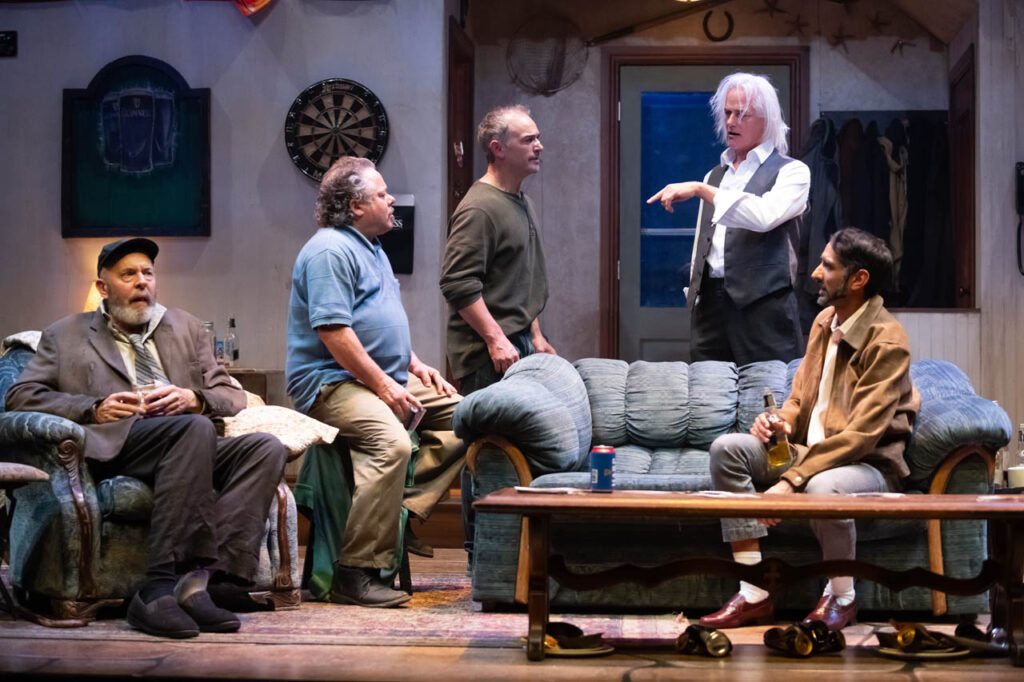
So, if want to see a great show at a fantastic price hurry down to The Motel Theatre at the Arts Commons and catch Montparnasse. The show runs until September 2nd at 8:00 pm nightly with a Saturday matinee at 2:00 pm. Tickets are just $25.00 for adults and $20.00 for students – cash only.
MONTPARNASSE
Created by Maev Beaty and Erin Shields with Andrea Donaldson
CAST: Katharine Zaborsky as Margaret/Sylvia – Carolyn Ruether as Amelia/Queen – Nicolas Bohle as Artists & Writers
CREW: Director Jay Whitehead – Designer Deonie Hudson – Sound Designer Nicolas Bohle – Technical Support Conner Christmas – Dialect Coaching Douglas MacArthur
Andy Curtis, Devon Dubnyk, Arielle Rombough, Kevin Rothery, Katherine Fadum. PHOTO CREDIT: Benjamin Laird Arts & Photo
Gather up the family and invite your friends, coworkers and neighbours to come experience the true spirit of Christmas at Lunchbox Theatre’s production of It’s a Wonderful Life. Presented as a radio play from the 1940s this production is a fun, energetic and inventive retelling of the classic story.
The Lunchbox production features an outstanding cast, brilliant direction, a beautiful set and an amazing mix of sound – both recorded and created live – to bring the story of George Bailey and the town of Bedford Falls to life.
I give it two thumbs up. Although I went to see the play with my sister, her husband, my niece, her boyfriend, and his mom and we all gave it two thumbs up so that’s twelve thumbs, right? How can you argue with twelve thumbs? That’s got to be as good as, if not better than, four stars or five sugarplums.
It’s a Wonderful Life asks the question: Does your life matter? Can one man or woman make a difference?
Devon Dubnyk, Arielle Rombough. PHOTO CREDIT: Benjamin Laird Arts & Photo
I think there’s a fundamental human need to live a meaningful life. When we reach the end we want to feel, in some way, that we’ve made a difference – that we’ve made the world a better place.
But of course sometimes when we face a crisis in our life we feel lost. We feel like nothing matters. We feel like we don’t have a friend in the world, and if you’ve ever felt like that then you can relate to George Bailey as he stands on a bridge thinking about jumping into the icy waters below and ending it all.
Luckily for George he has a guardian angel. An angel named Clarence. And Clarence shows George what the town of Bedford Falls would be like had George never been born. Let’s just say that George made a big difference in the lives of a lot of people.
That’s the story in a chestnut shell and the Lunchbox Theatre production does an amazing job of telling that story. I love the fact that we’re transported back to a Christmas Eve in the 1940s to hear and be a part of a “live” radio broadcast.
Katherine Fadum, Arielle Rombough, Devon Dubnyk, Andy Curtis. PHOTO CREDIT: Benjamin Laird Arts & Photo
The production stars a talented and versatile cast that includes:
Kevin Rothery as Freddie Filmore playing Clarence & others
Devon Dubnyk as Jake Laurents playing George Bailey
Arielle Rombough as Sally Applewhite playing Mary Hatch
Katherine Fadum as Lana Sherwood playing Violet Bick & others
Andy Curtis as Harry Heywood playing Uncle Billy & Others
Connor Pritchard as the Studio Assistant Edward Irvine
The entire ensemble captures beautifully the feel and energy of a live radio show while bringing humour and warmth to a classic Christmas story.
And if you like Vertigo Theatre then you’ll be familiar with Craig Hall and his inventive staging of noir thrillers from the 40s and 50s. His affinity for that time period shines in this production and even though it’s a “radio play” there’s never a dull moment. The actors are kept moving as they participate in creating the story and jumping from character to character.
Kevin Rothery. PHOTO CREDIT: Benjamin Laird Arts & Photo
The script for It’s a Wonderful Life is an adaptation of the original 1946 film written and directed by Frank Capra and starring Jimmy Stewart. And even though this version of the story is less than half the length of the movie playwright Joe Landry manages to skillfully keep much of the plot without losing any of the heart of the original film.
The costumes by Deitra Kalyn and the set and the lighting design by Anton de Groot only add to the nostalgia and drama of the story.
And the sound design by Aidan Lytton – much of it created live on stage by Connor Pritchard and the rest of the cast – is a marvel to watch and experience because – as this production proves – you can build an entire world with sound. You can be transported to any time or place. And the Lunchbox Production of It’s a Wonderful Life not only transports us to Bedford Falls but it takes us on a journey where we are reminded about the truly important things in life and the real spirit of Christmas.
***
After you see the show you can help spread the word by Tweeting about it, sharing an update to Facebook, posting about it on Instagram or writing a blog post. At the end of every Lunchbox Theatre Show the cast poses for photographs so you can add a photo to your social media shares. It’s a great idea and one that more theatre’s should be doing. Here’s my photo from when I saw the play:
Connor Pritchard, Andy Curtis, Devon Dubnyk, Kevin Rothery, Katherine Fadum, Arielle Rombough.
***
And one final thought, that I have contemplated long and often on many a Christmas Eve as I’ve sat waiting for Santa to arrive: Why on earth did George and his wife Mary name their daughter Zuzu?
Playwright Meredith Taylor-Parry – Photograph by James Hutchison
***
“The pattern is clear, women are drinking more. And not just in my circles. I think it’s a phenomenon in stay at home moms. It’s a way to get through the witching hour. It’s a way to relieve the anxiety and the pressure of information overload that moms now have because we’re trying to make the right choices. But there are so many choices laid out for us, with so many different arguments for which one is the right one, that we’re walking around with this mind boggling anxiety all the time that we’re making the wrong ones.” Playwright Meredith Taylor-Parry
Anna Cummer, Kira Bradley, Cheryl Hutton, Kathryn Kerbes, and Arielle Rombough in The Lunchbox Theatre Production of Book Club. Photo Benjamin Laird.
***
There’s a new play premiering at Lunchbox Theatre next week by Calgary Playwright Meredith Taylor-Parry called Book Club. It’s a funny and insightful look at being human, motherhood, and coping with life’s disappointments and joys.
And it’s funny – did I mention that?
Very funny. And beautifully written. I highly recommend it. So, take your daughter and your mother and your grandmother. Get your son and your father and your grandfather. Gather up the whole family, members of the Book Club, the Wine Club and the Social Club and make sure you head to Lunchbox Theatre and catch this gem of a play.
Last week, I published the first part of my interview with Meredith where we talked about her play Survival Skills. This week, in part two, we talk about her play Book Club.
***
Kira Bradley, Anna Cummer, Kathryn Kerbes and Cheryl Hutton in The Lunchbox Theatre Production of Book Club. Photo Benjamin Laird.
JAMES HUTCHISON
You came to the acting late, and now you’ve come to the writing later. And even though you haven’t been writing a long time you’ve had good feedback and some success including a production Off Off Broadway for your play Survival Skills. And now you have a new production coming up, here in Calgary, at Lunchbox Theatre for your play Book Club. How much do you feel maturity has played a role in you becoming a writer?
MEREDITH TAYLOR-PARRY
For me maturity was very important. I don’t think I would have had the confidence or the stories to become a writer if I’d tried this when I was nineteen.
For someone else, who’s got that confidence and talent right from the womb, they can sit down in their twenties and tell these great stories. But I wouldn’t have had the confidence to be able to tell them on paper and be brave enough to share them and get the feedback. I feel like I needed to gather confidence over the years, and then just gather a wealth of stories because life happens to you, and to other people, and you can write them down and turn them into drama.
And I struggle with that, from time to time, as a writer – when someone tells you something personal and you go, “Jesus, that’s a good line.” But if you’re a writer that’s what you do. I don’t make this stuff up. It’s hand delivered right to you – and you sit there and you take things in and you remember details.
Arielle Rombough, Kira Bradley, Cheryl Hutton, and Anna Cummer in The Lunchbox Theatre Production of Book Club. Photo Benjamin Laird.
JAMES
What is Book Club about?
MEREDITH
It’s about a bunch of mommies who are meeting for Book Club and I wanted to examine different kinds of mommies that I’ve met or mommy types. You know there’s the type of mommy, like me, that would give her kid a hot dog, and then there’s the type of mommy that would see that as child abuse. But we’re all mommies, right.
And then there’s that competitive nature we seem to have as human beings. That seems to happen with mommies. If you show up with bought cookies, from Safeway on bake sale day, you feel less than the person who shows up with homemade cookies that she must have spent all night slaving over.
And I also wanted to explore a darker idea. The phenomenon of wine being a civilized version of Valium in our generation. You know people get together for play dates and they have wine. They meet for book club and they have wine. The pattern is clear, women are drinking more. And not just in my circles.
I think it’s a phenomenon in stay at home moms. It’s a way to get through the witching hour. It’s a way to relieve the anxiety and the pressure of information overload that moms now have because we’re trying to make the right choices. But there are so many choices laid out for us, with so many different arguments for which one is the right one, that we’re walking around with this mind boggling anxiety all the time that we’re making the wrong ones.
Kathryn Kerbes, Cheryl Hutton, and Anna Cummer in The Lunchbox Theatre Production of Book Club. Photo Benjamin Laird.
JAMES
Tell me about workshopping the play at Lunchbox.
MEREDITH
Once I did the workshop process it became pretty clear right away – any wine drinking that happened had to be pretty tame because we wanted it to be a comedy and we didn’t want to explore the idea of addiction in stay at home mother’s at this time.
JAMES
You touch on it very lightly.
MEREDITH
Very lightly.
JAMES
There’s a resolution at the end of maybe we should stop drinking wine and actually read some books. So it is dealt with. But it’s a very funny play. And I think it’s all about trying to figure out life – it’s about hopes and dreams and figuring out how you can do the role you’ve been put into and whether or not that role fits you. And even though it’s about motherhood I think it’s about anybody because male or female we can relate to that because that’s a universal thing. How many dads are dads going – “Did I want to be a dad? I did want to be a dad. But now that I’m a dad –
MEREDITH
– boy does this ever suck –
JAMES
– this isn’t exactly where I want to be –
MEREDITH
– I wouldn’t trade them for anything but wow this sure sucks in some ways.”
JAMES
I love that you explore that because that’s not an unusual feeling. To think what life could be without the children but we’re made to feel guilty about that.
MEREDITH
Or to want other things, right? Because being a parent is supposed to be our most important role. Yeah, I want to be a great mom but I also want to be a great writer too. But, no, no, no, I have to want to be a great mom more – right? That’s more important.
Thanks for all the positive feedback by the way. I was shocked that everybody found it so funny and liked it so much because it was such a pleasure to write and it was easy to put down on paper. It just fell out of me.
When I did the workshop I’d get up early in the morning and I’d write a new scene and I’d go in and I’d be sick to my stomach when they sat down to read it because I’d just wrote it that day. And then when I got good feedback I just remember being continuously shocked – “Really? You really like it? Does that work?” And then when Mark Bellamy from Lunchbox read it and said, “I really like your play.” Once again I’m still kind of astonished that the feedback has been so good.
Kira Bradley, and Arielle Rombough in The Lunchbox Theatre Production of Book Club. Photo Benjamin Laird.
JAMES
Are you astonished in one sense because it was such an easy journey to reach a professional stage?
MEREDITH
Yes, absolutely – to reach a point where it’s going to be produced by a professional theatre. Yeah. That’s astonishing to me. So what does that tell you? I guess you should write what you know.
JAMES
How much do you credit the workshop? Because it was a wonderful ensemble – right – it just seemed to really work well.
MEREDITH
Yes, I had a bunch of superstars – fantastic actors – almost all of them young moms and then I had Shari Wattling and she’s a great director and a great dramaturge.
I also wanted to write a play with just female roles because the year before I put a play in and Glenda Stirling was at Lunchbox then and she said, “Wow four women up on stage – I love it! It didn’t make the cut this year but I really loved your play and I’d love to see all women up on stage.” And I said, “Yeah. I want to write good roles for women because I’m a woman and I’m an actor and I know how hard it is to find good roles.” So that was important.
But that process with Shari and the other actors was just gold because they gave me lots of things to think about. Lots of ideas. We discussed and talked about it at the table, and then I went home and thought about things they had said. When someone as talented as Myla Southward or Cheryl Hutton says, “I don’t know about that part – that’s a real harsh line or that falls flat with me…” and that’s the last thing you hear as you head out the door you think about that until bedtime. I trusted their opinions. These are talented artists. I was lucky to get that group.

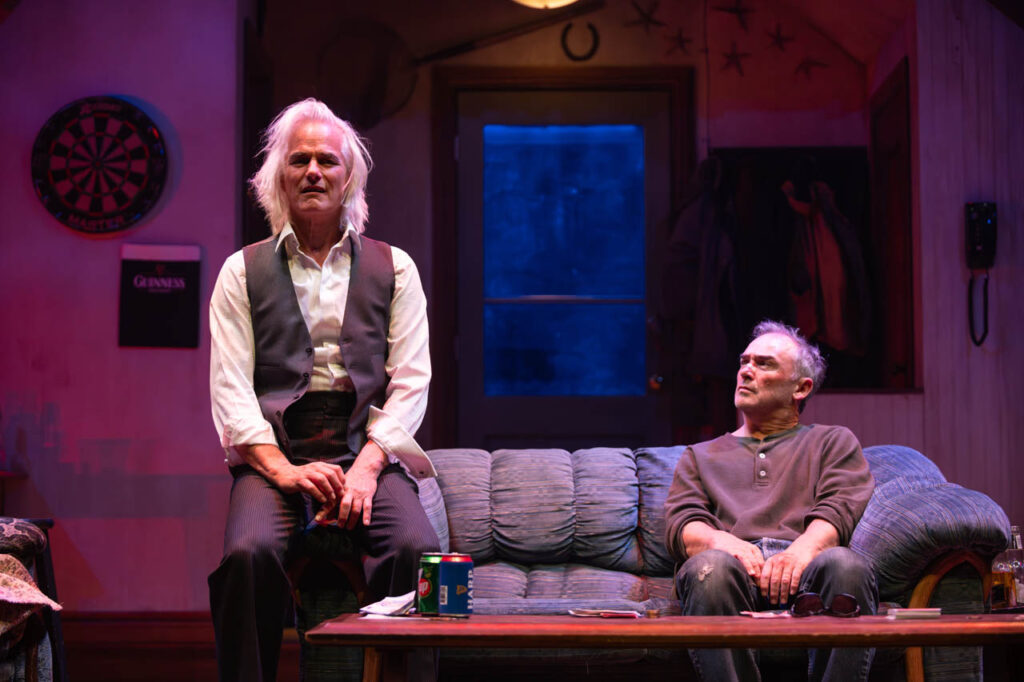
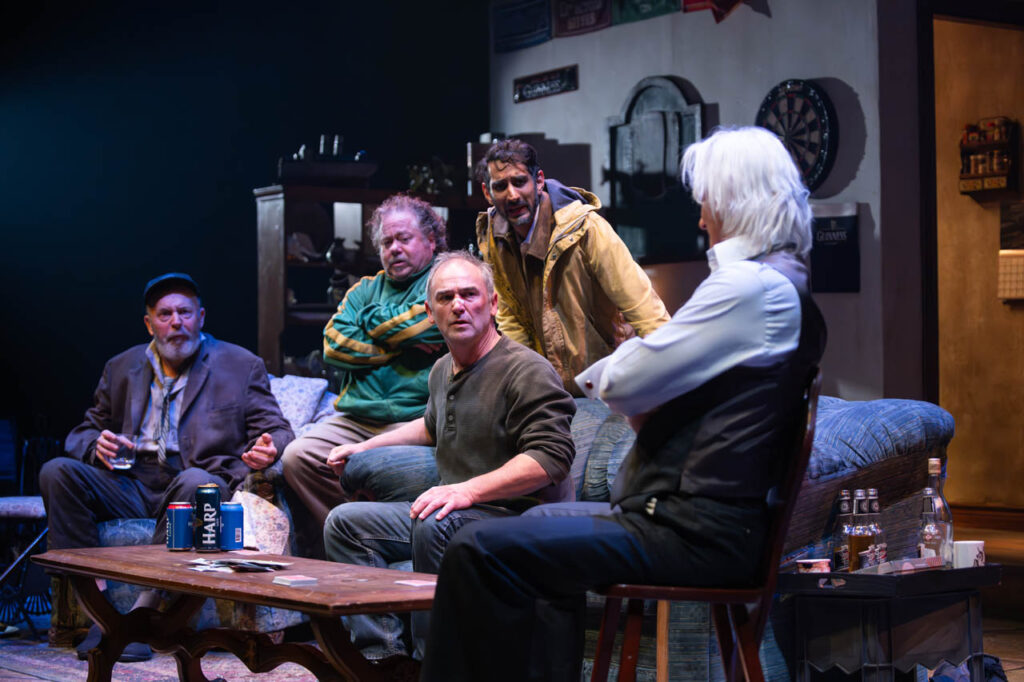
That’s the dumb luck part. The dumb ass luck part that Vern Theissen talked about when he was talking about a career as a playwright in his workshop that we went to.
JAMES
So, so far, you’ve had a lot of dumb ass luck.
MEREDITH
I’ve had a lot of dumb ass luck man. I don’t know what’s going on? But I also think I got a lot of bad writing out of my system early on which feels good. When I look back on the classes I took with Clem Martini when I was taking my BFA at the U of C fifteen years ago I purged a lot of crappy writing off the top…kind of like the head on a beer, you know. I look back on some of that stuff and it just makes me laugh at how bad and self-involved it is – and how it’s not dramatic and I don’t care about structure. Or when I was trying to be funny – oh man, that’s painful. So, I feel like I purged a bit of that. And then to come back at it years later I was in a different place.
Cheryl Hutton and Kira Bradley in The Lunchbox Theatre Production of Book Club. Photo Benjamin Laird.
JAMES
You told me Clem encouraged you to write so he must have recognized something.
MEREDITH
Yeah, I guess. I don’t know. I mean I never did exceptionally well in his classes or anything but he’s a good teacher and a lot of the stuff he told me stayed with me. He told us about writing dialogue, about structure, and about the hero’s journey – and that stayed with me over the years and I’d think about it, you know, when I’d read a book, or watch a movie, and maybe that was because I was supposed to become a writer in the end.
JAMES
Are you able to picture what you want the future to be for you as a writer?
MEREDITH
I want to be writing of course. I would like to spend more time collaborating with other artists like we did that week when we did the workshop at Lunchbox. That’s when I’m at my best. Not when I’m on my own but when there’s a group of people around and we’re on the same creative page. You know not just writing in my own little office but being able to collaborate with other artists in order to make something you’ve created even better.
Anna Cummer, Cheryl Hutton, Kira Bradley, Arielle Rombough, and Kathryn Kerbes in The Lunchbox Theatre Production of Book Club. Photo Benjamin Laird.
***
Book Club by Meredith Taylor-Parry
Directed by Shari Wattling
What happens at book club, stays at book club.
Jenny is the perfect wife and mother. At least that’s what her book club thinks until one day she disappears and they have to turn detective and follow her trail! This mad cap, adventure-filled romp, shines a light on the pressures of motherhood and the value of true friendship.
World Premiere at Lunchbox Theatre in Calgary from February 8th to 27th, 2016 with the following cast and crew.
Cast
Lisa – Cheryl Hutton
Ellen – Anna Cummer
Mary – Kathryn Kerbes
Kathy – Kira Bradley
Jenny – Arielle Rombough
Creative Team
Playwright – Meredith Taylor-Parry
Director – Shari Wattling
RBC Emerging Director – Jenna Rogers
Stage Manager – Ailsa Birnie
Apprentice Stage Manager – Melanie Crawford
Scenic & Lighting Design – Anton de Groot
Costume Design – Dietra Kalyn
Sound Design – Allison Lynch
***
Playwright Meredith Taylor-Parry
Meredith Taylor-Parry is a playwright based in Calgary, Alberta. Her play Survival Skills won the New Works of Merit Playwriting Contest in 2013 and was produced Off Off Broadway by the 13th Street Repertory Company, NYC in April 2014. Her play Devices received a production in Week One of the New Ideas Festival at Alumnae Theatre in Toronto in March of 2015. Her most recent work, Book Club, was developed as part of the Suncor Energy Stage One Festival of New Canadian Work at Lunchbox Theatre in Calgary in 2014 and will receive a world premiere at Lunchbox in February 2016. Meredith is Co-Artistic Director of Bigs and Littles Theatre Society and also enjoys writing and performing for young audiences.
You can contact Meredith at LinkedIn by clicking the link above or by email at: mtaylorparry@gmail.com
***
Book Club was part of the Suncor Energy Stage One Festival of New Canadian Work at Lunchbox Theatre in June of 2014 where it received a workshop and reading.
Cast
Lisa – Brieanna Blizzard
Ellen – Myla Southward
Mary – Kathi Kerbes
Kathy – Cheryl Hutton
Jenny – Arielle Rombough
Creative Team
Playwright – Meredith Taylor-Parry
Director/Dramaturge – Shari Wattling
Assistant Dramaturg – Jacqueline Russel
Setting
The action takes place over a few hours in Lisa’s home, at a male strip club, outside a tattoo parlour, in a rough part of town, and outside an airport.
Synopsis
When Jenny is a no-show on Book Club night the mommies start to worry. When she sends them a text to tell them she has booked a flight to Italy, they really get frantic. The group heads out on the town to track down their friend and hopefully talk some sense into her. This is a play about motherhood, from the stress of competitive parenting to the beauty of a good girlfriend who will help you get through it.
Bartley and Margaret Bard and Betty Gibb founded Lunchbox Theatre in Calgary in 1975. Lunchbox delivers a fun and unique experience to its audience – upbeat performances in an intimate and comfortable atmosphere. Patrons are encouraged to eat their lunch while they enjoy the show. Lunchbox Theatre focuses on the development and production of original one-act plays; many of which are written by local Calgarians.