The Legend of Sleepy Hollow at Alberta Theatre Projects – Interview with Director Craig Hall

The Legend of Sleepy Hollow at Alberta Theatre Projects
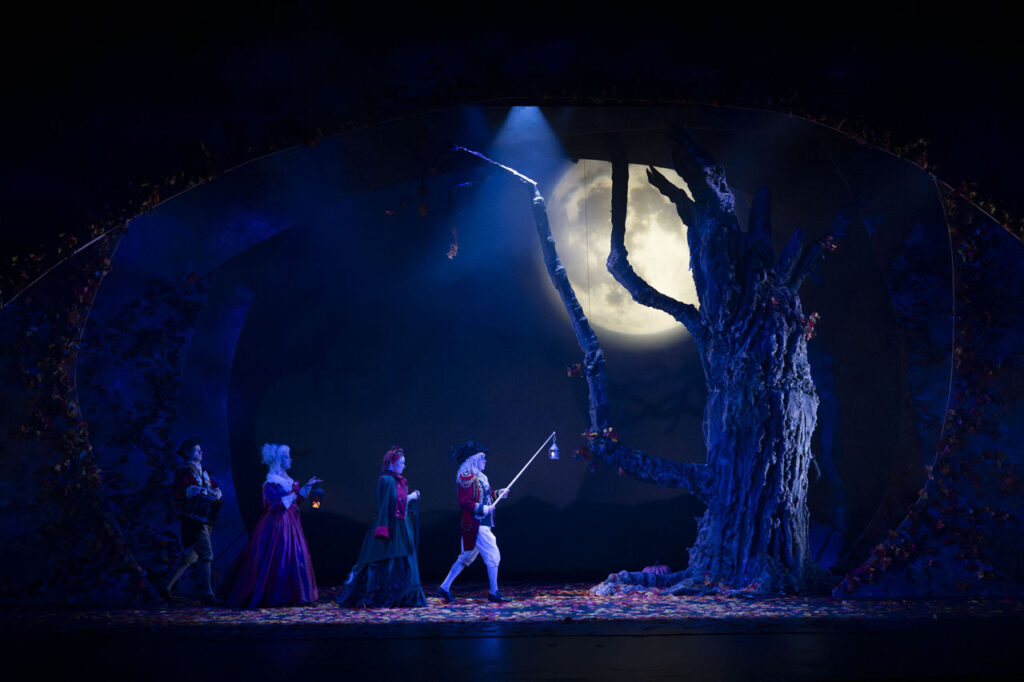
Devon Brayne, Jamie Konchak, Emily Howard and Doug McKeag in The Legend of Sleepy Hollow. Photo by Abigaile Edwards, courtesy of Banff Centre for Arts and Creativity. Set, Puppet & Costume Design by The Old Trout Puppet Workshop. Lighting Design by Sonoyo Nishikawa.

This October The Legend of Sleepy Hollow comes alive on the Alberta Theatre Projects stage featuring all your favourite characters including Ichabod Crane, Katrina Van Tassel, Brom Bones and of course the Headless Horseman. The story has been expanded to dive deeper into the murky waters of post-Revolutionary America and the politics and superstitions of the time. The play is being penned by Anna Cummer and Judd Palmer and features Matthew Mooney as Ichabod, Emily Howard as Katrina, and Devon Brayne as Brom. Rounding out the cast is Christopher Clare, Jamie Konchak, Doug McKeag, and Alice Wordsworth.

The play is being produced in association with the Banff Centre for Arts and Creativity and is being brought to life by the twisted genius of The Old Trout Puppet Workshop which includes Judd Palmer, Pete Balkwill, and Pityu Kenderes along with the rest of the design team including lighting designer Sonoyo Nishikawa and sound designer Andrew Blizzard.

The play runs from October 22nd to November 9th at the Martha Cohen Theatre in the Werklund Centre which was formally known as Arts Commons. Tickets are available at albertatheatreprojects.com or by calling 403-294-7402

***

I contacted the director of the play Craig Hall, who was out in Banff along with the entire creative team making final preparations for the play’s premiere, in order to ask him about this particular adaptation and how it evolved.
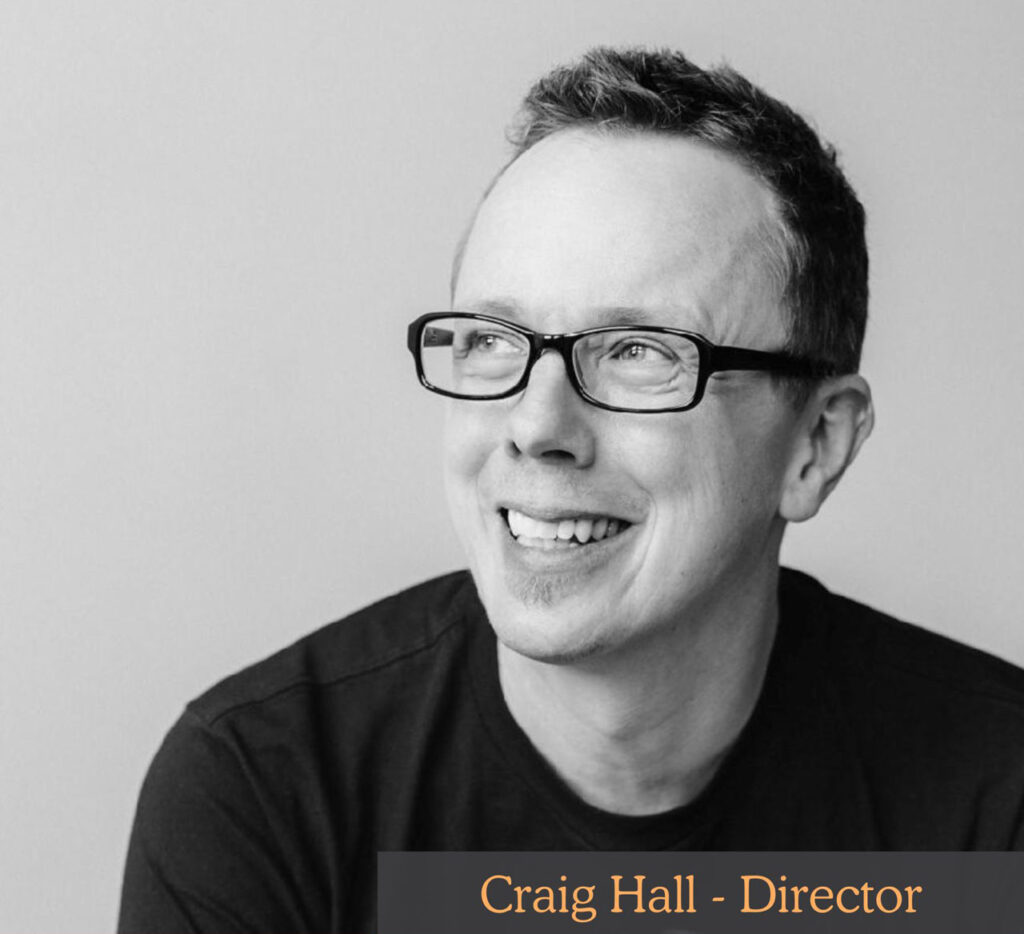
Craig Hall - Director Sleepy Hollow

JAMES HUTCHISON

So, stories like Dr. Jekyll and Mr. Hyde, Dracula, and The Legend of Sleepy Hollow continue to be retold and reimagined even centuries after they were first shared with people. What is it about these myths, ghost stories, and tales of the supernatural that allows them to transcend their original time and place and still resonate with a modern audience?

CRAIG HALL

I think it’s good storytelling. You know with all the right tension and with all the right sort of secrets and mystery. And audiences love being scared. And I don’t just mean theatre audiences. Look at the horror genre. It’s massive. And so these stories are classics because it’s great storytelling and because audiences love to be scared.

JAMES

Who hasn’t hidden around the corner and gone boo at one of their unsuspecting family members.

CRAIG

Exactly. It’s in us. That love of being surprised and the adrenaline rush that is caused by something being unknown or unexplainable. And the mystery genre in fiction is one of the biggest genres in the world and has been for a long time. Even if it’s a straight-ahead drama or comedy, there’s always an element of mystery in everything that I’m drawn to because it’s more than just an intellectual experience, it’s a physical experience as well. And it makes us active. We’re an active participant in the story. And I would suggest that every ghost story is a mystery although not every mystery is a ghost story.
The Legend of Sleepy Hollow at Alberta Theatre Projects
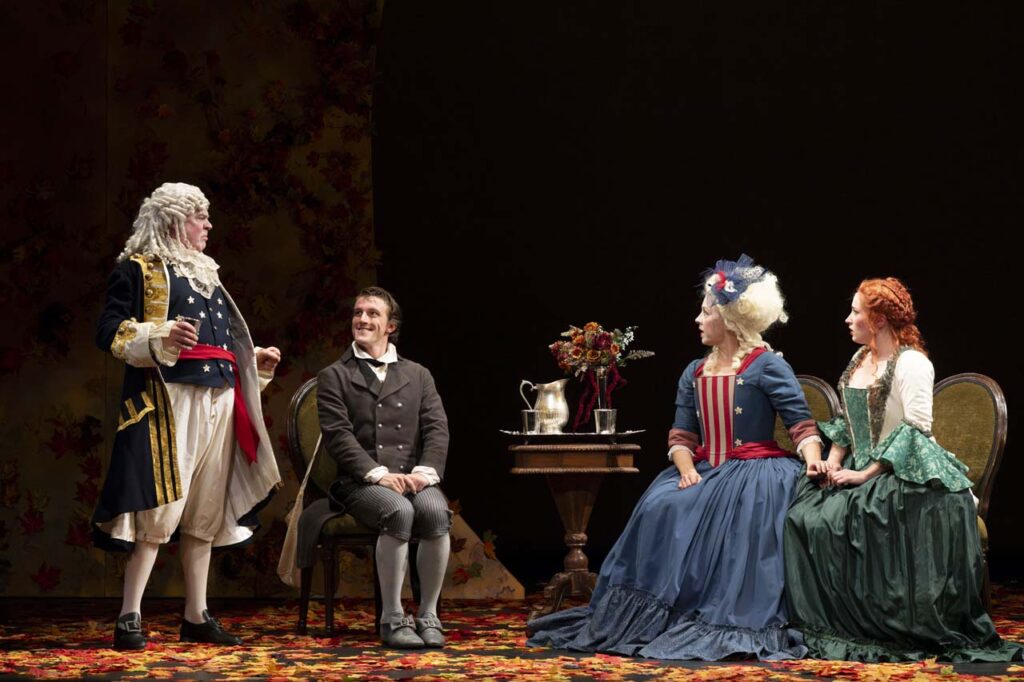
Doug McKeag, Matthew Mooney, Jamie Konchak and Emily Howard in The Legend of Sleepy Hollow. Photo by Abigaile Edwards, courtesy of Banff Centre for Arts and Creativity. Set, Puppet & Costume Design by The Old Trout Puppet Workshop. Lighting Design by Sonoyo Nishikawa.

JAMES

This is a new play and it’s an adaptation of an existing story so as the director I’m wondering how you see your role first in working on the script and the story with the playwrights Anna Cummer and Judd Palmer. How did that process work.

CRAIG

It’s been a long process. Anna and Judd have been working on this since Covid. They were looking for something to tackle and they went with The Legend of Sleepy Hollow because it had the intrigue that they were looking for. It had the potential for the style that they were looking for. And it’s a story that’s in the public domain so they could do what they wanted with it.

I’ve been in and out of the process as a bit of a dramaturge with a directorial eye. And I’ve been involved in the workshops as we’ve gone along and that role kind of transforms from dramaturge to director through the course of the process. So, it’s been a real luxury to be involved with it from its inception.

Anna Cummer and Judd Palmer Playwrights The Legend of Sleepy Hollow by Washington Irving

Often as a director you’re coming into it just as somethings heading into production. But to be involved since the inception and to be able to nudge and contribute has been great. Anna and Judd are certainly the leads, but we’ve all had a little bit of input here and there and it’s been great working with the Old Trout Puppet Workshop and with Anna who is my partner of course.

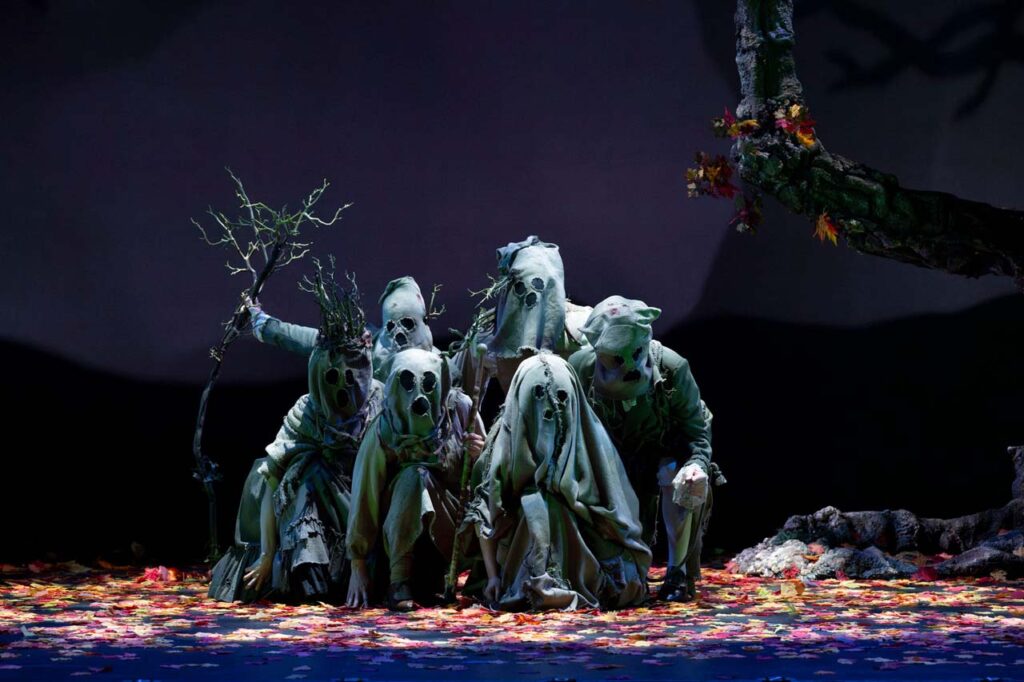
And because the Trouts are so heavily involved the design almost develops alongside the play. Your usual process is the designers come in as you’re heading into production, but this play has had a design dramaturgy kind of lens, so the design evolved very organically. So, we’ve been able to create the play with the design in mind.
The Legend of Sleepy Hollow at Alberta Theatre Projects
Alice Wordsworth, Devon Brayne, Jamie Konchak, Emily Howard, Christopher Clare. and Doug McKeag in The Legend of Sleepy Hollow. Photo by Abigaile Edwards, courtesy of Banff Centre for Arts and Creativity. Set, Puppet & Costume Design by The Old Trout Puppet Workshop. Lighting Design by Sonoyo Nishikawa.

JAMES

As you mentioned a core component of this adaptation of Sleepy Hollow is the The Old Trout Puppet Workshop who are bringing their puppetry and storytelling talents to the adaptation. In what ways does having puppetry expand the storytelling possibilities?

CRAIG

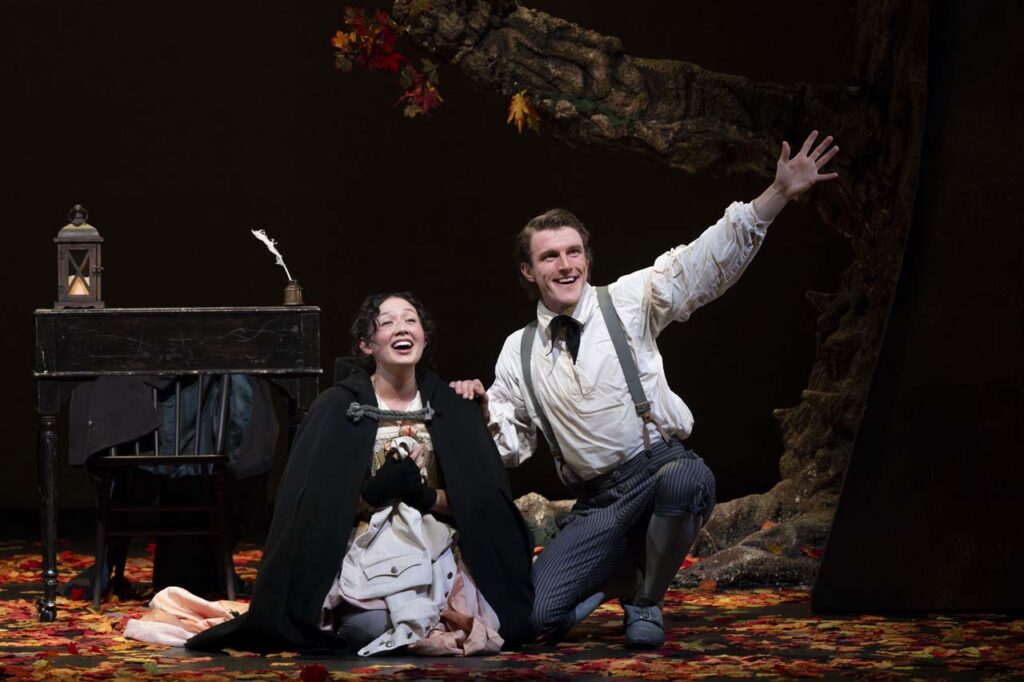
It’s interesting, I mean, because it’s the Trouts everybody assumes that it’s puppet-forward but in this case it’s more about the esthetic of the whole show. The Trouts are doing the costumes. They’re doing the props. They did the set. There’s some puppetry in the piece and everyone knows that the Headless Horseman is going to make an appearance at some point, but it’s less a puppet show than it is a Trout-driven esthetic. It’s almost like the humans are the puppets in a way. They act as narrators. They act as characters. And everything from their costumes to how they move through this world is a very Trout-driven esthetic.
The Legend of Sleepy Hollow at Alberta Theatre Projects
Alice Wordsworth and Matthew Mooney in The Legend of Sleepy Hollow. Photo by Abigaile Edwards, courtesy of Banff Centre for Arts and Creativity. Set, Puppet & Costume Design by The Old Trout Puppet Workshop. Lighting Design by Sonoyo Nishikawa.

JAMES

So, as part of the process of bringing The Legend of Sleepy Hollow to the stage ATP teamed up with The Old Trout Puppet Workshop along with the Banff Centre for Arts and Creativity. In fact, as we’re doing this interview, you’re currently in Banff in rehearsals getting the play ready for its premiere. How did the opportunity to bring the play to the Banff Centre contribute to the development of the play both artistically and from a practical perspective.

CRAIG

I shouldn’t speak out of turn here, but the Banff Centre made this possible. Without the Banff Centre I’m not sure that ATP could have taken this project on. It was when the Banff Centre came on board that everything lurched forward and got under way. And last night Doug McKeag took us all out on a night time walk through the forest that he’d planned and the group recreated one of the ritual scenes that’s in the show and they came out of the forest with lanterns and you don’t get that kind of bonding beyond the rehearsal hall when everybody is living in their home and going home directly after work. So, it’s been such a privilege to be out here in such an extraordinary facility as an ensemble and to concentrate on the work.
The Legend of Sleepy Hollow at Alberta Theatre Projects
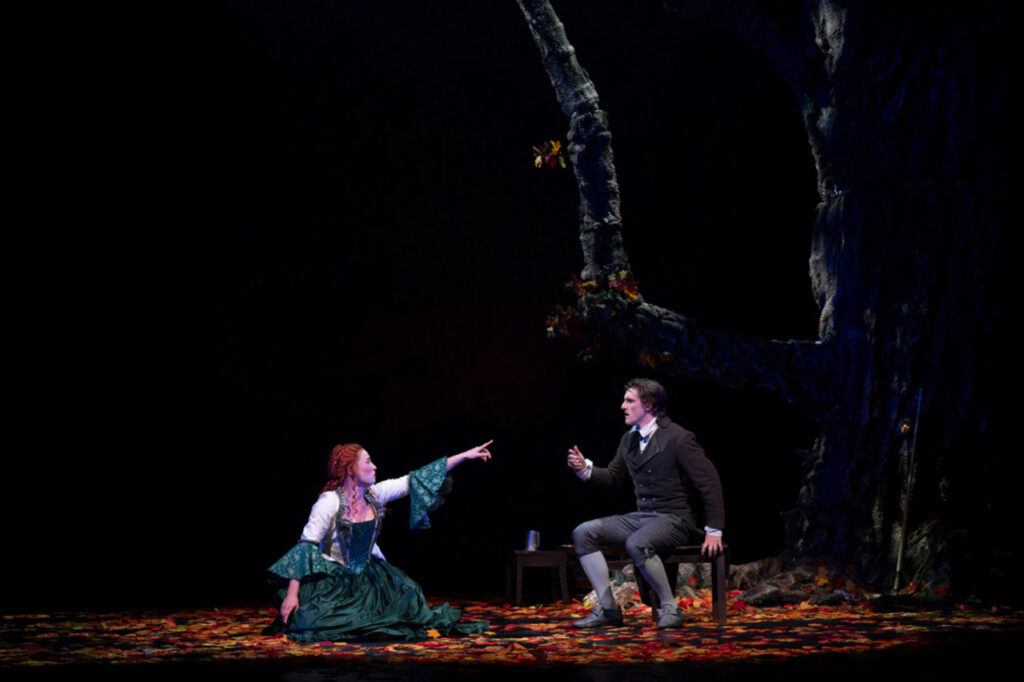
Emily Howard and Matthew Mooney in The Legend of Sleepy Hollow. Photo by Abigaile Edwards, courtesy of Banff Centre for Arts and Creativity. Set, Puppet & Costume Design by The Old Trout Puppet Workshop. Lighting Design by Sonoyo Nishikawa.

JAMES

I read the original story The Legend of Sleepy Hollow by Washington Irving and one of the things that really stood out to me was just how clear and vivid the characters are in the story. Tell me about how these characters have been lifted from the page and put on stage to help tell the story.

CRAIG

It’s certainly not a traditional retelling of the story. Those basic characters of Katrina Van Tassel and Ichabod Crane and Brom Bones come from the original and the love triangle still exists but it’s an expanded world. It’s not as simple a story.

It’s got a lot of politics around the revolutionary war in it, and everybody is suffering a little bit of PTSD from the war and how the country was torn to pieces. So, Anna and Judd really dug into the history and what was happening at the time and how that parallels what’s happening now. The story goes far beyond the simple relationships of those three characters.

And Ichabod is very much a creature of survival. He will become whoever he needs to become in order to survive. You’ve got this character who’s out of his element and you’re really rooting for him but then his choices are not always correct morally. And what he believes to be true versus what’s actually true becomes this sort of interesting moral conundrum in the piece.

JAMES

You mentioned truth. Do you believe theatre’s role is to reveal truth?

CRAIG

I think its role is to wrestle with it. The most interesting theatre requires you to discern what the truth is. It offers both sides of an argument. And I think that’s what Anna and Judd have done. They want the audience to see there’s an ambiguity to it, and they want the audience to go I’m not sure who the hero is and whether or not they are a reliable narrator so that the audience is wrestling with that truth by the end. And I think they’ve put so much thought into the story and done a lovely job of it so that it ends up being a really satisfying journey and puzzle.
The Legend of Sleepy Hollow at Alberta Theatre Projects
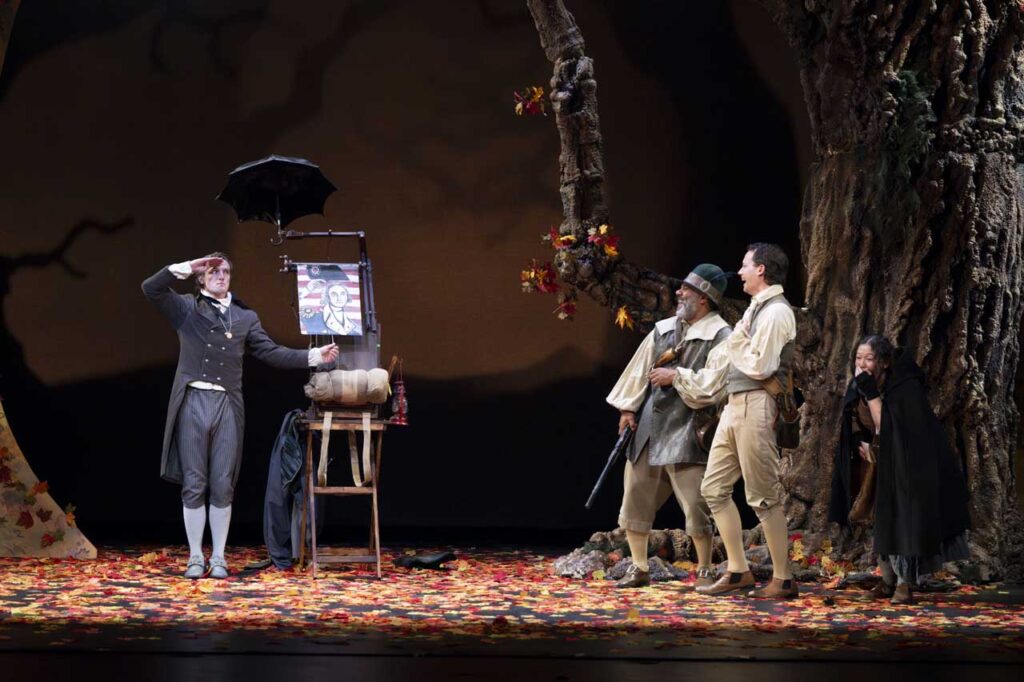
Matthew Mooney, Christopher Clare, Devon Brayne and Alice Wordsworth in The Legend of Sleepy Hollow. Photo by Abigaile Edwards, courtesy of Banff Centre for Arts and Creativity. Set, Puppet & Costume Design by The Old Trout Puppet Workshop. Lighting Design by Sonoyo Nishikawa.

JAMES

So, what kind of an experience are audiences going to have when they come to see the show?

CRAIG

I think at its base it’s a nice spooky experience with some beautiful ensemble storytelling. Some beautiful visuals. I think that people who know the story will love to see it expanded and to see these characters fleshed out.

And Judd and Anna are two of the smartest people I know. They both have their own fascinations. Judd loves chaos and Anna loves order. And you get to see these two things kind of battle inside of a script which makes for a really satisfying whole. I think that each of them individually would have written a very different piece, but together they wrote something that has a lot of complexity and depth.

And Ichabod calls himself a poet warrior. That’s his own self-aggrandizing definition of himself but words are what he uses for battle. It’s that idea that the pen is mightier than the sword and he’s going to change the world through his words, and he does but whether it’s for better or for worse remains to be seen.

***
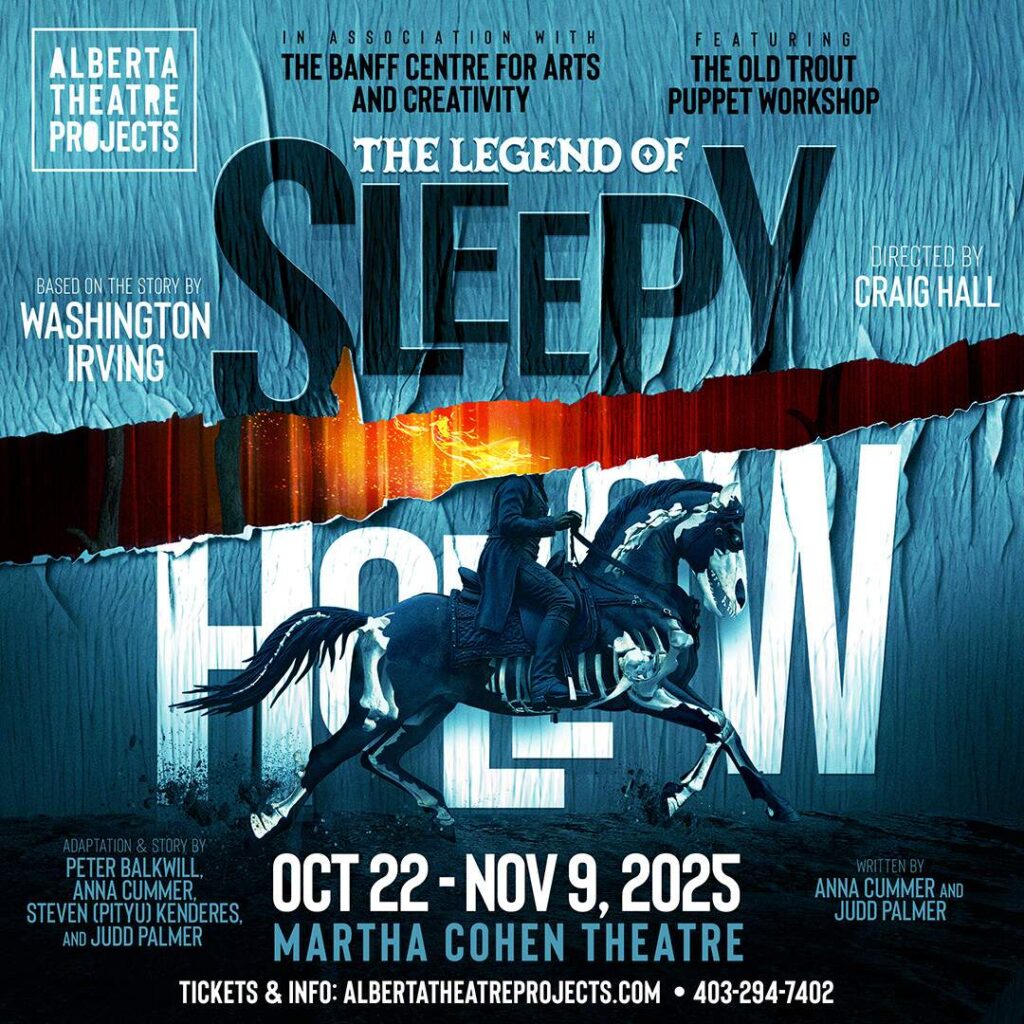
Alberta Theatre Projects presents the world premiere of a brand-new Canadian adaptation of The Legend of Sleepy Hollow by Washington Irving. Co written by Anna Cummer and Judd Palmer and produced in association with the Banff Centre for Arts and Creativity and The Old Trout Puppet Workshop, this production presents an exciting multi-organizational collaboration that breathes new life into the enduring and haunting tale of the Headless Horseman.

The Legend of Sleepy Hollow runs until November 9th at the Martha Cohen Theatre in the Werklund Centre. Tickets are available at albertatheatreprojects.com or by calling 403-294-7402.

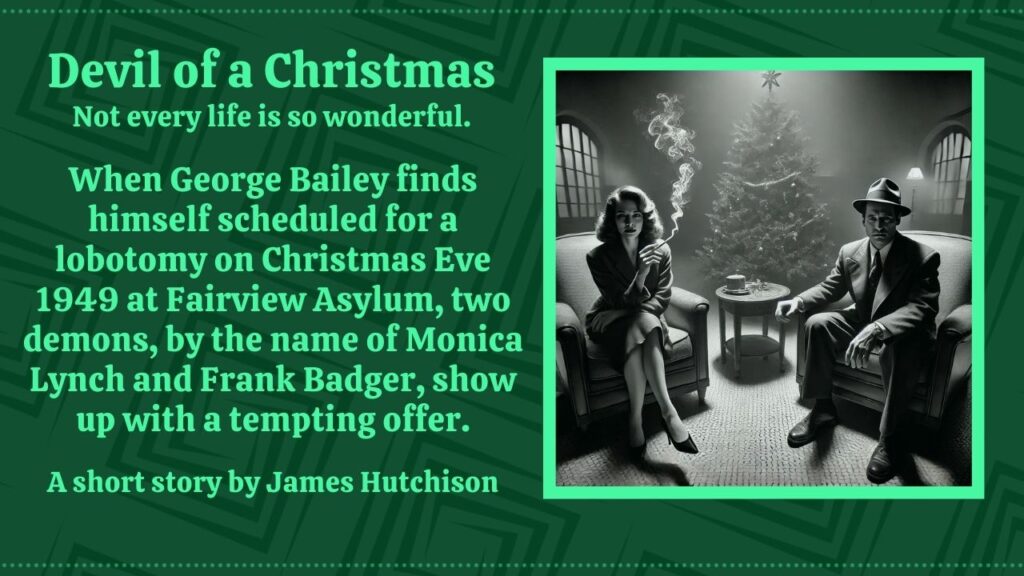
Graphic Linking to Story - Devil of a Christmas - Not every life is so wonderful. A short story by James Hutchison about George Bailey.

The Green House at Rosebud Theatre – Interview with Playwright Krista Marushy

Rosebud Theatre’s The Green House with Kate Corrigan, Heather Pattengale, and Camille Pavlenko.

Rosebud Theatre presents the world premiere of The Green House, a new family drama that explores the changing nature of memory by Alberta playwright Krista Marushy. Tickets can be purchased at www.rosebudtheatre.com or by phone at 1-800-267-7553.

***

The Green House travels through time and memory. In fact, the production is designed in such a manner that it feels like the play is not positioned in any single moment of time but instead flows between the past and the present revealing memories and relationships.

Heather Pattengale plays Susanne our haunted central character as an adult and Kate Corrigan plays the younger feistier version of Susanne known as Susu. In addition to Susu, there’s her roughhousing older brother Jameson played by Matthew Boardman and her domineering mother Kit who is also played by Heather Pattengale. Camille Pavlenko plays the mysterious and reclusive Ava Green who lives on the edge of town in what has come to be known as The Green House. Rounding out the cast is Nathan Schmidt who plays Struthers the peace maker who boards with Kit, Susu, and Jameson.

The Green House is a play that explores the changing nature of memory and how our understanding of ourselves and the people in our lives can be altered and changed as we gain a different perspective on past events. As part of the experience of seeing the play audiences are encouraged, in the program, to ask questions about their own memories and life mysteries and are invited to stay for talkbacks following the Friday evening and Saturday matinee performances.

The Green House is a challenging play to fully explain as doing so would give away too much of the plot however I was able to sit down over ZOOM with playwright Krista Marushy and ask her about the process of writing the play and what it was like to see The Green House reach the Rosebud Theatre stage and go out into the world.

KRISTA MARUSHY

When I started The Green House, I was in graduate school, and we were in a class that had very specific writing prompts and we had three days to execute it. The prompts for this particular play were an article I’d read in the newspaper that day, expressionism, an unreliable narrator, and two characters based on literary characters. And you had no time to think about it. You just had to go with it. The arch of the story was done in three days. And then I spent sixteen years fine tuning the details.

Playwright Krista Marushy

JAMES HUTCHISON

You look at memory and trauma in your play and you also look at it from three different points in time. Often the time periods even overlap within a single scene as actors inhabit characters at different moments in life. How much do you think time influences and alters our understanding and perception of past events and trauma.

KRISTA

I tend to think that feeling affects our memory more than time. So, we store a memory because it impacted us in some way. There are tonnes of things you and I both forget on a regular basis, but we can still remember being embarrassed by somebody in grade two. And there’s a study that came out of Northwestern that talks about how memory is more akin to the telephone game and the more you tell a story the more you remember the retelling than the actual memory. So, that shows how we actually are unreliable narrators of our own life. And as we tell ourselves the stories of why we are the way we are and who we are, and we communicate those to people over the years the story has shifted drastically from whatever the original facts were. That’s the science of it. That’s life.

JAMES

I think when people think about their lives they have these “Aha!” moments and that is a process of looking at a memory and understanding it from a different perspective. And in a sense, that’s sort of what happens in your play – there’s sort of an “Aha” moment where things fall into place that weren’t there before.

KRISTA

Yeah, and I just started writing the story from an intuitive place and then over the years I started to have more empathy for characters who weren’t necessarily the central characters. I think that the journey of the main character is ultimately having more empathy for some people that she originally saw in a limited way. And by revisiting the story and sort of walking a mile in their shoes she is seeing it from an older perspective and finding some empathy and forgiveness for things she didn’t necessarily see or understand at the time.

Rosebud Theatre’s The Green House with Matthew Boardman, Kate Corrigan, Heather Pattengale, and Nathan Schmidt.

JAMES

As a playwright you write it, but you need a creative team to put it together and get it on stage. So, lets talk about the creative team. Rosebud has assembled a great group of folks including Craig Hall who is directing the show. And you’ve got an amazing cast including Heather Pattengale, Camille Pavlenko, Nathan Schmidt, Matthew Boardman and Kate Corrigan. This is my first time seeing Matthew and Kate, but I’ve seen all the others many times and seen many shows directed by Craig. Just a terrific team. So, tell me about them and what they bring to the process and final production.

KRISTA

Well, it’s an incredible cast. I knew from the beginning I would be working with two students so that was always part of the deal with Rosebud and their organization. And Kate and Matthew have really done incredible work and I’m really proud of them. And then the three established professionals Heather, Nathan, and Camille of course are all incredible. So, it was a delight to see them bring the story to life.

Craig in particular was really helpful and instrumental especially in the first weeks of rehearsal because he gave such an open playground for the script to develop and I think he just approaches life with a very different brain than me. I’d say he looks at things more strategically and is always looking for clarity in a play that has all these layers of memory and expressionism. And that became a really important anchor for me. It was a really lovely counterpoint to have in rehearsals. Somebody who was simultaneously really generous and really intelligent and really insightful about the script, but someone also asking excellent questions and saying I’m missing something here but doing so very graciously and gently. That was incredibly helpful and necessary for the process of script development and for a first production.

And I feel like from the beginning the cast knew who these people were and they jumped in fully on board and that was an incredible gift to be in day three of rehearsal and feel like – they totally understand who these people are and what this is about and I can sit back and really look at how do we shape the text to heighten and highlight what’s already going on. 

Artistic Director Rosebud Theatre Craig Hall

JAMES

In addition to the actors you have to have a design team and the show is beautiful and the set and the lighting and the sound is absolutely gorgeous and you’ve got Luke Ertman who’s doing the sound design, Dale Marushy – whom you might know – is doing the scenic design, the costume designer is Amy Castro, and the lighting designer is Michael K. Hewitt and they’re all contributing their talents to the production. So, tell me about the design elements and the look and feel of the show in terms of visuals and sound and how that encapsulates and helps tell the story.

KRISTA

I did not speak to the design elements even though I’m married to the set designer. I was like, “Don’t show me. I don’t want to know.” Because I knew he would do beautiful work, and I didn’t want to invade that process at all. I think the design team went wild in a beautiful way and I hope they were inspired. I think it was really important to have a set in a world that could constantly be shifting but you still feel grounded. So, things like transparency and visibility are important design elements and are themes in the show. And it feels like everything has an emotional texture and the design of the show gives a sense of time without restricting us and gives the story so much ability to move and transform and go from one place to another without any delay.

Rosebud Theatre’s The Green House with Kate Corrigan, Heather Pattengale, and Camille Pavlenko
Rosebud Theatre’s The Green House with Kate Corrigan, Heather Pattengale, and Camille Pavlenko.

JAMES

You’ve been working on this play since 2009 and now here we are sixteen years later. When you saw the play on opening night what sort of thoughts went through your mind and what sorts of emotions did you go through as you watched the play come to life and go out into the world.

KRISTA

Well, first of all I will say though I’ve been working on this play for sixteen years I also had three children in that period, so it wasn’t like I was just typing away.

JAMES

So, you were producing a lot is what you’re trying to say.

KRISTA

Yeah, I had a lot of other productions during that time. So, yes, it’s been a long incubation period, but the essential story is still really close to what it’s been since the beginning. And I just have so many mixed feelings. It’s exciting. It’s vulnerable. It’s thrilling. There’s stuff I still want to fix because I’m a bit of a perfectionist. But you get to a place where you are excited to share it with the world, and I’m dazzled by the design and the creative team. There are so many feelings I have and then I also feel vulnerable because I don’t know if anyone is going to be into this. I feel like I took lots of creative risks and so I feel the trepidation of that, but I also feel really proud of that. Because I think that’s the kind of artist I want to be. Someone who takes a big swing and everything may not land but I’m really proud of the work.

Rosebud Theatre's The Green House with Kate Corrigan and Matthew Boardman.
Rosebud Theatre’s The Green House with Kate Corrigan and Matthew Boardman.

JAMES

So, why should people head out to Rosebud to see your play? The Green House. What are you hoping audiences can take away from the experience?

KRISTA

I think it’s a really original story. I think they will be surprised. And I think it’s also about having greater empathy and understanding for yourself and for your memories and for your own family. And also, it’s funny. However much it’s serious there’s a lot to laugh at. And I think the artists in Rosebud are doing phenomenal work. And hope is at the centre of this story and forgiveness and empathy and so I hope that it just increases people’s capacity for understanding themselves and the people around them and I hope they have a good time. I think they will.

JAMES

And with Rosebud you do get Chef Mo’s delicious buffet.

KRISTA

Yes, you get a good meal. A feast.

JAMES

Something for the stomach as well as something for the mind and the heart.

KRISTA

Exactly.

***

The Green House is a play about memory, empathy, and forgiveness featuring a stellar cast that shows how revisiting the past can alter our view and understanding of the present. The play not only invites audiences to experience Susanne’s journey and transformation but to also reflect on the stories we tell ourselves about the past.

Which brings to mind that each encounter with a production is a personal experience. We never come to the theatre in a completely neutral mind. That’s impossible. We are always at any moment an emotional and physical representation of where life has brought us up to this point in time. A year from now I’ll be a different person. A year ago, I was a different person. How much variation between who I was and who I will be depends on a multitude of factors.

So, our health and emotional and financial well being as well as the epoch in which we live influences how we think and react and interpret what we see and experience. And a big part of me is feeling rather exhausted mentally, physically, and spiritually at the moment.

Graham and James in Rosebud on September 20, 2025 looking forward to some good food and engaging theatre.

So, I’ve come to the theatre in need of nourishment. I need something to engage my mind and lift my spirits. And by that I don’t mean I need comedy. Even though I love comedy. What I need at the moment is engagement. I’m looking for a story that will reveal some truth about this journey we all find ourselves on. And so, with all that in mind I have to say I enjoyed my journey out to Rosebud and my encounter with The Green House and the discussions I had with my son, Graham, after we saw the show.

You can catch The Green House at Rosebud Theatre until Saturday October 25th with matinee performances from Wednesday to Saturday at 1:30 pm and evening performances on Friday and Saturday at 8:00 pm. Tickets can be purchased at www.rosebudtheatre.com or by phone at 1-800-267-7553.


Elvis is Dead - Title Card