Vertigo Theatre is launching its 50th Anniversary Season with the world premiere of The Lodger by Susie Moloney & Vern Thiessen. When a serial killer stalks the night and fear grips the city nobody is above suspicion.
The Lodger runs until October 25th. Tickets are available online at VertigoTheatre.com or by calling the box office at 403.221.3708.
In 1888 over the course of ten weeks Jack the Ripper brutally murdered five women and terrorized London. It was those murders that inspired Marie Belloc Lowndes to write her 1913 novel The Lodger. And that novel would later be adapted into a 1927 silent movie by the master of suspense Alfred Hitchcock.
The story would be adapted several more times for the silver screen including a 1953 adaptation starring Jack Palance as The Man in the Attic! And Jack Palance the Oscar-winning actor starred as Ebenezer Scrooge in the 1998 television western Ebenezer which is a reimagining of Charles Dickens’ A Christmas Carol in the old West which was filmed in the Calgary area!
What does that have to do with anything? Nothing really but I love the fact that a story can begin in one place and you can draw connections that lead you to some place else because that’s what a lot of fiction is. We take known facts and stories and ideas and play around with them. And through that exploration we connect the dots. In a murder mystery we are always trying to connect the dots to determine the killer. Isn’t that the whole basis of Poirot? The clues are there.
The Lodger, on the other hand, is less mystery about who the murderer is and more about how we handle suspicion. The novel has been adapted into a fast-paced suspense-driven story for the Vertigo stage by Canadian horror novelist Susie Moloney and multi-award-winning playwright Vern Thiessen.
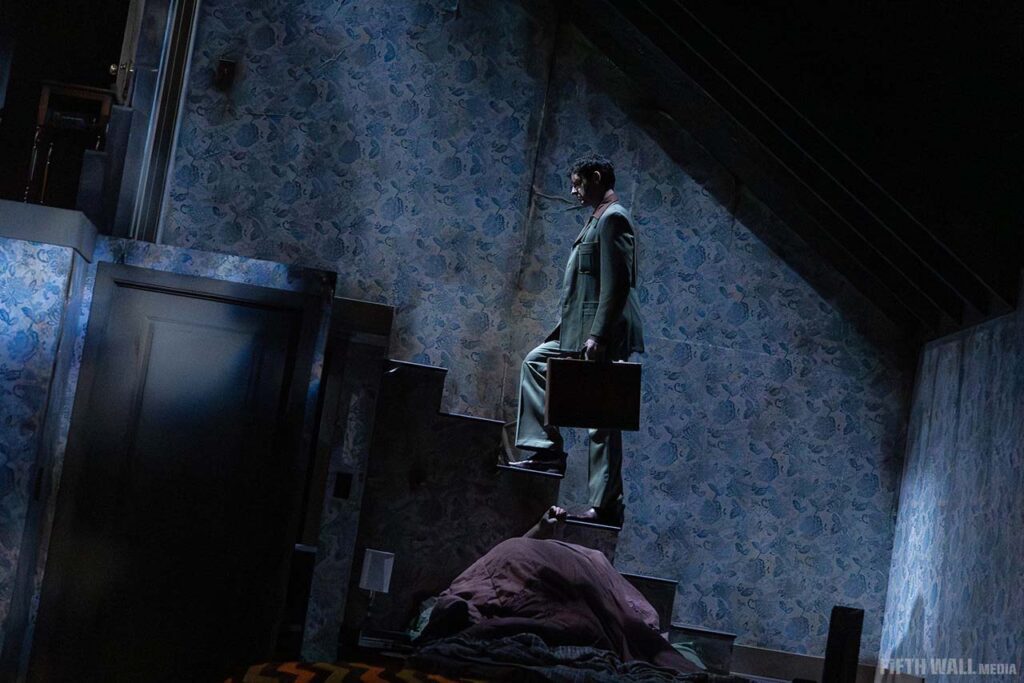
Thiessen and Moloney have set the story in the 1970s. This was the golden age of serial killers. It was also a decade of turmoil as the Vietnam war continued to grab headlines, Richard Nixon was forced to resign from office after the Watergate scandal, and the energy crisis caused by OPEC created gasoline shortages and prices to spike. And while the action of the play takes place in an unnamed city close to a large body of water my mind drifted back to Calgary during that decade and the stories that were appearing in our papers and on the radio and television about a serial killer preying on young women in the Calgary area.
The murders went unsolved for almost 50 years until DNA evidence linked those murders to an American serial killer who had been in Canada illegally at the time and who had died in an Idaho prison in 2011. I remember how those murders created a feeling of unease throughout the city and illustrated how important it was to have public telephones available so people could call for help. If your car broke down, you had to walk to a gas station. And hopefully if you found a phone you had a dime so you could make a call. Unlike today where most of us have a smartphone and can call for help people back then were truly alone and vulnerable.
And that’s how our story begins. It is late at night. We meet a young woman. Alone. Trying to make her way home when she thinks maybe she heard something. Maybe she isn’t alone after all. And then out of the darkness the killer grabs his first victim, and her screams are quickly silenced.
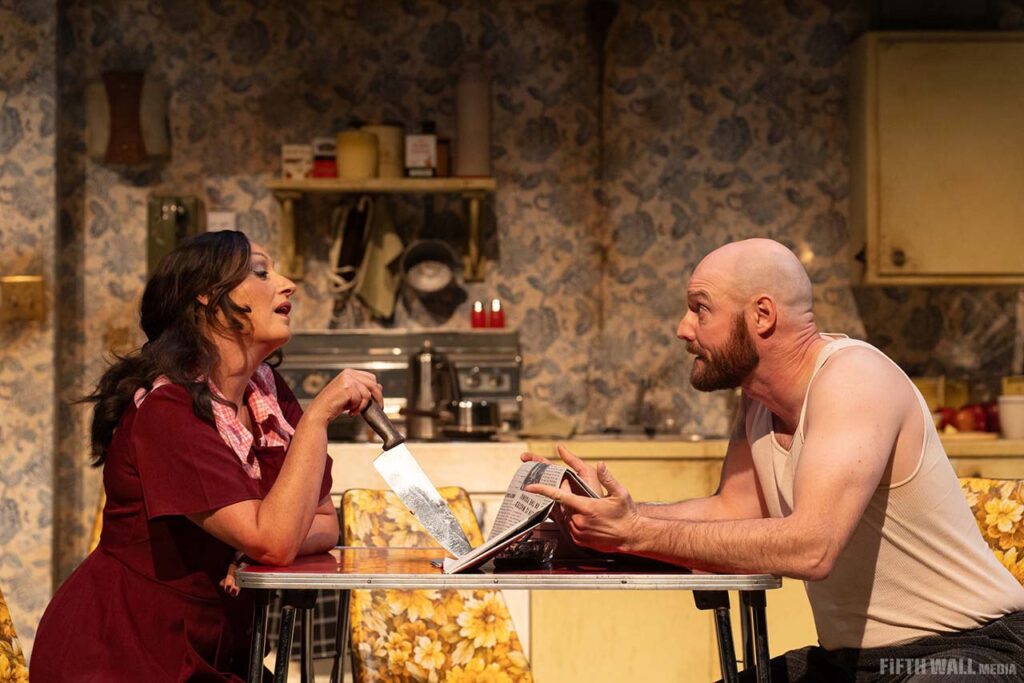
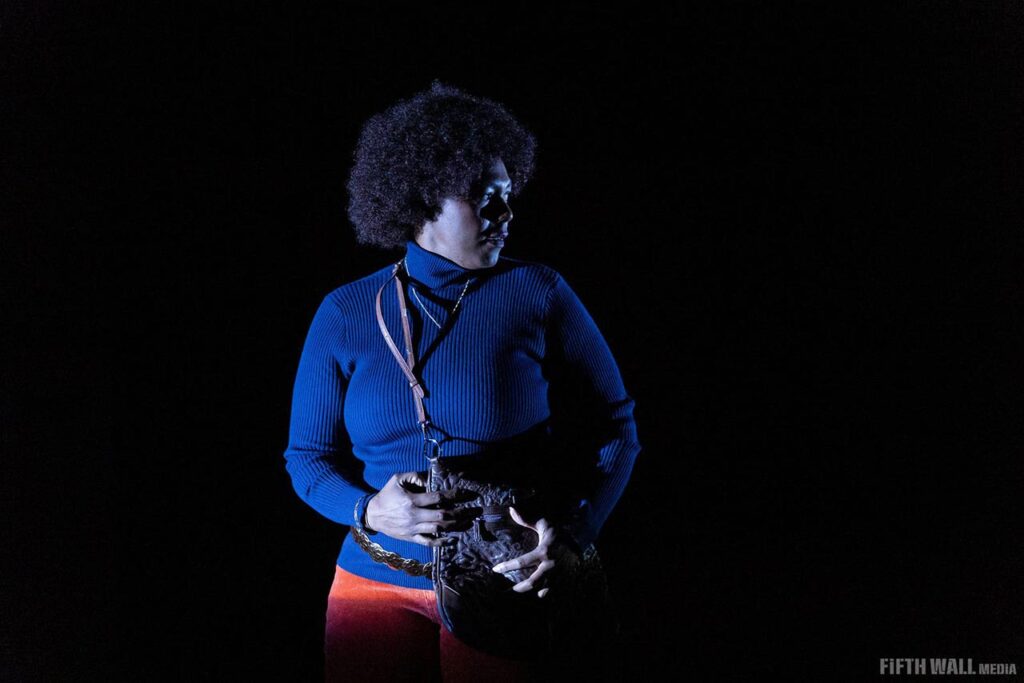
The following day we meet Ellen Bunting who works as a waitress and her out-of-work husband Bill Bunting who stays out late and spends too much time at the bar. Lauren Brotman plays Ellen with a world-weary sense of endurance and David Haysom plays her husband Bill who often seems on edge and struggles to control his temper.
Because Ellen’s the only one working there’s some tension and desperation in the air as the couple find themselves struggling to make ends meet and are at risk of defaulting on their mortgage. Ellen and Bill are living a life of forgotten dreams in a rather sad house in desperate need of repairs in a questionable district of town. And now there appears to be a killer on the loose.
Fortunately, they have an extra room available to rent and while Bill is off trying to pick up a few extra bucks doing some day labour a well-educated posh English gentleman, by the name of Laurence Moore, who happens to be a sociologist, shows up at Ellen and Bill’s door looking for lodging.
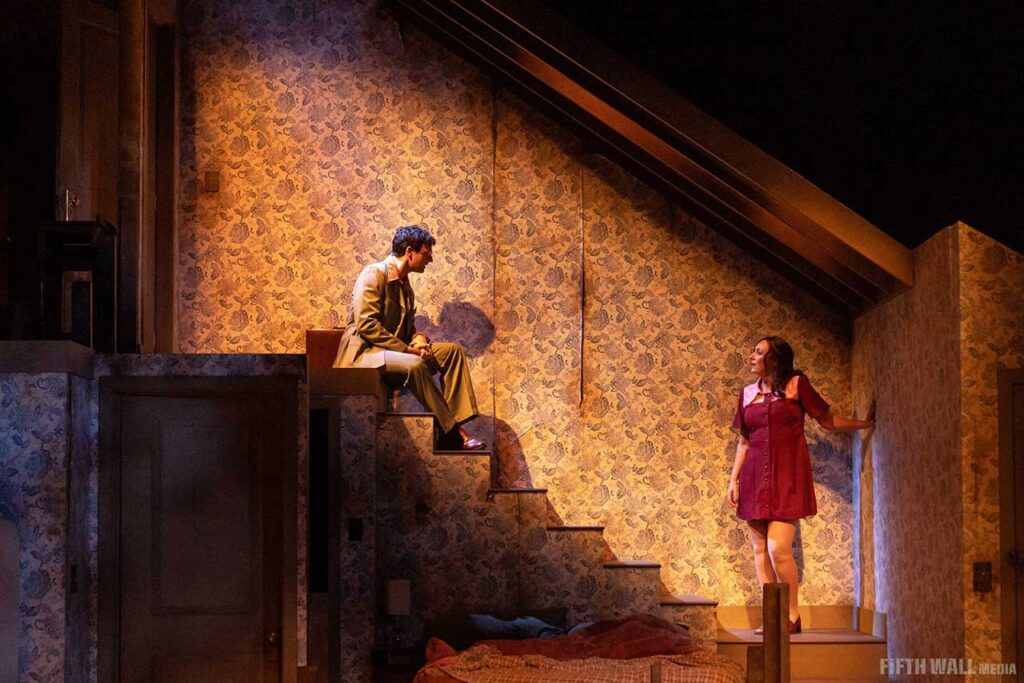
Tyrell Crews using his best British charm plays the mysterious stranger who is looking for a place where he can work undisturbed and do his research. When Laurence offers to pay for two weeks up front, the money and his friendly manner result in Ellen having no serious qualms about him staying in their home. Bill on the other hand doesn’t much like the guy and feels a need to assert his dominance to which the lodger initially defuses the situation by being completely agreeable and nonthreatening.
As was the case with Jack the Ripper, the murders in this story happen quickly and close together. Fortunately, one of Ellen’s friends is a police officer. Norma Lewis plays Joannie Buffie as a competent and determined woman who, having recently completed her police training, is now trying to do her job while dealing with the harassment and discrimination of the male officers in the force.
This is the 70s after all. And I remember there still being debates about whether or not women should work or stay at home and raise children. Needless to say, this argument never really applied to the poor because they had to work. They had no choice. But the choice of work was limited. So, while Joannie battles the chauvinism in her workplace, she is able to provide Ellen with more information about the investigation and efforts to capture the killer.
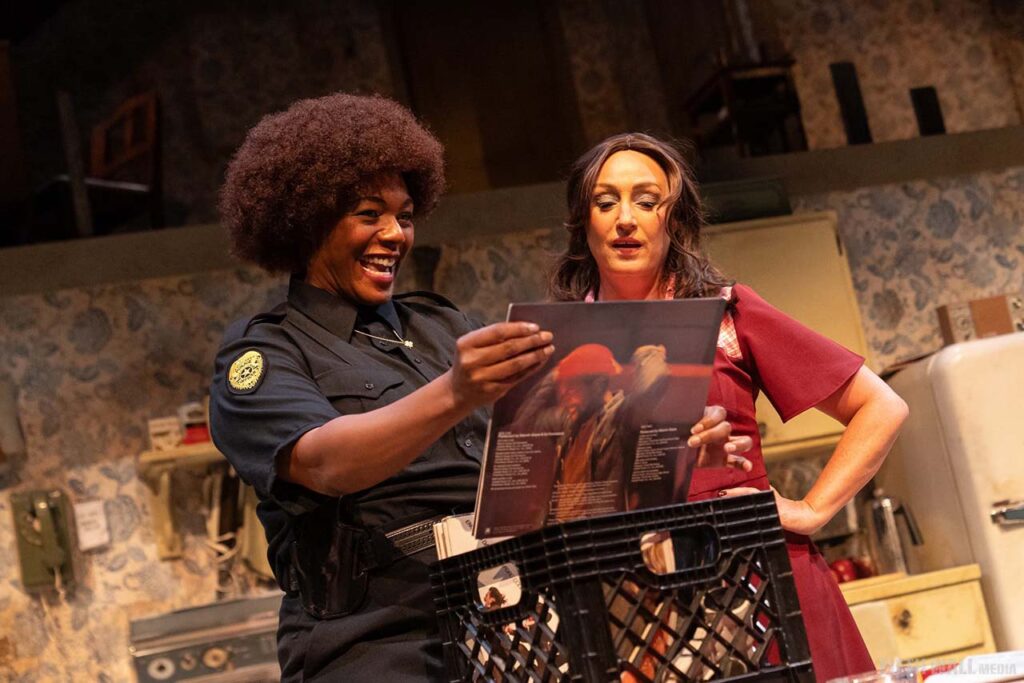
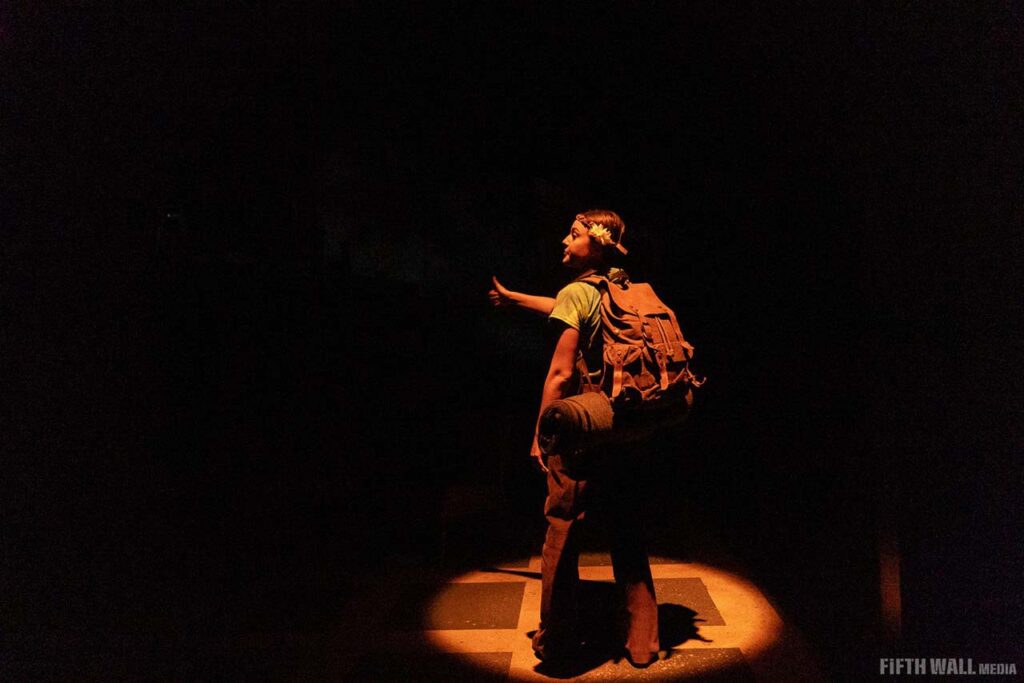
Grace Fedorchuk, besides playing the young victims of our killer, brings a youthful optimism to her portrayal of Daisy Bunting who is Bill’s little sister. Daisy is coming for a visit so she can check out the university. She has bigger dreams and she’s got the student loans and determination to make a better life for herself.
Unfortunately for Daisy, she has the exact appearance of the killer’s previous victims and that makes her a possible target. Of course, as the body count rises suspicions are raised as to who our killer might be. Is it the lodger or could it be the husband? Or is something else going on?
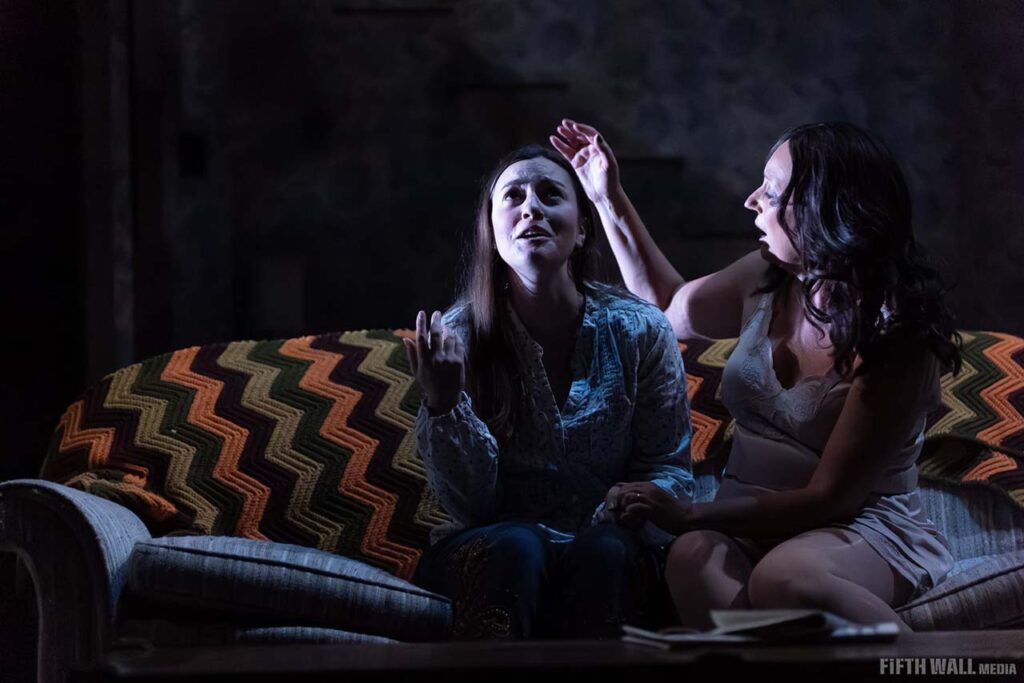
Director Jack Grinhaus keeps the play moving and the tension rising while bringing together a terrific design team including set designer Scott Reid, costume designer John Iglesias, lighting designer Narda McCarroll, and sound designer and composer MJ Dandeneau.
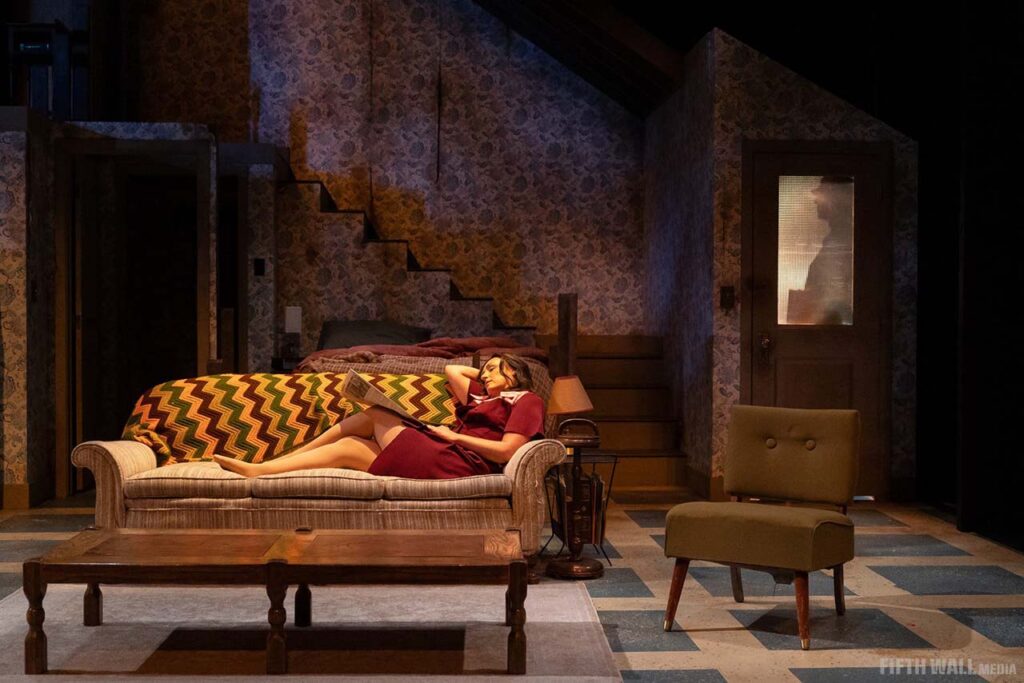
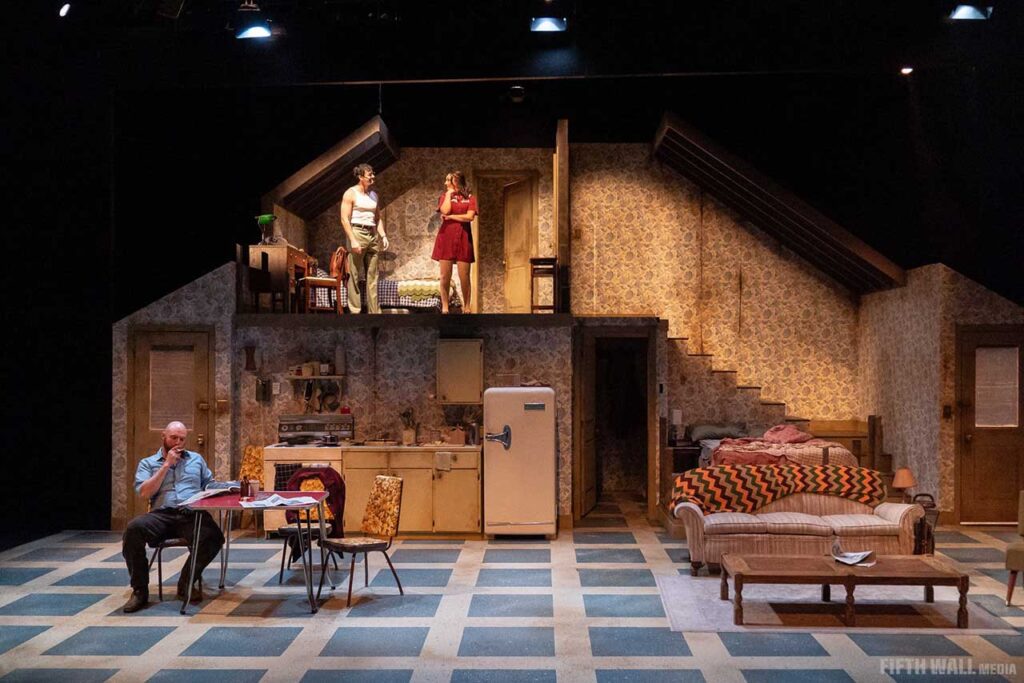
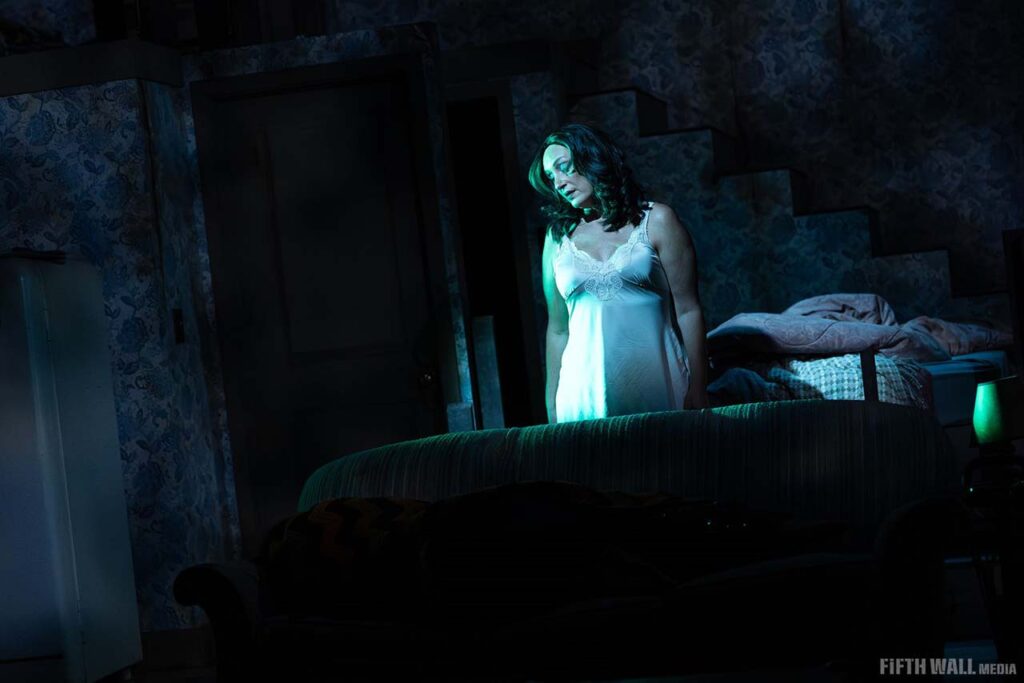
Reid’s set covers two stories and looks and feels like the well-lived-in and run-down home it’s meant to be. The lighting adds to the mystery by jumping from the dead of night to hinting at secret lives by focusing on a particular character and their location in the home. The costumes fit the time and suit the characters and look well-lived-in while the music does a wonderful job of building tension and highlighting key moments.
I sat down with Lauren Brotman to talk with her about why the story remains relevant, how she helps to create a feeling of suspense and danger on stage, and what she feels is the significance of setting the story in the 70s.
JAMES HUTCHISON
The play is based on the 1913 book, The Lodger by Marie Belloc Lowndes which has been adapted several times into feature films. And now here we are more than a hundred years later and we now have the story on stage here at Vertigo. Why do you think this story keeps getting retold?
LAUREN BROTMAN
Because it’s relevant to every generation and I think obviously, sadly, that women being hunted is something that happens in life and it’s a very scary thing. And so, you know, it makes for good genre-based storytelling because it is scary and we can be considered prey. And it’s always been that way. So, that’s the reality. And I think when there is a serial killer it makes people feel like this could happen to me and so it starts to affect us and people do pay more attention when things affect them.
JAMES
I’m curious about the environment you inhabit on stage as an actor. In The Lodger we have a very realistic feeling and looking set. Which I love. I love a realistic set because it immediately pulls me into the reality of the story. But that’s not to say that a more abstract set doesn’t work. For example, the stage design and setting for A Killing at La Cucina used a very abstract and futuristic setting which fit the themes of that play and the world of that story. But I’m curious as an actor about how a realistic or abstract setting impacts your performance?
LAUREN
So, I would say that when the set is as realistic as it is here for you as an audience member and it pulls you in, as an actor, it kind of does the same thing. Everything shifts in my head because the world is there and I don’t have to imagine it. And the body changes because in real life, we’re not stiff. We move. We think. We’re responsive in real life to our environment and so that starts to happen to me as well on stage.
In a more stylized set, it’s really interesting to see the difference because in a realistic set, there’s tons of props, tons of things that create the world because any room needs to have those things in it to feel real. And then those things can help you find beautiful moments. But they can also be technically very demanding at the same time.
But in a stylized set everything is stripped away. It’s almost like a dance set and a dance world in some ways where it’s the body in space and the body’s relationship with light and sound. Not that those things aren’t true as well in a realistic set, but they feel more deliberate in a stylized set. Everything you do is heightened. So, moving your arm in a stylized set can tell a different story and so you have to be really conscious of every single moment that you’re moving and all those things become really precise.
JAMES
That’s interesting because I think with a more abstract set things land differently for the individual audience members. In an abstract set things can be interpreted in different ways but in a realistic set it’s the door or the fridge and it’s grounded.
LAUREN
And it’s familiar. People like what’s familiar. Visually, there’s quite a bit to focus on in stylized sets. It just hits you differently. The visual hits you differently. Whereas I think the emotion hits you harder in a more realistic play. But sometimes I’ve left a show that is more stylized and I didn’t know how I felt about it. But then three weeks or a month later it’s still with me. And those images are so clear, those characters. So sometimes it just takes longer for it to penetrate us because it’s not as personal or familiar.
JAMES
What do you think is the importance of setting the play in the 70s?
LAUREN
Well, there were things happening at that time. There were serial killers like Ted Bundy. And it was a time when women in general were pushing back against having to be subservient and not being able to feel empowered in life in general. And everything about the 70s was about women being able to experience equality and being treated as human beings, really. And I think there was a big push at that time to reject the notion that we are prey and to fight back against that in some ways.
JAMES
I’m curious to know using The Lodger and your performance as an example, what are the tools you use as an actor to generate a feeling of suspense and danger for the audience watching the story unfold?
LAUREN
One of them is the pace of the play. Jack is a huge tension director. He loves tension. So, if we did the same play as a drama and not at Vertigo then you could give some breath and space to the hurt and wounds that the character might be feeling and take a moment. But in this play, you can’t sit too long in those moments because it drops the tension.
And for me, I’m running a marathon in this play where a lot is happening. And I found that by having an audible breath, not just for myself, but for the audience really helped keep something happening energetically and that breath means I’m connected to the audience in that moment of tension.
And in any play, I always want to know my overall need. What is the thing I’m trying to get to. And then I clock each scene. Am I far away from that need or close to that need because it helps me temper where I am emotionally.
But the thing we started to clock in this play was Ellen’s sleep deprivation which was separate from her need. She isn’t sleeping anymore. She wakes up in the middle of the night. She’s scared. And when you haven’t slept anxiety creeps in and things become way more heightened and at times, she’s almost hysterical and more paranoid and everything is just more reactive.
JAMES
Tell me a little bit about the cast you’re working with and what that’s been like.
LAUREN
Oh, we’ve had such a great time. I just love everybody and everybody’s really supportive of each other. I’ve worked with David before and we’re just so open with each other we can do anything. And Norma and I have this sisterhood because we did Mary Stuart together at Sage Theatre last year and that was like we moved together. So, we have a kind of natural stage bond. And Grace, because she’s young, is always fun and brings a really fresh energy with her. And Ty and I have worked together on a show like this one before but he’s supportive and we’re able to check in with each other, sometimes for safety because we’re dealing with knives and things, but also just because there is tension between these characters and to make sure that it’s not hitting us outside of the space. And I mean, generally, the whole team, our assistant director, stage manager, everyone has just been golden and so open-hearted. And we’re having a great time together, which is wonderful.
JAMES
Okay, well, talking about having a great time, why should audiences come see the show?
LAUREN
Well, last night we had this amazing student audience who showed us why, because they voice all the things that adults keep inside. I would say it is scary at times. Human at times. I think it’s a thrilling, very fast-paced journey for the audience. They’re going to be on the edge of their seats and they’re going to see people that they really identify with. So, I would highly recommend this gorgeous production. It’s a joy to be in and I think it’s been a joy for the audience to watch.
Vertigo Theatre’s 50th season is offering us a rich and exciting season of plays including world premieres, comedies, and mysteries. Their first production of the season, The Lodger, is a chilling psychological thriller that explores how fear and paranoia can make us panic and suspect the people closest to us.
You can catch The Lodger at Vertigo Theatre until October 25th. Tickets are available online at VertigoTheatre.com or by calling the box office at 403.221.3708.
THE LODGER
By Susie Moloney & Vern Thiessen
Based on the novel by Marie Belloc Lowndes.
And inspired by Alfred Hitchcock’s 1927 film.
Directed by Jack Grinhaus
Set Design by Scott Reid
Costume Design by John Iglesias
Lighting Design by Narda McCarroll
Sound Design & Composition by MJ Dandeneau
Production Photos by Fifth Wall Media