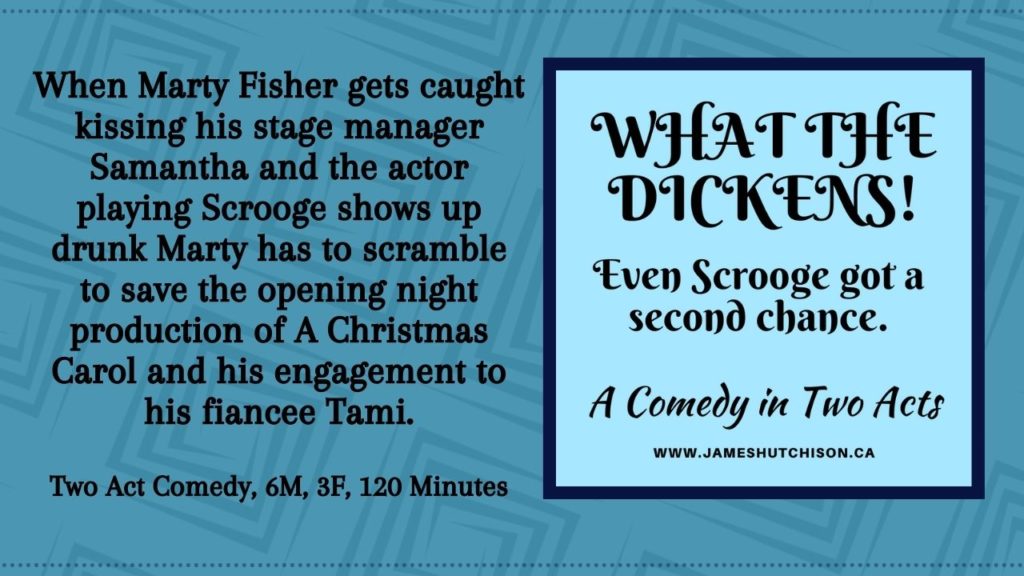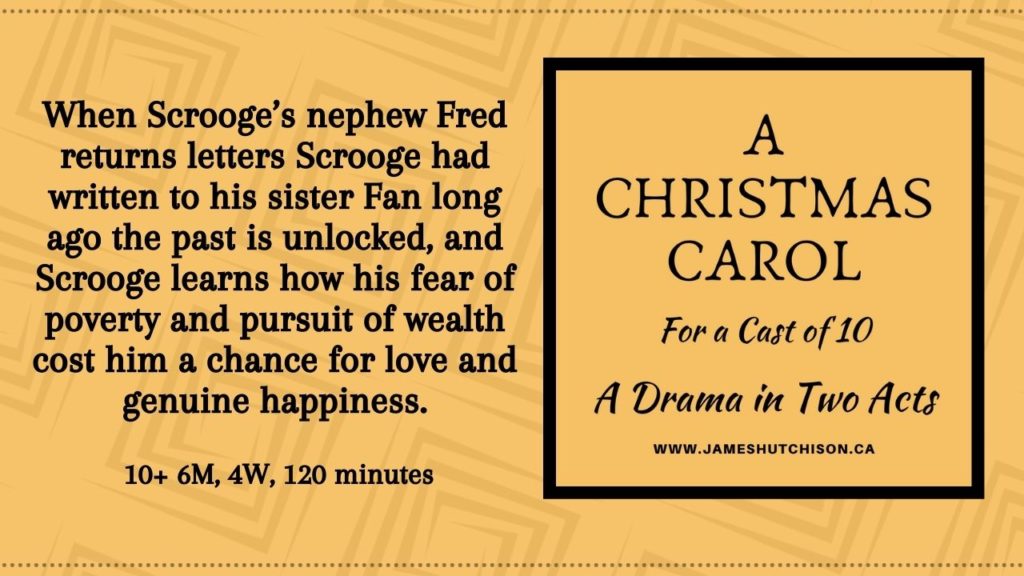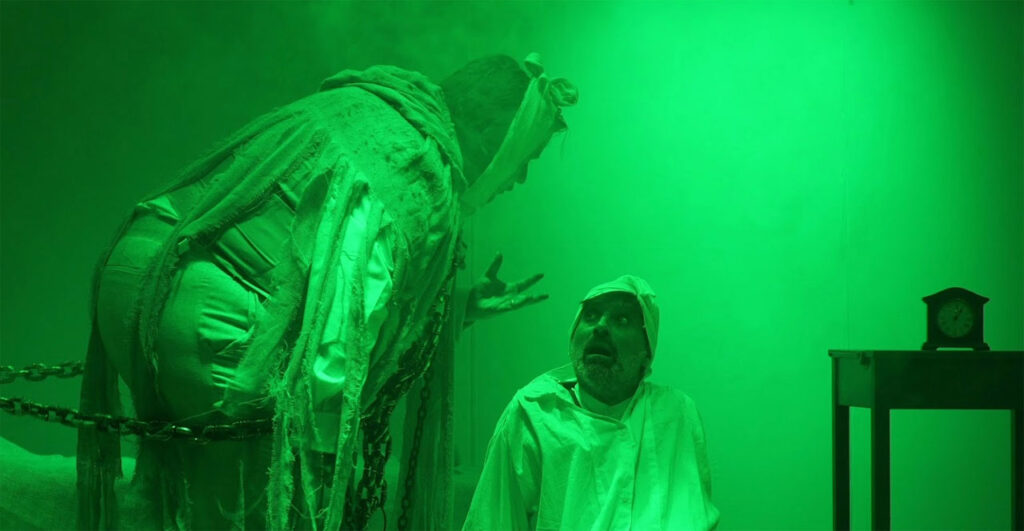
This Christmas the Thingwall Players are producing my adaptation of A Christmas Carol in Liverpool England. In my version of the story you’ll meet Mr. Bentley, learn about the letters Scrooge wrote to his sister Fan, and find out who Mr. Newbury is. You’ll still find all the ghosts of Christmas Past, Present, and Future along with Scrooge’s nephew Fred, and the love of Scrooge’s life, Belle. There are some new scary bits, a few good laughs, a tender moment or two, and some surprises! Above all else, A Christmas Carol shows us that no one is beyond redemption, and it’s always a thrill for me to have theatre companies like the Thingwall Players produce my adaptation of the story and share it with their community, because A Christmas Carol reminds us that we all have the power to make the world a better place.
I contacted Charlotte Holguin, the director of the show, to chat with her about why A Christmas Carol still resonates with audiences today, her love of theatre, and what audiences can expect when they go to see the show.
JAMES HUTCHISON
Charlotte what do you believe is the central role of a director in the creative process? Are you a guide? A collaborator? A visionary? Or something else?
CHARLOTTE HOLGUIN
I’m not sure I view myself in that way to be honest James. I think I’m a mix. I have a vision obviously. I think the director’s role is certainly initially to lift the page onto the stage. To bring the text to life. And then to give those around you – the actors as well as the crew – the inspiration and confidence to bring that into effect.
And sometimes other people have better ideas than me. So, I like an element of collaboration. I’m very open with the cast and the crew that if anybody has an idea then I really welcome it and I want them to tell me about it. And in this production, there have been many occasions where they’ve come up with much better ideas than me and we’ve put them into effect and they’ve worked.
JAMES
Well, you know you mentioned it’s a community production and so people are there for the love of theatre.
CHARLOTTE
Yes.
JAMES
And so where does your love of theatre come from?
CHARLOTTE
Oh, gosh. It’s my happy place. I suppose my love of theatre grew from being at school and being in productions and it continued through into my adult life. And I act, as well. That was my first love, and in fact, I’m relatively new to the director’s role and I wasn’t sure whether I was going to like it. But actually, I’ve loved it.
I think, the experience of being an actor is incredibly useful because I know the difficulties – the trials and tribulations – and I have a better understanding of where an actor is coming from by having been there myself.
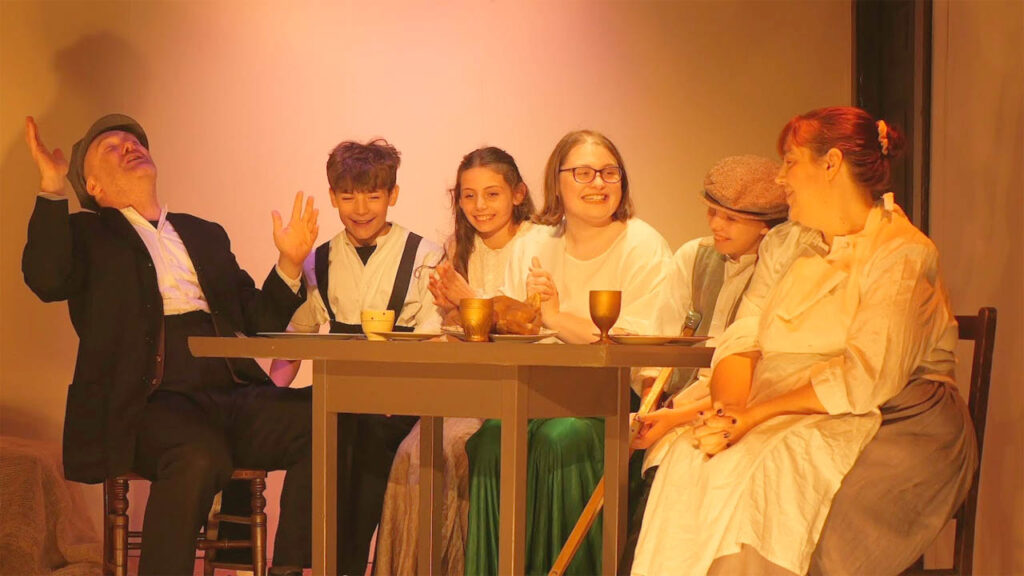
And this is the biggest cast that I’ve ever drawn together. I have tried to do very deliberately a selection of actors from a range of different ages, a range of different backgrounds, and a range of different experience levels. And I’m trying to draw from them the best that they can be so this production can be the best that it can be. That has been challenging but overwhelmingly joyful.
JAMES
You know some of the best loved stories in the world are actually stories about redemption and Christmas. So, what is it about these stories that continue to make them resonate with a modern audience. Why do we continue to watch them.
CHARLOTTE
These types of stories draw on themes, I think, that all of us – or certainly the vast majority of society deals with in their everyday lives. So, for example when you’re talking about economic challenges, social indifference, and inequality those are challenges that humanity has faced over centuries and it doesn’t stop. Those themes are as relevant now as they would have been in Dickensian times.
And so when people come and they experience a story that taps into those themes and is about growth, reflection, redemption, and hope and the idea that you can change for the better – the idea that community is important – that you can neglect your community but yet on a road to redemption you can rediscover it and thereby again rejoin it is something that the Christmas Carol story tells tremendously well and that people want to be a part of. I think that’s why perhaps they transcend time.
JAMES
Tell me about the cast you’ve assembled.
CHARLOTTE
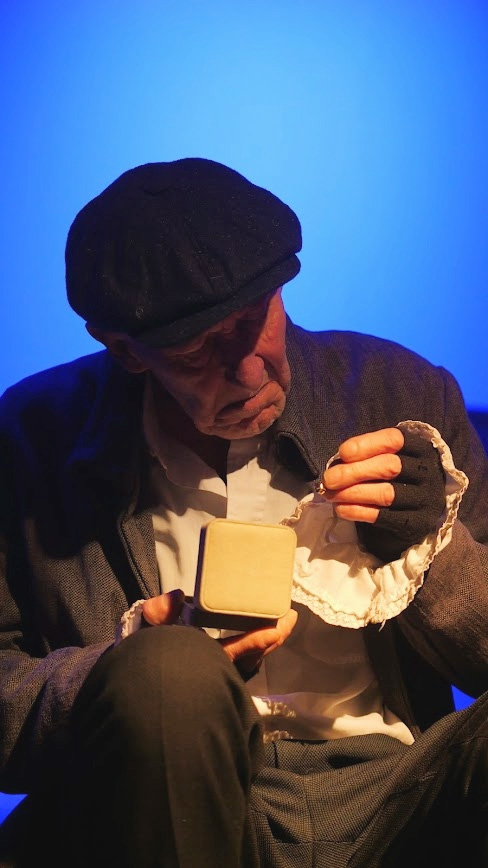
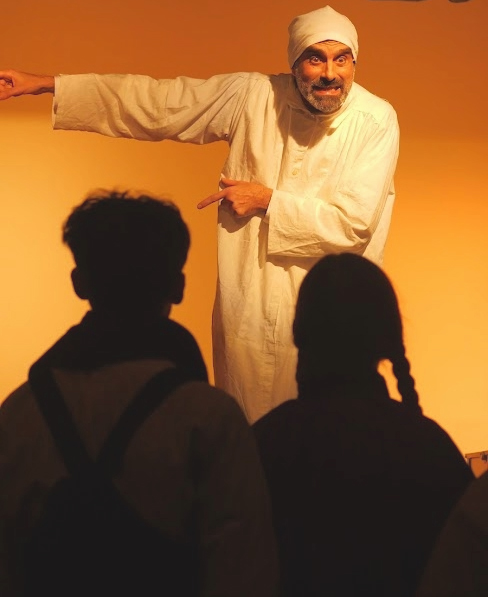
The actual cast that I’ve assembled is somewhat different than the cast I thought I was going to assemble. It’s twenty-six strong. It involves four children. The age ranges right up to 70s. Zoran Blackie plays Scrooge, and he’s tremendous. He doesn’t play the part as a miserly old man hunched over with white hair. He’s still got flocks of black hair. He’s very much approached Scrooge in a way that is much more the sensibilities of a modern man but in that time. Still a miserly, horrible, cruel individual but it’s more how he speaks down to people and dismisses people. It works tremendously well, and I think it feeds into the relevancy of it.
And then we have a huge supporting cast behind him. We have a female ghost of Christmas past, a female ghost of Christmas present, and a female ghost of Christmas future, so they’re all women. We’re also trying to showcase the musical talents of some of our cast members and in particular a younger cast member who can play the violin. So, she comes on as the fiddler at the opening of the play, and she comes on in the Fezziwig scene along side some other musicians.
JAMES
What was it that attracted you to my adaptation and what made you want to put it on stage and share it with your audience.
CHARLOTTE
I read and really enjoyed the prospect of your short play small cast version and what I intended initially was to select 10 actors to play the entire show. And I thoroughly enjoyed the prospect of being able to do the whole show in front of the audience.
In your Christmas Carol and, in my last show for example, all the set is changed by the cast. There are no stagehands. Pieces are multi functional. So, we have, for example, the schoolboy desk that when turned around converts to a newspaper stand in the street scene.
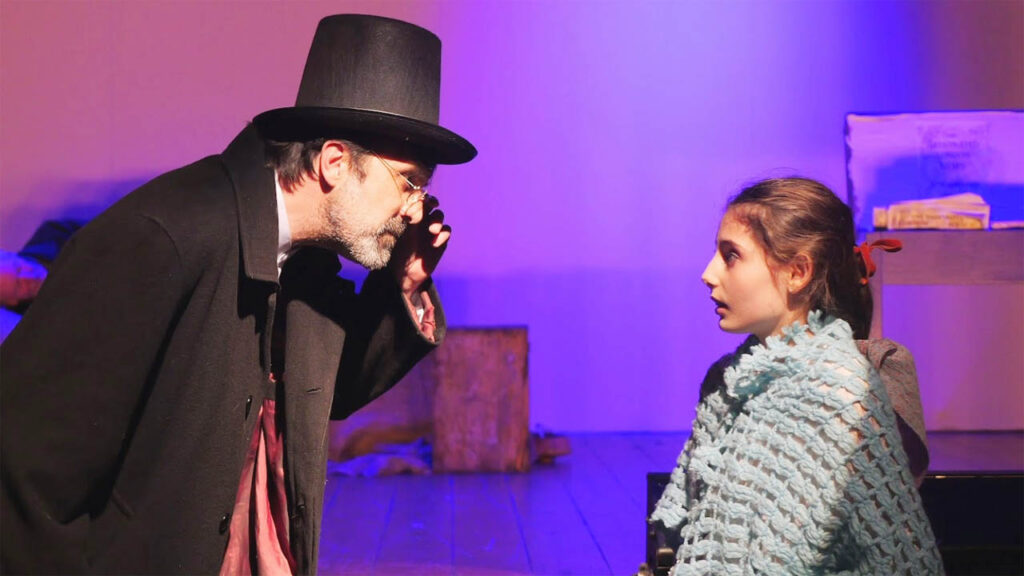
I like doing theatre where things are magically transformed on stage in front of the audience and you have actors playing multiple parts who just by snatching a hat or throwing on of a cape become a different character.
So, that’s what initially drew me to it. Alongside the fact that it is hugely flexible and adaptable to the number of cast members that you have, and for me that was really important because in community theatre you don’t know who you’re going to get turning up for the auditions.
You don’t know how many are turning up. You don’t know the experience level or whether you’re going to have any musicians or dancers. Your adaptation enabled me to either have a small cast or a large cast if need be. What happened and what changed was that I had a vast amount of people turn up to audition for this show. Which was wonderful.
And so, with this being community theatre I wanted to reflect the community. And I had enough people turn up that enabled me to do that. So, that’s what I did. I selected as widely as I could. It didn’t matter what their age was or if they had no experience or vast amounts of experience. What I hope we’ve succeeded in doing – in the true spirit of A Christmas Carol – is to reflect our community.
JAMES
So, for folks coming to see A Christmas Carol what sort of experience can they expect. What kind of show are they going to see. What can they look forward to?
CHARLOTTE
From the moment that an audience member walks through the door we create an immersive experience. We have the whole theatre decorated in Victorian Christmas style with garlands and wreaths. And we have it set up as a kind of market.
So, there are market stores around the outer edges. The audience is sat in the middle. So, there’s a sweets stall, a craft stall, a drinks stall, and the front of house are all in costume. And the cast all in costume come in fifteen minutes pre-show. They’re going to cue up with the audience. They’re going to buy sweets, and they’re going to buy drinks with them and move around the audience as if they were there in the Christmas market themselves. So, we’re creating smells and we are really trying to make it an immersive experience as soon as you walk in.
And then the play starts when the children who are on the stage having a snowball fight run off and the young lady – Emma – who I told you about who plays the violin grabs her violin and comes back out onto the stage. And we expect the audience is still going to be milling around at this stage, and she plays on her violin in solo the first line of Deck the Halls.
And then one of our strongest male cast members and vocalists, Fred, sings the first line of Deck the Halls. And I think as you in part envisaged the actors who are now all in the auditorium join in line by line of the song until we have a great crescendo and then we’re into the play.
And I’m hopeful that the audience will see a show that transports them through a range of emotions. That gives them an immersive experience. That leaves them in the end feeling joyful and that makes them smile more when they’re leaving than when they entered.
***
The Thingwall Players Production of A Christmas Carol by Charles Dickens
Adapted for the stage by James Hutchison
THE CAST
Ebenezer Scrooge – Zoran Blackie
Young Scrooge – Conor Burns
Jacob Marley – Paul Arends
Ghost of Christmas Past – Holly Blue
Ghost of Christmas Present – Lorna Pout
Ghost of Christmas Future – Chrys Fergani
Bob Cratchit – Kevin Thomas
Mrs. Cratchit – Natalie Pearce
Belle, Martha Cratchit – Meredith Clayton
Scrooge as a boy, Peter Cratchit, boy in street – Will Holguin
Carol singer, Abigail Cratchit, Georgina, girl – Hattie Holguin
Tiny Tim Cratchit – Emma Laurie
Mrs. Dilber (Scrooge’s housemaid) – Laura Powell
Fred – Connor Jones
Fan, Emma – Zoe Marras
Dick Wilkens, Topper – Shaun Greatbanks
Mrs Harrington, Rose – Angela McComb
Cook, Mrs Fezziwig – Kate Mulvihill
Mr. Fezziwig – Stephen Walsh
Grace, girl in Street – Serenity Arends
Mr. Bentley, Caroline – Samra Uddin
Thomas – Ray Ormsby
Mrs. Granger, Mr Newbury – Vicki Griffiths
Old Joe, homeless person – Tom Large
First Businessman – Dave Owens
Second Businessman – Dan Pout
Musicians – Emma Laurie, Sally Laurie, Aslan Herzen, Natalie
Pearce, Chrys Fergani, Meredith Clayton
THE CREW
Director and Producer – Charlotte Holguin
Light and Sound lead technician – Meg Doherty
Light and Sound assistants – Bethany and Natasha Cragg
Costume – Carol Golightly
Backstage/ Props – Caroline Doyle, Hayley Jeffrey and Laura Powell
Musician lead – Sally Laurie
Set making – Robert Bowes
Social Media/ Publicity – Mish Forder
***